ESP AUDI TT ROADSTER 2008 Workshop Manual
[x] Cancel search | Manufacturer: AUDI, Model Year: 2008, Model line: TT ROADSTER, Model: AUDI TT ROADSTER 2008Pages: 316, PDF Size: 70.1 MB
Page 186 of 316
_1--_l_ n _t _ e _ll _,ig ,_,_ e_n _t _ t_ e_ c_ h_n _o_ l_ o ~g""- y.e- __________________________________________ _
Intelligent technology
Notice about data recorded by
vehicle control modules
Your vehicle is not equipped with an Event Data Recorder (EDR),
installed by some manufacturers for the express purpose of
capturing data for retrieval after an accident or crash event . EDR's
are sometimes called "crash recorders".
Some state laws restrict the retrieval or downloading of data stored
by EDR's that were installed in a vehicle for the express purpose of
retrieving data after an accident or crash event w ithout the owner's
consent.
Although your vehicle is not equipped with an EDR, it is equipped
with a number of electronic control modules for various vehicle systems such as, for example, engine function, emission control, as
well as for the airbags and safety belts.
These electronic control modules also record vehic le-related data
during norma l vehicle opera tion for diagnostic and repair purposes .
The recording capacity of the electronic control modules is limited
to data (no sound is recorded) and only a small amount of data is
actually recorded over a very limited period of time and stored when
a system fault or other condition is sensed by a control unit. Some
of the data then stored may relate to vehic le speed, direction,
braking as well as restraint system use and performance in the
even t of a crash or other condition . Stored data can only be read and
downloaded with special equipment.
Electronic Stabilization Program (ESP)
Genel'61
The Electronic Stability Program increases driving
sta bility.
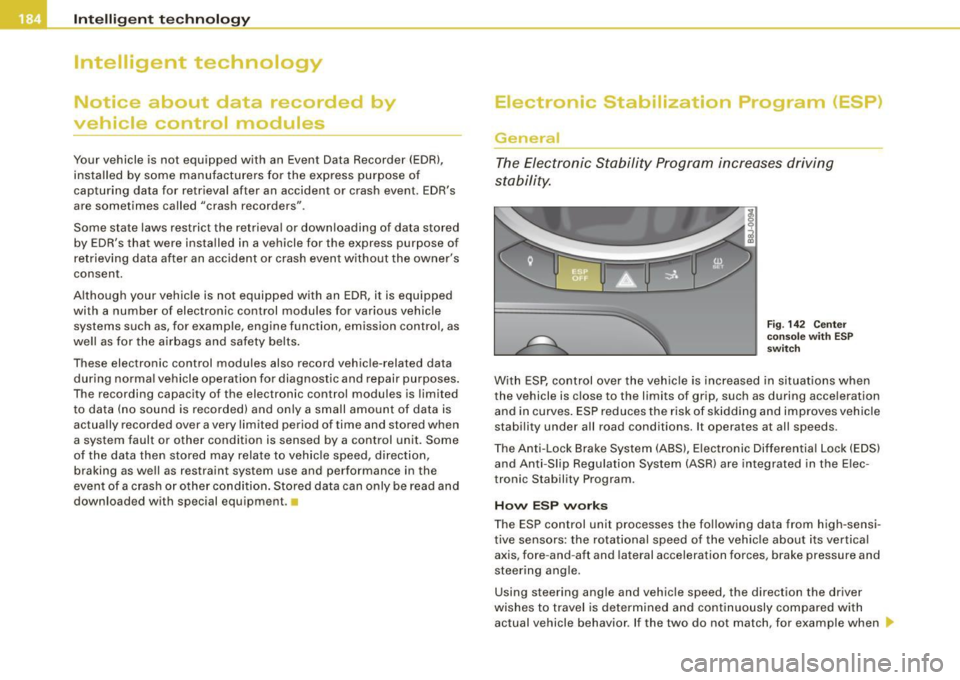
Fig . 142 Cente r
cons ole with ESP
sw itch
With ESP, control over the veh icle is increased in situations when
the vehicle is close to the limits of grip, such as during acce leration
and in curves. ESP reduces the risk of skidding a nd improves vehicle
stability under all road conditions . It operates at all speeds .
The Anti-Lock Brake System (ABS), E lec tronic Differentia l Lock (EDS)
and Anti-Slip Regulation System (ASR) are integrated in the Elec
tronic Stability Program .
H ow ESP work s
The ESP control unit processes the following data from high-sensi
tive sensors: the rotational speed of the vehicle about its vertica l
axis, fore -and -aft and lateral acceleration forces, brake pressure and
steering angle.
Using steering ang le and vehicle speed, the direction the driver
wishes to travel is determined and continuously compared with
actual vehicle behavior . If the two do not match, for example when
Page 187 of 316
the vehicle begins to skid, ESP brakes the appropriate wheel automatical ly .
The vehicle is stabilized again by the forces acting on the wheel during braking. With an oversteering vehicle (tendency for the rear
end to skid out of the curve), the brake application is mainly at the
front wheel on the outside of the curve, with an understeering
vehicle (tendency to run wide in the curve) at the rear wheel on the
inside of the curve or additionally at the other wheels as needed .
This brake application is accompanied by noises.
ESP works in conjunction with ABS=:>
page 189. If there is ma lfunc
tion in the ABS, ESP is also inoperative .
Activa ting
The ESP is automatica lly activated when the engine is started, and
it performs a self-test. As soon as the test is completed, the system
is in normal operating mode . With ASR deactivated, or with ESP/ASR
deactivated, pressing the button=>
page 184, fig. 142 returns the
system to normal operation.
D eac tiva ting
ESP should norma lly be activated at all times because this ensures
optimum vehicle stability . Only in certain exceptional cases it does
make sense to deactivate Anti -Slip Regulation (ASR) or the Elec
tronic Stability Program !ESP) by pressing the button =:>
page 184,
fig. 142. Both deactivation stages can only be activated from normal
mode.
Dea cti vat ing ASR
Tap the switch . Deactivation is indicated by s low flashing of the ESP
lamp in the instrument c luster. In certain situations (e.g. driving
with snow chains, in deep snow or on loose ground, or when rocking the car free), it may be necessary to deactivate ASR. Deacti
vation is effective only up to a speed of about 45 mph (70 km/h). At higher speeds, ASR is switched on again automatical ly in front
whee l drive vehicles, deactivation is possible only up to about 30
mph (50 km/h). With a ll -whee l drive vehicles, ASR is active above
Controls and equip
ment Safety first Vehicle operation
In
te llig ent tec hn olo gy
about 45 mph (70 km/h) and deactivated automatical ly below this
speed.
D eac tiva tin g ES P/ASR
Press the button for more than 3 seconds . Deactivation is indicated
by the ESP lamp in the instrument c luster staying on permanently .
This deactivates the E lectronic Stabi lity Program (ESP) in addition to
ASR . No Electronic Stability System operation and no Anti-Slip
Regu lation is availab le across the entire speed range; ASR and ESP
are activated only when the brakes are used for the duration of the
braking action and remain active until a stab le vehicle condition has
been reached. There is no driving situation which requires ESP to be
deactivated, so this should only be done if the driver's skill and the
traff ic situation permit .
& WARNING
• The limi ts of ph ysics ca nnot be suspe nd ed by E SP. E ven in vehi
cles w ith ESP, you should always adapt your dr iving to road and
tr affi c co ndition s. Thi s is part icul ar ly tr ue on a s lippe ry and wet
road . Do not be te mpt ed b y th e incre as ed safet y prov ided t o ta ke
ri sks - dang er of an accident !
• Plea se note that when ASR or ESP /ASR i s deactivated , the drive
w heel s can spin on icy and slipper y ro ad s and the vehi cle can
break away - da nger of skiddin g!
Ii ] Tip s
In the event of a defect in the rear spoiler system or in Audi
magnetic ride, it can happen that ASR and ASR/ESP cannot be deac
tivated, or they are activated automatica lly in the deactivated
state. •
Vehicle care Do-it-yourself service Technical data
Page 188 of 316
___ ln_ t _e_ ll-'"ig ...,_ e_ n_t _t_ e_ c_ h _ n_o _ l_o _,.g= y,_ __________________________________________ _
Electronic differential lock (EOL)
The electronic differential lock monitors the rotational
speed of the drive wheels.
General notes
The electronic differential lock (EDU helps the car to start moving,
accelerate and climb a gradient on surfaces providing poor or
almost no grip. Without EDL, this would be difficult, if not impos
sible.
How the system works
Th e EDL operates automatically. It monitors the rotational speed of
the drive wheels on an axle with the help of the ABS sensors
=> page 189. If a noticeable difference in rotational speed between
the drive wheels on one axle is detected (e.g. on slippery ground
on
one side),
the spinning wheel is braked, thereby transferring power
to the other drive wheel or wheels (all-wheel drivel. This is done up
to a speed of about 60 mph (100 km/hl. Noises from the brake
system signal that wheel spin is being controlled.
Driving off
When driving off, always be sure to keep road conditions in mind as
you accelerate . If one drive wheel spins because it is on a surface
with less grip, gradually increase the pressure on the accelerator
pedal until the car starts to move. The wheel less able to transfer
power spins.
Overheating of brakes
To prevent the disc brake of the braked wheel from overheating if
subjected
to excessive loads, the EDL cuts out temporarily . The
vehicle remains operational and behaves in the same way as a
vehicle without EDL.
As soon as the brake has cooled down, EDL switches on again auto
matically.
& WARNING
• When accelerating on slippery surfaces, such as on ice or snow,
always be careful when depressing the accelerator pedal. Even
with the EDL working, the drive wheels can spin and reduce your ability to control your car. -Risk of crash!
• The increased safety afforded by EDL does not mean that you
can take safety risks. Always adapt your driving style to the road
conditions and traffic situation.
[ i] Tips
If a fault occurs in the ABS, the EDL is also not functioning . This is
indicated by the ABS warning light=>
page 20. •
Anti-Slip Regulation System (ASR)
The Anti-Slip Regulation System prevents the driven
wheels from spinning when the car is accelerating.
General notes
The Anti-Slip Regulation System (ASR) is integrated in the electronic
stabilization program (ESP). When the vehicle starts up and acceler
ates , the wheels are prevented from spinning by adjusting the
engine power to match the amount of grip available from the road
surface .
How the system works
ASR performs automatically, i.e. without the driver's intervention .
With the aid of the ABS sensors =>
page 189, ASR monitors the
speed of the driven wheels. If the wheels start to spin, the engine
torque is reduced automatically until the tires find enough grip to
lock onto the road surface . The system is active across the entire
speed range.
The ASR works in conjunction with the ABS. If a malfunction should
occur in the ABS, the ASR will also be out of action .
~
Page 189 of 316
Activating
The ESP is automatically activated when the engine is started and it
performs a self-test. You can activate a deactivated ASR if required
by pressing the=>
page 184, fig. 142 button. When it is activated,
the message
ESP/ASR on appears briefly in the display. Vehicles
with front -wheel drive a deactivated ASR automatically re -activates
itself at a speed of 40 mph (70 km/h).
Deactivating
You can deactivate the ASR if required by pressing the button (for
less than 3 seconds)=>
page 184, fig. 142. With the ASR deactivated,
the ESP check light comes on, see=>
page 18. The message ASR off
appears in the display as well. On vehicles with front -wheel drive:
deactivation is possible only up to 30 mph (50 km/h) for safety
reasons. Vehicles with all -wheel drive : the ASR can be deactivated
at any speed.
The ASR should normally be activated all the time. Only in certain exceptional situations when some slip is desirable does it make
sense to deactivate the ASR. Examples:
• when driving with tire chains
• when driving in deep snow or on loose ground and
• when rocking the vehicle loose after it has become stuck.
When the abnormal situation is over, you should activate the ASR
again.
& WARNING
The increased safety afforded by ASR does not mean that you can
take safety risks. Always adapt your driving style to the road
conditions and traffic situation.
[ i J Tips
To ensure that the ASR works properly, all four wheels must be fitted
with identical tires. Any differences in rolling radius of the tires can
Intelligent technology
cause the system to reduce engine power when this is not desired.
See also ::::>
page 249, "New tires and replacing tires and wheels".
Rear spoiler
The rear spoiler improves vehicle handling and enhances
driver control.
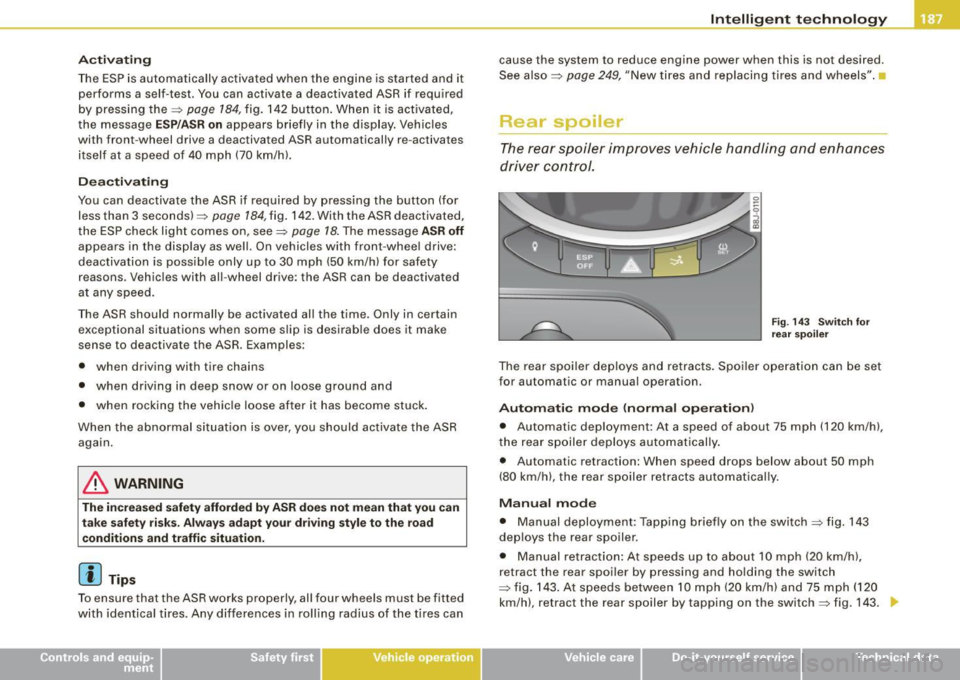
Fig. 143 Switch for
rear spoiler
The rear spoiler deploys and retracts. Spoiler operation can be set
for automatic or manual operation .
Automatic mode (normal operation)
• Automatic deployment : At a speed of about 75 mph (120 km/h),
the rear spoiler deploys automatically.
• Automatic retraction: When speed drops below about 50 mph
(80 km/h), the rear spoiler retracts automatically.
Manual mode
• Manual deployment: Tapping briefly on the switch ::::> fig. 143
deploys the rear spoiler .
• Manual retraction: At speeds up to about 10 mph (20 km/h),
retract the rear spoiler by pressing and holding the switch
::::> fig. 143. At speeds between 10 mph (20 km/h) and 75 mph (120
km/h), retract the rear spoiler by tapping on the switch=> fig. 143 .
Vehicle care I I irechnical data
Page 190 of 316
-Intelligent t echnology
--- =---- ----"-!...!-------------------------------
After 15 cycles (deploy and retract), manual operation is suspended
fo r up t o 2.5 minutes . Above 75 mph (120 km/h), operation swi tches
to automatic mode .
& WARNING
Driving at higher speeds witho ut the re ar spoiler deployed can
impair handling characteri stics, making the vehicle harder to
c ontrol.
• Always make sure that the spoiler i s deployed when driving at
speeds over 85 mph (140 k m/h). If the rear spoiler warning /ind i
c ator light in the in strument clu ster come s on , the rear spoiler
may not have deployed .
• Never drive at speed s higher than 85 mph (140 km /h ) if the
spoiler is not deployed . Have the spoiler inspe cted as soon as
po ssible by an authorized Audi dealer or qualified workshop.
• Always obey speed limits and other traff ic law s.
& WARNING
Improper operation of the rear spoiler can cause crushing injuries.
• Always make su re that nobody , especially children , is in the
way when the rear spoiler is deployed or retracted.
0 Note
Never push the vehicle or a pply force to the rear spoi ler -it cou ld be
damaged .
[ i ] Tips
Clean the spoi ler compartment every 2 to 3 months . The spoiler
compa rtment must always be free of ice, snow, leaves or other
debris. •
Braking
General "nformation
What aff ects braking effi cie ncy?
Operating condition s and driving habits
The brakes on today's automob iles a re sti ll sub ject to wea r,
depending large ly o n operati ng co nditions and driving habits~&.
On vehicles which are driven mostly in stop -and -go city traffic or
whic h are driven hard, the brake pa ds shou ld be checked by your
authorized Audi dea ler more often than specified in the
Mainte
nance
& Warranty booklet.
On steep slopes, you should use the braking effect of the en gine.
Th is way, you prevent u nneces sary wea r on the brake syste m. If you
must use your brakes, do not ho ld the brakes down continuous ly.
P ump the brakes at interva ls.
Moisture or road salt
U nde r certain co nditi ons, for example, when driving th rough water
or v ery heavy rain, or eve n after washing your vehicle, the braking
effec t can be red uced d ue to mo isture (o r in freezing c onditions ice)
o n the brake pads . A few cautious brake appl ica tions should dry off
the brake pads or remove any ice coat ings.
T he effe ctiveness of the brakes can be reduced when the ve hicle is
driven on a sa lt -covered road and the brakes are not used. Li kewise,
you clean off accu mulated sa lt co atin g fr om bra ke discs a nd pads
with a few cautious applications of the brake~&.
Corrosion
There may be a tendency for dirt to build up on the brake pads and
corr osi on to for m on the d iscs if the ca r is no t driven regu lar ly or
only for short trips with litt le use of the brakes .
I f the b ra kes a re not used frequently, or if co rros ion ha s formed on
the d iscs, it is adv isable to clean off the pads a nd discs by braking
firm ly a few times from a moderately high speed~& . .,_
Page 192 of 316
--~ln~t~ e~ l~ li ~g ~e~ n~ t~ te ~ c~h ~n ~ o~ l'..!: o ~g~ yL ________________________________________ _
(ABS control range). In order for ABS to be ab le to operate optima lly
in th is range, you m ust keep the brake pe dal depressed -do not
"pump the brakes" .
Brake ass istant
T he brake power assist unit increases the pressure that you
ge nera te wi th the brake pedal. I t wo rks only whe n the e ngine is
running .
Automatic full braking
This function al lows fu ll braking in spite of high brake pedal forces
(e .g. whe n the b rakes are seve rely s tresse d beca use the veh ic le is
ful ly loaded). The driver notices this function through a reduction of
pedal force a nd i ncrease d pe dal trave l. W hen the brake peda l is
released, fu ll braking assist switches off again automatically .
If there is an ABS fail ure , the brake assistant and automatic fu ll
brak in g ass ist are not ava ilable.
& WARNING
• ABS cannot suspend the la ws of physics . You should keep this
in mind in particular on an icy or wet road . If ABS control of braking
intervenes , you should adjust your speed immediately to road and
traffic condit ions. Do not be tempted by the increased safety
provided to t ake risks -danger of an accident.
• Please keep in mind that the risk of an accident is increased by
dri ving too fast, pa rticularly in bends and on icy or wet roads , and
by driving too close to the vehicle ahead . The increased risk of an
accident cannot be reduced by the brake as sistant - danger of an
accident .
[ i ] Tips
If a ma lfunction occurs in the ABS, this is signa lled by an indicator
lig ht, see
=> page 20. •
Electro-mechanical power assist
-----
The e lec tro -m ec han ical pow er as sis t h el ps th e dri ver
w he n steering.
T he degree of power assist is electronically matched to vehic le
sp eed .
Th e power steering system ass ists the driver so that he can steer the
ve hicle wi th re duced phy sica l eff ort .
P ower steer ing w ill not wo rk if the engine is o ff. As a result, the
steering wheel wi ll be hard to turn.
& WARNING
If the system develops a problem, you must seek qualified profes
sional assistance .
0 Note
If there is an electronic ma lfunction , servotronic will still funct ion
l ike a conventional power stee ring system, providing a constant
steer in g suppo rt fo rce t hat is no lon ge r proportionate to t he veh icle
speed . This is most noticeable when turning the steering wheel at
lo w spe eds (fo r examp le w hen park ing), -mo re effor t will be
required than usual.
• B e awa re of the d iffer ent than usua l ste ering response and
adjust your steering force accordingly.
• H ave the problem chec ked and set ri ght by an authorized Audi
dea ler as soon as possible .
• I f a steering ma lfunct ion occurs, this is signaled with the~ or.
@ in d ica to r ligh ts and a war ning tone, see . ._
Page 196 of 316
___ D_ r_ iv _i_ n-' g"'""'- a_ n_d_ e_ n _ v_i_r _ o _n_ m_ e_ n_t _____________________________________________ _
- Lack of proper maintenance as well as improper use of the
vehicle will impair the function of the emission con trol system
and could lead to damage.
exhaust gas can have a su lfur -like exhaust gas smell under some
operating states . This depends on the su lfur content of the fuel
being used. Using a different brand of fuel may he lp, or filling the
tank with lead-free super grade gasoline. •
Avoid damaging the vehicle
When you are driving on poor roads, or over curbs, steep ramps,
etc., make certain that low-lying parts such as spoilers and exhaust
system parts do not bottom out and get damaged.
This is especially true for vehicles with low-slung chassis (sports
chassis) and fully loaded vehicles. •
Operate your vehicle economically
and minimize pollution
General
Your personal style of driving will determine the economy
of your vehicle, as well as exhaust and noise levels.
Fuel economy, environmental impact, and wear on your engine,
brakes and t ires largely depend on three factors:
• your personal driving style
• operating condit ions
• technical limitations If
you anticipate what you need to do next and drive economically,
you can easily cut your fuel consumption by 10-15 percent . This
section will give you some tips on how you can he lp the environ
ment and your pocketbook .
[ i ] Tips
The consumption estimates as published by ENVIRONMENTAL
PROTECTION AGENCY (EPA) and Transport Canada may not corre
spond to your actua l consumption on the road, which will vary
depend ing upon vehicle load and speed, road and weather condi
tions, trip length, etc. •
Drive smoothly and keep a lookout ahead
Vehicles use the most fuel when they are accelerating.
Avoid unnecessary accelerating and braking.
Vehicles use the most fue l when they are accelerating . If you antici
pate what is going to happen next, you will need to brake less and,
thus, accelerate less. Let the vehicle coast whenever possible -for
example when you see that the next traffic light is red. •
Avoid full throttle
Driving at moderate speeds saves fuel and improves your
mileage.
- Try and keep well below your car's maximum speed.
Acce lerating gently reduces fuel consumption, engine wear, and
does not disturb the environment.
Fuel consumption, exhaust emissions and engine noise increase
disproportionately at high speeds. If you drive at approximately
three quarters of top speed, fuel consumption wil l be reduced by
9J,,
Page 197 of 316
one half. Never drive faster than the posted speed limit and weather
conditi ons permit. •
Reducing unnecessary Idling
Even when your car is just idling it burns up fuel.
- Shut the eng ine off when you are not driving the vehicle .
- Do not warm up the vehicle by letting the eng ine run at
idle.
I t makes sense to shut off the engine in traffic jams, when waiting
for trains to pass at railroad crossings, or at traffic lights that have long waits on red. Turning the engine off for just 30 -40 seconds
saves more fue l than is burned s tarting the engine again .
It takes a long time for the engine to warm up fully when it is
running at idle . However, wear and noxious emissions a re especial ly
high when the engine is warming up . So you should drive away as
soon as you start the engine and avoid running at high RPMs whi le
the engine is stil l warming up .
0 Note
Do not leave engine idling unattended after starting . If warning
lights should come on to indicate improper operation, they would
go unheeded. Extended idl ing also produces heat, wh ich cou ld
result in overheating or other damage to the vehicle or other
property .•
Regular maintenance
A badly tuned en gine unnecessarily wastes a lot of fuel.
- Have your v ehicl e serv ice d at reg ular intervals.
Controls and equip
ment Safety first Vehicle operation
Dri
ving and environm ent
By having your vehicle regularly serviced by an Audi dea ler helps to
ensure that i t runs properly and economically . The conditio n of your
vehic le not only affects its safety and abi lity to hold its va lue, it also
affects
fuel consumption .
Check your oil each time you fill your tank.
The amount of oil used is related to engine load and speed .
I t is normal for the oi l consumption of a new eng ine to reach its
lowest va lue after a certain mi leage has been driven.
You must drive your vehicle about 3,000 miles (5,000 kilometres) be fore you can proper ly assess o il consumpt ion.
This also applies to fuel consumption and engine output .
0 Note
• Have your vehicle maintained properly and in accordance with
t he service recommendations in your Main tenance
& Warranty
booklet. Lack of proper ma intenance as well as improper use of the
vehicle wi ll impair the function of the emission control system and
cou ld lead to da mage.
• Do not alter or remove any component of the Emission Contro l
System unless approved by the manufacturer .
• Do no t al te r or remove any device, such as heat shields,
switches, ignition wires, valves, which are designed to protect your
veh ic le' s Emission Control System and o ther i mportant vehicle
components. •
Fewer short trips
Fu el consu mption will alwa ys be relatively high on shor t
trips.
- Try to avo id driving short dista nce s wi th a cold engine.
Vehicle care Do-it-yourself service Technical data
Page 205 of 316
_____________________________________________ C_ l_ e _a_ n_ in_ g_a _ n_d_ p_ r_ o_ t _e_ c_t _io _ n __ lftlll
•
0 Note
• Never use a power washer to clean the powe r top itself .
• To avoid damaging your vehicle, always make sure that there is
sufficien t distance between the spray head and soft materials like
rubber hoses, plastic parts and sound -deadening materials. Never
aim the spray head at the same point for a long time. This also
applies to cleaning headlights and painted bumpers. Remember:
the closer the nozzle is to the surface of the material, the greater the stress on the material. •
Folding top care
The folding top requires special care.
Keeping your top looking great and making certain that it lasts a
long time depend to a great extent on proper use and care. Remove
bird droppings as soon as possible, since the corrosive chemicals in
them will cause the rubber impregnation in your top to swell and
possibly allow the fabric to leak .
W ith normal soiling, all you need to do is clear the top with a soft
brush and clear water . Always brush in the direction of the fabric
from front to rear.
If the top is very dirty and has spotted areas clean it with a brush
using a convertible top cleaner. Always brush in the direction of the
fabric from front to rear . Rinse with plenty of clear water, and allow
the top to air-dry.
Chamois are not suitable for drying the top.
Never use gasoline, spot remover, benzene, paint thinner or
solvents to remove spots. We recommend that you only use
cleaners especially formulated for use on convertible tops, and that
you follow the produce use directions carefully . Authori zed Audi
deals can provide detailed information.
& WARNING
Always read and heed all WARNINGS and the information on
:=> page 200.
0 Note
Never use a high -pressure power washer to clean the folding top. •
Applies to ve hicles: w ith win d def le cto r
Wind deflector
Clear the wind deflector with water or, if it is heavily soiled, a chem
ically neutral cleaning solution.
& WARNING
Always read and heed all WARNINGS and the information on
=> page 200. •
Waxing
Wax protects the vehicle's paint.
-Use a manually applied car wax occasionally to protect
the paint.
A good wax coating protects the vehicle paint to a large extent
against the environmental factors listed under ~ page 200,
"Washing" and even against slight scratches.
You can use a liquid car wax to protect your paint as soon as one
week after your vehicle has been delivered.
Even if you regularly use a waxing process in automatic car washes ,
we recommend that you manually apply a coat of wax to give the .,_
Vehicle care
I t •
Page 206 of 316
___ C_ le_ a _ n_i_n ~g _ a_ n_ d __ p_r _o _t _e _c_ t_ i_o _n ___________________________________________ _
paint extra protection, particularly if water no longer beads on the
clean paint .
Protect p lastic body parts with car wax in the same way as the
vehic le body .
During wa rm weather dead insects tend to collect on the fron t
bumper and on the forward area of the hood. They are much easier
t o remove from paint that is waxed
often .
& WARNING
Alway s read and heed all WARNING S and other information
~ page 200 .
0 Note
Do not use car wax on
• matte or anodized metal trim
• rubbe r or rubber -like trim .•
Polishing
P olishing restores the gloss to the paint.
Polish your veh icle on ly if t he pa in t has lost its shine and the g loss
cannot be brought back with wax.
If the polish used does not contain preservative compounds, the
paint mus t be wax ed afterwards ~
page 203, "Waxing".
& WARNING
Always read and heed all WARNINGS and the information
~ page 200 .
0 Note
Do not treat matte anodized metal trim, p lastic or rubber parts with
polish or wa x.•
Trim strips
Met al trim nee ds s peci al care .
For environmental reasons, Audi fabricates the bright trim strips
and tr im pieces from pure chromium -free a luminum.
D irt and marks on the trim strips should be removed with a
pH
balanced
clean ing agen t (do n ot use a chrome cleaner) . Audi
dea lers carry cleaning products which have been tested for use on
you r vehic le and are not harmful to the env ironment.
To avoid corrosion on the exterior trim s trips, only a pH -ba lanced
solution should be used for the windshield washer .
& WARNING
Always read and heed all WARNINGS and other inform ation
~ page200 .•
Plastic and vinyl
Plas tics needs spe cial care.
Use a clean, damp cloth or sponge to remove dust and light surface
dirt. For other soil, use a lukewarm all -purpose cleaning so lution or
a mild sadd le soap for vinyl tr im . Re move water spots and soap
traces with a clean, damp cloth or sponge. Use a clean, soft c loth to
r ub dry .
Grease, tar or oil stains can be removed with a clean cloth or sponge
soaked wi th all-purp ose cleaner o r wi th a solven t designe d espe -
cia lly to c lean vinyl. .,.