ESP AUDI TT ROADSTER 2008 Repair Manual
[x] Cancel search | Manufacturer: AUDI, Model Year: 2008, Model line: TT ROADSTER, Model: AUDI TT ROADSTER 2008Pages: 316, PDF Size: 70.1 MB
Page 212 of 316
___ C_ le_ a _ n_i_n ~g _ a_ n_ d __ p_r _o _t _e _c_ t_ i_o _n ___________________________________________ _
clothing materials can discolor leather seats (especially if such
clothing is damp and was not dyed correctly). Dust and dirt particles
in pores, folds, and seams can have an abrasive effect and can
damage the leather surface as well as weaken seams.
The leather should be cleaned regularly as needed. After having
been used for a relatively long time, your leather seats will acquire
a rich aged finish. This is a characteristic of natural leather and a
sign of true quality.
In order to maintain the value of this natural product over the life of
your vehicle, you should follow the recommendations below:
0 Note
• To keep your leather from bleaching out, do not allow it to be
exposed to bright sunlight for long periods of time. If you have to
leave the vehicle parked outside for long periods, cover the leather
to protect it from direct exposure to sunlight.
• Sharp objects on clothing, such as zippers, rivets or sharp pieces
on belts can leave permanent scratches or scrape marks on the
surface of the leather.
[ i J Tips
• After each time you clean the leather and at regular intervals, use
a leather preservative creme that contains UV -blockers and that
works into the leather. This creme will nourish and moisturize the leather, helping it to breathe and stay supple. It also helps to build
up a protective coating on the surface.
• Clean the leather every 2 -3 months, and clean any areas that get
soiled.
• Remove fresh marks made by ballpoint pens, ink, lipstick, shoe
polish, etc. as soon as possible.
• Preserve the color of the leather as needed by using a special
colored leather care creme to touch up areas of uneven color. •
Applies to vehicles: w ith natu ral leather
Cleaning and caring for leather upholstery
and trim
Natural leather requires special care and attention.
Normal cleaning
-Clean soiled areas with a slightly moistened cotton or
woolen cloth.
More stubborn dirt
- More stubborn dirt can be removed using a cloth satu
rated with a mild soap solution (2 tablespoons mild
liquid soap).
- Never allow the soap solution to saturate the leather, and
make certain that no water soaks into the seams.
Wipe off the soap solution with a soft, dry cloth.
Cleaning spots
-Remove fresh water-based spots (such as coffee, tea,
juices, blood) with an absorbent cloth or paper towel.
- Remove fresh
grease or oil-based spots (such as butter,
mayonnaise, chocolate) with an absorbent cloth or paper
towel, or use the cleaner from the leather care kit if the
spot has not yet penetrated into the surface of the
leather.
- Use an oil/grease dissolving spray, if
oil/grease spots
have dried on.
- Remove specific kinds of spots (ballpoint pen, felt
marker, fingernail polish, water-based paint, shoe polish,
etc.) with a spot remover specifically formulated for leather. ..,_
Page 217 of 316
Fuel supply and filling your fuel tank -___________ ...:._:......:,_______;::;...a,__ __
•
Blend of gasoline and ethanol (grain alcohol or ethyl alcohol)
• Anti -knock index must be 87 AKI or higher.
• Blend must not contain more than
10% ethanol.
Blend of gasoline and MTBE
• Anti-knock index must be 87 AKI or higher.
• Blend must contain not more than
15% MTBE.
Seasonally adjusted gasoline
Many gasoline grades are blended to perform especially well for
winter or summer driving . During seasona l change -over, we suggest
that you fil l up at busy gas stations where the seasonal adjustment
is more likely to be made in time.
0 Note
• Methanol fuels which do not meet these requirements may
cause corrosion and damage to p lastic and rubber components in
the fue l system.
• Do not use fue ls that fail to meet the specified criteria in this
chapter .
• If you are unable to determine whether or not a particu lar fuel
blend meets the specifications, ask your service station or its fuel
suppl ier.
• Do not use fue l for which the contents cannot be identified.
• Fuel system damage and performance problems resu lting from
the use of fuels different from those specified are not the responsi
bility of Audi and are not covered under the New Vehicle or the
Emission Control System Warranties.
• If you experience a loss of fuel economy or driveability and
performance problems due to the use of one of these fuel blends,
we recommend that you switch to unblended fuel. •
Gasoline additives
A major concern among many auto manufacturers is carbon
depos it build -up caused by the type of gasoline you use.
Although gasoline grades differ from one manufacturer to another,
they have certain things in common. All gaso line grades contain
substances that can cause deposits to collect on vita l engine parts,
such as fue l injectors and intake valves. Although most gasoline
brands include additives to keep engine and fue l systems clean,
they are not equally effective.
Audi recommends using TOP TIER Detergen t Gasoline. For more
information on TOP TIER Detergent Gasoline, please go to the offi
cial website (www.toptiergas .coml.
A ft er an extended period of using inadequate fuels, built-up carbon
deposits can rob you r engine of peak performance.
(D Note
Damage or malfunction due to poor fuel qua lity is not covered by
the Audi New Vehicle Limited Warranty .•
Fuel tank
Fuel filler neck
The fuel filler neck is located on the right rear side panel behind the
fue l filler f lap.
If the unlocking system should fai l, you can stil l open the flap manu
a lly -for detai led instructions see=>
page 218.
You can find the fuel tank capacity of your vehicle in Technical Data
=> page 291. _.,
Vehicle care I t •
Page 219 of 316
_____________________________________ F_ u_ e_l _s _u-= pc...:... p_ly =--- a_ n_ d_ f_ i_ ll _in -=: gc.. y -=--- o-u_ r_ fu_ e_l _t _a _n_ k __ fflllll
•
- Select a medium refuelling rate so that the nozzle
switches off automatically when the tank is full.
Putting the fuel cap back on
- After filling your tank, twist the fuel filler cap clockwise
until you hear a definite click.
- Close the fuel filler flap.
To avoid fuel spilling or evaporating from the fuel tank always close
fuel filler cap properly and completely. An improperly closed fuel
filler cap may also cause a message in the driver information system =>
page 24 or cause the MIL lamp=> page 26 to come on.
& WARNING
Improper refueling or handling of fuel can cause fire, explosion
and severe burns .
• Fuel is highly flammable and can cause severe burns and other
injuries.
• Failure to shut the engine off while refueling and/or to insert
the pump nozzle fully into the fuel filler neck could cause fuel to
spray out of filler neck or to overflow. Fuel spray and overflowing
fuel can cause a fire.
• Never use a cellular telephone while refueling . The electromag
netic radiation can cause sparks that can ignite fuel vapors and
cause a fire .
• Never get back into your vehicle while refueling. If in excep
tional circumstances you must get back in your vehicle while refu
eling, make certain that you close the door and touch metal to
discharge static electricity before touching the filler nozzle again.
Static electricity can cause sparks that can ignite fuel vapors
released during refueling.
• Never smoke or have an open flame anywhere in or near your
vehicle when refueling or filling a portable fuel container.
& WARNING (continued)
• For your safety, we strongly recommend that you do not travel
with a portable fuel container in your vehicle. The container, full or empty may leak and could cause a fire, especially in a crash .
• If, under exceptional circumstances, you must transport a
portable fuel container, please observe the following: -Never fill a portable fuel container while it is anywhere in or
on the vehicle (for example, in the luggage compartment, or on
the trunk). Static electricity can build up while filling and can ignite fuel vapors causing a fire.
- Always place a portable fuel container on the ground before
filling.
- Always keep the filler nozzle completely inside the portable
container before and during filling.
- If filling a portable container made of metal, the filler nozzle
must always be in contact with the container. This will help
prevent static electricity from discharging and cause a fire.
- Never spill fuel inside the vehicle or luggage compartment.
Fuel vapors are highly flammable.
- Always observe local and state/provincial laws regarding the
use, storage and transportation of fuel containers
- Make certain the fuel container meets industry standards
(ANSI / ASTM F852-86l.
(D Note
If any fuel has spilled onto the car, it should be removed immedi
ately to prevent damage to the paint.
<£> For the sake of the environment
As soon as the correctly operated nozzle switches off automatically
for the first time, the tank is full. Do not try to add more fuel because
fuel may spill out. In addition, the expansion space in the fuel tank ..,_
Vehicle care
I t •
Page 222 of 316
-~_C_ h_e _c _ k_ i_n ...:::g::;...._ a_n_ d_ f_ i_ll _in -'g:::;.._ ___________________________________________ _
Closing the engine hood
- Pull the hood down until the pressure from the struts is
reduced.
- Let the hood
drop down and latch in place. Do not try to
push it shut;
it may fail to engage~& .
& WARNING
A hood that is not completely latched could fly up and block your
view while driving.
• When you close the engine hood, check it to make sure the
safety catch has properly engaged. The hood should be flush with
the surrounding vehicle body parts.
• If you notice while driving that the hood is not secured prop
erly, stop at once and close it. •
Working in the engine compartment
Be especially careful whenever you work in the engine
compartment!
Whenever you must perform any work in the engine compartment,
for example checking and filling the different fluids, there is a risk of injury, burns and accidents. To prevent personal injury always
observe the following WARNINGS. The engine compartment of any
vehicle is a hazardous area!
=> &
& WARNING
To help avoid injury, before you check anything under the hood :
• Switch off the engine.
• Remove the ignition key.
• Apply the parking brake.
& WARNING (continued)
• Move selector lever of automatic transmission to "P" {Park);
put manual transmission in Neutral.
• Always let the engine cool down. Hot components will burn
skin on contact.
• To reduce the risk of being burned, never open the hood if you
see or hear steam or coolant escaping from the engine compart
ment. Wait until no steam or coolant can be seen or heard before
carefully opening the hood .
• Keep children away from the engine compartment.
• Never spill fluids on hot engine components. They can cause a
fire.
• Never touch the radiator fan. The auxiliary electric fan is
temperature controlled and can switch on suddenly.
• Never open the coolant reservoir cap when the engine is still
warm. The coolant system is pressurized and hot coolant could
spray out.
• Protect your face, hands and arm from steam or hot engine
coolant by placing a thick rag over the cap when you open the
coolant reservoir.
• If work on the fuel system or the electrical system is necessary:
- Always disconnect the battery .
- Never smoke or work near heaters or open flames. Fluids in
the engine compartment could start a fire.
- Keep an approved fire extinguisher immediately available.
• To avoid electrical shock and personal injury while the engine
is running or being started, never touch :
- Ignition cables
- Other components of the high voltage electronic ignition
system.
• If you must perform a check or repair with the engine running: .,_
Page 229 of 316
_____________________________________________ C_h_ e_ c_k _in ____ g_ a_n _d_ f_il _li _n __ g ____ fflllll
•
0 Note
Never mix oil additives with your engine oil. These additives can
damage your engine and adversely affect your Audi Limited New
Vehicle Warranty .
W For the sake of th e environm ent
• Before changing your oi l, first make sure you know where you
can properly dispose of the used oil.
• Always dispose of used engine oil properly. Do not dump it on
garden soil, wooded areas, into open streams or down sewage
drains .
• Recycle used engine oi l by taking it to a used engine oil collec
tion fac ility in your area, or contact a service station. •
Engine cooling system
Coolant
The engine coolant performs two functions: it keeps the
engine from overheating and it protects the engine from
freez ing in the winter.
The coo ling system is sealed and generally requires little attention.
T he coo ling system has been filled at the factory with a permanent
coolant which does not need to be cha nged . The coolant consists of
a mixture of water and the manufacturer's glycol-basedcoolant
addit ive G 12 + antifreeze with an ticorrosi on addit ives (50% for USA
models; 60% for Canadian models). This mixture both assures the
necessary frost protection and protects metal components in the
engine's cooling system from corrosion and scaling . It a lso raises
the boiling point of the coo lant .
Do not reduce t he concentration of the coolant in the summer by
adding plain water.
The prop ort ion of coolant additi ve mu st be at le
as t 50 % but not more th an 60 %
to maintain antifreeze protection
and co oling effic iency . If the coo lant fros t protect ion is too low, the
coolant could freeze and damage the vehic le heating and engine
coo ling system.
For year-round driving, antifreeze is added at the factory for temper
atures down to:
• - 31 °F ( - 35 °C) USA
• -40 °F ( -40 °C) Canada.
You can mix the G12 + coo lant additive with other additives (f or
examp le G11 or G12l. Always check with your authorized Audi
dea ler .
& WARNING
Before you check anything in the engine compartment , alway s
read and heed all WARNIN GS
=:> & in "Working i n the engine
c ompartment " on
page 220.
0 Note
• Before winter sets in, have the coolant checked to see if the
coolant additive in your vehicle is sufficient to meet the climate
conditions . This is especia lly important if you live in a region where
the winter is extremely cold. If necessary, increase the proport ion o f
coo lant additive to 60%.
• When adding coolant additive to your coo ling system,
remember :
- We recommend using only coolant additive G12+ (check the
label) for your vehicle. This coolant additive is avai lable at autho
rized Audi dealers. Other types of antifreeze can significantly
reduce corrosion protection. The resulting corrosion can cause a
loss of coolant and serious engine damage.
• Do not add any type of radiator leak sea lant to your vehicle's
engine coolant. Adding radiator repair fluid may adverse ly affect the _.,
Vehicle care I t •
Page 234 of 316
-Ch
ecking and filling ---=-----=----------------
We recommend that you use maintenance -free or cyc le- resis
tant /leak -pr oof
batteries according to the standards TL 825 06 (from
December 1997) and VW 7 50 73 (from Augus t 2001 ).
Replacing the battery should be carried by a qualified workshop.
P lease follow the instructions on the battery cover.
0 Note
• All work on the battery requires technical knowledge. Please
contact an Audi dealership or another authorized facility for ques
tions about the battery- danger of acid bu rns and explosion hazard!
• The battery must not be opened! Do not try to change the
battery's liquid level, otherwise detonat ing gas wil l escape from the
battery - explosion ha zard!
• The AGM battery in the luggage compartment cannot leak,
because the electrolyte for this battery is absorbed into a special
g lass mat . This leak-proof battery must not be rep lace with a
conventiona l battery .
• Make sure the ventilation hose on the side of the battery is
connected, otherwise fumes or battery acid can leak out.
• Battery holde r and terminals always have to be secured correctly .
• Before al l wo rk on the battery follow the
warning s below :::> & in
" Working on the battery" on page
232.
~ For the sake of the environment
Because of the problem of proper d isposal of a battery, we recom
mend your authorized Audi dea ler change the battery fo r you.
Batteries contain sulfur ic acid and lead and must always be
disposed of properly in compliance with all environmental regula
t ions . Di sposing of vehicle batteries i mproper ly is very dangerous to
the environment. Make sure that the removed battery cannot over
ba lance, otherwise sulfur ic acid migh t escape!
[ i ] Tips
If your ve hic le is left standing for several weeks at extremely low
temperatures, the vehicle battery should be removed and stored
where it will no t free ze. This will preven t it from being damaged and
having to be replaced. •
Working on the battery
Be especially care ful w hen wor king o n or nea r the
battery!
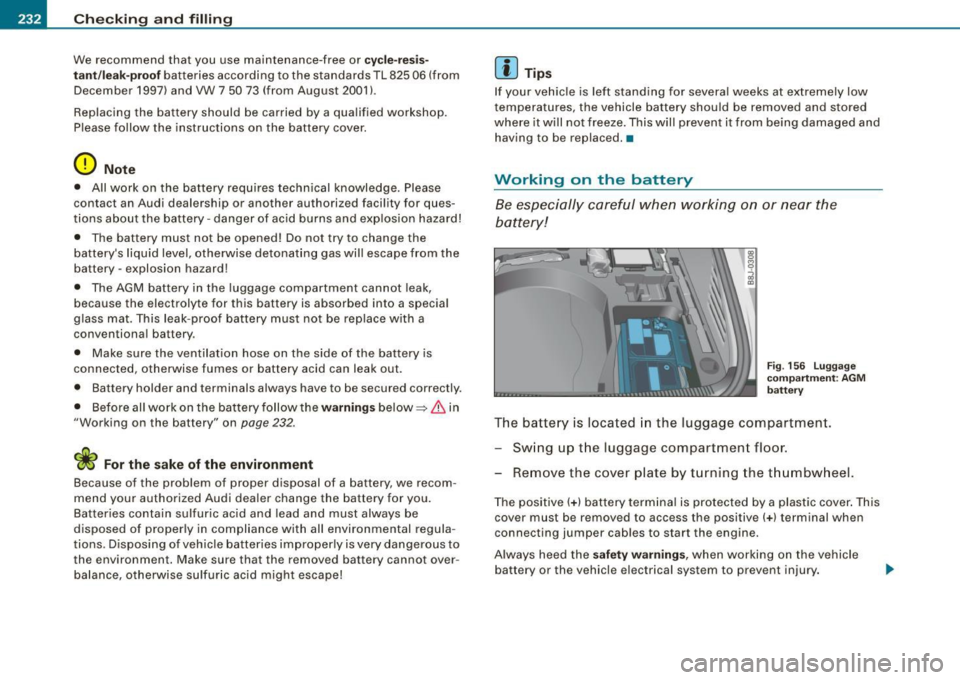
Fig . 156 Luggag e
co mp artment : AGM
batte ry
The batte ry is loca ted in the lu g ga ge compartmen t.
- Sw ing up t he luggage compartmen t floo r.
Remove the cover p late b y tu rning the t humbw heel.
The positive (+) battery term ina l is protected by a pla stic cover . This
cover must be removed to access the positive( +) terminal when
connecting jumper cab les to start the engine.
Always heed the
safety w arnings , when working on the vehicle
battery or the vehicle electrical system to prevent injury.
Page 241 of 316
________________________________________________ T_ i _r_e _s_ a_n_ d_ w_ h_ e_e _ l_s __ l'III
•
& W ARNING (continu ed )
crashes and serious personal in jur ies . Have worn or da maged t ires
replaced immediately .
• Tires age even if they are not being u sed and can fail suddenly ,
especially at high speeds. T ires that are more than 6 years old can
only be used in an emergency and then w ith special care and at
low speed.
Glossary of tire and loading terminology
Accessory weight
means the co mbined we ig ht ( in excess o f those sta nda rd items
which may be rep laced) of automatic transmission, power steering,
power brakes, power w indows, powe r seats, rad io, a nd heater, to
the extent that these items are avai lab le as factory-installed equip
m ent (w hether insta lled or not).
Aspect ratio means t he ratio o f th e height to t he w idt h of the tire in perce nt.
N umbers of 55 or lower indicate a low sidewa ll for improved
steer ing respo nse and b ette r overall ha ndl ing on dry pave ment.
Bead
means the part of the tire that is made of stee l wires, wrapped or
reinforced by ply cords and that is shaped to fit the rim.
Bead separation
means a breakdow n of the bond be tween co mponents i n the bead.
Cord
m eans the strands fo rmi ng the plies in the ti re.
& W ARNING (continued )
• Never mount used tires on your vehicle if you are not sure of
their "previous history. " Old used t ire s may ha ve been damaged
even though the damage cannot be seen that can lead to sudden
tire failure and lo ss of vehicle control.
• If you noti ce unusual vibration or if the vehicle pulls to one side
when driving , always stop as soon as it is safe to do so and check
the wheels and tires for damage . •
Cold tire inflation pressure
mea ns t he ti re pressure reco mm ended by the ve hicle ma nufacturer
for a tire of a designated size that has not been d riven for more tha n
a cou ple o f miles (k ilometers) at low speeds in t he t hre e ho ur per iod
before the tire pressure is measured or ad justed .
Curb weight
means the weight of a moto r vehic le with standard equipment
i nc lud ing the max imu m capac ity o f fue l, o il, and coola nt, a ir c ond i
tioning and additiona l weight of optional equipment.
Extra load tire
means a tire designed to ope rate at higher loads and at higher infla
tion pressures than the corresponding standard tire. Extra load tires
my be identified as "XL", "xi", "EX TRA LOAD", or "RF" on the side
wa ll.
Gross Axle Weight Rating ("GAWR ")
means the load -carrying capacity of a sing le ax le system, measured
at the ti re -ground interfaces.
Gross Vehicle Weight Rating ("GVWR "l
mea ns the ma ximum tot al l oade d weigh t of the vehicle.
Vehicle care
I t •
Page 242 of 316
-~_T_ ir_e_ s_ a_ n_d _ w_ h_ e_e _l_s _________________________________________________ _
Groove
means the space between two adjacent tread ribs.
Load rating (code)
means the maximum load that a tire is rated to carry for a given
inflation pressure . You may not find this information on all tires
because it is not required by law.
Maximum load rating
means the load rating for a tire at the maximum permissible infla
tion pressure for that tire.
Maximum loaded vehicle weight
means the sum of:
(a) Curb weight
(b) Accessory weight
(c) Vehicle capacity weight, and
(d) Production options weight
Maximum (permissible) inflation pressure
means the maximum cold inflation pressure to which a tire may be
in flated. Also called "maximum inflation pressure ."
Normal occupant weight
means 150 lbs. (68 kilograms) times the number of occupants
seated in the vehicle up to the total seating capacity of your vehicle.
Occupant distribution
means distribution of occupants in a vehicle .
Outer diameter
means the overall diameter of an inflated new tire.
Overall width
means the linear distance between the exteriors of the sidewalls of
an inflated tire, including elevations due to labeling, decorations, or
protective bands or ribs .
Ply
means a layer of rubber -coated parallel cords.
Production options weight
means the combined weight of those installed regular production
options weighing over 5 lbs. (2.3 kg) in excess of those standard
items which they replace, not previously considered in curb weight
or accessory weight, including heavy duty brakes, ride levelers,
heavy duty battery, and special trim.
Radial ply tire
means a pneumatic tire in which the ply cords that extend to the
beads are laid at substantially 90 degrees to the centerline of the
tread.
Recommended inflation pressure
see =:> page 239, "Cold tire inflation pressure".
Reinforced tire
means a tire designed to operate at higher loads and at higher infla
tion pressures than the corresponding standard tire. Reinforced
tires my be identified as "XL", "xi", "EXTRA LOAD", or "RF" on the
sidewall.
Rim
means a metal support for a tire or a tire and tube assembly upon
which the tire beads are seated .
Rim diameter
means nominal diameter of the bead seat. If you change your wheel
size, you will have to purchase new tires to match the new rim diam
eter.
Rim size designation
means rim diameter and width.
Rim width
means nominal distance between rim flanges .
Page 244 of 316
___ T_ i_ r_e _s_ a_ n_ d_ w_ h_ e_ e _ ls _________________________________________________ _
Occupant loading for vehicle normal load (no luggage)
Designated seating capacity , number of occupants
2
Cold tire inflation pressure
Vehicle normal load (no luggage ), number of occupants
2 •
Tire pressure affects the overall handling, performance and safety of a vehicle.
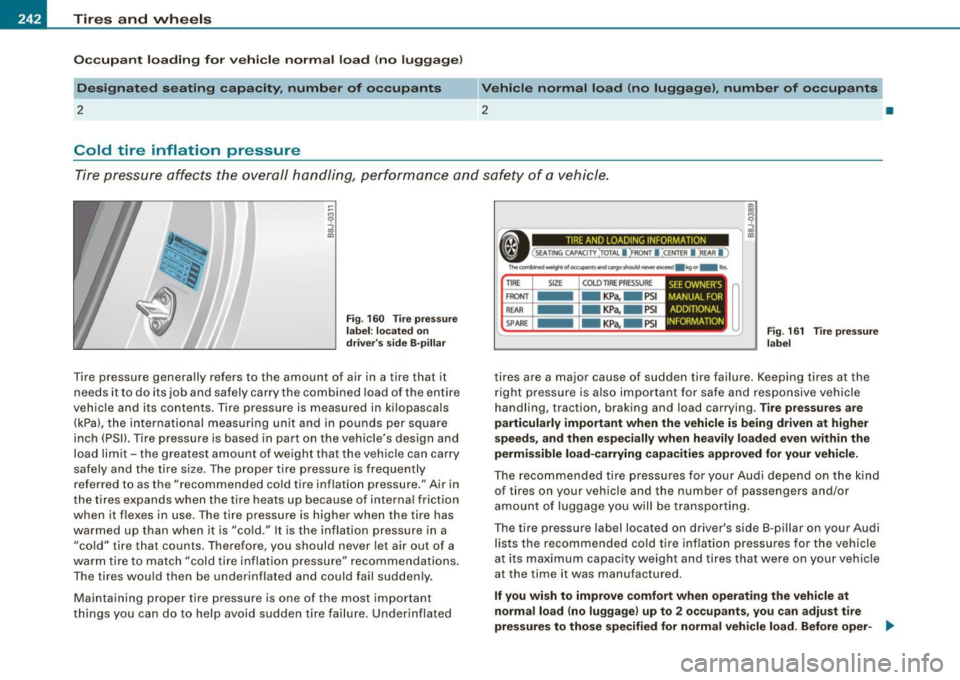
Fig. 160 Tire pressure
label: located on
driver's side B-pillar
Tire pressure generally refers to the amount of air in a tire that it
needs it to do its job and safely carry the combined load of the entire
vehicle and its contents. Tire pressure is measured in kilopascals
(kPal, the international measuring unit and in pounds per square
inch (PSll. Tire pressure is based in part on the vehicle's design and
load limit -the greatest amount of weight that the vehicle can carry
safely and the tire size . The proper tire pressure is frequently
referred to as the "recommended cold tire inflation pressure." Air in
the tires expands when the tire heats up because of internal friction
when it flexes in use. The tire pressure is higher when the tire has
warmed up than when it is "cold." It is the inflation pressure in a
"co ld" tire that counts. Therefore, you should never let air out of a
warm tire to match "cold tire inflation pressure" recommendations.
The tires would then be underinflated and could fail suddenly.
Main taining proper tire pressure is one of the most important
things you can do to help avoid sudden tire failure. Underinflated
ij
--~--------------- j
.(SEATING CAPAOn':jorAL l :FRONT l '.CENTER I '.REAR I )
The combmedwolghl "'°"'""""ond a,gor.hould ,_ l'>CC
FRO l'rr -KPa, - PSI
REAR -KPa, - PSI
~ A_ R _ E i..===..=;;;..;.;; KP..;;a, :.=;;;;;..;.. PS;;..;.I_
MANUAL FOR
ADDITIONAL
I N FORMATION SEE OWNER'S I
Fig. 161 Tire pressure
label
tires are a major cause of sudden tire failure. Keeping tires at the
right pressure is also important for safe and responsive vehicle
handling, traction, braking and load carrying .
Tire pressures are
particularly important when the vehicle is being driven at higher
speeds, and then especially when heavily loaded even within the
permissible load-carrying capacities approved for your vehicle.
The recommended tire pressures for your Audi depend on the kind
of tires on your vehicle and the number of passengers and/or
amount of luggage you will be transporting.
The tire pressure label located on driver's side B-pillar on your Audi
lists the recommended cold tire inflation pressures for the vehicle
at its maximum capacity weight and tires that were on your vehicle
at the time it was manufactured .
If you wish to improve comfort when operating the vehicle at
normal load (no luggage) up to 2 occupants, you can adjust tire
pressures to those specified for normal vehicle load. Before oper-
i.,.
Page 245 of 316
__________________________________________________ T_ ir_e_ s_ a_ n_d _ w_ h_ e_ e_l_s __ __
•
ating the vehicle at ma ximum load , you must increase the t ire pre s
sures to those specified for maximum vehi cle load
~ & .
Bear in mind that the t ire pressure mo nitoring system can only
monitor the tire pressures you have stored . The system does not
reco gnize the load cond itio n of your vehicle.
T he effectiveness of the tire pressure monitoring system will be
impaire d if you stor e nor mal loa d pressures but then operate the
vehic le at its maximum load~&. See the
illustration~ page 242, fig. 160 for the location of the label
on driver's si de B -pillar (co lor of the ac tual label a nd exact loca tion
on the veh ic le will vary slightly).
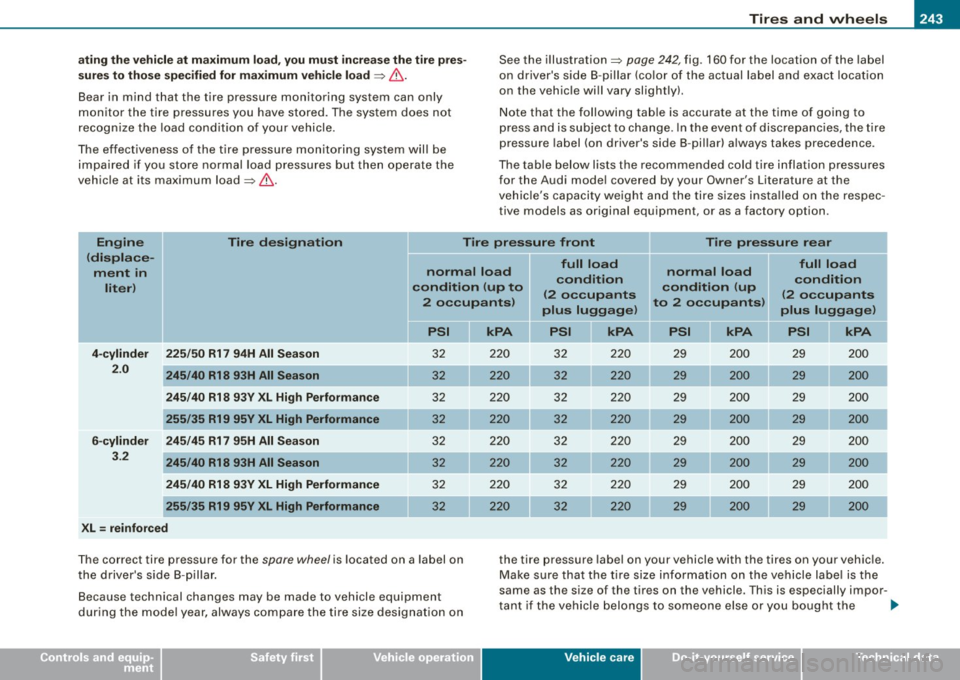
N ote that the following tab le is accu rate at the time of going to
press and is subject to cha nge . In t he event o f discrepancies, the t ire
pressure label (on driver's side B -pillar) a lways takes precedence .
The table belo w lists t he r ecom mend ed cold tire i nflatio n pressures
for the Audi mode l covered by your Owner's Literature at the
vehic le' s capacity weigh t and the tire size s insta lled o n the respec
tive models as original equipment , or as a factory option .
Engine Tire designation
Tire pressure front II Tire pressure rear
(displace -
= " full load full load
ment in normal load
condition normal
load
condition
liter ) condition
(up to condition (up
( 2 oc cupants (2 occupants
2 o ccupants ) to 2 occupants)
plus luggage) plus luggage)
I
PSI II kPA PSI II kPA II PSI II kPA
PSI I[ kPA I
I
4-cylinder
225/50 R17 94H All Season 32 220 3 2 220 29 200 29 200
2.0
245/40 R18 93H All Season 32 220 32 220 29 200 29 200
245 /40 R18 93Y XL High Performance 32 220 32 220 29 200 29 200
255 /35 R19 95Y XL High Performance 32 220 32 220 29 200 29 200
6 -cylinder 245/45 R17 95H All Season 3 2 220 32 2 20 29 200 29 2 00
3.2
245/40 R18 93H All Season 32 220 32 220 29 200 29 200
245 /40 R18 93V XL High Performance 32 220 3 2 220 29 200 29 200
255/35 R19 95V XL High Performance 32 2 20 32 220 29 200 29 200
XL = reinforced
T he correct tire pressure for the spare wheel is located on a label on the tire p ressure label on your vehicle with the tires on your vehic le.
t he d river's s ide B -pilla r. Make sure that the tire s ize inf ormat ion on t he veh icle labe l is t he
Because technical changes may be made to vehicle equipment same as the si
ze of the tires on the vehicle. This is especially impor -
t ant if the ve hicle belongs to so meo ne else or you bought the
dur ing th e mode l year, always co mpare the tire size designa tion on
Vehicle care
I t •
.,