lock AUDI TT ROADSTER 2008 Repair Manual
[x] Cancel search | Manufacturer: AUDI, Model Year: 2008, Model line: TT ROADSTER, Model: AUDI TT ROADSTER 2008Pages: 316, PDF Size: 70.1 MB
Page 186 of 316
_1--_l_ n _t _ e _ll _,ig ,_,_ e_n _t _ t_ e_ c_ h_n _o_ l_ o ~g""- y.e- __________________________________________ _
Intelligent technology
Notice about data recorded by
vehicle control modules
Your vehicle is not equipped with an Event Data Recorder (EDR),
installed by some manufacturers for the express purpose of
capturing data for retrieval after an accident or crash event . EDR's
are sometimes called "crash recorders".
Some state laws restrict the retrieval or downloading of data stored
by EDR's that were installed in a vehicle for the express purpose of
retrieving data after an accident or crash event w ithout the owner's
consent.
Although your vehicle is not equipped with an EDR, it is equipped
with a number of electronic control modules for various vehicle systems such as, for example, engine function, emission control, as
well as for the airbags and safety belts.
These electronic control modules also record vehic le-related data
during norma l vehicle opera tion for diagnostic and repair purposes .
The recording capacity of the electronic control modules is limited
to data (no sound is recorded) and only a small amount of data is
actually recorded over a very limited period of time and stored when
a system fault or other condition is sensed by a control unit. Some
of the data then stored may relate to vehic le speed, direction,
braking as well as restraint system use and performance in the
even t of a crash or other condition . Stored data can only be read and
downloaded with special equipment.
Electronic Stabilization Program (ESP)
Genel'61
The Electronic Stability Program increases driving
sta bility.
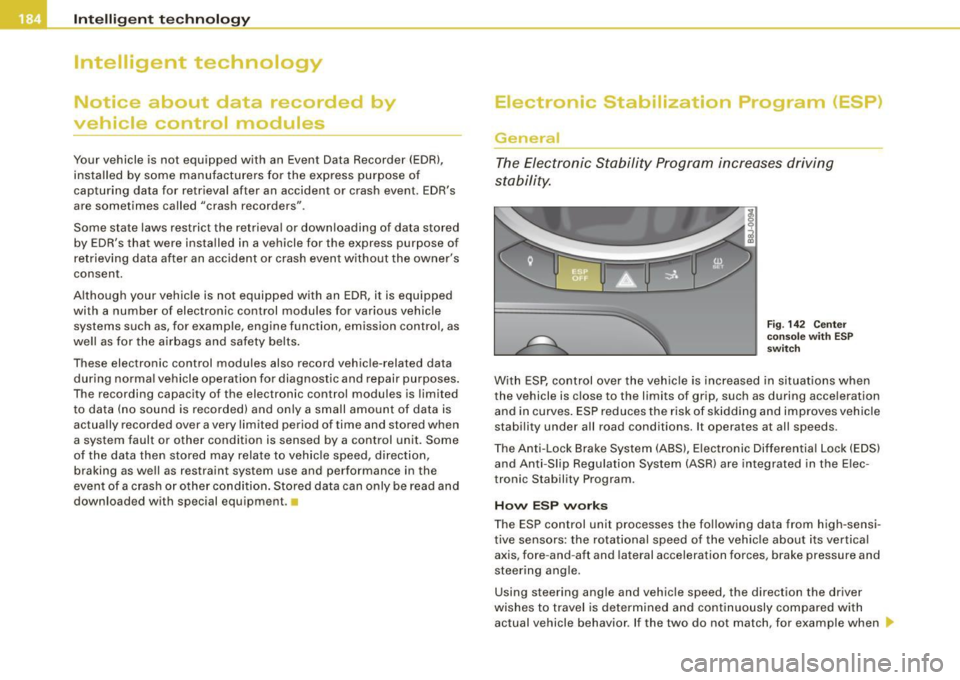
Fig . 142 Cente r
cons ole with ESP
sw itch
With ESP, control over the veh icle is increased in situations when
the vehicle is close to the limits of grip, such as during acce leration
and in curves. ESP reduces the risk of skidding a nd improves vehicle
stability under all road conditions . It operates at all speeds .
The Anti-Lock Brake System (ABS), E lec tronic Differentia l Lock (EDS)
and Anti-Slip Regulation System (ASR) are integrated in the Elec
tronic Stability Program .
H ow ESP work s
The ESP control unit processes the following data from high-sensi
tive sensors: the rotational speed of the vehicle about its vertica l
axis, fore -and -aft and lateral acceleration forces, brake pressure and
steering angle.
Using steering ang le and vehicle speed, the direction the driver
wishes to travel is determined and continuously compared with
actual vehicle behavior . If the two do not match, for example when
Page 188 of 316
___ ln_ t _e_ ll-'"ig ...,_ e_ n_t _t_ e_ c_ h _ n_o _ l_o _,.g= y,_ __________________________________________ _
Electronic differential lock (EOL)
The electronic differential lock monitors the rotational
speed of the drive wheels.
General notes
The electronic differential lock (EDU helps the car to start moving,
accelerate and climb a gradient on surfaces providing poor or
almost no grip. Without EDL, this would be difficult, if not impos
sible.
How the system works
Th e EDL operates automatically. It monitors the rotational speed of
the drive wheels on an axle with the help of the ABS sensors
=> page 189. If a noticeable difference in rotational speed between
the drive wheels on one axle is detected (e.g. on slippery ground
on
one side),
the spinning wheel is braked, thereby transferring power
to the other drive wheel or wheels (all-wheel drivel. This is done up
to a speed of about 60 mph (100 km/hl. Noises from the brake
system signal that wheel spin is being controlled.
Driving off
When driving off, always be sure to keep road conditions in mind as
you accelerate . If one drive wheel spins because it is on a surface
with less grip, gradually increase the pressure on the accelerator
pedal until the car starts to move. The wheel less able to transfer
power spins.
Overheating of brakes
To prevent the disc brake of the braked wheel from overheating if
subjected
to excessive loads, the EDL cuts out temporarily . The
vehicle remains operational and behaves in the same way as a
vehicle without EDL.
As soon as the brake has cooled down, EDL switches on again auto
matically.
& WARNING
• When accelerating on slippery surfaces, such as on ice or snow,
always be careful when depressing the accelerator pedal. Even
with the EDL working, the drive wheels can spin and reduce your ability to control your car. -Risk of crash!
• The increased safety afforded by EDL does not mean that you
can take safety risks. Always adapt your driving style to the road
conditions and traffic situation.
[ i] Tips
If a fault occurs in the ABS, the EDL is also not functioning . This is
indicated by the ABS warning light=>
page 20. •
Anti-Slip Regulation System (ASR)
The Anti-Slip Regulation System prevents the driven
wheels from spinning when the car is accelerating.
General notes
The Anti-Slip Regulation System (ASR) is integrated in the electronic
stabilization program (ESP). When the vehicle starts up and acceler
ates , the wheels are prevented from spinning by adjusting the
engine power to match the amount of grip available from the road
surface .
How the system works
ASR performs automatically, i.e. without the driver's intervention .
With the aid of the ABS sensors =>
page 189, ASR monitors the
speed of the driven wheels. If the wheels start to spin, the engine
torque is reduced automatically until the tires find enough grip to
lock onto the road surface . The system is active across the entire
speed range.
The ASR works in conjunction with the ABS. If a malfunction should
occur in the ABS, the ASR will also be out of action .
~
Page 191 of 316
Faults in the brake syst em
If you shou ld notice a sudden i ncrease in brake pedal travel, then
one of the two brake circuits may have failed=>
& -
Low brake fluid level
Ma lfunctions can occur in the brake system if the brake fluid leve l is
t oo low. The brake fluid level is moni tored e lect ronica lly .
Brake pow er assist unit
The brake p ow er assist un it increas es th e pressure that you
generate with the brake peda l. It works only when the engine is
running.
& WARNING
• You should perform braking maneuver s for the purpose of
c leaning the brake system only if road conditions permit . Other
road users must not be put at ri sk -you may cause an accident!
• Before des cending a steep grade , redu ce speed and sh ift trans
mi ssion into a lower gear or lower driving position . Do not ride the
br akes or hold the pedal down too long or too often . This could
cause the brakes to get hot and diminish braking efficiency .
• Do not "ride the brakes " by resting your foot on the pedal when
you do not intend to brake . Thi s may cause the brakes to overheat,
premature we ar and increased stopping distan ce .
• Under certain cl imatic and operating condit ions such as
pas sing through water , driv ing in heavy rain or after washing the
vehicle, the effectiveness of the brake s can be reduced . In winter ,
ice can ac cumulate on the brake pads , linings , discs and drums .
Cautiously apply brakes for a te st. Brakes will dry and ice coatings
will be cleaned off after a few cautious brake appli cations .
• Driving for an extended period of time on salt -covered road s
without using your brakes can also affect brak ing effic iency . Clean
off accumulated salt coating from brake discs and pads with a few
c autiou s brake applications .
Controls and equip ment Safety first Vehicle operation
Intelligent technology
& W
ARNING (continued )
• If you damage the front spo iler , or if you install a different
s poiler , be sure the air flow to the front brakes is not obstructed.
Otherwise the brake system could overheat redu cing the effective
ness of the entire br ake system.
• Failure of one brake circuit will impair the braking capability
resulting in an increa sed stopping distance. Avoid driving the
vehicle and have it towed to the nearest Audi dealer or qualified
workshop.
• Never let the veh icle roll to a stop with the engine shut off .
• If the b rake booster is not working , for e xample when towing
your vehicle, or because the brake booster has somehow been
damaged , the brake pedal must be pre ssed considerably harder to
make up for the lack of booster assistance . •
Anti- lock brake system (ABS)
ABS p revents the wheel s from loc king unde r br ak ing.
The anti -lock brake sys te m (ABS) makes a major contri but ion to
i ncreasing act ive d riv in g sa fety . You should not expect that brakin g
distances wi ll be
shortened unde r all c ircums tances wi th ABS.
B rak in g distance may even become somewhat
longer , for e xa m ple ,
on gravel or in new snow on s lippery ground, even if you are driving
carefully and slowly.
ABS operation
W hen a veh icle speed o f about 10 mph (20 km/ h) is reac hed , an au to
matic test sequence is run. Some noise from the pum p may be
audible.
I f the speed of a wheel s lows down too much re lative to vehicle
speed and i t starts to lock, br ake pressu re to th is whee l is reduce d.
T his adjustment process can be felt as a
pulsing motion of the b rake
pedal ,
accompanied by some noises. Yo u as the d rive r are in tent io n
a lly being g iven the in fo rmation that the wh eels a re tendin g to lock
Vehicle care Do-it-yourself service Technical data
Page 193 of 316
![AUDI TT ROADSTER 2008 Repair Manual [ i ] Tips
• If the pow er st eering sy stem sho uld fa il, or if the e ng ine is not
running (for examp le , whi le being towed), you will stil l be able to
st eer the ve hicl](/img/6/57671/w960_57671-192.png "AUDI TT ROADSTER 2008 Repair Manual [ i ] Tips
• If the pow er st eering sy stem sho uld fa il, or if the e ng ine is not
running (for examp le , whi le being towed), you will stil l be able to
st eer the ve hicl")
[ i ] Tips
• If the pow er st eering sy stem sho uld fa il, or if the e ng ine is not
running (for examp le , whi le being towed), you will stil l be able to
st eer the ve hicle . How eve r, more e ffort w ill be required to do so.
• I f the powe r steering system is not f unctioning pr ope rly, contact
your authorized Audi dea ler immediate ly.
Ap plies to vehicles : wit h A ll Wheel Driv e
Driving w ith your quattro®
With All Wheel Drive, all four w heels ar e dri ven.
General information
With All W hee l Dr ive, power is d is tr ibute d to all fou r whee ls . T his
happens automat ica lly depending on your driving style and the
r oad cond itio ns at the time. See also =>
page 186, "E lec tronic diffe r
entia l lock ( EDU" .
Winter tires
When driving in the winter, your vehic le with All Wheel Drive has an
advantage, even wi th regula r t ir es . In winter road conditions it may
be advisable to mount winter tires (or all -season tires) for improved
driveabi lit y an d braking : these tires m ust be mounted on
all four
wheels .
See also=> page 254 , "Win ter t ires" .
Snow chains
Where tire cha ins are mandatory on certain roads, this normally
a lso a pplies t o vehic le s wi th Al l Wheel Drive =>
page 255, "Sn ow
chains".
Replacing wheels /tires
Vehicles with A ll Wheel Drive must always have tires of the same
s iz e. Also av oid t ires w it h d iff eren t tr ead dep ths. For details see
page=>
page 249, " New tires and replacing tires and whee ls " .
Controls and equip
ment Safety first Vehicle operation
Intelligent technology
Off
-Road driving?
Your Audi d oes not have en ough gr ound clea rance to be use d as a n
off -road vehicle. It is therefore best to avoid roug h tracks and
u neven terrain as much as possible. A lso refer to=>
page 194.
& WARNING
Always adjust your driving to road and traffic conditions. Do not
let the extra safety afforded by All Wheel Drive tempt you into
taking extra risks .
• Although the All Wheel Drive is very effective , always
remember that braking capacity is limited by tire traction. You
should therefore not drive at e xcessive speeds on icy or slippery
road surfaces.
• On wet road su rfaces , be careful not to dr ive too fast because
the front wheels could begin to slide on top of the water (aqua
planing ).
If this should occur , you will have no warning from a
sudden increase in engine speed as with a front -wheel drive
vehicle . Always d rive at speeds which are suited to the road condi
tions. -risk of cra sh. •
Vehicle care Do-it-yourself service Technical data
Page 204 of 316
___ C_ le_ a _ n_i_n ~g _ a_ n_ d __ p_r _o _t _e _c_ t_ i_o _n ___________________________________________ _
& WARNING
• Do not cl ean th e under side o f the ch ass is, fender s, whe el
c over s, or other hard to r ea ch part s without protecting your h and s
a nd a rms. Yo u may cut you rse lf on sh ar p-edged m eta l p art s.
• Alway s read and h eed all WARNINGS and other informat ion
~ p age 2 00 .
0 Note
• Never try to remove dirt, mud or dust if the surface of the vehicle
is dry . Never use a dry cloth or sponge, s ince this cou ld scratch your
vehic le's paint or w indows .
• Never wash your car in br ight sunl ight. Drops of wa ter act as
magnifying lenses and may damage your paint .
• When you wash your car in the winter : if you rinse your vehicle
with a hose, be careful not to aim the stream of water directly at
locks, or at door or ha tch openings - they can freeze shut.
• Never use sponges designed to remove insects, or any kitchen
scouring sponges or simila r products. They can damage your paint
finish .
• Never use a dry cloth or sponge to c lean the head lights. Only use
wet cloths or sponges to prevent scratches . It is best to use soapy
water.
c£> For the sake of the environment
In the interest of the environment, the vehicle shou ld on ly be
washed in special wash bays. •
Washing your vehicle with a power washer
Cleaning the exterior of your car with a high-pressure
power washer is safe as long as you observe a few simple rules .
-Before us ing the powe r washer, make sure you have read
and understood the WARNINGS~
& in "General infor
mation" o n
page 200.
Always follow the operating instructions for the power
washer.
Make sure that the jet o n th e sp ray hose produces a "fan
shaped sp ray".
Do
not hold the spray n ozzle too close to soft ma terials .
Never u se a power washer to clean the power top itself .
When cleaning the vehicle with a power washer
always follow the
operating instructions. This applies particula rly to the
operating
pre ssure
and the spraying di stanc e. Maintain a sufficient distance
to soft materia ls such as rubber hoses and sound/vibration dead
ening materia ls (particularly on the underside of the engine hood).
Do not use a jet which sprays water in a
di re ct stre am or one that
has a
rotating jet.
Water temperature shou ld not exceed 140 °F (60 °Cl.
in. WARNING
Never wash tires with a jet that sp rays water in a dire ct stream .
Thi s could cause invisib le damage to the tire s and weaken them ,
even if the spra y is fr om a re lative ly lo ng d istanc e and f or a s ho rt
tim e. Damaged and we akened tire s can f ail and cau se ac cident s
a nd pers ona l i njur y. .,,_
Page 210 of 316
., __ C_ le_ a _ n_i_n ~g _ a_ n_ d __ p_r _o _t _e _c_ t_ i_o _n ___________________________________________ _
& WARN ING (c o ntinu ed )
• Do not apply additional und ercoating or ru stpr oofing on or
near the e xhaust man ifold , ex h aust p ipe s, ca talyt ic con verte r or
heat sh ields . W hile driving , the sub stan ce used for underco atin g
c ould overh eat and cause a fire .
• Alw ays read and heed all WARNINGS and oth er inform ation
~ p ag e200 .•
Care of interior
Aluminum trim
Use on ly neutral -pH products to remove spots and deposits from
a luminum surfaces. Chrome care products and alka line cleaners
wi ll attack aluminum surfaces and can damage them over t ime.
& WARNING
Alway s read and heed all WARNIN GS and the inform ation
~ page 200 . •
Fabrics and fabric coverings
Fabrics and fabric coverings (e .g. seats, door trim pane ls, etc.)
should be cleaned at regu lar intervals with a vacuum cleaner. This
removes surface dirt particles which could become embedded in
the fabric through use . Steam c leaners should not be used, because
the steam tends to push the dirt deeper into the fabric and lock it
there .
Norm al c leanin g
Generally, we recommend using a so ft sponge or a l int -free
microfiber cloth to the clean fabric. Brushes should only be used for carpets and floor mats, since other fabric surfaces could be harmed
b
y brushes .
Normal surface stains can be cleaned using a commercially avail
able foam cleaner . Spread the foam on the surface of the fabric with
a soft sponge and work it in gently. Do not saturate the fabric. Then
pat the foam dry using absorbent, dry cloths (e.g. microfiber c loth)
and vacuum it af ter it has dried complete ly .
C leaning st ains
Stains caused by beverages (e.g . coffee, fruit juice, etc.) can be
treated with a mild detergent solution. Apply the detergent so lution
with a sponge . In the case of stubborn stains, a de tergent paste can
be applied directly to the stain and worked into the fabric. After
wa rds, use copious amounts of clean wa ter to remove the
remaining detergent . App ly the water with a damp cloth or sponge
and pat the fabric dry w ith an absorbent, dry c lo th.
Stains from choco late or makeup shou ld have detergent paste (e .g.
ox -gall soap) rubbed into them . Afterwards, remove the soap with
water (damp sponge).
Alcoho l can be used to treat stains from grease, oi l, lipstick or a ba ll
point pen . Melted grease or dye must be patted off using absorbe nt
material. It may be necessary to retreat the areas with detergent
p aste and wa ter.
I n the case of general soiling of the upholstery and cover material,
we recommend hiring a specialist that has the equipment to clean
the seat covers and other fabr ic surfaces by shampooing and spray
extraction.
& WARNING
Alway s read and heed all WARNINGS and the information
~ page 200 .
Page 212 of 316
___ C_ le_ a _ n_i_n ~g _ a_ n_ d __ p_r _o _t _e _c_ t_ i_o _n ___________________________________________ _
clothing materials can discolor leather seats (especially if such
clothing is damp and was not dyed correctly). Dust and dirt particles
in pores, folds, and seams can have an abrasive effect and can
damage the leather surface as well as weaken seams.
The leather should be cleaned regularly as needed. After having
been used for a relatively long time, your leather seats will acquire
a rich aged finish. This is a characteristic of natural leather and a
sign of true quality.
In order to maintain the value of this natural product over the life of
your vehicle, you should follow the recommendations below:
0 Note
• To keep your leather from bleaching out, do not allow it to be
exposed to bright sunlight for long periods of time. If you have to
leave the vehicle parked outside for long periods, cover the leather
to protect it from direct exposure to sunlight.
• Sharp objects on clothing, such as zippers, rivets or sharp pieces
on belts can leave permanent scratches or scrape marks on the
surface of the leather.
[ i J Tips
• After each time you clean the leather and at regular intervals, use
a leather preservative creme that contains UV -blockers and that
works into the leather. This creme will nourish and moisturize the leather, helping it to breathe and stay supple. It also helps to build
up a protective coating on the surface.
• Clean the leather every 2 -3 months, and clean any areas that get
soiled.
• Remove fresh marks made by ballpoint pens, ink, lipstick, shoe
polish, etc. as soon as possible.
• Preserve the color of the leather as needed by using a special
colored leather care creme to touch up areas of uneven color. •
Applies to vehicles: w ith natu ral leather
Cleaning and caring for leather upholstery
and trim
Natural leather requires special care and attention.
Normal cleaning
-Clean soiled areas with a slightly moistened cotton or
woolen cloth.
More stubborn dirt
- More stubborn dirt can be removed using a cloth satu
rated with a mild soap solution (2 tablespoons mild
liquid soap).
- Never allow the soap solution to saturate the leather, and
make certain that no water soaks into the seams.
Wipe off the soap solution with a soft, dry cloth.
Cleaning spots
-Remove fresh water-based spots (such as coffee, tea,
juices, blood) with an absorbent cloth or paper towel.
- Remove fresh
grease or oil-based spots (such as butter,
mayonnaise, chocolate) with an absorbent cloth or paper
towel, or use the cleaner from the leather care kit if the
spot has not yet penetrated into the surface of the
leather.
- Use an oil/grease dissolving spray, if
oil/grease spots
have dried on.
- Remove specific kinds of spots (ballpoint pen, felt
marker, fingernail polish, water-based paint, shoe polish,
etc.) with a spot remover specifically formulated for leather. ..,_
Page 214 of 316
-Cleaning and prot
ection
-~--------------
Safety belts
Only well-maintained safety belts work reliably when
needed.
H eavily soiled safety be lts may no t retract properly.
- Keep belts c lean.
- For clean ing, use a mild soa p an d wa ter so luti on. Let
belts dry thoroughly and away from d irect sunlight.
- D o not allo w inertia reel safe ty belts to retra ct before
they are com pletely dry .
- Check the condition of your safety belts
regularly .
& WARNING
Damaged safety belt s can break in a crash .
• Anything that might damage your safety belts could mean that
y ou and yo ur pas senger s would not be adequatel y prote cted in an
accident .
• Safety belt performance depend s on correct in stallation . Never
remove belt s from the vehicle to clean them.
• Do not u se chemi cal cleaning agents , blea ch or dyes . They h ave
c orrosive propertie s wh ich weaken the webbing.
• When cleaning your safety belts , in spect them for dam age . If
you discover damage, see your Audi dealer .
• Alway s read and heed all WARNINGS and the infor mation
=> page 200 . •
Engine compartment
Be es pecially caref ul when cle aning the engine compart
ment.
Alwa ys swit ch off the ignition before cle aning the engine => & .
Plenum pan el
Remove leaves from the plenum pane l in front of the w indshield
under the engine hood. This prevents the water drain holes from
becoming blocked, and it prevents debris from entering the vehicle
inter ior through the heating and ventilation ducts.
Corrosion protection
The engine compartment and transmission have been corrosion
pro tected at the factory.
Good anti -co rros io n treatment is very important, particularly in the
winter. If the vehicle is frequent ly driven on salt treated roads, the
enti re eng ine compartmen t and p lenum panel should be thor
oughly cleaned at the end of winter and retreated to prevent salt
damage . At the same time, the unde rside o f the vehicle shou ld be
washed as we ll.
I f the engine compartment is cleaned at any time with grease
removing solut ions
ll, or if you have the engine washed, the anti
corrosion treatment is almost a lways removed as well. It is therefore
essential to have a long-lasting corrosio n pro tec tion reapp lied to a ll
surfaces, seams, joints and components in the engine compart
ment .
& WARNING
Be awa re: Th e engine comp artment of any motor vehicle is a
potentially hazardou s area .
• Befo re working in the eng ine compartme nt, be sure to read the
i nformat ion =>
page 212 . .,.
11 Use on ly the correct cleaning so lutions. Never use gasol ine or diesel fuel.
Page 217 of 316
Fuel supply and filling your fuel tank -___________ ...:._:......:,_______;::;...a,__ __
•
Blend of gasoline and ethanol (grain alcohol or ethyl alcohol)
• Anti -knock index must be 87 AKI or higher.
• Blend must not contain more than
10% ethanol.
Blend of gasoline and MTBE
• Anti-knock index must be 87 AKI or higher.
• Blend must contain not more than
15% MTBE.
Seasonally adjusted gasoline
Many gasoline grades are blended to perform especially well for
winter or summer driving . During seasona l change -over, we suggest
that you fil l up at busy gas stations where the seasonal adjustment
is more likely to be made in time.
0 Note
• Methanol fuels which do not meet these requirements may
cause corrosion and damage to p lastic and rubber components in
the fue l system.
• Do not use fue ls that fail to meet the specified criteria in this
chapter .
• If you are unable to determine whether or not a particu lar fuel
blend meets the specifications, ask your service station or its fuel
suppl ier.
• Do not use fue l for which the contents cannot be identified.
• Fuel system damage and performance problems resu lting from
the use of fuels different from those specified are not the responsi
bility of Audi and are not covered under the New Vehicle or the
Emission Control System Warranties.
• If you experience a loss of fuel economy or driveability and
performance problems due to the use of one of these fuel blends,
we recommend that you switch to unblended fuel. •
Gasoline additives
A major concern among many auto manufacturers is carbon
depos it build -up caused by the type of gasoline you use.
Although gasoline grades differ from one manufacturer to another,
they have certain things in common. All gaso line grades contain
substances that can cause deposits to collect on vita l engine parts,
such as fue l injectors and intake valves. Although most gasoline
brands include additives to keep engine and fue l systems clean,
they are not equally effective.
Audi recommends using TOP TIER Detergen t Gasoline. For more
information on TOP TIER Detergent Gasoline, please go to the offi
cial website (www.toptiergas .coml.
A ft er an extended period of using inadequate fuels, built-up carbon
deposits can rob you r engine of peak performance.
(D Note
Damage or malfunction due to poor fuel qua lity is not covered by
the Audi New Vehicle Limited Warranty .•
Fuel tank
Fuel filler neck
The fuel filler neck is located on the right rear side panel behind the
fue l filler f lap.
If the unlocking system should fai l, you can stil l open the flap manu
a lly -for detai led instructions see=>
page 218.
You can find the fuel tank capacity of your vehicle in Technical Data
=> page 291. _.,
Vehicle care I t •
Page 218 of 316
Fuel supply and filling your fuel tank
The label on the inside of the fuel filler flap tells you the correct fuel
for your vehicle. For more information about fuel specifications, see
~ page 214.
Your vehicle fuel tank has an on -board refuelling vapor recovery
system. This feature helps to prevent fuel vapors from escaping
from the tank and polluting the environment while you refuel your
vehicle. In order to fill the tank properly while protecting the envi
ronmen t, please follow this refueling procedure carefully.
& WARNING
Under normal operating conditions, never carry additional fuel
containers in your car. Gas canisters and other containers used to
transport fuel can be dangerous. Such containers, full or empty,
may leak and could cause a fire in a collision. If you must transport
fuel to use for your lawn mower, snow blower, etc ., be very careful
and always observe local and state laws regarding the use, trans
portation and storage of such fuel containers . Make certain the
container meets industry standards (ANSI/ASTM F852 -861.
0 Note
Never drive your vehicle until the fuel tank is completely dry. The
irregular supply of fuel can cause misfiring . Gasoline could enter
into the exhaust system and damage the catalytic converter. •
Refuelling
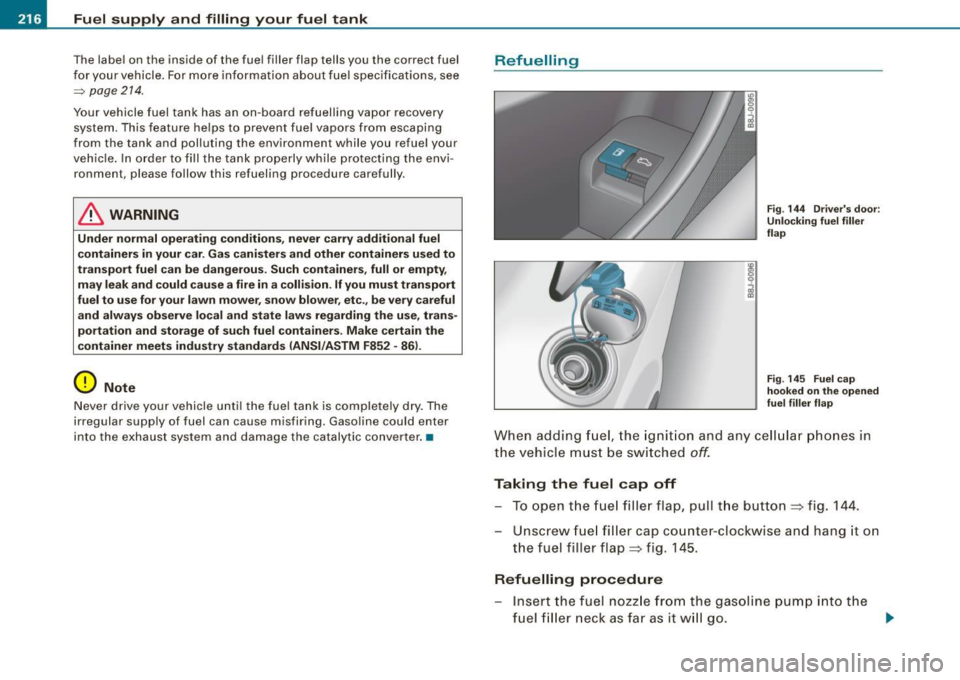
Fig. 144 Driver's door:
Unlocking fuel filler
flap
Fig . 145 Fuel cap
hooked on the opened
fuel filler flap
When adding fuel, the ignition and any cellular phones in
the vehicle must be switched
off.
Taking the fuel cap off
To open the fuel filler flap, pull the button ~ fig. 144.
Unscrew fuel filler cap counter-clockwise and hang it on
the fuel filler flap~ fig. 145 .
Refuelling procedure
Insert the fuel nozzle from the gasoline pump into the
fuel filler neck as far as
it will go. .,_