lock AUDI TT ROADSTER 2008 Manual PDF
[x] Cancel search | Manufacturer: AUDI, Model Year: 2008, Model line: TT ROADSTER, Model: AUDI TT ROADSTER 2008Pages: 316, PDF Size: 70.1 MB
Page 219 of 316
_____________________________________ F_ u_ e_l _s _u-= pc...:... p_ly =--- a_ n_ d_ f_ i_ ll _in -=: gc.. y -=--- o-u_ r_ fu_ e_l _t _a _n_ k __ fflllll
•
- Select a medium refuelling rate so that the nozzle
switches off automatically when the tank is full.
Putting the fuel cap back on
- After filling your tank, twist the fuel filler cap clockwise
until you hear a definite click.
- Close the fuel filler flap.
To avoid fuel spilling or evaporating from the fuel tank always close
fuel filler cap properly and completely. An improperly closed fuel
filler cap may also cause a message in the driver information system =>
page 24 or cause the MIL lamp=> page 26 to come on.
& WARNING
Improper refueling or handling of fuel can cause fire, explosion
and severe burns .
• Fuel is highly flammable and can cause severe burns and other
injuries.
• Failure to shut the engine off while refueling and/or to insert
the pump nozzle fully into the fuel filler neck could cause fuel to
spray out of filler neck or to overflow. Fuel spray and overflowing
fuel can cause a fire.
• Never use a cellular telephone while refueling . The electromag
netic radiation can cause sparks that can ignite fuel vapors and
cause a fire .
• Never get back into your vehicle while refueling. If in excep
tional circumstances you must get back in your vehicle while refu
eling, make certain that you close the door and touch metal to
discharge static electricity before touching the filler nozzle again.
Static electricity can cause sparks that can ignite fuel vapors
released during refueling.
• Never smoke or have an open flame anywhere in or near your
vehicle when refueling or filling a portable fuel container.
& WARNING (continued)
• For your safety, we strongly recommend that you do not travel
with a portable fuel container in your vehicle. The container, full or empty may leak and could cause a fire, especially in a crash .
• If, under exceptional circumstances, you must transport a
portable fuel container, please observe the following: -Never fill a portable fuel container while it is anywhere in or
on the vehicle (for example, in the luggage compartment, or on
the trunk). Static electricity can build up while filling and can ignite fuel vapors causing a fire.
- Always place a portable fuel container on the ground before
filling.
- Always keep the filler nozzle completely inside the portable
container before and during filling.
- If filling a portable container made of metal, the filler nozzle
must always be in contact with the container. This will help
prevent static electricity from discharging and cause a fire.
- Never spill fuel inside the vehicle or luggage compartment.
Fuel vapors are highly flammable.
- Always observe local and state/provincial laws regarding the
use, storage and transportation of fuel containers
- Make certain the fuel container meets industry standards
(ANSI / ASTM F852-86l.
(D Note
If any fuel has spilled onto the car, it should be removed immedi
ately to prevent damage to the paint.
<£> For the sake of the environment
As soon as the correctly operated nozzle switches off automatically
for the first time, the tank is full. Do not try to add more fuel because
fuel may spill out. In addition, the expansion space in the fuel tank ..,_
Vehicle care
I t •
Page 220 of 316
![AUDI TT ROADSTER 2008 Manual PDF Fuel supply and filling y our fu el ta nk
will be filled -causing the fuel to overflow when it becomes warm
and pollute the environment.
[ i ] Tips
• Running your engine wh](/img/6/57671/w960_57671-219.png "AUDI TT ROADSTER 2008 Manual PDF Fuel supply and filling y our fu el ta nk
will be filled -causing the fuel to overflow when it becomes warm
and pollute the environment.
[ i ] Tips
• Running your engine wh")
Fuel supply and filling y our fu el ta nk
will be filled -causing the fuel to overflow when it becomes warm
and pollute the environment.
[ i ] Tips
• Running your engine while refuel ling may cause vapors to
escape or even fuel to spill out of the tank . This would then shut off
the fue l nozzle before the tank is full.
• Do not refuel your vehicle with the ignition switched on . The fuel
gauge may otherwise not indicate the correct fuel level after
refuel ling .•
Unlocking the fuel filler flap by hand
You c an open the fuel filler flap by hand i f the p ower
locking system should fail .
Fig . 14 6 Lugg age
co mp artm ent : Cove r in
t h e r igh t-side interi or
tri m
If the power loc king syst em sho uld fa il, you can still open
the flap manually :
- Ope n the rear lid .
Open the round cover in the right -s ide interior trim.
Remove the red plastic knob from its reta iner . -
Pull the plastic cord in the direction of the arrow to
unlock the fuel filler flap~ fig. 146 . •
Page 222 of 316
-~_C_ h_e _c _ k_ i_n ...:::g::;...._ a_n_ d_ f_ i_ll _in -'g:::;.._ ___________________________________________ _
Closing the engine hood
- Pull the hood down until the pressure from the struts is
reduced.
- Let the hood
drop down and latch in place. Do not try to
push it shut;
it may fail to engage~& .
& WARNING
A hood that is not completely latched could fly up and block your
view while driving.
• When you close the engine hood, check it to make sure the
safety catch has properly engaged. The hood should be flush with
the surrounding vehicle body parts.
• If you notice while driving that the hood is not secured prop
erly, stop at once and close it. •
Working in the engine compartment
Be especially careful whenever you work in the engine
compartment!
Whenever you must perform any work in the engine compartment,
for example checking and filling the different fluids, there is a risk of injury, burns and accidents. To prevent personal injury always
observe the following WARNINGS. The engine compartment of any
vehicle is a hazardous area!
=> &
& WARNING
To help avoid injury, before you check anything under the hood :
• Switch off the engine.
• Remove the ignition key.
• Apply the parking brake.
& WARNING (continued)
• Move selector lever of automatic transmission to "P" {Park);
put manual transmission in Neutral.
• Always let the engine cool down. Hot components will burn
skin on contact.
• To reduce the risk of being burned, never open the hood if you
see or hear steam or coolant escaping from the engine compart
ment. Wait until no steam or coolant can be seen or heard before
carefully opening the hood .
• Keep children away from the engine compartment.
• Never spill fluids on hot engine components. They can cause a
fire.
• Never touch the radiator fan. The auxiliary electric fan is
temperature controlled and can switch on suddenly.
• Never open the coolant reservoir cap when the engine is still
warm. The coolant system is pressurized and hot coolant could
spray out.
• Protect your face, hands and arm from steam or hot engine
coolant by placing a thick rag over the cap when you open the
coolant reservoir.
• If work on the fuel system or the electrical system is necessary:
- Always disconnect the battery .
- Never smoke or work near heaters or open flames. Fluids in
the engine compartment could start a fire.
- Keep an approved fire extinguisher immediately available.
• To avoid electrical shock and personal injury while the engine
is running or being started, never touch :
- Ignition cables
- Other components of the high voltage electronic ignition
system.
• If you must perform a check or repair with the engine running: .,_
Page 230 of 316
___ C_h_ e_ c_k _in --== g'-- a_n _d_ f_il _li _n ..:::g:::..- ___________________________________________ _
function and performance of your cooling system and could result
in damage not covered by your New Vehicle Limi ted Warranty .•
Checking the engine coolant level
The engine coolant level can be checked with a quick
g lance .
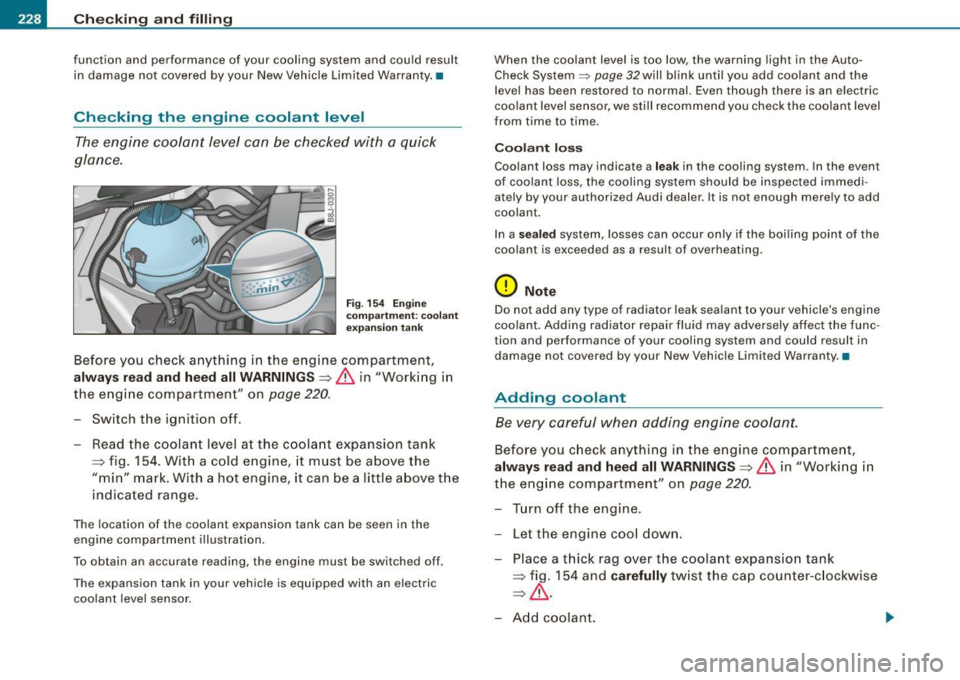
Fig. 154 Engin e
co mpartment : coo lan t
e xpansio n tank
Before you check anything in the engine compartment,
always read and heed all WARNINGS =>
& in "Working in
the engi ne compa rtment" on
page 2 20.
- Switch t he ignition off.
- Rea d the coo lan t leve l at th e co ola nt e xpansion tank
=> fig . 154. Wit h a c old engine , it must be a b ove the
"min" mark . With a hot engine, it can be a little a bove t he
indicated range .
The location of the coo lant expansion tank can be seen in the
engine compartment i llustration.
To obtain an accurate reading, the engine must be switched off .
The expans io n tank in your vehicle is equipped with an electric
coo lant level sensor . When the coolant leve
l is too low , the warning light in the Auto
Check System ~
page 32will blink un til you add coolant and the
level has been restored to normal. Even though there is an electric
coo lant level sensor, we still recommend you check the coolant level
from time to time .
Coolant los s
Coolant loss may indicate a leak in the cooling system . In the event
of coo lant loss, the cooling system should be inspec ted i mmedi
a tely by your authorized Audi dealer . It is no t enough mere ly to add
coolant.
In a
sealed system, losses can occur only if the boi ling point of the
coolant is exceeded as a result of overheating.
0 Note
Do not add any type of radiator leak sea lant to your vehicle's engine
coo lant. A dding ra diator repair fluid may adversely affec t the func
tion and performance of your cooling system and could result in
damage not cove red by your New Veh icle Limi ted War ranty. •
Adding coolant
Be very careful when adding en gine coolant.
Before you c heck anything in the engine compartment,
always read and heed all WARNINGS =>
& in "Working in
the eng ine compa rtment" on
page 220 .
-Turn off the engine.
- Let the engine coo l dow n.
- Place a t hick rag
over th e coola nt expansio n tank
=> fig . 154 and carefully twist the cap cou nter -c lockwise
=> & .
- Add coolant .
Page 231 of 316
___________________________________________ C_ h_e _c_ k_ i_n _g _ a_n _d_ f_il _li _n _g __ ffllll
•
- Twist the cap on again tightly.
Replacement engine coolant must conform to exact specifications
=>
page 227, "Coolant ". If in an emergency coolant additive G12 + is
not avai lab le, do
not use a d ifferen t addit ive. Use p lain water
instead until you can get the correct additive and can restore the
correct ratio . This should be done as soon as possib le .
If you have lost a considerable amoun t of coolant, then you should
add cold antifreeze and cold water only when the engine is cold.
Always use
new engine coolan t when refilling .
Do not fi ll coolant above the "MAX" mark. Excess coo lant will be
forced out through the pressure relief va lve in the cap when t he
engine becomes hot.
& WARNING
• The cooling system is under pres sure a nd can g et very hot.
Reduce the ri sk of scald ing from ho t co olant b y following the se
s tep s.
- Turn off the engine and allow it to cool d own .
- Prote ct your fa ce , hand s and arm s from e scaping fluid and
st eam b y covering the cap with a l arge , thick rag .
- Turn the cap slo wly and very carefully in a count er-c lockw ise
dire ction while applying light , do wnward pres sure on th e top
o f the cap.
- To avoid b eing burned , do not spill antifre eze or coolant on
th e ex haus t syste m or hot e ngine parts . Under cert ain co nd i
tion s, the eth yle ne gly col in en gine co ola nt can cat ch fire .
• Antifr ee ze is poison ous. Alw ay s s tore antifr ee ze in its origi nal
c ontainer and well out of the re ach of children.
• If you dr ain th e coola nt , it mu st be caught and safe ly stored in
a proper contain er cle arly m ark ed "p oison ".
0 Note
• Coolant po llutes the env ironment and could cause an engine
fire . Excess coo lant wil l be forced out through the pressure relief
valve in the cap when the engine becomes ho t.
• I f, in an emergency, only water can be added, the correct ratio
between water and antifreeze=>
page 227must be restored as soon
as possib le .
<£> For the sake of the environment
Drained coolant should not be reused . Always dispose of used
coolant while observi ng all environmental regulations. •
Radiator fan
The radiator fan switches on automatically by itself.
The electric radiator fan is controlled by thermoswitches that switch
on and off depending on coolant and engine compartment temper
atures.
An auxiliary electric radiator fan * switches on and off depending on
coolant temperature and other vehic le operation conditions .
After you switch the eng ine o ff, the aux iliary fan can continue
running for up to 10 minutes -even with the ignition off. It can even
switch on again later by itself=>& , if
• the temperature of the engine coolant rises due to the heat
build -up from the engine in the engine compar tment, or
• the engine compartment heats up because the vehicle is parked
in intense sunlight.
& WARNING
• To reduc e the ri sk of per sonal in jur y nev er t ouch t he radiato r
f a n . .,_
Vehicle care
I t •
Page 247 of 316
________________________________________________ T_ i _r_e _s_ a_n_ d_ w_ h_ e_e _ l_s __ _
•
pressure for a trip - even one that you would not consider to be
"long." See=>
page 246, "Tires and vehicle load limits" for more
important information .
Always use an accurate tire pressure gauge when checking and adjus ting inflation pressures . Check all of the tires and be sure not
to forget the spare tire . If the pressure in any tire is too high when
the tire is "cold," let air out of the tire slowly with the edge of the tire gaug e and keep checking the pressur e until you reach the pressure
that is correct for the load (passengers and luggage) and kind of driving you plan to do.
I f the pressure in any tire is too low, note the difference between the
pressure in the cold tire and the pressure you need and add the air
that you need to reach the correct pressure for the vehicle load
(passengers and luggage) for the tires on your vehicle as listed on
the on your vehicle and in this manual and the kind of driving you
plan to do.
Ne ver e xceed the m aximum inflat ion pre ssure l isted on the tire
sid ewall for any rea son .
Remember that the veh ic le manufacturer, not the tire manufacturer ,
determin es the correct tire pressure for the tires on your vehicle .
It is important to check the tire pressure when the tires are cold .
• Read the required tire pressure from the tire pressure label
located on driver 's side 8 -pillar.
• T urn the va lve stem cap counter -clockwise to remove it from the
tire valve .
• Place the air pressure gauge on the valve .
• The tire pressures should only be checked and adjusted when
the tires are cold. The s lightly raised pressures of warm tir es mus t
not be reduced.
• Adjust the tire pressure to the load you are carrying .
• Reinstall the va lve stem cap on the valve .
When should I ch eck the tir e pr essu re?
The correct tire pressure is especially important a t high speeds . The
pressure should therefore be checked a t least once a month and
a lways before sta rting a journey.
Wh en sho uld I adjust the tire p re ss ure s?
Adjust the tire pressure to the load yo u are carrying . After changing
a wheel
o r replacing wheels you have to adjust the tire pressures on
a ll whee ls . In addition, you must then initia lize the new tire pres
sures in the tire pressure monitoring system=>
page 41.
& WARNING
Incorre ct t ir e pre ssures and /or underinfl ati on ca n lead sudden tire
failure , los s of contro l, colli sion , seriou s per sonal injury or even
death .
• Whe n the w arnin g sy mbol appear s in the instrument
cl uster , sto p and in spe ct the tire s.
• Inco rre ct tire pre ssure and /or underin flati on can cau se
in creased tire wear and can affe ct the ha ndling of the vehicle and
s topping ability.
• Incorre ct t ire pre ssures and /or underinfl atio n c an a ls o le ad to
s udden tire f ailure , including a blowout and sudden deflation ,
ca usi ng loss o f vehi cle co ntrol.
• The driv er i s re sp o nsible for the correct tire p re ss ure s for all
tire s on the vehicle . T he appl icable pre ssure v alu es are lo ca ted o n
a stic ker on th e driver 's side B -pillar.
• Onl y w hen all tire s on th e veh icle a re fi lled to the corre ct pre s
s ure , the tire pre ssure monitor ing sy ste m can work correctly .
• The u se of incorre ct t ire pr essure val ues can lead to accidents
or other d am age. The refo re it is esse ntial th at the dri ver ob serve
the spe cified tire pr essur e value s fo r the t ire s and the correc t pr es
s ures for the function of the tire pr essure monitoring sy stem.
• Always inflate t ires to the r ecom mended and corre ct tir e pr es -
su re bef ore dri ving off.
~
Vehicle care I t •
Page 254 of 316
-Tires and wheels
P'tr:1-------------------
will not work prope rly . In this case, the tire pressure monitoring
s ys tem would n ot b e ab le to mon itor the tire p ressure or wa rn yo u
if it is necessary .
• The battery inside of the tire pressure sensor has a limited
se rvice life .
• Always d rive with the valve stem caps sec urely mounted . We
recommend using factory insta lled valve stem caps . Ask your au tho
rized Audi dealer to replace lost va lve stem cap s.
The installation o f rep laceme nt tire s wi th steel cor d body p lies in
the tire sidewal l may cause malfunction of the tire pressure moni
t or ing sys tem, a nd is no t re com mended (cord mater ial i nformat ion
in molded on the tire sidewa ll) .
A lw ays check your tire p ressure monito rin g s ystem i ndicator afte r
replacing o ne or mor e tir es o n you r vehi cle. If th e tire p ressu re
monito ring syste m indicat or flashes, o r is on, you r sy stem is not
wo rk in g pr oper ly. Your rep lac em ent ti re mig ht be i nco mpat ibl e wi th
your tir e pressure monitoring syst em , or som e component o f th e
tir e pr ess ure monito ring syste m may be da mag ed.
& WARNING
• Using incorrect or unmatched tires and/ or wheels or improper
tire and wheel combinations can lead to loss of control, collision
and serious personal injury .
• Always use tires , rims and wheel bolts that meet the specifica
tions of original factory -installed tires or other combinations that
have been spe cifically approved by the vehicle manufacturer.
• Tires age even if they are not being used and can fail suddenly ,
especially at high speeds . Tires that are more than 6 years old can
only be used in an emergency and then with special care and at
lower speeds .
• Never mount used tires on your vehi cle if you are not sure of
their "previous history. " Old used tires may have been damaged
even though the damage cannot be seen that can lead to sudden
tire failure and loss of vehi cle control.
& WARNING (continued)
• All four wheels must be fitted with radial tires of the same type,
size (rolling circumference ) and the same tread pattern. Driving
with different tires reduces vehicle handling and can lead to a loss
of control.
• If the spare tire is not the same as the tires that are mounted
on the vehicle -for e xample with winter tires -only use the spare
tire for a short period of time and drive with extra care . Refit the
normal road wheel as soon as safely possible.
• Never drive faster than the maximum speed for which the tires
on your vehicle are rated because tires that are driven faste r than
their rated speed can fail suddenly .
• Overloading tires cause heat build-up , sudden tire failure ,
including a blowout and sudden deflation and loss of control .
• Temperature grades apply to tires that are properly inflated and
not over or underinflated .
• For te chnical reasons it is not always possible to use wheels
from other vehicles -in some cases not even wheels from the
same vehicle model.
• If you install wheel trim discs on the vehicle wheels, make sure
that the air flow to the brakes is not blocked. Redu ced airflow to
the brakes can them to overheat , increasing stopping distances
and causing a collision.
• Run flat tires may only be used on vehicles that were equipped
with them at the fa ctory . The vehicle must have a chassis designed
for run flat tires and a factory -installed tire pressure monitoring
system that indi cate s a loss of tire pressure . Incorre ct use of run
flat tires can lead to vehicle damage or accidents . Check with an
authorized Audi dealer o r tire specialist to see if your vehicle can
be equipped with run flat tires .
If run flat tires are used, they must
be installed on all four wheels . Mixing tire types is not permitted. .,
Page 257 of 316
Tires and wheels -
----------------
•
& WARNING (continu ed )
personal injur ies . Have worn or damaged tires repl aced immed i
ately.
• Winter tires have ma ximu m speed rating th at may be lower
than your vehicle 's maximum speed.
• Never drive faster than the speed for which the winter or other
tire s installed on your vehicle are rated.
& WARNING
Alway s adjust your driving to the road and traffi c cond it ions .
Never let the good acceleration of the winter tires and all -wheel
drive tempt you into tak ing e xtra ri sks . Always remember :
• When braking , an all -wheel drive vehicle h andles in the same
way as a front drive vehicle .
• Drive carefully and reduce your speed on icy and slippery roads ,
even winter tires cannot help under black ice conditions.
c£> For the sake of the environment
Use summer tires when weather conditions permit. They are
quieter, d o not wear as qu ic kly and reduce fue l con sump tion. •
Snow chains
Snow c ha ins may be fitte d only to t he fr ont w heels , and only to
certain t ire sizes. Ask your authorized Audi dea ler on which tire
s izes snow chains ca n be used .
I f you are going to use snow chains, then you must instal l them on
the front whee ls at least.
The snow chains must have low-pro file l inks and must not be thicker
than 0. 53 inch ( 13 .5 mm), including the lock. Remove wheel center covers and
trim discs before putting snow
chains o n yo ur vehicle ~
(D. For safe ty reaso ns cover caps mus t
then be fitted over the whee l bolts. These are available from autho
r iz ed A ud i deale rs.
& WARNING
Using the wrong snow chain s for your vehicle or installing them
inco rrectly can increase the risk of loss of control leading to
serious personal injury.
• Snow chains are ava ila ble in d ifferent si zes . Always make sure
to follow the instructions provided by the snow chain manufac
turer .
• When driving with snow chain s never drive faster than the
speed permitted for your spe cific snow cha ins .
• Always observe local regulations .
0 Note
• Remove snow chai ns before d riving o n roads not cov ered w ith
snow to avoid damaging t ires and wearing the snow chains down
unnecessar ily .
• Snow chains, which come into direct contact with the wheel rim,
can scratch or damage it. Therefore, make sure t hat the s now c hains
are suitably covered.
[ i ] Tips
Where snow chains are mandatory on certain roads, this normally
a lso a ppl ies to veh ic les w it h All Wheel Dr iv e. •
Vehicle care I t •
Page 265 of 316
_____________________________________________ W_ h_ a_t _d.....;. o_ l _d _o :....:.. n:..o:.. w.:....... ?:....:..--Jffllll
& WARNING
• Using a bumper jac k to raise the vehicle will damage the
bumper system . The jack may slip , causing injury .
• Never support your veh icle on cinder blocks , bri cks or other
obje cts. The se may not be able to support the load and could
c ause injury when they fail.
• Never start or run the engine while the vehicle is supported by
the jack .
• If you mu st work under the vehicle, always use safety stands
specifically des igned for this purpose .
• Never use the he xagonal socket in the handle of the screw
driver to loo sen or tighten the wheel bolts . •
Tire repair
App lies to vehicles: with Tire Mob ility System
General and safety pointers
Tire repair is in tended only for te m porary, shor t- te rm use.
®
Fig . 16 7 Tire damage
for which the Tire Mobility Sy stem is not
suited
Your vehicle is equipped with a tire repai r kit, the Tire Mobil ity
System (TMS) *. I
n the event of a tire fai lure, the TMS is in the luggage compartment
u nde r th e floo r. It cons ists of the tir e sealan t and an el ectric a ir
pump .
U sing TMS, tire damage caused by foreign bodies up to about
0 .16 inch (4 mm ) in diam eter can be seale d relia bly.
T he foreign object can stay in the tire .
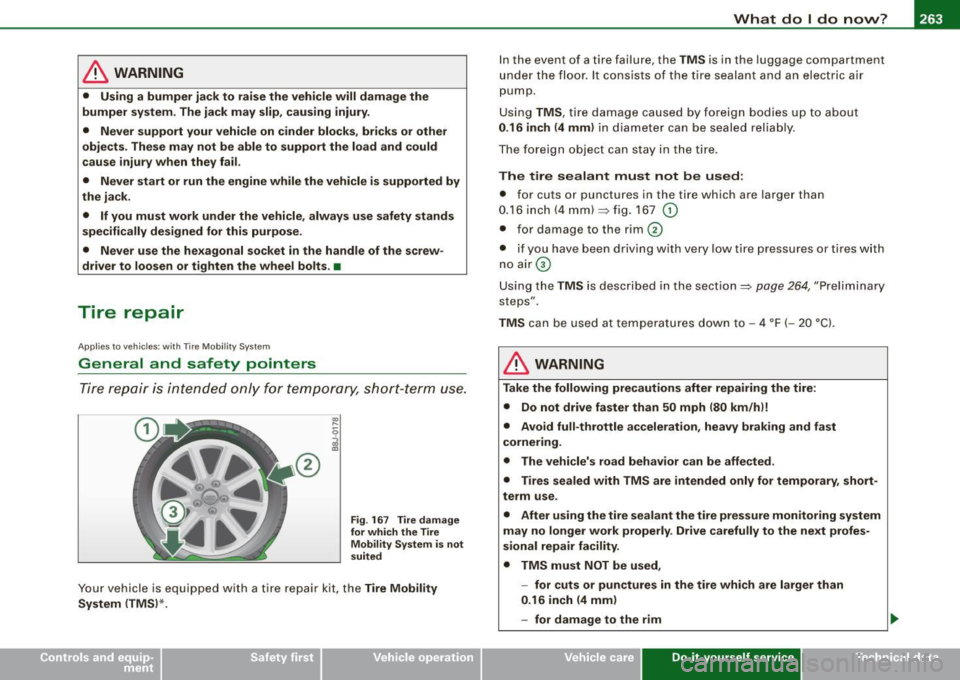
The tire sealant must not be used:
• for cuts or punctures in the tire which are large r than
0.16 inch (4 mm)~ fig . 167
G)
• for damage to the rim 0
• if you have been driving with very low tire pressures or tires w ith
n o air G)
Using the TMS is described in the section~ page
264, "Preliminary
steps" .
TMS can be used a t te m peratures down to -4 °F ( -20 °C).
& WARNING
Take the following precautions after repairing the tire :
• Do not drive faster than 50 mph (80 km /hi!
• Avoid full -throttle acceleration , heavy braking and fast
cornering .
• The vehicle's road behavior can be affe cted .
• Tires sealed with TMS are intended only for temporary , short
term use .
• After using the tire sealant the tire pressure monitoring system
m ay no longer work properly . Drive carefully to the next profes
s ional repair facility.
• TMS must NOT be used ,
- for cuts or punctures in the tire whi ch are larger than
0 .16 inch (4 mm )
- for damage to the rim
Vehicle care Do-it-yourself service irechnical data
Page 270 of 316
_L--_W:...:....: h..:. a .:.:....: t..:..d=o ....:...I ..:d .:..;o:......;. n..:.. o.::;..;. vv..:....:.. ? ______________________________________________ _
App lies to veh ic les : w it h cap-cove red whee l bo lts
Wheels vvith cap -covered wheel bolts
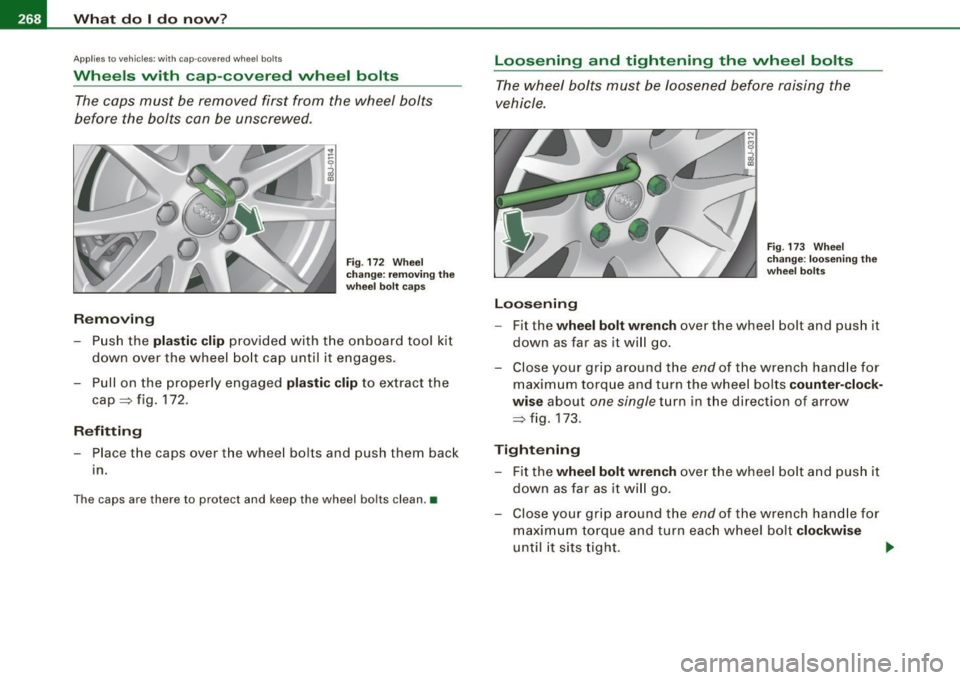
The caps must be removed first from the wheel bolts
before the bolts can be unscrewed .
Remo ving
Fig . 172 W hee l
c h an ge: remo vin g t he
wh eel b olt caps
- Push the plasti c clip provided with t he on board tool kit
down over the wheel bo lt cap until it engages.
- Pull on the properly engaged plas tic c lip to ex tract the
cap
=> fig. 172 .
Refi tt ing
- Place the caps over the wheel bolts and push them back
1n.
The caps are there to prot ect and keep th e wheel bolts cl ean .•
Loosening and tightening the wheel bolts
The wheel bolts must be loosened before raising the
vehicle .
Lo os enin g
Fig. 173 Wheel
c h an ge : loose nin g the
wheel bol ts
- Fit the wheel b olt wr ench over the wheel bolt and push it
down as far as it wi ll go .
- Close your grip around the
end of the wrench hand le for
maximum torque and turn the wheel bolts counter-c lock
wis e about
one single turn in the direct ion of arrow
=> f ig . 173 .
Tight ening
Fit the wheel b olt wr ench ove r the wheel bolt and pus h it
down as far as it wi ll go.
- Close your gri p around the
end of the wrench hand le for
ma ximum torque and turn eac h wheel bolt clockwi se
until it sits tight . _..