fuel pressure AUDI TT ROADSTER 2008 Owners Manual
[x] Cancel search | Manufacturer: AUDI, Model Year: 2008, Model line: TT ROADSTER, Model: AUDI TT ROADSTER 2008Pages: 316, PDF Size: 70.1 MB
Page 36 of 316
![AUDI TT ROADSTER 2008 Owners Manual Driver information system
[ i] Tips
• The engine oil pressure symbol 9:::r. is not an indicator for a low
engine oil level. Do not rely on it. Instead, check the oil level](/img/6/57671/w960_57671-35.png "AUDI TT ROADSTER 2008 Owners Manual Driver information system
[ i] Tips
• The engine oil pressure symbol 9:::r. is not an indicator for a low
engine oil level. Do not rely on it. Instead, check the oil level")
Driver information system
[ i] Tips
• The engine oil pressure symbol 9:::r. is not an indicator for a low
engine oil level. Do not rely on it. Instead, check the oil level in your
engine at regular intervals, preferably each time you refuel, and
always before going on a long trip.
• The yellow oil level warning indication · requires oil refill or
workshop service without delay. Do not wait until the red oil pres
sure warning symbol
9:::r. starts to flash before you respond to the
low oil level warning . By then, your engine may already have
suffered serious damage. •
Yellow symbols
A yellow symbol means WARNING.
Yellow symbols mean:
Low fuel level
Check engine oil level Engine oil sensor malfunction
-
Worn brake pads
USA models:
Speed warning 1
Canada models:
Speed warning 1
-
USA models:
Speed warning 2
-Canada models:
Speed warning 2 =>
pag
e35
=> page35
=> page35
-
=> page35
=> page35
=> page35
=> page35
-
=> page35
Dynamic headlight range con
trol* defective => page35
Windshield washer fluid level low
=> page 35
Battery voltage too high or too
low
Defective light bulb
USA models:
Defective brake light
Canada models:
Defective brake light =>
page35
=> page36
=> page36
=> page36
Light/rain
sensor defective (auto-=> page 36
matic headlights) * defective
Adaptive Light* defective =>
page 36
Tire pressure monitoring system * => page 37
Yellow symbols indicate a priority 2 malfunction -Warning!
When a yellow symbol appears, a warning tone will sound
once .
Check the displayed function as soon as possible . If more than one
priority 2 malfunction is detected, all symbols will appear one after
the other for about two seconds.
To display driver information
As an example, the[} symbol appears in the display . If you now
press the button =>
page 12, fig. 2 ©, the following driver message
appears in the display:
PLEASE REFUEL
The driver message in the display goes out after about 5 seconds.
You can display the driver message again by briefly p ressing the
button. •
Page 43 of 316
Switchin g bet w ee n m enu l ev els
- Tap the Rest button ® briefly to reach the various menu
levels one after the other ("Computer 1 ", "Computer 2",
"Navigation system"* and "Start menu") .
Rese ttin g th e fun ction to z ero
- Select the desired function.
- Push the reset button ® for at least two seco nds .
The trip computer only operates when the ignition is on. When you
turn on the ignition, the function that was in use when you last
turned the ignition off will be displayed .
In addition to the trip computer information (memory level 1 or 2)
and navigation information can be displayed. To switch the display
between the different systems, tap the Reset button
@ briefly .
You can reset the following va lues to zero using the reset button:
• driving time
• average mileage
• average speed
In addition,
a ll the values in the single -trip or the total-trip memory
can be de leted simu ltaneously .
[ i ] Tips
• If you hold down the reset button for longer than 2 seconds, the
current value (for example, average fuel consumption) will be reset
to zero .
• Malfunction displays in Auto -Check Control are shown even with
the display switched off.
• All stored values will be lost if the vehicle battery is
disconnected. •
Controls and equip
ment
Dri ver infor mat io n sy ste m
Tire pressure monitoring system
General notes
As an added safety feature, your vehicle has been equipped with a
tire pressure monitoring system (TPMS) that illuminates a low tire
pressure telltale when one or more of your tires is significant ly
under -inflated. The TPMS only provides a low tire pressure warning
and does not reinflate your tires.
Accordingly, when the low tire pressure tellta le illuminates, you
should stop and check your tires as soon as possib le, and inflate
them to the proper pressure. Driving on a significantly under
inflated t ire causes the tire to overheat and can lead to tire failure .
Under -inflation a lso reduces fuel efficiency and tire tread l ife, and
may affect the vehicle's handling and stopping ability.
(D Note
• Please note that the TPMS is not a substitute for proper tire
maintenance, and it is the driver's respons ib ility to maintain correct
tire pressure, even if under -inflation has not reached the level to
trigger illumination of the TPMS low tire pressure telltale .
• Each tire, including the spare, should be checked monthly when
cold and inflated to the inflat ion pressure recommended by the
vehic le manufacturer on the vehicle p lacard or tire inflation pres
s u re label. (If your vehicle has tires of a different size than the size
indicated on the vehicle placard or tire inflation pressure labe l, you
should determine the proper tire inflation pressure for those
tires.) •
TPMS malfunction indicator
Your vehic le has a lso been equipped with a TPMS malfunction indi
cator to indicate when the system is not operating proper ly . The
TPMS malfunction indicator is combined with the low tire pressure _.,
I • •
Page 44 of 316
Driver inf orm atio n syst em
telltale. When the system detects a malfunction, the telltale will
flash for approximately one minute and then remain continuously
illuminated. This sequence will continue upon subsequent vehicle
starts up as long as the malfunction exists .
When the ma lfunction indicator is illuminated, the system may not
be able to detect or signal low tire pressure as intended.
TPMS malfunctions may occur for a variety of reasons, including the installation of replacement or alternate tires or wheels on the
vehicle that prevent the TPMS from functioning properly. A lways
check the TPMS malfunction tellta le after replacing one or more
tires or whee ls on your vehicle to ensure that the replacement or
a lternate tires and wheels al low the TPMS to continue to function
proper ly .•
Introduction
The tire pressure monitoring system monitors air pressure
in all four road wheels while the vehicle is moving.
As soon as the t ire pressure monitoring system senses a s ignificant
loss of air pressure in one or several tires, text messages and yel low
symbo ls appear in the instrument cluster display to a lert the driver.
The warning light in the instrument c luster comes on when the
tire is significantly underinflated
=> page 17.
The warning light
malfunction . also
illuminates in the case of a system
Be aware that tire pressure is also dependent on the temperature of
the tire . For every 18 °F (10 °C) increase in tire temperature, tire pres
sure increases by about 1 .5 psi (0. 1 bar) . The tire warms up while the
vehic le is moving and tire pressure rises. So you should adjust tire
pressure on ly when they are
cold , when the temperature of the tires
is roughly the same as the ambient air temperature.
In order to keep the tire pressure monitoring system properly ca li
brated, tire pressure on all four tires should be checked at regular intervals, adjusted if necessary and saved in the proper setting
(recommended
pressure)=>
page 44.
The tire pressure is shown on the label located on the driver 's side
B -pillar (visible when the door is open) .
& WARNING
• When the tire pre ssure monitor ing system warn ing light i s lit ,
one or more of your t ir es is s ignificantl y unde r-inflated . You should
s top and check your tire s as s oon as po ssible , and inflate them to
the p rope r pre ss ure as indi cated on th e vehicl e's tire pr essure
label
=> pag e 242. Driv ing on a s ignific antl y un der-inflated t ire
c a use s the tire to overhe at and can le ad to tire fa ilure. Unde r-inf la
ti on also i s lik el y to impair the vehicle' s handling and stopping
ability .
• Do not adju st t ir e pressur e wh en t ire t emp erature is exce ssiv e.
Thi s could le ad to seriou s tire dam age and even cau se the tire t o
bur st, w ith the addition al dan ger of an accident.
W For the sake of the environment
Driving with under -inflated tires reduces fuel efficiency and tire
tread life.
[ i ] Tips
• Each tire should be checked month ly when the temperature of
the tires is abou t the same as ambient air temperature and s et to the
recommended inflation pressure as specified on the tire pressure
label =>
page 242.
• The factory supplied spare whee l is equipped with a se nsor for
the tire pressure monitoring sys tem. As long as the spare wheel is
n ot mounted, the tire pressure of this tire wil l not be monitored.
• T he tire pressure monitoring system he lps the driver to keep an
eye on tire pressures . But the driver still has the responsibility f or
maintaining the correct tire pressure . .,_
Page 222 of 316
-~_C_ h_e _c _ k_ i_n ...:::g::;...._ a_n_ d_ f_ i_ll _in -'g:::;.._ ___________________________________________ _
Closing the engine hood
- Pull the hood down until the pressure from the struts is
reduced.
- Let the hood
drop down and latch in place. Do not try to
push it shut;
it may fail to engage~& .
& WARNING
A hood that is not completely latched could fly up and block your
view while driving.
• When you close the engine hood, check it to make sure the
safety catch has properly engaged. The hood should be flush with
the surrounding vehicle body parts.
• If you notice while driving that the hood is not secured prop
erly, stop at once and close it. •
Working in the engine compartment
Be especially careful whenever you work in the engine
compartment!
Whenever you must perform any work in the engine compartment,
for example checking and filling the different fluids, there is a risk of injury, burns and accidents. To prevent personal injury always
observe the following WARNINGS. The engine compartment of any
vehicle is a hazardous area!
=> &
& WARNING
To help avoid injury, before you check anything under the hood :
• Switch off the engine.
• Remove the ignition key.
• Apply the parking brake.
& WARNING (continued)
• Move selector lever of automatic transmission to "P" {Park);
put manual transmission in Neutral.
• Always let the engine cool down. Hot components will burn
skin on contact.
• To reduce the risk of being burned, never open the hood if you
see or hear steam or coolant escaping from the engine compart
ment. Wait until no steam or coolant can be seen or heard before
carefully opening the hood .
• Keep children away from the engine compartment.
• Never spill fluids on hot engine components. They can cause a
fire.
• Never touch the radiator fan. The auxiliary electric fan is
temperature controlled and can switch on suddenly.
• Never open the coolant reservoir cap when the engine is still
warm. The coolant system is pressurized and hot coolant could
spray out.
• Protect your face, hands and arm from steam or hot engine
coolant by placing a thick rag over the cap when you open the
coolant reservoir.
• If work on the fuel system or the electrical system is necessary:
- Always disconnect the battery .
- Never smoke or work near heaters or open flames. Fluids in
the engine compartment could start a fire.
- Keep an approved fire extinguisher immediately available.
• To avoid electrical shock and personal injury while the engine
is running or being started, never touch :
- Ignition cables
- Other components of the high voltage electronic ignition
system.
• If you must perform a check or repair with the engine running: .,_
Page 226 of 316
-L~C~ h~ e~c ~k ~in ~ g~a~ n~d ~ f ~i~ ll ~in ~ g~------------------------------------------
Engine oil consumption
The engine in your vehicle de pen ds on an ade quate
amount of oil to lubric ate and co ol all of its moving parts.
In order to provide effective lubrication and cooling of interna l
engine components, al l internal co mbustion engines consume a
certain amount of oil. Oil consumption varies from engine to engine
and may change sign ificant ly over the life of the engine . Typ ical ly,
engines with a specified break -in period (see=>
page 192) consume
more oil duri ng the brea k-in period than they consume afte r oil
consumption has stabi liz ed.
Unde r no rmal conditions, the rate of oil consumption depends on
the quality and viscosity of t he oil, the RPM ( revo lutions per m inute)
at which the engine is operated, the ambient temperature and road
co nd itions. Further factors are the amount of oi l dilut io n from water
condensation or fue l residue and the oxidation leve l of the oil. As
any e ng ine is subject to wear as mil eage builds up, the o il consump
tion may increase over time until replacement of worn components
may become necessary .
With all these var iables com ing into p lay, no standard rate of oil
consu mption can be es tab lished or speci fied. There is no a lternative
t o regular and frequent checking of the oi l leve l, see Note.
If the yellow engine oi l level warning symbol in the instrumen t
cluster _ lights up, y ou should check the oil level as soon as
possible
with the oil dipstick=> page 224. Top off the oil at your
ea rlies t conve nience =>
page 225.
ln. WARNING
Before you check anything in the engine compartment , alway s
re ad and heed all WARNINGS =>
& in "Working in the engine
c ompartment" on
page 220.
0 Note
D riving with an insufficient o il level is lik ely to cause seve re damage
to the engine .
[ i ] Tips
• The oil pressure warning display 't!:r. is not an indicator of the oil
level. Do not rely on it. Instead , check the oil level in your engine at
regular intervals , preferab ly ea ch time you refuel , and alw ays before
going on a long trip.
• I f you have the impression your engine consumes excessive
a m oun ts o f oi l, we recommend tha t you consu lt your Audi dealer to
have the cause of your concern properly diagnosed . Keep in mind
that the acc urate measure ment o f oil co nsum ptio n requires grea t
care and may take some time . Your Audi dea ler has instructions
about how to measu re oil consump tion accurately. •
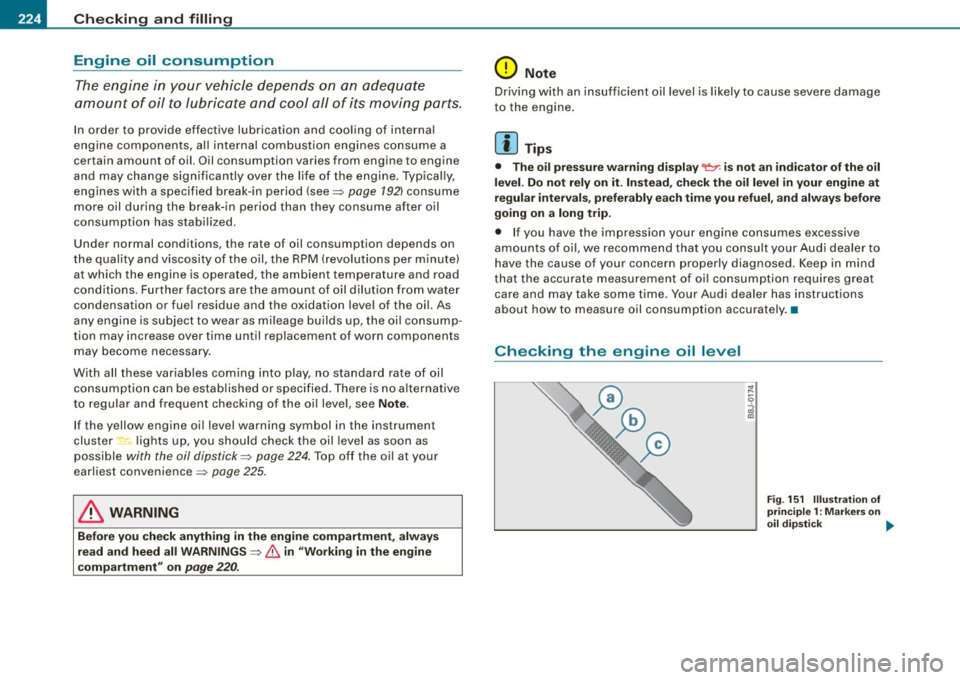
Checking the engine oil level
Fig . 151 Illust rat ion of
principle 1 : Marker s on
oil dip stic k
~
Page 248 of 316
-~_T_ ir_e_ s_ a_ n_d _ w_ h_ e_e _l_s _________________________________________________ _
& WARN ING (continued )
• Driving with underinflated tires bend more , letting them get
too hot re sulting in t read separation , sudden t ire failure and loss
of control.
• Excessive speed and /overloading can cau se heat bu ild-up ,
sudden tire failure and lo ss of control.
• If the tire pressure is too low or too high , the tires will wear
prematurely and the vehicle will not handle well .
• If the tire is not flat and you do not have to change a wheel
immediately, drive at reduced speed to the nearest service station
to che ck the tire pres sure and add air as required .
0 Note
Driving without valve stem caps can cause damage to the tire
va lves. To prevent this, always ma ke sure that fact ory insta lled valve
stem caps on all whee ls are securely mounted on the valve .
<£> For the sake of the environment
Underinflated tires will also increase the fue l consumption. •
Tires and vehicle load limits
There are limits to the amount of load or weight that any vehicle and
any tire can carry. A vehicle that is overloaded will not handle well
and is more difficu lt to stop. Overload ing can not only lead to loss
of vehicle contro l, but can a lso damage important parts of the
veh ic le an d ca n lead to sudden t ire fa ilu re , inc lud ing a bl owout a nd
sudden deflation that can cause the vehicle to crash.
Yo ur saf ety a nd that of you r passenge rs also de pends on making
sure that load limits are not exceeded . Vehicle load includes every
body and eve ryt hing in and on the vehic le . Th ese load limi ts are technica
lly referred to as the vehicle's
Gross Vehicle We ight Rating
("GVWR").
Th e "GVWR" includes the weight of the basic vehicle, all factory
insta lled accessories, a ful l tank of fuel, oil, coolant and other f luids
p lus max imum load. The ma ximu m load inc ludes the numbe r of
passengers that the vehicle is intended to carry ("seating capacity")
w it h an assu med we ight o f 150 lbs (68 kg) for eac h pass enger at a
designated seating position and the total weight of any luggage in
t he vehicle.
T he
Gross Axle Weight Rating ("GAWR"l is the maximum load that
can be a pplied a t eac h of the vehic le's two a xles .
T he Gross Veh icle Weigh t Rat ing a nd the Gross A xle We igh t R ating
are listed on the safety comp liance stic ker label located on the
dr iver's s ide B -p illar . You r Aud i has 2 sea ting pos it io n s. Eac h seating
posit ion has a safety belt=>
page 137, "Safety belts".
T he fact that the re is a n up per lim it to yo ur vehicle's G ross Veh ic le
We ig ht Rating means that the to tal we ight o f what ev e r is be ing
ca rried in the ve hicle is lim ited. The mo re pas se ngers in the vehic le
or passe ngers w ho ar e heav ier t han th e sta ndard weights assumed
mean that less weight can be carried as luggage.
T he ti re p ress ure labe l on yo ur Aud i al so list s the maxi mum
combined weight of a ll of the occupants and luggage or other cargo
th at the vehicle can car ry. F or the lo ca tio n of t he label =>
page 242,
fig . 160.
& WARNING
Overloading a vehicle can cause loss of vehicle control , a crash or
other accident, serious personal injury , and even death .
• Carrying more weight than your vehicle was des igned to carry
will prevent the vehicle from handling properly and increase the risk of the loss of vehi cle control .
• The brakes on a vehicle that has been overloaded may not be
able to stop the vehicle within a safe distance. .,_
Page 259 of 316
________________________________________________ T_ i _r_e _s_ a_n_ d_ w_ h_ e_e _ l_s __ !II
•
• After any impact, immediately inspect your tires or have them
inspected by the nearest authorized Audi dealer. Replace a
damaged tire as soon as possible .
• Inspect your tires every 2,000 miles (3,000 km) for damage and
wear . Damage is not always easy to see. Damage can lead to loss of
air and underinflation, which could eventua lly cause tire fai lure . If
you believe that a tire may have been damaged, replace the tire as
soon as possible .
• These tires may wear more quickly than others.
• Please a lso remember that, whi le these tires deliver responsive
handling, they may ride less comfortably and make more noise than
other choices.
R edu ced p erform an ce in w in te r/ c o ld sea son
co nditi ons
All tires are designed for certain purposes. The low aspect ratio,
ultra high performance tires originally installed on your vehicle are
intended for maximum dry and wet road performance and hand ling.
They are not suitable for cold, snowy or icy weather conditions . If
you drive under those circumstances, you should equip your vehicle
with al l- season or winter tires, which offer better traction under
those conditions . We suggest you use the recommended snow or
a ll- season tires specified for your vehicle, or their equivalent .
Refer to=>
page 254 for more detai led in formation regarding winter
tires. •
Run-flat tires
Applies to vehi cles : w ith R un-f lat tires
Introduction
Run-flat tires help keep you moving if a tire goes flat.
Reinforced s idewalls give the ti res run -flat capability if tire pressure
is lost . We recommend that run-flat tires only be mounted on vehicles that
we
re origina lly equipped with these special tires at the fac tory and
have a Tire Pressure Monitoring System .
Run-flat t ires can be ident ified by the letter s "RSC" on the tire side
wall.
If you do change the tires on your vehic le from normal to run -flat
tires, you must buy the special rims required for run-flat tires, and
the Tire Pressure Monitoring System must be reprogrammed by an
authorized Audi dea ler or other qualified workshop.
Wh at do run-fl at tir es do?
These special t ires have run-flat capabi lities that he lp keep you
moving if a tire loses pressure and goes flat. Under favorable condi
t ions tires can be driven
at least 30 miles (50 km ), but you must not
drive
f as ter t han 50 mph (80 km/h i=> page 258 , "Driving with run
flat t ires".
The Tire Pressure Moni toring System constantly checks the air pres
sure in the tires. If the run -flat system is active (shown in the center
display), you must inspect the affected tire or tires and then decide
whether to continue driving . Be sure to follow these tips
=>
page 258, "Driving with run-flat tires" .
When it is not po ssibl e to continue driving , even with
run -fl at tire s?
• If the Electronic Stabilization Program (ES P) is not working or
keeps coming on.
• If the Tire Pressure Monitoring System does not work.
• If the tire has been severely damaged, in a crash , for example .
The tread can separate from a damaged tire as the wheel turns, and
hit parts of the vehicle , such as the fue l tank filler neck, fuel lines or
brake lines.
• Do not continue driving if severe vibration occurs or if the tire
starts to smoke because the tire is running hot.
• Do not continue driving if damage to the tire, such as cracks in
the s idewall, appears .
~
Vehicle care I t •
Page 277 of 316
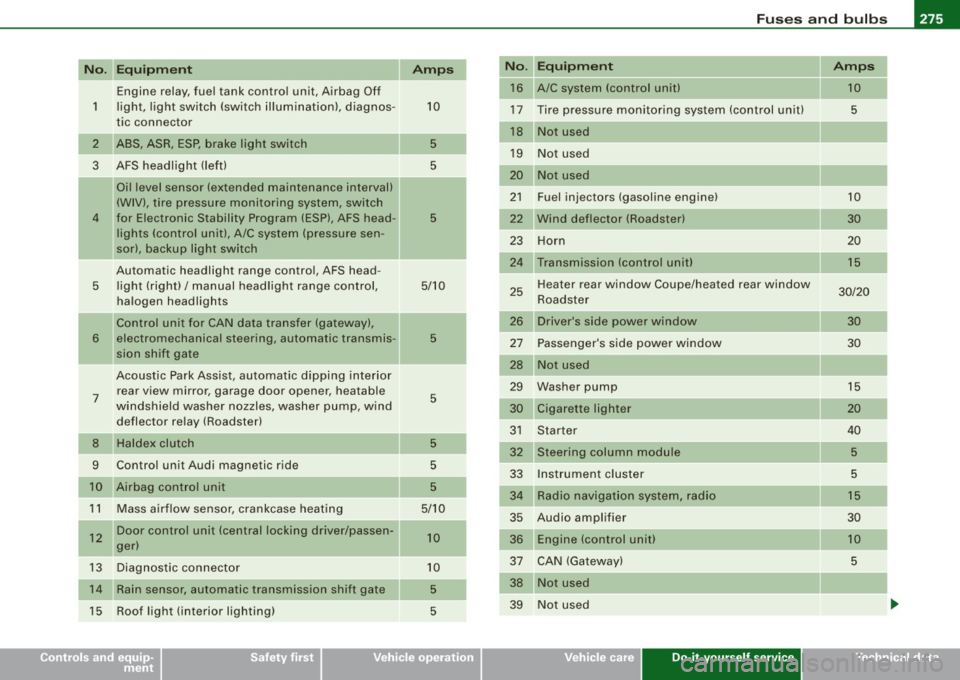
Fuses and bulbs -
----------------
Equipment No. Equipment
Amps
Engine relay, fuel tank control unit, Airbag Off
16 A/C system (control unit) 10
1
light, light switch (switch illumination), diagnos-10
tic connector
17 Tire pressure monitoring system (control unit) 5
18
Not used
ABS, ASR, ESP, brake light switch
5 19
Not used
3 AFS headlight (left) 5
Not used
Oil level sensor (extended maintenance interval)
(WIV), tire pressure monitoring system, switch
21 Fuel injectors (gasoline engine) 10
4 for Electronic Stability Program (ESP), AFS head-5 Wind deflector (Roadster) 30
lights (control unit), A/C system (pressure sen -23 Horn 20 sorl, backup light switch
Automatic headlight range control, AFS head-
24 Transmission (control unit) 15
5
light (right)/ manual headlight range control, 5/10
25 Heater rear window Coupe/heated rear window 30/20
halogen headlights Roadster
Control unit for CAN data transfer (gateway),
26 Driver's side power window 30
6 electromechanical steering, automatic transmis-5
27 Passenger's side power window 30
sion shift gate
28 Not used
Acoustic Park Assist, automatic dipping interior
rear view mirror, garage door opener, heatable
29 Washer pump 15
7
windshield washer nozzles, washer pump, wind 5
30 Cigarette lighter 20
deflector relay (Roadster)
31 Starter 40
8
Haldex clutch 5 32 Steering column module 5
9
Control unit Audi magnetic ride 5 33
Instrument cluster 5
Airbag control unit 5 34 Radio navigation system, radio 15
1 1 Mass airflow sensor, crankcase heating 5/10
35
Audio amplifier 30
12 Door control unit (central locking driver/passen-10
36 Engine (control unit) 10 ger)
13 Diagnostic connector 10 37 CAN (Gateway) 5
Rain sensor, automatic transmission shift gate 5 38 Not used
15 Roof
light (interior lighting) 5 39 Not used
• Do-it
-yourself service
Page 305 of 316
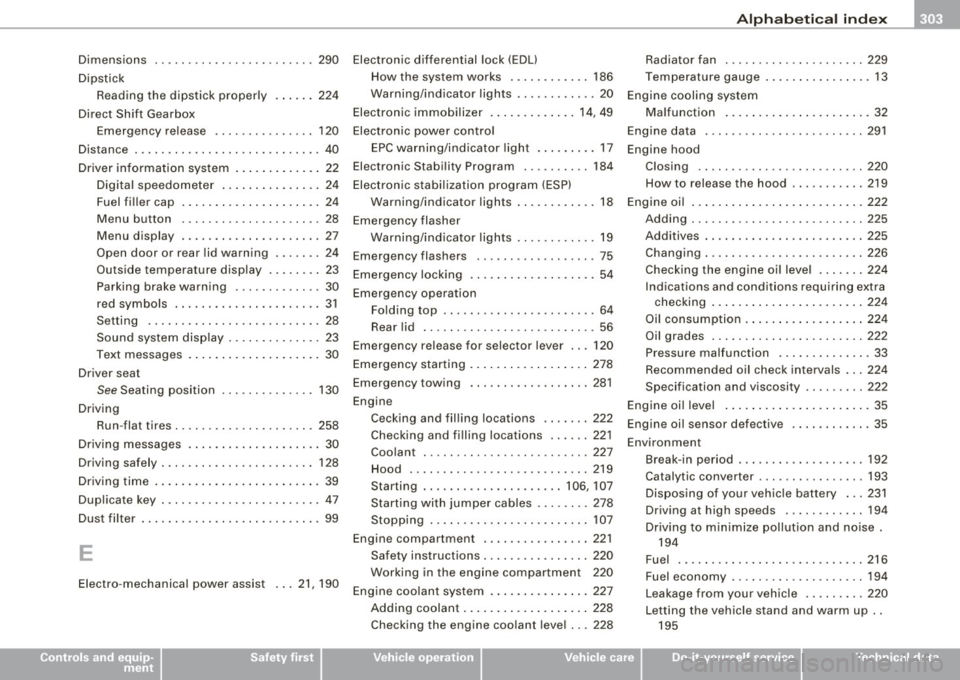
______________________________________________ A_ l_,_ p _h_ a_ b_e _t_i c_ a _ l _in _ d_e _ x __ lllll
Dimensions ... .. ...... . .... .. .. .... 290 Electronic differential lock (EDU
Dipstick Reading the dipstick properly
Direct Shift Gearbox 224
Emergency release . . . . . . . . . . . . . . . 120
Distance ........ .... ....... ...... ... 40
Driver information system . .... .... ... . 22
Digital speedometer ... .. .... ...... 24
Fuel filler cap ...... ..... .... .... .. 24
Menu button ..................... 28
Menu display ..................... 27
Open door or rear lid warning . ......
24
Outside temperature display .. .... .. 23
Parking brake warning ............. 30
red symbols .. ............. ....... 31
Setting ...... .... ... .... ..... .. .. 28
Sound system disp lay ............ .. 23
Text messages . .... .... .... .... ... 30
Driver seat See Seating position . ............. 130
Driving Run -flat tires . .... .... ....... .... . 258
Dr iving messages ... ..... .. ... .... ... 30
Driving safely . . . . . . . . . . . . . . . . . . . . . . . 128
Driving time ... .... ... ..... .... .... .. 39
Duplicate key .... .... ...... ....... ... 47
Dust filter . ....... .... .... ........ ... 99
E
Electro -mechanical power assist ... 21, 190 How the system works
............ 186
Warning/indicator lights ............ 20
Electronic immobilizer ...... ... .. .. 14, 49
Electronic power cont ro l
EPC warning/indicator light ..... .... 17
Electronic Stability Program .......... 184
Electronic stabilization program (ESP! Warning/indicator lights ........ .... 18
Emergency flasher Warning/ind icator lights .. .... ...... 19
Emergency flashers .................. 75
Emergency locking . ... .... .... ... .. .. 54
Emergency operation Folding top ....................... 64
Rear lid .. .... ....... .... .... .... . 56
Emergency release for selector lever ... 120
Emergency starting ........ ... .... ... 278
Emergency towing .. ............. .. . 281
Engine Cecking and filling locations ... ... . 222
Checking and filling locations ...... 221
Coolant ... .. .... .... ..... .. ... .. 227
Hood . ..... .. ... ... .. .... ..... .. 219
Starting ..................... 106, 107
Starting with jumper cables ........ 278
Stopping .... .... ...... ...... ... . 107
Engine compartment .... ...... ...... 221
Safety instructions ................ 220
Working in the engine compartment 220
Engine coolant sys tem ..... .... ...... 227
Adding coolant .... .... ..... ... ... 228
Checking the engine coolant leve l .. . 228 Radiator fan
... .. .. .. .... .... .... 229
Temperature gauge ................ 13
Engine cooling system Malfunction ... .. .... .... .... ..... 32
Engine data .. ............... .... ... 291
Engine hood Closing .. ... ........ .... ... ..... 220
How to release the hood ... ... ... .. 219
Engine oil . ...... .... .... ... .... .... 222
Adding .... ....... .... ... .... .... 225
Additives .. .... .... ... .... .... ... 225
Changing . .... .... .... ..... ..... . 226
Checking the engine oi l leve l ... .... 224
Indications and conditions requiring extra checking .... .... .... .... .... ... 224
Oil consumption . ...... ..... .. .... 224
Oil grades . ....... .... .... ....... 222
Pressure malfunction .............. 33
Recommended oil check intervals ... 224
Specification and viscosity ......... 222
Engine oi l leve l .. .... .... ... .... .... . 35
Engine oil sensor defective .... ...... .. 35
Environment Break-in period ..... .. ... .... .... . 192
Catalytic converter .......... ... .. . 193
Disposing of your vehic le battery .. . 231
Driving at high speeds . ...... .... . 194
Dr iving to minim ize pollution and noise .
194
Fuel .. .... .... .... ... .... .... ... 216
Fuel economy ......... ........ ... 194
Leakage from your vehicle . .... .... 220
Letting the vehicle stand and warm up ..
195
Controls and equip ment Safety first Vehicle operation
Vehicle care Do-it-yourself service Technical data
Page 311 of 316
______________________________________________ A_ l_,_ p _h_ a_ b_e _t_ic _ a _ l _in _ d_e _ x __ lll
Sound system display
Driver info rma tion system .... .... .. 23
Speed rating letter code ........... ... 251
Speed warning 1 . .... ...... ... .. .... . 35
Sp eed warning 2 . .... .... ... ... ... .. . 35
Speed warning system ... .... .. .. .... . 37
Speedometer . . . . . . . . . . . . . . . . . . . . . . . . 14
Starting assistance ...... .... ...... .. 279
Starting the engine .. .... .... ... . 106, 107
What should I do if the engine does not
star t? ........ .... .... ... .. ... . 10 7
Stee l wheels .... ....... .... .. . ..... 206
Steering
See Electro-mechanical power assist 21,
190
Steering co lumn
Adjusting .... ... .... .... ...... .. 105
Locking the steering ... .. .... .... . 106
Steps fo r determining co rrect load limit 247
Stopping the engine ...... ....... .... 107
Storage . .... .... .... .... ... .... .... . 95
Compartment in the front seats . .... 96
Cup holder ... .... .... ......... ... 94
Glove compartment ...... .... .... .. 96
Sun visors .. .. .. ..... ... ..... .. ..... 77
Switches Emergency flasher ..... .. .... .... .. 75
T
Tachometer ... .. .... .... ... .... .... . 12
Tank flap
Un locking the fuel filler flap by hand 218
Controls and equip
ment Safety first
Technical
modifications ..... .... ..... 297 Tires and wheels
Tempera ture ............ ... .... .... 100 Checking tire pressure .
.... ...... . 244
The firs t 1,000 miles ( 1,500 kml and Co
ld tire inflation pressure . ... ... .. 242
afterwards ... .. .. .. .... .... .... 192 Dimensions
.. ... .... ... .. .... .... 249
Tightening whee l bolts ... .... .... .... 267 General
notes ...... ... .... ...... . 238
Tire mobility system .... ....... .... .. 263
Tire pressure .... .. ...... .... ....... 244 G
lossary of tire and loading terminology
239
New tires and wh eels . ....... .... . 249
Tire pressure monitor ing system ...... . 42
Changing wheels ........... .... ... 44
Declaration of conform ity . .... .... .. 45
Learning process . ..... ... .... .... . 44
Loss of air pressure ........... .. 17, 43
Malfunctions ... .. .... .... .... ... . 45
Sensors ........... ... .... ....... 251
Storing tire pressures ............. . 44
Tires and wheels ...... .... .... ... 251
Valves ....... .... .... .... .... ... 25 1
Warning light ..... .. .... .... .... .. 37
Tire repair kit ... ... ...... .... .... ... 263
Tire service life ........ .... ... .... .. 248
Tires .... .. . ... ... ................. 238
Replacing .... .... .... .... ... 249, 251
run -flat .. .... ... .... .... .... .... 257
S ervice lif e ..... .... ... .. .... .... 248
speed ra ting let ter code ..... .. ... . 251
Tire manufacturing date . .... ...... 251 Replacing
..... .. .... .... ..... .. . 250
Snow chains ...... .... .. . .. .. .... 255
Ti re pressure monitoring system .... 251
Tires and vehicle load limits ... .... . 246
Wheel bo lts ... .... .... ... .... .... 256
Winter tires ... .... .... ....... .. .. 254
Ti res/Wheels
Low aspect ratio tires . .... ...... .. 256
Tire mob ility system ..... .. .... ... 263
Tire pressure mon itoring system .. 17, 42
Tire repair kit ................ .... 263
Tool kit ..... .... ... .. .... .. .... .... 262
Touch -up paint ... .. .... .... .... .... 205
Towing Front eyelet ... ... ..... ... .... .... 281
Rear eyelet ... .... .... .... ....... 282
Tow truck procedures .. ...... .... . 281
Trailer towing .......... .. ...... .... . 196
Tire specifica tions . ...... ... .... .. 250 Transmission
Tread depth ..... .... ...... .. .... 248 6
-speed manua l transmission ...... 113
Uniform tire quality grading ... ..... 253 S tronic transm
ission ............. 113
Winter tires .... .... ... .... ....... 254 Transport Canada
........ .. .. ....... 293
Tires and vehicle load limits ... ....... 246 Tread
Wear Indicator (TWI) ... .... .... . 248
Vehicle operation Vehicle care Do-it-yourself service Technical data