warning AUDI TT ROADSTER 2011 Owners Manual
[x] Cancel search | Manufacturer: AUDI, Model Year: 2011, Model line: TT ROADSTER, Model: AUDI TT ROADSTER 2011Pages: 260, PDF Size: 64.11 MB
Page 190 of 260
188 Checking and filling
If the brake fluid level falls considerably be
l ow the "MIN" mark, the brake warning/indi
cator light (U .S . mode ls: . , Canadian
models: .) will come on
¢ page 16 and
¢ page 30. Do not continue to operate the ve
h icle . The complete brake system shou ld be
thoroughly checked by an authorized A ud i
dea ler o r othe r qualified facility and t he cause
corrected. If the bra ke fluid level is too low,
the bra ke warning/ind ic a tor ligh t will illum i
nate . Contact an authorized Aud i dea ler
im
mediatel y.
Changing brake fluid
Hove the broke fluid changed by on experi
enced technician.
B rake fl uid abso rbs mois ture from the a ir. If
the water content in the b ra ke fluid i s too
h igh, corros ion in the brake sys tem may result
after a period of t ime . The boi ling point o f the
b rake fluid wi ll also decrease considerab ly and
decrease braking per formance.
T herefore, the brake flu id mus t be changed
every two year s. Always use new b rake fluid
which conforms to Fede ral Motor Vehicle
Standard "FMVSS 116 DOT 4".
T he brake flu id rese rvoi r can be difficul t to
reach, therefo re, we recommend that yo u
have the brake f luid changed by yo ur autho r
ized
Audi dealer . Your dealer has the correct
too ls, the right b rake f luid and the know-how
to do this for you.
A WARNING
- B rake fluid is poiso nous . It mus t be stor
ed only in th e closed orig inal con tainer
o ut of the reac h of children!
- Brake fa ilure can result from old o r inap
propriate b ra ke fluid. Observe these pre
c aut ions:
- Use o nly brake fluid t hat meets SAE
specif ication
J 1703 and confo rms to
Federal Motor Vehicle Standard 116.
Always check with your a uthorized Audi
dealer to make s ure you are using the
correct brake fl uid. T he correct type of brake flu
id is also ind icate d on the
brake f lu id rese rvoir.
- The brake fl uid must be new . Heavy use
of the brakes can cause a vapo r lock if
the brake fluid is left in the system too
long . This can se riously affect the effi
c iency of t he brakes as well as your
safe ty. This co uld resu lt in a n accide nt.
([) Note
Brake fluid will damage the paint of your
vehicle.
@ For the sake of the environment
Because o f the prob lem of prope r disposal
of brake fluid as well as t he spec ial too ls
required and the necessary expertise, we
recomme nd t hat yo u have th e brake flu id
cha nged by yo ur autho rize d Au di dea le r.
Battery
General information
Your ve hicl e is equipped with a specia l bat
tery, an
ACM battery. This battery is located
in t he luggage compartment and must be re
placed with an origina l equipment battery.
U nder normal opera ting condit ions, the bat
te ry is
maintenance-fr ee .
Have the battery checked when you take your
vehicle in for se rv ice . You a re well advised to
replace a battery that is o lde r th an 5 years .
Disconnecting the battery terminals
Some vehicle functions (power window reg u
lators, for example) are lost if the battery te r
mina ls are disconnected. T hese functions have
to be relearned after the battery termina ls are
connected aga in . T o prevent t his, t he battery
shou ld only b e disconne cted from the ve hicle
ele ct ric al sy stem w hen abso lutely ne cessary
f o r rep air s.
Vehicles not driven for long periods
If you are go ing to let your vehicle stand for a
long time a nd not drive it, you should remem
ber there are elect rical components which a re
Ill-
Page 191 of 260
still functioning and they will draw energy
from the battery and drain it, for example, the
engine immobilizer . To prevent this, you can
e ither charge the battery occasionally to keep
it in good working condi tion or you can d is
connect the negat ive cable on the battery .
Winter ope ration
During the winter months, battery capacity
tends to decrease as temperatures drop . This
is because more power is also consumed while
start ing, and the headlights, rear window de
fogger, etc ., are used more often .
Avoid unnecessary power consumption, par
ticularly in c ity traffic or when traveling on ly
short distances. Let your authori zed Audi
dealer check the capacity of the vehicle bat
tery before winter sets in
¢ page 192. A well
charged battery w ill not only prevent starting
p rob lems when the weathe r is cold, but will
a lso last longer .
Replacing b attery
The new battery m ust have the same capaci
ty, voltage (12 volts), amperage, construction
a n d p lug sealing, as the origina l batte ry. Spec
ifications are listed on the batte ry housing.
Batteries specially developed by A udi f ulfill
the ma intenance, output, and safety require
ments.
When insta lling the bat tery , make sure the ig
n ition and all e lectr ica l cons umers are sw itch
ed
off ¢ (j) .
We recommend that you use ma intenance
free or
cy cle-re sis tant /le ak -proof batteries
according to the standards TL 825 06 (from
December 1997) and VW 7 SO 73 (from Au
gust 200 1).
Replacing the battery should be ca rried by a
qua lified workshop. Please follow the instruc
tions on the battery cover.
(D Note
- All work on t he battery requires techni
ca l knowledge. Please contact an A udi
dealership or anothe r authorized facili ty
Checkin g and fillin g 189
for questions abo ut the batte ry - danger
of acid burns and exp losion hazard!
- T he battery must not be opened! Do not
try to change the battery's liquid level,
otherwise detonating gas will escape
from the battery - explosion hazard!
- The AGM battery in the luggage com
partment cannot leak, because the elec
tro lyte for this battery is absorbed into a
special glass mat. This leak-proof battery
must not be replace with a convent iona l
battery.
- Make sure the ventilation hose on the
side of the battery is connected, other
w ise fumes or battery ac id can leak out.
- Battery holder and terminals always
have to be secured correctly.
- Before all work on the battery follow the
warnings below ¢.&. in Working on the
battery on page 190.
@) For the sake of the environment
Because of the prob lem of proper disposal
of a battery, we recommend your author
ized Audi dealer change the battery for
you. Batteries contain sulfur ic acid and
l ead and must always be disposed of prop
erly in compl iance with a ll environmental
regulat ions. Disposing of vehi cle batter ies
improperly is very dangerous to the envi
ronment. Make sure that the removed bat
tery cannot overbalance, otherwise sulfu ric acid might escape!
(D Tips
If your vehicle is left standing for several
weeks at extremely low temperatures, the
vehicle battery shou ld be removed and
stored where it w ill not freeze. This will
prevent it from be ing damaged and having
to be replaced . •
•
Page 192 of 260
190 Checking and filling
Working on the battery
Be especially careful when working on or near
the battery!
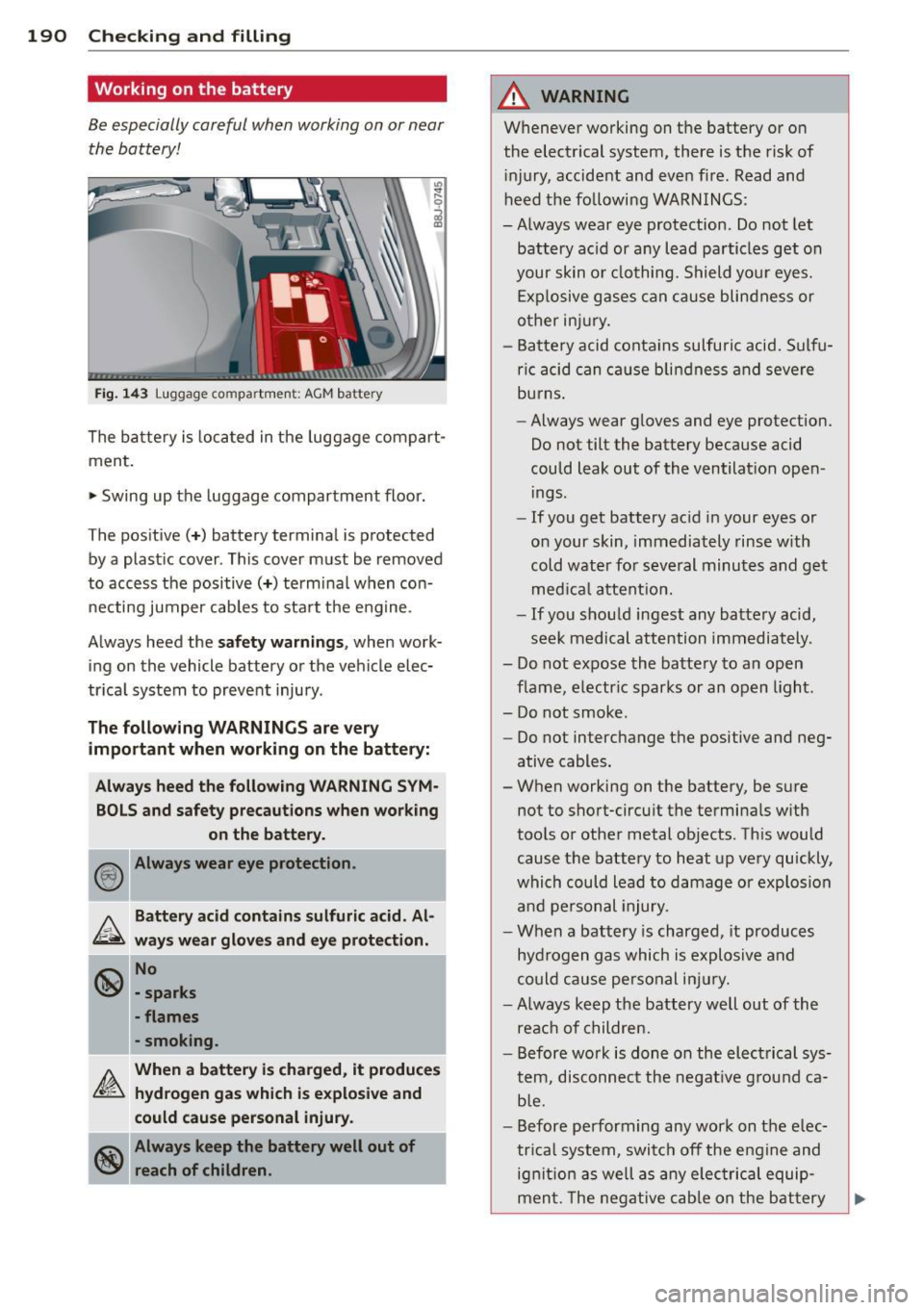
Fig . 14 3 Luggage compartment: AGM battery
The battery is loca ted in the luggage compart
ment.
~ Swing up the luggage compartment floor.
The positive( +) battery terminal is p rotected
by a plast ic cover . This cover must be removed
to access the positive( +) termina l when con
necting jumper cables to start the eng ine .
Always heed the
safe ty war nings, when work
ing on the vehicle battery or the vehicle elec
tr ica l system to prevent injury .
The following WARN INGS are ver y
import ant when w orking on the battery:
Alw ays heed t he follow ing W ARNING SYM ·
BOLS a nd safety precautions wh en working
on th e bat tery.
® Always wear eye protection .
I).. Battery acid contain s sulfuric acid. Al
~ ways wear gl oves a nd e ye prot ecti on.
I/£ No
\l:!S' -spar ks
• flames
- smoking.
When a batter y is ch arged , it pr odu ce s
h y d rogen g as which i s ex plosi ve and
could cau se personal injury.
----Always keep the battery well out of
re ach of children .
®
.&_ WARNING
Whenever working on the battery or on
the elect rical system, there is the risk of
i njury, accident and even fire. Read and
heed the fo llowing WARNINGS:
-Always wear eye protection. Do not let battery ac id or any lead particles get on
your skin o r clothing. Shield your eyes.
E xp losive gases can cause blindness or
o ther inju ry.
- Ba ttery acid conta ins sulfuric acid. Sulfu
ric acid can ca use blindness and severe
burns .
- Always wear gloves and eye protection.
Do not tilt the battery because acid
could leak out of the ventilat ion open
ings .
- If you get battery acid in your eyes or
on your skin, immediately rinse w ith
cold water for several minutes and get
medica l attent ion.
- If you shou ld ingest any battery acid,
seek medical attention immediately.
- Do not expose the battery to an open flame, e lectr ic sparks or an open light .
- Do not smoke.
- Do not interchange the positive and neg-
ative cables.
- When working on the battery, be sure
not to short-circuit the terminals with
tools or other metal objects . Th is would
cause the battery to heat up very quickly,
which could lead to damage or explosion and personal injury.
- When a battery is charged, it produces
hydrogen gas which is explos ive and
could cause pe rsonal in ju ry.
- Always keep the battery well out of the
reac h of children.
- Before work is done on the electrical sys
tem, disconnect the negat ive g round ca
b le.
- Before performing any work on the e lec
tr ica l system, switch off the engine and
ignit ion as well as any elec trical equip
ment. The negative cable on the bat tery
Page 193 of 260
must be disconnected. If you are just go
ing to replace a light bulb, then it is
enough to switch off the lights.
- Before disconnecting the battery, switch
off the anti-theft alarm system! Other
wise you will set off the alarm.
- When disconnecting the battery, first
disconnect the negative cable and then
the positive cable.
- Before reconnecting the battery, make
sure all electrical consumers are switch
ed off. Reconnect the positive cable first
and then the negative cable. Never inter
change the cables -this could start a fire!
- Never charge a frozen or a thawed-out battery. It could explode! If a battery has
frozen, then it must be replaced. A dis
charged battery can freeze over at 32 °F
(0 oc).
-Make sure the vent hose is always attach
ed to the opening on the side of the bat
tery.
- Never use batteries which are damaged.
Danger of explosion! Always replace a
damaged battery.
A WARNING
California Proposition 65 Warning:
- Battery posts, terminals and related ac
cessories contain lead and lead com
pounds, chemicals known to the State of
California to cause cancer and reproduc
tive problems. Wash hands after han
dling.
CD Note
- Do not disconnect the vehicle battery
when the ignition is switched on or when
the engine is running, otherwise, you will
damage electronic components in the
electrical system.
- If your vehicle is going to stand for a
long period of time without being driven,
protect the battery from "freezing", oth
erwise it will be damaged and will then have to be replaced.
Checking and filling 191
Checking the battery acid level on magic
eye batteries*
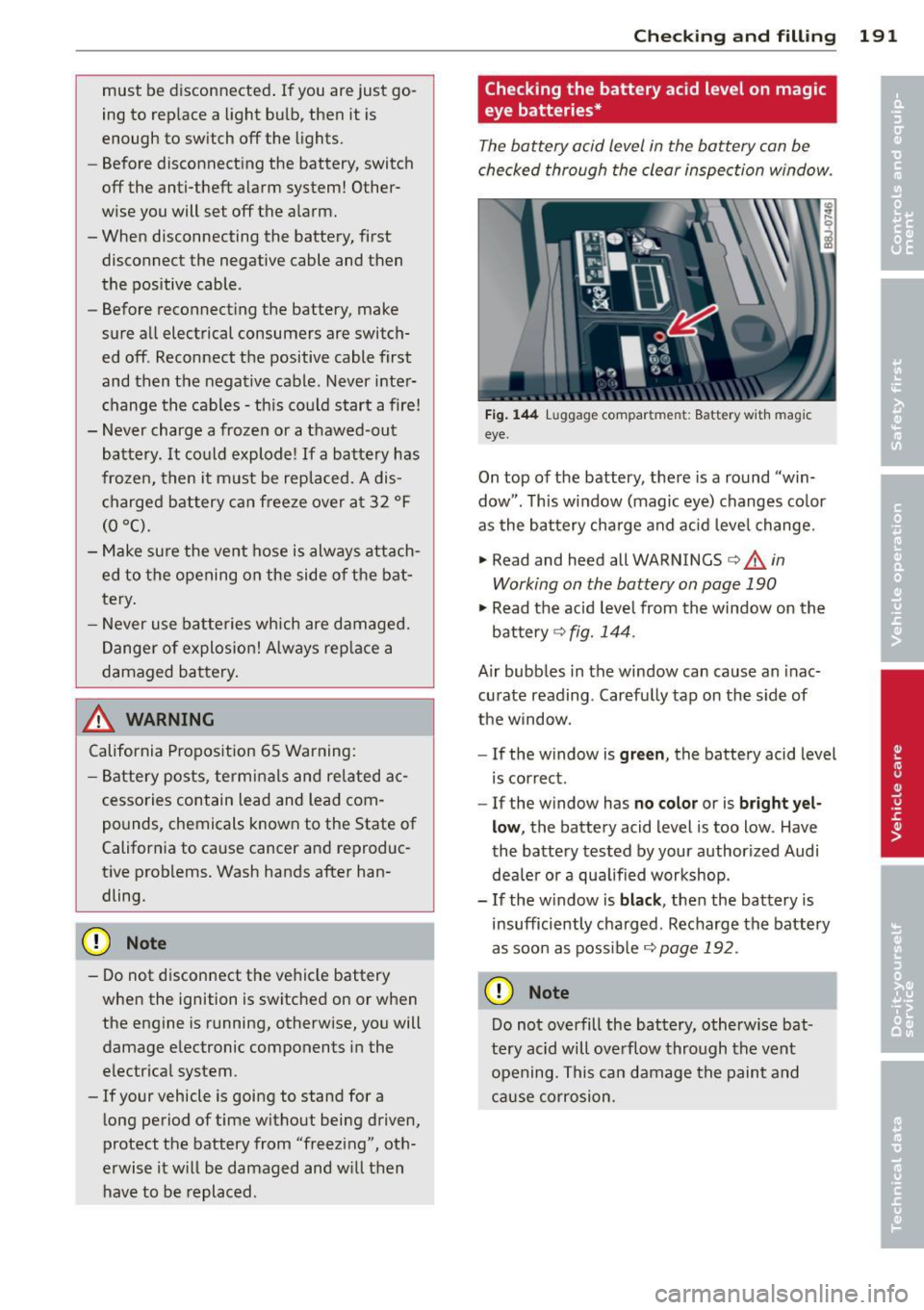
The battery acid level in the battery can be
checked through the clear inspection window .
Fig. 144 Luggage compartment: Battery With magic
eye.
On top of the battery, there is a round "win
dow". This window (magic eye) changes color
as the battery charge and acid level change.
.. Read and heed all WARNINGS
c::> &_ in
Working on the battery on page 190
.. Read the acid level from the window on the
battery
c:> fig. 144.
Air bubbles in the window can cause an inac
curate reading . Carefully tap on the side of
the window.
- If the window is
green, the battery acid level
is correct.
- If the window has no color or is bright yel
low ,
the battery acid level is too low . Have
the battery tested by your authorized Audi
dealer or a qualified workshop.
- If the window is
black , then the battery is
insufficiently charged . Recharge the battery
as soon as possible
r:::, page 192 .
CD Note
Do not overfill the battery, otherwise bat
tery acid will overflow through the vent
opening. This can damage the paint and
cause corrosion .
Page 194 of 260
192 Checking and filling
Charging of battery
Starting the engine requires a well charged battery.
,. Always read and heed all W ARNIN GS be
low
c> A and c> A in Working on the bat
tery on page 190.
,. Switch off the ignitio n and all electrical con
s u mers.
,. Make sure the area is well vent ilated when
yo u charge the battery.
,. Connect charger cables.
ALWAY S co nnect
ch arg er ca ble s PO SITIV E
G) to POSITIVE
G) ; NE GATI VE Q to NEGATI VE Q .
,. Switch on the charger.
,. Make sure the charging rate is not over
6 amps.
,. Turn off the charger¢.&_.
,. Disconnect the charger cables .
,. Connect both battery cables to the battery if
necessary-
first plus, then m inus.
It is not necessary to remove the battery from
the luggage compartment, and it is also not
necessa ry to disconnect the cables.
Normally, a battery should be charged at no
more than 10 percent of its rated capacity.
For example, a charging current of 4.5 amps
wou ld be used on a battery rated at 45 Ah.
Rated capacity of the battery in your veh icle is
listed on the battery housing .
The battery caps should
not be opened when
charging a battery.
&,. WARNING
-
Charging a battery can be dangerous.
- Never charge a frozen battery . It may ex
plode because of gas trapped in the ice.
Allow a frozen battery to thaw out first.
- Do not reuse batteries which were fro
zen. The battery housing may have
c racked and weakened whe n the battery
froze.
- Charge the battery in a we ll ventilated
area . Keep away from open f lame o r elec
t ric al spa rk . Do not smoke. Hydrogen gas
gene rate d by the b attery is exp losive. -
To reduce the danger of explosion, never
connect or d isconnect charger cab les
while the charger is operating .
- Fast charging a battery is dangerous and
should only be attempted by a compe
tent tech nician with the proper equip
ment .
- Battery acid that may spill during charg
ing should be washed off with a solution
of wa rm water and bak ing soda to neu
tralize th e ac id .
(D Note
Never use a fast charger as a booster to
start the eng ine . Th is w ill seriously dam
age sensit ive electronic components, such
as cont ro l units, re lays, radio, etc., as well
as the battery charger.
{1) Tips
The vehicle batte ry must not be charged
with a standa rd small charger that p lugs
i nto the cigarette lig hter or outlet.
Windshield/head Light
washer container
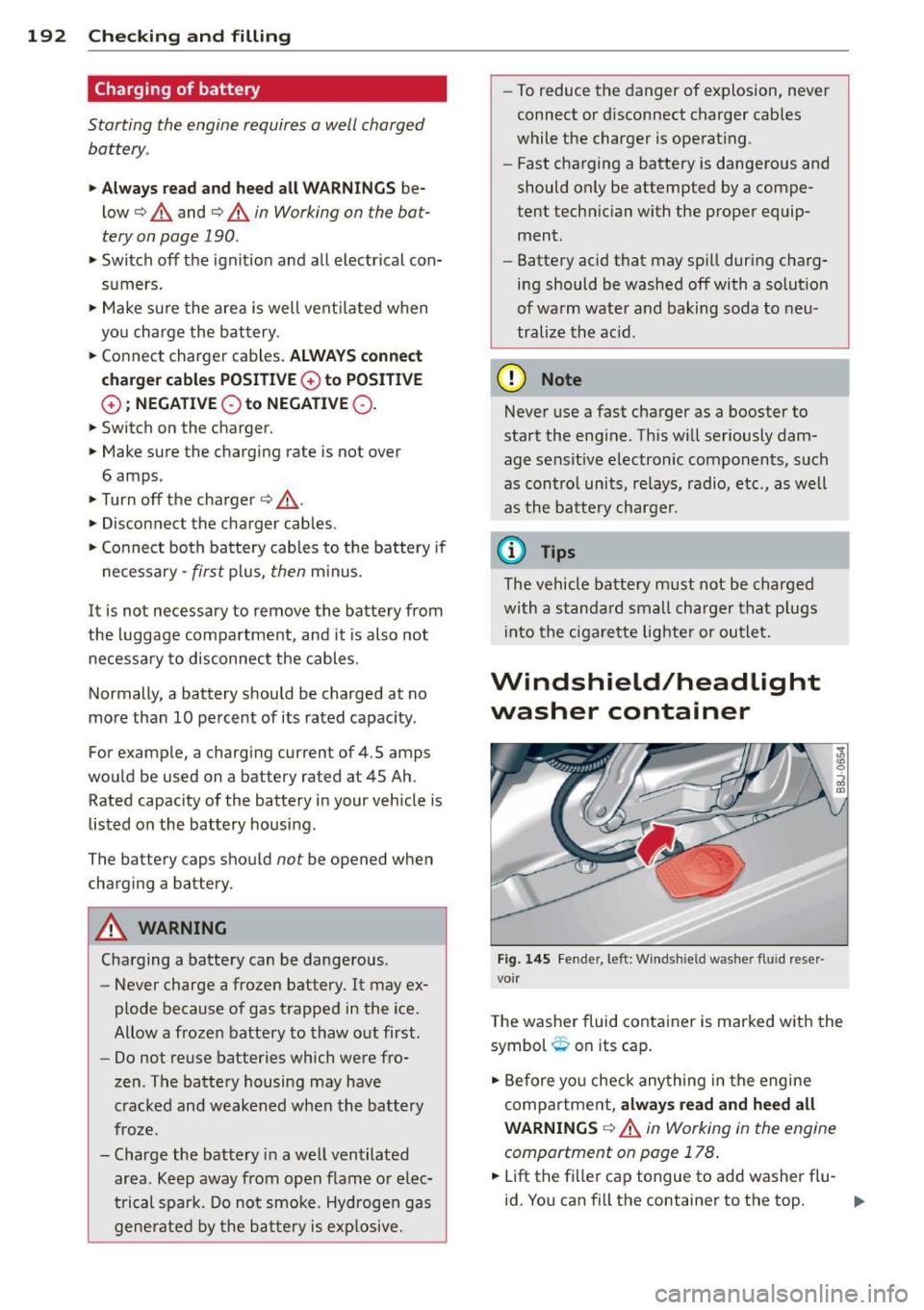
Fig . 14 5 Fender, left: Windshie ld washer fluid reser·
vo ir
T he washer fluid container is marked with the
symbol
O on its cap.
,. Before you check any thing in the engine
compa rtme nt,
a lwa ys read and heed all
WARNINGS ¢
A in Working in the engine
compartment on page 178 .
,. Lift the filler cap tongue to add washer flu-
id. You can fill the container to the top.
111>
Page 196 of 260
194 Tire s and wheel s
Tires and wheels
Tires
General notes
Tires may be the least appreciated and most
abused parts of a motor vehicle .
Tires may be the least appreciated and most
abused parts of a motor vehicle . Tires are,
however, one of the most important parts of a
vehicle, particularly considering the compara
tive ly small patch of rubber on each tire that
assures that a ll-important contact between
you, you r vehicle and the road.
Maintaining the correct tire pressure, mak ing
sure that your veh icle and its t ires do not have
to carry mo re weight than they can safe ly han
d le, avoiding damage from roa d haza rds and
r eg ularly inspecting t ires for damage includ
ing cuts, slashes irregu la r wear and ove rall
condition are the most important things that
you can do to he lp avoid s udden tire failure in
cluding tread separat ion and blowouts.
Avoiding damage
If you have to drive over a curb or similar ob
stacle, drive very s low ly and as close as possi
b le at a right angle to the curb.
A lways keep chem ica ls incl ud ing gre ase, o il,
gasoline and b rake fluid off the t ires .
Inspect the t ir e s regularly for damage (cuts,
cracks or b listers, etc.). Remove any fo reign
bod ies embedded in the treads.
Storing tires
Mark ti res when you remove them to indicate
the direction of rotation . T his ensures you to
be ab le to mount them correctly when you re
install t hem.
When removed, the whee ls or t ires should be
stored in a cool, d ry and preferably dark place .
Store tires in a vertical pos ition if they are not
mounted on rims, in a horizontal pos it ion if
they are mounted on rims.
New tires
New t ires have to be broken in¢&,. .
T he tread depth of new t ires may vary, accord
ing to the type a nd make of t ire and the tread
pa tte rn .
Hidden damage
Damage to tires and r ims is ofte n not readily
vis ible . If you notice unusual v ibrat ion or the
vehicle p ulls to one side, th is may ind icate
t h at one of the t ires has been damaged . Th e
t ir es m ust be checked immed iate ly by an au
tho rized Aud i dea le r or q uali fied wor ks hop.
Unidirectional t ires
A un idirectional tire can be identified by ar
rows on the sid ewa ll, that po int in the direc
t ion the t ire is desig ned to rotate. You must
f ol low the specified d irec tion of rot ation . This
is necessa ry so tha t these tires can develop
their optimum characterist ics regarding grip,
road no ise, wear and hyd rop laning resistance.
For more information ¢
page 226.
A WARNING
-New tires or t ires that are o ld, worn or
damaged cannot provide maximum con
trol and braking ability .
-
-New tires tend to be slippery and must
be broken in . To reduce the risk of losing
control, a co llision and ser ious personal
in jur ies, d rive w ith special ca re fo r the
fi rst 3 50 m iles (560 km).
- Driving with worn or damaged tires can
le ad to loss of control, sudden tire fail
ure, including a blowou t and sudden de
fla tion, crashes and seriou s personal in
juries . Have wo rn or damaged t ires re
p laced immediate ly .
- Ti res age even if they are not being used
an d can fai l sudden ly, especially at high
speeds. Tires that are more than 6 years
old can only be used in an emergency
and then w ith specia l care and at low
speed.
Page 198 of 260
196 Tires and wheels
Maximum loaded vehicle weight
means the sum of:
(a) Curb weight
(b) Accessory weight
(c) Vehicle capacity we ight, and
(d) Production options weight
Maximum (permissible) inflation pressure
means the maximum cold inflation pressu re
to which a tire may be inflated. Also called
"maximum inflation p ressure."
Normal occupant weight
means 150 lbs. (68 kilograms) times the
number of occupants seated in the vehicle up
to the total seating capacity of your vehicle.
Occupant distribution means distribution of occupants in a vehicle .
Outer diameter means the overa ll diameter of an inf lated new
tire.
Overall width
means the linear distance between the exteri
ors of the sidewalls of an inflated tire, includ
ing e levations due to labeling, decorations, or
protective bands or ribs.
Ply
means a laye r of rubber-coated parallel cords.
Production options weight
means the comb ined we ight of those installed
regular production options weighing over 5
lbs . (2 .3 kg) in excess of those standard items
which they replace, not previously considered
in curb weight or accessory weight, including
heavy duty brakes, r ide leve lers, heavy duty
battery, and special trim.
Radial ply tire
means a pneumatic tir e in which the p ly cords
that extend to the beads are laid at substan
tially 90 degrees to the centerline of the
tread . Recommended inflation pressure
see
~
page 195, Cold tire inflation pressure.
Reinforced tire
means a t ire designed to operate at higher
loads and at higher inflation p ressures than
the corresponding standard tire. Reinforced
ti res my be ident ified as "XL" "xl" "E XTRA
, ,
LOAD", or "RF" on the sidewall.
Rim
means a metal support for a tire or a t ire and
tube assembly upon which the tire beads are seated.
Rim diameter
means nominal d iameter of the bead seat. If
you change your wheel s ize, you w ill have to
purchase new tires to match the new r im di
ameter .
Rim size designation
means rim diameter and width.
Rim width
means nominal distance between rim flanges .
Sidewall
means that portion of a tire between the
tread and bead.
Speed rating (letter code)
means the speed at which a tire is designed to
be driven for extended periods of time. The
r atings range from 93 mph (150 km/h) to
186 mph (298 km/h)
~ page 206 . You may
not find this information on all tires because
it is not requ ired by law.
T he speed rating letter code, where applica
ble, is molded on the tire sidewall and indi
cates the maximum perm iss ibl e road speeds
~ A in Winter tires on page 209 .
Tire pressure monitoring system
means a system that detects when one or
more of a veh icle's tires are underinflated and
i lluminates a low tire pressure warning tell-
tale. ..,_
Page 202 of 260
200 Tires and wheels
other cargo that the vehicle can carry. For the
location of the tire pressure label
r=:>fig. 146.
A WARNING
Overloading a vehicle can cause loss of ve
hicle control, a crash or other accident, se
rious personal injury, and even death.
- Carrying more weight than your vehicle
was designed to carry will prevent the
vehicle from handling properly and in
crease the risk of a loss of veh icle con
trol.
- The brakes on a vehicle that has been
overloaded may not be able to stop the
vehicle within a safe distance.
- Tires on a vehicle that has been overload
ed can fail suddenly causing loss of con
tro l and a crash.
A WARNING ,~ -
- Incorrect tire pressures and/or underin
flation can lead to a serious or fatal acci
dent.
- Incorrect tire pressures and/or underin
flation cause increased tire wear and can
affect the handling of the vehicle.
- Incorrect tire pressures and/or underin
flation can also lead to sudden tire fa il
ure, including a blowout and sudden de
flation, causing loss of vehicle control.
Checking tire pressure
The correct tire pressure for the tires original
ly installed on your vehicle is listed on the tire
pressure label located on driver's side 8-pil
lar.
The recommended t ire pressures are on the
tire pressure labe l and in the table
r=:> page 198, Cold tire inflation pressure . This
means that the pressure must be checked and
adjusted when the tire has not been driven for more than a couple of miles (kilometers) at
low speeds during the previous three hours.
A ir i n the tires expands when the tire heats up
as a result of interna l fr iction as it flexes in use.
The tire pressure is higher when the tire
has warmed up than when it is "co ld."
It i s the inflation pressure in a "cold" tir e that
counts. Therefore, you should never let air out
of a warm tire to match "Cold tire inflation
pressure" recommendations
r=;, page 198. The
t ir es wou ld then be underinf lated and co uld
fail suddenly .
The tire pressure label on your Audi lists the
recommended cold tire inflation pressures for
the new, original eq uipment tires that were
on your veh icle at the time it was manufac
tured. For the location of the labe l
r=:>page 198, fig . 146.
Most tires lose air natura lly over t ime. They
can a lso lose some air if you drive over a pot
hole or hit a curb while park ing. It is usually
not possible to see whether the rad ial tires
used today are underinflated just by looking
at them.
Therefore, be sure to check t ire pressures at
least once a month and a lways before going
on a long trip . Make sure to take the number
of peop le and the amount of luggage into ac
count when adjust ing tire pressu re for a trip -
even one that yo u wou ld not consider to be
" long." See
r=;, page 202, Tires and vehicle
load limits
for more important information.
Always use an accurate tire pressure gauge
when checking and adjusting inflation pres
sures. Check all of the tires and be s ure not to
forget the spare tire. If the pressure in any tire
is too high when the tire is "cold," let air out
of the tire s low ly with the edge of the tire
gauge and keep checking the pressure until
you reach the pressure that is correct for the load (passengers and luggage) and kind of
dr iv in g you plan to do.
If the pressure in any tire is too low, note the
difference between the pressure in the cold
tire and the pressure you need and add the air
that you need to reach the correct pressure for
the vehicle load (passengers and luggage) for
the tires on your vehicle as listed on the on
your vehicle and in this manual and the kind
of driving you plan to do. .,..
Page 203 of 260
Never exceed the m aximum inflati on pres
s u re li sted on the ti re sidew all for any rea
son.
Remembe r that the vehicle manufacturer, not
the t ire manufacturer, determines the co rrect
tire pressure for the tires on your vehicle.
It is importan t to check the tire pressure when
t he t ires are cold .
- Read the requ ired ti re pressure from the tire
pressure label located on d river's s ide B-pi l
l ar .
- T urn the valve stem cap counter-clockwise
to remove it from the tire valve .
- Place the air pressure gauge on the valve .
- The tire pressures should only be checked
and adjusted when the tires are cold . The
s li ght ly raised p ressures of warm tires must
not be reduced.
- Adjust the t ire pressure to the load you a re
ca rrying.
- Re install the valve stem cap on the valve .
When should I ch eck the ti re pres sur e?
The correct tire pressure is especially impor
tant at high speeds. The pressure should
therefore be checked at least once a month
and a lways before start ing a journey .
When should I ad just th e tir e pre ss ures?
Ad just the tire pressure to the load you are
carrying . After changing a wheel
or replacing
wheels you have to adjust the tire pressures
on all wheels. In addition, you must then in it i
alize the new tire pressures in the tire pres
sure mon itor ing system
q page 212 .
A WARNING
Incorrect tire pressures and/or unde rinfla
tion can lead sudden tire failure, loss of cont ro l, col lision, ser ious persona l inju ry
or even death.
- When the warning symbo l
[D] appears in
the instrument cl uster, stop and inspect
the tires.
- Incor rect tire pressure and/or underinfla
tion can cause increased tire wear and
Tire s an d wheel s 201
can affect the handling of the vehicle and
stopping ability .
- Incorrect tire pressures and/or underin
flation can a lso lead to sudden t ire fail
ure, including a blowout and sudden de
flation, caus ing loss of veh icle control.
- The driver is responsible for the correct
tire pressures for all tires on the veh icle.
The applicable pressure values are locat ed on a sticker on the dr iver's s ide B-pil
lar .
- On ly when all tires on the vehicle are fil
led to the correct pressure, the t ire p res
sure mon itor ing system can work cor
rectly.
- The use of incorrect tire p ressu re va lues
can lead to acc idents or other damage.
Therefore it is essential that the drive r
observe the spec ified t ire p ress ure val ues
for the t ires and the correct pressures for
the function of the tire press ure monito r
ing system.
-A lways inflate tires to the recommended
and correct tire pressure before dr iv ing
off.
- Driving with underinf lated tires bend
mo re, letting them get too hot resulting
in tread separation, sudden tire failure
and loss of control.
- Excessive speed and/over loading can
cause heat b uild-up, sudden tire failure
and loss of control.
- If the tire pressure is too low or too high,
the t ires will wear prematurely and the
veh icle w ill not handle well.
- If the tire is not flat and you do not have
to change a wheel immediately, drive at
reduced speed to the nearest service sta
tion to check the t ire p ressu re and add
a ir as requ ired.
(D Note
Driving w it h out valve stem caps can cause
damage to the tire valves. To prevent this,
always make sure that factory installed
valve stem caps on all whee ls are secu rely
mounted o n the valve. .,.
•
•
Page 204 of 260
202 Tires and wheels
@ For the sake of the environment
Underinflated tires will a lso increase the
fue l consumption.
Tires and vehicle load limits
There are limits to the amount of load or
weight that any vehicle and any t ire can carry.
A vehicle that is overloaded w ill not handle
well and is more difficult to stop. Overload ing
can not only lead to loss of vehicle control,
but can also damage important pa rts of the
vehicle and can lead to s udden tire failure, in
cluding a blowout and sudden deflation that
can cause the vehicle to crash.
Your safety and that of your passengers a lso
depends on making sure that load limits are
not exceeded. Vehicle load includes everybody
and everything in and on the vehicle. These
l oad limits are technically referred to as the
vehicle's
Gross Vehicle Weight Rating
("GVWR").
The "GVWR" includes the weight of the basic
vehicle, all factory installed accessories, a full
tank of fuel, oil, coo lant and other fluids plus
maximum load. The maximum load includes
the number of passengers that the vehicle is
intended to carry ("seating capacity") with an
assumed weight of 150 lbs (68 kg) for each
passenger at a designated seat ing pos ition
and the total weight of any l uggage in the ve
h icle.
The
Gross Axle Weight Rating ("GAWR") is
the maximum load that can be app lied at each
of the vehicle's two axles.
The Gross Vehicle Weight Rating and the
Gross Axle Weight Rating are listed on the
safety compliance stick er labe l located on the
driver 's side 8-p illar. Your Audi has 2 seat ing
positions. Each seating pos ition has a safety
be lt ¢
page 107, Safety belts.
The fact that the re is an upper limit to your
vehicle's Gross Vehicle Weight Rating means
that the tota l weight of whatever is being car
ried in the vehicle is limited. The more passen
gers in the vehicle or passengers who are heavier
than the standard weights assumed
mean that less weight can be carried as lug
gage.
T he tire pressure label on your Audi also lists
the maximum combined weight of a ll of the
occupants and luggage or other cargo that
the vehicle can carry. For the location of the
label ¢
page 198, fig. 146.
A WARNING
Overloading a vehicle can cause loss of ve
h icle control, a crash or other accident, se
rious personal injury, and even death.
- Carrying more we ight than your veh icle
was des igned to carry will prevent the
veh icle from handling properly and in
crease the risk of the loss of vehicle con
trol.
- The brakes on a vehicle that has been
overloaded may not be able to stop the
veh icle w ithin a safe distance .
- Tires on a vehicle that has been overload
ed can fail suddenly, including a blowout
and 5udden deflation, cau5ing lo55 of
control and a crash.
Determining correct load limit
Use the example below to cal
culate the total weight of the passengers and luggage or oth
er things that you plan to trans
port so that you can make sure
that your vehicle will not be
overloaded.
Steps for Determining
Correct Load Limit
1. Locate the statement "THE
COMBINED WEIGHT OF QC
CU PANTS AND CARGO
SHOULD NEVER EXCEED XXX .,..