brake fluid AUDI TT ROADSTER 2011 User Guide
[x] Cancel search | Manufacturer: AUDI, Model Year: 2011, Model line: TT ROADSTER, Model: AUDI TT ROADSTER 2011Pages: 260, PDF Size: 64.11 MB
Page 190 of 260
188 Checking and filling
If the brake fluid level falls considerably be
l ow the "MIN" mark, the brake warning/indi
cator light (U .S . mode ls: . , Canadian
models: .) will come on
¢ page 16 and
¢ page 30. Do not continue to operate the ve
h icle . The complete brake system shou ld be
thoroughly checked by an authorized A ud i
dea ler o r othe r qualified facility and t he cause
corrected. If the bra ke fluid level is too low,
the bra ke warning/ind ic a tor ligh t will illum i
nate . Contact an authorized Aud i dea ler
im
mediatel y.
Changing brake fluid
Hove the broke fluid changed by on experi
enced technician.
B rake fl uid abso rbs mois ture from the a ir. If
the water content in the b ra ke fluid i s too
h igh, corros ion in the brake sys tem may result
after a period of t ime . The boi ling point o f the
b rake fluid wi ll also decrease considerab ly and
decrease braking per formance.
T herefore, the brake flu id mus t be changed
every two year s. Always use new b rake fluid
which conforms to Fede ral Motor Vehicle
Standard "FMVSS 116 DOT 4".
T he brake flu id rese rvoi r can be difficul t to
reach, therefo re, we recommend that yo u
have the brake f luid changed by yo ur autho r
ized
Audi dealer . Your dealer has the correct
too ls, the right b rake f luid and the know-how
to do this for you.
A WARNING
- B rake fluid is poiso nous . It mus t be stor
ed only in th e closed orig inal con tainer
o ut of the reac h of children!
- Brake fa ilure can result from old o r inap
propriate b ra ke fluid. Observe these pre
c aut ions:
- Use o nly brake fluid t hat meets SAE
specif ication
J 1703 and confo rms to
Federal Motor Vehicle Standard 116.
Always check with your a uthorized Audi
dealer to make s ure you are using the
correct brake fl uid. T he correct type of brake flu
id is also ind icate d on the
brake f lu id rese rvoir.
- The brake fl uid must be new . Heavy use
of the brakes can cause a vapo r lock if
the brake fluid is left in the system too
long . This can se riously affect the effi
c iency of t he brakes as well as your
safe ty. This co uld resu lt in a n accide nt.
([) Note
Brake fluid will damage the paint of your
vehicle.
@ For the sake of the environment
Because o f the prob lem of prope r disposal
of brake fluid as well as t he spec ial too ls
required and the necessary expertise, we
recomme nd t hat yo u have th e brake flu id
cha nged by yo ur autho rize d Au di dea le r.
Battery
General information
Your ve hicl e is equipped with a specia l bat
tery, an
ACM battery. This battery is located
in t he luggage compartment and must be re
placed with an origina l equipment battery.
U nder normal opera ting condit ions, the bat
te ry is
maintenance-fr ee .
Have the battery checked when you take your
vehicle in for se rv ice . You a re well advised to
replace a battery that is o lde r th an 5 years .
Disconnecting the battery terminals
Some vehicle functions (power window reg u
lators, for example) are lost if the battery te r
mina ls are disconnected. T hese functions have
to be relearned after the battery termina ls are
connected aga in . T o prevent t his, t he battery
shou ld only b e disconne cted from the ve hicle
ele ct ric al sy stem w hen abso lutely ne cessary
f o r rep air s.
Vehicles not driven for long periods
If you are go ing to let your vehicle stand for a
long time a nd not drive it, you should remem
ber there are elect rical components which a re
Ill-
Page 204 of 260
202 Tires and wheels
@ For the sake of the environment
Underinflated tires will a lso increase the
fue l consumption.
Tires and vehicle load limits
There are limits to the amount of load or
weight that any vehicle and any t ire can carry.
A vehicle that is overloaded w ill not handle
well and is more difficult to stop. Overload ing
can not only lead to loss of vehicle control,
but can also damage important pa rts of the
vehicle and can lead to s udden tire failure, in
cluding a blowout and sudden deflation that
can cause the vehicle to crash.
Your safety and that of your passengers a lso
depends on making sure that load limits are
not exceeded. Vehicle load includes everybody
and everything in and on the vehicle. These
l oad limits are technically referred to as the
vehicle's
Gross Vehicle Weight Rating
("GVWR").
The "GVWR" includes the weight of the basic
vehicle, all factory installed accessories, a full
tank of fuel, oil, coo lant and other fluids plus
maximum load. The maximum load includes
the number of passengers that the vehicle is
intended to carry ("seating capacity") with an
assumed weight of 150 lbs (68 kg) for each
passenger at a designated seat ing pos ition
and the total weight of any l uggage in the ve
h icle.
The
Gross Axle Weight Rating ("GAWR") is
the maximum load that can be app lied at each
of the vehicle's two axles.
The Gross Vehicle Weight Rating and the
Gross Axle Weight Rating are listed on the
safety compliance stick er labe l located on the
driver 's side 8-p illar. Your Audi has 2 seat ing
positions. Each seating pos ition has a safety
be lt ¢
page 107, Safety belts.
The fact that the re is an upper limit to your
vehicle's Gross Vehicle Weight Rating means
that the tota l weight of whatever is being car
ried in the vehicle is limited. The more passen
gers in the vehicle or passengers who are heavier
than the standard weights assumed
mean that less weight can be carried as lug
gage.
T he tire pressure label on your Audi also lists
the maximum combined weight of a ll of the
occupants and luggage or other cargo that
the vehicle can carry. For the location of the
label ¢
page 198, fig. 146.
A WARNING
Overloading a vehicle can cause loss of ve
h icle control, a crash or other accident, se
rious personal injury, and even death.
- Carrying more we ight than your veh icle
was des igned to carry will prevent the
veh icle from handling properly and in
crease the risk of the loss of vehicle con
trol.
- The brakes on a vehicle that has been
overloaded may not be able to stop the
veh icle w ithin a safe distance .
- Tires on a vehicle that has been overload
ed can fail suddenly, including a blowout
and 5udden deflation, cau5ing lo55 of
control and a crash.
Determining correct load limit
Use the example below to cal
culate the total weight of the passengers and luggage or oth
er things that you plan to trans
port so that you can make sure
that your vehicle will not be
overloaded.
Steps for Determining
Correct Load Limit
1. Locate the statement "THE
COMBINED WEIGHT OF QC
CU PANTS AND CARGO
SHOULD NEVER EXCEED XXX .,..
Page 206 of 260
204 Tires and wheels
c::>fig . 148 running across the tread. Depend
ing on the make, there will be six to eight of
them evenly placed around the tire. Marks on
the tire sidewall (for example "TWI" or other
symbols) indicate the positions of the tread
wear ind icators . Worn tires must be replaced .
Different figures may apply in other countries
c::> ,& .
Tire pressure
Incorrect tire pressure causes premature wear
and can cause sudden tire blow-out . For this
reason, tire pressure must be checked at least
once a month
c::> page 200.
Driving style
Driving fast around curves, heavy acceleration
and hard braking increase tire wear.
Rotating tires for more even wear
For a ll four tires on your vehicle to have the
same service life, we recommend that the
front and rear tires are rotated according to
the tire manufacturer's suggested tire rota
tion intervals. Please remember the follow
ing:
- Tire rotation interva ls may differ from the
vehicle serv ice intervals outlined in your
Warranty
& Maintenance Booklet.
- The longer one tire is used in one location
on the vehicle, the more it wears at certain
points; therefore, we recommend that you
follow the tire manufacture r's suggested
t ir e rotation intervals .
- Vehicles with front-wheel drive experience
more tread wear on the front wheels com
pared to all-wheel drive (quatt ro ® ).
- Please rotate t ires as shown
c::> fig . 149.
-Extra care must be taken when rotating di-
rect ion-specific tires
c::> page 226.
Wheel balancing
The whee ls on new vehicles are balanced.
However, various situations during everyday
driving can cause them to become unbal
anced, resulting in vibrations you can usually
feel through the steering wheel. Unbalanced
wheels must be rebalanced to
avoid excessive wear on steering, suspension
and t ires . A whee l must also be reba lanced
when a new tire is installed.
Incorrect wheel alignment
Incorrect wheel alignment can cause exces
sive tire wear, impairing the safety of the vehi
cle. If tires show excessive wear, have the
whee l alignment checked by an authorized
Audi dealer or qualified workshop.
All Wheel Drive
Vehicles with quattro ® must a lways have tires
of the same size, construction and tread type .
For details see c::>page
154.
A WARNING
-Sudden tire fai lure can lead to loss of con-
trol, a crash and serious personal injury!
- Never drive a vehicle when the tread on
any tire is worn down to the wear indica
tors.
- Worn tires are a safety hazard, they do not grip well on wet roads and increase
your r isk of "hydroplaning" and loss of
control.
- Always keep chemicals that can cause
tire damage, such as grease, oil, gasoline
and brake fluid away from tires.
- Tires age even if they are not being used
and can fail suddenly, especially at high
speeds. Tires that are more than 6 years
old can only be used in an emergency
and then w ith special care and at lower
speeds.
- Never mount used tires on your vehicle if
you are not sure of their "previous histo
ry." O ld used tires may have been dam
aged even though the damage cannot be
seen that can lead to sudden tire fai lure
and loss of vehicle control.
Page 245 of 260
-Always make sure the transm ission se
lector lever is in "P" (Park position) and
the hand brake is firmly applied.
@ For the sake of the environment
- Changing the engine settings wi ll ad
versely affect emission levels . This is det
rimental to the environment and increas
es fue l consumption .
- Always observe environmental regula
tions when d ispos ing of old engine oil,
used brake fluid , dirty engine coolant,
spent batter ies or wo rn out t ires.
- Undeployed airbag modules and preten
s ioners might be classified as Perchlo
r ate Material -spec ial handling may ap
ply, see www.dtsc.ca .gov/hazardous
was te/perch lorate. When the veh icle or
parts of the restrai nt system in cl ud ing
airb ag mod ules safety be lts wit h preten
s ione rs are scrapped, all app licable laws
and regulations must be observed. Your
a uthorized Audi dea ler is familiar w ith
these requirements and we recommend
th at you have your dea ler perform this
serv ice for you .
Additional accessories,
modifications and
parts replacement
Additional accessories and parts
replacement
Always consult an authori zed Audi dealer be
fore purchasing accessories .
Your vehicle inco rporates the latest safety de
sign featu res ensu ring a high standard of ac
tive and passive safe ty .
T his safety could be comp romised by non -ap
p roved cha nges to the ve hicle . For this reason,
if pa rts have to be replaced , p lease observe
the following points when ins tall ing addition
a l accessories:
App roved Audi accessor ies and genuine Audi
pa rts a re ava ilable from a uth orized Audi dea l
e rs.
Con sumer In formation 243
T hese dea le rs a lso have the necessary facili
ties, tools a nd trained specialists to install the
parts and accessories properly .
_& WARNING
Using the wrong spare parts or using non
approved accessories can cause damage to
the vehicle and ser ious persona l in jury .
- Use on ly accessories express ly approved
by Audi and ge nuine Audi spare parts
- These parts and accessories have been
specially designed to be used on yo ur ve
hicle .
- Never install accessor ies such as tele
phone crad les or beverage ho lders on air
bag covers or w ithi n the airbag deploy
ment zo nes. Do ing so wi ll increas e the
ris k of injury if a irbags are triggered in an
accide nt!
- Before you check anything in the engine
compa rtment, always read an d heed a ll
W ARNIN GS
<:!)page 172.
(D Note
-If items o ther than ge nuine Audi spare
parts, add-on equipment and accessory
items are used o r if repair wo rk is no t
perf ormed ac cor ding to spe cifie d meth
ods, this ca n resu lt in seve re dam age to
your vehicle's engine and bo dy (such as
co rrosion) an d adve rsely affect yo ur vehi
cle 's warranty .
- The i nnovat ive aluminium concept of
your Audi TT means t hat all servicing, re
pairs or other work on the vehicle body
must be carr ied out exclusive ly by an Au
di workshop .
- If emergency repairs must be performed
elsewhere, have the veh icle examined by
an authorized Audi dealership as soon as
possible .
- The manufacturer cannot be held liable
for damage wh ich occu rs due t o failure
to comply with these stipu lations .
-
•
•
Page 247 of 260
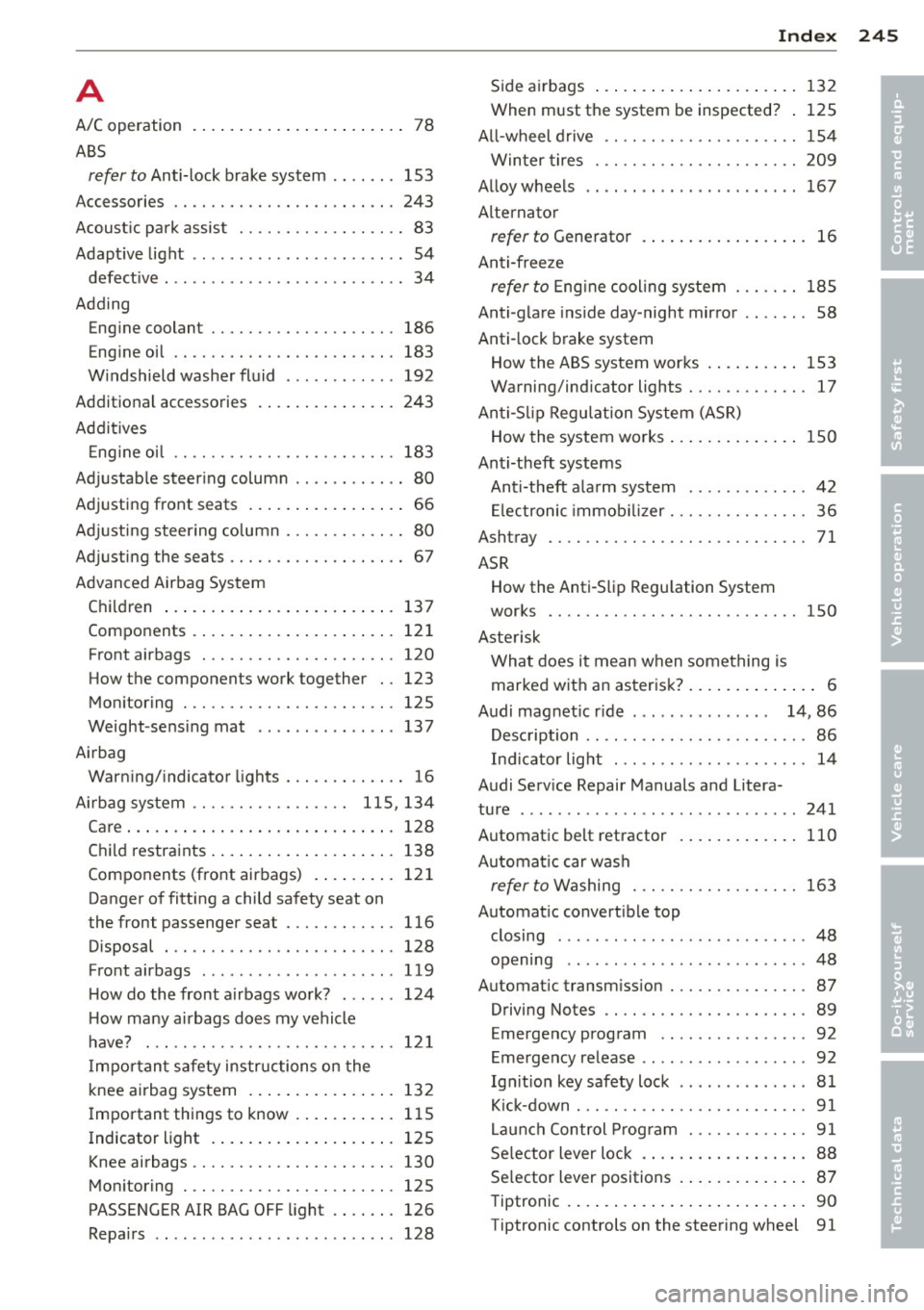
A
A/C operation
ABS ................... .... 78
refer to Anti-lock brake system .. .. .. . 153
Accessories . . . . . . . . . . . . . . . . . . . . . . . . 243
Acoustic park assist . . . . . . . . . . . . . . . . . . 83
Adaptive light ................ .... ... 54
defective . . . . . . . . . . . . . . . . . . . . . . . . . . 34
Adding Engine coolant ........... .. .. .. .. .
Engine oil ...... .... ... .. .. .. .. .. .
Windshield washer fluid ....... . ... .
Additional accessories
Additives Engine oil .. ............. .. .. .. .. .
Adjustable steering column ...... ... .. . 186
183
192
243
183 80
Adjusting front seats ............ ..... 66
Adjusting steering column ... .. .. .. .. .. 80
Adjusting the seats ......... .. .. .. .. .. 67
Advanced Airbag System Children ... ................ ... ... 137
Components ................ ... .. .
Front airbags ............ .... .. .. .
How the components work together . . 121
120
123
Monitoring . . . . . . . . . . . . . . . . . . . . . . . 125
Weight -sensing mat ......... .... .. 137
Airbag Warning/indicator lights ..... .. .. .. .. 16
Airbag system . . . . . . . . . . . . . . . . . 115, 134
Care ....... .. ............... .. .. . 128
Child restraints .............. ... ... 138
Components (front airbags) . ... .. .. . 121
Danger of fitting a child safety seat on
the front passenger seat . . . . . . . . . . . . 116
Disposal 128
Front airbags .... .. ...... .. .. .. .. . 119
How do the front airbags work? . ..... 124
How many airbags does my vehicle
have? . .. .. .... ............. .. .. . 121
I mportant safety instructions on the
knee airbag system .......... ... .. . 132
Important things to know ... ... .. .. . 115
Indicator light .............. ... ... 125
Knee airbags . . . . . . . . . . . . . . . . . . . . . . 130
Monitoring . ............. .... .. ... 125
PASSENGER AIR BAG OFF light .. .. .. . 126
Repairs . ... ... .. .. ...... .. .. .. .. . 128
Index 245
Side airbags ..... ................. 132
When must the system be inspected? . 125
All-wheel drive .. .. ................. 154
Winter tires ... .. .... ........... . .
Alloy wheels .. .. .. .. . ... ...... ... . .
Alternator
refer to Generator . . .............. ..
Anti-freeze 209
167
16
refer to Engine cooling system ... .. .. 185
Anti -glare inside day-night mirror ....... 58
Anti-lock brake system How the ABS system works ......... . 153
Warning/indicator lights ........ .. .. . 17
Anti-Sl ip Regulation System (ASR)
How the system works .............. 150
Anti-theft systems Anti-theft alarm system ........ .. .. . 42
Electronic immobilizer .......... .. .. . 36
Ashtray
ASR
.... .. .. .. ... ............ ...
How the Anti-Slip Regulation System 71
works .... .. .. .. ................. 150
Asterisk What does it mean when something is marked with an asterisk? .............. 6
Audi magnetic ride . . . . . . . . . . . . . . . 14, 86
Description .. .. .. ... ............ .. . 86
Ind icator light . .... ... .......... .. . 14
Audi Service Repair Manuals and Litera-
ture .......... ... .. .. ... ......... .
Automatic belt retractor ............ .
Automat ic car wash
refer to Washing . .... ........... . .
Automatic convertible top 241
110
163
closing . .. .. .. .. .. . .. .... ........ . 48
opening ........ .. ............... .
Automatic transmission ............ .. .
Driving Notes .. .. ................. . 48
87
89
Emergency program .. .. ...... ...... 92
Emergency release . . . . . . . . . . . . . . . . . . 92
Ignition key safety lock .............. 81
Kick-down ... .. .. ... ............ ... 91
Launch Control Program .......... .. . 91
Selector lever lock . . . . . . . . . . . . . . . . . . 88
Selector lever positions . . . . . . . . . . . . . . 87
Tiptronic . . . . . . . . . . . . . . . . . . . . . . . . . . 90
Tiptronic controls on the steering wheel 91
•
•
Page 248 of 260
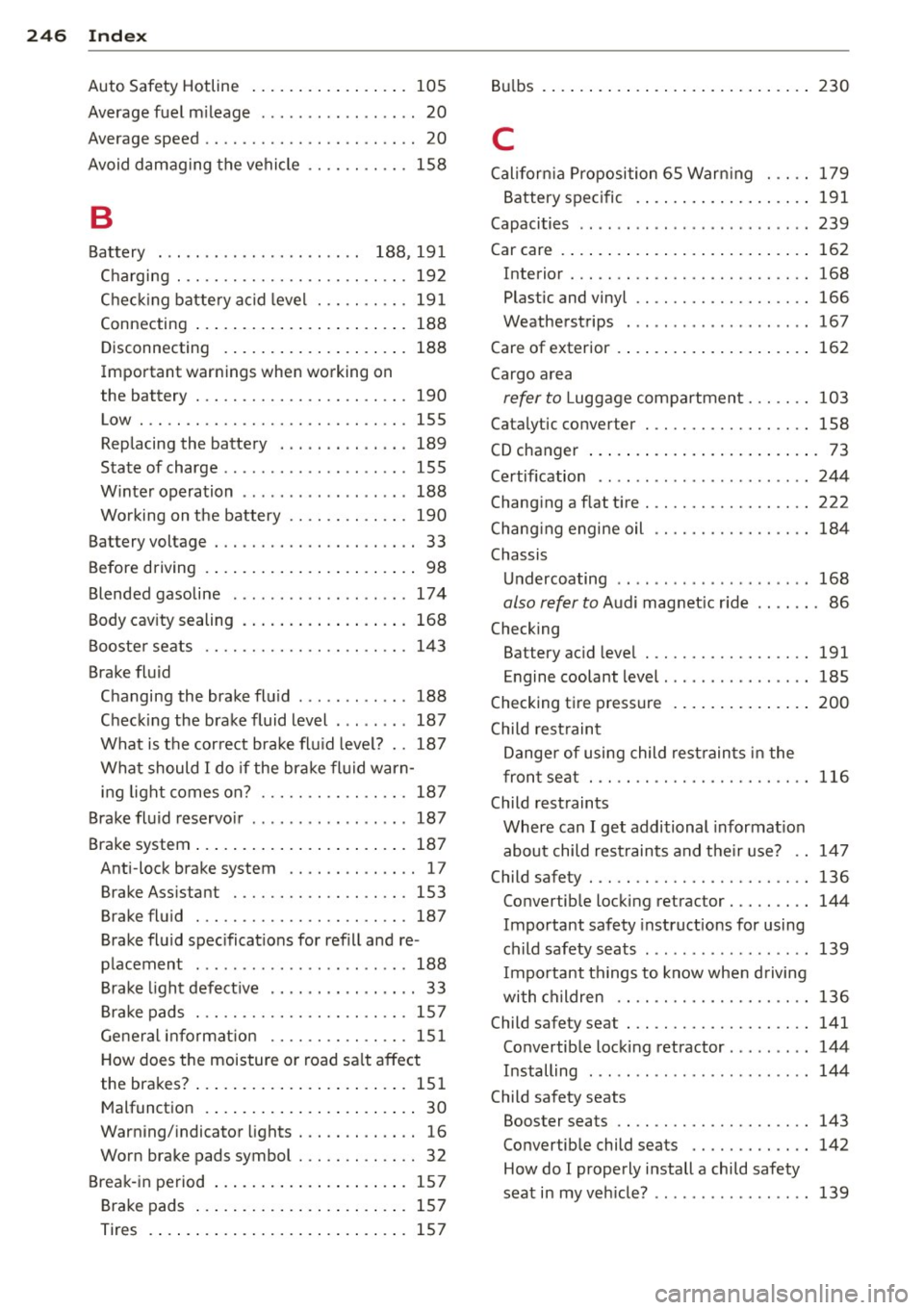
246 Index
Auto Safety Hotline ............ .... . 105
Average fuel mileage ........... .. .... 20
Average speed . . . . . . . . . . . . . . . . . . . . . . . 20
Avoid damaging the vehicle ...... .... . 158
B
Battery . . . . . . . . . . . . . . . . . . . . . . 188, 191
Charging . .. ............. .. .. .. .. . 192
Check ing battery acid level ..... .... . 191
Connecting ............... ... .... . 188
Disconnecting ............... .... . 188
Important warnings when working on
the battery .................. .... .
190
Low . .. .. .. ............. .. .. .. ... 155
Replacing the battery .............. 189
State of charge . . . . . . . . . . . . . . . . . . . . 155
W inter operation ............... ... 188
Working on the battery ............. 190
Battery voltage ................ .... .. 33
Before driving .............. ... .... . .
Blended gasoline ..... ..... .. .. .. .. .
Body cavity sealing
Booster seats
Brake fluid 98
174
168
143
Changing the brake fluid ....... .. ... 188
Checking the brake fluid level .... .... 187
What is the correct brake flu id level? .. 187
What should I do if the brake fluid warn-
ing light comes on? ................
187
Brake fluid reservoir ......... ... .. .. . 187
Brake system ............... ... .... . 187
Anti-lock brake system ............. . 17
Brake Assistant .......... .. .. .... . 153
Brake fluid .................. ..... 187
Brake fluid spec ificat ions for refill and re-
placement .... .. ... ..... .. .. .. .. .
188
Brake light defective ................ 33
Brake pads .............. .... .... . 157
General information ............... 151
How does the moisture or road sa lt affect
the brakes? ............... ... .... .
151
Malfunction .............. ... .... . . 30
Warning/indicator lights ..... .. .. .. . . 16
Worn brake pads symbol ... .. .. .... .. 32
Break-in period .............. .. .... . 157
Brake pads ............... ... .... . 157
Tires .... .. ................ ..... . 157
Bulbs ..... ..... .. ............. .... 230
C
Cal iforn ia Proposition 65 Warn ing . ... .
Battery specific . ................. .
Capacities .. .. .. .. .. ...... ..... .. . . 179
191
239
Car care ... ..... .. ............. .... 162
Interior ..... .. .. ................. 168
Plastic and vinyl ................... 166
Weatherstrips 167
Care of exterior .... ................ . 162
Cargo area
refer to Luggage compartment ....... 103
Catalytic converter .................. 158
CD changer ..... .. .................. 73
Certification . . . . . . . . . . . . . . . . . . . . . . . 244
Changing a flat tire .................. 222
Changing engine oil ............... .. 184
Chassis
Undercoating .. .. ... .... ...... .. ..
168
also refer to Audi magnetic r ide .. .. .. . 86
Checking
Battery acid level .................. 191
Engine coolant level ................ 185
Checking tire pressure .............. . 200
Child restraint
Danger of using child restraints in the
front seat . ................... ....
116
Child restraints
Where can I get additional information
about child restraints and the ir use? ..
147
Child safety . ....................... 136
Convertible locking retractor ......... 144
Important safety instructions for using
ch ild safety seats .... .... ...... .. ..
139
Important things to know when driving
with children .....................
136
Child safety seat .................... 141
Convertible locking retractor . .. ..... . 144
Installing ... .. .. ....... ...... .. .. 144
Child safety seats
Booster seats . . . . . . . . . . . . . . . . . . . . .
143
Convertible child seats ............. 142
How do I properly install a child safety
· h' l ? 139 seat in my ve 1c e ...... ........... .
Page 251 of 260
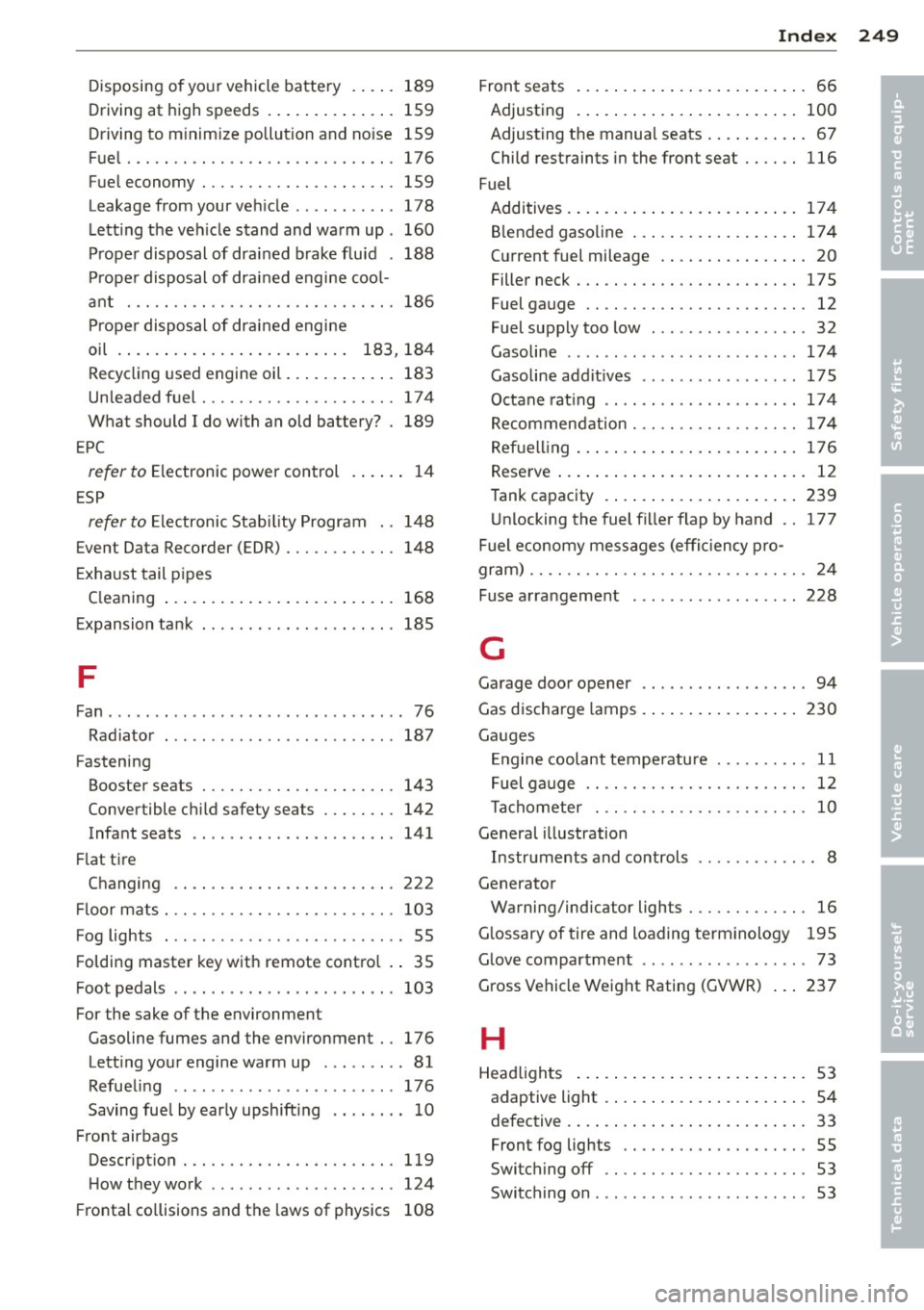
Disposing of your vehicle battery .. .. . 189
Driving at high speeds . . . . . . . . . . . . . . 159
Driving to minimize pollution and no ise 159
Fuel ... .. .. ................. .. ... 176
Fuel economy ................ .. ... 159
Leakage from your veh icle ...... . ... . 178
Letti ng the ve hicle stand and warm up . 160
Proper disposal of drained brake fluid . 188
Proper disposal of drained engine coo l-
ant ... .. .. ................. .. ... 186
Proper disposal of drained engine
oil . . . . . . . . . . . . . . . . . . . . . . . . . 183, 184
Recycling used engine oil ......... .. . 183
Un leaded fuel ............ .. .. .. ... 174
What should I do with an old battery? . 189
EP C
refer to Electronic power control . . . . . . 14
E SP
refer to Electronic Stability Program . . 148
Event Data Recorder (E DR) ... .. .. .. .. . 148
E xhaust tail pipes
Cleaning ... .. ... ........ .. .. .. ... 168
E xpansion tank .... .. ... ... .. .. .. .. . 185
F
Fan .... .... ... ................ .... . 76
Radiator ... .. ........ ... .. ... ... . 187
Fastening Booster seats . . . . . . . . . . . . . . . . . . . . . 143
Convertible c hild safety sea ts . .. .. .. . 142
Infant seats .. ..... ............. .. 141
Fl at tire
Changing .. .. .. ........... .. .. ... 222
Fl oor mats ... .... ............. .. .. . 103
Fog lights . . . . . . . . . . . . . . . . . . . . . . . . . . 55
F olding master key with remote contro l .. 35
Foot pedals .. .......... ... .... .. .. . 103
For the sake of the environment
Gasoline fumes and the environment .. 176
Lett ing your engine warm up . .. ... ... 81
Refuel ing . . . . . . . . . . . . . . . . . . . . . . . . 176
Saving fuel by early upshift ing .. .. .. .. 10
Front airbags Descr ipt ion ..... ............. .. .. . 119
H ow they work ... .. ...... .. .. .. .. . 124
Fr onta l co llisions and the laws of physics 108
Index 249
Front seats . . . . . . . . . . . . . . . . . . . . . . . . . 66
Adjusting ... .. .... . ............ .. 100
Adjusting the manual seats . . . . . . . . . . . 67
Child restraints in the front seat .... .. 116
Fuel Additives . ... .. .... . ............ .. 174
Blended gasoline . . . . . . . . . . . . . . . . . . 17 4
C ur rent fuel mileage . .......... .. .. . 20
Filler neck . .. .. .. .. .. ........... .. 175
Fuel gauge . . . . . . . . . . . . . . . . . . . . . . . . 12
Fuel supply too low . . . . . . . . . . . . . . . . . 32
Gasoline .. .. .. .. .. . .. .. ...... .. .. 174
Gasoline addit ives .. .............. . 175
Octane rat ing .. .. ................. 174
Recommendation . .... ......... .. .. 174
Refuelling ... .. .. .. . .. .......... .. 176
Reserve ... .. .. .... . ............ .. . 12
Tank capacity ....... .. ........ .. .. 239
Unlocking the fuel filler flap by hand .. 177
Fuel economy messages (efficiency pro-
gram) ...... .. .. .. .. . .............. . 24
Fuse arra ngeme nt ........ ......... . 228
G
Garage door opener .. ............... . 94
Gas discharge lamps . .. .. .......... .. 230
Ga uges
En gine coolant temperatu re . . . . . . . . . . 11
Fuel gauge . . . . . . . . . . . . . . . . . . . . . . . . 12
Tachom eter . . . . . . . . . . . . . . . . . . . . . . . 10
General illustration
Instruments and controls ... ... ... .. .. 8
Generator Warning/indicator lights .......... .. . 16
Glossary of tire and loading terminology 195
G lo ve compar tme nt . . . . . . . . . . . . . . . . . . 73
Gross Vehicle Weight Rating (GVWR) ... 237
H
Head lights ....... .. . .. .......... .. . 53
adaptive light . . . . . . . . . . . . . . . . . . . . . . 54
defective . . . . . . . . . . . . . . . . . . . . . . . . . . 33
Front fog lights . . . . . . . . . . . . . . . . . . . . 55
Switching off . . . . . . . . . . . . . . . . . . . . . . 53
Switching on . . . . . . . . . . . . . . . . . . . . . . . 53
•
•