engine oil AUDI TT ROADSTER 2011 User Guide
[x] Cancel search | Manufacturer: AUDI, Model Year: 2011, Model line: TT ROADSTER, Model: AUDI TT ROADSTER 2011Pages: 260, PDF Size: 64.11 MB
Page 151 of 260

A WARNING
- The limits of physics cannot be suspended by ESP. Even in vehicles w ith ESP, you
should always adapt your driving to road
and traffic conditions. This is particular ly
t rue on a slippery and wet road. Do not
be tempted by the inc reased safety pro
vided to take ris ks - danger of an acci
dent!
- Please note tha t when ESP/ASR is deacti
vated, the drive whee ls can spin on icy
and slippery roads and the veh icle can
break away - danger of skidding!
Switching on and off
Fi g. 130 Center co nsole wit h ESP switch
The ES P is a utomatically activated when the
engine is star ted, and it performs a self-test.
As soon as the test is completed, the system
is in normal operating mode.
Deactivating
ESP should normally be activated at all times
because this ensures optimum vehicle stabil i
ty. Only in some cases it does make sense to
deactivate the Electronic Stability P rogram
(ESP) by press ing the button
~fig . 130. Deac
tivation is ind icated by the ESP lamp
I in the
instr ument cluster f lashes. The message
ESP
OFF
appears in the instrument cluster. Ant i
Slip Regulation is completely deactivated and
the stabilization effects from the ESP system are lim ited. Th is makes a mo re agile and spor
ty driv ing style poss ible, but the fu ll exte nt of
t he s tabiliza tion f unct ion is not available .
Intelligent technolog y 149
Activating
Press the@] button again~ fig. 130. T he ind i
cator light
I goes out . The message ESP ON
appears brief ly in the instrument cluster dis
play.
&_ WARNING
i=
You shou ld only switch the ESP off if your
driving ab ility and the traff ic situat ion al
low. Please note that when ESP/ASR is de
activated, the d rive wheels can spin on icy
a nd slippery roads and th e vehicle can
b reak away- dange r of skidd ing!
a) Tips
- If Aud i magnetic ride* is malfunct io ni ng,
the ESP may not sw itch off or it may
switch off automatically.
- In the event of a defect in the rear spoil er sys tem or in Audi magnet ic ride, it can
happen that ASR and ASR/ESP cannot be
deactivated, o r they are ac tiva ted au to
matically in the deactiva ted st ate.
Electronic differential lock (EDL)
The electronic differential lock monitors the
rotational speed of the drive wheels.
General notes
The electronic d ifferential lock (EDL) helps the
ca r to start moving, accele rate and climb a
gradient on su rfaces provid ing poor or a lmost
no g rip. Withou t EDL, this would be d iff icul t ,
i f not impossib le.
How the system works
The EDL operates automatica lly. It mon itors
the rotational speed of the dr ive wheels on an
axle with the help of the ABS sensors
c;:> page 153. If a noticeable difference in ro
tational speed
between the drive wheels on
o ne axle is detected (e.g. on s lippery ground
on one side), the s pinning wheel is braked,
thereby t ransferring power to the other drive
whee l or wheels (a ll-wheel drive). This is done
up to a speed of about 60 mph (100 km/h). ..,_
Page 152 of 260

150 Intelligent te chn olog y
Noises from the b rake system signal that
wheel spin is being controlled.
Driving off
When drivi ng off, a lways be sure to keep road
conditions in mind as you accelerate. If one
d rive wheel spi ns because it is on a surface
with less grip, gradua lly increase the press ure
on the accelerator pedal until the car starts to
move. The wheel less able to transfer power
spins.
O verheating of bra kes
To prevent the disc brake of the braked wheel
from overheating if subjected to excessive
loads, the EDL cuts out temporarily. The vehi
cle rema ins operationa l and behaves in the
same way as a vehicle without EDL.
As soon as the brake has cooled down, EDL
switches on again automatically .
A WARNING
-When accelerating on slippery surfaces,
such as on ice or snow, always be careful
when depressing the acce lerator pedal.
Even with the EDL working, the drive
wheels can spin and reduce yo ur ability
to contro l your car. -Risk of crash!
- The increased safety afforded by EDL
does not mean that you can ta ke safety
risks. Always adapt your dr iving sty le to
the road conditions and traff ic situa tion.
@ Tips
If a fa ult occurs in the ABS, the EDL is also
not f unct ion ing. This is indicated by the
ABS warning light ¢
page 17.
Anti-Slip Regulation System (ASR)
The Anti-Slip Regulation System prevents the
driven wheels from spinning wh en the car is
accelerating.
General notes
The Anti-Slip Regulation System (ASR) is inte
grated in the electronic stabilization program
(ESP). When th e vehicle starts up and acceler- ates, the whee
ls are prevented from spinning
by adjusting the engine power to match the
amount of grip available from the road sur
face.
How the system works
ASR pe rforms a utomat ica lly, i.e . w ithout t he
driver's intervention. With the aid of the ABS
sensors ¢
page 153, ASR monitors t he speed
of the dr iven whee ls . If the whee ls start to
spin, the engine torq ue is reduced automati
cally until the tires find enough gr ip to lock
onto the road surface . The system is active
across the ent ire speed range .
The ASR works in conjunction with the ABS. If
a malfunction should occur in the ABS, the
ASR w ill also be out of act io n.
@ Tips
To ensure that the ASR works properly, all
four whee ls must be fitted wit h ident ica l
tires . Any differences in ro lling radius of
the tires can cause the system to reduce
engine power wh en this is not desired. See
a lso
¢ page 205, New tires and repla cing
tires and wheels.
Rear spoiler
The rear spoiler improves vehicle handling
and enhances driver control .
Fig. 131 Switc h fo r rear spo iler
The rear spoiler deploys and retracts. Spoiler
operation can be set for automat ic or manual
operation .
Page 153 of 260
Automatic mod e (normal operat ion)
- Automatic deployment: At a speed of about
75 mph (120 km/h), the rear spoiler deploys
automatically .
- Automatic retraction: When speed drops be
low abo ut SO mph (80 km/h), the rear spoil
er retracts automatically.
Manual mode
- Manua l dep loyment: Tapping briefly on the
switch
¢ fig. 131 dep loys the rear spo iler .
- Manual retraction: At speeds up to about 10
mph (20 km/h), retract the rear spoiler by
pressing and holding the switch ¢
fig. 131.
At speeds between 10 mph (20 km/h) and
75 mph (120 km/h), retract the rear spoi ler
by tapping on the switch
¢ fig. 131 .
A WARNING
Driv ing at higher speeds w ithout the rear
spoiler dep loyed can impair handling char
acteristics, making the vehicle harder to
control.
- Always make sure that the spoiler is de·
ployed whe n driving at speeds over 85
mp h (140 km/h) . If the rea r spo ile r
wa rning/ind icator light in the instru
ment cluster comes on, the rear spo iler
may not have dep loyed.
- Never drive at speeds hig her than 85
mp h (1 40 km/h) if the spoiler is not de
ployed. Have the spoi ler inspected as
soon as possible by an authorized A udi
dealer or qualified workshop .
- Always obey speed limits and other traf
fic laws.
A WARNING
Improper operation of the rear spoiler can
cause crushing injuries .
- Always make sure that nobody, especia lly
children, is in the way when the rear
spoiler is deployed or retracted.
Q) Note
Never push the vehicle o r apply fo rce to
the rear spoiler -it could be damaged.
Int ellig ent technolog y 151
(D Tips
Clean the spoiler compa rtment every 2 to
3 months. The spoiler compartment must
a lways be free of ice, snow, leaves or other
debr is .
Braking
General information
What affects braking efficiency?
Ope rating condition s and driving h abits
The brakes on today's automobiles are still
subject to wear, depending largely on operat
ing condit ions and driving habits ¢.&, . On ve
hicles that a re either dr iven mostly in stop
and-go city t raff ic or are dr iven hard, the
brake pads should be chec ked by yo ur author
ized Audi dea ler mo re often than specified in
the
W arranty & Maintenanc e boo klet. Failure
to have your brake pads inspected can result in reduced brake performance .
On steep slopes, you should use the braking
effect o f the engine . This way, you prevent un
necessary wear on the brake system. If you
must use your brakes, do not hold the brakes
down cont in uous ly. Pump the brakes at inter
vals.
Noises may occur when braking depending on
the speed, braking force and o utside condi
tions such as temperature and humid ity.
Moisture o r ro ad s alt
U nder certa in conditions, for examp le, when
driving through water or very heavy rain , or
even after washing your vehicle, the b raking
effect can be reduced due to moist ure (or in
freezing cond itions ice) on the brake pads. A
few cautious brake applications should dry off
the brake pads or remove any ice coatings .
The effectiveness of the brakes can be reduced
when the vehicle is driven on a salt-covered road and t he brakes are not used. L ikewise,
you clean off accumulated salt coating from brake d iscs and pads with a few cautious ap-
plications of the b rake ¢ .&, .
IJJ,
•
•
Page 154 of 260
152 Intelligent technology
Corrosion
There may be a tendency fo r dirt to bu ild up
on the brake pads and corrosion to form on
the discs if the car is not driven regularly or
only for short trips with little use of the brakes .
I f the b rakes are not used frequen tly, or if cor
rosion has fo rmed on the discs, it is advisab le
to clean
off the pads and discs by b raking
firm ly a few times from a moderate ly high
speed
c> .& .
Fault s in the bra ke sy ste m
If you should notice a sudden increase in
brake peda l travel, then one of the two brake
circu its may have failed¢.& .
Low brake fluid level
Malf unc tions can occur in the brake system if
the brake fl uid level is too low. The b rake fluid
l eve l is monitored electronica lly .
Brake lining wear status
Brake lin ing wea r may be c hecked by visual i n
spection of the condition of the brake pads
through the openings in the whee l. If neces
sary, the whee l may be removed for this in
spection ¢
page 222, What should I be
aware of when changing a tire?.
Brake power assist unit
The brake power assist un it increases the
p ress ure th at yo u genera te with the b rake
pedal. It works on ly when the engine is run
ning.
& WARNING
- Yo u should perform braking maneuve rs
for the purpose of clean ing the brake
system on ly if road condit ions permit.
Other road users must not be put at r isk -
you may cause an acc ident!
- Before descending a steep grade, reduce
speed and shift transmiss io n into a lowe r
gear or lowe r driving position . Do not
ride the brak es or ho ld the pedal down
too long or too ofte n. This cou ld cause the brakes to get hot and dimin
ish b rak
ing efficiency.
- Do not " ride the brakes" by rest ing you r
foot on the pedal when you do not intend
to brake. This may cause the brakes to
overheat, premature wear and increased
stopping distance .
- Under certain cl imatic and ope rat ing
conditions such as passing through wa
ter, dr iv ing in heavy rain or after washing
the vehicle, the effectiveness of the
b rakes can be reduced . In wi nte r, ice can
a ccumu late on the br ake pads , lin ings,
d iscs and drums. Cautiously app ly bra kes
for a test . Brakes wi ll dry and ice coat
ings wi ll be cleaned
off after a few cau
tious b rake app lications .
- Driving for an exten ded period of t ime on
salt-covered roads without using your
brakes can a lso affect bra king efficiency.
Clean
off accum ulated salt coating from
brake discs and pads with a few cautious
brake applications.
- If you damage the front spoiler, or if you
install a diffe rent spoiler, be sure the a ir
f low to the front b rakes is not obs truc t
ed. Otherwise the bra ke system could
overhea t redu cing t he effectiveness o f
the entire brake system.
- Fai lure of one b rake circuit will impa ir
the braking capa bility result ing in an in
cre ase d stopping dist ance. Avoid driving
the vehicle and have it towed to the near
est A udi dealer or qualified workshop .
- Never let the vehi cle roll to a s top with
the engine sh ut
off .
- If t he bra ke booste r is no t working, for
examp le when towing yo ur vehicle, or
because the brake booster has somehow
been damaged, the bra ke peda l must be
pressed considerably harder to make up
for the lack of booster assistance .
Page 160 of 260
158 Driving and en vi ro nm ent
Avoid damaging the
vehicle
When you are driving on poor roads, or over
curbs, steep ramps, etc ., make certain that
low-lying parts such as spoilers and exhaust
system parts do not bottom out and get dam
aged.
This is especially true for vehicles with low
slung chassis (sports chassis) and fully loaded
vehicles .
Driving through water
on roads
Note the following to avoid vehicle damage
when driving through water, for example on
flooded roads:
- T he water must not be any highe r tha n the
bottom of the vehicle body.
- Do not d rive faster than wa lking speed.
_& WARNING
After d riving through wate r, m ud, slush,
etc., the brakes may be slow to take effect
because o f wet brake rotors and pads . Dry
the brakes first by braking carefully to re
store the full braking effect.
(]) Note
Vehicle components such as the engine,
transmiss ion, suspension or electrical sys
tem can be severely damaged by driving
through water.
- Check the depth of the water before driv
ing through it.
- Do not stop the veh icle, drive in reverse
or switch the engine
off when driving
through water.
- Keep in mind that oncoming vehicles may create waves that raise the water
level and make it too deep for your vehi
cle to drive through safely.
- Avoid driving thro ugh salt water because
it can ca use corrosion.
-
Catalytic converter
It is very important that your emission con
trol system (catalytic converter) is function
ing properly to ensure that your vehicle is run
ning in an environmentally sound manner.
.. Always use lead-free gasoline ¢ page 17 4,
Fuel supply .
.. Never run the tank down all the way to emp
ty.
.. Never put too much motor o il in your eng ine
r::;> page 183, Adding engine oil~-
.. Never try to p ush- or tow-sta rt your vehicle.
The catalytic converter is an efficient "clean
up" dev ice built into the exhaust system of
t h e vehicle. The cata lytic conve rter bu rns
many of the pollutants in the exha ust gas be
f ore they are re leased into the atmosphere.
T he exclusive use of unleaded fuel is critically
impor tant for the life of the catalyt ic convert
er and prope r funct ion ing of the engine.
A WARNING
- Do not park or operate the vehicle in
areas where the hot exha ust system may
come in contact with dry grass, brush,
fue l spill or other material wh ich can
cause a fire.
- Do not app ly additiona l undercoating or
rustproofing on or near the exhaust
manifold, exhaust pipes, catalytic con
verter or heat sh ields. Dur ing driv ing, the
substance used fo r undercoating could
overheat and cause a fire.
(D Note
- Be aware that just one tank filling with
leaded fuel will already ser iously de-
grade the performance of the catalytic
converter .
- Do not exceed the correct engine oil level
¢page 183.
-Do not drive until the fuel tank becomes
completely empty . The engine could mis-
fire. Unburned fuel could also get into ..,.
Page 162 of 260
160 Driving and en vi ro nment
Reducing unnecessary idling
Even when your car is just idling it burns up
fuel .
.,. Shut the engine off when you are not dr iving
the vehicle.
.,. Do not warm up the vehicle by letting the
engine run at idle .
It makes sense to shut
off the engine in traffic
jams, when waiting for trains to pass at ra il
road crossings, or at traff ic l ights that have
l ong wa its on red . Turning the engine
off fo r
just 30-40 seconds saves more fue l than is
burned starting the eng ine again .
It takes a long time for the engine to warm up
fu lly when it is running at idle . However , wear
and nox ious em issions are especially high
when the engine is warming up. So you should
drive away as soon as you start the engine and
avoid running at high RPMs whi le the engine
is sti ll warming up.
(D Note
Do not leave engine idling unattended af
ter starting . If warning lights should come
on to indicate imp roper operation, they
wou ld go unheeded. Extended idling also
produces heat, which cou ld result in over
heating or other damage to the vehicle or
other property .
Regular maintenance
A badly tuned engine unnecessarily wastes a
lot of fuel .
... Have your vehicle serv iced at regular inter-
vals.
By having your vehicle regularly serviced by an
Audi dea ler helps to ensure that it runs prop
erly and economica lly. The cond it ion of yo ur
vehicle not only affects its safety and ability to
hold its value, it also affects fuel consump
tion .
Check you r oil ea ch time you fill you r tank. T
he amount o f oi l used is re lated to engine
load and speed.
It i s normal fo r the oil consump tion of a new
engine to reach its lowest value after a certa in
mileage has been d riven.
You must drive your veh icle about 3,000 m iles
(S,000 kilometres) before yo u can properly
assess oil consumpt ion.
T his also app lies to fue l consumption and en
gine o utput.
(D Note
- Have your veh icle ma inta ined properly
and in acco rdance with the service rec
ommendations in your Wa rranty
& Main
t enance boo klet . Lack of p roper ma inte
nance as well as improper use of the ve
hicle will impair the function of the
emission contro l system and cou ld lead
to damage.
- Do not alter or remove any component of
the Emission Control System unless ap
proved
by the manufacturer.
- Do not alter or remove any device, such
as heat sh ie lds, switches, ign it ion w ires,
valves, which are designed to protect
your vehicle's Emission Control System and other important vehicle compo
nents.
Fewer short trips
Fuel consumption will always be relatively
high on short trips .
.,. Try to avoid driv ing short distances w ith a
cold engine .
T he engine and cata lytic converter have to
reach their opt imal operat ing temperature to
reduce fuel consumption and nox ious emis
s ions effectively .
- Ju st after starting, a cold engine in a mid
size car burns the fue l at a poor rate of 6-8
m iles per gallon (30-40 l/l00km). Half a
m ile down the road , the mileage improves
to 12 MPG (20 l/100 km). It w ill take the
ll>
Page 166 of 260
164 Cleaning and protection
regular basis, fo r example when
refuelling your vehicle.
- Never use a dry cloth or sponge to clean
the headlights . Only use wet cloths or
sponges to prevent scratches. It is best
to use soapy water.
@J For the sake of the environment
In the interest of the env ironment, the ve
hicle sho uld only be washed in special
wash bays.
Washing your vehicle with a power
washer
Cleaning the exterior of your car with a high
pressure power washer is safe as long as you observe a few simple rules .
.. Before us ing the power washer, make sure
you have read and understood the WARN INGS
c> & in General information on
page 162.
.. Always fo llow the operating instructions for
the power washer .
.. Make sure that the jet on the spray hose pro
duces a "fan shaped spray".
.. Do
not hold the spray nozzle too close to
soft materia ls.
N eve r u se a pow er w asher to clean the power
top itse lf.
When clea ning t he vehicle w it h a powe r wash
e r
always fo llow the operating instructions.
This applies particularly to the
o pera tin g
p re ssu re
and the s p ra yi ng dist ance. Maintain
a sufficient distance to soft materials such as
rubber hoses and so und/vibration deadening
materia ls (part icularly on the underside of the
engine hood). Do not use a jet wh ich sprays
water in a
dire ct st ream or one that has a ro
tat ing
jet .
Water temperature shou ld not exceed 140 °F
(60
°() .
A WARNING
Never wash tires w ith a jet that sprays wa
ter in a d irect stream. This could cause in- visible damage to the tires and weaken
them, even
if the spray is from a relative ly
long distance and for a short time. Dam
aged and weakened tires can fail and cause
accidents and personal inju ry.
(D Note
- Never use a power washer to clean the
power top itself.
- To avoid damaging your veh icle, always
make sure that there is sufficient dis
tance between the spray head and soft
materials like rubber hoses, plast ic parts
and sound-deadening materials. Never
aim the spray head at the same point for
a long time. This also app lies to cleaning
head lights and pa inted b umpe rs. Re
member: the closer the nozz le is to the
surface of the material, the greate r the
stress on the materia l.
Convertible top care
The convertible top requires special care.
Keeping you r top looking great and mak ing
certain tha t it lasts a long time depend to a
great extent on proper use and care . Remove
bird droppings as soon as possible, since the
corrosive chemicals in them will cause the
rubber impregnation in your top to swell and
poss ibly allow the fabric to leak .
With
normal soiling, all you need to do is
clea r the top with a soft br ush and clear wa
ter. A lways brush in the direction of the fabric
from front to rear.
If the top is very dirty and has spotted areas
clean it with a brush using a convertible top
cleaner . Always brush in the direction of the
fabric from front to rear. R inse with plenty of
clear water, and allow the top to air-dry.
Chamois are not suitable for drying the top.
Never use gaso line, spot remover, benzene,
paint thinner or solvents to remove spots . We
recommend that you on ly use cleaners espe
cia lly formulated for use on convertib le tops,
and that you fo llow the produce use directions ...
Page 174 of 260
172 Cleaning and protection
• Once the stain is no longer visib le, use a soft
dry cloth or tissu e to soak up the moisture .
Do not use leather cleaning produc ts on Al
cantara .
You may use a suitable shampoo fo r remov ing
dust and dirt.
Dust and grit in the pores and seams can
scratch and damage the surface . If the car is
l eft stand ing i n the sun fo r long pe riods, the
A lcantara should be p rotected against direc t
sun light to preven t it from f ad ing. Slig ht color
va ria tions will develop in normal use an d are
not an indication of material deterioration .
CI) Note
-Never use chemi cal solven ts (e.g. lighter
fl uid , turpentine), waxes, shoe po lish or
s imilar products on Alcantara ® sur faces.
- To avoid damage, have stubborn stains
r emoved by a commerc ia l cleaning spe
cia list.
- Do no t use br ushes, st iff sponges or sim
ilarly abrasive cleaning a ids.
Safety belts
Only well-maintained safety belts work relia
bly when ne eded .
Heavily soiled safety belts may not retr act
p rope rly.
• Keep be lts clean.
• For cleaning, use a m ild soap and wate r sol
u tio n. Le t be lts d ry thoro ughly and away
from direct s unli gh t.
• Do no t all ow ine rtia reel safety be lts to re
t ract before they are completely d ry .
• Check the condition of your safety belts
reg
ularly.
A WARNING
Damaged safety belts can break in a crash.
1l Use o nly th e co rrec t cle anin g so lu ti on s. Ne ver use gas
oli ne or d ie se l fuel.
- Anyth ing that might damage yo ur sa fety
be lts could mean that you and your pas
sengers would not be adequate ly pro
tected in an accident .
- Safety belt performance depends on co r
rect insta llation. Never remove be lts
from the veh icle to clean them .
- Do not use chemical clea ning agents,
b leach or dyes . They have corrosive prop
ert ies which wea ken the webb ing .
- When clean ing your safety be lts, inspect
them for damage . If you discover dam
age, see your Audi dea ler .
'
-Always read a nd heed a ll WARNINGS and
the information
<=;> page 162 .
Engine compartment
Be especially careful when cleaning the en
gine compar tment.
Always switch off the ignition before clean
ing the engine<=;>.&, .
Plenum panel
Remove leaves from the plenum panel in front
of the w indshield under the eng ine hood . This
preve nts the water drain holes from becomin g
block ed, and it prevents debris from enter ing
the ve hicle interio r thr ough the heating and
ventilat ion duc ts.
Corrosion protection
T he eng ine compartment and transmission
have been corrosion -protected at the factory .
G ood anti- corrosio n treatmen t is very impor
tant, par ticul arly in the w inter.
If the vehi cle
is frequently driven on salt t reated roads, the
entire engine compa rtment an d plen um panel
sho uld be thoro ughly cleaned at the end of
winter and retreated to prevent salt damage.
At the same time, the unde rside of the vehicle
shou ld be washed as well.
If the engine compa rtment is cleaned at any
time with grease remov ing solutions
1> , or if ..,.
Page 181 of 260
-Apply the parking brake.
- Move selector lever to "P" (Park).
- Always let the engine cool down. Hot
components will burn skin on contact.
- To reduce the risk of being burned, never
open the hood if you see or hear steam
or coolant escaping from the engine
compartment. Wa it until no steam or
coolant can be seen or heard before care
fully opening the hood.
- Keep children away from the engine com
partment .
- Never spill fluids on hot engine compo
nents. They can cause a fire.
- Never touch the radiator fan. The auxili
ary electric fan is temperature controlled
and can switch on suddenly.
- Never open the coolant reservoir cap
when the engine is still warm. The cool
ant system is pressurized and hot cool
ant could spray out .
- Protect your face, hands and arm from
steam or hot engine coolant by placing a
thick rag over the cap when you open the
coolant reservoir .
- If work on the fuel system or the electri
cal system is necessary:
- Always disconnect the battery.
- Never smoke or work near heaters or
open flames. Fluids in the engine com
partment could start a fire.
- Keep an approved fire extinguisher im
mediately available.
- To avoid electrical shock and personal in
jury while the engine is running or being
started, never touch:
- Ignition cables
- Other components of the high voltage
electronic ignition system.
-If you must perform a check or repair
with the engine running:
- First, fully apply the parking brake,
move selector lever to "P" (Park).
Checking and filling 179
-Always use extreme caution to prevent
clothing, jewelry, or long hair from get
ting caught in the radiator fan, V-belts
or other moving parts, or from contact ing hot parts . Tie back hair before
starting, and wear no clothing that will
hang or droop into the engine.
- Minimize exposure to emission and
chemical hazards
9 .&, .
&_ WARNING
California Proposition 65 Warning:
- Engine exhaust, some of its constituents,
and certain vehicle components contain
or emit chemicals known to the State of
California to cause cancer and birth de
fects and reproductive harm. In addition,
certain fluids contained in vehicles and
certain products of component wear con
tain or emit chemicals known to the
State of California to cause cancer and birth defects or other reproductive harm.
- Battery posts, terminals and related ac
cessories contain lead and lead com
pounds, chemicals known to the State of
California to cause cancer and reproduc
tive harms. Wash hands after handling .
(D Note
When adding fluids, always make sure that
they are poured into the proper container
or filler opening, otherwise serious dam
age to vehicle systems will occur.
@ For the sake of the environment
To detect leaks in time, inspect the vehicle
floor pan from underneath regularly . If
you see spots from oil or other vehicle flu
ids, have your vehicle inspected by an au
thorized Audi dealer. •
•
Page 182 of 260
18 0 Che cking and filling
Engine compartment
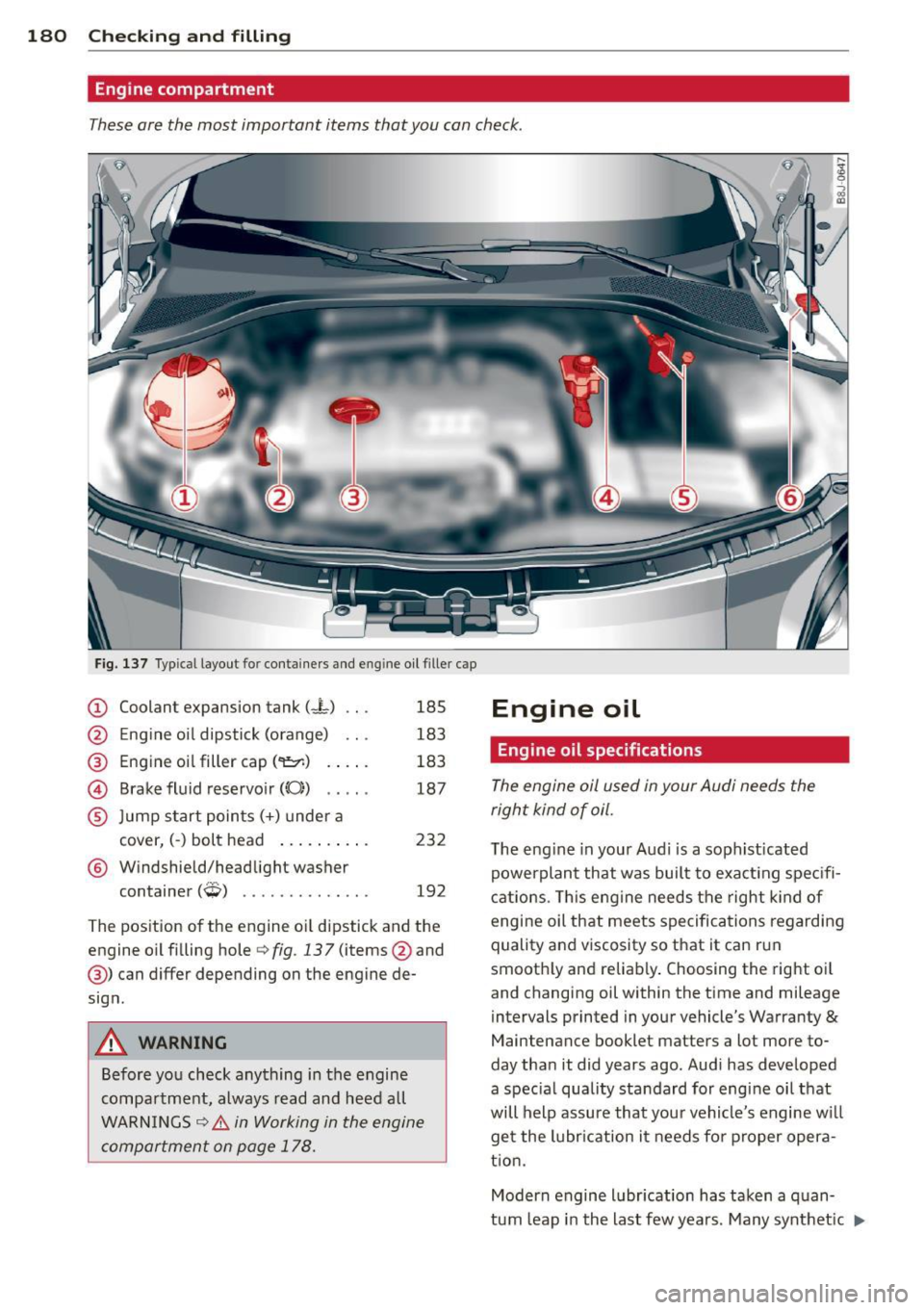
These are the most important items that you can check .
•
Fig. 137 Typ ica l layout fo r containers and eng ine oil filler cap
(D Coolant expansion tank (-L) 185
@ Eng ine o il dipstick (o range) 183
@ Engine oi l filler cap ('1:::r.) . . . . . 183
@ Brake fluid reservoir((();) . . . . . 187
® Jump start points(+) under a
cover,(-) bolt head . . . . . . . . . . 232
® Windshield/headlight washer
t . (
;;p, ) con ainer ,-!,, •••.•••. •.• •• . 192
The position of the engine o il dipstick and the
engine o il filling hole
r::> fig . 137 (items @and
@) can differ depending on the engine de
sign .
A WARNING
Before you check anything in the engine
compartment, always read and heed all
WARN INGS
c::> .& in Working in the engine
compartment on page 178.
Engine oil
Engine oil specifications
The engine oil used in your Audi needs the
right kind of oil.
T he eng ine in your Aud i is a soph ist icated
powerplant that was built to exact ing spec ifi
cat ions . T his engine needs the right kind of
engine oil that meets specifications regarding
quality and viscosity so that it can run
smooth ly and reliab ly . Choosing the right o il
and changing oil within the time and mileage
intervals printed in your vehicle's Warranty
&
Maintenance booklet matters a lot more to
day than it did years ago . Audi has developed
a spec ia l quality standard for engine oil that
will help assure that you r vehicle's engine w ill
get the lubr ication i t needs fo r proper opera
t io n.
Modern engine lubr ication has taken a quan
tum leap in the last few years. Many synthet ic
1J.