wheel AUDI TT ROADSTER 2011 Owner's Manual
[x] Cancel search | Manufacturer: AUDI, Model Year: 2011, Model line: TT ROADSTER, Model: AUDI TT ROADSTER 2011Pages: 260, PDF Size: 64.11 MB
Page 127 of 260
-The inflating airbag will hit the child
safety seat or infant carrier with great
force and w ill smash the ch ild safety seat
and child against the backrest, center
arm rest, door or roof.
- If you must install a rearward facing
child safety seat on the front passenger
seat because of exceptional circumstan ces and the
PASSENGER AIR BAG OFF
light does no t come on and stay on, im
med iately install the rear-facing child
safety seat in a rear seating position and
have the airbag system inspected by your
Audi dealer .
&_ WARNING
Objects between you and the airbag will
increase the risk of in jury in a crash by in
terfering with the way the airbag unfolds or by being pushed into you as the a irbag
inflates.
- Never hold th ings in your hands or on
your lap when the vehicle is in use .
- Never transport items on or in the area
of the front passenger seat. Objects
could move into the area of the front air
bags dur ing braking or other sudden ma
neuver and become dange rous projec
t il es that can cause serious personal in
jury if the airbags inflate.
- Never place o r attach accessories or oth
er objects (such as cup ho lders, tele
phone brackets, large, heavy or b ulky ob
jects) on the doors, over or near the area
marked "AIRBAG" on the steering wheel,
instrument panel, seat backrests or be
tween those areas and yourself. These
objects could cause injury in a crash, es
pecially when the airbags inflate.
- Never recline the front passenger's seat
to transport objects. Items can also move into the area of the side airbag or
the front airbag dur ing braking or in a
sudden maneuver. Objects near the air
bags can be come project iles and cause
injury, part icularly when the seat is re
cl ined.
-
A irbag sys tem 125
&_ WARNING
The fine dust created when airbags deploy
can cause breathing prob lems fo r people
with a history of as thma or other breath
ing cond itions.
- To reduce the risk of breath ing problems,
those with asthma o r other respiratory
conditions s hou ld get fresh air r ight
away by getting o ut of the veh icle or
open ing windows or doors.
- If you are in a collision in which airbags
deploy, wash your hands and fa ce with
mild soap and wate r before eating.
- Be ca reful not to get the dust in to your
eyes, o r into any c uts or sc ratches.
- If the residue should get into your eyes,
f lush them w ith wate r.
Monitoring the
Advanced Airbag System
fl~ Airbag monitoring indicator light
Two separate indicators monitor the function
of the Advanced Airbag System: the airbag
monitoring indicator light and the
PASSEN
GER AIR BAG O FF
light.
T he Advanced A irbag System (includ ing the
electron ic co ntro l unit, sensor circu its and sys
tem wiring) is monitored continuously to
make sure that it is function ing properly
whenever the ignition is on. Each time you
turn on the ignition, the airbag mon itoring in
dicator light
I will come on for a few seconds
(self diagnostics).
Th e syste m mu st b e in spected when the
indicator light
I :
- does not come on when the ignition is
sw itched on,
- does not go out a few seconds after you
have switched on the ignit ion, or
- comes on while driving.
If an airbag system malfunction is detected,
the indicator light wi ll first start flashing to
catch the driver's attention and then stay on
llo-
•
•
Page 130 of 260
128 Airbag system
-Even though your vehicle is equipped
with an Advanced Airbag System, make
certain that all children, especially 12
years and younger, always ride on the
back seat properly restrained for their
age and size.
- If you must install a rearward-facing
child safety seat on the front passenger
seat because of exceptional circumstan
ces and the
PASSENGER AIR BAG OFF
light does not appear and stay on, imme
diately install the rear-facing child safety
seat in a rear seating position and have the airbag system inspected by your Audi
dealer.
- A tight tether or other strap on a rear
ward-facing child restraint attached to
the front passenger seat can put too
much pressure on the weight-sensing
mat in the seat and register more weight
than is actually on the seat. The heavier
weight registered can make the system
work as though an adult were on the seat
and deploy the Advanced Airbag when it
must be suppressed causing serious or
even fatal injury to the child.
- If, in exceptional circumstances, you
must install a forward-facing child re
straint on the front passenger seat, al
ways move the seat into its rearmost po
sition in the seat's fore and aft adjust
ment range, as far away from the airbag
as possible. The backrest must be adjust
ed to an upright position . Make sure that
the
PASSENGER AIR BAG OFF light
comes on and stays on all the time when
ever the ignition is switched on.
A WARNING
- If the PASSENGER AIR BAG OFF light
does not go out when an adult is sitting
on the front passenger seat after taking
the steps described above, have the air
bag system inspected by your Audi deal
er before transporting anyone on the
front passenger seat.
-
(!) Tips
If the weight-sensing mat in the front pas
senger seat detects an empty seat, the
front airbag on the passenger side will be
turned
off, and PASSENGER AIR BAG OFF
will stay on.
Repair , care and disposal of the airbags
Parts of the airbag system are installed at
many different places on your Audi. Installing,
removing, servicing or repairing a part in an
area of the vehicle can damage a part of an
airbag system and prevent that system from
working properly in a collision.
There are some important things you have to
know to make sure that the effectiveness of
the system will not be impaired and that dis
carded components do not cause injury or pol
lute the environment.
A WARNING
-Improper care, servicing and repair proce-
dures can increase the risk of personal in
jury and death by preventing an airbag from deploying when needed or deploying
an airbag unexpectedly:
- Never cover, obstruct, or change the
steering wheel horn pad or airbag cover
or the instrument panel or modify them
in any way.
- Never attach any objects such as cup
holders or telephone mountings to the
surfaces covering the airbag units.
- For cleaning the horn pad or instrument
panel, use only a soft, dry cloth or one
moistened with plain water. Solvents or
cleaners could damage the airbag cover
or change the stiffness or strength of the material so that the airbag cannot de
ploy and protect properly.
- Never repair, adjust, or change any parts
of the airbag system.
- All work on the steering wheel, instru
ment panel, front seats or electrical sys-
tem (including the installation of audio
II),
Page 134 of 260
132 Airbag system
help to reduce the risk of injury to the lower
extremit ies.
All this takes place instantaneously, so fast
that many people don 't even realize that the
airbags have deployed. The airbags also in
flate with a great deal of force and it is impor
tant for occupant safety that nothing should be in their way when they deploy.
Fully inflated airbags in combination with
properly worn safety belts slow down and lim
it the occupant's forward movement and help
to reduce the risk.
Important safety instructions on the
knee airbag system
Airbags are only supplemen tal res traints. Al
ways wear safety belts correctly and ride in a
proper seating position.
The re is a lot tha t you and your passengers
must know and do to help the safety belts and
airbags to provide supplemental protection .
A WARNING
An inflating knee airbag can cause serious
injury. Wearing safety belts incorrectly and
improper seating positions increase the
risk of serious personal injury and death
whenever a vehicle is being used .
- The airbag system cannot protect you
properly if you are seated too close to
any of the airbag locations. When adjust
ing their seat positions, it is important
that both the driver and the front pas
senger keep their upper bodies and
knees at the following minimum safe
distances:
- 10 inches (25 cm) between the chest
and the steering wheel/instrument
panel.
- 4 inches (10 cm) between the knees
and the lower part of the instrument
panel.
- The risk of personal injury increases if
you lean forward or to the side, or if the seat is improperly positioned and you are
not wearing your safety belt. The risk in- creases even more should the airbag de
ploy
.
- Always make sure that the knee airbag
can inflate without interference. Objects
between yourself and the airbag can in
crease the risk of injury in an accident by
interfering with the way the airbag de
ploys or by being pushed into you as the
airbag deploys.
- No persons (children) or animals
should ride in the footwell in front of
the passenger seat.
If the airbag de
ploys, this can result in serious or fatal
injuries.
- No objects of any kind should be car
ried in the footwell area in front of the
driver 's or passenger's seat . Bulky ob
jects (shopping bags, for example) can
hamper or prevent proper deployment
of the airbag . Small objects can be
thrown through the vehicle if the air
bag deploys and injure you or your pas
sengers.
- Make sure there are no cracks, deep
scratches or other damage in the area of
the instrument panel where the knee air
bags are located.
- If children are incorrectly seated, their
risk of injury increases in the case of an
accident
c:> page 136, Child Safety.
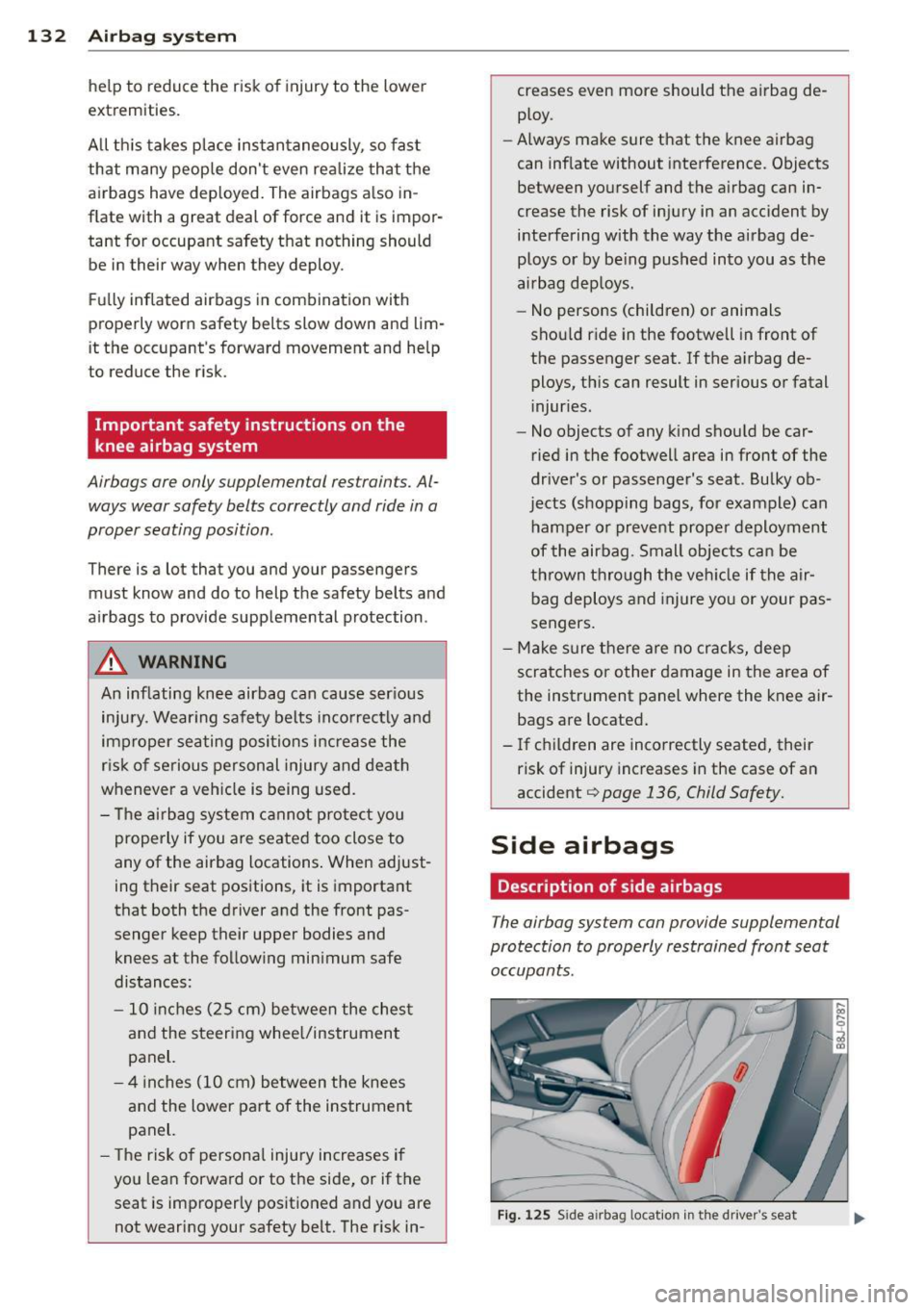
Side airbags
Description of side airbags
T he airbag system can provide supplemen tal
protection to properly restrained front seat
occupants.
Fig. 12S S ide a irba g locatio n in the d river's seat
Page 139 of 260

A WARNING ,~
If, in exceptional circumstances, you must
install a forward-facing child restraint on
the front passenger's seat:
- Always make sure the forward-facing
seat has been designed and certified by
its manufacturer for use on a front seat
with a passenger front and side airbag.
-Always follow the manufacturer's in
structions provided with the child safety
seat or carrier.
- Always move the passenger seat into its
rearmost position in the seat's fore and
aft adjustment range, as far away from
the airbag as possible before installing
the child restraint. The backrest must be
adjusted to an upright position.
- Always make sure that the
PASSENGER
AIR BAG OFF light comes on and stays
on all the time whenever the ignition is
switched on.
Advanced front airbag system and children
Your vehicle is equipped with an "Advanced
Airbag System" in compliance with United
States Federal Motor Vehicle Safety Standard
(FMVSS) 208 as applicable at the time your
vehicle was manufactured.
The Advanced Airbag system in your vehicle
has been certified to meet the "low-risk" re
quirements for 3- and 6-year old children on
the passenger side and small adults on the
driver side. The low risk deployment criteria
are intended to reduce the risk of injury
through interaction with the airbag that can
occur, for example, by being too close to the
steering wheel and instrument panel when
the airbag inflates. In addition, the system has been certified to comply with the "sup
pression" requirements of the Safety Stand
ard, to turn
off the front airbag for infants up
to 12 months who are restrained on the front
passenger seat in child restraints that are list
ed in the Standard.
Child Safety 137
Even though your vehicle is equipped with an
Advanced Airbag system, a child should al
ways ride in theseat properly restrained for its
age and si ze . The airbag on the passenger side
makes the front seat a potentially dangerous
place for a child to ride . The front seat is not
the safest place for a child in a forward-facing
child safety seat . It can be a very dangerous
place for an infant or a larger child in a rear
ward-facing seat.
Advanced Airbags and the weight
sensing mat in the front seat
The Advanced Airbag System in your vehicle detects the presence of an infant or child in a
child restraint on the front passenger seat us
ing the weight -sensing mat in the seat cush
ion and the sensor below the safety belt latch
on the front passenger seat that measures the
tension on the safety belt.
The weight -sensing mat measures total
weight of the child and the child safety seat
and a child blanket on the front passenger
seat. The weight on the front passenger seat
is related to the design of the child restraint
and its "footprint", the size and shape of the
bottom of the child restraint as it sits on the
seat. The weight of a child restraint and its
"footprint" vary for different kinds of child re
straints and for the different models of the
same kind of child restraint offered by child
restraint manufacturers .
The weight ranges for the individual types,
makes and models of child restraints that the
NHTSA has specified in the Safety Standard
together with the weight ranges of typical in
fants and typical 1 year-old child have been
stored in the control unit of the Advanced Air
bag System. When a child restraint is being
used on the front passenger seat with a typi
cal 1 year-old child, the Advanced Airbag Sys
tem compares the weight measured by the
weight sensing mat with the information stor
ed in the electronic control unit.
The electronic control unit also registers the
tension on the front passenger safety belt. ..,. •
•
Page 150 of 260

148 Intelligent technology
Intelligent technology Notice about data
recorded by vehicle
control modules
Your vehicle is not equipped with an Event Da
ta Recorder (EDR), installed by some manu
facturers fo r the express purpose of capturing
data for retrieval after an accident or crash
event . EDR's are sometimes called "crash re
corders".
Some state laws restrict the retrieval or down
loading of data stored by EDR's that were in
stalled in a vehicle for the express purpose of
retrieving data after an accident or crash
event without the owner's consent.
A lthough your vehicle is not equipped with an
EDR, it is equipped with a number of electron
ic control modules for various vehicle systems
such as, for example, engine function, emis
sion control, as well as for the airbags and
safety belts .
These electronic control modules also record
vehicle-related data during normal vehicle op
eration for diagnostic and repair purposes.
The recording capacity of the electronic con
trol modules is limited to data (no sound is re
corded) and only a small amount of data is ac
tually recorded over a very limited period of
time and stored when a system fault or other
condition is sensed by a control unit. Some of
the data then stored may relate to vehicle
speed, direction, braking as well as restraint
system use and performance in the event of a
crash or other condition. Stored data can only
be read and downloaded with special equip
ment.
Electronic Stabilization
Program (ESP)
General
The Electronic Stability Program increases
driving stability.
With ESP, control over the vehicle is increased
in situations when the vehicle is close to the
limits of grip, such as during acceleration and
in curves . ESP reduces the risk of skidding and
improves vehicle stability under all road con
ditions.
It operates at all speeds.
The Anti -Lock Brake System (ABS), Electronic
Differential Lock (EDS) and Anti-Slip Regula
tion System (ASR) are integrated in the Elec
tronic Stability Program .
How ESP works
The ESP control unit processes the following
data from high-sensitive sensors : the rota
tional speed of the vehicle about its vertical
axis , fore-and-aft and lateral acceleration
forces, brake pressure and steering angle.
Using steering angle and vehicle speed, the
direction the driver wishes to travel is deter
mined and continuously compared with actual
vehicle behavior. If the two do not match, for
example when the vehicle begins to skid, ESP
brakes the appropriate wheel automatically.
The vehicle is stabilized again by the forces
acting on the wheel during braking. With an
oversteering vehicle (tendency for the rear end to skid out of the curve), the brake appli
cation is mainly at the front wheel on the out
side of the curve, with an understeering vehi
cle (tendency to run wide in the curve) at the
rear wheel on the inside of the curve or addi
tionally at the other wheels as needed. This
brake application is accompanied by noises.
ESP works in conjunction w ith ABS
~ page 153. If there is malfunction in the
ABS, ESP is also inoperative.
Page 151 of 260

A WARNING
- The limits of physics cannot be suspended by ESP. Even in vehicles w ith ESP, you
should always adapt your driving to road
and traffic conditions. This is particular ly
t rue on a slippery and wet road. Do not
be tempted by the inc reased safety pro
vided to take ris ks - danger of an acci
dent!
- Please note tha t when ESP/ASR is deacti
vated, the drive whee ls can spin on icy
and slippery roads and the veh icle can
break away - danger of skidding!
Switching on and off
Fi g. 130 Center co nsole wit h ESP switch
The ES P is a utomatically activated when the
engine is star ted, and it performs a self-test.
As soon as the test is completed, the system
is in normal operating mode.
Deactivating
ESP should normally be activated at all times
because this ensures optimum vehicle stabil i
ty. Only in some cases it does make sense to
deactivate the Electronic Stability P rogram
(ESP) by press ing the button
~fig . 130. Deac
tivation is ind icated by the ESP lamp
I in the
instr ument cluster f lashes. The message
ESP
OFF
appears in the instrument cluster. Ant i
Slip Regulation is completely deactivated and
the stabilization effects from the ESP system are lim ited. Th is makes a mo re agile and spor
ty driv ing style poss ible, but the fu ll exte nt of
t he s tabiliza tion f unct ion is not available .
Intelligent technolog y 149
Activating
Press the@] button again~ fig. 130. T he ind i
cator light
I goes out . The message ESP ON
appears brief ly in the instrument cluster dis
play.
&_ WARNING
i=
You shou ld only switch the ESP off if your
driving ab ility and the traff ic situat ion al
low. Please note that when ESP/ASR is de
activated, the d rive wheels can spin on icy
a nd slippery roads and th e vehicle can
b reak away- dange r of skidd ing!
a) Tips
- If Aud i magnetic ride* is malfunct io ni ng,
the ESP may not sw itch off or it may
switch off automatically.
- In the event of a defect in the rear spoil er sys tem or in Audi magnet ic ride, it can
happen that ASR and ASR/ESP cannot be
deactivated, o r they are ac tiva ted au to
matically in the deactiva ted st ate.
Electronic differential lock (EDL)
The electronic differential lock monitors the
rotational speed of the drive wheels.
General notes
The electronic d ifferential lock (EDL) helps the
ca r to start moving, accele rate and climb a
gradient on su rfaces provid ing poor or a lmost
no g rip. Withou t EDL, this would be d iff icul t ,
i f not impossib le.
How the system works
The EDL operates automatica lly. It mon itors
the rotational speed of the dr ive wheels on an
axle with the help of the ABS sensors
c;:> page 153. If a noticeable difference in ro
tational speed
between the drive wheels on
o ne axle is detected (e.g. on s lippery ground
on one side), the s pinning wheel is braked,
thereby t ransferring power to the other drive
whee l or wheels (a ll-wheel drive). This is done
up to a speed of about 60 mph (100 km/h). ..,_
Page 152 of 260

150 Intelligent te chn olog y
Noises from the b rake system signal that
wheel spin is being controlled.
Driving off
When drivi ng off, a lways be sure to keep road
conditions in mind as you accelerate. If one
d rive wheel spi ns because it is on a surface
with less grip, gradua lly increase the press ure
on the accelerator pedal until the car starts to
move. The wheel less able to transfer power
spins.
O verheating of bra kes
To prevent the disc brake of the braked wheel
from overheating if subjected to excessive
loads, the EDL cuts out temporarily. The vehi
cle rema ins operationa l and behaves in the
same way as a vehicle without EDL.
As soon as the brake has cooled down, EDL
switches on again automatically .
A WARNING
-When accelerating on slippery surfaces,
such as on ice or snow, always be careful
when depressing the acce lerator pedal.
Even with the EDL working, the drive
wheels can spin and reduce yo ur ability
to contro l your car. -Risk of crash!
- The increased safety afforded by EDL
does not mean that you can ta ke safety
risks. Always adapt your dr iving sty le to
the road conditions and traff ic situa tion.
@ Tips
If a fa ult occurs in the ABS, the EDL is also
not f unct ion ing. This is indicated by the
ABS warning light ¢
page 17.
Anti-Slip Regulation System (ASR)
The Anti-Slip Regulation System prevents the
driven wheels from spinning wh en the car is
accelerating.
General notes
The Anti-Slip Regulation System (ASR) is inte
grated in the electronic stabilization program
(ESP). When th e vehicle starts up and acceler- ates, the whee
ls are prevented from spinning
by adjusting the engine power to match the
amount of grip available from the road sur
face.
How the system works
ASR pe rforms a utomat ica lly, i.e . w ithout t he
driver's intervention. With the aid of the ABS
sensors ¢
page 153, ASR monitors t he speed
of the dr iven whee ls . If the whee ls start to
spin, the engine torq ue is reduced automati
cally until the tires find enough gr ip to lock
onto the road surface . The system is active
across the ent ire speed range .
The ASR works in conjunction with the ABS. If
a malfunction should occur in the ABS, the
ASR w ill also be out of act io n.
@ Tips
To ensure that the ASR works properly, all
four whee ls must be fitted wit h ident ica l
tires . Any differences in ro lling radius of
the tires can cause the system to reduce
engine power wh en this is not desired. See
a lso
¢ page 205, New tires and repla cing
tires and wheels.
Rear spoiler
The rear spoiler improves vehicle handling
and enhances driver control .
Fig. 131 Switc h fo r rear spo iler
The rear spoiler deploys and retracts. Spoiler
operation can be set for automat ic or manual
operation .
Page 155 of 260
Anti-lock brake system (ABS)
ABS prevents the wheels from locking under braking.
The anti-lock brake system (ABS) makes a ma
jor contribution to increasing active dr iving
safety. You should not expect that braking d is
tances will be
shortened under all circumstan
ces with ABS. Braki ng d istance may even be
come somewhat
longer, for example, on grav
e l or in new snow on slippery g round, even if
you are driving care fully and s low ly.
ABS operation
When a vehicle speed of about 10 mph (20
km/h) is reached, an automatic test sequence
is run. Some noise from the pump may be au
d ible.
I f the speed of a wheel slows down too much
r e lative to veh icle speed and it starts to lock,
brake pressure to this wheel is reduced. This
ad justment process can be felt as a
pul sin g
moti on of the br ake pedal , accompanied by
some noises. You as the driver are intentiona l
ly being given the information that the whee ls
are tending to lock (ABS control range). In or
der for ABS to be able to operate optimally in
this range, you must keep the brake pedal de pressed - do not "pump the brakes ".
Brake a ssist ant
The brake power assist unit increases the
pressure that you generate with the brake
pedal. It works only w hen the eng ine is run
ning .
Automatic full br ak ing
This function allows full brak ing in spite of
high brake pedal forces (e.g. when the brakes
are severely stressed because the vehicle is
fully loaded) . The driver notices th is function
throug h a reduction of pedal force and in
creased pedal travel. When the brake pedal is released, fu ll braking assist switches off again
automatically .
Intellig ent technolog y 153
If there is an ABS failure, the b rake assistant
and automatic fu ll braking assist are not avail
able.
A WARNING
- ABS cannot suspend the laws of physics.
You should keep th is in mind in particu
lar on an icy or wet road . If ABS control
of braking intervenes, you should adjust
your speed immed iately to road and traf
fic conditions. Do not be tempted by the increased safety provided to take risks -
danger o f an accident .
- Please keep in mind tha t the risk of an
accident is increased by driving too fast,
particularly in bends and on icy or wet
roads, and by driving too close to the ve
hicle ahead . The increased risk of an acci
dent cannot be reduced by the brake as
sistant - danger of an accident.
(D Tips
If a malfunction occurs in the ABS, this is
s ignalled by an indicator light, see
<=:> page 17.
Electro-mechanical
power assist
The electro-mechanical power assist helps
the driver when steering .
The degree of power assist is electronically
matched to vehicle speed.
The power steering system assists the driver
so that he can steer the vehicle with reduced physical effort .
Power steering will not work if the engine is
off . As a result, the steering wheel will be hard
to turn .
A WARNING
If the system develops a problem, you
must seek qualified professiona l assis
tance.
•
•
Page 156 of 260
154 Intelligent technology
If there is an electronic malfunction, ser
votronic
w ill st ill function like a conven
tional power steer ing system, prov iding a
constant steer ing support force that is no
longer proportionate to the ve hicle speed .
This is most noticeable when turning the
steer ing whee l at low speeds (for examp le
when par kin g), -more effo rt will be re
qui red th an usual.
- Be aware of the different than usual
stee ring response and adjust you r steer
i ng force a ccord ingly.
- Have the p roblem chec ked and set right
by an authori zed Audi dealer as soo n as
poss ib le.
- If a stee ring malfunct io n occu rs, this is
s ignaled with the
42J or .• indic ator
li ghts and a wa rning tone, see.
(D Tips
- If the power steering system shou ld fa il,
or if the eng ine is no t runn ing (fo r exam
ple, while being towed), yo u wi ll st ill be
able to stee r the veh icle. However, more
effort will be req uired to do so .
- If the power steer ing system is not func
tioning p roperly , contact your a uthorized
A udi dealer immediate ly .
Driving with your
quattro ®
With All Wheel Drive, all four wheels are driv
en.
General inform ation
W ith All Whee l Dr ive, power is d istributed to
all four wheels. This happens automatically
depending on your dr iv ing sty le and the road
conditions at the t im e. See also ¢
page 149,
E lectronic differential lock (EDL) .
Winter tires
When driving in the winter, your vehicle w it h
All Wheel Drive has an advantage, even with regular t ires. In winter road co nditions it may
be adv isable to mount winter tires (o r all-sea- son tires) for
improved driveability and brak
ing : these tires must be mounted o n
all four
wheel s.
See also ¢ page 209, Winter tires .
Snow chains
Where tire chains a re m andatory o n certa in
roads, this no rma lly also app lies to ve hicles
wi th All Wheel Drive
¢ page 210, Snow
chains.
Replacing wheels /tires
Vehicles wi th A ll Wheel D rive mus t always
have t ires of the same s ize. A lso avoid tires
with different tread depths . For deta ils see
page ¢
page 205, New tires and replacing
tires and wheels .
Off-Road driving?
Your Aud i does not have enough g ro und clea r
an ce to be used as an off- road vehicle. It is
therefore bes t to avoid rough tracks and un
even terrain as much as possib le . Also refer to
¢ page 158.
A WARNING ~
Always ad just your dr iv ing to road and traf-
f ic conditions. Do not let the extra safety
afforded by All Wheel Dr ive tempt you into
taking ext ra ris ks.
- Although the All Wheel Drive is very ef
fective , always remember that braking
capacity is lim ited by tire t raction . You
should therefore not d rive at excessive
speeds on icy or slippe ry road s urfa ces.
- On wet road surfaces, be careful not to
drive too fast because the front whee ls
could begin to slide o n top of the wate r
(aquapla ning). If th is should occur, yo u
will have no warning from a s udden in
crease in eng ine speed as wit h a front
wheel drive veh icle. Always drive at
speeds which are su ited to the road con
d itions. -risk of crash.
Page 164 of 260
162 Cleaning and protection
Cleaning and
protect ion
General information
Regular care preserves vehicle value .
Any automobile is exposed to industr ial
f umes, corrosive road salt, etc. A well cared
for Audi can look like new many years after pu rchase . Regula r and correct care w ill con
tr ibute to maintain ing the beauty and value of
your Aud i.
Furthermore , good care may be a condition
for substantiating a warranty claim should
corrosion damage or paint de fects occur.
Your authorized Audi dealer has a variety of
dedicated vehicl e-care products and can ad
v ise wh ich ones to use for cleaning the exter i
or and inte rior of your vehicle .
Whether you use produc ts recommended by
Aud i or other commercially ava ilable clean ing
agents, please make sure you apply t hem cor
r ectly .
A WARNING
-Cleaning agents may be poisonous. Keep
them o ut of t he rea ch of childre n.
- Heed a ll ca ution labels.
- Always read directions on th e co ntai ner
b efore using a ny product . Follow the di
rec tions caref ully.
- Most chemical cleaners a re concentrat ed
and have to be diluted.
- Use spot removing fluids only in well
ventilated areas.
- Do not use gasoline, kerosene, d iesel
fuel, nail pol is h remover or ot her volati le
fluids. They may be toxic, flammab le or
h azar dou s in other w ays. Do not was h,
w ax or dry the vehicle wi th the ig nit ion
on or the eng ine running .
- D o not cl ea n the under sides of ch assis,
f en ders, wheel cove rs , etc. without pro
tectin g your hands and a rms. You may
c u t yourself on s harp-ed ged metal parts . -
Moisture and ice on b rakes may impair
brak ing eff ic iency
c::> page 151 , General
information.
Test the brakes carefully
each time you wash t he vehicle .
@ For the sake of the environment
Select on ly environ mentally friendly clean
i ng products. Leftover cleaning products
s hou ld not d isposed of in the househo ld
waste .
Care of exterior
Washing
Frequent washing protects the vehicle .
The best p rotection against environmen tal i n
fluences is
frequent wash ing and waxing . How
often t his is requi red depends o n:
- How much t he ve hicle is used
- Whe re the veh icle is parked (garage, i n the
open under trees, etc.)
- The seasona l and weather conditions
- Environmental infl uences
T he longer b ird d roppings, inse cts, tree res in,
r oad and indus trial grime, ta r, soo t, road salt
and other mater ials remain on the vehicle
paint, the more lasting t heir destr uctive ef
f ects w ill be .
Hig h tempera tures, as from e xpos ure to in
tense sun light, intensify the co rrosive e ffect
part icu lar ly when humidity is high as well.
Un der certa in ci rcumstances,
weekly w ashing
may be ne cessary. Un der othe r cond it ions , a
mon thly washing and waxing may be a de
quate.
After the winter, the unders ide of the vehicle
sho uld be thoro ughly washe d pre ferab ly in a
pro fessional ca r wash.
A WARNING ~
A lways read and heed all WARNINGS a nd
the information
c::> page 162.