seats AUDI TT ROADSTER 2011 Owner's Guide
[x] Cancel search | Manufacturer: AUDI, Model Year: 2011, Model line: TT ROADSTER, Model: AUDI TT ROADSTER 2011Pages: 260, PDF Size: 64.11 MB
Page 144 of 260
142 Child Safet y
Convertible child safety seats
Properly used convertible child safety seats
can help protect toddlers and children over
age one who weigh between
20 and 40 lbs . (9
and 18 kg) in a crash.
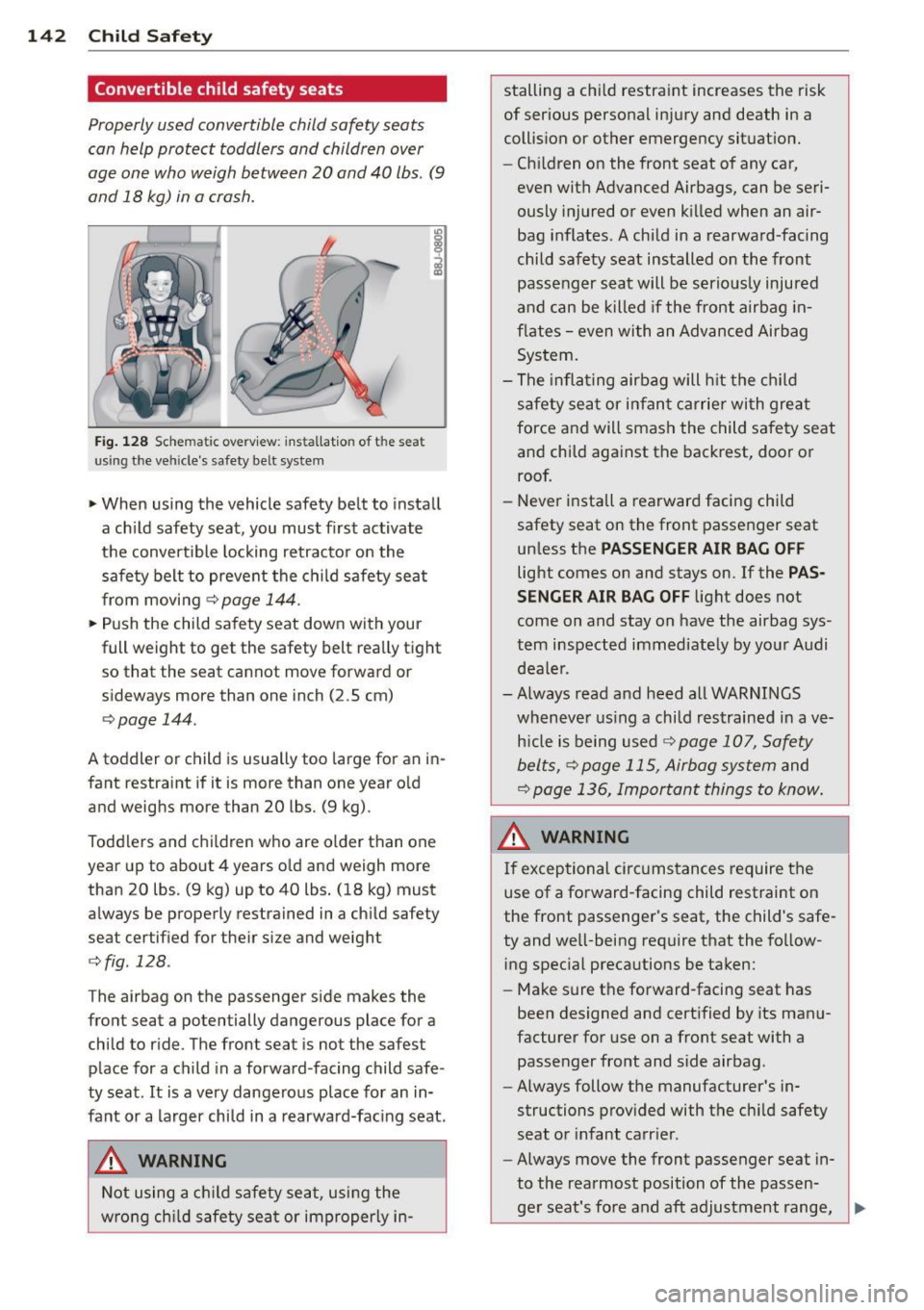
Fig. 128 Sche mati c ove rview : in stallat ion o f the seat
u sing t he ve hicle's safety be lt system
~ When using the vehicle safety be lt to install
a ch ild safety seat, you must first activate
the convertible locking retracto r on the
safety belt to prevent the child safety seat
from movi ng
Q page 144.
~ Push the child safety seat down with your
full weight to get the safety belt rea lly tight
so that the seat cannot move forward or
sideways more than one inch (2.5 cm)
Q page 144.
A toddler or child is usually too large for an in
fant restraint if it is more than one year o ld
and weighs more than 20 lbs. (9 kg) .
Toddle rs and c hildren who are o lder than one
year up to about 4 years o ld and weigh more
than 20 lbs . (9 kg) up to 40 lbs. (18 kg) must
a lways be properly restrained in a ch ild safety
seat certi fied for the ir size and weight
Q fig . 128 .
The airbag on the passenger side makes the
front seat a potentially dangerous place for a child to r ide. The front seat is not the safes t
p lace for a child in a forward -facing child safe
ty seat.
It is a very dangero us p lace for an in
fant or a larger child in a rearward-facing seat .
A WARNING
Not using a child safety seat, usi ng the
w ro ng ch ild s afety sea t or improperly in-
-
stalling a ch ild restra int increases the risk
of ser ious personal in jury and death in a
collis ion or other emergency situat ion.
- Ch ildren on the front seat of any car,
even with Advanced Airbags, can be seri
ously i njured or even k illed when an air
bag inflates . A chi ld in a rearwa rd-facing
child safety seat installed on the front passenger s eat will be s erio usly injured
an d can be killed if the front a irbag in
f lates -even with an Advanced Airbag
Sys tem.
- T he infla ting airbag will h it the c hild
safety sea t or i nfan t carrier wi th grea t
force and will smash the child safety seat
and child aga inst the back rest, door or
roof.
- Never i nsta ll a rearward facing child
safety seat on the front passenger seat
un less the
PASSENGER AIR BAG OFF
light comes on and stays on. If the PAS
SENGER AIR BAG OFF
light does not
come on and stay on have the airbag sys
tem inspected immediate ly by yo ur Audi
deale r.
- Always read and heed all WAR NINGS
wh eneve r using a child restrained in ave
h icle is being used
9 page 107, Safety
belts,
Q page 115, Airbag system and
Q page 136, Importan t thing s to know .
.8_ WARNING
If excep tional circ ums tan ces require the
use of a fo rward -f a cing child restraint on
the front passenger's seat, the child's safe
ty and we ll-being requ ire that the fo llow
in g spec ial precautions be taken:
- Make sure t he forward -facing seat has
been designed and cert ified by its man u
facturer for use on a front seat with a
passenger front and side airbag .
- Always follow the manufacturer's in
structions prov ided with the c hild safety
seat o r infant ca rr ie r.
- Always move the front passenger seat in
to the rearmost position of the passen- ge r seat's fo re and aft adjustment range, ,..
Page 145 of 260
and as far away from the airbag as
poss ible before installing the child re
straint.
- Always make sure that nothing prevents
the front passenger's seat from being
moved to the rearmost position in its
fore and aft adjustment range .
- Always make sure the backrest is in an
upright position .
- Make sure that the
PASSENGER AIR BAG
OFF
light comes on and stays on all the
time whenever the ignition is switched
on .
- If the light does not stay on, perform the
checks ~
page 125, Monitoring the Ad
vanced Airbag System .
- If the PASSENGER AIR BAG OFF light
does not come on and stay on have the
airbag system inspected immed iate ly by
your Audi dealer.
Booster seats and safety belts
Properly used booster seats can help protect
children weighing between about 40 lbs. and
80 lbs. (18 kg and 36 kg) who are less than 4
~- 9 in . (57 inches/1 .45 meters) tall.
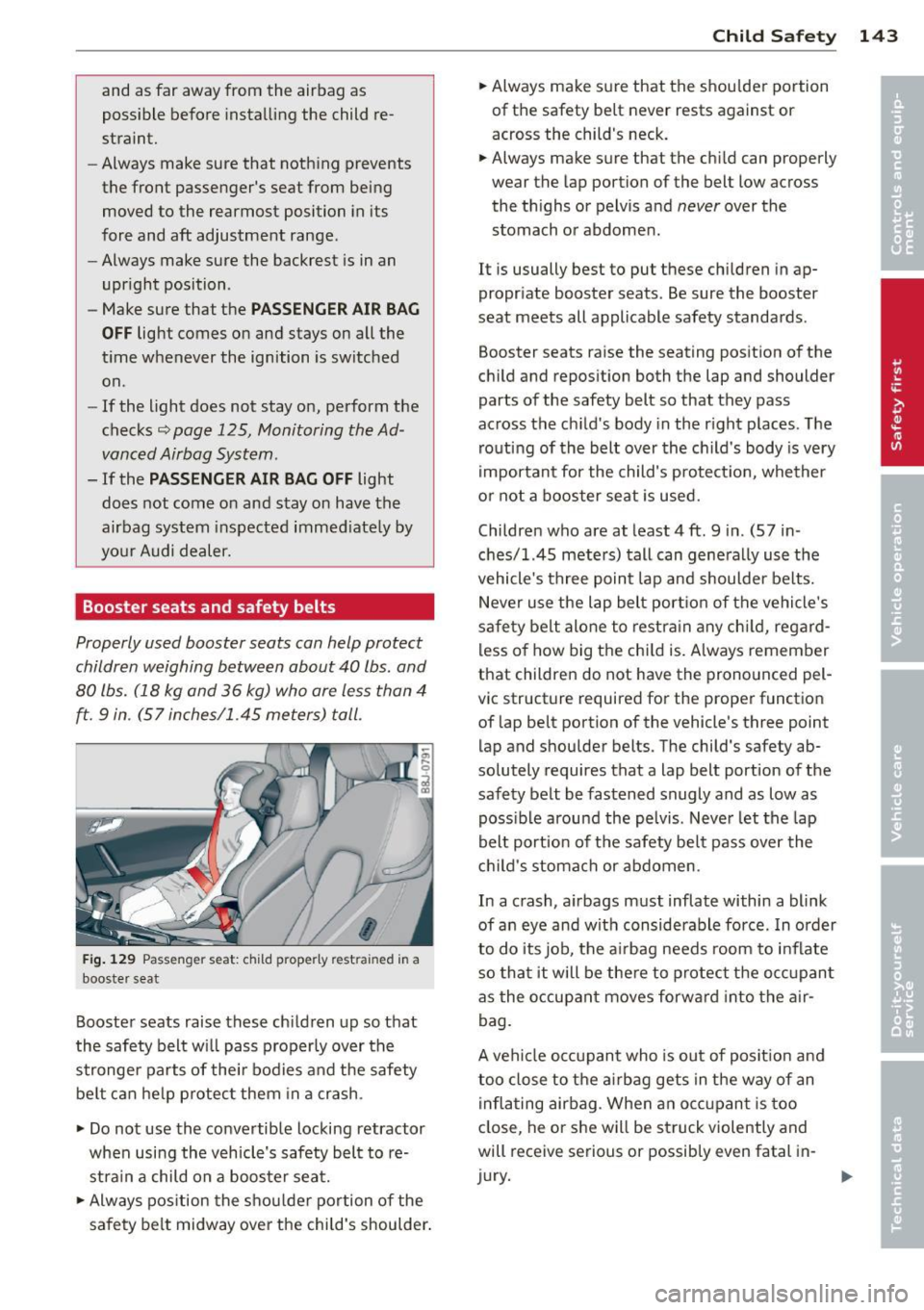
Fig. 129 Passe nger seat : ch ild p rop erly rest ra in ed in a
boos ter sea t
Booster seats raise these children up so that
the safety belt will pass properly over the
stronge r parts of their bodies and the safety
belt can he lp pro tec t them in a crash .
• Do not use the convertible locking retractor
when using the vehicle's safety belt to re
strain a child on a booster seat.
• Always position the shoulder portion of the
safety belt midway over the chi ld's shoulder . Child Safety 143
• Always make sure that the shou lder portion
of the safety belt never rests against or
across the child's neck.
• Always make sure that the ch ild can properly
we ar the lap portion of the belt low across
the th ighs or pelvis and
never over the
stomach or abdomen .
It is usually best to put these children in ap
propr iate booster seats . Be sure the booster
seat meets all applicable safety standards .
Booster seats raise the seating position of the
child and repo sition both the lap and shoulder
parts of the safety belt so that they pass
across the ch ild's body in the right places . The
routing of the belt over the child's body is very
im portant for the child's protect ion, whether
or not a booster seat is used.
Children who are at least 4 ft. 9 in . (57 in
ches/1.45 meters) tall can generally use the
vehicle 's three point lap and shoulder belts.
Never use the lap belt portion of the vehicle's
safety belt alone to restra in any child, regard
less of how big the chi ld is. A lways remember
that children do not have the pronounced pel
vic structure required for the proper function
of lap belt portion of the vehicle's three point
lap and shoulder belts. The child's safety ab
solutely requires that a lap belt portion of the
safety belt be fastened snugly and as low as
poss ible around the pelvis. Never let the lap
belt portion of the safety be lt pass over the
child's stomach or abdomen .
In a crash, airbags must inflate within a blink
of an eye and with considerable force . In order
to do its job, the airbag needs room to inflate
so that it will be there to protect th e occupant
as the occupan t moves forwa rd into the air
bag .
A vehi cle occupant who is out of position and
too close to the airbag gets in the way of an
inflating airbag. When an occupa nt i s too
close, he or she will be struck violently and
will receive serious or possibly even fatal in -
jury.
Ill>
Page 146 of 260
144 Child Safety
In o rder for the airbag to offer protection, it is
important that all vehicle occupants, especia l
l y any children, who must be in the front seat
because of exceptional circumstances, be
properly restrained and as far away from the
a irbag as poss ible. By keep ing room between
the child's body and the front of the passen
ger compartment, the airbag can inflate com
p letely and provide supplemen tal p rotection
i n cer tain frontal co llisions .
& WARNING
Not using a booster seat, using the boos
ter seat improperly, incorrect ly installing a
booste r seat or using the vehicle safety
belt improperly increases the risk of seri
ous personal injury and death in a collision
or ot her emergency situation. To help re
duce the risk of ser ious personal injury
and/or death:
- Always make sure to position the should
er port ion of the three-po int belt over
the midd le of ch ild's shou lder .
- Never let the shoulder port ion of the belt
rest against or across the neck, face,
chin, or throat of the child .
-Always make sure the lap belt portion of the three-po int be lt is worn snug and
passes as low as possib le across the
c hild's pelvis. Neve r let the belt pass over
the soft abdomen.
- Failure to properly route safe ty belts
over a ch ild 's body will cause severe inju
ries in an acc iden t or other emergency
sit uation
c;, page 10 7.
- Children on t he front seat of any car ,
even w ith Advanced A irbags, can be seri
o usly injured or even killed when an air
bag inflates .
- Never let a child stand or knee l on any
seat, for examp le the front seat.
- Never let a child ride in the ca rgo a rea of
yo ur vehicle.
- Always remember that a ch ild lean ing
f orward, sitting sideways or o ut o f posi
t ion in any way during an acc ident can be
struck by a deploying airbag. This will re
sult in serious personal injury or death.
-
- If you must insta ll a booster seat on the
front passenger seat because of excep
tional circumstances the
PASSENGER
AIR BAG OFF
li ght must come on and
stay on, whenever the ignition is switch
ed on .
- If the
PA SSENGER AIR BAG OFF light
does not come on and stay on, pe rform
the checks descr ibed
¢page 125, Moni
toring the Advanced Airbag System.
- If the PASSENGER AIR BAG OFF light
does not come on and stay on whenever
the ignition is switched on the infla ting
ai rbag w ill hit the child sa fety seat or in
fant car rier with g reat force and will
smash the child safety seat and child
aga inst the backrest, door or roof . Have
the airbag system inspected immed iately
by your Audi dea ler.
- Always read and heed all WARNINGS whenever us ing a child restrained in ave
h icle is being used
c;, page 107, Safety
belts,
c;, page 115, Airbag system and
c;, page 136, Important things to know.
Installing a child safety
seat
Securing a child safety seat using a
safety belt
Safety belts for the front passenger can be
locked with the convertible locking retractor
to properly secure child safety seats .
The safety belts emergency locking retractors
for the front passenger's seat safety belt have
a convertible locking retractor for ch ild re
stra ints . The safety be lt must be locked so
that be lt webbing cannot unree l. The retrac
tor can be act ivated to lock the safety belt and
prevent the safety be lt webb ing from loosen
ing up during norma l driving. A child safety
seat can only be properly insta lled when the
safety belt is locked so that the chi ld and child
safety seat will stay in place.
Always remember : Even tho ugh your vehicle is
equipped with an Advanced Airbag system, a
ll-
Page 147 of 260
child should always ride in the seat properly
restrained for its age and size .
A WARNING
Improperly installed child safety seats in
crease the risk of ser ious personal injury
and death in a collision.
- Always make sure that the safety belt re tractor is locked when installing a ch ild
safety seat . An unlocked safety belt re
tractor cannot hold the child safety seat
in place during normal driving or in a
crash.
- Always buckle the child safety seat firmly
in place even if a child is not s itting in it .
A loose ch ild safety seat can fly around
dur ing a sudden stop o r in a coll ision
- T he inflating a irbag w ill hit the child
safety seat or infant carrier w ith great
f orce and w ill smash t he ch ild safety sea t
and child against the backrest, door or
roof .
- F orward-fac ing ch ild safe ty sea ts or in
f ant ca rriers installed on the front pas
senger's seat may inte rfe re with the de
ployment of the airbag and cause serious
injury to the ch ild.
- Always read and heed all WARNINGS
whenever using a child restrained in
ave
hicle is being used¢ page 136 . Special
precautions apply when installing a ch ild
safety seat on the front passenge r seat
¢ page 116, Child restraints on the front
seat -some important things to know.
A WARNING
-
Always take special precautions if you
m ust in stal l a forw ard or rearward-f acing
child restrain t on the front passenger's
sea t in except iona l situat ions:
- Whenever a fo rw ard or rearward- facing
child restraint is installed on the fron t
passenge r seat, the
PASSENGER AIR
BAG OFF
light must come on and stay on
whenever the ignition is switched on.
- If the
PASSENGER AIR BAG OFF light
does not come on and stay on, perform
Child Sa fet y 145
the checks described ¢ page 125, Moni
toring the Advanced Airbag System.
- If the PASSENGER AIR BAG OFF light
does not come on and stay on whenever
the ignition is switched on the inflating
airbag w ill hit the child safety seat or in
fant carrier with great force and will
smash the child safety seat and child
aga inst the backrest, door or roof. Have
the airbag system i nspe cte d immed iate ly
by your Audi de aler.
- I mp roper installation of ch ild restraints
can reduce t heir effec tiveness o r even
preven t them from providing any pro tec
tion.
- An improperly installed ch ild restr aint
can interfere with the airbag as i t de
ploys and seriously injure o r even kil l the
child.
- Always carefu lly follow the manu fact ur
er 's instructions p rovi ded with t he chi ld
safety seat or car rier .
- Never p lace additiona l items on the seat
that ca n increase the total weight reg is
tered by the weight-sensing mat and can
cause injury in a crash.
A WARNING
Forward-facing child rest raints:
- Always make s ure the forward- facing
seat has been designed and certified by its manufacturer for use on a front seat
with a passenger front and s ide a irbag .
- Never put the forward-facing child re
straint up , against or
very near the in
strument panel.
- Always move the passenger seat into its
rearmost pos ition in the seat 's fore and
aft ad justment range, as fa r away from
the airbag as possible before installing
the forward-fa cing ch ild restra int. The
b ackrest mus t be ad ju ste d to a n up right
posi tion.
- Ma ke sure that the
PASSENGER AIR BAG
OFF
li ght comes on and st ays o n all the
time whenever the ignit ion is switched
on. •
•
Page 149 of 260
Deactivating the convertible locking
retractor
The convertible locking retractor for child re
straints will be deactiva ted automatically
when the belt is wound all the way back into the retractor.
" Press the red button on the safe ty belt buc k
l e. The bel t tongue w ill pop out of the buck
l e .
" Guide the safety be lt all the way back into
its stowed pos ition .
A lways le t the safety belt retrac t complete ly
into its stowed pos it ion . The sa fety belt can
now be used as an ordinary safety belt with
out the convert ib le lock ing ret ractor for chi ld
rest ra ints .
If the conver tible locking retractor shou ld be
activated inadve rtently , the safety belt m ust
be unfastened and guided comp letely back in
to its stowed position to deactivate th is fea
ture. If the conver tib le locking retractor is not
deactivated, the safety belt will gradually be
come tighter and u ncomfo rtable to wea r.
A WARNING
Imprope rly insta lled child saf ety seats in
c rease the risk of ser ious perso nal inju ry
a n d de ath in a colli sion.
- Never unfasten the safety belt to deacti
va te the convert ible lo cking re tr actor for
ch ild re st rain ts w hile the veh icle is mov
ing. You would not be rest rained an d
cou ld be ser iously injure d in an accident.
- Always read and hee d all WARN INGS
whenever using a child rest rained in ave
hicle is being use d¢
page 136. Spec ial
precautions apply when installing a ch ild
safety seat on the front passenger seat
¢ page 116, Child restraints on the front
seat -some important things to know .
Child Safet y 147
Additional Information
Sources of information about child
restraints and their use
T here a re a number o f sources of add itiona l
information abo ut child restraint se lection, in
stallation and use :
N HT SA advises t hat the bes t ch ild safety seat
is the one that fi ts your chi ld and fits in your
vehicle, and that yo u will use correct ly and
consistently.
T ry before yo u buy!
U.S National Highway Traffic Safety Admin
istration
T el.: 1 -888 -3 27-42 36 (TIY: 1-800-4 24-9153)
www. n hts a .gov
National SAFE KIDS Campaign
Tel.: (202) 66 2-0600
www.safe kids.o rg
Safety BeltSafe U. S.A
Tel.: (800) 7 45-SAFE (English)
Te l.: (800) 7 47-SANO (Span ish)
www. carseat .org
Transport Canada Information Centre
Tel.: 1 (800) 333-037 1 or call
1 (613) 9 98-8616 if you are in the Ottawa
area
www.tc.gc. ca/ ro ad safe ty
Audi Cu stomer CARE
T el.: (800) 82 2-2834 •
•
Page 158 of 260
156 Intelligent technology
If starting capability is jeopa rdized due to en
ergy consumption, a message appears in the
driver information disp lay.
You have to start the engine to charge the
battery.
With the engine running
A lthough electrical energy is generated when
the vehicle is being driven, the battery can be
come discharged. This happens most ly when
little energy is being generated and a great
deal consumed and the battery's state o f
charge is not optima l.
To bring the energy balance back into equili
brium, consumers which require especially
l arge amounts of energy are temporarily cut
back or switched off. Heating systems in par
ticular require a great dea l of energy. If you
notice, for example, that the heated seats* or
the heated rear window are not heating, they
have been temporar ily cut back or switched
off. These systems will be ava ilable again as
soon as the energy balance has been restored.
You will also notice that engine idle speed has been increased slightly . This is normal and not
a cause for concern . By increas ing engine idle
speed the add itiona l energy required is gener
ated and the battery is charged.
Driver notification in the instrument
cluster display
If battery power drops into the range where it
can limit the ability of the engine to start, th is
is shown in the instrument cluster display
with the following driver message:
(•) Low battery charge : battery will be
charged while driving
This notification reminds you that the starting
capability of the engine may be limited. As
soon as you start driving again, the battery
will be recharged and the notification will go
out.
Driver notification appears and goes out
again
If this driver notification appears after the ig
nition is turned on or whi le driving and it goes
out again after a while, the battery has been
adequately recharged.
Driver notification appears and does not
go out again
If this driver notif ication appears after the ig
nition is turned on or while driving and does
not go out again, the battery 's state of charge
is not in the optimal range. Starting ability is
restricted . Have the battery checked as soon
as possible by an autho rized Aud i dea le r o r
qualified wo rkshop.
Page 171 of 260
(D Note
To avoid scratching the display, you should never clean it dry.
Aluminum trim
Use only neutr al- pH products to remove spots
and depos its from alum inum surfaces.
Chrome care products and alkaline cleaners
will attack alum inum su rfaces and can dam
age them over time.
A WARNING
Always read and heed a ll WARNINGS and
t he information<=>
page 162.
Fabrics and fabric coverings
Fabrics and fabric coverings (e .g. seats, door
trim panels, etc.) should be cleaned at regular
interva ls with a vacuum cleaner. T his removes
surface dirt particles which could become em
bedded in the fabr ic through use. Steam
cleaners should not be used, because the
steam tends to push the dirt deeper into the
fabric and lock it there.
Norm al cleaning
Generally, we recommend using a soft sponge
or a lint-free microfiber cloth to the clean fab
ric. Brushes should only be used for carpets
and floor mats, s ince other fabric surfaces
could be harmed by b rushes .
Normal surface sta ins can be cleaned using a
commercially available foam cleaner . Spread
the foam on the surface of the fabric with a
soft sponge and work it in gently . Do not satu
rate the fabric. Then pat the foam d ry using
absorbent, dry cloths (e.g. microfibe r clo th)
and vacuum it afte r it has dr ied comp lete ly.
Cl eaning stains
Stains caused by beve rages (e .g. coffee, fruit
juice, etc.) can be t reated with a mild deter
gent solution. App ly the dete rgent so lution
wi th a sponge. In the case of s tubbor n stains,
a detergent paste can be applied directly to
Cleaning and protec tion 169
the stain and worked into the fabric. After
wards, use copious amounts of clean water to
remove the rema in ing detergent. Apply the
water with a damp cloth or sponge and pat
the fabric dry with an absorbent, dry cloth.
Stains from choco late or makeup should have
detergent paste (e.g . ox-gall soap) rubbed in
to them. Afterwards, remove the soap with
water (damp sponge).
A lcohol can be used to treat stains from
grease, o il, lipstick or a ballpoint pen. Melted
grease or dye must be patted off using ab
sorbent mater ial. It may be necessary to re
treat the areas with detergent paste and wa
te r.
In the case of genera l soiling of the uphols
tery and cover material, we recommend hir ing
a specia list that has the equipment to clean
t h e seat covers and othe r fabr ic surfaces by
shampooing and spray extraction .
A WARNING
Always read and heed all WARNINGS and
the info rmation
<=> page 162.
@ Tips
Open Velcro fasteners on your clothing can
damage the seat cover. Please make sure
that Ve lcro fasteners are closed.
Plastic parts and instrument panel
A lways use a clean clo th moistened in clea r
water to clean these areas . For pe rsistent d irt
u se an Aud i approved
solvent-free p lastic
clea ner/protectant.
A WARNING
Solvents can change the properties of
some plastics and make it harder for the
a irbag to deploy.
-
- Never clean the instrument panel or the
surface of Airbag modu les with cleaning
products that co nta in solvents .
- Products containing solvents will make
the surface of this part porous. •
•
Page 172 of 260
170 Cleaning and protection
-Serious injuries can result if plastic parts
come loose when the airbag is deployed.
- Always read and heed all WARNINGS and
the information
¢page 162.
(D Note
Cleaning agents containing solvents will
attack the material and can change the
way it behaves.
Instrument cluster glass
~ Clean the glass with a soft, damp cloth .
In order to preserve the anti-glare properties
of the instrument cluster glass, it should only
be cleaned with a soft, damp cloth.
Natural leather
Applies to vehicles: with natural leather
Audi makes great efforts to maintain the
properties , natural look and feel of interior
leather.
General
We offer many different types of leather on
our vehicles. Most are different types of nappa
leather, which has a smooth surface and
comes in various colors .
The intensity of the color determines the visu
al characterist ics and appearance. If the sur
face of the leather has a typical natural look,
then the leather is a nappa leather that has
been left in a relatively natural condition. This
leather offers par ticularly good com fort and
breathes well . Fine veins, closed grains , insect
bites, skin folds , and subtle variations in color
remain visible. These characteristics demon
strate that the material is natural.
Natural nappa leather is not covered by a col
or finish .
It is therefore more sensitive to soil
ing and wear, which is something you need to
consider if children, animals or other factors
might prove to be particularly hard on the
leather.
By contrast, leather types that are covered by
a colored finish layer are more durable. This has a positive effect on the leather's resist
ance to wear and soiling in daily us
e. On the
other hand, the typical characteristics of natu
ral leather are barely or not apparent. Howev
er, this does not mean that the leather itself
is of inferior quality .
Care and handling
Because of the exclusive nature of the types of
leather that Audi uses and their unique prop
erties (such as sensitivity to oils, grease, soil
ing, etc.), you will need to be somewhat care
ful with these leathers, and a certain type of care is required. For example, dark clothing
materials can discolor leather seats (especial
ly if such clothing is damp and was not dyed
correctly) . Dust and dirt particles in pores,
folds, and seams can have an abrasive effect
and can damage the leather surface as well as
weaken seams.
The leather should be cleaned regularly as
needed. After having been used for a relatively
long time, your leather seats will acquire a
rich aged finish. This is a characteristic of nat
ural leather and a sign of true quality .
In order to maintain the value of this natural
product over the life of your vehicle, you
should follow the recommendations below:
(D Note
- To keep your leather from bleaching out,
do not allow it to be exposed to bright
sunlight for long periods of time. If you
have to leave the vehicle parked outside
for long periods, cover the leather to
protect it from direct exposure to sun
light .
- Sharp objects on clothing, such as zip
pers, rivets or sharp pieces on belts can
leave permanent scratches or scrape
marks on the surface of the leather.
(l) Tips
-After each time you clean the leather and
at regular intervals, use a leather preser
vative creme that contains UV-blockers
and that works into the leather. This
Page 230 of 260
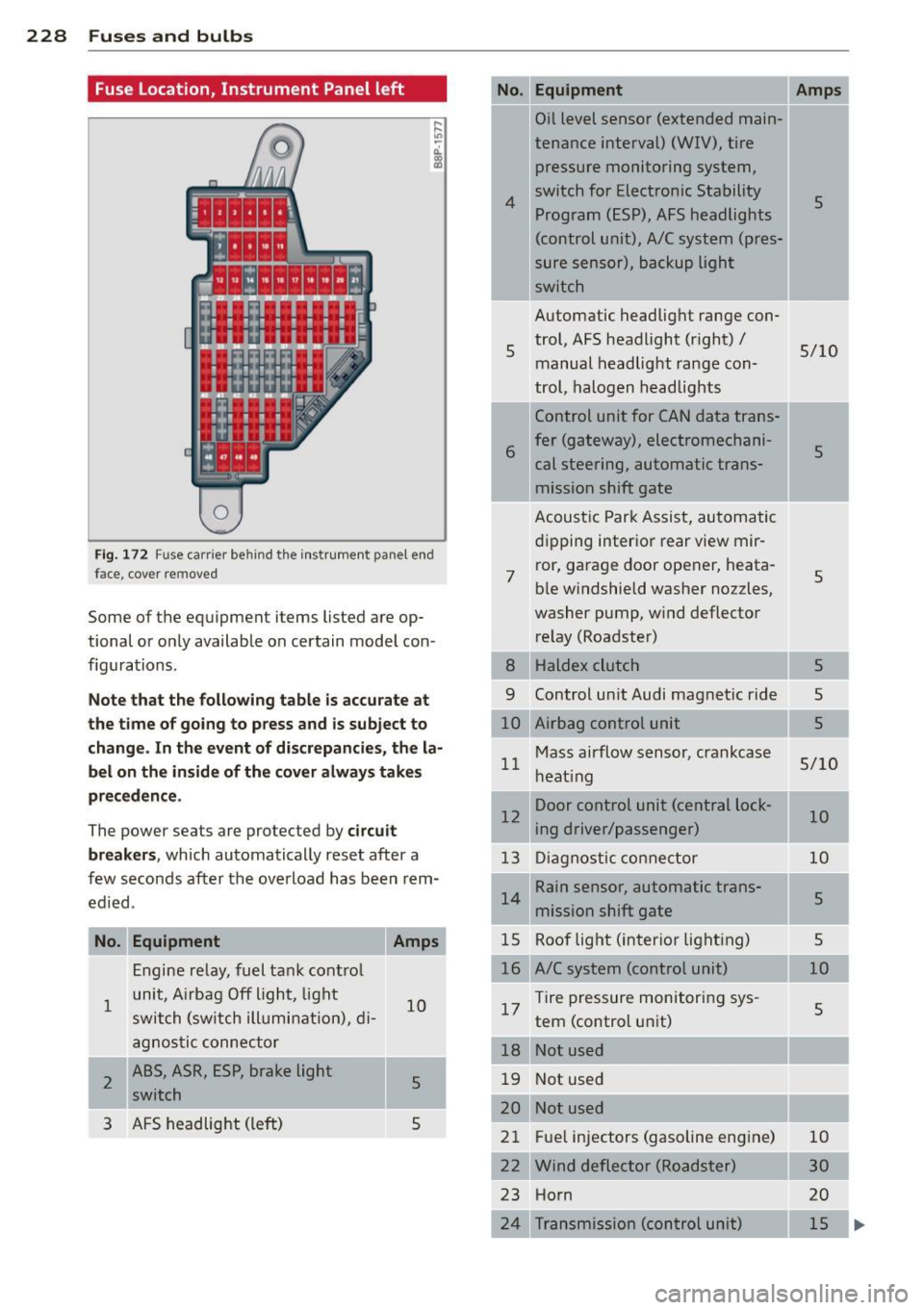
228 Fuses and bulbs
Fuse Location, Instrument Panel left
0
Fig. 172 Fuse ca rrier be hind the inst rum ent pan el end
fa ce, cover rem oved
Some of the equipment i tems lis ted are op
tional or only available on certain model con
figurations.
Note that the following table is accurate at
the time of going to press and is subject to
change. In the event of discrepancies, the la
bel on the inside of the cover always takes
precedence.
The power seats are protected by circuit
breakers,
which automatically reset after a
few seconds after the overload has been rem
edied .
No. Equipment
1
I 2
Engine relay, fuel tank control
unit , Airbag Off light, light
switch (switch illumination), di-
agnostic connector
ABS, ASR, ESP, brake light switch
3 AFS headlight (left)
Amps
10
5
s
No.
4
5
6
7
Equipment
Oil level sensor (extended main-
tenance interval)
(WIV), tire
pressure monitoring system,
switch for Electronic Stability Program (ESP), AFS headlights
(control unit), A/C system (pres-
sure sensor), backup light
switch
Automatic headlight range con
trol, AFS headlight (right)/
manual headlight range con
trol, halogen headlights
Control unit for CAN data trans
fer (gateway), electromechani
cal steering, automatic trans mission shift gate
Acoustic Park Assist, automatic
dipping interior rear
view mir-
ror, garage door opener, heata
ble windshield washer nozzles,
washer pump, wind deflector
relay (Roadster)
--r-
Amps
5
5/10
5
5
8 Haldex clutch 5
9 Control unit Audi magnetic ride 5
10 Airbag control unit 5
Mass airflow sensor, crankcase
11 5/10
heating
Door control unit (central lock-
12 10
ing driver/passenger)
--
13 Diagnostic connector 10
Rain sensor, automatic trans-
14 5
mission shift gate
15 Roof light (interior lighting) 5
16 A/C system (control unit) 10
17 Tire pressure monitoring sys-
5
tern (control unit)
l
I
18 Notused -
19 Not used
20 Not used
21 Fuel injectors (gasoline engine)
Wind deflector (Roadster)
Horn
24 Transmission (control unit) 10
30
20
15
..,.
Page 231 of 260
No.
25
Heater rear window Coupe/
heated rear window Roadster
26 Driver's side power window
27 Passenger's side power window
28 Not used
29 Washer pump
30 Cigarette lighter
31 Starter
32 Steering column module
33 Instrument cluster
34 Radio navigation system, radio
35 Audio amplifier
Engine (control unit)
37 CAN (Gateway)
38 Cigarette lighter
39 Not used
40 Not used
41 Not used
42 Not used
43 Not used
44 Not used
45 Not used
46 Not used
47 SOARS tuner, cell phone p ack-
age, TV tuner
48 VOA interface
49 N ot used
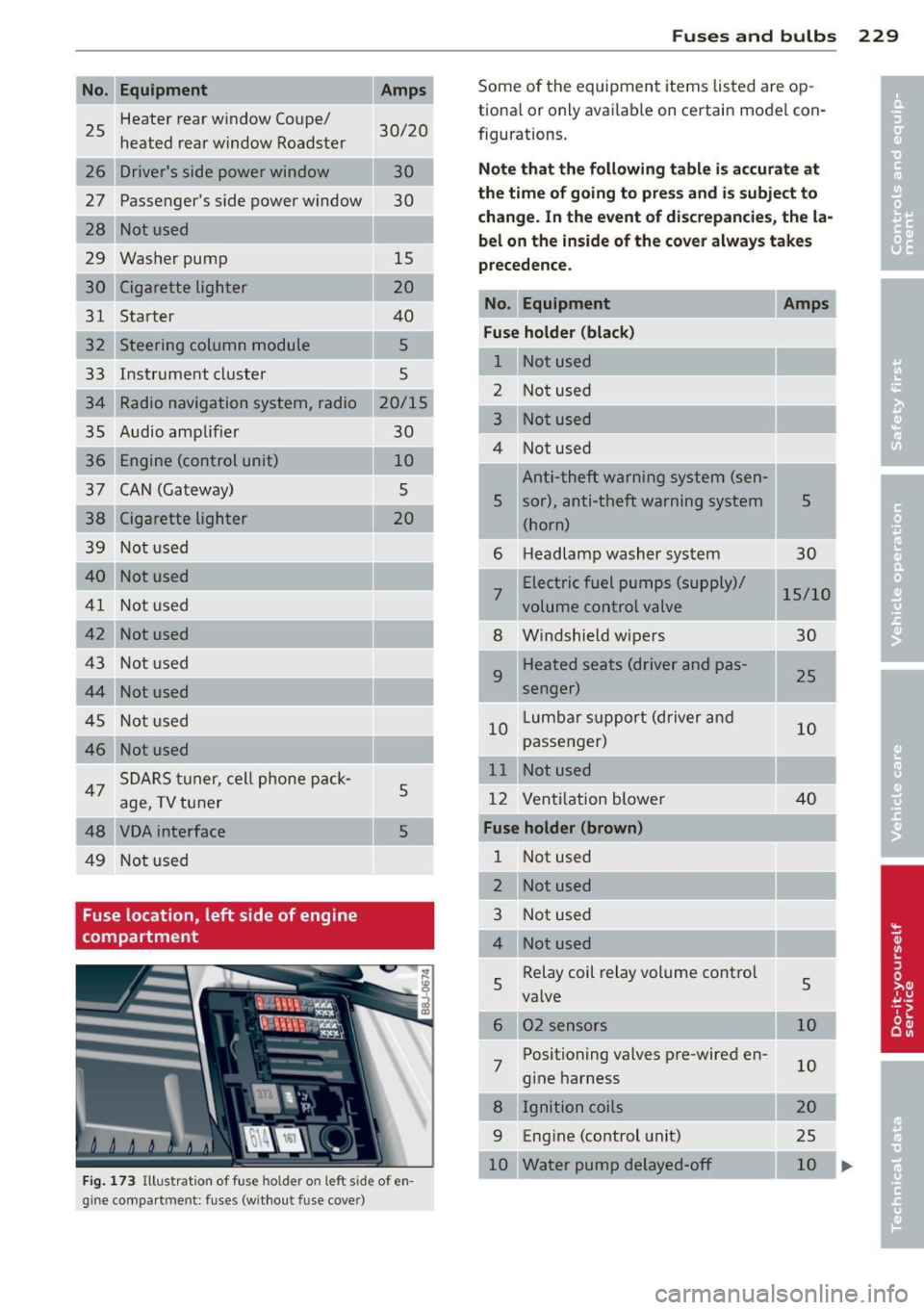
Fuse location, left side of engine
compartment Amps
30/20
30 15
40
30 10 5
20
-
5
5
F ig. 173 Illustrat ion of fuse holder on left side of en
g ine co mpa rtment : fuses (without fuse cover)
Fuse s and bulb s 229
Some of the equipment items listed are op
tiona l or only avai lab le on certain model con
figurations.
Note tha t the foll owing table i s ac cur ate at
the time of going t o press and is subject to
change . In the event of di screpancie s, the la·
bel on the inside of the cover always takes
precedence.
No . Equipment Amps
Fuse holder (black )
1 Notused -
----------'
2 Not used
3 Not used
4 Not used
Anti-theft warning system (sen-
5 sor), anti-theft wa rning system
(horn)
6 H eadlamp washer system
7
Electric fuel pumps (supply)/
volume control valve
8 W indshield wipers
9
Heated seats (driver and pas-
senger)
10
L umbar support (driver a nd
passenger)
11 Not used
12 Vent ilation blower
Fuse holder (brown )
1
2
3
4
5
6
7
9 N
ot used
Not used
Not used
Not used
Relay coil relay volume contro l
va lve
Position ing valves pre-wired en
g ine harness
I gnition coils
Eng ine (control unit)
10 Water pump delayed-off
5
30
15/10
30
25
10
40
-
5
10
10
20
25 10
1111-