ignition AUDI TT ROADSTER 2011 Repair Manual
[x] Cancel search | Manufacturer: AUDI, Model Year: 2011, Model line: TT ROADSTER, Model: AUDI TT ROADSTER 2011Pages: 260, PDF Size: 64.11 MB
Page 147 of 260
child should always ride in the seat properly
restrained for its age and size .
A WARNING
Improperly installed child safety seats in
crease the risk of ser ious personal injury
and death in a collision.
- Always make sure that the safety belt re tractor is locked when installing a ch ild
safety seat . An unlocked safety belt re
tractor cannot hold the child safety seat
in place during normal driving or in a
crash.
- Always buckle the child safety seat firmly
in place even if a child is not s itting in it .
A loose ch ild safety seat can fly around
dur ing a sudden stop o r in a coll ision
- T he inflating a irbag w ill hit the child
safety seat or infant carrier w ith great
f orce and w ill smash t he ch ild safety sea t
and child against the backrest, door or
roof .
- F orward-fac ing ch ild safe ty sea ts or in
f ant ca rriers installed on the front pas
senger's seat may inte rfe re with the de
ployment of the airbag and cause serious
injury to the ch ild.
- Always read and heed all WARNINGS
whenever using a child restrained in
ave
hicle is being used¢ page 136 . Special
precautions apply when installing a ch ild
safety seat on the front passenge r seat
¢ page 116, Child restraints on the front
seat -some important things to know.
A WARNING
-
Always take special precautions if you
m ust in stal l a forw ard or rearward-f acing
child restrain t on the front passenger's
sea t in except iona l situat ions:
- Whenever a fo rw ard or rearward- facing
child restraint is installed on the fron t
passenge r seat, the
PASSENGER AIR
BAG OFF
light must come on and stay on
whenever the ignition is switched on.
- If the
PASSENGER AIR BAG OFF light
does not come on and stay on, perform
Child Sa fet y 145
the checks described ¢ page 125, Moni
toring the Advanced Airbag System.
- If the PASSENGER AIR BAG OFF light
does not come on and stay on whenever
the ignition is switched on the inflating
airbag w ill hit the child safety seat or in
fant carrier with great force and will
smash the child safety seat and child
aga inst the backrest, door or roof. Have
the airbag system i nspe cte d immed iate ly
by your Audi de aler.
- I mp roper installation of ch ild restraints
can reduce t heir effec tiveness o r even
preven t them from providing any pro tec
tion.
- An improperly installed ch ild restr aint
can interfere with the airbag as i t de
ploys and seriously injure o r even kil l the
child.
- Always carefu lly follow the manu fact ur
er 's instructions p rovi ded with t he chi ld
safety seat or car rier .
- Never p lace additiona l items on the seat
that ca n increase the total weight reg is
tered by the weight-sensing mat and can
cause injury in a crash.
A WARNING
Forward-facing child rest raints:
- Always make s ure the forward- facing
seat has been designed and certified by its manufacturer for use on a front seat
with a passenger front and s ide a irbag .
- Never put the forward-facing child re
straint up , against or
very near the in
strument panel.
- Always move the passenger seat into its
rearmost pos ition in the seat 's fore and
aft ad justment range, as fa r away from
the airbag as possible before installing
the forward-fa cing ch ild restra int. The
b ackrest mus t be ad ju ste d to a n up right
posi tion.
- Ma ke sure that the
PASSENGER AIR BAG
OFF
li ght comes on and st ays o n all the
time whenever the ignit ion is switched
on. •
•
Page 148 of 260
146 Child Safety
_& WARNING
Rearward -fac ing ch ild restraints:
- A ch ild in a rearward-facing child safety
seat installed on the front passenge r
seat will be seriously injured and can be
ki lled if the front airbag inflates - even
with an Advanced Airbag System.
- The inflating airbag will hit the child
safety seat or infant carrier with great
force and w ill smash the ch ild safety seat
and child against the backrest, door or
roof.
- Always be especially careful if you must
install a rearward facing child safety seat
on the front passenger seat in exception
al circumstances .
- Make sure that the
PA SSENGER AIR BAG
OFF
light comes on and stays on all the
t ime whenever the ignition is switched
on.
- Never install a rearward facing child
safety seat on the front passenger seat
unless the
PASSENGER AIR BAG OFF
ligh t comes on and stays on. H the PAS
SEN GER AIR BAG OFF light does not
come on and stay on have the airbag sys
tem inspected immediately by your Audi
dealer.
Activating the convertible locking retractor
Use the convertible locking retractor to se
cure a child restraint.
A lways heed the child safety seat man ufactur
er's instructions when installing a child re
straint in your vehicle. To activate the conver
tible locking retractor:
• Place the child restraint on a seat .
• Slow ly pull the be lt
all the way out .
• Route it around or through the child re
stra int be lt path
c::> &_ .
• Push the child safety seat dow n with your
full weight to get the safety belt really t ight .
• Insert the be lt tongue into t he buckle for
t h at seating position. •
Guide the safety belt back into the retractor
until the be lt lies flat and snug on the child
safety seat .
• You shou ld hear a "clicking" noise as the
be lt winds back into the inertia reel. Test the
convert ible lock ing retractor by pu lling on
the belt. You should no longer be able to
pull the be lt out of the retractor . The con
ve rtible locking re trac to r i s now activated .
• Ma ke s ure t hat the red release b utton is fac
ing away from the child rest raint so that it
can be unbuckled quic kly.
• Pull on the belt to make sure the safety be lt
is properly tight and fastened so that the
seat cannot move forward or sideways more
than one inch (2 .5 cm).
_& WARNING
Using the wrong child restraint or an im
p roperly installed chi ld restrai nt can cause
se rious pe rsonal injury or deat h in a cr ash.
- Always make sure that the safety belt re-
tracto r is loc ked when insta lling a child
safety seat. An unlocked safety belt re
tracto r ca nnot hold the child safety sea t
in place dur ing no rma l dr iving o r in a
crash.
- Always buckle the child sa fe ty seat firmly
in p lace even if a ch ild is not si tt ing in it.
A loose child safety seat can fly around
during a s udden stop or in a crash .
- Always ma ke sure the seat backrest to
which the child restraint is installed is in
an upright pos ition. Otherw ise, the seat
back with the ch ild safety seat attached
to it could fly forward in the event of an
accident o r other emergency situation .
- Always read and heed a ll WARNINGS
whenever us ing a child restrained in ave
h icle is being used
c::> page 136. Special
p reca utions apply when insta lling a child
safety sea t on the front passenger seat
c::> page 116, Child re straints on the front
seat -some important things to know.
-
Page 157 of 260

Energy management
Starting ability is optimized
Energy management controls the distribution
of electrical energy and thus optimizes the
availability of electrical energy for starting the engine .
If a vehicle with a conventional energy system
is not driven for a long period of time, the bat
tery is discharged by idling current consumers
(e.g. immobilizer). In ce rtain c ircumstances it
can result in there being insuff icient ene rgy
avai lab le to start the engine .
Intell igent energy management in your vehi
cle handles the d istribution of electrical ener
gy. Starting ab il ity is markedly imp roved and
the life of the battery is extended .
Basically, energy management consists of
batt ery diagno sis, idlin g current man ag e
m ent
and dyn ami c en ergy manag emen t.
Batter y diagnosis
Battery diagnosis continuously determines
the state of the battery . Sensors determ ine
battery vo ltage, battery current and battery
temperature. This determ ines the current
state of charge and the powe r of the battery.
Idling curr ent man agement
Idling current management reduces energy
consumption while the vehicle is stand ing .
W ith the ignition switched off, it cont ro ls the
energy s upply to the various electr ical compo
nents . Data from battery diagnosis is consid
ered.
D epending on the batte ry's state of charge,
i nd ividua l consumers are gradual ly t urned off
to prevent excess ive d ischarge of the battery
and thus maintain starting capability .
Dynam ic en ergy management
While the vehicle is being driven, dynamic en
e rgy management dist ributes the energy gen
e rated according to the needs of the individu
a l components.
It reg ulates cons umption, so
that more electrical energy is not being used
Int ellig ent technolog y 155
than is being generated and ensures an opti
mal state of charge for the battery.
(0 Tips
- But even energy management canno t
negate the limits of physics . Consider
that the power and life of a battery are
limited .
- If starting ability is threatened, you are
informed by a warning
r::!)poge 156,
Driver notification in the instrument
cluster display.
What you should know
The highest priority is given to maintaining
starting capability.
The battery is severe ly taxed in short -distance
driving, in city traffic and during the cold time
of year. Abundant electrical energy is re quired, but only a little is generated .
It is also
critical if the engine is not running and electri
cal components are turned on . In this in
stance energy is be ing consumed but none is
being generated.
It is in precisely these situations that you will
notice energy management actively regulat
ing the d istribution of energy .
Vehicle stands for an e xtended peri od
If you do not drive your vehicle over a period
of several days or weeks, e lectr ical compo
nents are gradually cut back or switched off.
This reduces energy consumption and ma in
ta ins start ing capability over a longer period .
Take into considerat ion that when you unlock
your vehicle, some convenience functions, such as the remote key or power seat adjust
ment, may not be available . The conven ience
funct ions w ill be available again when you
tu rn o n the ignition and start the engine .
With the engine turned off
If you listen to the radio, for example, w ith
the engine turned off, the battery is being d is-
charged.
~
•
•
Page 161 of 260
the exhaust system and this could cause
the catalytic converter to overheat.
- Do not turn off the ignition while the ve
hicle is moving .
- Do not con tinue to operate yo ur vehicle
under these conditions, as otherwise fuel
can reac h the cata lytic converter . This
could result in overheating of the con
verter, requ iring its replacement.
- To assure efficient operation of the Emis
sion Control System:
- Have your veh icle ma inta ined properly
and in acco rdance with the service rec
ommendations in your Wa rranty
&
Ma intenance booklet.
- La ck of proper maintenance as well as
improper use of the vehicle will impa ir
t he funct ion of the emission control
system and cou ld lead to damage.
@ For the sake of the environment
Even when the Emission Contro l System is
operating p roperly, t he exhaus t gas can
have a s ulfu r- like exhaust gas smell under
some operating states. This depends on
the s ulfur content o f the fue l being used.
Using a different brand of fuel may help,
or filling the tank w ith lead-free super
grade gasoline .
Operate your vehicle
economically and
minimize pollution
General
Your personal style of driving will determine
the economy of your vehicle, as well as ex
haust and noise levels .
Fuel economy, environmental impact, and
wear on your engine, brakes and t ires largely
depend on three factors :
- your persona l driving style
- operating conditions
- technical lim itations
I f you anticipate w hat you need to do nex t and
d rive economically, you can eas ily cut your
Dri vin g and en vironm ent 159
fuel consumption by 10 -15 percent. This sec
tion w ill give yo u some tips on how you can
help the env ironment and your pocketbook .
(D Tips
The cons umption estimates as publishe d
by ENVIRONME NTAL PROTEC TION AGENCY
(EPA) and Transport Canada may not corre
spond to your actual consumption on the road, which will vary depending upon vehi
cle load and speed, road and weather con
dit ions, trip length, etc.
Drive smoothly and keep a lookout
ahead
Vehicles use the most fuel when they are ac
celerating.
Avoid unnecessary accelerat ing and braking .
Vehicles use the most fuel when they are ac
ce lerat ing . If you anticipate what is going to
happe n next, you will need to brake less and,
th us, accele rate less . Let the vehicle coast
whenever possible -for examp le when you see
that the next t raff ic light is red.
Avoid full throttle
Driving at moderate speeds saves fuel and
improves your mileage.
"' Try and keep well below your car's maximum
speed.
Acce lerat ing gently reduces fue l consump
tion, eng ine wear, and does not disturb the
environment.
Fuel consumpt ion, exhaust emiss ions and en
gine noise increase disproportionately at high
speeds. If you drive at app roximately three
quarte rs of top speed, fuel consumption w ill
be reduced by one half. Nev er drive faster
t h an the posted speed limit and weathe r con
ditions perm it.
•
•
Page 174 of 260
172 Cleaning and protection
• Once the stain is no longer visib le, use a soft
dry cloth or tissu e to soak up the moisture .
Do not use leather cleaning produc ts on Al
cantara .
You may use a suitable shampoo fo r remov ing
dust and dirt.
Dust and grit in the pores and seams can
scratch and damage the surface . If the car is
l eft stand ing i n the sun fo r long pe riods, the
A lcantara should be p rotected against direc t
sun light to preven t it from f ad ing. Slig ht color
va ria tions will develop in normal use an d are
not an indication of material deterioration .
CI) Note
-Never use chemi cal solven ts (e.g. lighter
fl uid , turpentine), waxes, shoe po lish or
s imilar products on Alcantara ® sur faces.
- To avoid damage, have stubborn stains
r emoved by a commerc ia l cleaning spe
cia list.
- Do no t use br ushes, st iff sponges or sim
ilarly abrasive cleaning a ids.
Safety belts
Only well-maintained safety belts work relia
bly when ne eded .
Heavily soiled safety belts may not retr act
p rope rly.
• Keep be lts clean.
• For cleaning, use a m ild soap and wate r sol
u tio n. Le t be lts d ry thoro ughly and away
from direct s unli gh t.
• Do no t all ow ine rtia reel safety be lts to re
t ract before they are completely d ry .
• Check the condition of your safety belts
reg
ularly.
A WARNING
Damaged safety belts can break in a crash.
1l Use o nly th e co rrec t cle anin g so lu ti on s. Ne ver use gas
oli ne or d ie se l fuel.
- Anyth ing that might damage yo ur sa fety
be lts could mean that you and your pas
sengers would not be adequate ly pro
tected in an accident .
- Safety belt performance depends on co r
rect insta llation. Never remove be lts
from the veh icle to clean them .
- Do not use chemical clea ning agents,
b leach or dyes . They have corrosive prop
ert ies which wea ken the webb ing .
- When clean ing your safety be lts, inspect
them for damage . If you discover dam
age, see your Audi dea ler .
'
-Always read a nd heed a ll WARNINGS and
the information
<=;> page 162 .
Engine compartment
Be especially careful when cleaning the en
gine compar tment.
Always switch off the ignition before clean
ing the engine<=;>.&, .
Plenum panel
Remove leaves from the plenum panel in front
of the w indshield under the eng ine hood . This
preve nts the water drain holes from becomin g
block ed, and it prevents debris from enter ing
the ve hicle interio r thr ough the heating and
ventilat ion duc ts.
Corrosion protection
T he eng ine compartment and transmission
have been corrosion -protected at the factory .
G ood anti- corrosio n treatmen t is very impor
tant, par ticul arly in the w inter.
If the vehi cle
is frequently driven on salt t reated roads, the
entire engine compa rtment an d plen um panel
sho uld be thoro ughly cleaned at the end of
winter and retreated to prevent salt damage.
At the same time, the unde rside of the vehicle
shou ld be washed as well.
If the engine compa rtment is cleaned at any
time with grease remov ing solutions
1> , or if ..,.
Page 175 of 260
you have the engine washed, the anti-corrosion treatment is a lmost always removed as
wel l. It is therefore essential to have a long
lasting corrosion protection reapplied to all
surfaces, seams, joints and components in the
engine compartment .
A WARNING
Be aware: The engine compartment of any
motor vehicle is a potentially hazardous
area.
- Before working in the engine compart
ment, be sure to read the informat io n
c::.>page 172.
- Before reaching into the front plenum
pane l, always remove the ignition key.
O therw ise, the windshield wipe r system
cou ld unintentiona lly be switched on,
poss ibly causing pe rsonal injury from the
moving wiper linkage .
- Never reach into the area around or
touch the radiator fan. The auxiliary fan
is temperature controlled and can switch
on suddenly- even when the ign it ion is
off.
- Do not wash, wax or dry the engine w ith
the engine running. Moving or hot parts cou ld injure you .
- Do not clean the underside of the chas sis, fenders, wheel covers, or other hard
to reach parts w ithout protecting your
hands and arms. You may cut yourse lf on
sharp-edged metal parts .
- Always read and heed all WARNINGS and
other information
c::.> page 162.
Cleaning and protec tion 173
•
•
Page 178 of 260
1 76 Fuel supply and filling your fuel tank
transport fuel to use for your lawn mower,
snow blower, etc., be very careful and al
ways observe local and state laws regard
ing the use, transportation and storage of
such fuel containers. Make certain the con
tainer meets industry standards (ANSI/
ASTM F852 - 86).
(D Note
Never drive your vehicle until the fuel tank
is completely dry. The irregular supply of
fuel can cause misfiring. Gasoline could
enter into the exhaust system and damage
the catalytic converter.
Refuelling
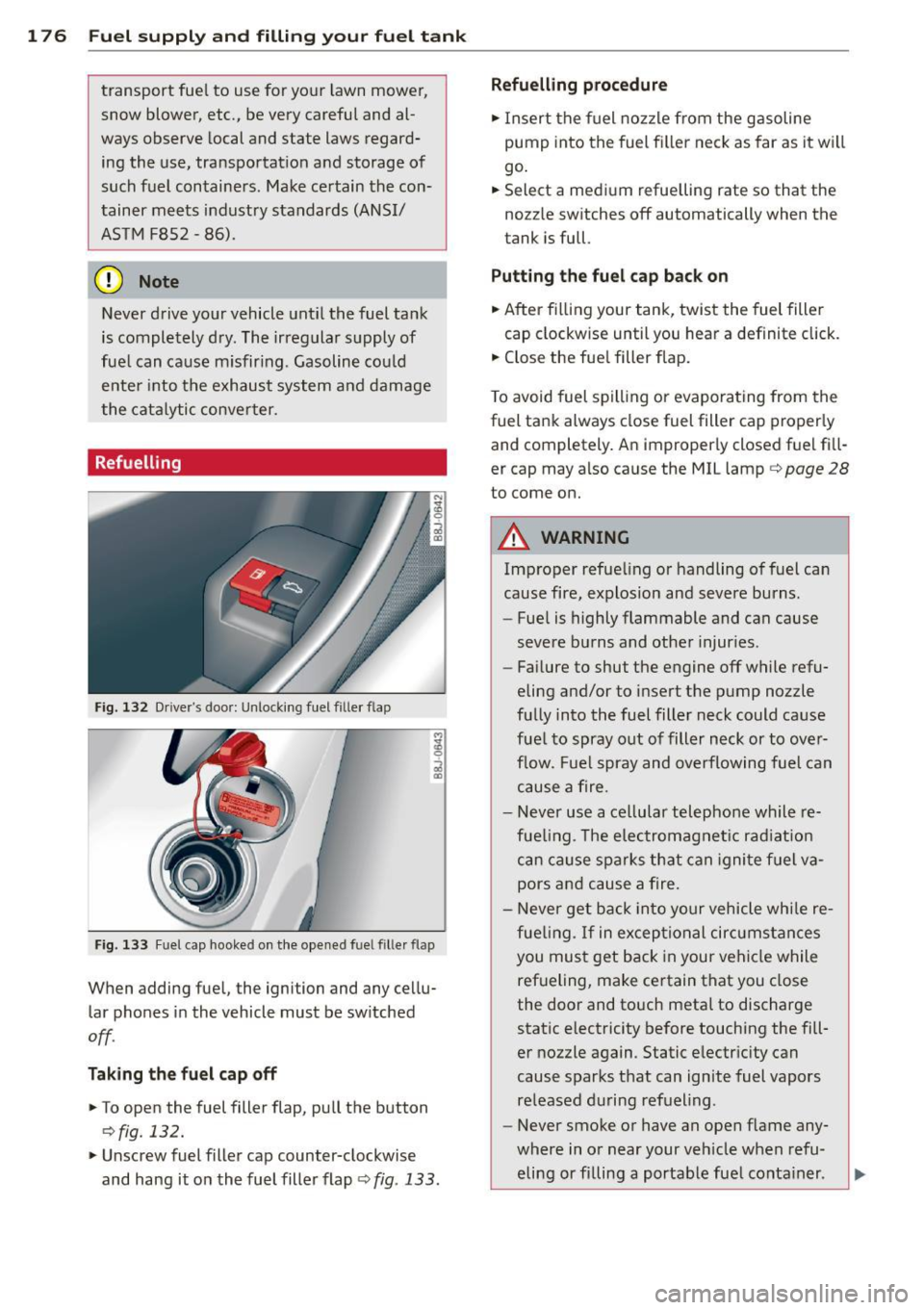
Fig. 132 Driver's door: Un locking fuel filler flap
Fig. 133 Fuel cap hooked on the opened fue l filler flap
When adding fue l, the ignition and any ce llu
lar phones in the vehicle must be switched
off .
Taking the fuel cap off
• To open the fuel filler flap, pull the button
9fig. 132.
• Unscrew fuel filler cap counter-clockwise
and hang it on the fuel filter flap¢
fig. 133 .
Refuelling procedure
• Insert the fuel nozzle from the gasoline
pump into the fuel filler neck as far as it will
go.
• Select a medium refuelling rate so that the
nozzle switches off automatically when the
tank is full.
Putting the fuel cap back on
• After filling your tank, twist the fuel filter
cap clockwise until you hear a definite click.
• Close the fuel filler flap.
To avoid fuel spilling or evaporating from the
fuel tank always close fuel filler cap properly and completely. An improperly closed fuel fill
er cap may also cause the MIL lamp¢
page 28
to come on.
A WARNING
Improper refueling or handling of fuel can
cause fire, explosion and severe burns.
- Fue l is highly flammable and can cause
severe burns and other injuries.
- Failure to shut the engine off while refu
eling and/or to insert the pump nozzle
fully into the fuel filter neck could cause
fuel to spray out of filler neck or to over
flow. Fuel spray and overflowing fuel can
cause a fire.
- Never use a cellular telephone while re
fueling. The electromagnetic radiation
can cause sparks that can ignite fuel va
pors and cause a fire.
- Never get back into your vehicle while re
fueling.
If in exceptional circumstances
you must get back in your vehicle while
refueling, make certain that you close
the door and touch metal to discharge
static electricity before touching the fill
er nozzle again. Static electricity can
cause sparks that can ignite fuel vapors
released during refueling .
- Never smoke or have an open flame any
where in or near your vehicle when refu
eling or filling a portable fuel container.
Page 181 of 260
-Apply the parking brake.
- Move selector lever to "P" (Park).
- Always let the engine cool down. Hot
components will burn skin on contact.
- To reduce the risk of being burned, never
open the hood if you see or hear steam
or coolant escaping from the engine
compartment. Wa it until no steam or
coolant can be seen or heard before care
fully opening the hood.
- Keep children away from the engine com
partment .
- Never spill fluids on hot engine compo
nents. They can cause a fire.
- Never touch the radiator fan. The auxili
ary electric fan is temperature controlled
and can switch on suddenly.
- Never open the coolant reservoir cap
when the engine is still warm. The cool
ant system is pressurized and hot cool
ant could spray out .
- Protect your face, hands and arm from
steam or hot engine coolant by placing a
thick rag over the cap when you open the
coolant reservoir .
- If work on the fuel system or the electri
cal system is necessary:
- Always disconnect the battery.
- Never smoke or work near heaters or
open flames. Fluids in the engine com
partment could start a fire.
- Keep an approved fire extinguisher im
mediately available.
- To avoid electrical shock and personal in
jury while the engine is running or being
started, never touch:
- Ignition cables
- Other components of the high voltage
electronic ignition system.
-If you must perform a check or repair
with the engine running:
- First, fully apply the parking brake,
move selector lever to "P" (Park).
Checking and filling 179
-Always use extreme caution to prevent
clothing, jewelry, or long hair from get
ting caught in the radiator fan, V-belts
or other moving parts, or from contact ing hot parts . Tie back hair before
starting, and wear no clothing that will
hang or droop into the engine.
- Minimize exposure to emission and
chemical hazards
9 .&, .
&_ WARNING
California Proposition 65 Warning:
- Engine exhaust, some of its constituents,
and certain vehicle components contain
or emit chemicals known to the State of
California to cause cancer and birth de
fects and reproductive harm. In addition,
certain fluids contained in vehicles and
certain products of component wear con
tain or emit chemicals known to the
State of California to cause cancer and birth defects or other reproductive harm.
- Battery posts, terminals and related ac
cessories contain lead and lead com
pounds, chemicals known to the State of
California to cause cancer and reproduc
tive harms. Wash hands after handling .
(D Note
When adding fluids, always make sure that
they are poured into the proper container
or filler opening, otherwise serious dam
age to vehicle systems will occur.
@ For the sake of the environment
To detect leaks in time, inspect the vehicle
floor pan from underneath regularly . If
you see spots from oil or other vehicle flu
ids, have your vehicle inspected by an au
thorized Audi dealer. •
•
Page 188 of 260

186 Checking and filling
Before you check anything in the engine com
partment,
alwa ys r ea d and heed all WARN
INGS ¢ A in Working in the engine
comportment on page 178.
• Switch the ignition off .
• Read the coo lant level at the coolant expan
s ion tank ¢
fig. 141 . With a co ld engine, it
must be above the "min" mark. W ith a hot
engine, it can be a little above the indicated
range.
The location of the coolant expansion tank
can be seen in the engine compartment illus
tration .
To obtain an accurate reading , the engine
must be switched
off.
The expansion tank in you r vehicle is equipped
with an e lectric coolant level sensor .
When the coolant level is too low, the warning light in the Auto- Check System ¢
page 31 will
blink until you add coo lant and the level has
been restored to no rma l. Even though there is
an electric coolant level sen sor, we still rec
ommend you check the coolant leve l from
time to time.
Coolant loss
Coolant loss may indicate a leak in the cooling
system . In the event of coolant loss, the cool
ing system should be inspected immediately
by your authorized A udi dealer. It is not
enough merely to add coolant .
In a
sealed system, losses can occur only if
the boiling point of the coolant is exceeded as
a result of overheating.
@ Note
Do not add any type of ra diator leak seal
ant to yo ur vehicle's eng ine coolant. Add
ing radiator repair f luid may adversely af
fect the function and performance of your
cooling system and could result in damage
not covered by your New Vehicle Limited
Warranty.
Adding coolant
Be very careful when adding engine coolant.
Before you check anyth ing in the engine com
partment,
always read and heed all WARN
INGS ¢ A in Working in the engine comport
ment on page 178 .
•Turnoff the engine.
• Let the eng ine cool down.
• Place a thick rag ove r the coolant expansion
tank
¢ page 185, fig . 141 and carefully
tw ist the cap counter-clockwise ¢&_ .
• Add coolant.
• Twis t the cap o n aga in
tightly.
Replacement engine coolant must conform to
exact spec ificat ions
¢ page 185, Coolant.
E ven in a n emerge ncy, if coo lant addi -
t ive G1 2++, G12+ or G12 is not ava ilable , do
not use a d ifferen t addit ive. Use plain water
instead unti l you can get the cor rect additive
and can restore the correct ratio . This sho uld
be done as soon as possible .
If you have los t a considerab le amo unt o f
coolant , then you sho uld add cold ant ifreeze
and co ld wate r on ly w hen the engine is cold.
Always use
new engine coo la nt whe n refilling .
Do not fill coola nt above the "MAX" mark. Ex
cess coo la nt wi ll be fo rced o ut through the
pressure relief valve in t he cap w hen the en
gine becomes hot.
,&. WARNING ~ -
- T he cooling system is under pressure and
can get very hot. Reduce the risk of
scalding from hot coolant by followi ng
these steps.
- T urn
off the engine and allow it to coo l
down.
- Protect you r face, hands and a rms from
esca ping fluid and steam by covering
the cap w ith a large, t hick rag.
- T urn the cap slowly a nd ve ry carefully
in a counter-clo ckwise direction while
applying light, downward pres sure on
the top o f the cap.
Page 189 of 260
-To avoid being burned, do not sp ill an
tifreeze or coolant on the exhaust sys tem or hot engine parts. Under certa in
conditions, the ethylene glyco l in en
g ine coolant can catc h fire.
- Antifreeze is poisonous. Always store an
t ifreeze in its or iginal co ntaine r and well
o ut of the reach of children.
- If you drain the coolant, it must be
caught and safely stored in a proper con
tainer clearly ma rked "poison".
(D Note
- Coolant pollutes the env ironment and
could cause a n engine fire. Excess cool
ant wi ll be forced out through the pres
su re re lief va lve in the cap when the en
gine becomes hot.
- If, in an emergency, only water can be
added, the cor rect ratio be tw een wate r
and antifreeze
¢page 185 must be re
store d as soon as possib le.
@ For the sake of the environment
Drained coolant s hould no t be reused. Al
ways dispose of use d coolan t w hile obse rv
ing all envir onmental reg ulations.
Radiator fan
The radiator fan switches on automatically by
i tself
The electric radiator fan is contro lled by ther
moswitches that switch on and off depend ing
on coolant and eng ine compa rtment tempera
tures.
An aux iliary electr ic radiator fa n* switches on
and off depen ding on coolant t emperature
and other ve hicl e operation conditions.
After you switch t he engine off, the a uxiliary
fan ca n cont inue runn ing fo r up to 10 minutes
- even with the ignition off .
It can even sw itch
on agai n later by i tself
c::> &., , if
- the temperature of the eng ine coolant rises
due to the heat bui ld-up from the eng ine in
t h e engine compartment, o r
Checking and fillin g 187
- the engine compartment heats up because
the vehicle is parke d in intense sunlight.
A WARNING
-To reduce the risk of persona l in ju ry nev
er touch the radiator fan .
- The a uxiliary electric fan is tempe rat ure
contro lled and can switch on suddenly
even when the engine is not running.
- The a uxiliary radiator fan sw itches on a u
tomatically when the engine coo lant
reaches a certa in temperature and w ill
continu e to run until the coo lant temper
ature drops.
Brake fluid
Checking brake fluid level
T he brake fluid level can be checked wi th a
qui ck gl ance.
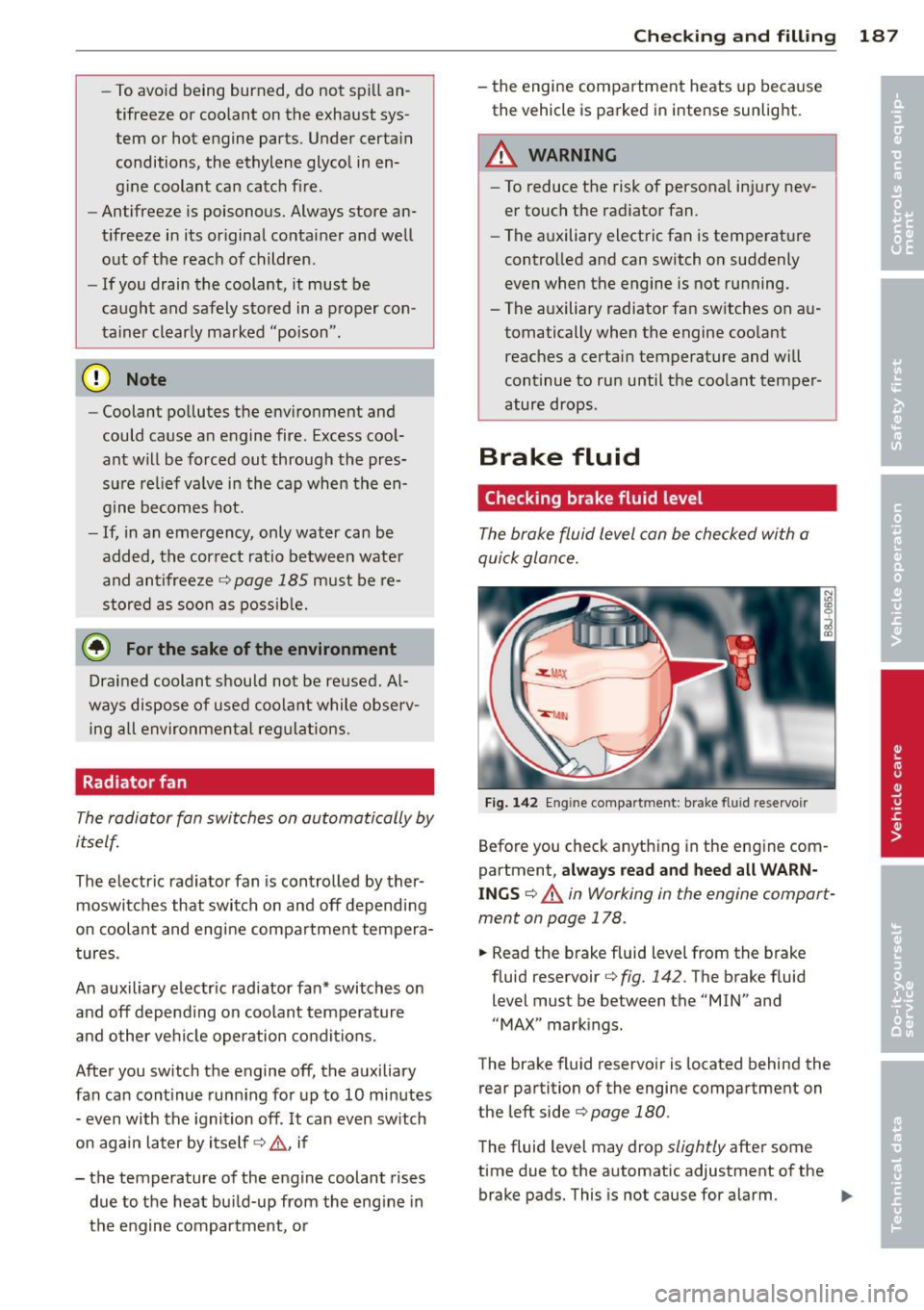
Fi g. 142 Engin e compart ment : brake flu id reservoir
Before you check anyth ing in the eng ine com
partment,
alw ays read and heed all WARN
INGS c::> A in Working in the engine compart
ment on page 178 .
.,. Read the brake fluid level from the brake
fluid reservoir
c::> fig. 142. The brake fluid
level must be between the "MIN" and
"MAX" markings.
The brake fluid reservoir is located behind the
rear partition of the engine compartment on
the left side
c::> page 180.
The fluid level may drop slightly after some
time due to the automatic adjustment of the
brake pads. This is not cause for alarm.
IJ1'-