warning light AUDI TT ROADSTER 2011 Repair Manual
[x] Cancel search | Manufacturer: AUDI, Model Year: 2011, Model line: TT ROADSTER, Model: AUDI TT ROADSTER 2011Pages: 260, PDF Size: 64.11 MB
Page 143 of 260
-Always read and heed all WARNINGS
whenever using a child restrained in a ve
hicle is being used
¢page 107, Safety
belts,
c:;, page 115, Airbag system and
c:;, page 136, Child Safety.
A WARNING
To reduce the risk of serious injury, make
sure that the
PASSENGER A IR BAG OFF
light comes on and stays on whenever a
child restrain t is installed on the front pas
senger seat and the ignition is switched
on.
- Never ins tall a rearward facing child
safety seat on the front passenger seat
unless the
PASSENGER AIR BAG OFF
light comes on and stays on. If t he PAS
SENGER AI R BAG O FF
light does not
come on and stay on the inflating airbag
will hit the child safety seat or infant ca r
rie r with great fo rce and will smash the
child safety seat and child against the
back rest, door or roof. Have the airbag
s ystem inspected immediately by your
Audi dealer.
Child safety seats
Infant seats
Babies and infants up to about one year old
and 20 lbs. or 9 kg need special rearward-fac
ing child restraints that support the back,
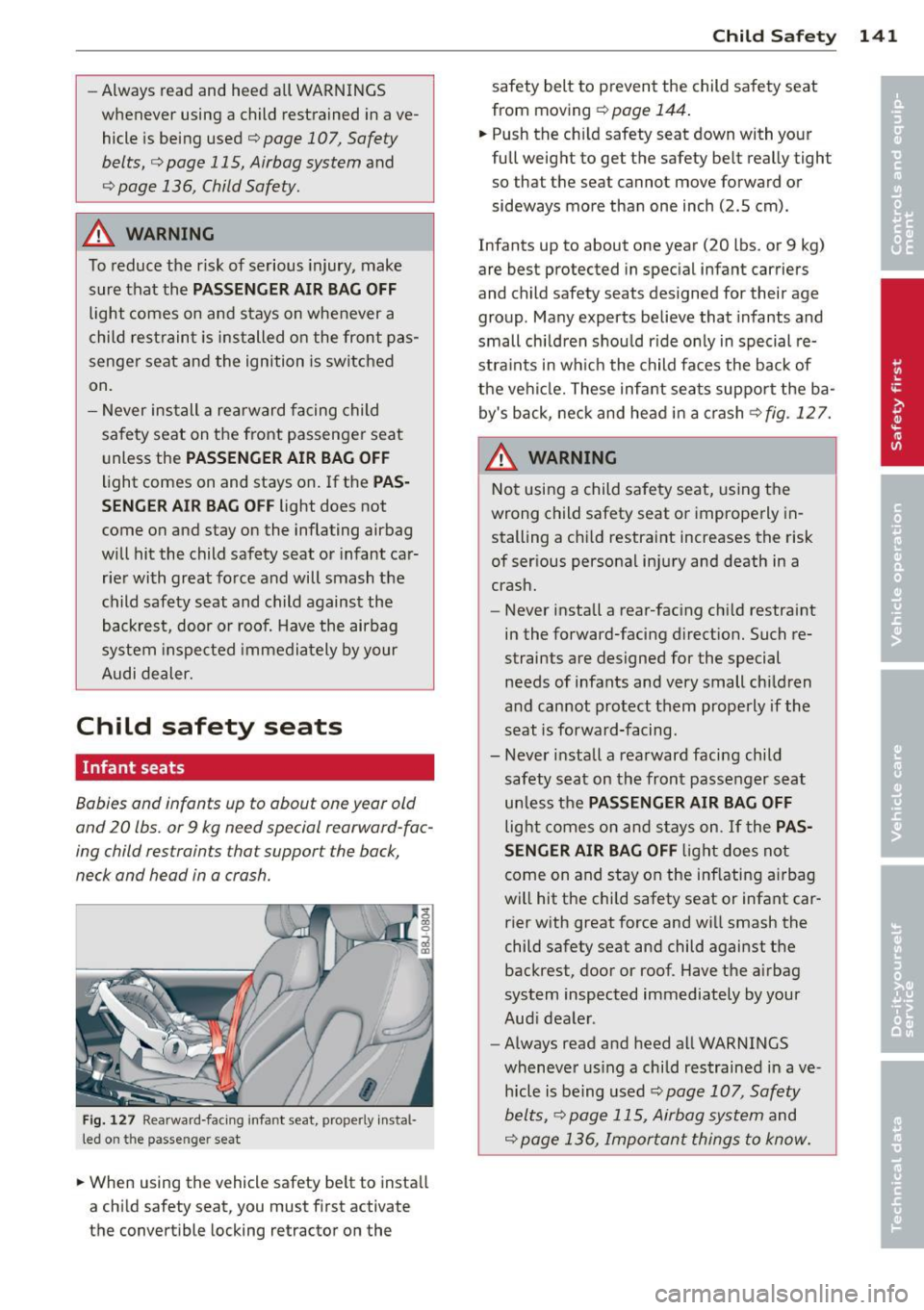
neck and head in a crash.
I
Fig. 1 27 Rea rward-faci ng infant seat, proper ly insta l·
led on th e passe nge r seat
.,. When using the vehicle safety belt to insta ll
a ch ild safety seat, you must f irst activate
the convertible locking retractor on the
Child Safety 141
safety belt to prevent the child sa fety seat
from moving ¢page 144.
.,. Push the child safety seat down with your
fu ll weig ht to get the safety be lt really tight
so that the seat cannot move forward or
sideways more than one inch (2.5 cm).
Infants up to about one year
(20 lbs. or 9 kg)
are best protected in spec ial infant carriers
and child safety seats designed for their age
group . Many experts believe that infants and
small chi ldren shou ld r ide on ly in special re
stra ints in wh ic h the child faces the back of
the vehi cle. These infa nt seats support the ba
by's back, nec k and head in a crash
c:;, fig. 12 7.
A WARNING
Not using a child sa fe ty seat, using the
wrong child safety seat o r improperly in
stalling a child restraint increases the risk
of ser ious personal injury and death in a
crash.
- Never install a rear-fac ing ch ild restraint
in the forward-facing d irection. Such re
straints are designed for the special
needs of infants and very small children
and cannot protect them properly if the
seat is forward-facing.
- Never install a rearward faci ng child
safety seat on the front passenger seat
unless t he
PASSENGER AIR BAG OFF
light comes on and s tays on. If t he PAS
SENGER AIR BAG OFF
l ight does not
come on and stay on the inflating a irbag
wi ll hit the child safety seat or infant car
rier with great force and wi ll smash the
child safety seat and child against th e
backrest, door or roof. Have the airbag
system inspected immediately by your
Aud i dealer .
- Always read and heed all WARNINGS
wheneve r us ing a child restrained in ave
hicle is being used
¢ page 107, Safety
belts,~ page 115, Airbag system
and
c:;, page 136, Impor tant things to know.
Page 144 of 260
142 Child Safet y
Convertible child safety seats
Properly used convertible child safety seats
can help protect toddlers and children over
age one who weigh between
20 and 40 lbs . (9
and 18 kg) in a crash.
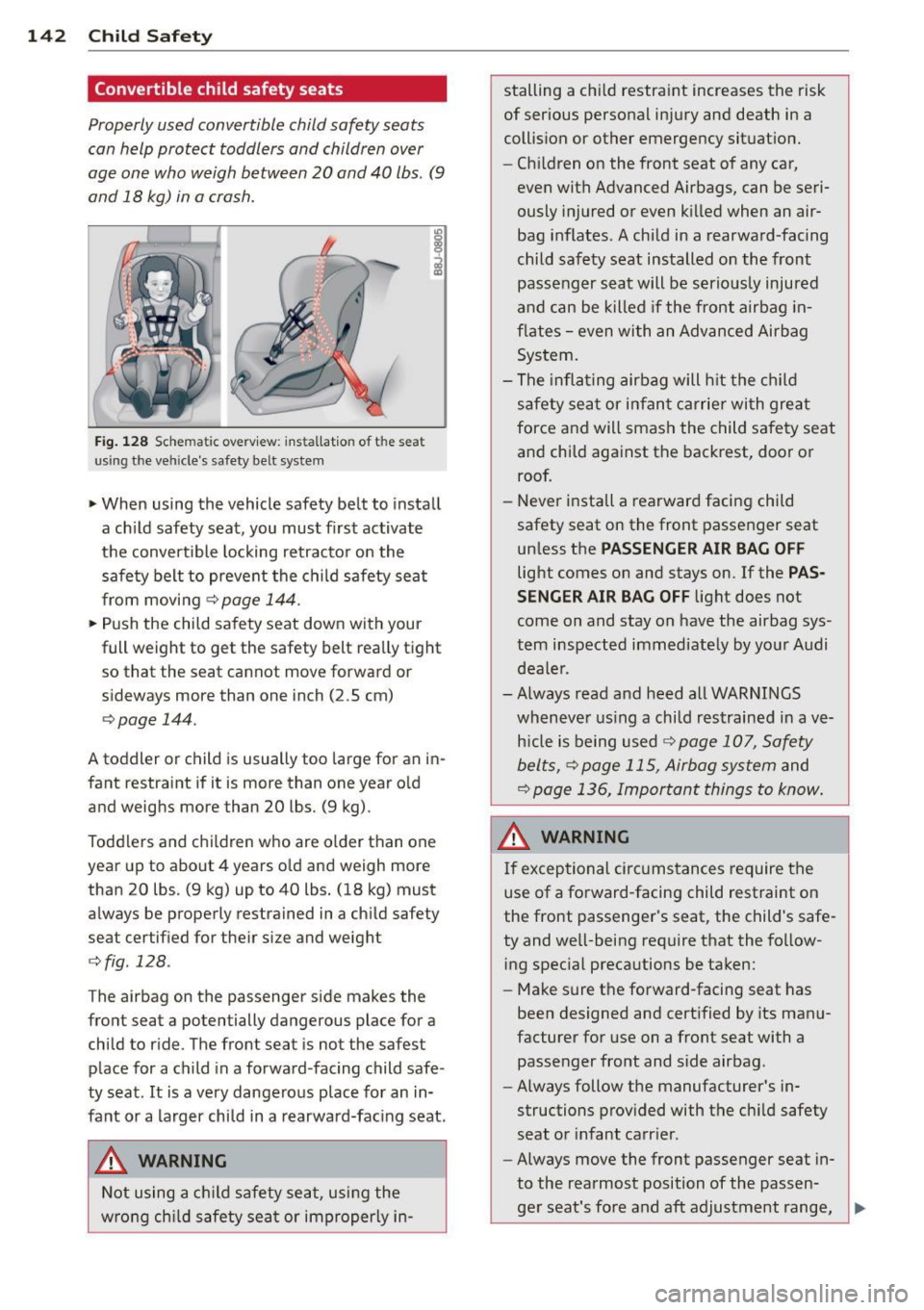
Fig. 128 Sche mati c ove rview : in stallat ion o f the seat
u sing t he ve hicle's safety be lt system
~ When using the vehicle safety be lt to install
a ch ild safety seat, you must first activate
the convertible locking retracto r on the
safety belt to prevent the child safety seat
from movi ng
Q page 144.
~ Push the child safety seat down with your
full weight to get the safety belt rea lly tight
so that the seat cannot move forward or
sideways more than one inch (2.5 cm)
Q page 144.
A toddler or child is usually too large for an in
fant restraint if it is more than one year o ld
and weighs more than 20 lbs. (9 kg) .
Toddle rs and c hildren who are o lder than one
year up to about 4 years o ld and weigh more
than 20 lbs . (9 kg) up to 40 lbs. (18 kg) must
a lways be properly restrained in a ch ild safety
seat certi fied for the ir size and weight
Q fig . 128 .
The airbag on the passenger side makes the
front seat a potentially dangerous place for a child to r ide. The front seat is not the safes t
p lace for a child in a forward -facing child safe
ty seat.
It is a very dangero us p lace for an in
fant or a larger child in a rearward-facing seat .
A WARNING
Not using a child safety seat, usi ng the
w ro ng ch ild s afety sea t or improperly in-
-
stalling a ch ild restra int increases the risk
of ser ious personal in jury and death in a
collis ion or other emergency situat ion.
- Ch ildren on the front seat of any car,
even with Advanced Airbags, can be seri
ously i njured or even k illed when an air
bag inflates . A chi ld in a rearwa rd-facing
child safety seat installed on the front passenger s eat will be s erio usly injured
an d can be killed if the front a irbag in
f lates -even with an Advanced Airbag
Sys tem.
- T he infla ting airbag will h it the c hild
safety sea t or i nfan t carrier wi th grea t
force and will smash the child safety seat
and child aga inst the back rest, door or
roof.
- Never i nsta ll a rearward facing child
safety seat on the front passenger seat
un less the
PASSENGER AIR BAG OFF
light comes on and stays on. If the PAS
SENGER AIR BAG OFF
light does not
come on and stay on have the airbag sys
tem inspected immediate ly by yo ur Audi
deale r.
- Always read and heed all WAR NINGS
wh eneve r using a child restrained in ave
h icle is being used
9 page 107, Safety
belts,
Q page 115, Airbag system and
Q page 136, Importan t thing s to know .
.8_ WARNING
If excep tional circ ums tan ces require the
use of a fo rward -f a cing child restraint on
the front passenger's seat, the child's safe
ty and we ll-being requ ire that the fo llow
in g spec ial precautions be taken:
- Make sure t he forward -facing seat has
been designed and cert ified by its man u
facturer for use on a front seat with a
passenger front and side airbag .
- Always follow the manufacturer's in
structions prov ided with the c hild safety
seat o r infant ca rr ie r.
- Always move the front passenger seat in
to the rearmost position of the passen- ge r seat's fo re and aft adjustment range, ,..
Page 146 of 260
144 Child Safety
In o rder for the airbag to offer protection, it is
important that all vehicle occupants, especia l
l y any children, who must be in the front seat
because of exceptional circumstances, be
properly restrained and as far away from the
a irbag as poss ible. By keep ing room between
the child's body and the front of the passen
ger compartment, the airbag can inflate com
p letely and provide supplemen tal p rotection
i n cer tain frontal co llisions .
& WARNING
Not using a booster seat, using the boos
ter seat improperly, incorrect ly installing a
booste r seat or using the vehicle safety
belt improperly increases the risk of seri
ous personal injury and death in a collision
or ot her emergency situation. To help re
duce the risk of ser ious personal injury
and/or death:
- Always make sure to position the should
er port ion of the three-po int belt over
the midd le of ch ild's shou lder .
- Never let the shoulder port ion of the belt
rest against or across the neck, face,
chin, or throat of the child .
-Always make sure the lap belt portion of the three-po int be lt is worn snug and
passes as low as possib le across the
c hild's pelvis. Neve r let the belt pass over
the soft abdomen.
- Failure to properly route safe ty belts
over a ch ild 's body will cause severe inju
ries in an acc iden t or other emergency
sit uation
c;, page 10 7.
- Children on t he front seat of any car ,
even w ith Advanced A irbags, can be seri
o usly injured or even killed when an air
bag inflates .
- Never let a child stand or knee l on any
seat, for examp le the front seat.
- Never let a child ride in the ca rgo a rea of
yo ur vehicle.
- Always remember that a ch ild lean ing
f orward, sitting sideways or o ut o f posi
t ion in any way during an acc ident can be
struck by a deploying airbag. This will re
sult in serious personal injury or death.
-
- If you must insta ll a booster seat on the
front passenger seat because of excep
tional circumstances the
PASSENGER
AIR BAG OFF
li ght must come on and
stay on, whenever the ignition is switch
ed on .
- If the
PA SSENGER AIR BAG OFF light
does not come on and stay on, pe rform
the checks descr ibed
¢page 125, Moni
toring the Advanced Airbag System.
- If the PASSENGER AIR BAG OFF light
does not come on and stay on whenever
the ignition is switched on the infla ting
ai rbag w ill hit the child sa fety seat or in
fant car rier with g reat force and will
smash the child safety seat and child
aga inst the backrest, door or roof . Have
the airbag system inspected immed iately
by your Audi dea ler.
- Always read and heed all WARNINGS whenever us ing a child restrained in ave
h icle is being used
c;, page 107, Safety
belts,
c;, page 115, Airbag system and
c;, page 136, Important things to know.
Installing a child safety
seat
Securing a child safety seat using a
safety belt
Safety belts for the front passenger can be
locked with the convertible locking retractor
to properly secure child safety seats .
The safety belts emergency locking retractors
for the front passenger's seat safety belt have
a convertible locking retractor for ch ild re
stra ints . The safety be lt must be locked so
that be lt webbing cannot unree l. The retrac
tor can be act ivated to lock the safety belt and
prevent the safety be lt webb ing from loosen
ing up during norma l driving. A child safety
seat can only be properly insta lled when the
safety belt is locked so that the chi ld and child
safety seat will stay in place.
Always remember : Even tho ugh your vehicle is
equipped with an Advanced Airbag system, a
ll-
Page 147 of 260
child should always ride in the seat properly
restrained for its age and size .
A WARNING
Improperly installed child safety seats in
crease the risk of ser ious personal injury
and death in a collision.
- Always make sure that the safety belt re tractor is locked when installing a ch ild
safety seat . An unlocked safety belt re
tractor cannot hold the child safety seat
in place during normal driving or in a
crash.
- Always buckle the child safety seat firmly
in place even if a child is not s itting in it .
A loose ch ild safety seat can fly around
dur ing a sudden stop o r in a coll ision
- T he inflating a irbag w ill hit the child
safety seat or infant carrier w ith great
f orce and w ill smash t he ch ild safety sea t
and child against the backrest, door or
roof .
- F orward-fac ing ch ild safe ty sea ts or in
f ant ca rriers installed on the front pas
senger's seat may inte rfe re with the de
ployment of the airbag and cause serious
injury to the ch ild.
- Always read and heed all WARNINGS
whenever using a child restrained in
ave
hicle is being used¢ page 136 . Special
precautions apply when installing a ch ild
safety seat on the front passenge r seat
¢ page 116, Child restraints on the front
seat -some important things to know.
A WARNING
-
Always take special precautions if you
m ust in stal l a forw ard or rearward-f acing
child restrain t on the front passenger's
sea t in except iona l situat ions:
- Whenever a fo rw ard or rearward- facing
child restraint is installed on the fron t
passenge r seat, the
PASSENGER AIR
BAG OFF
light must come on and stay on
whenever the ignition is switched on.
- If the
PASSENGER AIR BAG OFF light
does not come on and stay on, perform
Child Sa fet y 145
the checks described ¢ page 125, Moni
toring the Advanced Airbag System.
- If the PASSENGER AIR BAG OFF light
does not come on and stay on whenever
the ignition is switched on the inflating
airbag w ill hit the child safety seat or in
fant carrier with great force and will
smash the child safety seat and child
aga inst the backrest, door or roof. Have
the airbag system i nspe cte d immed iate ly
by your Audi de aler.
- I mp roper installation of ch ild restraints
can reduce t heir effec tiveness o r even
preven t them from providing any pro tec
tion.
- An improperly installed ch ild restr aint
can interfere with the airbag as i t de
ploys and seriously injure o r even kil l the
child.
- Always carefu lly follow the manu fact ur
er 's instructions p rovi ded with t he chi ld
safety seat or car rier .
- Never p lace additiona l items on the seat
that ca n increase the total weight reg is
tered by the weight-sensing mat and can
cause injury in a crash.
A WARNING
Forward-facing child rest raints:
- Always make s ure the forward- facing
seat has been designed and certified by its manufacturer for use on a front seat
with a passenger front and s ide a irbag .
- Never put the forward-facing child re
straint up , against or
very near the in
strument panel.
- Always move the passenger seat into its
rearmost pos ition in the seat 's fore and
aft ad justment range, as fa r away from
the airbag as possible before installing
the forward-fa cing ch ild restra int. The
b ackrest mus t be ad ju ste d to a n up right
posi tion.
- Ma ke sure that the
PASSENGER AIR BAG
OFF
li ght comes on and st ays o n all the
time whenever the ignit ion is switched
on. •
•
Page 148 of 260
146 Child Safety
_& WARNING
Rearward -fac ing ch ild restraints:
- A ch ild in a rearward-facing child safety
seat installed on the front passenge r
seat will be seriously injured and can be
ki lled if the front airbag inflates - even
with an Advanced Airbag System.
- The inflating airbag will hit the child
safety seat or infant carrier with great
force and w ill smash the ch ild safety seat
and child against the backrest, door or
roof.
- Always be especially careful if you must
install a rearward facing child safety seat
on the front passenger seat in exception
al circumstances .
- Make sure that the
PA SSENGER AIR BAG
OFF
light comes on and stays on all the
t ime whenever the ignition is switched
on.
- Never install a rearward facing child
safety seat on the front passenger seat
unless the
PASSENGER AIR BAG OFF
ligh t comes on and stays on. H the PAS
SEN GER AIR BAG OFF light does not
come on and stay on have the airbag sys
tem inspected immediately by your Audi
dealer.
Activating the convertible locking retractor
Use the convertible locking retractor to se
cure a child restraint.
A lways heed the child safety seat man ufactur
er's instructions when installing a child re
straint in your vehicle. To activate the conver
tible locking retractor:
• Place the child restraint on a seat .
• Slow ly pull the be lt
all the way out .
• Route it around or through the child re
stra int be lt path
c::> &_ .
• Push the child safety seat dow n with your
full weight to get the safety belt really t ight .
• Insert the be lt tongue into t he buckle for
t h at seating position. •
Guide the safety belt back into the retractor
until the be lt lies flat and snug on the child
safety seat .
• You shou ld hear a "clicking" noise as the
be lt winds back into the inertia reel. Test the
convert ible lock ing retractor by pu lling on
the belt. You should no longer be able to
pull the be lt out of the retractor . The con
ve rtible locking re trac to r i s now activated .
• Ma ke s ure t hat the red release b utton is fac
ing away from the child rest raint so that it
can be unbuckled quic kly.
• Pull on the belt to make sure the safety be lt
is properly tight and fastened so that the
seat cannot move forward or sideways more
than one inch (2 .5 cm).
_& WARNING
Using the wrong child restraint or an im
p roperly installed chi ld restrai nt can cause
se rious pe rsonal injury or deat h in a cr ash.
- Always make sure that the safety belt re-
tracto r is loc ked when insta lling a child
safety seat. An unlocked safety belt re
tracto r ca nnot hold the child safety sea t
in place dur ing no rma l dr iving o r in a
crash.
- Always buckle the child sa fe ty seat firmly
in p lace even if a ch ild is not si tt ing in it.
A loose child safety seat can fly around
during a s udden stop or in a crash .
- Always ma ke sure the seat backrest to
which the child restraint is installed is in
an upright pos ition. Otherw ise, the seat
back with the ch ild safety seat attached
to it could fly forward in the event of an
accident o r other emergency situation .
- Always read and heed a ll WARNINGS
whenever us ing a child restrained in ave
h icle is being used
c::> page 136. Special
p reca utions apply when insta lling a child
safety sea t on the front passenger seat
c::> page 116, Child re straints on the front
seat -some important things to know.
-
Page 151 of 260

A WARNING
- The limits of physics cannot be suspended by ESP. Even in vehicles w ith ESP, you
should always adapt your driving to road
and traffic conditions. This is particular ly
t rue on a slippery and wet road. Do not
be tempted by the inc reased safety pro
vided to take ris ks - danger of an acci
dent!
- Please note tha t when ESP/ASR is deacti
vated, the drive whee ls can spin on icy
and slippery roads and the veh icle can
break away - danger of skidding!
Switching on and off
Fi g. 130 Center co nsole wit h ESP switch
The ES P is a utomatically activated when the
engine is star ted, and it performs a self-test.
As soon as the test is completed, the system
is in normal operating mode.
Deactivating
ESP should normally be activated at all times
because this ensures optimum vehicle stabil i
ty. Only in some cases it does make sense to
deactivate the Electronic Stability P rogram
(ESP) by press ing the button
~fig . 130. Deac
tivation is ind icated by the ESP lamp
I in the
instr ument cluster f lashes. The message
ESP
OFF
appears in the instrument cluster. Ant i
Slip Regulation is completely deactivated and
the stabilization effects from the ESP system are lim ited. Th is makes a mo re agile and spor
ty driv ing style poss ible, but the fu ll exte nt of
t he s tabiliza tion f unct ion is not available .
Intelligent technolog y 149
Activating
Press the@] button again~ fig. 130. T he ind i
cator light
I goes out . The message ESP ON
appears brief ly in the instrument cluster dis
play.
&_ WARNING
i=
You shou ld only switch the ESP off if your
driving ab ility and the traff ic situat ion al
low. Please note that when ESP/ASR is de
activated, the d rive wheels can spin on icy
a nd slippery roads and th e vehicle can
b reak away- dange r of skidd ing!
a) Tips
- If Aud i magnetic ride* is malfunct io ni ng,
the ESP may not sw itch off or it may
switch off automatically.
- In the event of a defect in the rear spoil er sys tem or in Audi magnet ic ride, it can
happen that ASR and ASR/ESP cannot be
deactivated, o r they are ac tiva ted au to
matically in the deactiva ted st ate.
Electronic differential lock (EDL)
The electronic differential lock monitors the
rotational speed of the drive wheels.
General notes
The electronic d ifferential lock (EDL) helps the
ca r to start moving, accele rate and climb a
gradient on su rfaces provid ing poor or a lmost
no g rip. Withou t EDL, this would be d iff icul t ,
i f not impossib le.
How the system works
The EDL operates automatica lly. It mon itors
the rotational speed of the dr ive wheels on an
axle with the help of the ABS sensors
c;:> page 153. If a noticeable difference in ro
tational speed
between the drive wheels on
o ne axle is detected (e.g. on s lippery ground
on one side), the s pinning wheel is braked,
thereby t ransferring power to the other drive
whee l or wheels (a ll-wheel drive). This is done
up to a speed of about 60 mph (100 km/h). ..,_
Page 152 of 260

150 Intelligent te chn olog y
Noises from the b rake system signal that
wheel spin is being controlled.
Driving off
When drivi ng off, a lways be sure to keep road
conditions in mind as you accelerate. If one
d rive wheel spi ns because it is on a surface
with less grip, gradua lly increase the press ure
on the accelerator pedal until the car starts to
move. The wheel less able to transfer power
spins.
O verheating of bra kes
To prevent the disc brake of the braked wheel
from overheating if subjected to excessive
loads, the EDL cuts out temporarily. The vehi
cle rema ins operationa l and behaves in the
same way as a vehicle without EDL.
As soon as the brake has cooled down, EDL
switches on again automatically .
A WARNING
-When accelerating on slippery surfaces,
such as on ice or snow, always be careful
when depressing the acce lerator pedal.
Even with the EDL working, the drive
wheels can spin and reduce yo ur ability
to contro l your car. -Risk of crash!
- The increased safety afforded by EDL
does not mean that you can ta ke safety
risks. Always adapt your dr iving sty le to
the road conditions and traff ic situa tion.
@ Tips
If a fa ult occurs in the ABS, the EDL is also
not f unct ion ing. This is indicated by the
ABS warning light ¢
page 17.
Anti-Slip Regulation System (ASR)
The Anti-Slip Regulation System prevents the
driven wheels from spinning wh en the car is
accelerating.
General notes
The Anti-Slip Regulation System (ASR) is inte
grated in the electronic stabilization program
(ESP). When th e vehicle starts up and acceler- ates, the whee
ls are prevented from spinning
by adjusting the engine power to match the
amount of grip available from the road sur
face.
How the system works
ASR pe rforms a utomat ica lly, i.e . w ithout t he
driver's intervention. With the aid of the ABS
sensors ¢
page 153, ASR monitors t he speed
of the dr iven whee ls . If the whee ls start to
spin, the engine torq ue is reduced automati
cally until the tires find enough gr ip to lock
onto the road surface . The system is active
across the ent ire speed range .
The ASR works in conjunction with the ABS. If
a malfunction should occur in the ABS, the
ASR w ill also be out of act io n.
@ Tips
To ensure that the ASR works properly, all
four whee ls must be fitted wit h ident ica l
tires . Any differences in ro lling radius of
the tires can cause the system to reduce
engine power wh en this is not desired. See
a lso
¢ page 205, New tires and repla cing
tires and wheels.
Rear spoiler
The rear spoiler improves vehicle handling
and enhances driver control .
Fig. 131 Switc h fo r rear spo iler
The rear spoiler deploys and retracts. Spoiler
operation can be set for automat ic or manual
operation .
Page 153 of 260
Automatic mod e (normal operat ion)
- Automatic deployment: At a speed of about
75 mph (120 km/h), the rear spoiler deploys
automatically .
- Automatic retraction: When speed drops be
low abo ut SO mph (80 km/h), the rear spoil
er retracts automatically.
Manual mode
- Manua l dep loyment: Tapping briefly on the
switch
¢ fig. 131 dep loys the rear spo iler .
- Manual retraction: At speeds up to about 10
mph (20 km/h), retract the rear spoiler by
pressing and holding the switch ¢
fig. 131.
At speeds between 10 mph (20 km/h) and
75 mph (120 km/h), retract the rear spoi ler
by tapping on the switch
¢ fig. 131 .
A WARNING
Driv ing at higher speeds w ithout the rear
spoiler dep loyed can impair handling char
acteristics, making the vehicle harder to
control.
- Always make sure that the spoiler is de·
ployed whe n driving at speeds over 85
mp h (140 km/h) . If the rea r spo ile r
wa rning/ind icator light in the instru
ment cluster comes on, the rear spo iler
may not have dep loyed.
- Never drive at speeds hig her than 85
mp h (1 40 km/h) if the spoiler is not de
ployed. Have the spoi ler inspected as
soon as possible by an authorized A udi
dealer or qualified workshop .
- Always obey speed limits and other traf
fic laws.
A WARNING
Improper operation of the rear spoiler can
cause crushing injuries .
- Always make sure that nobody, especia lly
children, is in the way when the rear
spoiler is deployed or retracted.
Q) Note
Never push the vehicle o r apply fo rce to
the rear spoiler -it could be damaged.
Int ellig ent technolog y 151
(D Tips
Clean the spoiler compa rtment every 2 to
3 months. The spoiler compartment must
a lways be free of ice, snow, leaves or other
debr is .
Braking
General information
What affects braking efficiency?
Ope rating condition s and driving h abits
The brakes on today's automobiles are still
subject to wear, depending largely on operat
ing condit ions and driving habits ¢.&, . On ve
hicles that a re either dr iven mostly in stop
and-go city t raff ic or are dr iven hard, the
brake pads should be chec ked by yo ur author
ized Audi dea ler mo re often than specified in
the
W arranty & Maintenanc e boo klet. Failure
to have your brake pads inspected can result in reduced brake performance .
On steep slopes, you should use the braking
effect o f the engine . This way, you prevent un
necessary wear on the brake system. If you
must use your brakes, do not hold the brakes
down cont in uous ly. Pump the brakes at inter
vals.
Noises may occur when braking depending on
the speed, braking force and o utside condi
tions such as temperature and humid ity.
Moisture o r ro ad s alt
U nder certa in conditions, for examp le, when
driving through water or very heavy rain , or
even after washing your vehicle, the b raking
effect can be reduced due to moist ure (or in
freezing cond itions ice) on the brake pads. A
few cautious brake applications should dry off
the brake pads or remove any ice coatings .
The effectiveness of the brakes can be reduced
when the vehicle is driven on a salt-covered road and t he brakes are not used. L ikewise,
you clean off accumulated salt coating from brake d iscs and pads with a few cautious ap-
plications of the b rake ¢ .&, .
IJJ,
•
•
Page 155 of 260
Anti-lock brake system (ABS)
ABS prevents the wheels from locking under braking.
The anti-lock brake system (ABS) makes a ma
jor contribution to increasing active dr iving
safety. You should not expect that braking d is
tances will be
shortened under all circumstan
ces with ABS. Braki ng d istance may even be
come somewhat
longer, for example, on grav
e l or in new snow on slippery g round, even if
you are driving care fully and s low ly.
ABS operation
When a vehicle speed of about 10 mph (20
km/h) is reached, an automatic test sequence
is run. Some noise from the pump may be au
d ible.
I f the speed of a wheel slows down too much
r e lative to veh icle speed and it starts to lock,
brake pressure to this wheel is reduced. This
ad justment process can be felt as a
pul sin g
moti on of the br ake pedal , accompanied by
some noises. You as the driver are intentiona l
ly being given the information that the whee ls
are tending to lock (ABS control range). In or
der for ABS to be able to operate optimally in
this range, you must keep the brake pedal de pressed - do not "pump the brakes ".
Brake a ssist ant
The brake power assist unit increases the
pressure that you generate with the brake
pedal. It works only w hen the eng ine is run
ning .
Automatic full br ak ing
This function allows full brak ing in spite of
high brake pedal forces (e.g. when the brakes
are severely stressed because the vehicle is
fully loaded) . The driver notices th is function
throug h a reduction of pedal force and in
creased pedal travel. When the brake pedal is released, fu ll braking assist switches off again
automatically .
Intellig ent technolog y 153
If there is an ABS failure, the b rake assistant
and automatic fu ll braking assist are not avail
able.
A WARNING
- ABS cannot suspend the laws of physics.
You should keep th is in mind in particu
lar on an icy or wet road . If ABS control
of braking intervenes, you should adjust
your speed immed iately to road and traf
fic conditions. Do not be tempted by the increased safety provided to take risks -
danger o f an accident .
- Please keep in mind tha t the risk of an
accident is increased by driving too fast,
particularly in bends and on icy or wet
roads, and by driving too close to the ve
hicle ahead . The increased risk of an acci
dent cannot be reduced by the brake as
sistant - danger of an accident.
(D Tips
If a malfunction occurs in the ABS, this is
s ignalled by an indicator light, see
<=:> page 17.
Electro-mechanical
power assist
The electro-mechanical power assist helps
the driver when steering .
The degree of power assist is electronically
matched to vehicle speed.
The power steering system assists the driver
so that he can steer the vehicle with reduced physical effort .
Power steering will not work if the engine is
off . As a result, the steering wheel will be hard
to turn .
A WARNING
If the system develops a problem, you
must seek qualified professiona l assis
tance.
•
•
Page 162 of 260
160 Driving and en vi ro nment
Reducing unnecessary idling
Even when your car is just idling it burns up
fuel .
.,. Shut the engine off when you are not dr iving
the vehicle.
.,. Do not warm up the vehicle by letting the
engine run at idle .
It makes sense to shut
off the engine in traffic
jams, when waiting for trains to pass at ra il
road crossings, or at traff ic l ights that have
l ong wa its on red . Turning the engine
off fo r
just 30-40 seconds saves more fue l than is
burned starting the eng ine again .
It takes a long time for the engine to warm up
fu lly when it is running at idle . However , wear
and nox ious em issions are especially high
when the engine is warming up. So you should
drive away as soon as you start the engine and
avoid running at high RPMs whi le the engine
is sti ll warming up.
(D Note
Do not leave engine idling unattended af
ter starting . If warning lights should come
on to indicate imp roper operation, they
wou ld go unheeded. Extended idling also
produces heat, which cou ld result in over
heating or other damage to the vehicle or
other property .
Regular maintenance
A badly tuned engine unnecessarily wastes a
lot of fuel .
... Have your vehicle serv iced at regular inter-
vals.
By having your vehicle regularly serviced by an
Audi dea ler helps to ensure that it runs prop
erly and economica lly. The cond it ion of yo ur
vehicle not only affects its safety and ability to
hold its value, it also affects fuel consump
tion .
Check you r oil ea ch time you fill you r tank. T
he amount o f oi l used is re lated to engine
load and speed.
It i s normal fo r the oil consump tion of a new
engine to reach its lowest value after a certa in
mileage has been d riven.
You must drive your veh icle about 3,000 m iles
(S,000 kilometres) before yo u can properly
assess oil consumpt ion.
T his also app lies to fue l consumption and en
gine o utput.
(D Note
- Have your veh icle ma inta ined properly
and in acco rdance with the service rec
ommendations in your Wa rranty
& Main
t enance boo klet . Lack of p roper ma inte
nance as well as improper use of the ve
hicle will impair the function of the
emission contro l system and cou ld lead
to damage.
- Do not alter or remove any component of
the Emission Control System unless ap
proved
by the manufacturer.
- Do not alter or remove any device, such
as heat sh ie lds, switches, ign it ion w ires,
valves, which are designed to protect
your vehicle's Emission Control System and other important vehicle compo
nents.
Fewer short trips
Fuel consumption will always be relatively
high on short trips .
.,. Try to avoid driv ing short distances w ith a
cold engine .
T he engine and cata lytic converter have to
reach their opt imal operat ing temperature to
reduce fuel consumption and nox ious emis
s ions effectively .
- Ju st after starting, a cold engine in a mid
size car burns the fue l at a poor rate of 6-8
m iles per gallon (30-40 l/l00km). Half a
m ile down the road , the mileage improves
to 12 MPG (20 l/100 km). It w ill take the
ll>