tires AUDI TT ROADSTER 2011 Owners Manual
[x] Cancel search | Manufacturer: AUDI, Model Year: 2011, Model line: TT ROADSTER, Model: AUDI TT ROADSTER 2011Pages: 260, PDF Size: 64.11 MB
Page 5 of 260
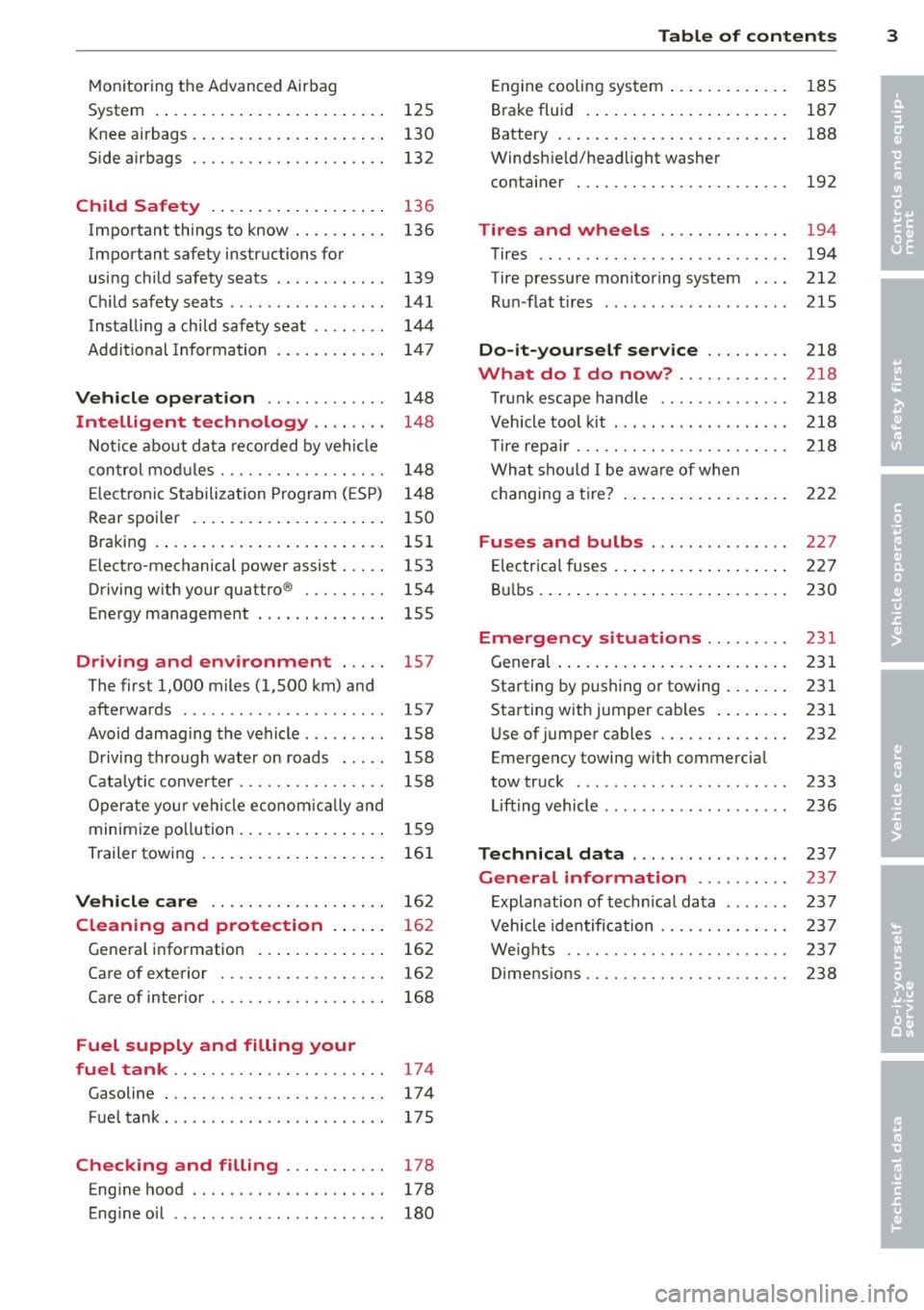
Monitoring the Advanced Airbag
System . . . . . . . . . . . . . . . . . . . . . . . . . 125
Knee airbags . . . . . . . . . . . . . . . . . . . . . 130
Side airbags . . . . . . . . . . . . . . . . . . . . . 132
Child Safety . . . . . . . . . . . . . . . . . . . 136
Important things to know . . . . . . . . . . 136
Important safety instructions for
using child safety seats . . . . . . . . . . . . 139
Ch ild safety seats . . . . . . . . . . . . . . . . . 141
Install ing a child safety seat . . . . . . . . 144
Addit io n al Information 14 7
Vehicle operat ion . . . . . . . . . . . . . 148
Intelligent technology . . . . . . . . 148
N ot ice about data recorded by vehi cle
con trol mod ules . . . . . . . . . . . . . . . . . . 148
E lect ronic S tabilization Program ( ESP) 1 48
Rear spoiler . . . . . . . . . . . . . . . . . . . . . 150
Braking . . . . . . . . . . . . . . . . . . . . . . . . . 151
Electro-mechanical power assist . . . . . 153
Driving w ith your quattro ® . . . . . . . . . 154
Energy management . . . . . . . . . . . . . . 155
Driving and environment . . . . . 157
The first 1,000 miles (1,500 km) and
afterwards . . . . . . . . . . . . . . . . . . . . . . 157
Avoid damaging the vehicle . . . . . . . . . 158
Driving through water on roads . . . . . 158
Cata lytic conve rter . . . . . . . . . . . . . . . . 158
Opera te you r vehi cle econom ic all y and
minim ize po llution . . . . . . . . . . . . . . . . 15 9
Trailer towing . . . . . . . . . . . . . . . . . . . . 161
Vehicle care . . . . . . . . . . . . . . . . . . . 162
Cleaning and protection . . . . . . 162
Gene ral information . . . . . . . . . . . . . . 162
Care of exterior . . . . . . . . . . . . . . . . . . 162
Care of inter ior . . . . . . . . . . . . . . . . . . . 168
Fuel supply and filling your
fuel tank .. ................. .. ..
174
Gasoline . . . . . . . . . . . . . . . . . . . . . . . . 17 4
Fue ltank ..... ................ ... 175
Checking and filling . . . . . . . . . . . 178
Eng ine hood . . . . . . . . . . . . . . . . . . . . . 178
Eng ine oil . . . . . . . . . . . . . . . . . . . . . . . 180
Table of contents 3
Engine cooling system .. ..... ... .. . 185
B rake fluid . ... .... . ... ...... ... . 187
•
Battery ... .. .. .. .. . .. ... .... ... . 188 •
Windsh ie ld/headlight washer
container . .. .. .. .... ........... .
192
Tires and wheels ........... .. . 194
Tires ..... .. .. .. .. . ............ . 194
Tire pressure mo nitoring system . .. .
212
R un -flat t ires .. .. .. . .. .... .... .. . 215
Do -it-yourself service ........ . 218
What do I do now? .. ...... ... . 218
T ru nk escape handle ............. . 218
V ehicle tool kit . .. ... .. .. ... ..... . 218
T ire repa ir ... .. ...... ........... . 218
What shou ld I be awa re of when
h . t
' 7 c anging a ire ... .. . .. .. ..... ... . 222
Fuses and bulbs .............. . 227
E lectr ica l fuses ... .. .. .. .. .... ... . 227
B ul bs ... .. .. .... .. . .. .. ..... ... .
230
Emergency situations ........ . 231
Genera l ... .. .... .. . .. .. ..... ... .
231
Starting by pushing or towing . ... .. . 231
Starting with jumper cables .. ... .. . 231
U se of jumper cables ............. .
232
Emergency towing wit h commercia l
tow truck ....... .. ............. . 233
Li fting vehicle .. .. .. .. .. ...... ... . 236
Technical data ..... .... ... .... . 237
General information ... ... ... . 237
E xplanation of techn ica l data ...... . 237
Vehicle identification ........... .. . 237
We ights .. .. .. .. .. .. ........... . 237
Di mens ions .. .. .. .. ............. . 238
Page 30 of 260
28 Driv e r in formation sy stem
A few seconds after the adjustment is com
p leted, the illumination for the odometer and
the dig ital clock will go o ut.
@ Tips
This warning threshold can also be con
trolled through the trip computer
~page 22, Navigating the menu.
On-Board Diagnostic
system (OBD)
On-Board Diagnostics
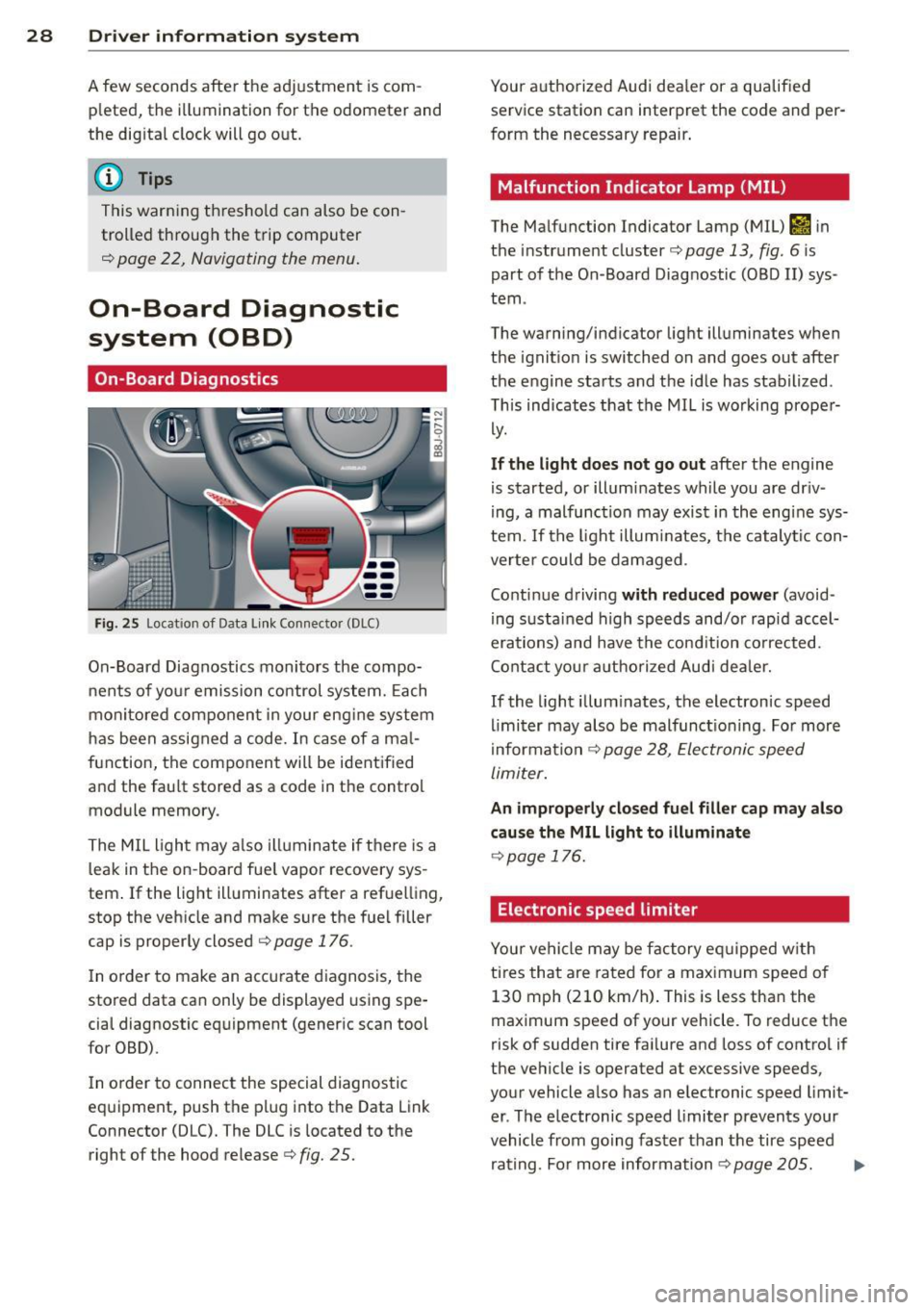
Fig. 25 Locat ion of Data Link Connecto r (DLC)
On-Board Diagnostics monitors the compo
nents of you r emission control system. Each
monitored compo nen t in your eng ine system
has been assigned a code . In case of a ma l
function, the component will be identified
and the fau lt stored as a code in the control
module memory.
The MIL light may a lso illuminate if there is a
leak in the on-board fue l vapor recovery sys
tem .
If the light illuminates after a refuelling,
stop the vehicle and make sure the fuel filler
cap is properly closed ¢
page 176.
In o rder to make an accurate diagnosis, the
stored data can only be displayed using spe
cia l diagnostic equipment (generic scan tool
for OBD).
I n o rder to connect the special diagnostic
equipment, push the plug into the Data Link
Connector (DLC). The DLC is located to the
right of the hood release¢
fig. 25.
Your authorized Audi dea ler or a qualified
service station can interpret the code and per
form the necessary repair .
Malfunction Indicator lamp (MIL)
The Malfunction Indicator Lamp (MIL) &'I in
the instrument cluster¢
page 13, fig. 6 is
part of the On-Board Diagnostic COBO II) sys
tem .
The warning/indicator light illuminates when
the ignit io n is switched on and goes out after
the e ngine starts and the idle has stabilized.
Th is indicates that the MIL is working prope r
ly.
If th e light d oes not go out after the engine
is started, or illum inates wh ile you are dr iv
ing, a malfunc tion may exist in the engine sys
tem.
If the light illum inates, the catalytic con
verte r could be damaged .
Continue driving
with reduced p ower (avoid
ing sustained high speeds and/or rapid accel
erations) and have the cond ition corrected.
Contact you r authorized Audi dea le r.
If the light illum inates, the electronic speed
limi ter may also be malfunct ioning . For more
i nformation ¢
page 28, Electronic speed
limiter.
An improperly clo sed fu el filler cap ma y also
cau se the MIL light to illuminate
¢ page 176.
Electronic speed limiter
Your vehicle may be factory eq uipped w ith
tires that are rated for a maximum speed of 130 mph (210 km/h) . This is less than the
maximum speed of your vehicle. To reduce the
risk of sudden tire fai lure and loss of control if
the vehicle is operated at excessive speeds,
your vehicle a lso has an electronic speed limit
er . The electronic speed limiter prevents your
vehicle from going faster than the tire speed
rating. Fo r more information
¢page 205. ...,
Page 31 of 260
If the engine control unit receives fau lty vehi
cle roadspeed signa ls , the Ma lfunction Indica
tor Light (MIL)
Ill will illum inate . If th is oc
curs, contact the nearest authori zed Audi
dealer for assistance.
S mod els
Your vehicle 's top speed is e lectronically limit
ed to 155 mph (250 km/h).
If the engine control unit rece ives fa ulty vehi
cle roadspeed signa ls , the Ma lfunction Indica
tor Lamp (MIU ¢• will i lluminate. If this oc
curs, contact the nearest authorized Audi
dea ler for assistance.
A WARNING
-
Always observe the posted speed limits
and adjust your speed to suit prevailing
road, traff ic and weather conditions. Never
drive your vehicle faster than the maxi
mum speed rating of the tires insta lled.
Warnings and symbols
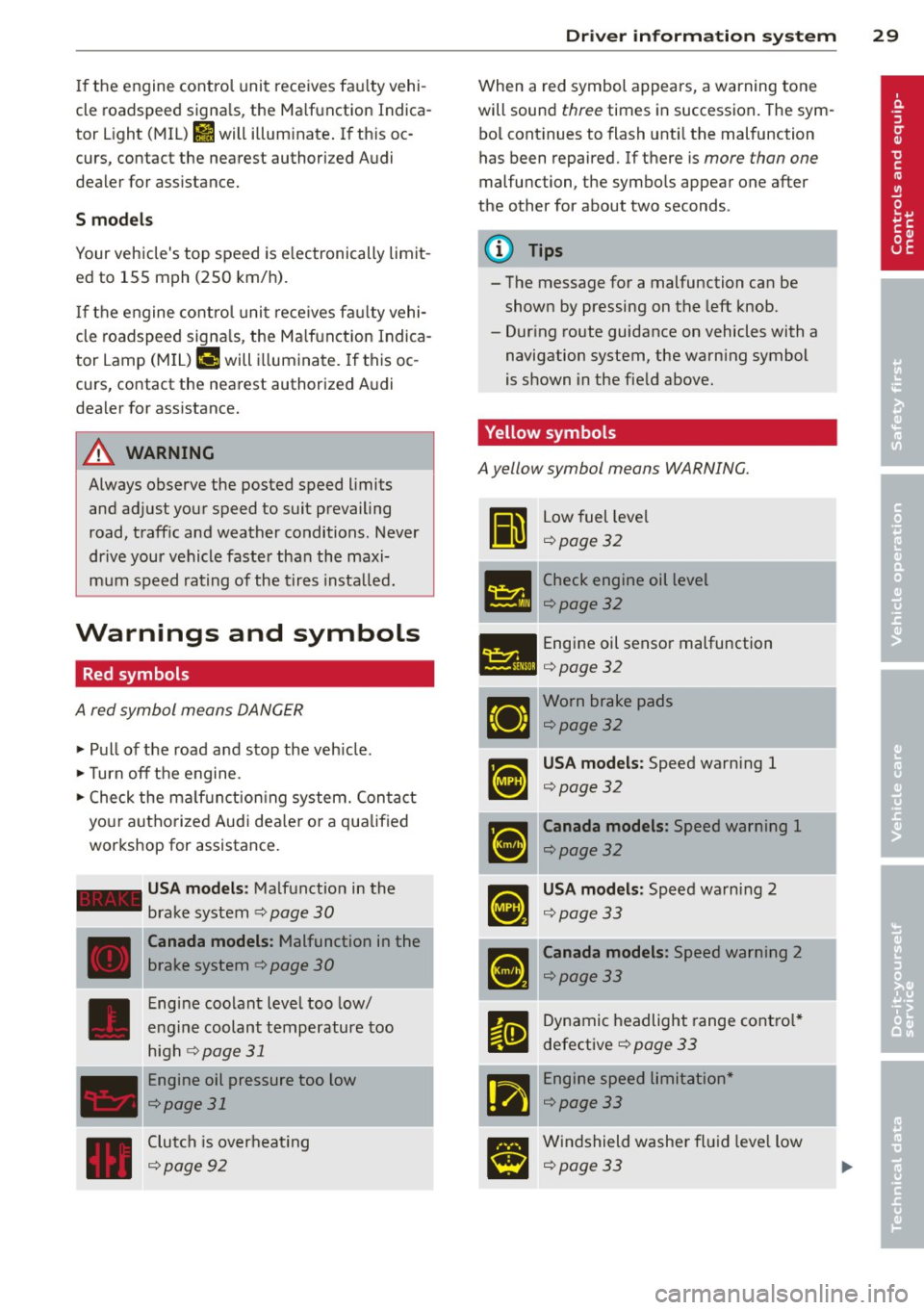
Red symbols
A red symbol means DANGER
" Pull of the road and stop the veh icle .
"T urn off the engine.
" Check the ma lf u nction ing system. Contact
your autho rized Audi dea le r o r a qualified
workshop for assistance.
- USA models : Malfunction in the
brake system ¢
page 30
---·--
D
Canada models : Malfunction in the
brake system ¢
page 30
Engine coolant level too low/
engine coolant temperature too
high
r:1;> page 31
Engine oil pressure too low
¢page 31
Clutch is overheat ing
c:1;> page 92
Dr iver in formati on sys tem 29
When a red symbol appears, a warning tone
will sound
three times in succession . The sym
bo l cont inues to flash unti l the malfunction
has been repaired. If there is
more than one
malfunc tion, the symbo ls appear one after
the other for about two seconds .
(D Tips
- The message for a malfunction can be
shown by pressing on the left knob.
- Dur ing route guidance on vehicles with a
navigation system, the warn ing symbol
is shown in the field above.
Yellow symbols
A yellow symbol means WARNING.
Ii
Low fuel leve l
¢page32
- -- Check engine oil level
151!1 ¢page 32
- Engine oil sensor malfunction
l:ill ¢ page 32
Worn brake pads
¢page32
USA models : Speed warning 1
c:1;> page 3 2
Canada models : Speed warning 1
¢page32
USA models: Speed warning 2
c:1;> page 3 3
Canada models: Speed warning 2
c:1;> page 33
Dynamic headlight range contro l*
defective
¢ page 33
-Engine speed limitation *
c:1;> page 33
Windshield washer fl ui d leve l low
c:1;> page 33
Page 107 of 260
re commended cold tir e infla tio n pr es
su res for the vehicle at it s max imum ca
p acity weight a nd t he tires t hat were o n
you r vehicle at t he time it was ma nufac
tur ed. For r ecomm ended tire pre ss ure s
fo r normal load co ndition s, ple as e see
c hap ter Q pag e
198 .
Reporting Safety
Defects
Applicable to U.S.A.
If you believe that your vehicle
has a defect which could cause
a crash or could cause injury or
death, you should immediately
inform the National Highway
Traffic Safety Administration (NHTSA) in addition to notify
ing Audi of America, Inc.
If NHTSA receives similar com
plaints, it may open an investi
gation, and if it finds that a
safety defects exists in a group
of vehicles, it may order a recall
and remedy campaign. Howev
er , NHTSA cannot become in
volved in individual problems between you, your dealer, or
Audi of America , Inc .
To contact NHTSA, you may call
the Vehicle Safety Hotline toll
free at :
Tel.: 1-888-327-4236 (TTY: 1-800-424-9153)
Driving Safely 105
or write to :
Administrator NHTSA 1200 New Jersey Avenue, SE
Washington, D.C. 20590
You can also obtain other infor mation about motor vehicle
safety from :
http: //www. safercar.gov
Applicable to Canada
Canadian customers who wish
to report a safety-related de
fect to Transport Canada, De
fect Investigations and Recalls, may telephone the toll free hot
line:
Tel.: 1-800-333-0371 o r
Tel.: 1-613-998-8616 if you are
in the Ottawa area
TTY for hearing impaired: 1-888-675-6863
email comments /questions to:
road safetywebmail@tc .gc .ca
or contact Transport Canada by mail at: ..,.
•
• '
Page 152 of 260

150 Intelligent te chn olog y
Noises from the b rake system signal that
wheel spin is being controlled.
Driving off
When drivi ng off, a lways be sure to keep road
conditions in mind as you accelerate. If one
d rive wheel spi ns because it is on a surface
with less grip, gradua lly increase the press ure
on the accelerator pedal until the car starts to
move. The wheel less able to transfer power
spins.
O verheating of bra kes
To prevent the disc brake of the braked wheel
from overheating if subjected to excessive
loads, the EDL cuts out temporarily. The vehi
cle rema ins operationa l and behaves in the
same way as a vehicle without EDL.
As soon as the brake has cooled down, EDL
switches on again automatically .
A WARNING
-When accelerating on slippery surfaces,
such as on ice or snow, always be careful
when depressing the acce lerator pedal.
Even with the EDL working, the drive
wheels can spin and reduce yo ur ability
to contro l your car. -Risk of crash!
- The increased safety afforded by EDL
does not mean that you can ta ke safety
risks. Always adapt your dr iving sty le to
the road conditions and traff ic situa tion.
@ Tips
If a fa ult occurs in the ABS, the EDL is also
not f unct ion ing. This is indicated by the
ABS warning light ¢
page 17.
Anti-Slip Regulation System (ASR)
The Anti-Slip Regulation System prevents the
driven wheels from spinning wh en the car is
accelerating.
General notes
The Anti-Slip Regulation System (ASR) is inte
grated in the electronic stabilization program
(ESP). When th e vehicle starts up and acceler- ates, the whee
ls are prevented from spinning
by adjusting the engine power to match the
amount of grip available from the road sur
face.
How the system works
ASR pe rforms a utomat ica lly, i.e . w ithout t he
driver's intervention. With the aid of the ABS
sensors ¢
page 153, ASR monitors t he speed
of the dr iven whee ls . If the whee ls start to
spin, the engine torq ue is reduced automati
cally until the tires find enough gr ip to lock
onto the road surface . The system is active
across the ent ire speed range .
The ASR works in conjunction with the ABS. If
a malfunction should occur in the ABS, the
ASR w ill also be out of act io n.
@ Tips
To ensure that the ASR works properly, all
four whee ls must be fitted wit h ident ica l
tires . Any differences in ro lling radius of
the tires can cause the system to reduce
engine power wh en this is not desired. See
a lso
¢ page 205, New tires and repla cing
tires and wheels.
Rear spoiler
The rear spoiler improves vehicle handling
and enhances driver control .
Fig. 131 Switc h fo r rear spo iler
The rear spoiler deploys and retracts. Spoiler
operation can be set for automat ic or manual
operation .
Page 156 of 260
154 Intelligent technology
If there is an electronic malfunction, ser
votronic
w ill st ill function like a conven
tional power steer ing system, prov iding a
constant steer ing support force that is no
longer proportionate to the ve hicle speed .
This is most noticeable when turning the
steer ing whee l at low speeds (for examp le
when par kin g), -more effo rt will be re
qui red th an usual.
- Be aware of the different than usual
stee ring response and adjust you r steer
i ng force a ccord ingly.
- Have the p roblem chec ked and set right
by an authori zed Audi dealer as soo n as
poss ib le.
- If a stee ring malfunct io n occu rs, this is
s ignaled with the
42J or .• indic ator
li ghts and a wa rning tone, see.
(D Tips
- If the power steering system shou ld fa il,
or if the eng ine is no t runn ing (fo r exam
ple, while being towed), yo u wi ll st ill be
able to stee r the veh icle. However, more
effort will be req uired to do so .
- If the power steer ing system is not func
tioning p roperly , contact your a uthorized
A udi dealer immediate ly .
Driving with your
quattro ®
With All Wheel Drive, all four wheels are driv
en.
General inform ation
W ith All Whee l Dr ive, power is d istributed to
all four wheels. This happens automatically
depending on your dr iv ing sty le and the road
conditions at the t im e. See also ¢
page 149,
E lectronic differential lock (EDL) .
Winter tires
When driving in the winter, your vehicle w it h
All Wheel Drive has an advantage, even with regular t ires. In winter road co nditions it may
be adv isable to mount winter tires (o r all-sea- son tires) for
improved driveability and brak
ing : these tires must be mounted o n
all four
wheel s.
See also ¢ page 209, Winter tires .
Snow chains
Where tire chains a re m andatory o n certa in
roads, this no rma lly also app lies to ve hicles
wi th All Wheel Drive
¢ page 210, Snow
chains.
Replacing wheels /tires
Vehicles wi th A ll Wheel D rive mus t always
have t ires of the same s ize. A lso avoid tires
with different tread depths . For deta ils see
page ¢
page 205, New tires and replacing
tires and wheels .
Off-Road driving?
Your Aud i does not have enough g ro und clea r
an ce to be used as an off- road vehicle. It is
therefore bes t to avoid rough tracks and un
even terrain as much as possib le . Also refer to
¢ page 158.
A WARNING ~
Always ad just your dr iv ing to road and traf-
f ic conditions. Do not let the extra safety
afforded by All Wheel Dr ive tempt you into
taking ext ra ris ks.
- Although the All Wheel Drive is very ef
fective , always remember that braking
capacity is lim ited by tire t raction . You
should therefore not d rive at excessive
speeds on icy or slippe ry road s urfa ces.
- On wet road surfaces, be careful not to
drive too fast because the front whee ls
could begin to slide o n top of the wate r
(aquapla ning). If th is should occur, yo u
will have no warning from a s udden in
crease in eng ine speed as wit h a front
wheel drive veh icle. Always drive at
speeds which are su ited to the road con
d itions. -risk of crash.
Page 159 of 260
Driving and
environment
The first 1
1000
miles
(11500 km) and
afterwards
New engine
The engine needs to be run-in during the first
1,000 miles (1 ,500 km) .
For the fir st 600 mile s (1,000
kilometre s):
.,. Do not use full throttle .
.,. Do not drive at engine speeds that are more
than 2/3 of the max imimum permitted
RPM .
.,. Avoid high engine speeds.
From 600 to 1,000 miles (1 ,000 to
1,500 kilometres):
.. Speeds can gradually be increased to the
maximum pe rm iss ib le road or eng ine speed .
During and after break-in period
.. Do not rev the engine up to high speeds
when it is cold . T hi s applies whether the
transmission is in N (Neutral) o r in gear.
After the break- in period
.. Do not exceed max imum eng ine speed un
der any circumstances .
.. Upshift into the next hig her gear
before
reaching the red area at the end of the tach
ometer scale
<::;> page 10.
During the first few hours of driving, the en
g ine's inter na l friction is higher tha n later
when all the moving pa rts have been broken
i n. How well this break-in p rocess is done de
pends to a considerable exten t on the way t he
veh icle is driven d uring the first 1,000 miles
(1, 500 kilome tres) .
(D Note
Extremely high engine speeds a re auto
mat ic al ly reduced. However, t hese RPM-
Driving and environment 157
limits were programmed for an eng ine
well run-in, not a new eng ine.
@ For the sake of the environment
Do not d rive wi th unnecess arily h igh en
gine speeds -upshifting ear ly saves f uel,
r educes noise and protects the environ
ment.
New tires
If your vehicle is running on new tires, drive
particularly carefu l for the first 350 miles
(500 ki lometres) after fitting .
A WARNING
-New tires tend to be s lippery and must a l-
so be "b roken-in". Be s ure to remembe r
this dur ing t he firs t 35 0 m iles (500 kilo
me tres) . Brake gent ly . Avo id following
closely behind other vehicles or other sit uations that m ight require sudden, hard
b raking.
New brake pads
Remember that new brake pads do not have a
full brak ing effect during the first 250 m iles
(400 kilometres) after they are installed.
New brake pads have to be "burnished in" be
fore they have optima l grab¢ .&..
D uring the break-in period, yo u should avoid
putting seve re loads on the brakes . Severe
l oads include, for example, su dden hard brak
ing, in particular at very h igh speeds or, for
example, on mou nta in passes.
A WARNING
Until t hey develop the maximum "bite" for
best stopping power, the s urfaces on new
b rake pads requ ire some "brea king- in" dur
in g the initial 10 0 to 150 miles (15 0 to
20 0 kilome tres) of normal c ity dr iv ing. Yo u
can compensate for this by press ing the
b rake peda l more f irm ly . This applies
whenever new pads are installed.
•
•
Page 166 of 260
164 Cleaning and protection
regular basis, fo r example when
refuelling your vehicle.
- Never use a dry cloth or sponge to clean
the headlights . Only use wet cloths or
sponges to prevent scratches. It is best
to use soapy water.
@J For the sake of the environment
In the interest of the env ironment, the ve
hicle sho uld only be washed in special
wash bays.
Washing your vehicle with a power
washer
Cleaning the exterior of your car with a high
pressure power washer is safe as long as you observe a few simple rules .
.. Before us ing the power washer, make sure
you have read and understood the WARN INGS
c> & in General information on
page 162.
.. Always fo llow the operating instructions for
the power washer .
.. Make sure that the jet on the spray hose pro
duces a "fan shaped spray".
.. Do
not hold the spray nozzle too close to
soft materia ls.
N eve r u se a pow er w asher to clean the power
top itse lf.
When clea ning t he vehicle w it h a powe r wash
e r
always fo llow the operating instructions.
This applies particularly to the
o pera tin g
p re ssu re
and the s p ra yi ng dist ance. Maintain
a sufficient distance to soft materials such as
rubber hoses and so und/vibration deadening
materia ls (part icularly on the underside of the
engine hood). Do not use a jet wh ich sprays
water in a
dire ct st ream or one that has a ro
tat ing
jet .
Water temperature shou ld not exceed 140 °F
(60
°() .
A WARNING
Never wash tires w ith a jet that sprays wa
ter in a d irect stream. This could cause in- visible damage to the tires and weaken
them, even
if the spray is from a relative ly
long distance and for a short time. Dam
aged and weakened tires can fail and cause
accidents and personal inju ry.
(D Note
- Never use a power washer to clean the
power top itself.
- To avoid damaging your veh icle, always
make sure that there is sufficient dis
tance between the spray head and soft
materials like rubber hoses, plast ic parts
and sound-deadening materials. Never
aim the spray head at the same point for
a long time. This also app lies to cleaning
head lights and pa inted b umpe rs. Re
member: the closer the nozz le is to the
surface of the material, the greate r the
stress on the materia l.
Convertible top care
The convertible top requires special care.
Keeping you r top looking great and mak ing
certain tha t it lasts a long time depend to a
great extent on proper use and care . Remove
bird droppings as soon as possible, since the
corrosive chemicals in them will cause the
rubber impregnation in your top to swell and
poss ibly allow the fabric to leak .
With
normal soiling, all you need to do is
clea r the top with a soft br ush and clear wa
ter. A lways brush in the direction of the fabric
from front to rear.
If the top is very dirty and has spotted areas
clean it with a brush using a convertible top
cleaner . Always brush in the direction of the
fabric from front to rear. R inse with plenty of
clear water, and allow the top to air-dry.
Chamois are not suitable for drying the top.
Never use gaso line, spot remover, benzene,
paint thinner or solvents to remove spots . We
recommend that you on ly use cleaners espe
cia lly formulated for use on convertib le tops,
and that you fo llow the produce use directions ...
Page 196 of 260
194 Tire s and wheel s
Tires and wheels
Tires
General notes
Tires may be the least appreciated and most
abused parts of a motor vehicle .
Tires may be the least appreciated and most
abused parts of a motor vehicle . Tires are,
however, one of the most important parts of a
vehicle, particularly considering the compara
tive ly small patch of rubber on each tire that
assures that a ll-important contact between
you, you r vehicle and the road.
Maintaining the correct tire pressure, mak ing
sure that your veh icle and its t ires do not have
to carry mo re weight than they can safe ly han
d le, avoiding damage from roa d haza rds and
r eg ularly inspecting t ires for damage includ
ing cuts, slashes irregu la r wear and ove rall
condition are the most important things that
you can do to he lp avoid s udden tire failure in
cluding tread separat ion and blowouts.
Avoiding damage
If you have to drive over a curb or similar ob
stacle, drive very s low ly and as close as possi
b le at a right angle to the curb.
A lways keep chem ica ls incl ud ing gre ase, o il,
gasoline and b rake fluid off the t ires .
Inspect the t ir e s regularly for damage (cuts,
cracks or b listers, etc.). Remove any fo reign
bod ies embedded in the treads.
Storing tires
Mark ti res when you remove them to indicate
the direction of rotation . T his ensures you to
be ab le to mount them correctly when you re
install t hem.
When removed, the whee ls or t ires should be
stored in a cool, d ry and preferably dark place .
Store tires in a vertical pos ition if they are not
mounted on rims, in a horizontal pos it ion if
they are mounted on rims.
New tires
New t ires have to be broken in¢&,. .
T he tread depth of new t ires may vary, accord
ing to the type a nd make of t ire and the tread
pa tte rn .
Hidden damage
Damage to tires and r ims is ofte n not readily
vis ible . If you notice unusual v ibrat ion or the
vehicle p ulls to one side, th is may ind icate
t h at one of the t ires has been damaged . Th e
t ir es m ust be checked immed iate ly by an au
tho rized Aud i dea le r or q uali fied wor ks hop.
Unidirectional t ires
A un idirectional tire can be identified by ar
rows on the sid ewa ll, that po int in the direc
t ion the t ire is desig ned to rotate. You must
f ol low the specified d irec tion of rot ation . This
is necessa ry so tha t these tires can develop
their optimum characterist ics regarding grip,
road no ise, wear and hyd rop laning resistance.
For more information ¢
page 226.
A WARNING
-New tires or t ires that are o ld, worn or
damaged cannot provide maximum con
trol and braking ability .
-
-New tires tend to be slippery and must
be broken in . To reduce the risk of losing
control, a co llision and ser ious personal
in jur ies, d rive w ith special ca re fo r the
fi rst 3 50 m iles (560 km).
- Driving with worn or damaged tires can
le ad to loss of control, sudden tire fail
ure, including a blowou t and sudden de
fla tion, crashes and seriou s personal in
juries . Have wo rn or damaged t ires re
p laced immediate ly .
- Ti res age even if they are not being used
an d can fai l sudden ly, especially at high
speeds. Tires that are more than 6 years
old can only be used in an emergency
and then w ith specia l care and at low
speed.
Page 197 of 260
-Never mount used tires on yo ur vehicle if
you are not sure of their "previous histo
ry." Old used tires may have been dam
aged even though the damage cannot be
seen that can lead to sudden tire failure
and loss of vehicle control.
Glossary of tire and loading terminology
Accessory weight
means the comb ined weight (in excess of
those standard items wh ich may be rep laced)
of automa tic tra nsmission, power steering,
power br akes, power w indows, power sea ts,
radio, and heater, to the ex tent that these
items are avai lab le as factory -installed eq uip
ment (whether installed or not).
Aspect ratio
means the rat io of the height to the w idt h of
the tire in percent . Numbers of 55 o r lower in
d icate a low sidewall fo r improve d steer ing re
sponse and better overall handling on dry
pavement.
Bead
means the pa rt of the t ire t hat is made o f
s teel wires, wrapped o r reinforce d by ply cor ds
and that is shaped to fit the r im.
Bead separation
means a b reakdown of the bond between
com ponents in the bead .
Cord
means the strands forming the plies in the
tire .
Cold tire infl ation pres sure
means the tire pressure recommended by the
vehicle manufacturer for a t ire of a designated
size that has not been dr iven for more than a
couple of miles (kilometers) at low speeds in
the three hour period before the tire pressure
i s measu red or adjusted.
Tire s an d wheel s 195
-If you notice un usua l vibration or if the
veh icle pulls to one side when driv ing, a l
ways stop as soon as it is safe to do so and check the wheels and tires for dam
age.
Curb weight
mea ns the we ight of a motor ve hicle w it h
standard equipment in cl ud ing t he maximum
capacity of fuel, o il, and coolant, ai r cond i
tion ing and addi tional weig ht o f optiona l
equipment .
Extra load tire
means a t ire designed to operate at higher
loads and at highe r inflat ion p ressu res tha n
th e co rresponding standard tire. Extr a load
tir es my be i dent ified as "X L", "xl", " EXTRA
L O AD", or "RF" on t he sidewall.
Gross Axle Weight Rating ("GAWR ")
mea ns the load-carry ing capac ity of a s ingle
axle system, measured at the tire-ground in
te rfaces .
Gross Vehicle Weight Rating ( "GVWR ")
mea ns the maximum total loaded we ight of
t h e ve hicle.
Groove
means the space between two adjacent tread
ribs.
Load rating (code )
means the maximum load tha t a t ire is rate d
to ca rry for a given inflation press ure. Yo u
may not find this information on all tires be
ca use it is not required by law.
Maximum load rating
me ans the loa d ra ting f or a t ire a t the maxi
mum pe rm issi ble inflat ion pressure for that
ti re . •
•
...