light AUDI TT ROADSTER 2014 Owners Manual
[x] Cancel search | Manufacturer: AUDI, Model Year: 2014, Model line: TT ROADSTER, Model: AUDI TT ROADSTER 2014Pages: 244, PDF Size: 60.87 MB
Page 182 of 244
180 Checking and filling
Windshield/headlight
washer container
M N
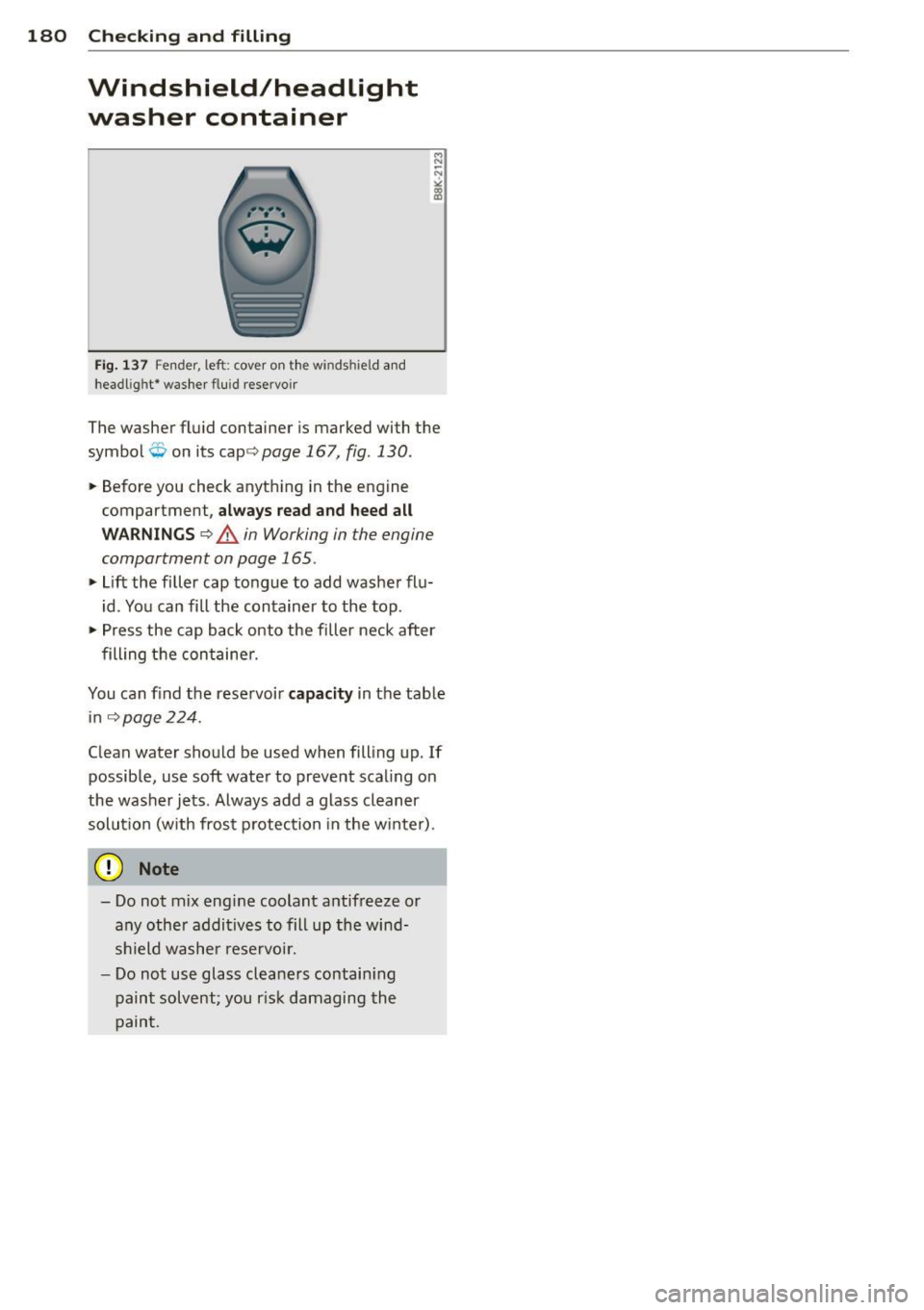
Fi g. 137 Fender , left : cover on t he w inds hield a nd
headl ig ht* was her fl uid reservoir
The washer flu id container is marked wi th the
symbol
Q on its cap <=>page 16 7, fig . 130 .
.. Before you check anyth ing in the engine
compartment,
alw ays re ad an d heed all
W ARNING S r=> A in Working in the engine
compartment on page 165 .
.,. Lift the filler cap tongue to add washer flu
id . You can fill the container to the top .
.,. Press the cap back onto the fi ller neck after
filling the containe r.
You can find the reservoir
ca pacity in the table
i n
r=> page 224 .
Clean water should be used when filling up . If
possible, use soft water to prevent scal ing on
the washer jets . Always add a glass cleaner
solutio n (with frost p rotection in the winter) .
(D Note
-Do not mix engine coolant antifreeze or
any other addi tives to fill up the wind
shield washer rese rvoi r.
- Do not use glass cleaners contain ing
paint solvent; you r isk damaging the
paint.
Page 188 of 244
186 Tire s and wheel s
you have stored . The system does not
recognize the load condition of your vehicle.
The effectiveness of the tire pressu re monito r
ing system w ill be impaired if yo u store nor
mal load pressures but then operate the vehi
cle at its maximum load¢.&..
See the il lustration¢
fig. 138 for the location
of the label on dr iver's side 8-pillar (color of
the actua l labe l and exact location on the ve
hicle wi ll vary slightly).
Note that the followi ng tab le is accurate a t
the time o f go ing to press and is subject to change. In the
event of discrepancies, the t ire
pressure label (on driver's side 8-pi llar) a lways
takes precedence .
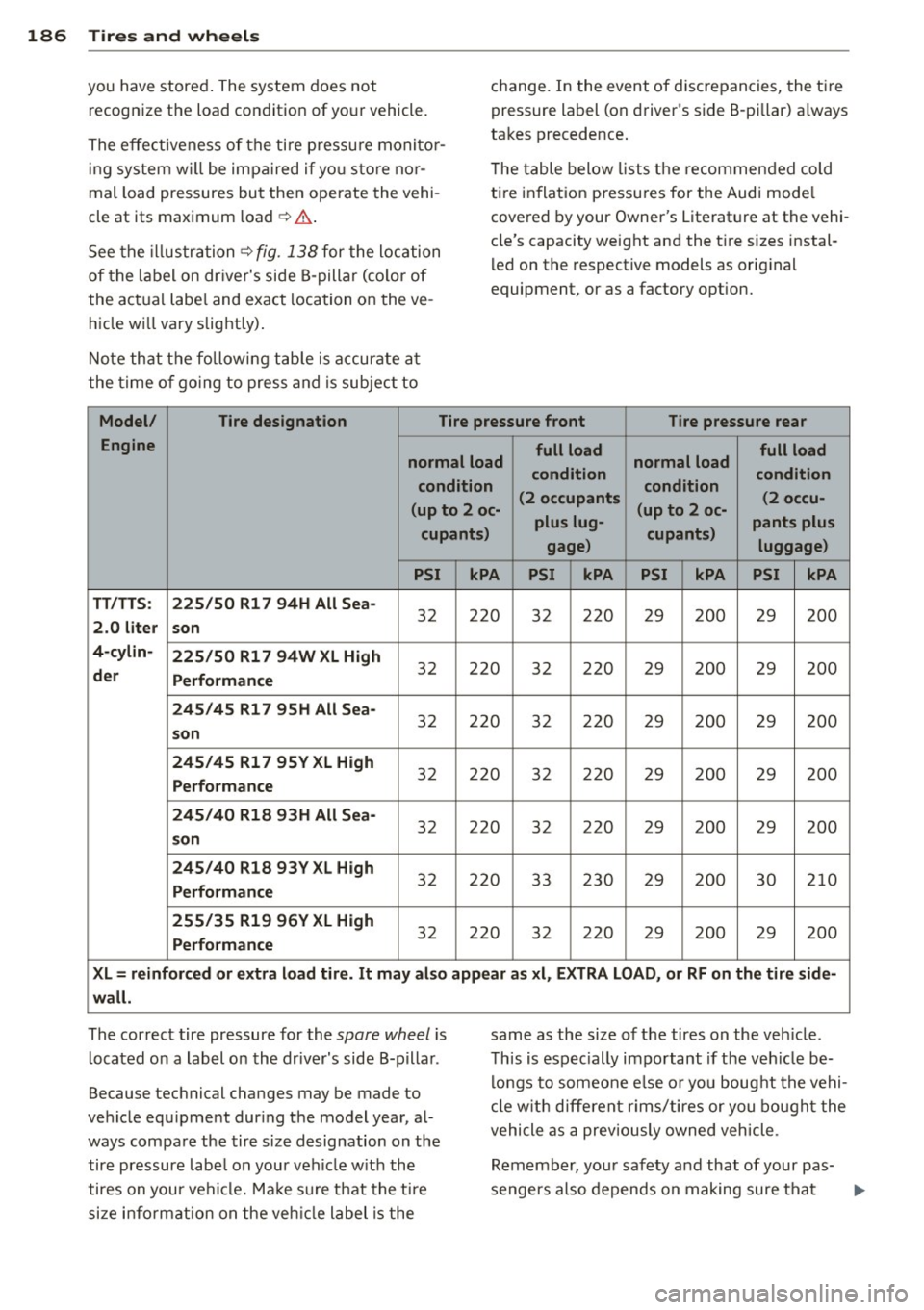
T he table below lists the recommended cold
ti re inflation pressu res for the Audi mode l
covered by your Owner's Literature at the vehi
cle's capacity weight and the t ire sizes instal
l ed on the respective models as original
equipment, or as a factory option.
Model/ Tire designation
Tire pressure front Tire pressure rear
Engine full load full load
no rmal load
condition normal load
condition
condition (2 occupants condition
(2 occu-
( up to 2 oc-
plus lug- (up to 2 oc-
pants plus
cupants)
gage) cupants)
luggage)
PSI kPA PSI kPA PSI kPA PSI kPA
TT /TTS : 22 5/50 Rl 7 94H All Sea -
32 220 32 220 29 200 29 200 2.0 liter son
4-c ylin-225 /50 Rl 7 94W XL High
d er
Perf orm ance
32 220 32 220 29 200 29 200
2
45 /4 5 Rl 7 95 H All Sea-
32 220 32 220 29 200 29 200 son
245 /45 Rl7 95YX L High
32 220 32 220 29 200 29 200 Perf ormance
245 /40 R1 8 93H All S ea-
32 220 32 220 29 200 29 200 son
2 45 /40 Rl8 9 3Y XL High
32 220 33 230 29 200 30 210 Perform ance
25 5/35 Rl 9 96Y XL Hi gh
32 220 32 220 29 200 29 200 Perf or mance
X L= r ein for ce d or e xtra lo ad tire . It m ay also a ppear as xl, EX TRA LO AD, or RF on th e tire side-
w all.
The correct tire pressure for the spare wheel is
l ocated on a label on the driver's side 8-pillar.
Because technical changes may be made to
vehicle equ ipment dur ing the model year, al
ways compare the tire size designation on the
tire pressure labe l on your vehicle w ith the
tires on your vehicle. Ma ke sure that the tire
size information on the vehicle label is the same
as the size of the tires on the veh icle.
T his is espec ially important if the veh icle be
longs to someone e lse or you boug ht the vehi
cle w ith different rims/tires or you bought the
vehicle as a previously owned veh icle.
Remember, your safety and that of your pas-
sengers also depends on making sure that
II>-
Page 190 of 244
188 Tire s and wheel s
forget the spare tire. If the pressure in any tire
is too high when the tire is "cold," let air out
of the tire slowly with the edge of the tire
ga uge and keep checking the pressure until
you reach the pressure that is correct for the
load (passengers and luggage) and kind of
driving you plan to do.
If the pressure in any tire is too low, note the
d ifference between the pressure in the cold
tire and the pressure you need and add the air
that you need to reach the correct pressure for
the vehicle load (passengers and luggage) for
the tires on your veh icle as listed on the on
your ve hicle and in this manua l and the kind
of dr iving you p lan to do .
Never exc eed th e maximum inflati on pres
sure listed on th e tir e s idewall for any rea
s on.
Remembe r that the vehicle manufacturer, not
the t ire manufactu rer, determ ines the correct
tire pressure for the t ires on your vehicle.
It is important to check the tire pressure when
the t ires a re cold .
- Read the requ ired tire press ure from the tire
pressure label located on driver's side B-pil
lar .
- Turn the valve stem cap counter-clockwise
to remove it from the tire valve.
- Place the air pressure gauge on the valve.
- The tire pressures sho uld only be checked
and adjusted when the tires are cold. The
slightly raised pressures of warm tires must
not be reduced.
- Adjust the tire pressure to the load you are
carrying.
- Re insta ll the valve stem cap on the valve.
Wh en should I check the tir e pr essure?
The correct tire pressure is espe cially impor
tant at high speeds . The pressure should
therefore be checked at least once a month
and a lways before starting a journey.
When should I ad ju st the tire pressures?
Adj ust the t ire p ressu re to the load yo u are
carry ing . After changing a wheel
or replacing whee
ls you have to adjust the tire p ressures
o n all whee ls. In addition, yo u m ust then initi
alize the new tire press ures in the t ire pres
s u re monitoring system¢
page 199.
A WARNING
Incorrect tire pressures and/or underinfla
tion can lead sudden tire fa ilure, loss of
control, collision, serious pe rsonal injury
or even death.
- When the warn ing symbol
RI] appears in
the instrument cluster, stop and inspect
the t ires.
- Incorrect tire pressure and/or underinfla
tion can cause increased tire wea r and
can affect the handling of the vehicle and
s topping ability.
- I nco rrect tire pressures and/or underin
f lation can a lso lead to s udden t ire fail
ure, including a blowout and su dden de
flation, ca using loss of veh icle cont ro l.
- The drive r is responsible for the co rrec t
tire pressures for all tires on the veh icle .
The applicable pressure values are loca t
ed on a sticker on the driver's side B -pil
lar.
- On ly when all tires on the vehicle are fil
led to the correct pressu re, the tire pres
sure mon itor ing system can work cor
rectly.
- The use of incorrect tire pressu re va lues
can lead to acc idents or other damage.
Therefore it is essential that the driver
observe the spec ified t ire pressure values
for the tires and the correct pressures for
the function of the t i re p ress ure monito r
ing system.
- Always inf late tires to the recommended
and correct t ire pressure before dr iv ing
off.
- Driving with unde rinf lated tires bend
mo re, letting them get too hot resulting
in tre ad separation, sudden tire failure
and loss of cont ro l.
- Excessive speed and/overloading can
cause heat b uild- up, sudden tire failure
and loss of cont ro l.
Page 202 of 244
200 Tires and wheels
remain continuo usly illuminated . This se
quence will continue upon subsequent vehicle
start-ups as long as the ma lfunction ex ists.
When the malfunction indicator is illuminat
ed, the system may not be able to detect or
signal low tire pressure as intended. TPMS
malfunctions may occur for a variety of rea
sons, including the installation of replace ment or alternate tires or wheels on the vehi
cle that prevent the TPMS from functioning properly . Always check the TPMS malfunction
tellta le after replacing one or more t ires or
wheels on your veh icle to ensure that the re
placement or alternate tires and wheels allow
the TPMS to continue to function properly.
Tire pressure indicator appears
Applies to vehicles: with tire pressure monitoring system
The tire pressure indicator in the instrument
cluster informs you if the tire pressure is too
low or if there is a system malfunction.
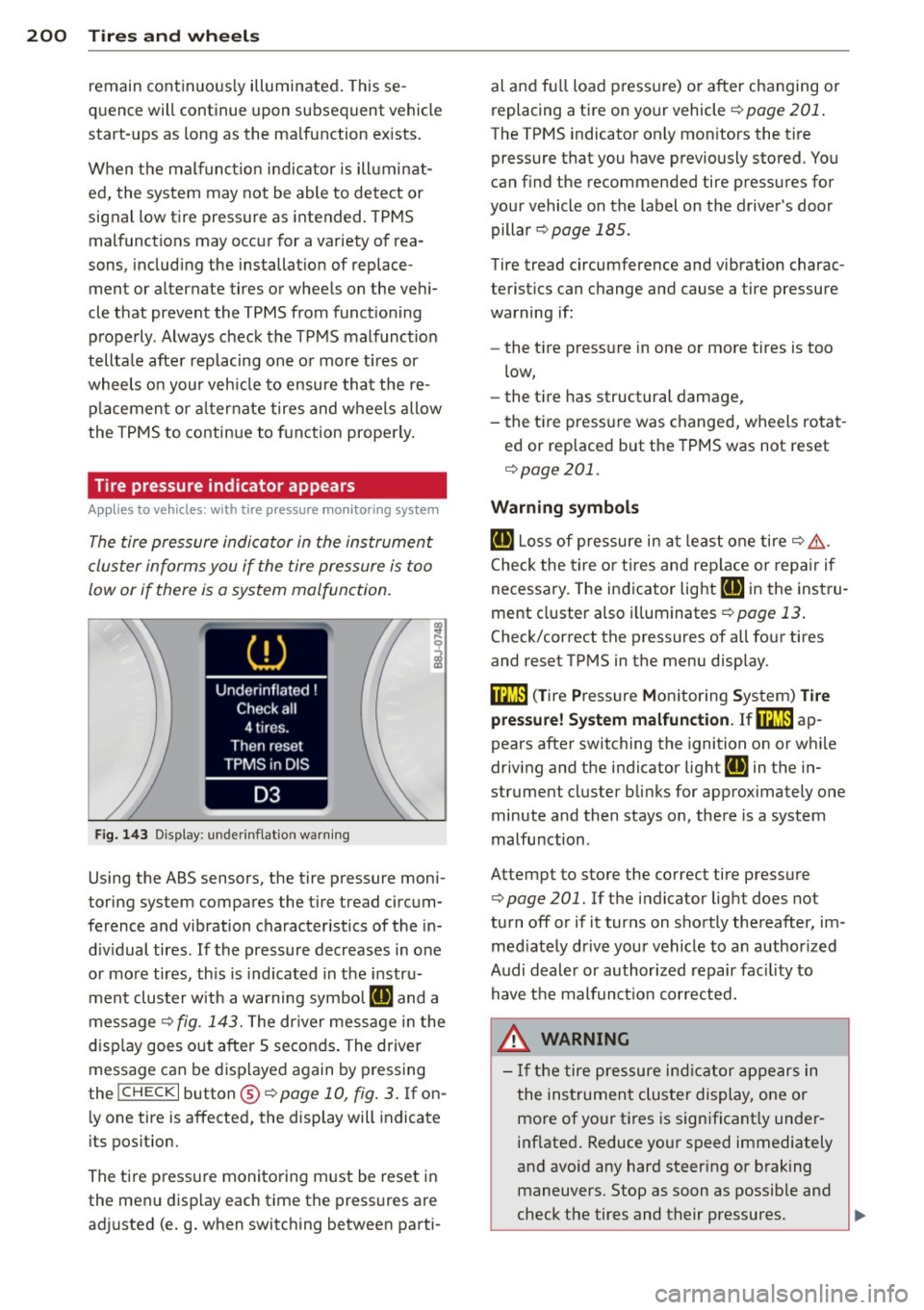
F ig. 143 Display : underi nflat io n warn ing
Using the ABS sensors, the tire pressure moni
toring sys tem compares the t ire tread circum
ference and vibration characteristics of the in
d iv idual tires . If the pressure decreases in one
or more tires, th is is indicated in the instru
ment clus ter with a warning symbo l
ail and a
message<>
fig. 143. The dr iver message in the
display goes out after 5 seconds . The driver
message can be displayed again by pressing
the
! CHECK I button @¢ page 10, fig . 3 . If on
l y one tire is affected, the display will indicate
its pos ition.
The tire press ure monitoring m ust be reset in
the menu display each time the pressures are
ad justed (e.g. when switching between parti- al and fu
ll load pressure) or after changing or
replacing a tire on your vehicle<>
page 201.
The TPMS indicator only mon itors the t ire
pressure that you have previously stored . You
can find the recommended tire pressures for
your vehicle on the label on the driver's door
pillar
¢ page 185.
Tire tread circumference and vibration charac
teristics can change and cause a tire pressure
warning if:
- the t ire pressure in one or more tires is too
low,
- the tire has structural damage,
- the tire pressure was changed, wheels rotat -
ed or replaced but the TPMS was not reset
¢ page 201.
Warning symbols
ail Loss of pressure in at least one tire¢& .
Check the tire or tires and replace or repa ir if
necessary . The indicator light
HE in the instru
ment cluster also illuminates
<>page 13.
Check/correct the pressures of all four tires
and reset TPMS in the menu display .
ffim (T ire Pressure Monitoring System) Tire
pressure! System malfunction. Ifffim
ap
pears after switching the ignition on or while
driv ing and the indicator lig ht
HE in the in
strument cluster blinks for approx ima tely one
minute and then stays on, there is a system
malfunction .
At tempt to store the correct tire pressure
¢ page 201. Ifthe indicator light does not
turn
off or if it turns on shortly thereafter, im
med iate ly drive your vehicle to an author ized
Audi dealer or author ized repair facility to
have the malfunction corrected.
_&. WARNING
-
- If the tire pressure indicat or appears in
the instrument cluster display, one or
more of your tires is significant ly under
inflated . Reduce your speed immediately
and avoid any hard steer ing or braking
maneuvers. Stop as soon as possible and
check the tires and their pressures.
IJJ,,
Page 206 of 244
204 Tires and wheels
Handling characteristics change when
dr iving with low air pressure or with flat
tires even with special run-flat tires
A low pressure or flat front tire affects vehicle
handling characteristics by pulling the vehicle
slightly to the side where the tire is mounted
and reduces braking performance.
A low pressure or flat
rear tire also affects
driving characteristics by pul ling to the side
where the tire is mounted and also reduces
brak ing performance. The effect on vehicle
handling is most not iceable when driving
around curves.
& WARNING
Changed vehicle handling characteristics
when driving in the run -flat mode can
cause loss of vehicle contro l, a c rash and
serious personal in jury.
- Driving on special run-flat tires in the
run-flat mode will change vehicle han
dling characteristics during braking,
when cornering and under heavy acceler
ation .
- Never drive faster than the maximum
rated speed of 50 mph (80 km/h) when
dr iv ing in the run-flat mode .
- Always adjust vehicle speed to traffic,
road and weather cond itions and drive
slower than the max imum rated speed if
necessary weather and road conditions
are taken into account.
- Always obey speed limits and other traf
fic laws.
(D Note
We a lways recommend driving w ith even
more care when using these specia l tires in
the run-flat mode. Always avo id sudden
maneuvers.
Replacing run-flat tires and rims
Applies to veh icles: w it h Run -flat tires
Your vehicle was especially designed to use
special run-flat tires .
You may use and combine only approved run
flat tires and special matching rims that have
been designed for run -flat tires . Mounting
special run-flat tires on standard whee ls will
not work and will not provide the advantages
fo the run-falt feature. Never use special run
flat tires on standa rd whee l rims.
After dr iving w ith a t ire in the run-flat mode,
always have the veh icle and affected tire(s)
and rim(s) inspected by an author ized Audi
dealer. Tires that have been dr iven in the run
flat mode must be rep laced .
& WARNING
=
Use of damaged run-flat tires and rims can
cause vehicle damage that can lead to loss
of vehicle control, a crash and serious per
sonal injury.
- Always have the vehicle and affected
tire(s) and r im(s) inspected by an author
ized Audi dealer after driving a tire in the
run-flat mode.
- Tir es that have been dr iven in the run
flat mode must be replaced.
Page 210 of 244
208 What do I do now?
• Remove the dust cap from the valve of the
defective tire.
• Screw the hose@) onto the valve
(J)
¢fig . 153.
• Insert the plug@¢ fig. 152 into the socket
for the cigarette lighter.
• Switch on the ignition .
Inflating tire
• Move the switch@¢ fig. 153 on the e lec
tric air pump
l ) to position I. After 5 mi
nutes, tire pressure must have reached at
least 1.8 bar .
• Switch the electric air pump off -switch in
pos it ion
0 . If the requ ired tire pressure of at
least 1.8 bar has not been reached, follow
the instructions in the section
Re-inflating
tire.
Re -inflating tire
• Remove the hose from the valve and pull the
plug out of the socket.
• Drive the vehicle slow ly 10 meters backward
or forward. This helps to distribute the seal
ant better .
• Remove the empty inflation bott le and
screw the hose®¢
fig. 152 from the elec
tric pump directly onto the valve.
• Insert the plug@¢
fig. 152 into the socket
for the cigarette lighter.
• Switch on the ignition .
• Move the switch @¢
fig. 153 on the e lec
t ric air pump
l) to posit ion I. After 5 mi
nutes, tire pressure must have reached at
least 1.8 bar.
• Switch the electric air pump off -switch in
position
0. If the required tire pressure of at
l east 1.8 bar has not been reached, it is not
poss ible to make a repair with the tire seal
ant. Seek professional ass istance.
Disassembling Tire Mobility System
• Remove the hose from the valve and pull the
plug out of the socket.
• Screw the dust cap onto the va lve.
1l The electric air p ump sho uld never ru n fo r long er than
6 min utes.
• Place the empty sea lant bott le back in the
original packaging and clip it in place under
the floor so that no t ire sea lant can run out
into the veh icle.
• Place the electric air pump in the luggage
compartment for the t ime being .
• Start driv ing right away so that the sealant
is distributed in the tire.
_&. WARNING
- Follow the manufacturer's safety instruc
tions on the decal for the air pump and
the sealan t bottle.
- If a tire pressure of 1.8 bar cannot be
achieved after pumping for 5 minutes,
the tire is too severe ly damaged. Do not
continue to drive.
- Seek professional assistance if it is not
possible to repair the tire with the tire
sealant.
(D Tips
- Do not operate the electric air pump for
more than 6 minutes without stopping,
otherwise it can overheat . When the air
pump has cooled down, you can continue
to use it.
- If sea lant has escaped, allow it to dry,
then you can pee l it off.
Final check
App lies to vehicles: wit h Tire Mobility System
After driving for a short distance, tire
pressure must be checked
• After driving for about 10 minutes, stop and
check the tire pressure .
• If tire pressure is still at least 1.3 bar, in
flate the tire to specified pressure (see driv
ers side B-pillar), drive to the next repa ir
shop and have the tire and the sealant bot
tle replaced.
• If tire pressure is less than 1.3 bar, the tire
is too severely damaged. Do not continue to
drive . Seek professional assistance. .,.
Page 213 of 244
slip and cause an injury if it does not
have sufficient hold on the veh icle.
- A soft or unstable surface under the
jack may cause the vehicle to slip off the jack. Always provide a firm base for
the jack on the ground. If necessary, use a sturdy board under the jack .
- On hard, slippery surface (such as tiles)
use a rubber mat or similar to prevent
the jack from slipping .
- To help prevent injury to yourself and
your passengers:
- Do not raise the vehicle u nti l yo u are
sure the jack is sec urely engaged .
- Pa ssenge rs must not remai n in the ve
h icle when it is jacked up.
- Make sure that passengers wait in a
safe pl ace away from the vehicle and
well away from the roadway and traffic.
- Make sure ja ck position is correc t, ad
just as necessary and then continue to
ra ise the jack .
(D Note
A floor jac k or the pads o n the hoist arms
m ust
n ot be po sit ioned at the po ints
shown
-arrows- .
Taking the wheel off
Follow these instructions step-by-step for
changing the wheel.
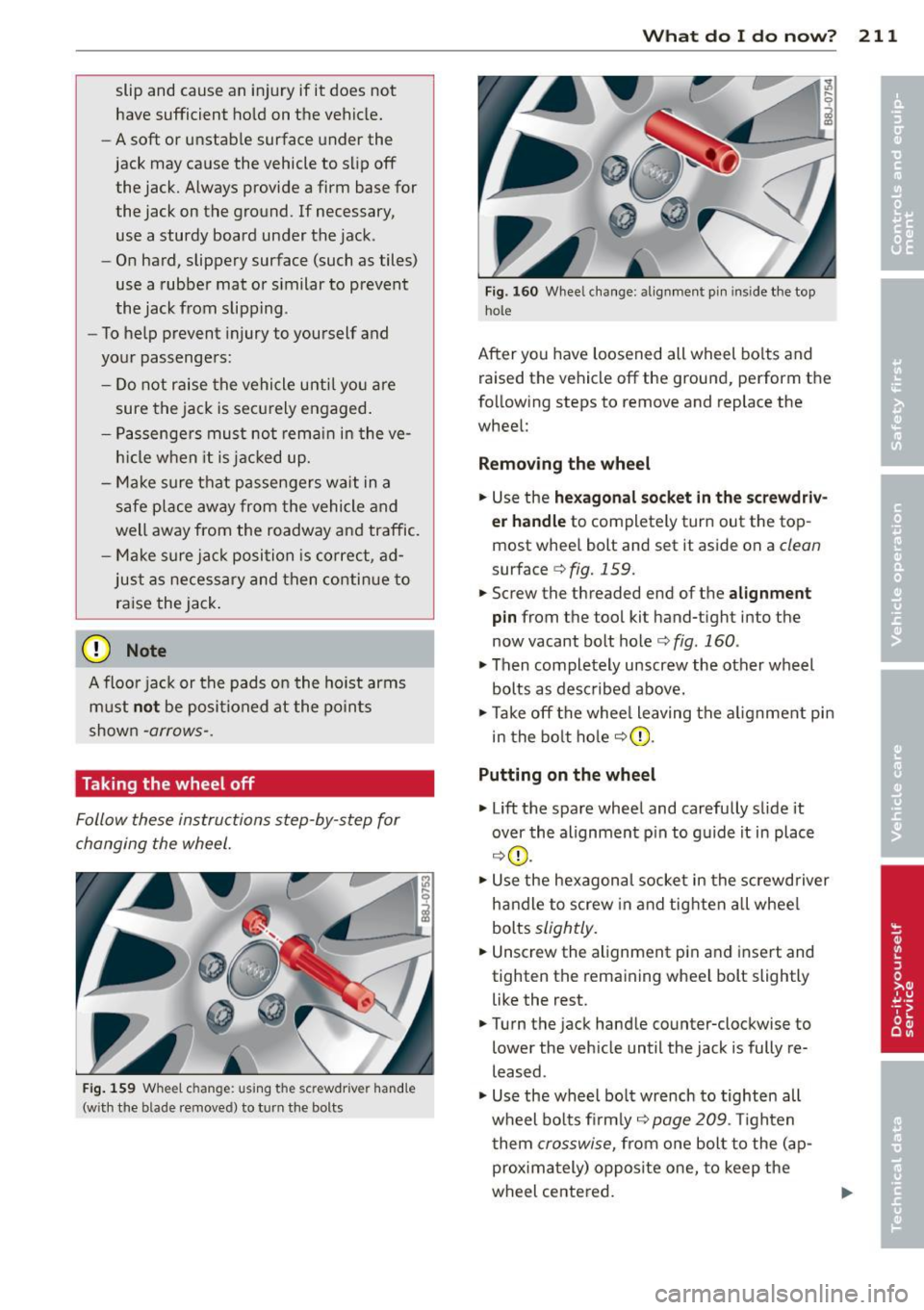
Fig . 159 W hee l ch ange : us ing th e sc rewdr ive r hand le
(w ith t he blade re m ove d) to turn t he bo lts
What do I d o now ? 211
Fig . 1 60 W hee l cha nge : alignmen t pin inside the top
ho le
After yo u have loosened all wheel bo lts and
raised the vehicle off the ground, perform the
follow ing steps to remove and replace the
whee l:
Remo ving the wheel
.,. Use the he xagonal socket in the scr ewdri v
er handle
to completely turn out the top
most whee l bolt and set it aside on a
clean
surface ¢ fig. 159.
.,. Screw the threaded end of the alignment
pin
from the tool kit hand-tight into the
now vacant bolt hole¢
fig. 160 .
.,. Then completely unscrew the other wheel
bolts as desc ribed above.
.,. Take off the whee l leaving the alignment pin
in the bo lt ho le ¢ (D.
Putting on th e wheel
.,. Lift the spare wheel and carefully slide it
over the alignment p in to guide it in place
Q (D .
.,. Use the hexagona l socket in the screwd river
handle to screw in and tig hten all whee l
bolts
slightly .
.,. Unscrew the alignment p in and insert and
tighten the remaining wheel bolt slightly like the rest .
.,. Turn the jack handle counter-clockwise to
lower the veh icle until the jack is fully re
leased .
.,. Use the whe el bo lt wrench to tighten all
wheel bo lts fi rm ly
Q page 209 . Tighten
t hem
crosswise, from one bolt to the (ap
proxima tely) opposi te one, to keep t he
wheel cente red.
Page 216 of 244
214 Fuses and bulbs
Fuse Location, Instrument Panel left
0
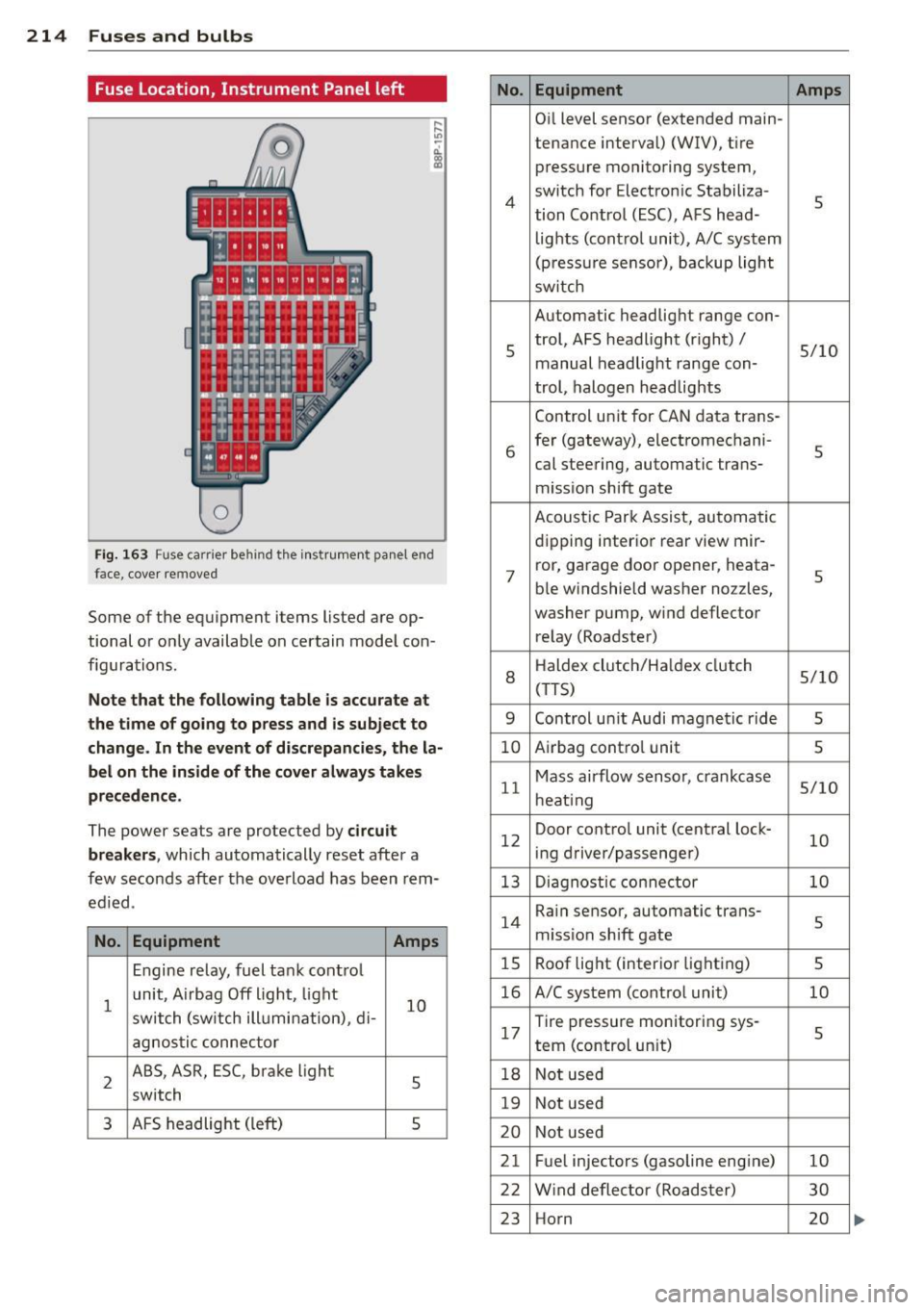
Fi g. 163 Fuse carrier behind the instrument panel end
face, cove r removed
Some of the equipment items listed are op
tional or only available on certain model con
figurations .
Note that the following table is accurate at
the time of going to press and is subject to
change. In the event of discrepancies, the la
bel on the inside of the cover always takes
preceden ce .
The power seats are protected by circuit
breaker s,
which automatically reset after a
few seconds after the overload has been rem
ed ied.
No . Equipment Amps
Engine relay, fuel tank control
1
unit, A irbag Off light, light
10 switch (sw itch illumination), d i-
agnos tic connector
2
ABS, ASR, ESC, brake light
5 switch
3 AFS headlight (left) s
No.
4
5
6
7
8
9
10
11
12
13
14
15
16
17
18
19
20
21
22
23
Equipment Amps
Oil level sensor (extended main-
tena nce interval) (WIV), tire
pressure monitoring system,
switch for Electronic Stabiliza-
s tion Control (ESC), AFS head-
lights (control unit), A/C system
(pressure sensor), backup light
sw itch
Automatic headlight range con-
trol, AFS headlight (right) /
5/10
manual headlight range con-
trol, halogen headlights
Control unit for CAN data trans-
fer (gateway), electromechani-
s cal steering, automatic trans-
mission shift gate
Acoustic Park Assist, automatic
dipping interior rear view mir- ror, garage door opener, heata-
s ble windshield washer nozzles,
washer pump, wind deflector
relay (Roadster)
H aldex clutch/Ha ldex clutch
5/10 (T TS)
Control un it Audi magnetic ride
s
Airbag contro l unit s
Mass airflow sensor, crankcase 5/10
heating
Door control unit (central lock-
10 ing driver/passenger)
Diagnostic connector
10
Rain sensor, automatic trans-
s miss ion shift gate
Roof light (interior lighting)
5
A/C system (control unit) 10
Tire pressure monitoring sys-
5 tern (control un it)
Not used
Not used
Not used
Fuel injectors (gasoline engine)
10
Wind deflector (Roadster) 30
Horn 20
Page 217 of 244
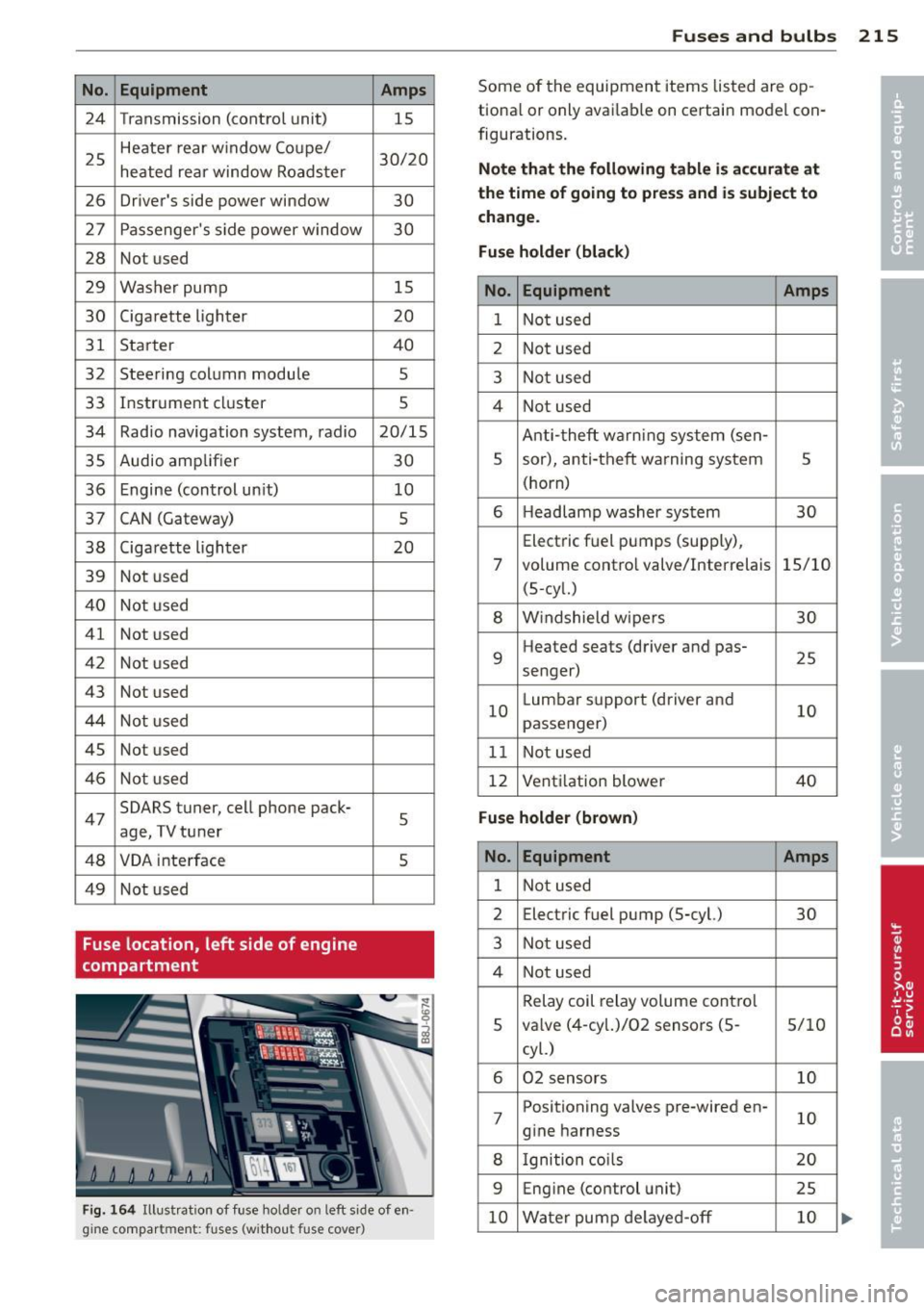
No. Equipment 24 Transmission (control unit)
25 Heater rear window Coupe/
heated rear window Roadster
26 Driver's side power window
27 Passenger's s ide power window
28 Not used
29 Washer pump
30 Cigarette lighter
31 Starter
32 Steering column module
33 Instrument cluster
34 Radio navigation system, radio
35 Audio amplifier
36 Engine (control un it)
37 CAN (Gateway)
38 Cigarette lighter
39 Not used
40 Not used
41 Not used
42 Not used
43 Not used
44 Not used
45 Not used
46 Not used
47 SOARS
tuner, cell phone pack-
age, TV tuner
48 VOA inte rface
49 Not used
Fuse location, left side of engine
compartment Amps
15
30/20
30
30
15
20
40
5
5
20/15
30 10
5
20
5
5
Fig. 164 Illustrat ion of fuse ho lder on left side of en
gine compart ment: fuses (without fuse cover)
Fuse s and bulb s 215
Some of the equipment items listed are op
tiona l or only avai lab le on certain model con
figurations.
Note th at the foll owing t abl e is ac cur ate at
the time of going t o pre ss and i s subject to
ch ang e.
Fus e holder (bla ck )
No. Equipment Amps
1 Not used
2 Not used
3 Not used
4 Not used
Anti-theft warning system (sen-
5 sor), anti-theft warning system
5
(horn)
6 H
eadlamp washer system
30
Electric f uel pumps (supp ly),
7 volume contro l valve/Interrelais 15/10
(5-cy l.)
8 W indshield w ipers 30
9 Heated
seats (driver and pas-
25
senger)
10 L
umbar support (driver and
10
passenger)
11 Not used
12 Vent
ilation blower
40
Fu se holder (brown )
No. Equipment Amps
1 Not used
2 Electric
fuel pump (5-cyl.)
30
3 Not used
4 Not used
Relay coil relay volume cont ro l
5 va
lve (4-cy l.)/02 sensors (5 -
5/10
cyl.)
6 02 sensors 10
7 Positioning valves pre-wired en-
10
g ine harness
8 Ignition coi ls 20
9 Eng
ine (control unit)
25
10 Water pump de layed-off 10
Page 218 of 244
216 Fuse s a nd bul bs
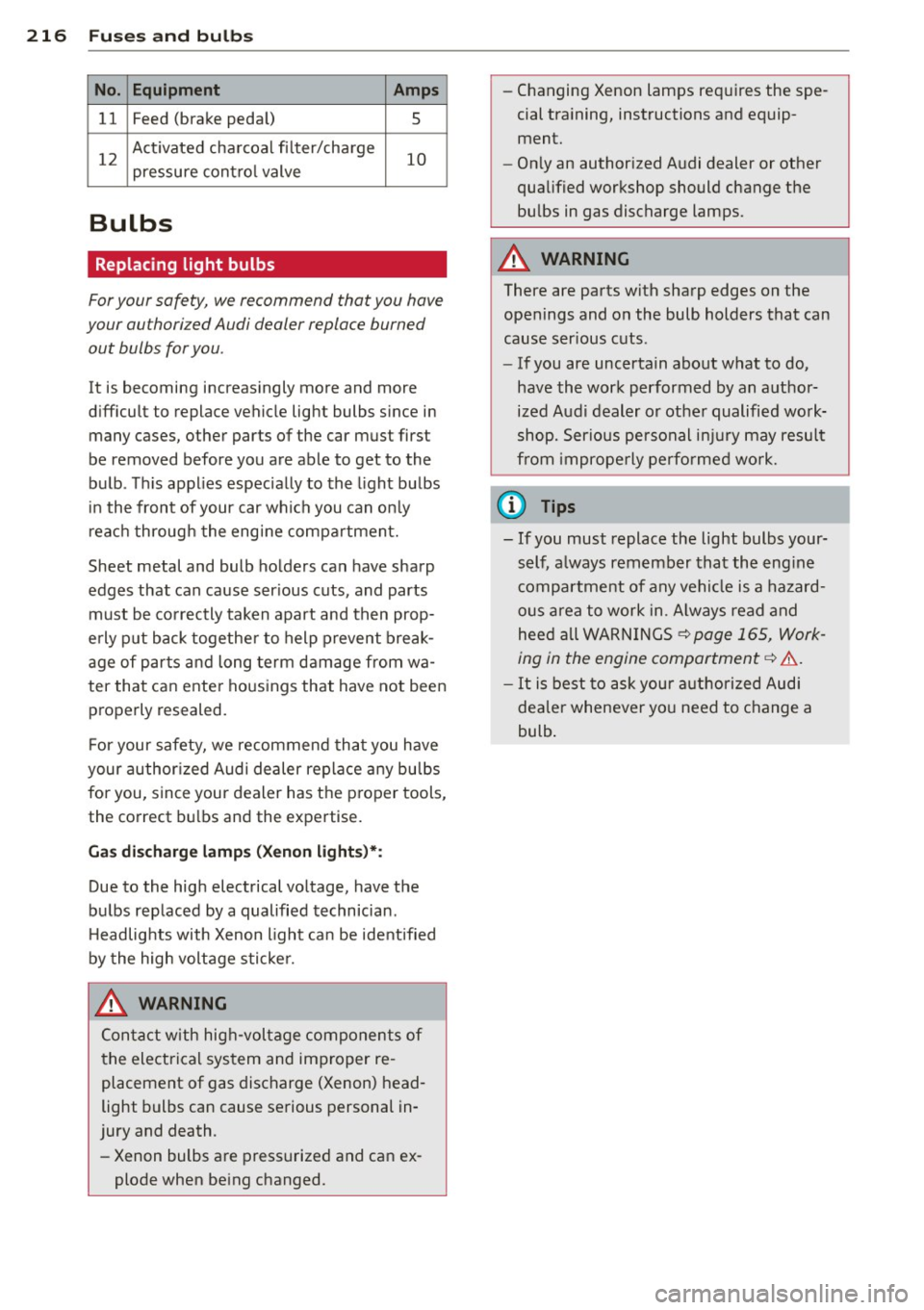
No. Equipment Amps
11 Feed (brake pedal) 5
12
Activated charcoal fi lter/charge
10 pressure contro l valve
Bulbs
Replacing light bulbs
For your safety, we recommend that you have
your authorized Audi dealer replace burned
out bulbs for you .
It is becoming increasingly more and more
difficult to replace vehicle light bulbs since in
many cases, other parts of the car must first
be removed before you are able to get to the
bulb . Th is appl ies especially to the l ight bulbs
in the front of your car which you can only
reach through the engine compartment.
Sheet metal and bulb holders can have sharp
edges that can cause ser ious cuts, and parts
must be co rrectly taken apart and then prop
e rly put back together to help prevent break
age of parts and long term damage from wa
ter that can enter housings that have not been properly resealed.
For your safety, we recommend that you have
your author ized Audi dealer replace any bulbs
for you, since your dealer has the proper tools,
the correct bu lbs and the expertise.
Gas disc harg e la mps (X enon l ig ht s}*:
Due to the high electrical voltage, have the
bulbs replaced by a qualified technician.
Headlights with Xenon light can be identified
by the high voltage sticker.
A WARNING
Contact with high-voltage components of
the electrical system and improper re
placement of gas discharge (Xenon) head
light bulbs can cause serious personal in
jury and death.
- Xenon bulbs are pressurized and can ex
plode when being changed. -
Changing Xenon lamps requires the spe
cial tra ining, instructions and equip
ment.
- Only an authorized Audi dealer or other
qualified workshop should change the
bulbs in gas discharge lamps.
A WARNING
=
There are parts with sharp edges on the
openings and on the bulb holders that can
cause ser ious cuts.
- If you are uncertain about what to do,
have the work performed by an author
ized Audi dealer or other qualified work
shop. Serious personal injury may result
from improperly performed work.
@ Tips
- If you must replace the light bulbs your
self, a lways remember that the eng ine
compartment of any vehicle is a hazard
ous area to work in. A lways read and
heed all WARNINGS
¢page 165, Work
ing in the engine compartment¢.&..
-It is best to ask your authorized Audi
dealer whenever yo u need to change a
bulb .
-