light AUDI TT ROADSTER 2014 Owners Manual
[x] Cancel search | Manufacturer: AUDI, Model Year: 2014, Model line: TT ROADSTER, Model: AUDI TT ROADSTER 2014Pages: 244, PDF Size: 60.87 MB
Page 160 of 244
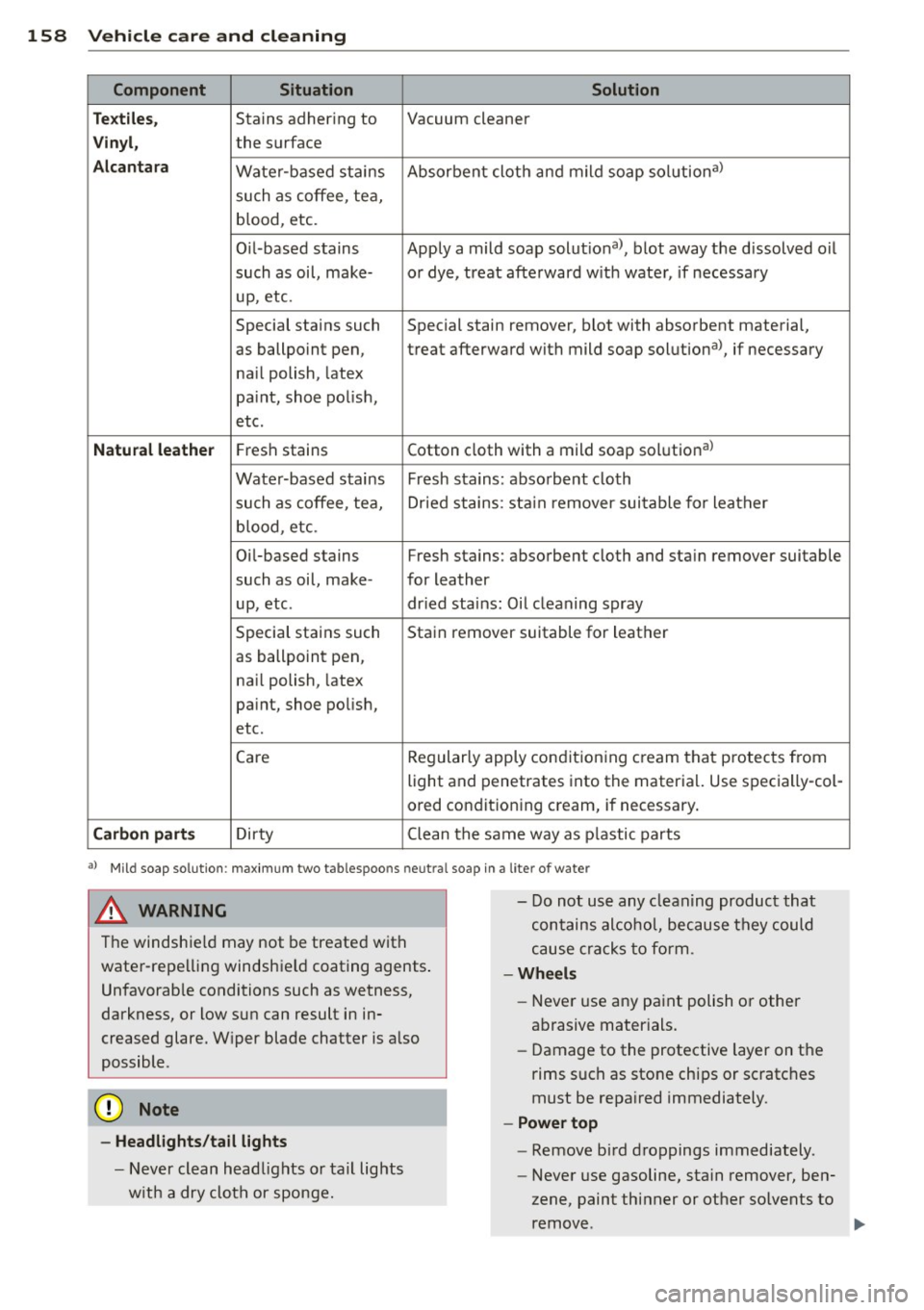
158 Vehicle care and cleaning
Component Situation Solution
T ex tile s,
Stains adhering to Vacuum cleaner
Vin yl, the surface
Alcan ta ra Water -based stains Absorbent cloth and mild soap solutiona>
such as coffee, tea,
blood, etc.
O il-based stains Apply a mild soap solutiona>, blot away the d issolved oil
such as oil, make- or dye, treat afte rward w ith water, if necessary
up, etc.
Special stains such Special stain remover, b lot with absorbent material,
as ballpoint pen, treat afterward with mild soap solutiona>, if necessary
na il polish, latex
pa int, shoe po lish,
etc.
Natu ral leather Fresh stains Cotton cloth with a mild soap solutiona>
Wate r-based stains Fresh s tains: absorbent cloth
such as coffee, tea, Dr ied stains: sta in remover sui table for leather
blood, etc.
Oi l-based stains Fresh stains: absorbent cloth and sta in remover suitable
such as oil, make- for leather
up, etc. dried stains: Oil cleaning spray
Special stains such Stain remover suitable for leather
as ballpo int pen,
na il polish, latex
pa int, shoe polish,
etc.
Care Regular
ly apply condit ion ing c ream that protec ts from
light a nd penetrates into the materia l. Use specially-col-
ored conditioning cream, if necessary.
Carbon part s Dirty Clean tlhe same way as plastic parts
a) Mi ld soap solut ion : maximum two tablespoons neut ra l soap in a lite r of wate r
& WARNING
The windshie ld may not be treated with
water -repe lling windshield coating agents .
Unfavorab le conditions such as wetness,
darkness, or low sun can result in in
creased glare. W iper blade chatter is a lso
possible .
(V Note
- Headlights /tail lights
- Never clean headlights or tail lights
w it h a dry cloth or sponge. -
Do not us e any cleaning product that
contains alcohol, because they could
cause cracks to form.
-Wheels
- Never use any paint polish or other
abrasive mater ials.
- Damage to the protective layer on the
rims such as stone chips or scratc hes
must be repa ired immediately.
- Power top
-Remove bird droppings immediately.
- Never use gasoline, stain remover, ben-
zene, paint thinner or other so lvents to
remove .
Page 161 of 244
-Window s
-Remove snow and ice on windows and
exterior mirrors with a plastic scraper .
To avoid scratches, move the scraper only in one direction and not back and
forth.
- Never remove snow or ice from w in
dows and m irrors using wa rm or hot
wate r because this cou ld cause crac ks
t o form .
- To avoid damage to the rear window
defogger, do not apply any sticke rs on
the heating wires on the ins ide of the
window.
- Deco rative p art s/ trim
- Never use chrome care or cleaning
products.
-Pa int
- To reduce the risk of scratches, the ve-
hicle must be free of dirt and dust be
fore polishing or waxing.
- To prevent paint damage, do not polish
or wax the veh icle in direct sunlight.
- To reduce the risk of paint damage, do
not polish away rust film .
-Trim
- To reduce the risk of damage , do not
treat the trim around the panorama
sunroof with paint po lish .
-Deco rative d eca ls
- To reduce the risk of damage, do not
use any rough powder or abrasive
cleaning products.
- To reduce the risk of damage, do not
polish decorat ive parts that have a
matte finish .
-Di spla ys
- To avoid scratches, do not use dry
cleaning methods on displays.
- Control s
-Make sure that no fluids enter the con-
trols, because this cou ld cause dam
age.
- Safe ty belt s
-Do not remove the safety belts to clean
them.
V ehicl e ca re a nd cl eanin g 159
- Neve r clean safety belts or their com
ponents chemically or with corrosive
flu ids or solvents and never allow
sharp objects to come into contact
with the safety belts . This could cause
damage to the belt webbing .
- If there is damage to the webbing, the
connections, the retractors or the buck
les, have them replaced by an author
ized Audi dealer or a qualified work
shop.
- Te xtil es/ Vin yl/ Alcantara
- Never treat Vinyl/Alcantara w ith leath-
er ca re p rod ucts, solvents, floor polish,
shoe polish, stain remover or similar products.
- To avoid damage, have stubborn stains
removed by an authorized Audi dea ler
o r a qualified workshop.
- Never use steam cleaners, brushes,
hard sponges, etc. when cleaning.
- Objects with sharp edges such as zip
pers, rivets on clothing or be lts can
cause damage to the surface.
- Open hook and loop fasteners, for ex
ample on clothing, can damage seat
covers. Make sure hook and loop fas
teners are closed .
-Natural leather
- Never treat leather w ith solvents, floo r
polish, shoe polish, stain remover or
similar products.
- Objects w ith sharp edges such as zip
pers, rivets on clothing or be lts can
cause damage to the surface.
- Never use steam cleaners, brushes,
hard sponges, etc. when cleaning.
- To help prevent the leather from fad
ing , do not leave the vehicle in d irect
sun light for long per iods of t ime .
If
leaving the vehicle par ked for long pe
riods of time, you should cover the
leather to protect it from d irect sun
light.
(D Tips
- Insects are easier to remove from paint
that has been freshly waxed.
•
•
Page 167 of 244
Checking and filling Engine hood
Releasing the engine hood
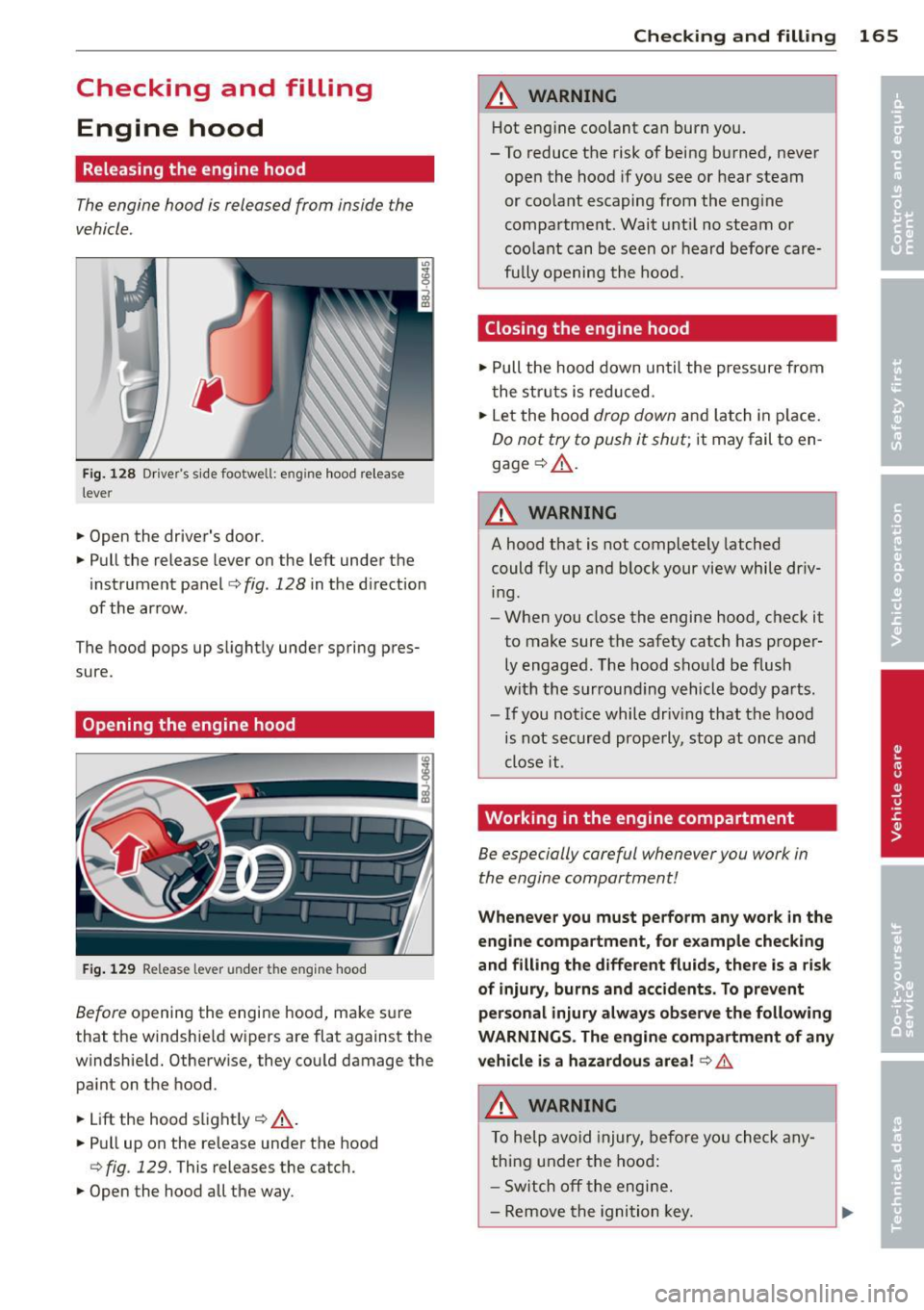
The engine hood is released from inside the
vehicle .
Fig. 128 Dr ive r's s ide footwe ll: e ng ine hood relea se
lever
"' Open the driver's door .
"' Pull the release lever on the left under the
instrument panel
i=> fig. 128 in the d irection
of the arrow .
The hood pops up slightly under spring pres
sure.
Opening the engine hood
F ig . 129 Release lever u nde r the engine hood
Before opening the engi ne hood, make sure
that the windshield wipers are flat against the
windshie ld. Otherwise, they could damage the
paint on the hood.
"' Lift the hood slight ly ¢
_A .
"' Pull up on the release under the hood
¢ fig . 129. This releases the catch.
"' Open the hood all the way .
Checking and fillin g 165
A WARNING
Hot engine coolant can burn you.
- To reduce the risk of being burned, never open the hood if you see or hear steam
or coolant escaping from the eng ine
compartment . Wait unt il no steam or
coolant can be seen or heard before care
fu lly opening the hood.
Closing the engine hood
"' Pull the hood down until the pressure from
the struts is reduced.
"' Let the hood
drop down and latch in p lace.
Do not try to push it shut; it may fail to en
gage ¢_& .
A WARNING
--
A hood that is not completely latched
could fly up and b lock your view while dr iv
ing.
- When you close the engine hood, check it
to make sure the safety catch has proper
ly engaged. The hood shou ld be flush
with the surround ing vehicle body parts.
- If you notice while driv ing that the hood
is not secured properly, stop at once and
close it .
Working in the engine compartment
Be especially careful whenever you work in
the engine compartment!
Whenever yo u must pe rform any wo rk in the
e n g ine compartment, for e xample ch ecki ng
and filling th e diff erent fluids, there is a risk
of injury, burn s and a ccidents. To prev ent
p ersonal injury always obse rve the foll owing
WARNINGS . The engine compa rtment of an y
vehicle i s a hazardou s area !
¢ &.
A WARNING ~
To help avoid injury, be fo re yo u check any
thing under the hood:
- Sw itch off the engi ne.
- Remove the ignition key.
Page 169 of 244
Checking and fillin g 167
Eng ine compartment
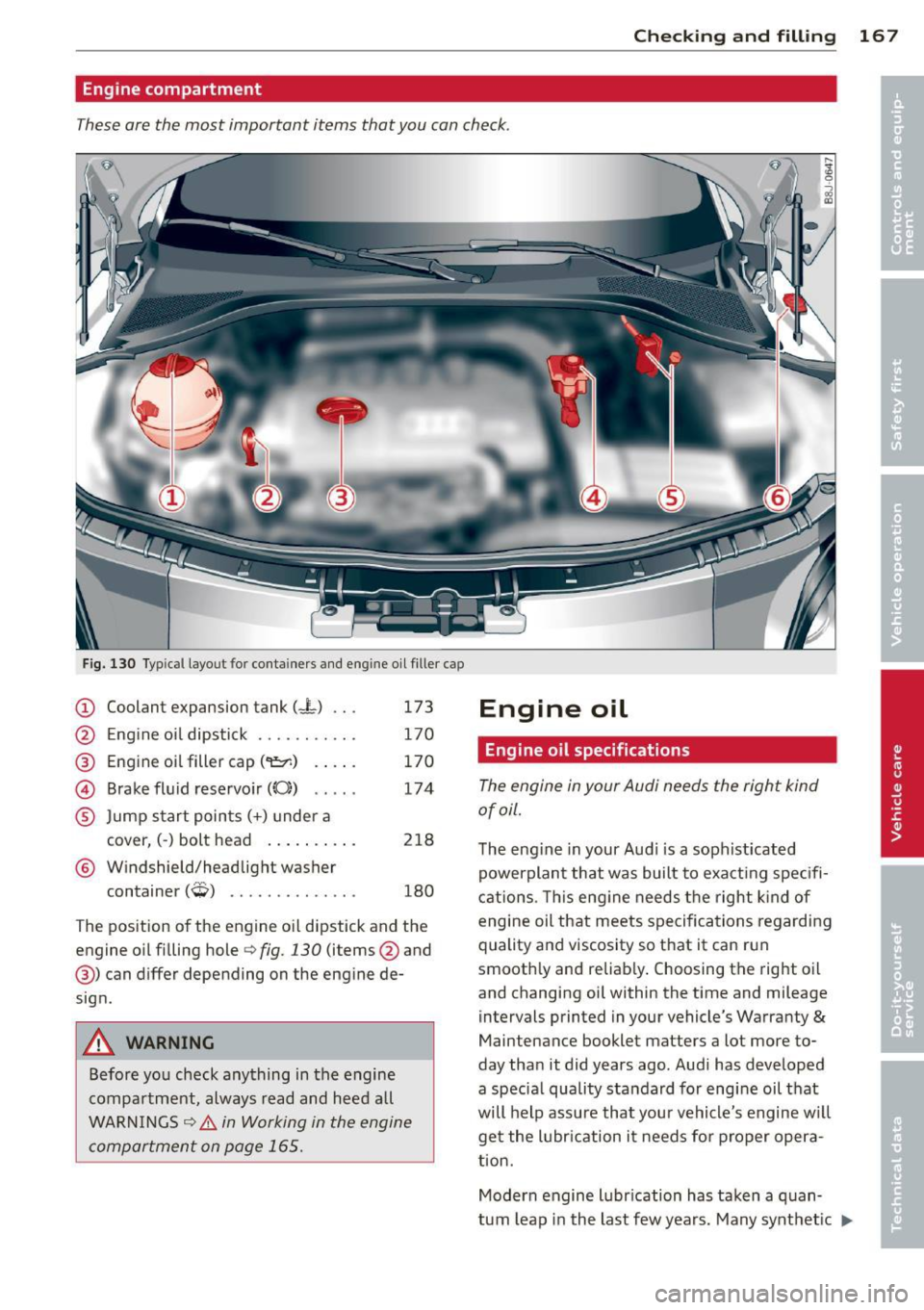
These are the most important items that you can check .
•
Fig. 130 Typ ical layout for containers and eng ine oil filler cap
(D Coolant expansion tank (-L) . . . 173
@ Eng ine oi l dipstick . . . . . . . . . . . 170
@ Engine oil filler cap (
® Jump start points(+) under a
cover,(-) bolt head . . . . . . . . . . 218
® Windshield/headlight washer
t . (ffi) con amer *
...... ....... . 180
The position of the engine o il dipstick and the
engine oil filling hole
i::> fig. 130 (items @and
@) can differ depending on the engine de
sign.
_&. WARNING
Before yo u check anything in the engine
compartment, always read and heed all
WARN INGS
i::> &. in Working in the engine
compartment on page 165.
Engine oil
Engine oil specifications
The engine in your Audi needs the right kind
of oil.
The eng ine in your Aud i is a sophist icated
powerplant that was built to exacti ng spec ifi
cations . T his eng ine needs t he right k ind of
engine oil that meets specifications regarding
quality and viscosity so that it can run
smoot hly and reliably . Choosing the right o il
and changing oil within the time and mileage
intervals printed in your vehicle's Warranty
&
Maintenance booklet matters a lot more to
day than it did years ago. Audi has developed
a specia l quality standard for engine oil t hat
will help assu re that you r vehicle's engine w ill
get the l ubr ication i t needs fo r proper opera
tion.
Modern engine lubr ication has taken a q uan
tum leap in the last few years. Many synt het ic
IJI,,
Page 175 of 244
Checking the engine coolant level
The engine coolant level can be checked with
a quick glance .
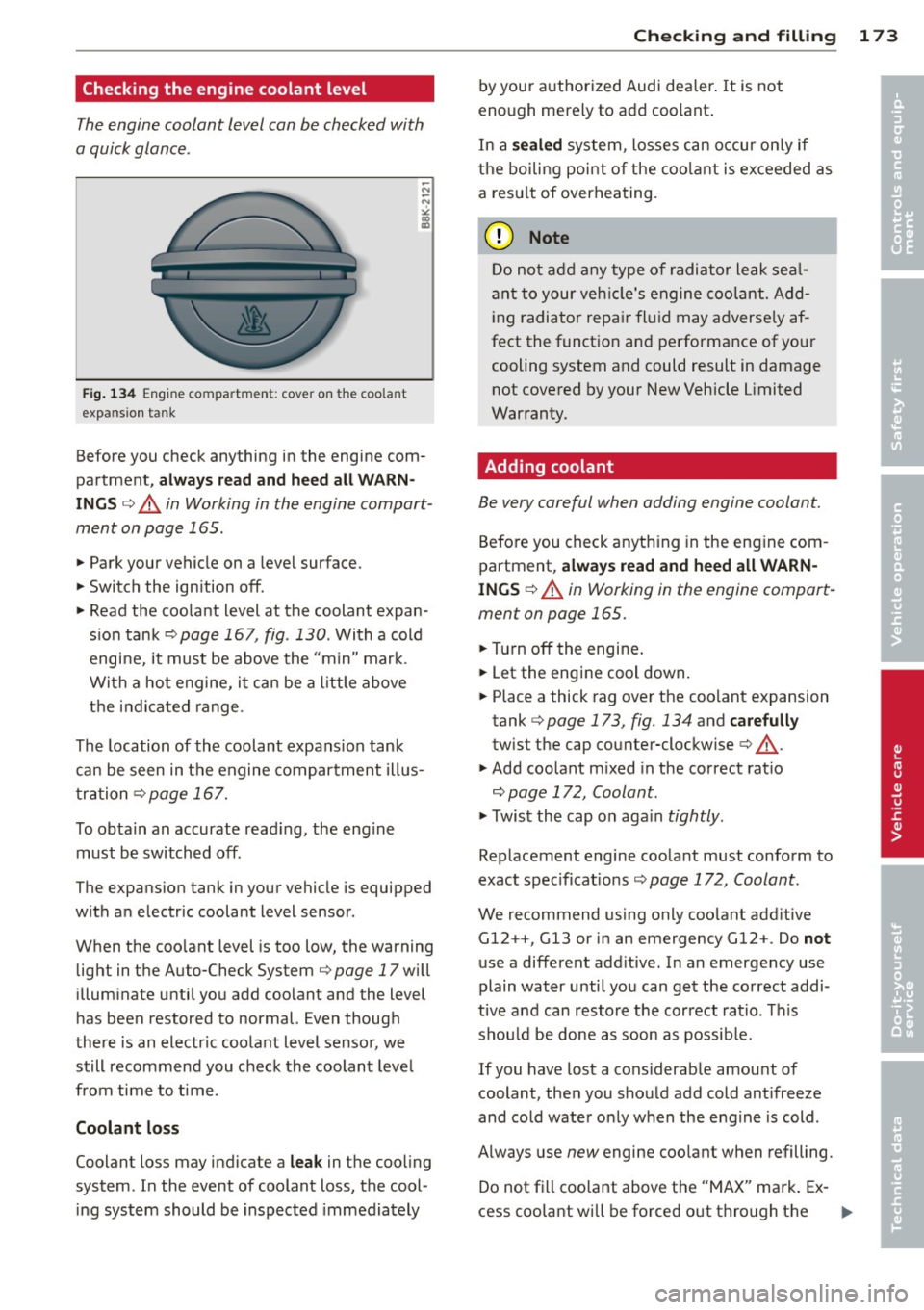
Fig. 134 Eng ine compartme nt: cover o n the coolant
expansion tank
Before you check anything in the engine com
partment,
a lway s read and he ed all WARN
INGS ¢ A in Working in the engine compart
ment on page 165.
.,. Park your vehicle on a level surface.
.,. Switch the ignition
off .
.,. Read the coola nt level at the coolant expan
s ion tank
¢ page 167, fig . 130. With a cold
engine, it must be above the "min" mark.
With a hot engine, it can be a l ittle above
the indica ted range.
The location of the coolant expans ion tank
can be seen in the engine compar tment illus
tration
¢page 167.
To obtain an accurate read ing, the eng ine
must be switched
off.
The expans ion tank in your vehicle is equipped
with a n electric coolant level sensor.
When the coo lant level is too low, the warning
light in the Auto-Check System¢
page 17 will
illum inate until you add coolant and the level
has been restored to normal. Even though
there is an electric coolant level sensor, we
still recommend you check the coolant leve l
from time to time.
Coolant loss
Coolant loss may indicate a leak in the cool ing
system. In the event of coolant loss, the cool
i ng system should be inspected immediately
Checkin g and fillin g 173
by your authorized Audi dea ler . It is not
enough merely to add coo lant .
In a
s ealed system, losses can o ccu r on ly if
the boiling point o f the coo lant is exceeded as
a res ult of overheating.
(D Note
Do not ad d any type of radiator leak sea l
ant to your veh icle's engine coo lant. Add
ing radiator repa ir flui d may adverse ly af
fect the function and performance of yo ur
cooling system and could result in damage
not covered by your New Vehicle Limited
War ranty.
Adding coolant
Be very careful when adding engine coolant.
Before you check anyth ing in the engine com
partment,
alway s read and heed alt WARN
INGS ¢ A in Working in the engine compart
ment on page 165.
... Tu rn off the engine .
.,. Let the engine cool down.
.,. Place a thick rag ove r the coolant expansion
tank ¢
page 173, fig. 134 and carefully
twist the cap counter-clockwise ¢_& .
.,. Add coo lant m ixed in the correct rat io
¢ page 172, Coolant .
.,. Twist the cap on aga in tightly.
Rep lacement engine coo lant must conform to
exact specificat ions¢
page 172, Coolant.
We recommend using only coolant add itive
Gl2 ++, Gl3 or in an emergency Gl2+. Do not
use a different additive. In an emergency use
plain water until you can get the correct addi
tive and can resto re the correct ratio . Th is
shou ld be done as soon as possib le.
If you have lost a cons iderab le amount of
coolant, then you should add cold ant ifreeze
and co ld wate r on ly when the engine is cold.
Always use
new engine coolant when refilling.
Do not fill coolant above the "MAX" mark. Ex-
cess coolant will be fo rced o ut through the ..,_
•
•
Page 176 of 244
17 4 Che cking and filling
pressure relie f valve in the cap when the
engine becomes hot .
.&_ WARNING
-The coo ling system is under pressure and
can get
very hot. Reduce the risk of
sca lding from hot coolant by following
these steps .
- Turn off the eng ine and a llow it to cool
down.
- Protec t your face, hands and arms from
escap ing fl uid and steam by cover ing
the cap with a large, thick rag.
- Tu rn the cap slowly and
very ca refully
in a counter -clockwise direct ion while
applying light, downward p ress ure on
the top of the cap.
- To avo id being burned, do not sp ill an
tifreeze or coolant on the exhaust sys
tem or hot engine parts. Under certain
conditions, the ethylene glyco l in en
g ine coolant can catch fire.
- Antifreeze is poisonous. Always store an
t ifreeze in its or iginal container and we ll
out of the reach of children.
- If you drain the coolant, it must be
caught and safely stored in a proper con
ta iner clearly marked "poison".
(D Note
- Coolant po llutes the environment and
could cause an engine fire. Excess cool
ant will be forced out through the pres
sure re lief
valve in the cap when the en
gine becomes hot .
- If, in an emergency, only water can be
added, the correct ratio between wate r
and antifreeze~
page 172 must be re
stored as soon as possib le.
@) For the sake of the environment
Dra ined coolant should not be reused. Al
ways dispose of used coolant while obse rv
ing all environmental regulations .
Radiator fan
The radiator fan switches on automatically by
itself .
The electric radiator fan is controlled by ther
moswitches that switch on and off depending
on coolant and eng ine compartment tempera
tures.
An a uxiliary electric radiator fan* sw itches on
and off depending on coolant temperature
and other vehicle operat ion conditions .
After you switch the engine off, the aux iliary
fan can continue running for up to 10 minutes
-even w ith the ignition off. It can even switc h
on aga in later by itself
c> &. , if
- the temperature of the engine coo lant rises
due to the heat build-up from the engine in
the engine compartment, or
- the engine compartment heats up because
the vehicle is parked in intense sunlight.
.&_ WARNING
-
- To reduce the risk of personal inju ry nev-
er touch the radiator fan.
- The auxiliary electric fan is temperature
controlled and can sw itch on suddenly
even when the engine is not ru nning.
- The auxiliary radiator fan sw itches on au
tomatically when the engine coo lant
reac hes a certain t emperature and w ill
continue to run until the coolant temper
a ture drop s.
Brake fluid
' Checking brake fluid level
N
N
N
" ~
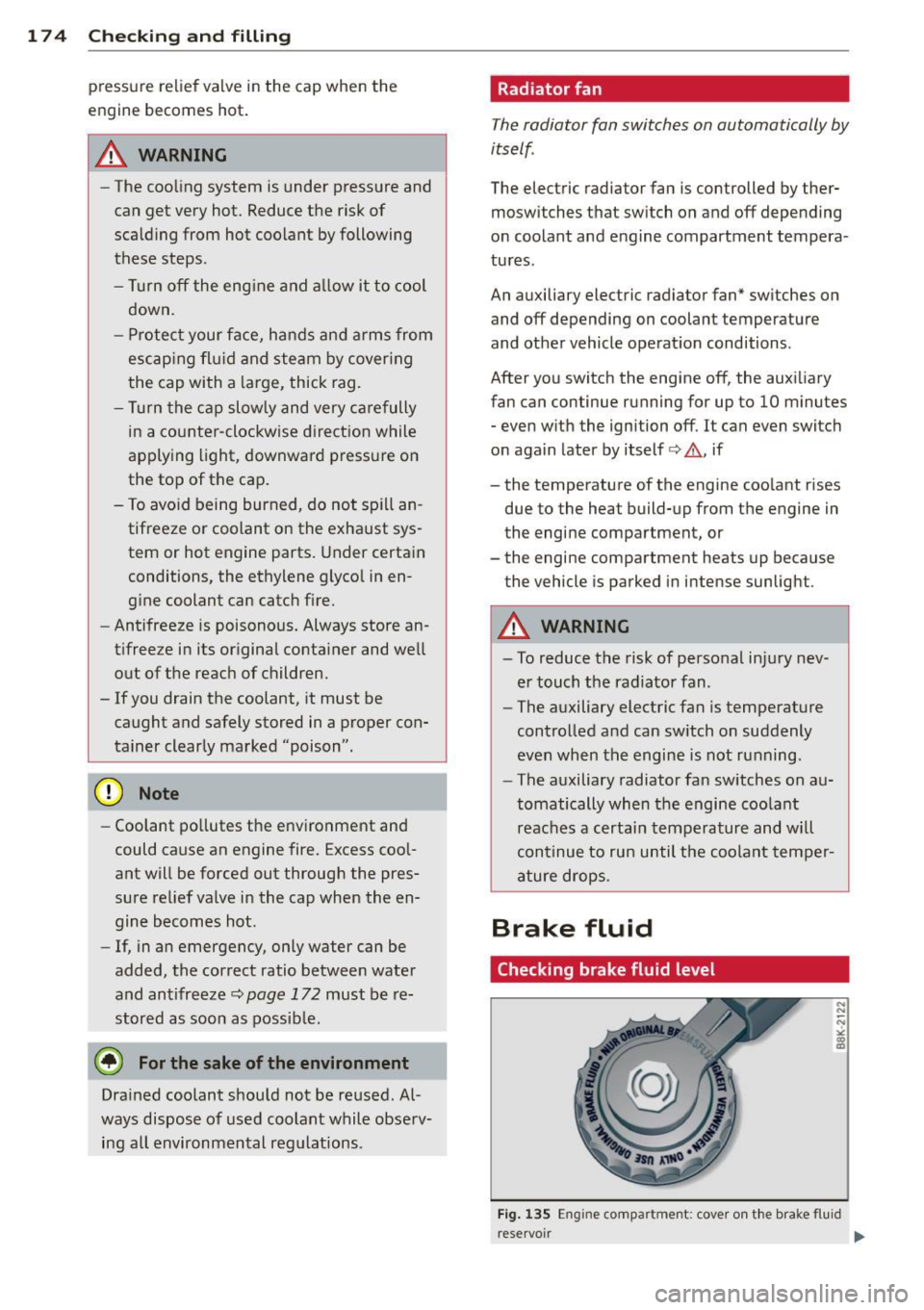
Fi g. 13S Engine compartment: cover on th e brake fluid
reservoir
Page 177 of 244
Before you check anything in the engine com
partment,
always r ead and heed all WARN
ING S
~ A in Working in the engine compart
ment on page 165.
.. Read the brake flu id level from the brake
fluid reservoir
9 page 167, fig. 130 . The
brake f lu id leve l must be between the "MIN"
and "MAX" markings.
The brake f luid reservoir is located behind the
rear partition of the engine compartment on
the left side
9 page 167.
The fl uid level may drop slightly after some
time due to the automatic adjustment of the brake pads . This is not cause for alarm .
If the brake fluid level falls considerably be
l ow the "M IN" mark, the brake wa rning/indi
cator light (U .S . mode ls:
1111 , Canadian
models: .) will come on ¢
page 14 . Do not
continue to operate the vehicle. The complete
brake system shou ld be thoroughly checked
by an authorized Audi dealer or other quali
f ied fac ility and the cause corrected . If the
b rake fluid level is too low, the brake warn ing/
i ndicator light w ill illuminate . Co ntact an au
thor ized Audi dealer
immediately .
Changing brake fluid
Have the brake fluid changed by an experi
enced technician .
Brake fluid abso rbs moistu re from the a ir . If
the water content in the brake fluid is too
hi gh, cor ros ion in the b rake system may result
after a per iod of t ime . The bo iling po int of t he
b ra ke fluid w ill also decrease considerab ly and
decrease braking performance.
Therefore, the brake flu id must be changed
e very two year s. Always use new b rake fluid
which confo rms to Fede ral Motor Vehicle
Standard "FMVSS 1 16 DO T 4".
The brake flu id rese rvoi r ca n be difficult to
r each, therefo re , we recommend that yo u
h ave the brake fl uid changed by you r autho r
i zed
Audi dealer . Your deale r has the correct
Checkin g and fillin g 175
tools, the right brake fl uid and t he know -how
to do this for you .
A WARNING
-Brake flu id is poisonous. It must be stor
ed only in the closed or iginal container
out of the reach of children!
- Brake failure can res ult from o ld or inap
propriate brake f lu id. Observe these pre
cautions:
- Use only b rake fluid th at mee ts SA E
spe cificat ion
J 17 03 and conforms to
Federa l Mo to r Ve hicl e Standard 1 16.
Always check with yo ur authorized Au di
dealer to make sure yo u are using the
correct brake fluid. The cor rect type of
brake f luid is also ind icated on the
brake f luid reservoir .
- The bra ke fluid must be new. Heavy use
of the brakes ca n cause a vapor lock if
the brake fluid is left i n the system too
long. This can se riously affect the effi
c iency of the b rakes as well as your
safety , T his could result in an accide nt.
(!) Note
Brake fluid will damage the pai nt of your
vehicle.
@) For the sake of the environment
Because of the prob lem of proper disposal
of brake fluid as well as the spec ial too ls
r equired and the nec essary expertise, we
r ecommend that yo u have th e brake flu id
c hanged by you r aut ho rized Aud i dea le r.
Battery
General information
Your vehicle is equipped with a specia l bat
tery, an
ACM battery. This battery is located
in the luggage compartment and must be re
placed with an origina l equipment batte ry .
Un der normal ope rat ing condit io ns, t he bat-
te ry is
maintenanc e-free . .,.
•
•
Page 178 of 244
176 Check ing and filling
Have the battery checked when you take your
vehicle in for service. You are well advised to replace a battery that is older than S years .
Disconn ect ing the battery terminals
Some veh icle functions (power w indow regu
lators, for example) are lost if the battery ter
minals are disconnected . These functions have
to be re learned after the battery terminals are
connected again. To prevent this, the battery
should only be d isconnected from the vehicle
electr ical system when absolutely necessary
for repairs .
V ehicles not dri ven for l ong period s
If you do not drive your vehicle over a period
of several days or weeks, electrical compo nents are gradually cut back or switched off .
This reduces energy consumption and main tains starting capab ility over a longer period
c:::>
page 147. Some of the convenience func
tions may not operate, suc h as the inte rior
l ights or power seat adjustme nt. The conven
i ence functions wi ll be ava ilable aga in whe n
you switch on the ignition and start the en
gine.
Winter operati on
During the winter months, batte ry capacity
tends to decrease as tempe ratu res d rop . This
is because more powe r is also consumed while
start ing , and the headlights, rea r window de
fogger, etc., are used more often.
Avoid unnecessary power consumption, par
ticularly in c ity traffic or when t rave ling on ly
short distances. Let you r authorized Aud i
dea ler check the capacity of the vehicle bat
tery before winter sets inc:::>
page 179 . A we ll
charged battery w ill not only prevent starting
prob lems when the weather is cold, but will
a lso last longer .
Replacing battery
The new battery must have the same capaci
ty, vo ltage (12 volts), amperage, construction
and p lug sealing, as the origina l battery. Spec
if ications are listed on the battery housing.
Batteries specially developed by Audi fulfill the maintenance, outp
ut, and safety require
ments .
When install ing the battery, m ake su re the ig
ni tion and a ll ele ct rical consumers are switch
ed off
c:::> (i) .
We recommend that you use maintenance
free or
cy cle-re si stant /leak -proof b atter ies
accord ing to the s tanda rds TL 825 06 (from
Apri l 2008) and VW 7 SO 73 (from April
2010) .
Rep lac ing the bat tery shou ld be car ried by a
qualified wo rkshop. Please fo llow the instruc
tions on the battery cover .
(D Note
- All wo rk on the ba tte ry req uire s techn i
c al know ledge . Please con ta ct an Aud i
dealership o r another authorized faci lity
for questions abo ut the batte ry -danger
o f ac id burns and exp losion hazard!
- The battery must not be opened! Do not
try to change the battery's liquid level,
otherwise detonating gas will escape
from the battery - explosion hazard!
- The AGM battery in the l uggage com
partment cannot leak, because the elec
tro lyte for this battery is absorbed into a
special glass mat. This leak-proof battery
must not be replace with a convent ional
battery.
- Make sure the ventilation hose on the
side of the battery is connected, other
w ise fumes or battery ac id can leak out .
- Batte ry holder and termina ls always
have to be secured correctly .
- Before all work on the battery follow the
warnings be low c:::> .&. in Working on the
battery on page 177.
@ For the sake of the environment
Because of the prob lem of proper disposal
of a battery, we recommend your author
iz ed Audi dealer change the battery for
you. Batteries contain sulfur ic acid and
l ead and must a lways be disposed o f prop-
erly in compliance wi th al l envi ronmental ..,.
Page 180 of 244
1 78 Che cking and filling
must be disconnected . If you are just go
ing to rep lace a light bu lb, then it is
enough to switch off the lights.
- Before disconnecting the battery, switc h
off the anti-theft alarm system! Other
wise you will set off the alarm.
- When disconnecting the battery, first disconnect the negative cable and then
the positive cable .
- Before reconnect ing the battery, make
sure all electrical consumers are switch
ed off . Reconnect the positive cable first
and then the negative cable. Never inte r
change the cables - th is could start a fire!
- Never charge a frozen or a thawed-out battery.
It could explode! If a battery has
frozen, then it must be replaced. A dis
charged battery ca n freeze over at 32 °F
(0 oc).
- Make sure the vent hose is always attach
ed to the opening on the side of the bat
tery .
- Never use batte ries which are damaged.
Danger of explos ion! Always rep lace a
damaged battery .
8_ WARNING
California Proposition 65 Warning:
- Battery posts, te rm inals and related ac
cessories contain lead and lead com
pounds, chemicals known to the State of
California to cause cancer and reproduc
tive problems. Wash hands after han dling.
(D Note
- Do not disconnect the vehicle battery when the ignition is switched on
or when
the engine is running, otherwise, you will
damage e lectronic components in the
electrical system.
- If your vehicle is going to stand for a long period of time without being driven,
protect the battery from "freezing", oth
erwise it w ill be damaged and w ill then
have to be replaced .
Checking the battery acid level on magic
eye batteries*
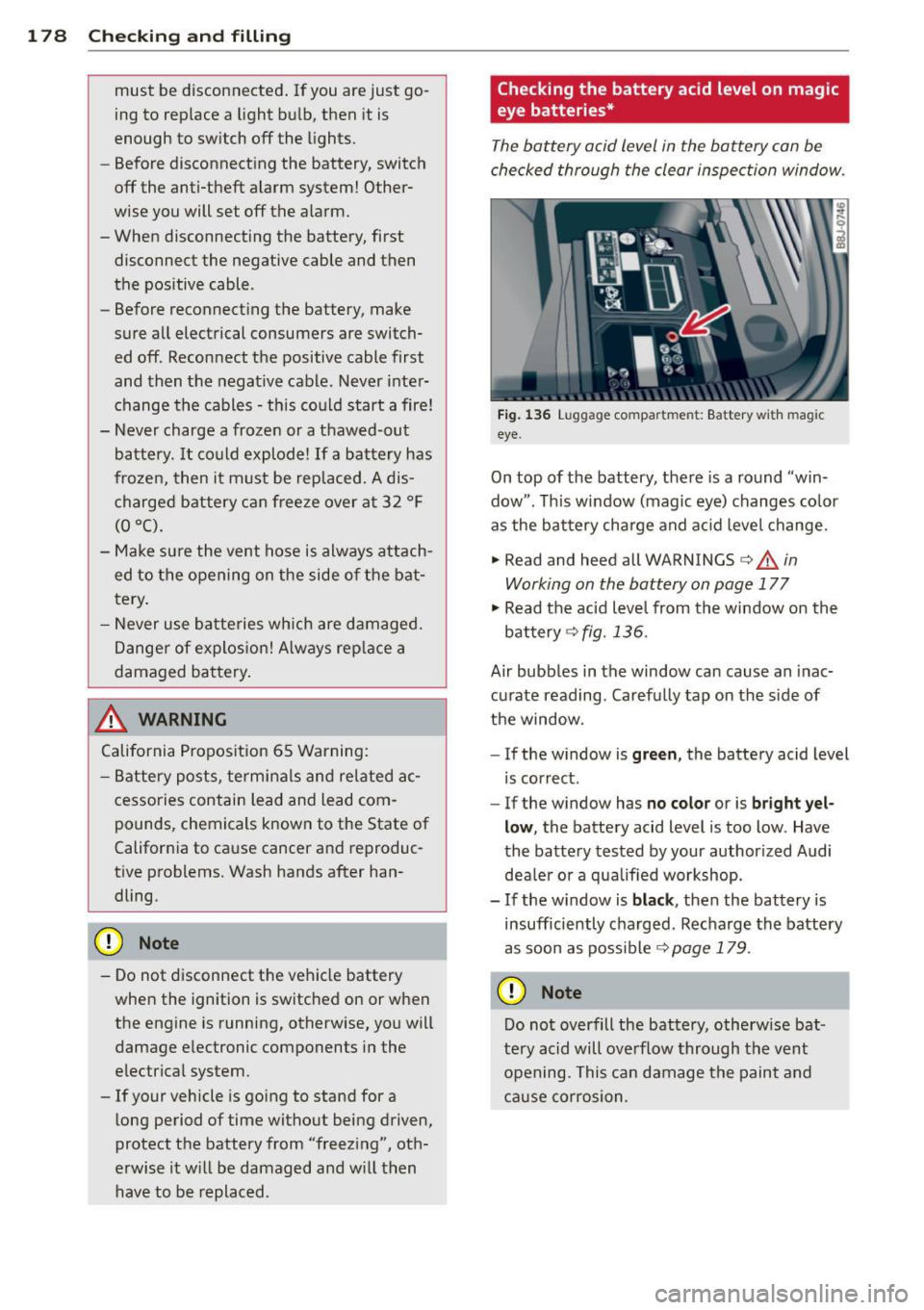
The battery acid level in the battery can be
checked through the clear inspection window .
Fig . 1 36 Lu gga ge compar tment: Battery w ith magic
eye .
On top of the battery, there is a round "win
dow". This window (magic eye) changes co lor
as the battery cha rge and ac id leve l change.
.,. Read and heed all WARNINGS
<=> .&_ in
Working on the battery on page 177
.,. Read the acid level from the window on the
battery <=>
fig. 136.
Air bubbles in the window can cause an inac
curate reading . Carefu lly tap on the s ide of
the window.
- If the window is
green , the battery acid level
is correct.
- If the window has
no colo r or is brigh t y el
lo w,
the battery acid level is too low . Have
the battery tested by your author ized Audi
dea ler or a qualified workshop.
- If the w indow is
black , then the battery is
insufficiently charged . Recharge the battery
as soon as possible¢
page 179 .
(D Note
Do not overfill the battery, otherw ise bat
tery acid will ove rflow through the vent
opening . This can damage the paint and
cause corrosion .
Page 181 of 244
Charging of battery
Starting the engine requires a well charged battery.
11-Al way s read and heed all WARNING S be
low¢
A and ¢ A in Working on the bat
tery on page 177.
11-Switch off the ignit ion and all electrical con
sumers.
11-Make sure the area is well vent ilated when
you charge the bat tery.
11-Connect charger cables. ALWAY S co nnect
charge r cables POSITI VE
G) to POSITIVE
G) ; NEGATIVE Qto NEGA TIV E Q .
11-Switch on the charger.
11-Turn off the charger¢ &_.
11-Disconnect the charger cables.
11-Connect both battery cables to the battery if
necessary -
first plus, then m inus.
When charging at
low voltages (e.g. with a
trickle charg er), the battery cables do not
h ave to be d isconnected first. Before charging
at
high voltages, i.e. " fas t charging ", you
must disconnect both cables. In e ithe r case,
follow the instru ctions from the man ufactu rer
of the charger .
Fastcharging a battery is
dan gerou s¢ & in
Working on the battery on page 177.
It r e
q ui res specia l charg ing equipment and the
know ledge to go with it. We recommend hav
ing your battery fast charged on ly by a quali
f ied workshop .
A discharged battery can
freeze at tempera
tures of on ly 32 °F (0 °C). A llow a frozen bat
tery to thaw completely befo re attempting to
charge it¢ & . However, we recommend not
using a thawed battery again because the bat
tery cas ing can be cracked due to ice forma
tion and can leak battery acid.
Do not open the battery caps when charging
the battery.
A WARNING
-
Charging a battery can be dangerous.
Checkin g and fillin g 179
-Never charge a frozen battery. It may ex
plode because of gas trapped in the ice.
Allow a frozen battery to thaw out first.
- Do not reuse batteries wh ich were fro
zen. The battery housing may have
cracked and weakened when the battery
froze.
- Charge the battery in a well ventilated
area. Keep away from open flame or elec
trical spark. Do not smoke. Hydrogen gas
generated by the battery is explos ive.
- To reduce the danger of explosion, never
connect or d isconnect c harger cab les
while the charger is ope rat ing.
- Fast cha rging a batte ry is dangerous and
should only be attempted by a compe
tent techn ic ian with the prope r equip
men t.
- Battery acid that may spi ll dur ing cha rg
i n g should be washed off wi th a solu tion
of wa rm w ater and baking soda to neu
trali ze the ac id.
(D Note
Neve r use a fast cha rg er as a boost er to
star t the engi ne. This w ill ser iously dam
age sens it ive e lectronic componen ts, su ch
as cont ro l units, re lays, radio, etc., as well
as the batte ry charger.
(D Tips
T he vehicle ba tte ry mu st not be charged
wi th a standa rd small charger that plugs
into t he cigarette lighter or outlet . •
•