ECO mode AUDI TT ROADSTER 2014 Owner's Manual
[x] Cancel search | Manufacturer: AUDI, Model Year: 2014, Model line: TT ROADSTER, Model: AUDI TT ROADSTER 2014Pages: 244, PDF Size: 60.87 MB
Page 88 of 244
86 Transmis sion
If you have selected a lower gear than the cur
rent one, the transmission w ill only shift down
when the engine cannot be overspeeded.
I f kick-down is actuated, the transmiss ion
shifts into a lower gear independently of
speed and engine rpm .
Steering wheel with Tiptronic controls
Applies to vehicles: with S tro nic
The selector paddles allow the driver to keep
both hands on the steering wheel when shift
ing gears.
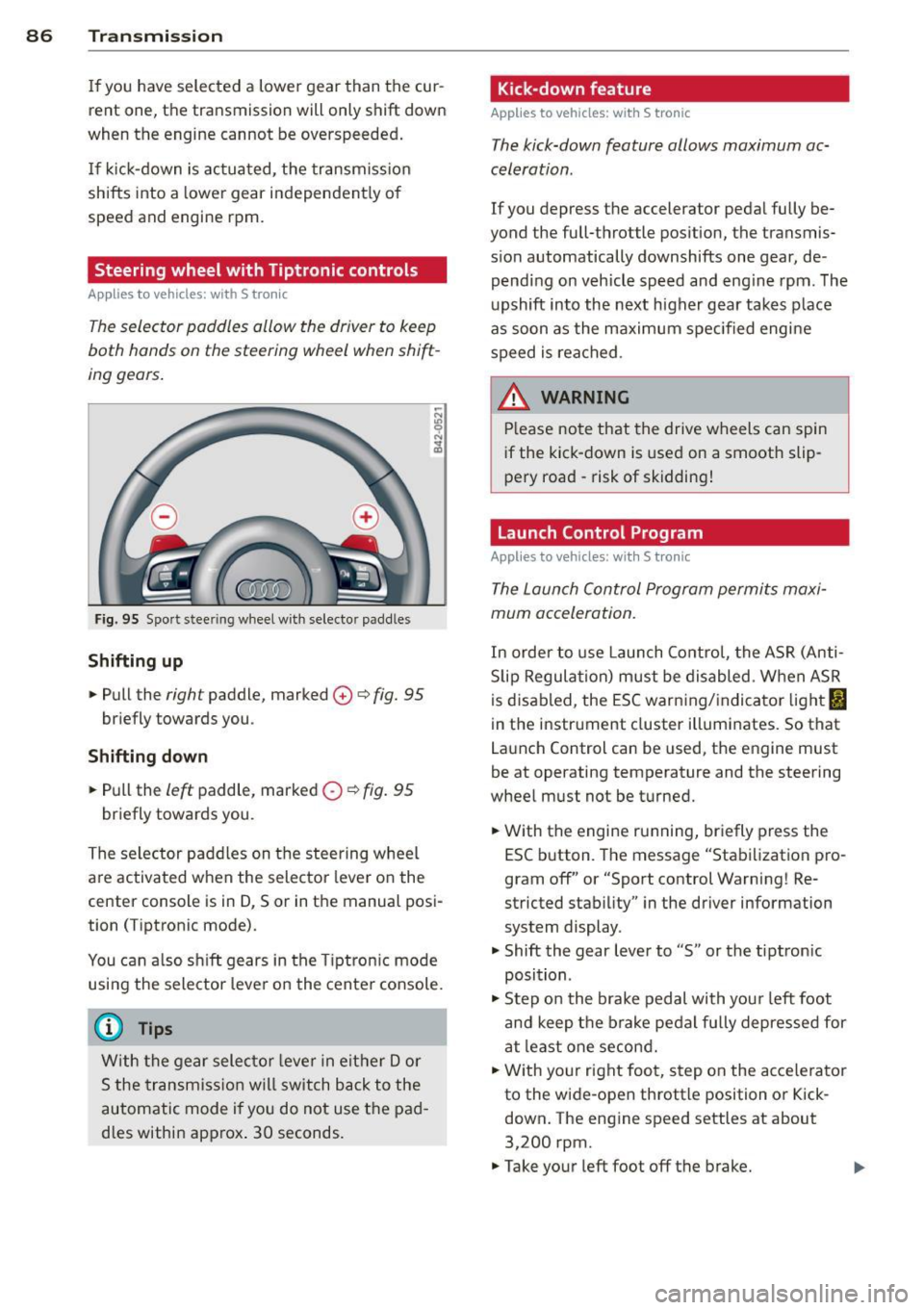
Fig. 95 Spo rt stee ring wheel w ith selecto r paddle s
Shifting up
.,. Pull the right paddle, marked 0 ¢ fig. 95
briefly towards you .
Shifting down
.,. Pull the left paddle, marked O ¢ fig. 95
briefly towards you .
The selector paddles on the steering wheel
are activated when the selector lever on the
center console is in D, 5 or in the manual posi
tion ( Tiptronic mode).
You can also shift gears in the Tiptronic mode
using the selector lever on the center console.
(D Tips
With the gear selector lever in either Dor
5 the transmission will switch back to the
automatic mode if you do not use the pad
dles within approx . 30 seconds.
Kick-down feature
Applies to vehicles: w it h S tronic
The kick-down feature allows maximum ac
celeration.
If you depress the accelerator pedal fully be
yond the full-throttle position, the transmis·
sion automatically downshifts one gear, de·
pending on vehicle speed and eng ine rpm. The
upshift into the next higher gear takes place
as soon as the maximum specified engine
speed is reached.
.&_ WARNING i-==
Please note that the drive wheels can spin
if the kick-down is used on a smooth slip·
pery road -risk of skidding!
Launch Control Program
Applies to veh icles: w it h S t ronic
The Launch Control Program permits maxi
mum acceleration.
In order to use Launch Control, the ASR (Anti
S lip Regulation) must be disabled . When ASR
is disabled , the ESC warning/indicator light
fl
in the instrument cluster illuminates. So that
Launch Control can be used, the engine must
be at operating temperature and the steering
wheel must not be turned.
.,. With the engine running, briefly press the
ESC button . The message "Stabilization pro
gram off" or "Sport control Warning! Re
stricted stability" in the driver information
system display .
.,. Shift the gear lever to "5" or the tiptronic
position .
.,. Step on the brake pedal with your left foot
and keep the brake pedal fully depressed for
at least one second.
.,. With yo ur right foot, step on the accelerator
to the wide-open throttle position or Kick·
down. The eng ine speed settles at about
3,200 rpm .
.,. Take your left foot off the brake. ..,.
Page 91 of 244
Homelink
Universal remote
control
General information
The HomeLink universal remote control can
be programmed with hand-held transmitters
from existing equipment.
You must first program the Homelink trans
mitter before you can use the system
~ page 89, Programming the HomeLink
transmitter.
In order to program the Homelink transmit
ter for devices utilizing rolling code, a second
person on a ladder who can safely reach the
garage door opener motor is recommended.
It is also necessary to locate the "learn" but
ton on your garage door opener motor . Refer
to the operating instructions for the opener, as the location and color of this button may
vary by manufacturer .
You can still use the origina l remote control
for the device at any time.
A WARNING
-
- Never use the Homelink transmitter
with any garage door opener that does
have not the safety stop and reverse fea
ture as requ ired by federal safety stand
ards. This includes any garage door open
er model manufactured before April 1,
1982.
- A garage door opener which cannot de
tect an object, signaling the door to stop
and reverse does not meet current feder
al safety standards. Using a garage door
opener without these features increases
risk of serious injury or death.
- For safety reasons never release the
parking brake or start the engine while
anyone is standing in front of the vehicle.
- A garage door or an estate gate may
sometimes be set in motion when the Homelink remote control is being pro
grammed. If the device is repeatedly ac-
Homelink 89
tivated, this can overstrain motor and
damage its electrical components -an
overheated motor is a fire hazard!
- To avoid possible injuries or property
damage, please always make absolutely
certain that no persons or objects are lo
cated in the range of motion of any
equipment being operated.
(!) Tips
- If you would like more information on
Homelink, where to purchase the Home
Link compat ible products, or would like
to purchase the Homelink Home Light
ing Package, please call toll-free:
1-800-355-3515.
- For Declaration of Compliance to United
States FCC and Industry Canada regu la
tions
~page 229.
Programming the Homelink transmitter
The transmitter is programmed in two phas
es. For rolling code transmitters, a third
phase is also necessary.
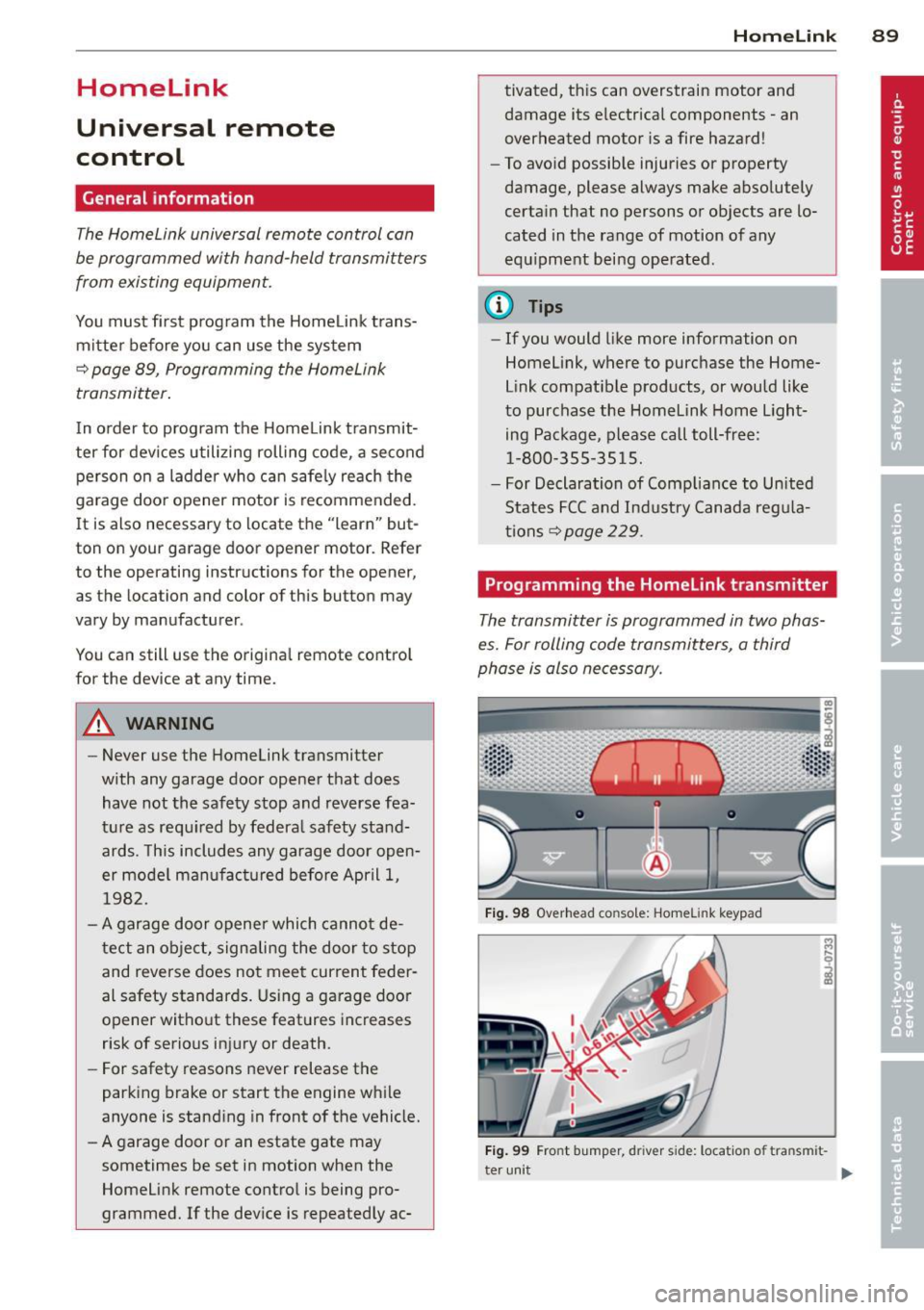
Fig. 98 Overhead co nsole: Homelink keypad
Fig. 99 Fro nt bumper, d river side: locatio n of tra nsm it-
ter unit
IJ-
Page 92 of 244
90 Homelink
Phase 1:
programming the overhead keypad
1. Make sure yo ur vehicle is wit hin o peratin g
range of the remote contro lled garage
door opener .
2. Set the parking brake¢.&. in General in
formation on page 89 .
3. Tur n the ignition on . Do not sta rt the e n
g ine!
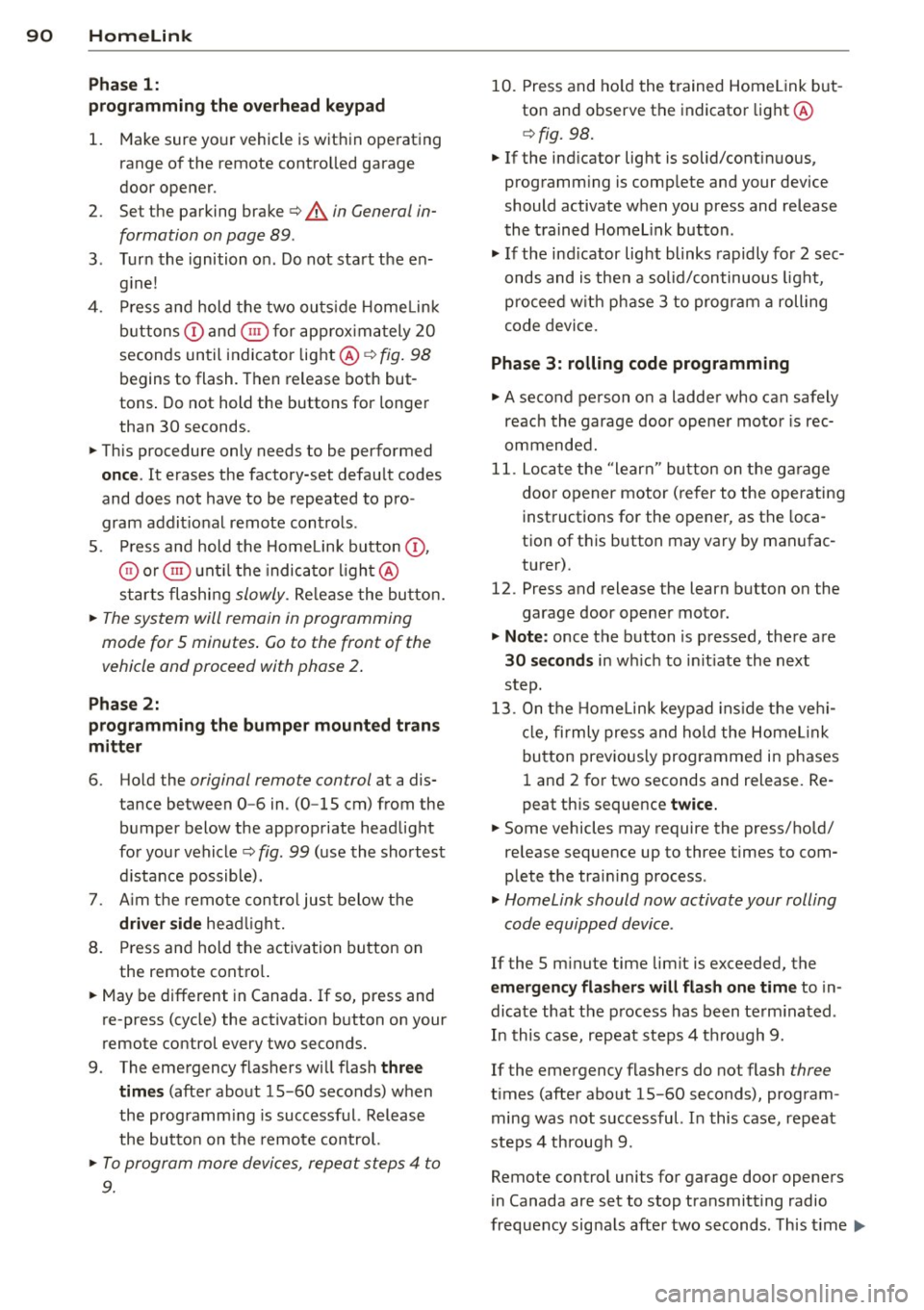
4 . Pr ess and hold the two ou ts ide Home Link
b uttons
(D and @for app rox imately 2 0
seconds un til indicator light @¢fig . 98
begins to flash. Then release both but
tons . Do not hold the buttons for longe r
than
30 seconds.
.,. This procedure only needs to be performed
once . It erases the factory-set defau lt codes
and does not have to be repeated to pro
gram addit ional remote cont rols .
S . Press and hold the Hom elink button
(D ,
® or @ unt il the indica to r li gh t@
starts flashi ng
slowly. Re lease the bu tton.
.,. The system will remain in programming
mode for 5 minutes .
Co to the front of the
vehicle and proceed with phase 2 .
Phase 2:
programming the bumper mounted tran s
mitter
6 . Hold the original remote control at a dis
tance between
0 -6 in . (0 -15 cm) from the
b umper below the appropriate head light
fo r you r vehicle
q fig. 99 (u se the sho rtest
d istance possible).
7 . Aim t he remo te con trol jus t below the
driver side hea dligh t.
8 . Pr ess and hold the activation button on
the remote cont ro l.
.,. May be different in Canada. If so, press and
re-press (cycle) the activat ion b utton on your
remote control every two seconds.
9 . The eme rgency flashers will flash
three
time s
(after abo ut 15 -60 seconds) when
the programm ing is successf ul. Release
the butto n on the remote control.
.,. To program more devi ces, repea t steps 4 to
9.
10. Press and ho ld the trained Homelink but
ton and observe the indicator light @
¢fig. 98.
.,. If the ind icator lig ht is solid/contin uous,
prog ramm ing is comp lete and your device
should activate when you press and release
t he tra ined Homel ink b utton .
.,. If the ind icator light blinks rapidly fo r
2 se c
onds and is then a so lid/continuous ligh t,
procee d w ith p hase
3 to progr am a roll ing
code device.
Phase 3: rolling code programming
.,. A seco nd person o n a ladde r who can safely
reach th e garage door opene r moto r is rec
ommended .
11. Loc ate t he "lear n" bu tton on t he g arage
doo r opener motor ( re fer to the operating
inst ructions for the opener, as the loca
tion of t his button may vary by man ufac
turer).
12. Press and release the learn b utton on the
garage door opene r motor .
.,. Note : once the b utton is p ressed, the re a re
30 seconds in w hich to in it iate the next
step.
13. On t he Home link keypad ins ide t he ve hi
cl e, fi rmly press and hol d the Home link
bu tton prev ious ly progr ammed in phases
1 an d 2 for two seconds and release. Re
peat th is sequence
twice.
.,. Some vehicles may require the press/hold/
release sequence up to three times to com
plete the trai ning process .
.,. Homelink should now activate your rolling
code equipped d evice .
If the 5 minute time limit is exceeded , the
emergency flashers will flash one time to in
dicate that the p rocess has been te rm ina ted .
In this case, repeat steps 4 through 9.
If the emergency flashers do not flash
three
t imes (afte r about 15 -60 seconds) , program
ming was not successful. I n this case, repeat
steps 4 through 9 .
Remote contro l units for garage do or openers
in Canada are set to stop transmitting radio
fr eq uency sig nals afte r two seconds. Th is t ime ..,.
Page 93 of 244
may not be sufficient for the Homelink sys
tem to learn the radio frequency signal. Per
form all other steps as descr ibed above.
Operating the Homelink transmitter
The HomeLink transmitter works in the same
manner as the original hand held remote con
trol that came with the system.
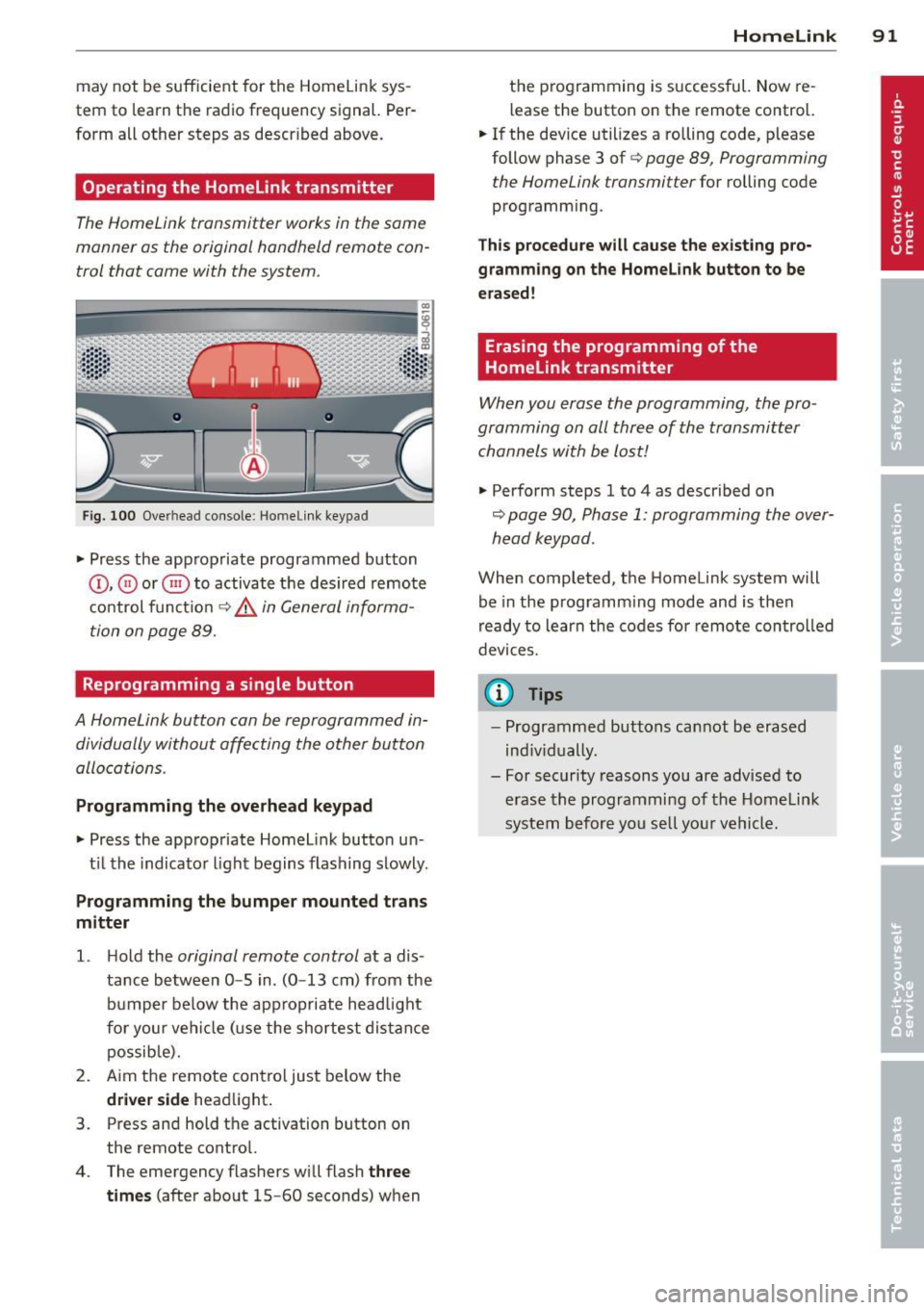
Fi g. 100 Overhead co nsole: Homeli nk keypad
• Press the app ropriate programmed button
© , @ or@ to activat e th e des ired remote
c o ntrol func tion
¢ &. in General informa
tion on page 89.
Reprogramming a single button
A HomeLink button can be reprogrammed in
dividually without affecting the other button
allocations.
Programming the overhead keypad
• Press the app ropriate Homel ink button u n-
t il t he indicato r light begins flashing slowly .
Programming the bumper mounted tran s
mitter
1. H old the original remote control at a dis
tance between
0 -5 in . (0 -13 cm) from the
bumper below the appropriate headlight
fo r you r vehi cle (u se the sh ortest dis tan ce
possib le).
2. A im the remote con tro l just below the
driver side head light.
3. Press and hold the activation button on the remote contro l.
4 . The emergency flashers wi ll flash
three
times
(after about 15 -60 seconds) w hen
Homelink 91
the p rogramming is successful. Now re
l ease the button on the remote control.
• If the dev ice utilizes a rolling code, p lease
follow phase 3 of ¢
page 89, Programming
the Home Link transmitter
for rolling code
programm ing .
Th is p rocedu re will cause the e xisting pro
gramming on the Homelink button to be
erased!
Erasing the programming of the
Homelink transmitter
When you erase the programming, the pro
gramming on all three of the transmitter channels with be lost!
• Perform steps 1 to 4 as described on
~ page 90, Phase 1: programming the over
head k eypad .
When completed, the Homelink system will
be in the prog ramm ing mode and is then
r eady to learn the codes fo r remote controlled
devices.
(D Tips
- Programmed buttons can not be erased
ind iv idually.
- For security reasons you are advised to erase the programming of the Homelink
system before yo u se ll you r vehicle.
Page 94 of 244
92 Driving Safel y
Driving Safely
General notes
Safe driving habits
Please remember -safety first!
This chapter contains important information,
tips, instructions and warnings that you need
to read and observe for your own safety, the
safety of your passengers and others . We have
summarized here what you need to know
about safety belts, a irbags, ch ild restra ints as
well as child safety. Your safety is for us
priori
ty number 1.
Always observe the info rmat ion
and warn ings in th is sect ion -fo r yo ur own
safety as well as for that of your passengers.
The information in this se ction app lies to all
model ve rsions of your veh icle . Some of the
feat ures desc ribed in this sec tions may be
standard equipment on some models, or may
be optional equipment on others . If you are
not sure, ask your authorized Aud i dealer.
A WARNING
- Make certain that you follow the instruc
t ions and heed the WARNINGS in this
Manual. It is in your interest and in the
interest of your passengers .
- Always keep the complete Owner's Liter
ature in your Audi when you lend or sell
yo ur vehicle so that this important info r
mation will a lways be ava ilable to the
dr iver and passenge rs.
- Always keep the Owner's literature handy
so that you can find i t eas ily if you have
ques tions.
Safety equipment
The safety features are part of the occupant
restraint system and work together to help
redu ce the risk of injury in a wide variety of
accident situations.
Your safety and the safety of your passenge rs
should not be left to chance. Advances in
technology have made a varie ty o f fea tures
avai la bl e to he lp re duce the risk of injury in an accident
. The following is a lis ting o f just a
few of the safety features in your Audi:
- sophis tic ated s afety be lts fo r drive r and a ll
passenger sea ting pos it ions,
- safety belt pre-tensione rs,
- fro nt airbags,
- knee airbags for the front seats,
- side airbags in the front seats,
- LATCH anchorages for child restraints,
- ad justab le steering column .
T hese ind iv idual safety features can wor k to
ge ther as a sys tem to he lp p rotec t you and
you r passengers in a wide range of accidents.
These features cannot wo rk as a system if
they are not always p roper ly adjusted and
properly used!
Safet y is everyb ody's re spon sibilit y!
Important things to do before driving
Safety is everybody's job! Vehicle and occu
pant safety always depends on the informed and careful driver.
For yo ur safety and the safety of you r passen
gers,
befor e driving alwa ys:
"' Make s ure that all lights and signa ls are op
erati ng correctly .
"' Ma ke su re t hat the t ire p ressu re is co rrec t.
"' Mak e su re that all windows are clean and a f
ford good vis ibility to the outs ide.
"' Sec ure all luggage and other items caref ully
I:!) page 66.
"'Make sure that nothing can interfere with
the pedals.
"' Adjust front seat, head res traint and mirrors
correctly for your height .
"' Inst ruct passe ngers to adjust the head re
st raints accord ing to the ir height .
"' Ma ke sur e to use the r igh t chi ld restraint
correc tly to protect c hild ren
¢ page 130,
Child Safety .
"'Sit properly in your seat and make sure that
your passengers do the same
I:!) page 60,
General recommendations. .,_
Page 125 of 244
-Never modify the front bumper or parts
of the veh icle body.
- Always make sure that the side airbag
can inflate without interference:
- Never install seat covers or replace
ment upho lstery ove r the front seat
backs that have not been spec ifically
approved by Audi.
- Never use add itiona l seat cushions that
cover the areas where the side airbags
inflate .
- Damage to the o rigina l seat covers or
to the seam in the area of the side air
bag module must always be repa ired
immediate ly by an authorized Audi
dealer.
- The airbag system can be activated only
once . After an airbag has inflated, it
must be replaced by an author ized Audi
dealer or qualif ied technic ian who has
the techn ica l information, tra ining and
special equipment necessary.
- The airbag system can be deployed only
once. After an a irbag has been deployed,
it must be replaced w ith new replace
ment parts designed and approved espe
c ially for your Aud i model version. Re
placeme nt of complete ai rbag systems
or airbag componen ts m ust be per
f ormed by qualified workshops only.
Make su re that any airbag service act ion
is entered in your Audi Warranty
& Main
tenance booklet under
AIRBAG REPLACE
MENT RECORD.
- For safety reasons in severe accidents,
the a lternator and starter are separated
from the vehicle battery with a pyrotech
nic circuit interrupter.
- Wo rk on the pyrote chnic cir cu it inter
rupter must on ly be per formed by a
qualified dealer - risk of an accident!
- If the veh icle or the ci rcuit interrupter
is sc rapped, all applicable safety pre
cautions must be followed .
Airbag system 123
@:) For the sake of the environment
Un deployed airbag modules and p reten
sione rs might be classified as Perchlorate
Materia l -special handling may apply, see
www. dtsc. ca.gov/hazard o u swa ste/ per-
ch lo rate. When the veh icle or parts of the
restraint system including airbag modules
and safety be lts with pretensioners are
scrapped, all applicab le laws and regu la
tions mus t be obse rved. Your authori zed
A udi dealer is familia r wi th these require
ments and we recommend that you have
your dealer perform this service fo r you .
Other things that can affect Advanced
Airbag performance
Chang ing the veh icle's suspens io n system can
c h ange the way that the Advanced Airbag Sys
tem perfo rms in a crash. For examp le, using
tir e-rim combi nat ions not approved by A udi,
l ower ing the veh icle, chang ing the st iffness of
the suspens ion, including the spr ings, suspen
sion struts, shock absorbers etc. can change
the forces that are measured by the airbag
sensors and sent to the electronic contro l
u nit. Some suspension changes can, for exam
ple, i ncrease the force levels measured by the
sensors and make the airbag system deploy in c rashes in which it wou ld not deploy if the
c h anges had not been made. Other kinds of
c h anges may reduce the fo rce leve ls meas
ur ed by the sensors and preven t the airbag
from dep loying when i t should.
T he sensors in the safety be lt b uck le for the
d rive r and fr on t p assenger seat te ll the e lec
tron ic cont ro l modu le if the s afety be lt is
l atche d or no t. If the safety be lt is being used,
the front airbag will deploy at a slightly high er rate of veh icle deceleration t han i f th e safe
ty belt is not be ing used. Therefore, in a par
ticular coll is ion, it is possible t hat an airbag
will not deploy at a seat ing pos ition where the
safety belt is be ing used b ut w il l inflate at the
pos ition wher e th e safety be lt is not be ing
u sed. It is impo rtant that noth ing in terfere
Ill>
•
•
Page 134 of 244
132 Child Saf ety
typical 1 year -old chi ld, the Advanced Airbag
Syst em compares the weight meas ured by the
weight sensing mat with the in format ion stor
ed in the electron ic contro l unit.
The electron ic contro l unit a lso registers the
tension on the front passenge r safety belt.
The tens ion on the safety be lt fo r the front
passenger seat will be d ifferent for an adult
who is properly using the safety belt as com pared to the tension on t he be lt whe n it is
used to attach a child restraint to the seat .
The senso r below the latch fo r the safety be lt
fo r the front seat passenger measu res the
tension on the be lt. T he inp ut from this sen
sor is then used with the we igh t to "decide",
whether there is a chi ld restraint with a typica l
1 year-o ld child o n the front passenger seat
and whether or not the airbag must be turned
off.
Child restraints and Advanced Airbags
Regardless of the ch ild restraint that you use,
make sure tha t it has been ce rtified to meet
Un ited States Fede ral Motor Vehicle Safety
S tanda rds a nd has been cer tified by its manu
facture r fo r u se wit h an air bag. If i n excep
tional circumstances yo u m ust use it on the
front passenge r seat, caref ully read all of the
info rmation on c hild safety an d Advanced Air
bags and heed a ll of the app licable WARN
INGS. Make certai n that t he child restraint is
correctly recogni zed by the weig ht-sensing
mat i nside the front passenger seat, that the
fro nt passenge r airbag is tur ned off and that
the airbag status is a lways correctly signaled
by the
PASSENGER AIR BAG OFF light .
Many types and models of child restra ints
have been ava ilable over the years, new mod
e ls ar e introduced regularly incorporat ing new
a nd improved designs a nd older models are
taken out of p ro du ction. Child res traints are
not stan dardized . Ch ild restra ints o f the same
type typically have different weights and s izes
a nd d ifferent 'footprints,' the s ize and s hape
of the bottom o f the child restraint that sits
on the seat, when they are installed on a veh i
cle seat. These differences make it virtually impossible to certify compliance wi
th t he re
quirements for a dvanced airbags with eac h
and every ch ild restra int that has ever been
sold in the past or wi ll be sold over the course
of the useful life of your veh icle.
For t his reason, the United States National
Hig hway Traffic Safety Adm inistrat ion has
published a list of spec ific type, ma kes and
m odels of child restraints that must be used
to certify comp liance of the Advanced Airbag
System i n your veh icle w ith the su ppr ession
r equirem ents of Federal Motor Vehicle Safety
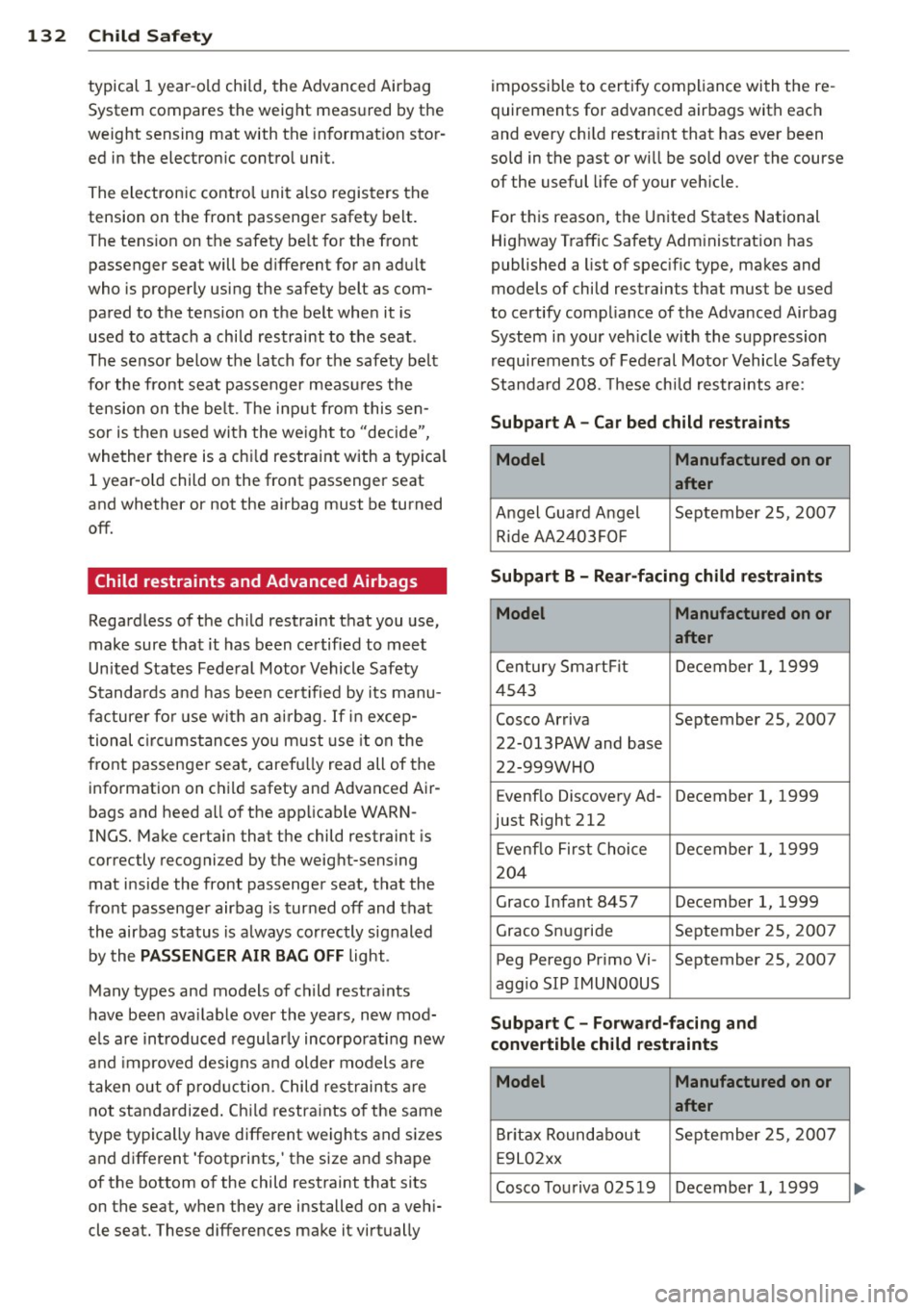
Standa rd 208. These chi ld restraints a re :
Subpart A -Car bed child restraints
Model Manufactured on or
after
A ngel Guard A ngel September 25, 2007
Ri de AA 2403FOF
Subpart B - Rear-facing child restraints
Model Manufactured on or
after
Ce ntury Smart Fit December 1, 1999
454 3
Cosco Ar riva September 2S, 2007
22-013PAW and base
22-999WHO
E venflo Discove ry Ad -December 1, 1999
just Right 212
E ven flo First Ch oic e De ce m be r 1, 1999
2 04
Graco Infant 8457 December 1, 1999
G raco Sn ug ride September 25
, 2007
Peg Perego Pr imo Vi -September 25, 2007
aggio SIP IMU NOOUS
Subpart C -Forward-facing and
convertible child restraints
Model Manufactured on or
after
B rit a x Round about S
eptember 2 5, 2007
E 9 L02xx
Cosco To uriva 02519 December 1, 1999
Page 155 of 244
Avoid full throttle
Driving at moderate speeds saves fuel and
improves your mileage.
""Try and keep well below your car's maximum
speed.
Accelerating gently reduces fuel consump
tion, engine wear, and does not disturb the
environment.
Fu el consumption, exhaust emissions and en
g ine noise increase disproportionately at high
speeds. If you drive at approximately three
quarters of top speed, fuel consumption will
be reduced by one half. Never drive faster
than the posted speed limit and weather con
ditions permit .
Reducing unnecessary idling
Even when your car is just idling it burns up
fuel.
""Shut the engine off when you are not driving
the vehicle.
""Do not warm up the vehicle by letting the
engine run at idle .
It makes sense to shut
off the engine in traff ic
jams, when waiting for trains to pass at ra il
road crossings, or at traffic lights that have
l ong wa its on red. Turning the engine
off for
just
30-40 seconds saves more fue l than is
burned starting the engine again .
It takes a long time for the engine to warm up
fully when it is running at idle. However, wear
and noxious emissions are especially high
when the engine is warming up. So you should
drive away as soon as you start the engine and
avoid running at high RPMs whi le the engine
is sti ll warming up .
(D Note
Do not leave engine idling unattended af
ter starting . If warning lights should come
on to indicate improper operation, they
would go unheeded. Extended idling also
produces heat, which could result in over-
Driving and environment 153
'
heating or othe r damage to the vehicle or
other property.
Regular maintenance
A badly tuned engine unnecessarily wastes a
lot of fuel.
""H ave your veh icle serviced at regular inter-
vals.
By having your vehicle regu larly serviced by an
Audi dealer helps to ensu re that it runs prop
erly and economically. The condition of your
vehicle not only affects its safety and ability to
hold its value, it also affects
fuel consump
tion.
Check your oil each time you fill your tank.
The amount of o il used is related to engine
load and speed.
It is normal for the oil consumption of a new
engine to reach its lowest value after a certain
mileage has been driven.
You must drive your vehicle about 3,000 miles
(5,000 kilometres) before you can properly
assess oil consumpt ion.
This also app lies to fue l consumption and en
gine output.
(U) Note
- Have your vehicle maintained properly
and in accordance with the service rec
ommendations in your Warranty
& Main
tenance booklet. Lack of proper mainte
nance as well as improper use of the ve
hicle will impair the function of the
emission control system and could lead
to damage.
- Do not alter or remove any component of
the Emission Control System unless ap
proved by the manufacturer.
- Do not alter or remove any device, such
as heat shields, switches, ignition wires,
valves, which are designed to protect
your vehicle's Emission Control System
and other important vehicle compo
nents .
•
•
Page 174 of 244
172 Checking and filling
@ For the sake of the environment
- Before changing your oil , first make sure
you know where you can properly dispose
of the used o il.
- Always dispose of used engine oil proper
l y. Do not dump it on garden soi l, wood
ed areas, into open streams or down
sewage dra ins.
- Recycle used engine oil by taking it to a
used engine o il collection facility in your
area, or contact a service station .
Engine cooling system
Coolant
The engine coolant performs two functions: it
keeps the engine from overheating and it pro tects the engine from freezing in the winter.
The cooling system is sea led and generally re
q uir es little attention .
The cooling system has been filled at the fac
tory with a pe rmanent coolant which does not
need to be c hanged. The coolant consists of a
mixture of spec ia lly condi tioned water and the
manuf acturer 's glyco l-b asedcoolan t addi -
tive G l3 antifreeze with ant icorros ion addi
tives (50% for USA models ; 60% for Canadian
mod els). This mixture both assures the nec es
sary frost protection and p rotects metal com
ponents in the engine's cooling system from
corrosion and scaling . It a lso raises the boil
ing point of the coo lant .
Do not red uce the concentration o f the coo l
ant in the summer by adding plain water.
The
proportion of coolant add itive must be at
l e a st 50 % but not more than 60 %
to main
tain antifreez e protection and cooling efficien
cy . If the coolant frost prote ct ion is too low,
the coo lant cou ld free ze and damage the veh i
cle hea ting and eng ine cooling system.
For yea r-round d riving, antifreeze is added at
the fac to ry for temperatures down to:
-- 31°F( -35°C)USA
- -40 °F ( -40 °C) Canada. If
you must add coolant, use a mixture o f wa
ter and coolant additive . Mixing the coo lant
additive with distilled water is recommended.
A WARNING
-
Before you c heck anything in the engine
compartment, always read and heed a ll
WAR NINGS
c::, & in Working in the engine
compartment on page 165.
(D Note
- Before winter sets in, have the coo lant
checked to see if the coolant additive in
your vehicle is sufficient to meet the cli m ate conditions . This is especia lly impor
tan t if you live in a reg io n wher e the win
t er is ex treme ly col d. If ne cessa ry, i n
crease the proportion of coo lant add itive
t o 60%.
- Whe n adding coolant additive to yo ur
c oolin g sys tem, remembe r:
- We recommend using on ly coolant ad
d itive Gl2++ or Gl3 for your vehicle .
This coolant additive is avai lab le at au
thor ized Audi dealers . Other types of
ant ifre eze can s ignificant ly reduce cor
rosion prote ctio n. T he resulti ng cor ro
sion can ca use a lo ss o f coolan t and se
rio us en gine d amage.
- Do not add any ty pe of rad iator leak seal
a n t t o y our vehicle 's engine coolant.
Add ing radiator rep air fl uid may adverse
ly affect the function and performance of
yo ur cooling system and co uld resu lt in
damage not covered by yo ur New Vehicle
Limited Warranty.
-
Page 177 of 244
Before you check anything in the engine com
partment,
always r ead and heed all WARN
ING S
~ A in Working in the engine compart
ment on page 165.
.. Read the brake flu id level from the brake
fluid reservoir
9 page 167, fig. 130 . The
brake f lu id leve l must be between the "MIN"
and "MAX" markings.
The brake f luid reservoir is located behind the
rear partition of the engine compartment on
the left side
9 page 167.
The fl uid level may drop slightly after some
time due to the automatic adjustment of the brake pads . This is not cause for alarm .
If the brake fluid level falls considerably be
l ow the "M IN" mark, the brake wa rning/indi
cator light (U .S . mode ls:
1111 , Canadian
models: .) will come on ¢
page 14 . Do not
continue to operate the vehicle. The complete
brake system shou ld be thoroughly checked
by an authorized Audi dealer or other quali
f ied fac ility and the cause corrected . If the
b rake fluid level is too low, the brake warn ing/
i ndicator light w ill illuminate . Co ntact an au
thor ized Audi dealer
immediately .
Changing brake fluid
Have the brake fluid changed by an experi
enced technician .
Brake fluid abso rbs moistu re from the a ir . If
the water content in the brake fluid is too
hi gh, cor ros ion in the b rake system may result
after a per iod of t ime . The bo iling po int of t he
b ra ke fluid w ill also decrease considerab ly and
decrease braking performance.
Therefore, the brake flu id must be changed
e very two year s. Always use new b rake fluid
which confo rms to Fede ral Motor Vehicle
Standard "FMVSS 1 16 DO T 4".
The brake flu id rese rvoi r ca n be difficult to
r each, therefo re , we recommend that yo u
h ave the brake fl uid changed by you r autho r
i zed
Audi dealer . Your deale r has the correct
Checkin g and fillin g 175
tools, the right brake fl uid and t he know -how
to do this for you .
A WARNING
-Brake flu id is poisonous. It must be stor
ed only in the closed or iginal container
out of the reach of children!
- Brake failure can res ult from o ld or inap
propriate brake f lu id. Observe these pre
cautions:
- Use only b rake fluid th at mee ts SA E
spe cificat ion
J 17 03 and conforms to
Federa l Mo to r Ve hicl e Standard 1 16.
Always check with yo ur authorized Au di
dealer to make sure yo u are using the
correct brake fluid. The cor rect type of
brake f luid is also ind icated on the
brake f luid reservoir .
- The bra ke fluid must be new. Heavy use
of the brakes ca n cause a vapor lock if
the brake fluid is left i n the system too
long. This can se riously affect the effi
c iency of the b rakes as well as your
safety , T his could result in an accide nt.
(!) Note
Brake fluid will damage the pai nt of your
vehicle.
@) For the sake of the environment
Because of the prob lem of proper disposal
of brake fluid as well as the spec ial too ls
r equired and the nec essary expertise, we
r ecommend that yo u have th e brake flu id
c hanged by you r aut ho rized Aud i dea le r.
Battery
General information
Your vehicle is equipped with a specia l bat
tery, an
ACM battery. This battery is located
in the luggage compartment and must be re
placed with an origina l equipment batte ry .
Un der normal ope rat ing condit io ns, t he bat-
te ry is
maintenanc e-free . .,.
•
•