check engine AUDI TT ROADSTER 2014 Owner's Manual
[x] Cancel search | Manufacturer: AUDI, Model Year: 2014, Model line: TT ROADSTER, Model: AUDI TT ROADSTER 2014Pages: 244, PDF Size: 60.87 MB
Page 153 of 244
Avoid damaging the
vehicle
When you are driving on poor roads, or over
curbs, steep ramps, etc., make certain that
low-lying parts such as spoilers and exhaust
system parts do not bottom out and get dam
aged.
T his is especially true for vehicles with low
slung chassis (sports chassis) and fully loaded
vehicles .
Driving through water
on roads
Note the following to avoid vehicle damage
when driving through water, for example on
flooded roads:
- T he water must not be any higher than the
bottom of the veh icle body.
- Do not d rive faster than wa lking speed.
..&, WARNING
After driving through wate r, m ud, slush,
etc., the brakes may be slow to take effect
because of wet brake rotors and pads . Dry
the brakes first by braking carefully to re
store the full braking effect.
(D Note
Vehicle components such as the engine,
transmiss ion, suspension or electrical sys
tem can be severely damaged by driving
through water.
- Check the depth of the water before driv
ing through it.
- Do not s top the veh icle, drive in reverse
or switch the engine off when driving
through water.
- Keep in mind that oncoming vehicles may create waves that raise the water
level and make it too deep for your vehi
cle to drive through safely.
- Avoid driving thro ugh sa lt water because
it can cause corrosion.
-
Dri vin g and en vironm ent 151
Catalytic converter
It is very important that your emission con
trol system (catalytic converter) is function
ing properly to ensure that your vehicle is run
ning in an environmentally sound manner .
.,. Always use lead-free gasoline¢ page 161 ,
Fuel supply.
.,. Never run the tank down all the way to emp
ty.
.,. Never put too much motor o il in your engine
c:::> page 170, Adding engine oil 9::71 .
.,. Never try to push- or tow-sta rt you r vehicle.
The catalytic converter is an efficient "clean
up" dev ice built into the exhaust system of
the vehicle. The cata lytic conve rter bu rns
many of the pollutants in the exha ust gas be
f ore they are re leased into the atmosphere .
T he exclusive use of unleaded fuel is critically
important for the life of the catalyt ic convert
er and prope r fu nct ion ing of the engine .
A WARNING
-
- Do not park or operate the vehicle in
areas where the hot exha ust system may
come in contact with dry grass, brush,
fue l spill or other materia l wh ich can
cause a fire .
- Do not apply additional undercoating or
rustproof ing on or near the exhaust
manifold, exhaust pipes, catalytic con
verter or heat shields. Dur ing driving, the
substance used for undercoating could
overheat and cause a fire .
(I) Note
-Be aware that just one tank filling with
leaded fuel w ill already ser iously de
grade the performance of the catalytic
converte r.
- Do not exceed the correct eng ine oil level
c:::> page 170.
- Do not drive until the fue l tank becomes
completely empty . The engine could m is-
fire. Unburned fuel could also get into
IJ,,
•
•
Page 155 of 244
Avoid full throttle
Driving at moderate speeds saves fuel and
improves your mileage.
""Try and keep well below your car's maximum
speed.
Accelerating gently reduces fuel consump
tion, engine wear, and does not disturb the
environment.
Fu el consumption, exhaust emissions and en
g ine noise increase disproportionately at high
speeds. If you drive at approximately three
quarters of top speed, fuel consumption will
be reduced by one half. Never drive faster
than the posted speed limit and weather con
ditions permit .
Reducing unnecessary idling
Even when your car is just idling it burns up
fuel.
""Shut the engine off when you are not driving
the vehicle.
""Do not warm up the vehicle by letting the
engine run at idle .
It makes sense to shut
off the engine in traff ic
jams, when waiting for trains to pass at ra il
road crossings, or at traffic lights that have
l ong wa its on red. Turning the engine
off for
just
30-40 seconds saves more fue l than is
burned starting the engine again .
It takes a long time for the engine to warm up
fully when it is running at idle. However, wear
and noxious emissions are especially high
when the engine is warming up. So you should
drive away as soon as you start the engine and
avoid running at high RPMs whi le the engine
is sti ll warming up .
(D Note
Do not leave engine idling unattended af
ter starting . If warning lights should come
on to indicate improper operation, they
would go unheeded. Extended idling also
produces heat, which could result in over-
Driving and environment 153
'
heating or othe r damage to the vehicle or
other property.
Regular maintenance
A badly tuned engine unnecessarily wastes a
lot of fuel.
""H ave your veh icle serviced at regular inter-
vals.
By having your vehicle regu larly serviced by an
Audi dealer helps to ensu re that it runs prop
erly and economically. The condition of your
vehicle not only affects its safety and ability to
hold its value, it also affects
fuel consump
tion.
Check your oil each time you fill your tank.
The amount of o il used is related to engine
load and speed.
It is normal for the oil consumption of a new
engine to reach its lowest value after a certain
mileage has been driven.
You must drive your vehicle about 3,000 miles
(5,000 kilometres) before you can properly
assess oil consumpt ion.
This also app lies to fue l consumption and en
gine output.
(U) Note
- Have your vehicle maintained properly
and in accordance with the service rec
ommendations in your Warranty
& Main
tenance booklet. Lack of proper mainte
nance as well as improper use of the ve
hicle will impair the function of the
emission control system and could lead
to damage.
- Do not alter or remove any component of
the Emission Control System unless ap
proved by the manufacturer.
- Do not alter or remove any device, such
as heat shields, switches, ignition wires,
valves, which are designed to protect
your vehicle's Emission Control System
and other important vehicle compo
nents .
•
•
Page 167 of 244
Checking and filling Engine hood
Releasing the engine hood
The engine hood is released from inside the
vehicle .
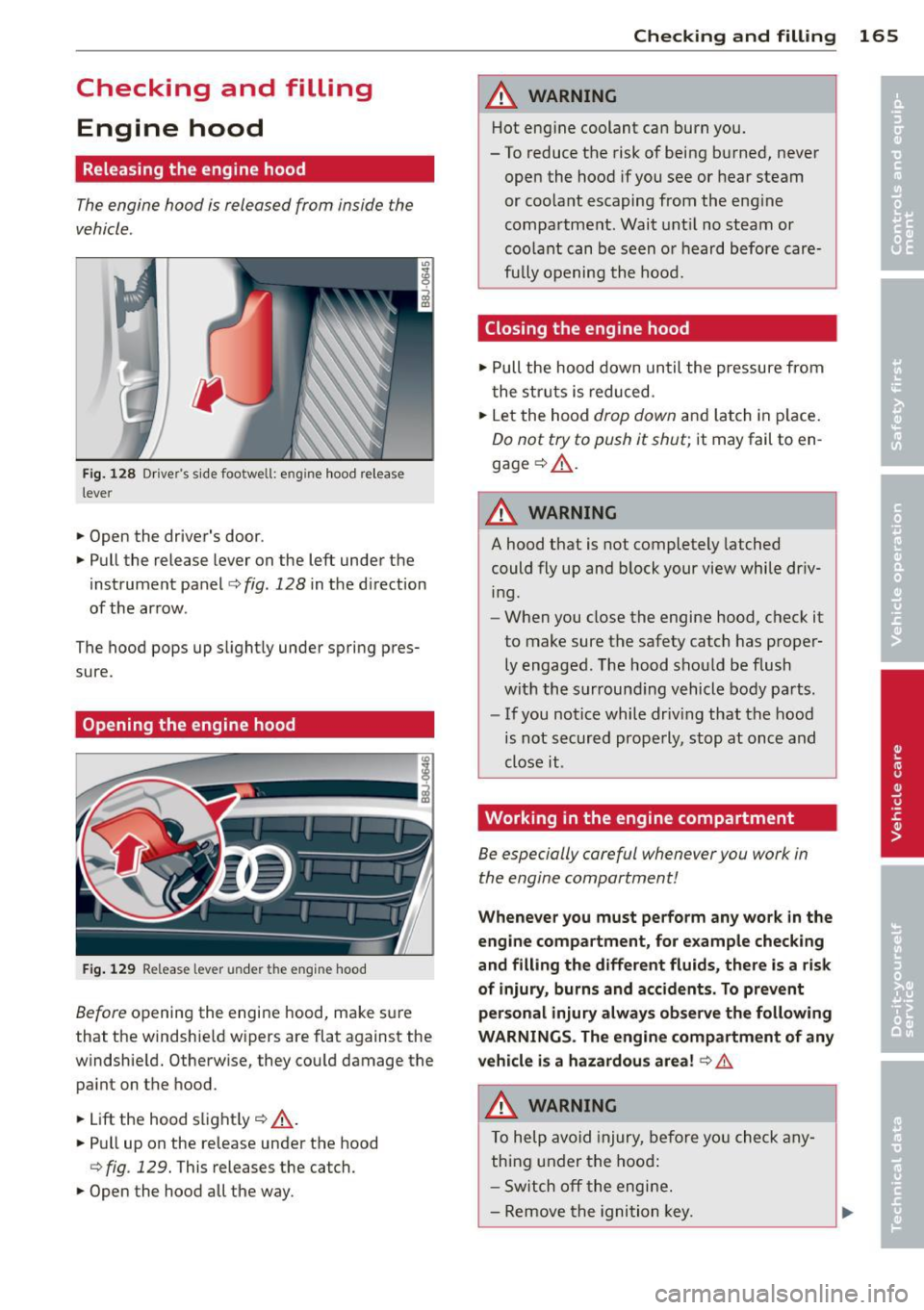
Fig. 128 Dr ive r's s ide footwe ll: e ng ine hood relea se
lever
"' Open the driver's door .
"' Pull the release lever on the left under the
instrument panel
i=> fig. 128 in the d irection
of the arrow .
The hood pops up slightly under spring pres
sure.
Opening the engine hood
F ig . 129 Release lever u nde r the engine hood
Before opening the engi ne hood, make sure
that the windshield wipers are flat against the
windshie ld. Otherwise, they could damage the
paint on the hood.
"' Lift the hood slight ly ¢
_A .
"' Pull up on the release under the hood
¢ fig . 129. This releases the catch.
"' Open the hood all the way .
Checking and fillin g 165
A WARNING
Hot engine coolant can burn you.
- To reduce the risk of being burned, never open the hood if you see or hear steam
or coolant escaping from the eng ine
compartment . Wait unt il no steam or
coolant can be seen or heard before care
fu lly opening the hood.
Closing the engine hood
"' Pull the hood down until the pressure from
the struts is reduced.
"' Let the hood
drop down and latch in p lace.
Do not try to push it shut; it may fail to en
gage ¢_& .
A WARNING
--
A hood that is not completely latched
could fly up and b lock your view while dr iv
ing.
- When you close the engine hood, check it
to make sure the safety catch has proper
ly engaged. The hood shou ld be flush
with the surround ing vehicle body parts.
- If you notice while driv ing that the hood
is not secured properly, stop at once and
close it .
Working in the engine compartment
Be especially careful whenever you work in
the engine compartment!
Whenever yo u must pe rform any wo rk in the
e n g ine compartment, for e xample ch ecki ng
and filling th e diff erent fluids, there is a risk
of injury, burn s and a ccidents. To prev ent
p ersonal injury always obse rve the foll owing
WARNINGS . The engine compa rtment of an y
vehicle i s a hazardou s area !
¢ &.
A WARNING ~
To help avoid injury, be fo re yo u check any
thing under the hood:
- Sw itch off the engi ne.
- Remove the ignition key.
Page 168 of 244
166 Checking and filling
-Apply the parking brake.
- Move selector lever to "P" (Park).
- Always let the engine cool down. Hot
components will burn skin on contact.
- To reduce the risk of being burned, never
open the hood if you see or hear steam
or coolant escaping from the engine
compartment . Wait until no steam or
coolant can be seen or heard before care
fully opening the hood.
- Keep children away from the engine com
partment .
- Never spill fluids on hot engine compo
nents. They can cause a fire.
- Never touch the radiator fan. The auxili
ary electric fan is temperature controlled
and can switch on suddenly.
- Never open the coolant reservoir cap
when the engine is still warm. The cool
ant system is pressurized and hot cool
ant could spray out .
- Protect your face, hands and arm from
steam or hot engine coolant by placing a
thick rag over the cap when you open the coolant reservoir .
- Do not remove the engine cover under
any circumstances . This increases the
risk of burns.
- If work on the fuel system or the electri
cal system is necessary:
- Always disconnect the battery .
- Never smoke or work near heaters or
open flames. Fluids in the engine com
partment could start a fire.
- Keep an approved fire extinguisher im
mediately available.
- To avoid electrical shock and personal in
jury while the engine is running or being
started, never touch:
- Ignition cables
- Other components of the high voltage
electronic ignition system.
- If you must perform a check or repair
with the engine running: -
First, fully apply the parking brake,
move selector lever to "P" (Park) .
- Always use extreme caution to prevent
clothing, jewelry, or long hair from get
ting caught in the radiator fan, V-belts
or other moving parts, or from contact ing hot parts. Tie back hair before
starting, and wear no clothing that will hang or droop into the engine.
- Minimize exposure to emission and chemical hazards~&, .
A WARNING
=
California Proposition 65 Warning:
- Engine exhaust, some of its constituents, and certain vehicle components contain
or emit chemicals known to the State of
California to cause cancer and birth de
fects and reproductive harm. In addition,
certain fluids contained in vehicles and
certain products of component wear con
tain or emit chemicals known to the
State of California to cause cancer and
birth defects or other reproductive harm.
- Battery posts, terminals and related ac
cessories contain lead and lead com
pounds, chemicals known to the State of
California to cause cancer and reproduc
tive harms. Wash hands after handling.
(D Note
When adding fluids, always make sure that
they are poured into the proper container
or filler opening, otherwise serious dam
age to vehicle systems will occur.
@) For the sake of the environment
To detect leaks in time, inspect the vehicle
floor pan from underneath regularly. If
you see spots from oil or other vehicle flu ids, have your vehicle inspected by an au
thorized Audi dealer.
Page 169 of 244
Checking and fillin g 167
Eng ine compartment
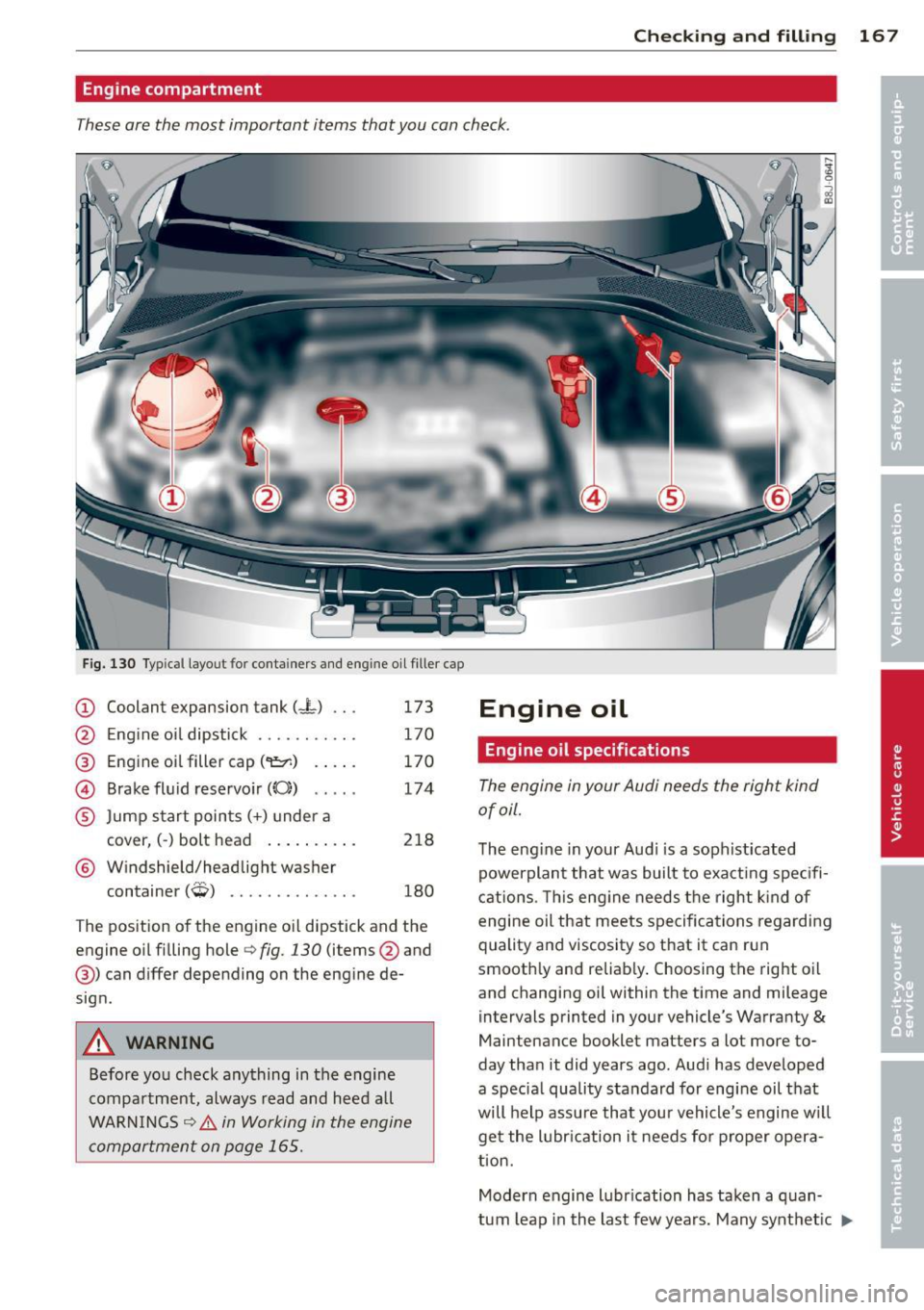
These are the most important items that you can check .
•
Fig. 130 Typ ical layout for containers and eng ine oil filler cap
(D Coolant expansion tank (-L) . . . 173
@ Eng ine oi l dipstick . . . . . . . . . . . 170
@ Engine oil filler cap (
® Jump start points(+) under a
cover,(-) bolt head . . . . . . . . . . 218
® Windshield/headlight washer
t . (ffi) con amer *
...... ....... . 180
The position of the engine o il dipstick and the
engine oil filling hole
i::> fig. 130 (items @and
@) can differ depending on the engine de
sign.
_&. WARNING
Before yo u check anything in the engine
compartment, always read and heed all
WARN INGS
i::> &. in Working in the engine
compartment on page 165.
Engine oil
Engine oil specifications
The engine in your Audi needs the right kind
of oil.
The eng ine in your Aud i is a sophist icated
powerplant that was built to exacti ng spec ifi
cations . T his eng ine needs t he right k ind of
engine oil that meets specifications regarding
quality and viscosity so that it can run
smoot hly and reliably . Choosing the right o il
and changing oil within the time and mileage
intervals printed in your vehicle's Warranty
&
Maintenance booklet matters a lot more to
day than it did years ago. Audi has developed
a specia l quality standard for engine oil t hat
will help assu re that you r vehicle's engine w ill
get the l ubr ication i t needs fo r proper opera
tion.
Modern engine lubr ication has taken a q uan
tum leap in the last few years. Many synt het ic
IJI,,
Page 170 of 244
168 Checking and filling
oils available today provide better engine lu
brication that can outlast traditional petrole
um-based oils, making them a smart choice
for use throughout the life of your Audi.
Whether you use synthetic or petroleum
based engine oil, the oil that you use must
conform to Audi's oil quality standard
VW 502 00 to help keep your vehicle's engine
running smoothly and help prevent the for
mation of harmful deposits, sometimes called
"sludge," that over t ime can lead to expensive
repairs .
At the time of printing, engine oils available in
the U .S . and Canada that meet the exacting
specifications of Audi oil standard VW 502 00
are synthetic engine oils. This does not mean, however, that every synthetic engine oil will
meet Audi oil standard VW 502 00. So always
be sure that you use an approved oil.
To help prevent the formation of harmful de posits use only oil with the following specifi
cations printed on the oil container:
Audi oil standard VW 502 00
Oil container labels may carry the specifica
tion singly or in combination with other desig
nations and oil quality standards .
Viscosity
Engine oils are graded according to their vis
cosity. The proper viscosity grade oil for your
engine depends on climactic or seasonal con
ditions where you drive. You can use oil with a
viscosity grade of SAE 5W40 across all tem
perature ranges for normal driving conditions.
However, if engine oil viscosity grade SAE
5W40 is not available, you can also use viscos
ity grade SAE 5W-30 or SAE OW-40 as long as
it meets Audi oil quality standard VW 502 00
specifications .
Because engine oil that meets the Audi oil
standard may not be available everywhere
when you need it, we strongly recommend
that you always carry with you an extra quart (liter) of oil that expressly conforms to the VW 502 00 specification, in case you have to
top
off the oil while on the road.
Only if the level of the oil is at or below the
minimum mark on the oil dipstick - and no oi l
that expressly conforms to Audi oil standard
VW 502 00 specifications is available -may
you top
off with a high quality engine oil, pref
erably synthetic-based, that meets ACEA A3
or API SM specifications, but even then, only
in viscosity grades SAE SW-40, SAE 5W-30, or
SAE OW-40 . However, during the entire time
between oil change intervals, never top
off
with more than a total of 0.5 qt/liter engine
oil that does not conform to Audi oil specifica
tion VW 502 00.
For more information about engine oil that
has been approved for your vehicle, please
contact either your authorized Audi dealer o r
Audi Customer Relations at 1 (800) 822-2834
or visit our web site at www.audiusa.com or
www.audicanada.ca . Here you will also find a
current list of oils (manufacturers, brand
names etc.) that conform to Audi oil standard
vw 502 00.
Changing the engine oil
The engine oil and oil filter must be changed
according to the mileage (kilometers) and
time intervals specified in your vehicle's War
ranty
& Maintenance booklet. Do not exceed
these intervals -harmful deposits from old
engine oil can reduce engine performance and
can lead to expensive engine repairs.
Changing the oil at the recommended inter
vals is so very important because the lubricat
ing properties of oil decrease gradually during
normal vehicle use. If you are not sure when
you have your oil changed, ask your author
ized Audi Service Advisor.
Under some circumstances the engine oil
should even be changed more frequently. Change oil more often if you drive mostly
short distances, operate the vehicle in dusty
areas or mostly under stop-and-go traffic con
ditions, or when you use your vehicle where
temperatures stay below freezing point for
long periods.
Page 171 of 244
Detergent additives in the oil will make fresh
oil look dark after the engine has been run
n ing for a short time . This is norma l and is not
a reason to change the o il more often than
recommended.
D amage o r m alfu nctions due to lac k of
m ainten ance
It is essen tial that yo u change your oil at the
recommended inte rva ls using only engine oil
that complies with A udi oil standard
VW 502 00 . Your Lim ited New Vehicle War
ranty does not cover damage or malfunctions
due to failure to follow recommended mainte nance and use requ ireme nts as set forth in
the Audi Owner 's Manual and Warranty
&
Maintenance book let . Your dea ler will have to
deny warranty coverage u nless you p resent to
the dea ler proof in the form of Serv ice or Re
pa ir Orde rs that all scheduled maintenance
was performed in a timely manner.
Engine oil consumption
The engine in your vehicle depends on an ade
quate amount of oil to lubricate and cool all
of its moving ports.
I n o rder to prov ide effective l ubr ication and
cooling of internal engine components, a ll in
ternal comb ustion engines consume a certain
amo unt of oi l. Oi l cons umption varies from
engine to engine and may change significantly
over the life of the eng ine . Typ ically, eng ines
with a specified break-in per iod (see
¢ page 150) consume more o il during the
break-in per iod than they consume after oil
consumption has stab ilized .
Under normal conditions, the rate of oil con
sumpt io n depends on the quality and viscosity
of the oil, the RPM (revolutions per m inute) at
which the engine is ope rated, the ambient
temperature and road condi tions. Furt her fac
tors are the amo unt of oil d ilution from wate r
condensation or fuel residue and the oxida
tion level of the oi l. As any engine is subject to
wear as mileage bui lds up, the oil consump
tion may increase over time until rep lacement
of worn components may become necessary.
Checkin g and fillin g 169
With a ll these variab les coming into p lay, no
standard rate of oil consumption can be es
tab lished or spec ified . There is no alte rnative
to regular and frequent check ing of the o il lev
el, see
Note .
If the yellow engine oil leve l warning symbo l
in the instrument cluster
Ill li ghts up, you
sho uld check the oil leve l as soon as possib le
with the oil dipstick¢ page 170. Top off the
o il at your earliest convenience ¢
page 170 .
A WARNING
Before you check anything i n the engine
compartment, always read and heed a ll
WAR NINGS ¢
& in Working in the engine
compor tment on page 165.
(D Note
D riving w it h an insufficient o il level is like
l y to cause severe damage to the engine.
© Tips
- The oil pr essur e warn ing display. is
not an indicator of th e oil level. Do not
rely on it . Instead, che ck the oil level in
your engine at regu lar int ervals, pr ef
erably e ach time you r efuel, and always
before going on a long trip .
-If you have the impression yo ur engi ne
cons umes excess ive amoun ts of oil, we
recommend that you consu lt your Aud i
dea ler to have the cause of your concern
properly d iagnosed. Keep in mind that
the accurate meas urement of o il con
sumption requires great care and may
take some t ime . Your Audi dea ler has in
st ruct ions about how to measure oil con
sumption acc urately.
-
•
•
Page 172 of 244
1 70 Checking and filling
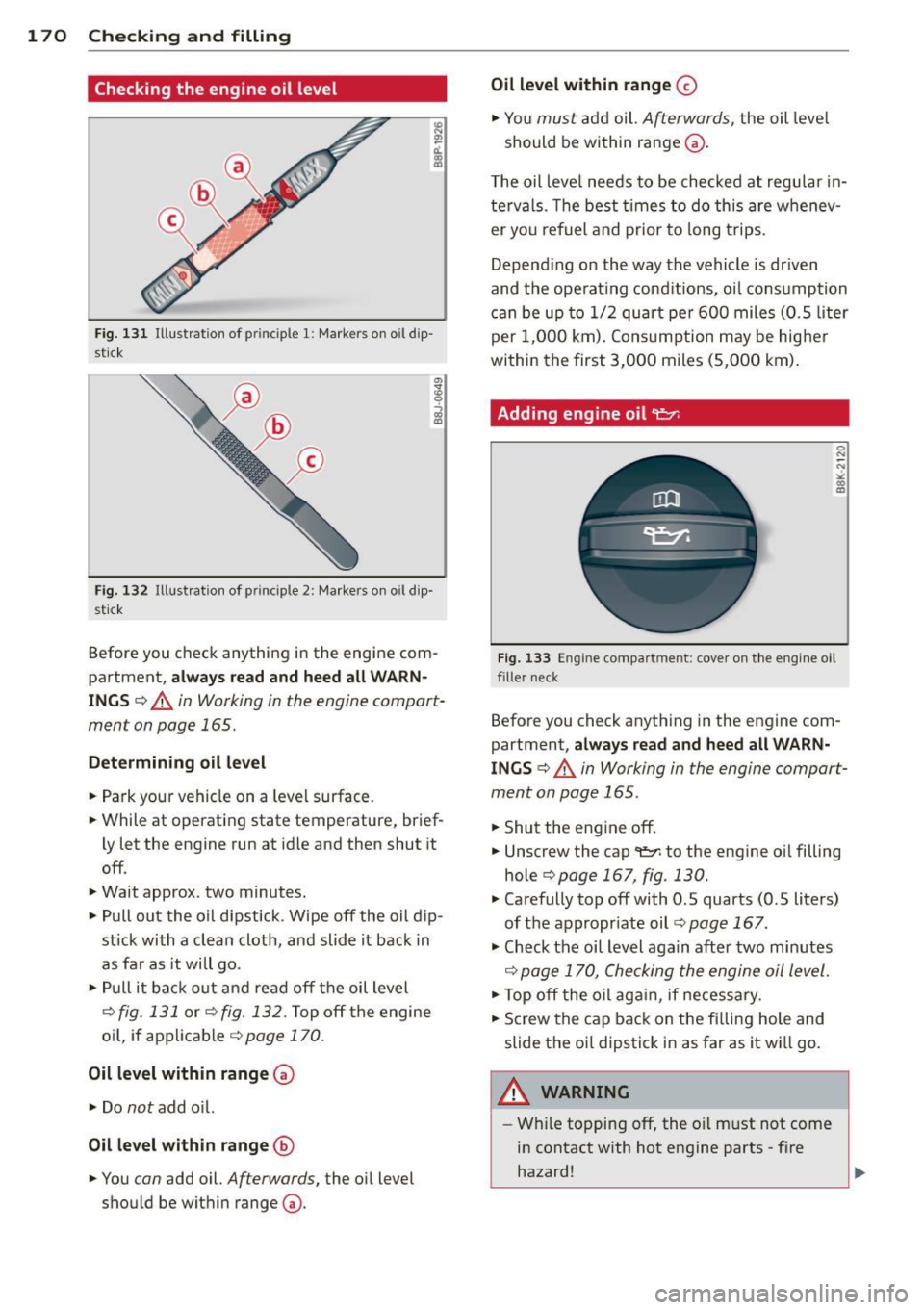
Checking the engine oil level
Fig. 131 Illustrat ion of p rinciple 1: Markers on o il dip
stick
F ig. 132 Illustration of princip le 2: Markers on oil dip·
stick
Before you check anything in the engine com
partment,
always read and heed all WARN·
INGS ¢ .&. in Working in the engine compart
ment on page 165.
Determining oil level
• Park your vehicle on a level surface.
• While at operating state temperature, brief
ly let the engine run at id le and then shut it
off .
• Wait approx . two minutes.
•Pu llout the oil dipstick. Wipe off the oil dip
stick with a clean cloth, and slide it back in
as far as it will go .
• Pull it back out and read off the oil level
<=?fig . 131 or ¢fig. 132 . Top off the engine
oi l, if applicable ¢
page 170.
Oil level within range~
• Do not add oil.
Oil level within range@
• You can add oil. Afterwards, the oil level
shou ld be within range~-
Oil level within range 0
• Yo u must add oil. Afterwards, the oil level
should be within range~-
T he oil leve l needs to be checked at regular in
tervals . Th e best times to do this are whenev
er you refuel and prior to long trips.
Depending on the way the vehicle is dr iven
and the operating conditions, oil consumption
can be up to 1/2 quart per 600 miles (0.5 liter
per 1,000 km). Consumption may be higher
within the first 3,000 miles (5,000 km) .
Adding engine oil "1::7-
0 N ,;;
><
"' IXl
Fig. 133 En g ine compartment: cove r on t he eng ine o il
fille r neck
Before you check anything in the engine com
partment,
always read and heed all WARN
INGS ¢.&. in Working in the engine comport·
ment on page 165 .
• Shut the engine off.
• Unscrew the cap
't::7-to the engine oil filling
hole
¢ page 167, fig . 130.
• Carefully top off with 0.5 quarts (0.5 liters)
of the appropriate oil
r::.>page 167.
• Check the oil level again after two minutes
¢ page 170, Checking the engine oil level.
• Top off the oil again, if necessary.
• Scr ew the cap back on the filling hole and
slide the oil dipstick in as far as it will go.
A WARNING
-While topping off, the oil must not come
in contact with hot engine parts -fire
hazard!
~
Page 173 of 244
-The oil fille r cap must be properly se
cured to preve nt oil from being sprayed
on the hot engine and exhaust system
when the eng ine is running -fire hazard!
- If your skin has come in contact w ith the
engine oil, you must subsequent ly
cleanse it thoroughly.
@ Note
- The oil leve l must not be above range 0
- danger of converter or eng ine damage!
Contact an authorized Audi dealer to
draw
off oil, if necessary.
- Audi does not recommend the use of o il
add itives . They may damage the engine
and adversely affect your New Vehicle
Warranty .
@ For the sake of the environment
-Un der no circ umstances ca n the o il come
i n contact with the sewage network o r
t h e soil.
- Observe and fo llow lega l regu lations
whe n disposing of empty oil con tainers.
Changing the engine oil
We recommend that have your oil changed by
an authorized Audi dealer or a qualified serv
ice station .
Before you check anything in the engine com
partment,
always read and heed all WARN
INGS
~ .& in Working in the engine compart
ment on page 165.
The engine oil must be changed according to
the intervals specified in you r Warra nty
&
Ma intenance boo klet . This is very important
because the l ubr icating prope rties of oil di
m ini sh gradua lly dur ing no rma l veh icle use.
Unde r some ci rcumstances the engine o il
should b e changed more frequently . Change
oil more often if you drive most ly short dis
tances, ope rate the vehicle in dusty areas or
u nder predomin antly stop -and-go t ra ffi c con
d itions, or have your ve hicle w here tempera-
Checkin g and fillin g 171
tu res remain below freezing for extended pe
riods .
Dete rgent additives in the oil will make fres h
o il look dar k after the engine has been run
ning for a sho rt time. This is normal an d is not
a reaso n to cha nge the oil more often t han
recommended.
Bec ause of t he prob lem o f proper disposal,
along with the specia l tools and necessa ry ex
pertise req uired, we st ro ngly recommend that
you have your oil changed by an a uthorized
Audi dealer or a qualified service station.
If you choose to change your oil yourself ,
please note the following important info rma
tion:
_& WARNING
To reduce the risk of pe rsonal inj ury if you
must change the eng ine oil in your vehicle
yourself:
- Wear eye protect io n.
- To reduce t he risk of burns from hot en-
gine oil , let the engine c oo l down to the
touch.
- When removing the o il dra in p lug with
your fingers, stay as far away as possible.
Always keep you r forearm parallel to the
grou nd to help p revent hot o il from run
ning down you r arm.
- Dra in the oil into a container designed
for this purpose, one la rg e enough to
hold at l east the tota l am ou nt of oil in
your engine.
- Engine oil is poisonous. Keep it well o ut
of the rea ch of childre n.
- Con tinuous contact wit h used eng ine o il
is harmful to yo ur ski n. A lways protect
your skin by washi ng oil
off th oroughly
w it h soap and w ater.
(D Note
N eve r mix oil additives wi th you r engine
oil. Th ese additives can damage your en
g ine and adversely affect your Au di Li m it
e d N ew Vehicle Warr anty.
•
•
Page 174 of 244
172 Checking and filling
@ For the sake of the environment
- Before changing your oil , first make sure
you know where you can properly dispose
of the used o il.
- Always dispose of used engine oil proper
l y. Do not dump it on garden soi l, wood
ed areas, into open streams or down
sewage dra ins.
- Recycle used engine oil by taking it to a
used engine o il collection facility in your
area, or contact a service station .
Engine cooling system
Coolant
The engine coolant performs two functions: it
keeps the engine from overheating and it pro tects the engine from freezing in the winter.
The cooling system is sea led and generally re
q uir es little attention .
The cooling system has been filled at the fac
tory with a pe rmanent coolant which does not
need to be c hanged. The coolant consists of a
mixture of spec ia lly condi tioned water and the
manuf acturer 's glyco l-b asedcoolan t addi -
tive G l3 antifreeze with ant icorros ion addi
tives (50% for USA models ; 60% for Canadian
mod els). This mixture both assures the nec es
sary frost protection and p rotects metal com
ponents in the engine's cooling system from
corrosion and scaling . It a lso raises the boil
ing point of the coo lant .
Do not red uce the concentration o f the coo l
ant in the summer by adding plain water.
The
proportion of coolant add itive must be at
l e a st 50 % but not more than 60 %
to main
tain antifreez e protection and cooling efficien
cy . If the coolant frost prote ct ion is too low,
the coo lant cou ld free ze and damage the veh i
cle hea ting and eng ine cooling system.
For yea r-round d riving, antifreeze is added at
the fac to ry for temperatures down to:
-- 31°F( -35°C)USA
- -40 °F ( -40 °C) Canada. If
you must add coolant, use a mixture o f wa
ter and coolant additive . Mixing the coo lant
additive with distilled water is recommended.
A WARNING
-
Before you c heck anything in the engine
compartment, always read and heed a ll
WAR NINGS
c::, & in Working in the engine
compartment on page 165.
(D Note
- Before winter sets in, have the coo lant
checked to see if the coolant additive in
your vehicle is sufficient to meet the cli m ate conditions . This is especia lly impor
tan t if you live in a reg io n wher e the win
t er is ex treme ly col d. If ne cessa ry, i n
crease the proportion of coo lant add itive
t o 60%.
- Whe n adding coolant additive to yo ur
c oolin g sys tem, remembe r:
- We recommend using on ly coolant ad
d itive Gl2++ or Gl3 for your vehicle .
This coolant additive is avai lab le at au
thor ized Audi dealers . Other types of
ant ifre eze can s ignificant ly reduce cor
rosion prote ctio n. T he resulti ng cor ro
sion can ca use a lo ss o f coolan t and se
rio us en gine d amage.
- Do not add any ty pe of rad iator leak seal
a n t t o y our vehicle 's engine coolant.
Add ing radiator rep air fl uid may adverse
ly affect the function and performance of
yo ur cooling system and co uld resu lt in
damage not covered by yo ur New Vehicle
Limited Warranty.
-