check engine light AUDI TT ROADSTER 2014 Owner's Manual
[x] Cancel search | Manufacturer: AUDI, Model Year: 2014, Model line: TT ROADSTER, Model: AUDI TT ROADSTER 2014Pages: 244, PDF Size: 60.87 MB
Page 175 of 244
Checking the engine coolant level
The engine coolant level can be checked with
a quick glance .
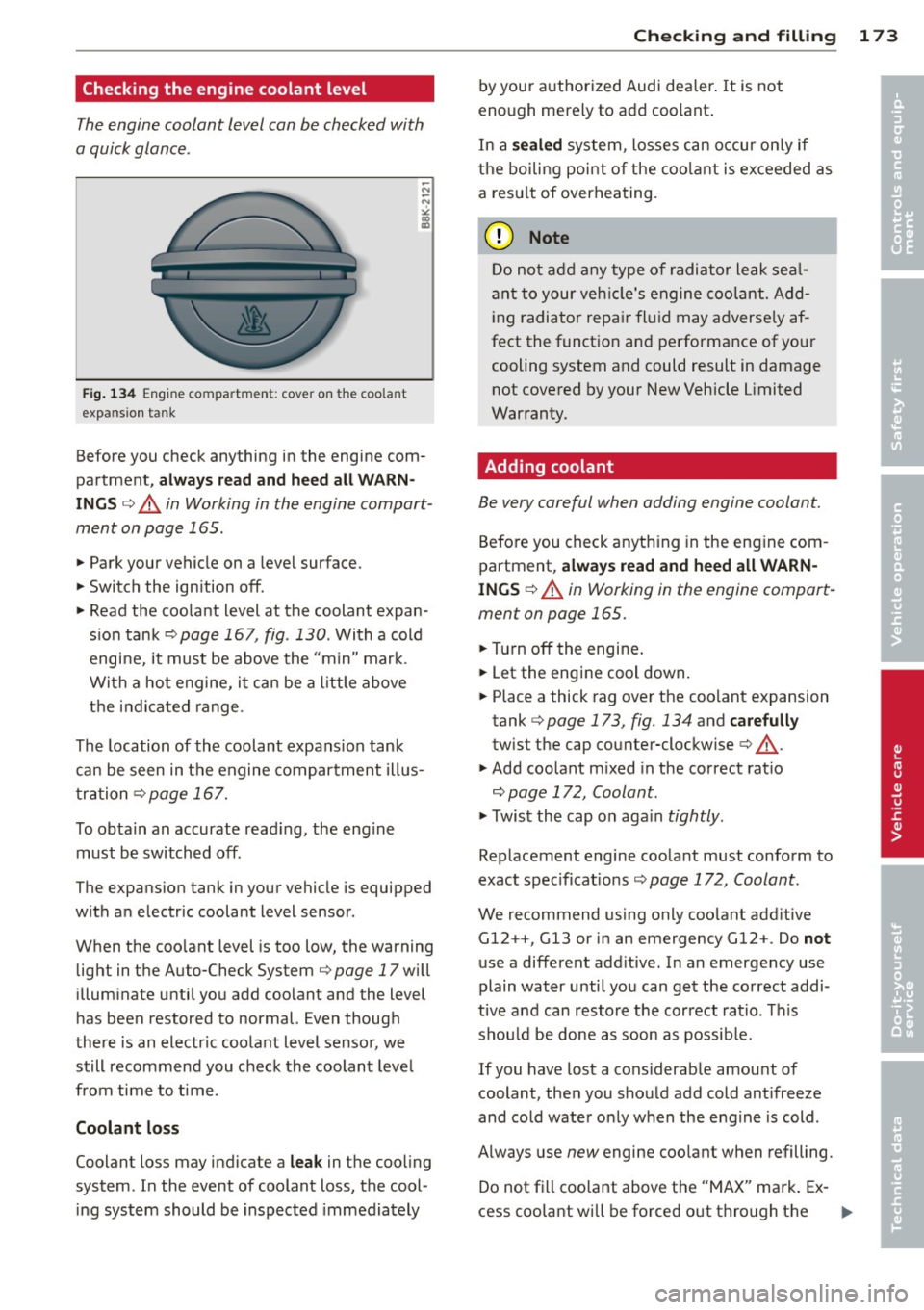
Fig. 134 Eng ine compartme nt: cover o n the coolant
expansion tank
Before you check anything in the engine com
partment,
a lway s read and he ed all WARN
INGS ¢ A in Working in the engine compart
ment on page 165.
.,. Park your vehicle on a level surface.
.,. Switch the ignition
off .
.,. Read the coola nt level at the coolant expan
s ion tank
¢ page 167, fig . 130. With a cold
engine, it must be above the "min" mark.
With a hot engine, it can be a l ittle above
the indica ted range.
The location of the coolant expans ion tank
can be seen in the engine compar tment illus
tration
¢page 167.
To obtain an accurate read ing, the eng ine
must be switched
off.
The expans ion tank in your vehicle is equipped
with a n electric coolant level sensor.
When the coo lant level is too low, the warning
light in the Auto-Check System¢
page 17 will
illum inate until you add coolant and the level
has been restored to normal. Even though
there is an electric coolant level sensor, we
still recommend you check the coolant leve l
from time to time.
Coolant loss
Coolant loss may indicate a leak in the cool ing
system. In the event of coolant loss, the cool
i ng system should be inspected immediately
Checkin g and fillin g 173
by your authorized Audi dea ler . It is not
enough merely to add coo lant .
In a
s ealed system, losses can o ccu r on ly if
the boiling point o f the coo lant is exceeded as
a res ult of overheating.
(D Note
Do not ad d any type of radiator leak sea l
ant to your veh icle's engine coo lant. Add
ing radiator repa ir flui d may adverse ly af
fect the function and performance of yo ur
cooling system and could result in damage
not covered by your New Vehicle Limited
War ranty.
Adding coolant
Be very careful when adding engine coolant.
Before you check anyth ing in the engine com
partment,
alway s read and heed alt WARN
INGS ¢ A in Working in the engine compart
ment on page 165.
... Tu rn off the engine .
.,. Let the engine cool down.
.,. Place a thick rag ove r the coolant expansion
tank ¢
page 173, fig. 134 and carefully
twist the cap counter-clockwise ¢_& .
.,. Add coo lant m ixed in the correct rat io
¢ page 172, Coolant .
.,. Twist the cap on aga in tightly.
Rep lacement engine coo lant must conform to
exact specificat ions¢
page 172, Coolant.
We recommend using only coolant add itive
Gl2 ++, Gl3 or in an emergency Gl2+. Do not
use a different additive. In an emergency use
plain water until you can get the correct addi
tive and can resto re the correct ratio . Th is
shou ld be done as soon as possib le.
If you have lost a cons iderab le amount of
coolant, then you should add cold ant ifreeze
and co ld wate r on ly when the engine is cold.
Always use
new engine coolant when refilling.
Do not fill coolant above the "MAX" mark. Ex-
cess coolant will be fo rced o ut through the ..,_
•
•
Page 176 of 244
17 4 Che cking and filling
pressure relie f valve in the cap when the
engine becomes hot .
.&_ WARNING
-The coo ling system is under pressure and
can get
very hot. Reduce the risk of
sca lding from hot coolant by following
these steps .
- Turn off the eng ine and a llow it to cool
down.
- Protec t your face, hands and arms from
escap ing fl uid and steam by cover ing
the cap with a large, thick rag.
- Tu rn the cap slowly and
very ca refully
in a counter -clockwise direct ion while
applying light, downward p ress ure on
the top of the cap.
- To avo id being burned, do not sp ill an
tifreeze or coolant on the exhaust sys
tem or hot engine parts. Under certain
conditions, the ethylene glyco l in en
g ine coolant can catch fire.
- Antifreeze is poisonous. Always store an
t ifreeze in its or iginal container and we ll
out of the reach of children.
- If you drain the coolant, it must be
caught and safely stored in a proper con
ta iner clearly marked "poison".
(D Note
- Coolant po llutes the environment and
could cause an engine fire. Excess cool
ant will be forced out through the pres
sure re lief
valve in the cap when the en
gine becomes hot .
- If, in an emergency, only water can be
added, the correct ratio between wate r
and antifreeze~
page 172 must be re
stored as soon as possib le.
@) For the sake of the environment
Dra ined coolant should not be reused. Al
ways dispose of used coolant while obse rv
ing all environmental regulations .
Radiator fan
The radiator fan switches on automatically by
itself .
The electric radiator fan is controlled by ther
moswitches that switch on and off depending
on coolant and eng ine compartment tempera
tures.
An a uxiliary electric radiator fan* sw itches on
and off depending on coolant temperature
and other vehicle operat ion conditions .
After you switch the engine off, the aux iliary
fan can continue running for up to 10 minutes
-even w ith the ignition off. It can even switc h
on aga in later by itself
c> &. , if
- the temperature of the engine coo lant rises
due to the heat build-up from the engine in
the engine compartment, or
- the engine compartment heats up because
the vehicle is parked in intense sunlight.
.&_ WARNING
-
- To reduce the risk of personal inju ry nev-
er touch the radiator fan.
- The auxiliary electric fan is temperature
controlled and can sw itch on suddenly
even when the engine is not ru nning.
- The auxiliary radiator fan sw itches on au
tomatically when the engine coo lant
reac hes a certain t emperature and w ill
continue to run until the coolant temper
a ture drop s.
Brake fluid
' Checking brake fluid level
N
N
N
" ~
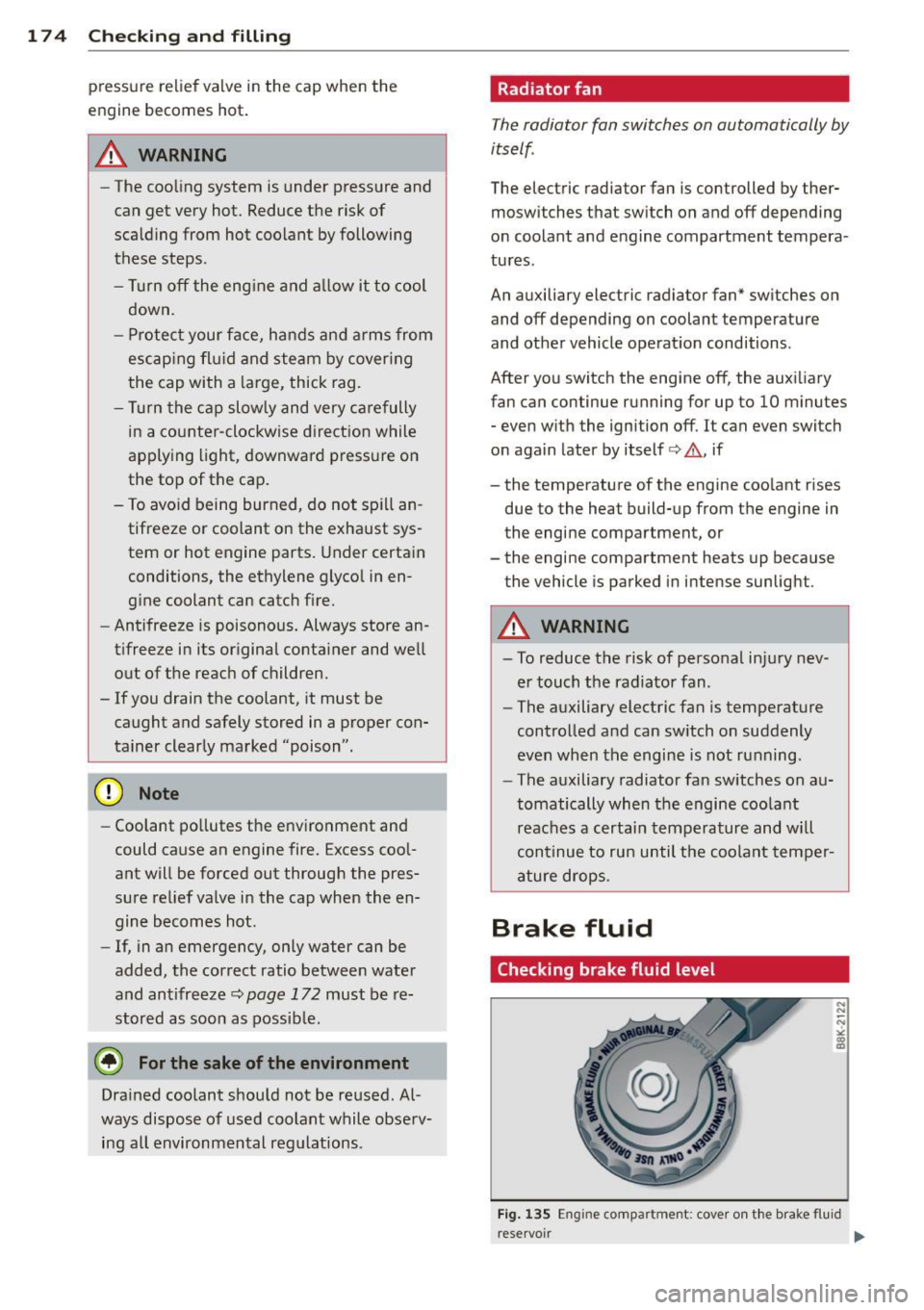
Fi g. 13S Engine compartment: cover on th e brake fluid
reservoir
Page 177 of 244
Before you check anything in the engine com
partment,
always r ead and heed all WARN
ING S
~ A in Working in the engine compart
ment on page 165.
.. Read the brake flu id level from the brake
fluid reservoir
9 page 167, fig. 130 . The
brake f lu id leve l must be between the "MIN"
and "MAX" markings.
The brake f luid reservoir is located behind the
rear partition of the engine compartment on
the left side
9 page 167.
The fl uid level may drop slightly after some
time due to the automatic adjustment of the brake pads . This is not cause for alarm .
If the brake fluid level falls considerably be
l ow the "M IN" mark, the brake wa rning/indi
cator light (U .S . mode ls:
1111 , Canadian
models: .) will come on ¢
page 14 . Do not
continue to operate the vehicle. The complete
brake system shou ld be thoroughly checked
by an authorized Audi dealer or other quali
f ied fac ility and the cause corrected . If the
b rake fluid level is too low, the brake warn ing/
i ndicator light w ill illuminate . Co ntact an au
thor ized Audi dealer
immediately .
Changing brake fluid
Have the brake fluid changed by an experi
enced technician .
Brake fluid abso rbs moistu re from the a ir . If
the water content in the brake fluid is too
hi gh, cor ros ion in the b rake system may result
after a per iod of t ime . The bo iling po int of t he
b ra ke fluid w ill also decrease considerab ly and
decrease braking performance.
Therefore, the brake flu id must be changed
e very two year s. Always use new b rake fluid
which confo rms to Fede ral Motor Vehicle
Standard "FMVSS 1 16 DO T 4".
The brake flu id rese rvoi r ca n be difficult to
r each, therefo re , we recommend that yo u
h ave the brake fl uid changed by you r autho r
i zed
Audi dealer . Your deale r has the correct
Checkin g and fillin g 175
tools, the right brake fl uid and t he know -how
to do this for you .
A WARNING
-Brake flu id is poisonous. It must be stor
ed only in the closed or iginal container
out of the reach of children!
- Brake failure can res ult from o ld or inap
propriate brake f lu id. Observe these pre
cautions:
- Use only b rake fluid th at mee ts SA E
spe cificat ion
J 17 03 and conforms to
Federa l Mo to r Ve hicl e Standard 1 16.
Always check with yo ur authorized Au di
dealer to make sure yo u are using the
correct brake fluid. The cor rect type of
brake f luid is also ind icated on the
brake f luid reservoir .
- The bra ke fluid must be new. Heavy use
of the brakes ca n cause a vapor lock if
the brake fluid is left i n the system too
long. This can se riously affect the effi
c iency of the b rakes as well as your
safety , T his could result in an accide nt.
(!) Note
Brake fluid will damage the pai nt of your
vehicle.
@) For the sake of the environment
Because of the prob lem of proper disposal
of brake fluid as well as the spec ial too ls
r equired and the nec essary expertise, we
r ecommend that yo u have th e brake flu id
c hanged by you r aut ho rized Aud i dea le r.
Battery
General information
Your vehicle is equipped with a specia l bat
tery, an
ACM battery. This battery is located
in the luggage compartment and must be re
placed with an origina l equipment batte ry .
Un der normal ope rat ing condit io ns, t he bat-
te ry is
maintenanc e-free . .,.
•
•
Page 180 of 244
1 78 Che cking and filling
must be disconnected . If you are just go
ing to rep lace a light bu lb, then it is
enough to switch off the lights.
- Before disconnecting the battery, switc h
off the anti-theft alarm system! Other
wise you will set off the alarm.
- When disconnecting the battery, first disconnect the negative cable and then
the positive cable .
- Before reconnect ing the battery, make
sure all electrical consumers are switch
ed off . Reconnect the positive cable first
and then the negative cable. Never inte r
change the cables - th is could start a fire!
- Never charge a frozen or a thawed-out battery.
It could explode! If a battery has
frozen, then it must be replaced. A dis
charged battery ca n freeze over at 32 °F
(0 oc).
- Make sure the vent hose is always attach
ed to the opening on the side of the bat
tery .
- Never use batte ries which are damaged.
Danger of explos ion! Always rep lace a
damaged battery .
8_ WARNING
California Proposition 65 Warning:
- Battery posts, te rm inals and related ac
cessories contain lead and lead com
pounds, chemicals known to the State of
California to cause cancer and reproduc
tive problems. Wash hands after han dling.
(D Note
- Do not disconnect the vehicle battery when the ignition is switched on
or when
the engine is running, otherwise, you will
damage e lectronic components in the
electrical system.
- If your vehicle is going to stand for a long period of time without being driven,
protect the battery from "freezing", oth
erwise it w ill be damaged and w ill then
have to be replaced .
Checking the battery acid level on magic
eye batteries*
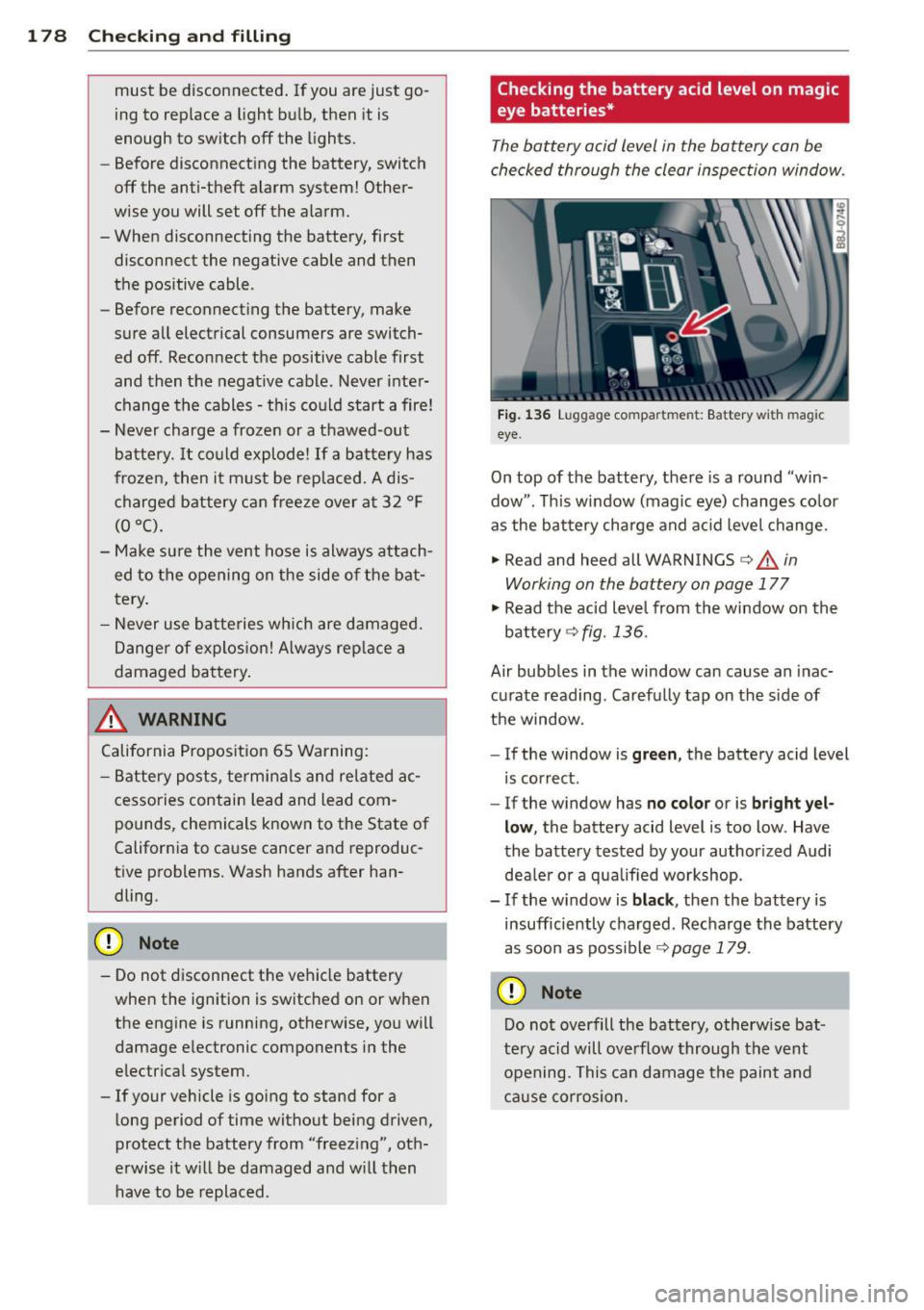
The battery acid level in the battery can be
checked through the clear inspection window .
Fig . 1 36 Lu gga ge compar tment: Battery w ith magic
eye .
On top of the battery, there is a round "win
dow". This window (magic eye) changes co lor
as the battery cha rge and ac id leve l change.
.,. Read and heed all WARNINGS
<=> .&_ in
Working on the battery on page 177
.,. Read the acid level from the window on the
battery <=>
fig. 136.
Air bubbles in the window can cause an inac
curate reading . Carefu lly tap on the s ide of
the window.
- If the window is
green , the battery acid level
is correct.
- If the window has
no colo r or is brigh t y el
lo w,
the battery acid level is too low . Have
the battery tested by your author ized Audi
dea ler or a qualified workshop.
- If the w indow is
black , then the battery is
insufficiently charged . Recharge the battery
as soon as possible¢
page 179 .
(D Note
Do not overfill the battery, otherw ise bat
tery acid will ove rflow through the vent
opening . This can damage the paint and
cause corrosion .
Page 181 of 244
Charging of battery
Starting the engine requires a well charged battery.
11-Al way s read and heed all WARNING S be
low¢
A and ¢ A in Working on the bat
tery on page 177.
11-Switch off the ignit ion and all electrical con
sumers.
11-Make sure the area is well vent ilated when
you charge the bat tery.
11-Connect charger cables. ALWAY S co nnect
charge r cables POSITI VE
G) to POSITIVE
G) ; NEGATIVE Qto NEGA TIV E Q .
11-Switch on the charger.
11-Turn off the charger¢ &_.
11-Disconnect the charger cables.
11-Connect both battery cables to the battery if
necessary -
first plus, then m inus.
When charging at
low voltages (e.g. with a
trickle charg er), the battery cables do not
h ave to be d isconnected first. Before charging
at
high voltages, i.e. " fas t charging ", you
must disconnect both cables. In e ithe r case,
follow the instru ctions from the man ufactu rer
of the charger .
Fastcharging a battery is
dan gerou s¢ & in
Working on the battery on page 177.
It r e
q ui res specia l charg ing equipment and the
know ledge to go with it. We recommend hav
ing your battery fast charged on ly by a quali
f ied workshop .
A discharged battery can
freeze at tempera
tures of on ly 32 °F (0 °C). A llow a frozen bat
tery to thaw completely befo re attempting to
charge it¢ & . However, we recommend not
using a thawed battery again because the bat
tery cas ing can be cracked due to ice forma
tion and can leak battery acid.
Do not open the battery caps when charging
the battery.
A WARNING
-
Charging a battery can be dangerous.
Checkin g and fillin g 179
-Never charge a frozen battery. It may ex
plode because of gas trapped in the ice.
Allow a frozen battery to thaw out first.
- Do not reuse batteries wh ich were fro
zen. The battery housing may have
cracked and weakened when the battery
froze.
- Charge the battery in a well ventilated
area. Keep away from open flame or elec
trical spark. Do not smoke. Hydrogen gas
generated by the battery is explos ive.
- To reduce the danger of explosion, never
connect or d isconnect c harger cab les
while the charger is ope rat ing.
- Fast cha rging a batte ry is dangerous and
should only be attempted by a compe
tent techn ic ian with the prope r equip
men t.
- Battery acid that may spi ll dur ing cha rg
i n g should be washed off wi th a solu tion
of wa rm w ater and baking soda to neu
trali ze the ac id.
(D Note
Neve r use a fast cha rg er as a boost er to
star t the engi ne. This w ill ser iously dam
age sens it ive e lectronic componen ts, su ch
as cont ro l units, re lays, radio, etc., as well
as the batte ry charger.
(D Tips
T he vehicle ba tte ry mu st not be charged
wi th a standa rd small charger that plugs
into t he cigarette lighter or outlet . •
•
Page 182 of 244
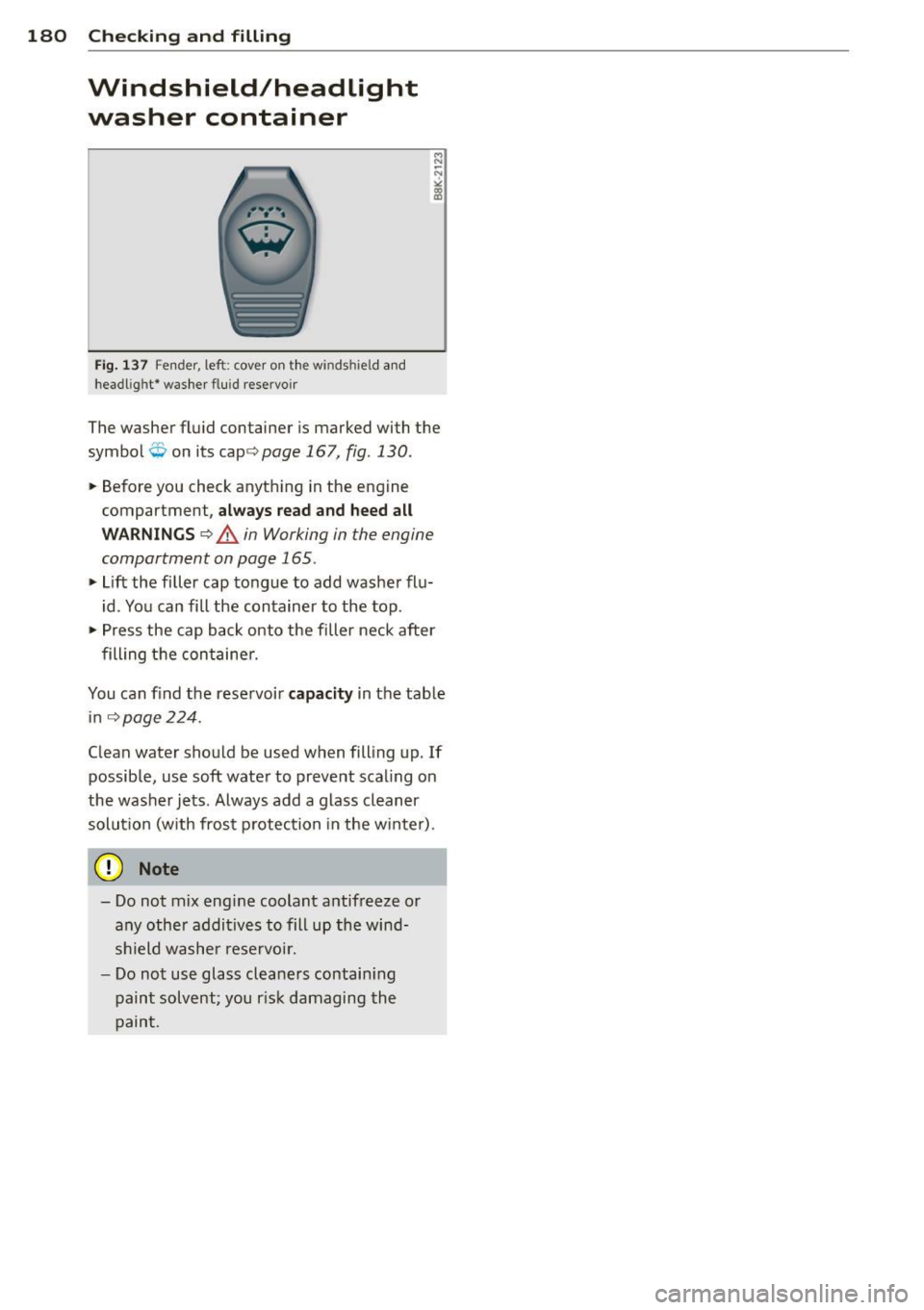
180 Checking and filling
Windshield/headlight
washer container
M N
Fi g. 137 Fender , left : cover on t he w inds hield a nd
headl ig ht* was her fl uid reservoir
The washer flu id container is marked wi th the
symbol
Q on its cap <=>page 16 7, fig . 130 .
.. Before you check anyth ing in the engine
compartment,
alw ays re ad an d heed all
W ARNING S r=> A in Working in the engine
compartment on page 165 .
.,. Lift the filler cap tongue to add washer flu
id . You can fill the container to the top .
.,. Press the cap back onto the fi ller neck after
filling the containe r.
You can find the reservoir
ca pacity in the table
i n
r=> page 224 .
Clean water should be used when filling up . If
possible, use soft water to prevent scal ing on
the washer jets . Always add a glass cleaner
solutio n (with frost p rotection in the winter) .
(D Note
-Do not mix engine coolant antifreeze or
any other addi tives to fill up the wind
shield washer rese rvoi r.
- Do not use glass cleaners contain ing
paint solvent; you r isk damaging the
paint.
Page 219 of 244
Emergency situations
General
This chapter is intended for trained emer
gency crews and working personnel who
have the necessary tools and equipment to
perform these operations.
Starting by pushing or
towing
(D Note
Vehicles with an automatic transmission
cannot be started by pushing or towing .
Starting with jumper
cables
If necessary, the engine can be started by
connecting it to the battery of another vehi
cle.
If the engine should fail to start because of a
discharged or weak battery, the battery can be
connected to the battery of
another vehicle,
using a
pair of jumper cables to start the en
g ine.
Jumper cables
Use only jumper cables of sufficiently
largecross section to safely carry the starter
current. Refer to the manufacturer's specifica
tions.
Use only jumper cables which have
insulated
termina l clamps and are properly marked for
distinction :
plus(+) cable in most cases colored red
minus(-) cable
in most cases colored black.
_& WARNING
Batteries contain electricity, acid, and gas.
Any of these can cause very serious or fatal
injury. Follow the instructions below for
safe handling of your vehicle's battery.
- Always shield you r eyes and avoid lean
ing over the battery whenever possible.
Emergency situations 21 7
-A discharged battery can already freeze
at temperatures just below 32 °F (0 °C).
Before connect ing a jumper cable, the
frozen battery must be thawed com
pletely, otherwise it could explode .
- Do not allow battery acid to contact eyes
or skin . Flush any contacted area with
water immediately .
- Improper use of a booster battery to
start a vehicle may cause an explosion.
- Vehicle batter ies generate explosive gas
es. Keep sparks, flame and lighted c iga
rettes away from batteries.
- Do not try to jump start any veh icle w ith
a low ac id level in the battery.
- The voltage of the booster battery must
also have a 12-Volt rating. The capacity
(Ah) of the booster battery should not be
lower than that of the discharged bat
tery. Use of batteries of diff erent voltage
or substantially different "Ah" rat ing
may cause an exp losion and personal in
jury.
- Never charge a frozen battery. Gas trap
ped in the ice may cause an explosion.
- Never charge or use a battery that has
been frozen . The battery case may have
be weakened.
- Use of batter ies of different voltage or
substantially different capacity (Ah) rat
ing may cause an exp losion and injury .
The ca pa city (Ah) of the booster battery
should not be lower than that of the dis
charged battery.
- Before you check anything in the engine
compartment, always read and heed all
WARNINGS
c::;,page 165, Working in the
engine compartment.
(D Note
- App lying a higher voltage booster bat
tery will cause expensive damage to sen
sit ive electronic components, such as
control units, relays, rad io, etc .
- There must be no electrical contact be
tween the vehicles as otherwise current
could already start to flow as soon as the
posit ive(+) terminals are connected. ..,. •
•
Page 232 of 244
230 Index
A
A/C operation . . . . . . . . . . . . . . . . . . . . . . . 71
Accessories . . . . . . . . . . . . . . . . . . . . . . . . 228
Acoustic park assist ........ .. .. .. .. . . 80
Adaptive light . . . . . . . . . . . . . . . . . . . 21, 49
Adding Eng ine coolant .............. ... .. .
Engine oil .. ..... ........... ... .. .
Windshield washer fluid ... .. .. .... .
Additional accessories
Addit ives
Engine oil . ...... ......... ... .... .
Adjustab le steer ing column ...... .. ... .
Adjusting front seats ....... .. .. .. .. . . 173
170
180
228
170 73
60
Adj usting steering column ... .... .... .. 73
Adjusting the seats ............... ... . 61
Advanced Airbag System Children 131
Components ............. .. .. .... . 115
Front airbags . ............. .. .... . 113
H ow the components work together . . 117
Monitoring .... ... ... .... .. .. .. .. . 119
Weight -se nsing mat ...... .. .. .. .. . 131
Airbag system . . . . . . . . . . . . . . . . . 109, 128
Care . .. .. .. ............... .. .... . 122
Ch ild restra ints .............. ... .. . 132
Components (front airbags) .. .. .. .. . 115
Danger of fitting a child safety seat on
the front passenger seat . . . . . . . . . . . . 110
Disposal ................ .. .. .... . 122
Fr ont airbags ..................... 113
How do the front airbags work? .. ... . 118
How many airbags does my vehicle
have? ... .. ............. .. .. .. ... 115
Important safety instructions on the knee airbag system ..... .. .. .. .. .. . 126
Important things to know ...... .. .. . 109
Indicator l ight .... ... .... .. .. .. .. . 119
Knee airbags ............. .. .. .. .. . 124
Monitoring ... ............. .. .... . 119
PASSENGER AIR BAG OFF light .. ..... 120
Repairs .... ................ ..... . 122
Side airbags . . . . . . . . . . . . . . . . . . . . . . 126
Warning/indicator lights ............. 15
When must the system be inspected? 119
A lcantara
C leaning ... .. .............. ..... . 158 All-wheel drive
.... ............. .... 147
Winter tires ..... ................ . 196
Alternator .. .... .. ............. .... . 16
Anti-free ze
refer to Eng ine cooling system . .. .. .. 172
Anti -lock brake system . . . . . . . . . . . . . . . 142
Warning/indicator lights ............. 18
Anti-s lip regulation ............. .... 142
Anti-theft systems Anti -theft alarm system ............. 38
Electronic immobilizer .......... .. .. . 33
Ashtray ... ..... .. .. .............. .. 64
Asterisk What does it mean when something is
marked with an asterisk? . . . . . . . . . . . . . . 6
Audi magnet ic r ide . . . . . . . . . . . . . . . 21, 80
Description . . . . . . . . . . . . . . . . . . . . . . . . 80
Indicator light . .. .. ........... .. .. . 21
Audi Service Repair Manuals and Li tera-
ture 226
Automatic be lt retractor ............ . 104
Automat ic convert ible top
closing
. .. .. .. .. ............. .. .. . 43
opening .. .. .. .. ................ .. 43
Automat ic transmission . . . . . . . . . . . . . . . 82
Driving Notes . . . . . . . . . . . . . . . . . . . . . . 84
Emergency program ........... .. .. . 87
Emergency release ............. .. .. . 87
Ignit ion key safety lock ........... .. . 74
Kick-down ..... .. ................ .. 86
Launch Control Program ............. 86
Se lector lever lock . . . . . . . . . . . . . . . . . . 83
Se lector lever positions ......... .. .. . 82
Tiptronic .. .... .. ............. .... . 85
T iptronic controls on the steering wheel 86
Auto Safety Hotline ................ .. 99
Average fuel mileage ............ .... . 23
Average speed . . . . . . . . . . . . . . . . . . . . . . . 23
Avoid damaging the vehicle ........ ... 151
B
Battery ...................... 175,178
Charg ing .. .... .. ............. .... 179
Checking battery acid level .......... 178
Connecting . ..... ................ . 175
Disconnecting 175
Page 233 of 244
Important warnings ... ... .. .. .. .. . 177
Location 177
Low ... .. .. .. ... ....... ... .. .. .. . 147
Replacing the battery ........... .. . 176
State of charge . . . . . . . . . . . . . . . . . . . . 147
W inter operation . . . . . . . . . . . . . . . . . . 17 5
Wo rking on the battery . . . . . . . . . . . . . 177
Before driving . . . . . . . . . . . . . . . . . . . . . . . 92
Blended gasoline .......... .. .. .. ... 16 1
Boost . .... .. ................. .. .... 26
Booster seats . .... ..... ... .. .. .. ... 137
Boost pressure ind icator ........... ... 26
Brake fl uid
Changing the brake fluid ... .. .. .. .. .
175
Checking the brake fluid level . ....... 174
What is the correct brake flu id level? .. 174
What should I do if the brake fl uid warn-
ing light comes o n? ................
174
Brake system ... ........... .. .. .. ... 174
Anti-lock brake system ........ ... ... 18
Brake ass ist system ........... ... .. 142
Brake fl uid ................. ... ... 174
Brake fluid spec ifi cat ions for refill and re
p lacemen t . . . . . . . . . . . . . . . . . . . . . . .
17 5
Brake ligh t de fect ive ................ 20
Brake pads . . . . . . . . . . . . . . . . . . . . . . . 150
General i nformation ... ... .. .. .. .. . 145
How does the moisture or road sa lt affect
the brakes? . ............. .... .. .. .
145
Malfunct ion . . . . . . . . . . . . . . . . . . . . . . . 14
Warn ing/ indicato r lights ....... ... ... 14
Wo rn brake pads symbol ....... ... ... 19
Brea k-in pe riod ... .. .... ... .. .. .... . 150
Brake pads . ............. .... .. ... 150
Tires
Bulbs
C
Ca lifo rnia Proposit io n 65 Wa rning
150
2 16
166
B att ery specific .......... .. .. .. .. . 178
Capac it ies ......................... 224
Carbon parts
Clean ing . . . . . . . . . . . . . . . . . . . .
157, 158
Care .. .. .. .. .. .. ........... .. .. ... 155
Cargo area
refer to Luggage compartment . . . . . . . . 97
Cata lytic converter .................. 151
Inde x 231
CD changer ... .... .. . .. .. ..... ... .. . 66
Certif ication ...... .. ............... 229
Changing a flat tire . ............. .. .. 209
Ch ang ing engine oil ................. 171
Checking
Battery ac id level ............. .... .
178
Engine coolant level ........... .... . 173
Checking t ire pressure ............... 187
Child res train t
Danger of using child res train ts in the
front seat
110
Child rest rain ts
Where can I ge t addi tional in format io n
abo ut child res train ts and the ir use? ..
1 4 1
Child safety .............. .......... 130
Convertible locking retractor ......... 138
Important safety instructions for using
c hi ld safety seats . .. .. ......... .. ..
133
Important t hings to know whe n driving
with children .. .... . ... ...... ... ..
130
Child safety seat .... ........... .... . 135
Convertib le locking retractor ......... 138
Installing . .. .. .. ................. 138
Child safety seats
Booster seats .. .. .. ...............
137
Co nve rtib le child seats ... ... ..... .. 135
How do I properly install a child safety
. h' l ? 133 sea t m my ve 1c e ................. .
Infan t seats . .. .. .... ........... ..
135
Safety instr uctions . .. .. ..... ... .. .. 133
Cigarette lighter ... .. . .. .. ... ..... .. . 65
Cleaning ..... .. ...... ............. 155
C limate controls . .. .. ........... .... . 68
A/C opera tion .. .. .... ............. . 71
Air distribution . . . . . . . . . . . . . . . . . . . . . 70
Air recircu lation mode . . . . . . . . . . . . . . . 71
Automat ic mode ... .. .. .... ... .. .. . 71
Controls . . . . . . . . . . . . . . . . . . . . . . . . . . 68
Defrost . .. .. .. .. .. ............... . 71
Economica l use .. .. . .. .. ... ..... .. . 72
Fan ................... ........... 69
Heated seats . . . . . . . . . . . . . . . . . . . . . . 72
Heating ... .. .. .. .... ........... .. . 68
Pollu tant fi lter . . . . . . . . . . . . . . . . . . . . . 68
Rea r window defogger .. ..... ... .. .. . 71
Switc hing on and off .... .... ... .. .. . 69
•
•
Page 235 of 244
E
Efficiency program ...... ... .. .. .. .. .. 27
F ue l economy messages ... .. .. .. .. .. 27
Memory leve ls . . . . . . . . . . . . . . . . . . . . . 23
Other equ ipment .. ....... .. .. .. .. .. 2 7
E lapsed t ime . .. .... .... ... .. .. .. .. .. 23
E lectro -mechanical power assist . . . 17, 146
El ectronic differential lock (EDL) . ... ... 142
Warn ing/ indicato r lights ... .. ...... .. 18
E lect ro nic immobilize r . . . . . . . . . . . . 12, 33
Electro nic power control
EPC warning/ind icator light .. ... .... . 19
El ectro nic speed limite r .. ... .. .. .. .. .. 31
E lec tronic Stabilization Control ( ESC) .. . 142
War ning/ indicator ligh ts ... .. .. .. .. .. 18
E mergency fla sher . . . . . . . . . . . . . . . . . . . 51
War ning/ indicato r lights ............ . 21
Emergency locking . ..... ... .. .. .... .. 37
E me rgency opera tion
Conve rtible top ........ .. .. .. .. .. .. 44
Rear lid . . . . . . . . . . . . . . . . . . . . . . . . . . . 38
E mergency sta rting . ....... .. .. .. .. . 217
Emergen cy towing ..... .. .. .. .. .. .. . 219
Energy management ....... .. .. .. .. . 14 7
B attery power . . . . . . . . . . . . . . . . . . . . 1 49
D river notification ..... ... .. .. .. .. . 149
E ng ine
C hec king and fill ing locations . .. .. .. . 167
Coolan t .. .. .... .. . .... .. .... .. .. . 172
D ata . ..... .. .. .. .. .... ... .. .. .. . 225
Hood .. .. .. .. .. .. .. .... ... .. .. ... 165
Starting . . . . . . . . . . . . . . . . . . . . . . 73, 74
Startingwith jumpercab les .. .. .. .. . 21 7
Stopping . .. ............. .... .. .. .. 75
E ng ine compartmen t ..... .. .. .. .. .. . 16 7
Safety ins tructions ..... ... .. .. .. .. . 165
Wo rking in the engine compartment .. 165
E ng ine cooling system ...... .. .. .. .. . 17 2
Adding cool ant ........... .. .. .. .. . 173
Chec king the eng ine coolan t leve l .. .. . 173
M alfunct ion . . . . . . . . . . . . . . . . . . . . . . . 17
Radiator fan . . . . . . . . . . . . . . . . . . . . . . 17 4
T emperature ga uge .... ... .. .. .. .. .. 11
E ng ine hood
C losing .. .. ............. .... .. ... 165
H ow to release the hood ... .. .. .. .. . 165
Inde x 233
Engine o il . ... .... .. . .. .. ..... ... . .
167
Adding ... .. .. .... . ... ...... ... . . 170
Additives . ... .. .. .. . .. ... .... ... . . 170
Changi ng ... .. .. ........ ........ . 171
Checking the engine oil leve l ....... . . 170
Ind ications and conditions requir ing ex -
t ra checking ... .. .. . .. ... ... .. .. . . 170
Oil consumpt ion ... ............... . 169
Oil g rades . .. .. .. .. . ... .......... . 16 7
Recommende d oi l che ck intervals . .. . . 170
Spec ificat ion and viscosity .... ... .. . . 167
Temperature display . .. ..... ... .. .. . 26
Engine o il leve l .. .. .. ............... . 20
Engine o il pressure (ma lfunction) .. .. .. .
16
Engine o il sensor defective ......... .. . 20
E ngine o il temperature indicato r ...... . . 26
Engine speed limitation ... .... ... .. .. . 19
En vir onment
Br eak-in per iod . .. .... .... ..... .. .. 150
C atalytic converter . .. .. ..... ... .. .. 151
Disposing of your vehic le battery ... .. 176
Driving at high speeds .. ..... ... .. .. 153
Driving to minimi ze po llution and noise 152
Fuel ...... .. .. .. .. .. .... ....... .. 163
Fuel economy . . . . . . . . . . . . . . . . . . . . . 152
Leakage from your vehicle ........... 165
Letting the vehicle stand a nd warm up . 153
Proper disposal of dra ined brake flu id . 175
P roper disposal of d ra ined eng ine cool-
an t ...... .. .. .. ................. 173
Proper disposal of d rained eng ine
oi l .. ... .. .. .. .... . ... ...... 170,171
Recycling used engine oil ..... ... .. .. 170
Un leaded fuel .. .. .. ............... 161
Wha t shou ld I do with an o ld bat tery? . 176
E PC
refer to E lect ronic power control ... ... 19
ESC (E lectronic Stab ilizat io n Control)
Wa rning/ind icator lights ... ..... .. .. . 18
Event Da ta Recorder (EDR) .......... .. 142
E xhaus t tai l pipes
Cleaning . ... .... .. . .. .. ..... ... .. 157
Expansion tank . . . . . . . . . . . . . . . . . . . . . 173
Exterior m irrors
Adjusting . . . . . . . . . . . . . . . . . . . . . . . . . 52
Dimming .. .. .. .... .......... ...... 53
Heating ..... .. .... .......... ...... 52
•
•