check oil AUDI TT ROADSTER 2014 Owner's Manual
[x] Cancel search | Manufacturer: AUDI, Model Year: 2014, Model line: TT ROADSTER, Model: AUDI TT ROADSTER 2014Pages: 244, PDF Size: 60.87 MB
Page 175 of 244
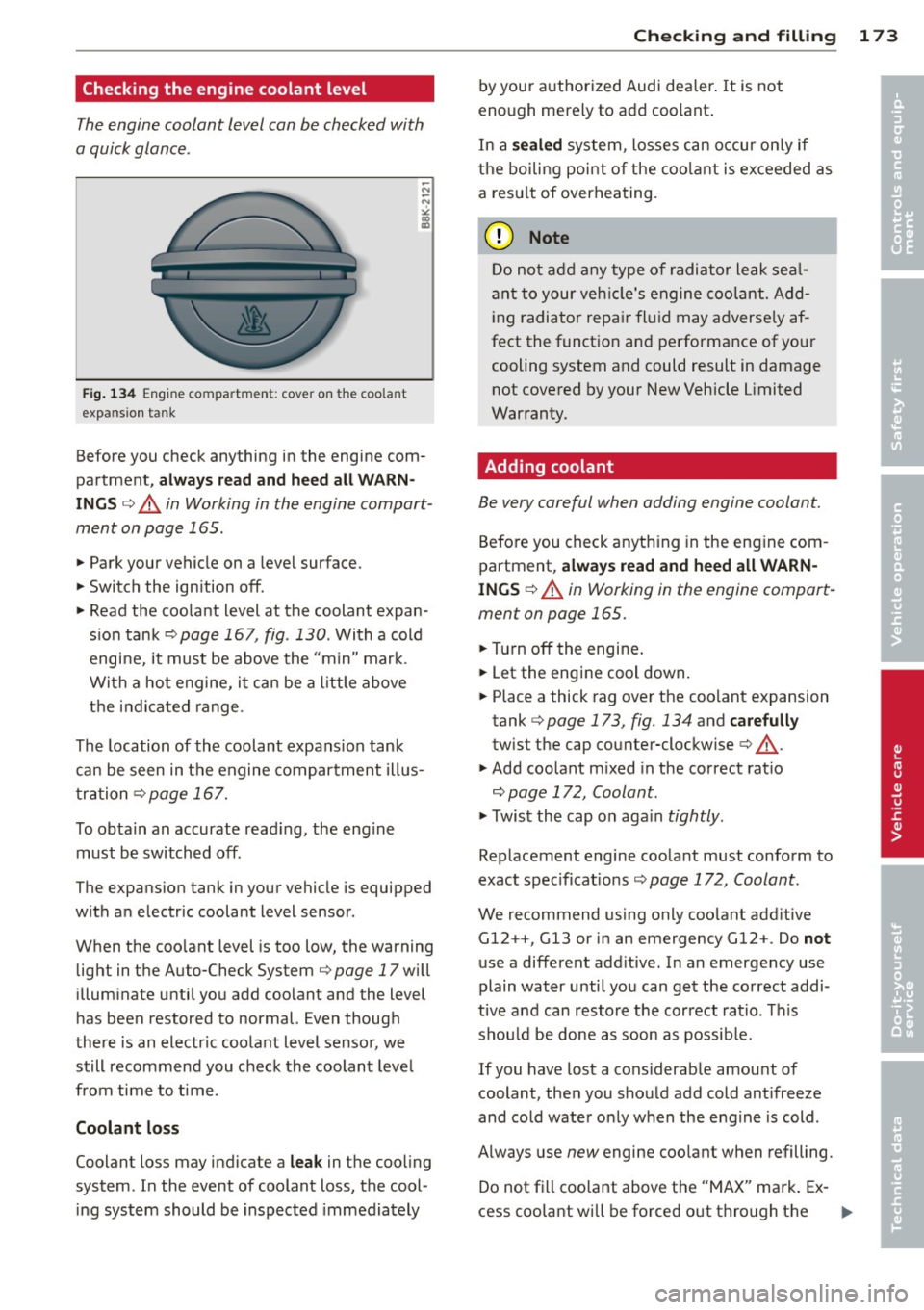
Checking the engine coolant level
The engine coolant level can be checked with
a quick glance .
Fig. 134 Eng ine compartme nt: cover o n the coolant
expansion tank
Before you check anything in the engine com
partment,
a lway s read and he ed all WARN
INGS ¢ A in Working in the engine compart
ment on page 165.
.,. Park your vehicle on a level surface.
.,. Switch the ignition
off .
.,. Read the coola nt level at the coolant expan
s ion tank
¢ page 167, fig . 130. With a cold
engine, it must be above the "min" mark.
With a hot engine, it can be a l ittle above
the indica ted range.
The location of the coolant expans ion tank
can be seen in the engine compar tment illus
tration
¢page 167.
To obtain an accurate read ing, the eng ine
must be switched
off.
The expans ion tank in your vehicle is equipped
with a n electric coolant level sensor.
When the coo lant level is too low, the warning
light in the Auto-Check System¢
page 17 will
illum inate until you add coolant and the level
has been restored to normal. Even though
there is an electric coolant level sensor, we
still recommend you check the coolant leve l
from time to time.
Coolant loss
Coolant loss may indicate a leak in the cool ing
system. In the event of coolant loss, the cool
i ng system should be inspected immediately
Checkin g and fillin g 173
by your authorized Audi dea ler . It is not
enough merely to add coo lant .
In a
s ealed system, losses can o ccu r on ly if
the boiling point o f the coo lant is exceeded as
a res ult of overheating.
(D Note
Do not ad d any type of radiator leak sea l
ant to your veh icle's engine coo lant. Add
ing radiator repa ir flui d may adverse ly af
fect the function and performance of yo ur
cooling system and could result in damage
not covered by your New Vehicle Limited
War ranty.
Adding coolant
Be very careful when adding engine coolant.
Before you check anyth ing in the engine com
partment,
alway s read and heed alt WARN
INGS ¢ A in Working in the engine compart
ment on page 165.
... Tu rn off the engine .
.,. Let the engine cool down.
.,. Place a thick rag ove r the coolant expansion
tank ¢
page 173, fig. 134 and carefully
twist the cap counter-clockwise ¢_& .
.,. Add coo lant m ixed in the correct rat io
¢ page 172, Coolant .
.,. Twist the cap on aga in tightly.
Rep lacement engine coo lant must conform to
exact specificat ions¢
page 172, Coolant.
We recommend using only coolant add itive
Gl2 ++, Gl3 or in an emergency Gl2+. Do not
use a different additive. In an emergency use
plain water until you can get the correct addi
tive and can resto re the correct ratio . Th is
shou ld be done as soon as possib le.
If you have lost a cons iderab le amount of
coolant, then you should add cold ant ifreeze
and co ld wate r on ly when the engine is cold.
Always use
new engine coolant when refilling.
Do not fill coolant above the "MAX" mark. Ex-
cess coolant will be fo rced o ut through the ..,_
•
•
Page 184 of 244
182 Tire s and wheel s
-Never mount used tires on yo ur vehicle if
yo u are not sure of their "previous histo
ry." Old used tires may have been dam
aged even though the damage cannot be
seen that can lead to sudden t ire failure
and loss of vehicle control.
- If you notice unusual vibration or if the
vehicle pulls to one side when driving, al
ways stop as soon as it is safe to do so
and check the wheels and tires for dam
age.
(D Note
Please note that summer and wi nte r tires
are designed for the cond itions that are
Glossary of tire and loading terminology
Accessory weight
means t he comb ined we ight (in excess of
those sta ndard items which may be rep laced)
of au toma tic tra nsmission, power s teer ing,
power brakes, power windows, power seats,
ra dio, and heater, to the extent that th ese
items are availab le as factory -installed equip
ment (whether installed or not) .
Aspect ratio
means t he ratio of the he ight to the w idth of
the tire in percent . Numbers of 55 or lower in
dicate a low sidewall for improve d steering re
sponse and better overall handling on dry pavement .
Bead
means the part of the ti re that is made of
steel wires, wrapped or reinforced by ply cords
and that is shaped to fit the rim.
Bead separation
means a b reakdown of the bond between
components in the bead.
Cord
means the strands forming the plies in the
tire . typ
ica l in those seasons . Aud i recommends
using winter tires during the winter
months . Low temperatures signif icant ly
decrease the e lasticity of summer tires,
which affects tract ion a nd brak ing ability.
If summer tires are used in very co ld tem
peratures, cracks ca n form on the tread
bars, res ulting in permanent tire damage
that can cause loud driving no ise and un
balan ced t ires. Audi i s not responsible for
th is type of damage .
Cold tire inflation pressure
means the tire p ress ure recommended by t he
vehicle manufacture r fo r a tire of a des igna ted
s iz e t hat has not bee n driven for more than a
coup le of miles (k ilometers) at low speeds in
t h e three hour period before the tire pressure
is measured or adjusted.
Curb weight
mea ns the we ight of a motor ve hicle with
standard equipment in clu din g the max imum
capacity of fuel, oil, and coolant, air condi
tioning and additional weight of optiona l
equipment.
Extra load tire
me ans a tire designed to ope rate a t higher
loads and at highe r inflation p ress ures than
the corresponding standard tire. Extra load
tires my be identified as "XL", "xl", "EXTRA
LOAD", or "RF" on the sidewall.
Gross Axle Weight Rating ("GAWR ")
me ans the lo ad -c a rry ing c apac ity of a s ingle
axle system , measured a t the tire-ground in
terfaces.
Gross Vehicle Weight Rating ("GVWR ")
mea ns the max imum total loaded we ight of
t h e ve hicl e. .,.
Page 191 of 244
-If the tire pressure is too low or too high,
the tires w ill wear prematurely and the
vehicle will not handle we ll.
- If the tire is not flat and you do not have
to change a wheel immed iate ly, drive at
reduced speed to the nearest service sta
t ion to check the tire pressure and add
air as required.
([) Note
Driving without va lve stem caps ca n cause
damage to the tire va lves . To prevent this ,
always make su re that facto ry installed
valve stem caps on all wheels a re secure ly
mounted on the va lve.
@ For the sake of the environment
Underinflated tires will a lso increase the
fue l consumption .
Tires and vehicle load limits
There are limits to t he amount of load or
weight that any veh icle and any t ire can carry.
A veh icle that is overloaded w ill no t handle
well and is more diff icult to stop. Overloading
can not on ly lead to loss of veh icle contro l,
but can a lso damage important parts of the
ve hicle and can lead to sudden tire failure, in
cluding a blowout and sudden deflation that
can cause the veh icle to crash .
Your safety and that of yo ur passengers a lso
depends on making sure that load limits are
no t exceeded. Vehicle load includes everybody
and everyth ing in and on the vehicle . These
load limits a re techn ica lly refer red to as the
ve hicle's
Gro ss Vehicl e W eight Rat ing
(" GVWR ").
T he "GVWR " includes the we ight of the basic
vehicle, all factory installed accesso ries , a full
tank of fue l, oil, coo lant and other fluids pl us
maximum load. The maximum load includes
the number of passengers th at the ve hicl e is
i ntended to carry ("seating capacity") with an
assumed weight of 150 lbs (68 kg) for eac h
passenger at a designated seating position
Tire s an d wheel s 189
and the total weight of any luggage i n the ve
hicle .
T he
Gro ss Ax le Weight Rating ( " G AWR ") is
the max imum load th at can be applied at each
of the vehicle's two axles .
T he Gross Vehicle Weight Rat ing and the
G ross Ax le Weig ht Ra ting are l iste d on the
s af ety comp liance s ticke r label lo cated on the
driver's side 8-pillar . Your Audi has 2 seating
positions. Each seating position has a safety
belt ~
page 101, Safety belts.
The fac t that there is an upper limit to yo ur
vehicle's G ross Vehicle Weight Rating means
that the total weight of whatever is being car ried in the vehicle is lim ited . The more passen
gers in the vehicle or passengers who are
heavier than the standard we ights assumed
mea n that less we ight can be carried as lug
gage .
The tire pressure label on your Audi also lists
the maximum combined weight of a ll of the
occupants and luggage or other cargo that
t h e ve hicle can ca rry . Fo r th e locat ion of the
label
~ page 185, fig . 138 .
_&. WARNING
Overloading a veh icle can cause loss of ve
h icl e co ntro l, a crash or o ther accide nt, se
rio us pe rsonal inj ury, and even dea th.
- Ca rrying more we igh t tha n your ve hicle
was des igned to carry wi ll prevent the
veh icle from handling properly an d in
crease the risk of the loss of vehicle con
trol.
- T he b rakes on a vehicle that has been
overloaded may not be able to stop the
veh icle w ith in a safe distance .
- Tires on a vehicle that has been over load
ed can fail suddenly, incl uding a blowo ut
and sudden deflation, causing loss of
control and a crash.
•
•
Page 200 of 244
198 Tire s and wheel s
snow cha ins a re suitab ly covered. Check
the position of the snow chains after driving a few yards and correct if neces
sary. Follow the instr uctions from the
snow cha in manufacturer when doing so.
{O) Tips
Where snow cha ins are mandatory oncer
tain roads, this norma lly also applies to
veh icles with all-wheel dr ive.
Wheel bolts
Wheel bolts must always be tightened to the
correc t torque .
The design of whee l bolts is matched to the
factory installed r ims . If different rims are fit
ted, the correct wheel bolt s with the r ight
length and correctly shaped bol t heads mus t
be used . This ensures that wheel s are fitted
securely and that the brake system functions
correctly .
In certain circumstances, you may not use
wheel bolts from a d iffe rent vehicle -even if it
i s the same model
Q page 228.
A WARNING
Imprope rly tig htened o r maintained whee l
bolts can be come loose ca using loss of
cont ro l, a co llision and serious person al in
jury .
- Always keep the w heel bol ts and the
t h reads in t he wheel hubs clean so the
wheel bolts can t urn easily and be p rop
er ly t ightened .
- N ever grease or oil the wheel bo lt s an d
the threads in the wheel h ubs. They can
become loose w hile d riving if greased or
oi led, even if tightened to the specif ied
torque.
- Only use whee l bolts that be long to the
rim being installed.
- Never use different whee ls bolts on your
vehicle .
- Always mai ntai n the co rrect tighte ning
torq ue for the wheel bolts to reduce the
risk of a wheel loss. If the tightening tor- que of the whee
l bolts is too low, they
can loosen and come out when the vehi
cle is mov ing. If the tig hte ning torq ue is
too high, the w heel bolts a nd threads
can be damaged and the whee l can be
come loose.
(D Note
The specified torque for t he whee l bolts is
90 ft lb (120 Nm) with a tolerance of± 7,4
ft lb(± 10 Nm). Torque whee l bolts diago
nally . After changing a whee l, the to rq ue
must be checked as soon as possible with a
torque w rench - prefe rably by an author
iz ed A udi dealer or quali fied workshop .
Low aspect ratio tires
Your Audi is factory-eq uipped w ith low aspect
ratio tires. These tires have b een tho ro ughly
tested and been se lected specifically for your
model for their supe rb performance, road fee l
and hand ling under a variety of driving condi
t ions . Ask your author ized Audi dealer for
more de tails .
The low aspect ratio of these t ires is ind icated
by a numeral of
55 or less in the tire 's s ize
designation . The numera l rep resents the ratio
of the tire 's s idewa ll height in relation to its
t read width exp ressed in percentage. Conven
tiona l tire s have a he igh t/w idth rat io of 60 or
more.
The p erformance of low-a spect-ratio tire s is
particularly sensitiv e to improper inflation
pre ssure. It i s ther efore important that low
aspect ratio tires are inflated to the specified
pre ssure and that the inflation pre ssure i s
regularly checked and maintained. Tire pre s
sures should be checked at least once a month and always before a long trip
Q page 187, Checking tire pressure.
What you can do to avo id tire and rim
damage
Low aspect ratio tires can be damaged mo re
easily by impact w ith po tholes, curbs, gul lies ..,.
Page 224 of 244
222 Emergency situations
Lifting vehicle
Lifting with workshop hoist and with
floor jack
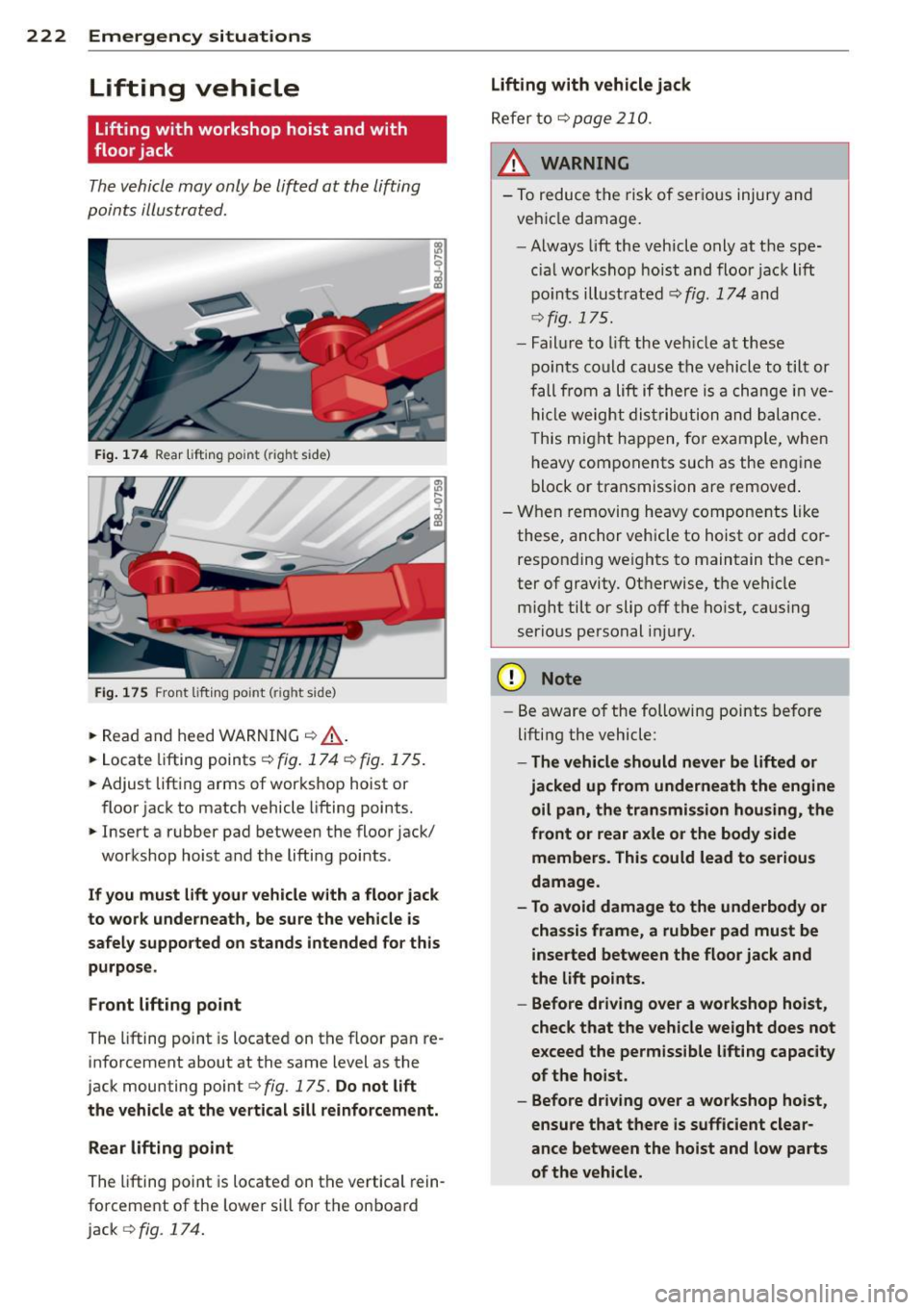
The vehicle may only be lif ted at the lifting
points illustra ted.
F ig. 174 Rear lift in g poin t (ri gh t side)
Fi g. 1 75 Fro nt lift in g po int (r ig ht s ide)
• Read and heed WARNI NG ¢,& .
• Locate lifting points
r=> fig . 174 r=> fig . 1 75 .
• Adjust lift ing arms of wor ks h op hoist or
floor jack to match vehicle lifting points.
• In se rt a rubber pad between the floor jack/
workshop hoist and the lifti ng po ints.
If you must lift your vehicle with a floor jack
to work underneath, be sure the vehicle is safely supported on stands intended for this
purpose.
Front lifting point
The lifting point is locate d on t he floor pan re
info rcement about at the same level as the
jac k mounting point
r=> fig. 175. Do not lift
the vehicle at the vertical sill reinforcement.
Rear lifting point
The lifting point is locate d on t he vertical rein
forceme nt of the lower s ill for t he on boa rd
j ac k
t:!>fig . 174.
Lifting with vehicle jack
Refer to r=>page 210.
/n.. WARNING
-To re duce the risk of ser ious injury and
ve hicl e damage .
- Always lift th e ve hicle o nly at t he spe
c ia l works hop hoist and floor jac k lift
p o ints illust rated
t:!> fig . 17 4 and
r=> fig. 175.
- Fa il u re to lift th e veh icle at th ese
p oi nts co ul d cau se the vehicle to tilt or
f a ll from a li ft if th ere is a ch an ge in ve
h icl e weig ht distr ib utio n an d ba lan ce.
T his mi ght happ en, for ex ample, when
h eavy com ponent s such as the engine
b lock o r tra nsmissi on are remove d.
- Wh en removin g heavy c ompone nts like
these , anch or vehicle to hoist or ad d co r
respon ding we ights to maintain t he cen
ter of gravity. Ot herwise , th e ve hicle
might tilt or slip off the ho ist, causing
serio us pe rsonal injury.
(D Note
-Be aware o f the followin g points bef ore
liftin g the vehicle:
- The vehicle should never be lifted or
jacked up from underneath the engine
oil pan, the transmission housing, the
front or rear axle or the body side members. This could lead to seriou s
damage.
- To avoid damage to the underbody or
chassis frame, a rubber pad must be inserted between the floor jack and
the lift points.
- Before driving over a workshop hoist,
check that the vehicle weight does not
exceed the permissible lifting capacity
of the hoist .
- Before driving over a workshop hoist,
ensure that there is sufficient clear
ance between the hoist and low parts
of the vehicle.
-
Page 230 of 244
228 Con sum er Inf ormation
-Always make sure the transmission se
lector lever is in "P" (Park position) and
the hand brake is firmly applied.
@ For the sake of the environment
- Changing the engine settings wi ll ad
versely affect em iss ion levels . This is det
rimental to the environment and increas
es fuel consumption .
- Always observe environmental regula
tions when dispos ing of old engine oil,
used brake fluid, dirty engine coolant,
spent batteries or worn out tires.
- Undeployed airbag modules and preten
s ioners might be classified as Perchlo
rate Material -spec ial handling may ap
ply, see www .dtsc.ca .gov/hazardous
waste/perch lorate . When the veh icle or
parts of the restrai nt system in cl uding
airbag modules safety bel ts with preten
s ioners are scrapped, all applicable laws
and regulations must be observed. Your
a uthorized Aud i dea ler is familiar w ith
these requirements and we recommend
that you have your dealer perform this
serv ice for you .
Additional accessories,
modifications and
parts replacement
Additional accessories and parts
replacement
Always consult an authorized Audi dealer be
fore purchasing accessories .
Your vehicle incorporates the latest safety de
sign features ensuring a high standard of
ac
tive and passive safety .
T his safety could be compromised by non -ap
proved changes to the veh icle. For this reason ,
if parts have to be replaced , please observe
the following points when installing addition
a l accessories:
Approved Audi accessor ies and genuine Audi
parts are ava ilable from a uthorized Aud i dea l
e rs. These dea
lers a lso have the necessary facili
ties, tools and trained specialists to install the
parts and accessories proper ly .
A WARNING
=
Using the wrong spare parts or using non-
approved accessories can cause damage to
the veh icle and ser ious perso na l injury .
- Use on ly accessories express ly approved
by Audi and genuine Audi spare parts
- These parts and accessories have been
specia lly designed to be used on your ve
h icle .
- Never install accessor ies such as tele
phone crad les or beverage ho lders on a ir
bag covers or within the airbag deploy
ment zones . Do ing so will increase the
risk of injury if a irbags are triggered in an
accident!
- Before you check anything in the engine
compa rtment, always read and heed a ll
WARNINGS
i=;, page 165 .
(D Note
-If items other than genu ine Audi spare
parts, add-on equipment and accessory
items are used o r if repair wo rk is not
performed accord ing to specified meth
ods, this can resu lt in seve re damage to
your vehicle's engine and body (such as
corrosion) and adversely affect yo ur vehi
cle's warranty.
- The innovat ive a luminium concept of
your Audi TT means that all servicing, re pairs or other work on the vehicle body
must be carr ied out exclusive ly by an
Audi workshop.
- If emergency repairs must be performed
elsewhere, have the veh icle examined by
an authorized Audi dealership as soon as
poss ible .
- The manufac turer cannot be held liable
for damage wh ich occurs due to failure
to comply with these stipulations .
Page 232 of 244
230 Index
A
A/C operation . . . . . . . . . . . . . . . . . . . . . . . 71
Accessories . . . . . . . . . . . . . . . . . . . . . . . . 228
Acoustic park assist ........ .. .. .. .. . . 80
Adaptive light . . . . . . . . . . . . . . . . . . . 21, 49
Adding Eng ine coolant .............. ... .. .
Engine oil .. ..... ........... ... .. .
Windshield washer fluid ... .. .. .... .
Additional accessories
Addit ives
Engine oil . ...... ......... ... .... .
Adjustab le steer ing column ...... .. ... .
Adjusting front seats ....... .. .. .. .. . . 173
170
180
228
170 73
60
Adj usting steering column ... .... .... .. 73
Adjusting the seats ............... ... . 61
Advanced Airbag System Children 131
Components ............. .. .. .... . 115
Front airbags . ............. .. .... . 113
H ow the components work together . . 117
Monitoring .... ... ... .... .. .. .. .. . 119
Weight -se nsing mat ...... .. .. .. .. . 131
Airbag system . . . . . . . . . . . . . . . . . 109, 128
Care . .. .. .. ............... .. .... . 122
Ch ild restra ints .............. ... .. . 132
Components (front airbags) .. .. .. .. . 115
Danger of fitting a child safety seat on
the front passenger seat . . . . . . . . . . . . 110
Disposal ................ .. .. .... . 122
Fr ont airbags ..................... 113
How do the front airbags work? .. ... . 118
How many airbags does my vehicle
have? ... .. ............. .. .. .. ... 115
Important safety instructions on the knee airbag system ..... .. .. .. .. .. . 126
Important things to know ...... .. .. . 109
Indicator l ight .... ... .... .. .. .. .. . 119
Knee airbags ............. .. .. .. .. . 124
Monitoring ... ............. .. .... . 119
PASSENGER AIR BAG OFF light .. ..... 120
Repairs .... ................ ..... . 122
Side airbags . . . . . . . . . . . . . . . . . . . . . . 126
Warning/indicator lights ............. 15
When must the system be inspected? 119
A lcantara
C leaning ... .. .............. ..... . 158 All-wheel drive
.... ............. .... 147
Winter tires ..... ................ . 196
Alternator .. .... .. ............. .... . 16
Anti-free ze
refer to Eng ine cooling system . .. .. .. 172
Anti -lock brake system . . . . . . . . . . . . . . . 142
Warning/indicator lights ............. 18
Anti-s lip regulation ............. .... 142
Anti-theft systems Anti -theft alarm system ............. 38
Electronic immobilizer .......... .. .. . 33
Ashtray ... ..... .. .. .............. .. 64
Asterisk What does it mean when something is
marked with an asterisk? . . . . . . . . . . . . . . 6
Audi magnet ic r ide . . . . . . . . . . . . . . . 21, 80
Description . . . . . . . . . . . . . . . . . . . . . . . . 80
Indicator light . .. .. ........... .. .. . 21
Audi Service Repair Manuals and Li tera-
ture 226
Automatic be lt retractor ............ . 104
Automat ic convert ible top
closing
. .. .. .. .. ............. .. .. . 43
opening .. .. .. .. ................ .. 43
Automat ic transmission . . . . . . . . . . . . . . . 82
Driving Notes . . . . . . . . . . . . . . . . . . . . . . 84
Emergency program ........... .. .. . 87
Emergency release ............. .. .. . 87
Ignit ion key safety lock ........... .. . 74
Kick-down ..... .. ................ .. 86
Launch Control Program ............. 86
Se lector lever lock . . . . . . . . . . . . . . . . . . 83
Se lector lever positions ......... .. .. . 82
Tiptronic .. .... .. ............. .... . 85
T iptronic controls on the steering wheel 86
Auto Safety Hotline ................ .. 99
Average fuel mileage ............ .... . 23
Average speed . . . . . . . . . . . . . . . . . . . . . . . 23
Avoid damaging the vehicle ........ ... 151
B
Battery ...................... 175,178
Charg ing .. .... .. ............. .... 179
Checking battery acid level .......... 178
Connecting . ..... ................ . 175
Disconnecting 175
Page 233 of 244
Important warnings ... ... .. .. .. .. . 177
Location 177
Low ... .. .. .. ... ....... ... .. .. .. . 147
Replacing the battery ........... .. . 176
State of charge . . . . . . . . . . . . . . . . . . . . 147
W inter operation . . . . . . . . . . . . . . . . . . 17 5
Wo rking on the battery . . . . . . . . . . . . . 177
Before driving . . . . . . . . . . . . . . . . . . . . . . . 92
Blended gasoline .......... .. .. .. ... 16 1
Boost . .... .. ................. .. .... 26
Booster seats . .... ..... ... .. .. .. ... 137
Boost pressure ind icator ........... ... 26
Brake fl uid
Changing the brake fluid ... .. .. .. .. .
175
Checking the brake fluid level . ....... 174
What is the correct brake flu id level? .. 174
What should I do if the brake fl uid warn-
ing light comes o n? ................
174
Brake system ... ........... .. .. .. ... 174
Anti-lock brake system ........ ... ... 18
Brake ass ist system ........... ... .. 142
Brake fl uid ................. ... ... 174
Brake fluid spec ifi cat ions for refill and re
p lacemen t . . . . . . . . . . . . . . . . . . . . . . .
17 5
Brake ligh t de fect ive ................ 20
Brake pads . . . . . . . . . . . . . . . . . . . . . . . 150
General i nformation ... ... .. .. .. .. . 145
How does the moisture or road sa lt affect
the brakes? . ............. .... .. .. .
145
Malfunct ion . . . . . . . . . . . . . . . . . . . . . . . 14
Warn ing/ indicato r lights ....... ... ... 14
Wo rn brake pads symbol ....... ... ... 19
Brea k-in pe riod ... .. .... ... .. .. .... . 150
Brake pads . ............. .... .. ... 150
Tires
Bulbs
C
Ca lifo rnia Proposit io n 65 Wa rning
150
2 16
166
B att ery specific .......... .. .. .. .. . 178
Capac it ies ......................... 224
Carbon parts
Clean ing . . . . . . . . . . . . . . . . . . . .
157, 158
Care .. .. .. .. .. .. ........... .. .. ... 155
Cargo area
refer to Luggage compartment . . . . . . . . 97
Cata lytic converter .................. 151
Inde x 231
CD changer ... .... .. . .. .. ..... ... .. . 66
Certif ication ...... .. ............... 229
Changing a flat tire . ............. .. .. 209
Ch ang ing engine oil ................. 171
Checking
Battery ac id level ............. .... .
178
Engine coolant level ........... .... . 173
Checking t ire pressure ............... 187
Child res train t
Danger of using child res train ts in the
front seat
110
Child rest rain ts
Where can I ge t addi tional in format io n
abo ut child res train ts and the ir use? ..
1 4 1
Child safety .............. .......... 130
Convertible locking retractor ......... 138
Important safety instructions for using
c hi ld safety seats . .. .. ......... .. ..
133
Important t hings to know whe n driving
with children .. .... . ... ...... ... ..
130
Child safety seat .... ........... .... . 135
Convertib le locking retractor ......... 138
Installing . .. .. .. ................. 138
Child safety seats
Booster seats .. .. .. ...............
137
Co nve rtib le child seats ... ... ..... .. 135
How do I properly install a child safety
. h' l ? 133 sea t m my ve 1c e ................. .
Infan t seats . .. .. .... ........... ..
135
Safety instr uctions . .. .. ..... ... .. .. 133
Cigarette lighter ... .. . .. .. ... ..... .. . 65
Cleaning ..... .. ...... ............. 155
C limate controls . .. .. ........... .... . 68
A/C opera tion .. .. .... ............. . 71
Air distribution . . . . . . . . . . . . . . . . . . . . . 70
Air recircu lation mode . . . . . . . . . . . . . . . 71
Automat ic mode ... .. .. .... ... .. .. . 71
Controls . . . . . . . . . . . . . . . . . . . . . . . . . . 68
Defrost . .. .. .. .. .. ............... . 71
Economica l use .. .. . .. .. ... ..... .. . 72
Fan ................... ........... 69
Heated seats . . . . . . . . . . . . . . . . . . . . . . 72
Heating ... .. .. .. .... ........... .. . 68
Pollu tant fi lter . . . . . . . . . . . . . . . . . . . . . 68
Rea r window defogger .. ..... ... .. .. . 71
Switc hing on and off .... .... ... .. .. . 69
•
•
Page 235 of 244
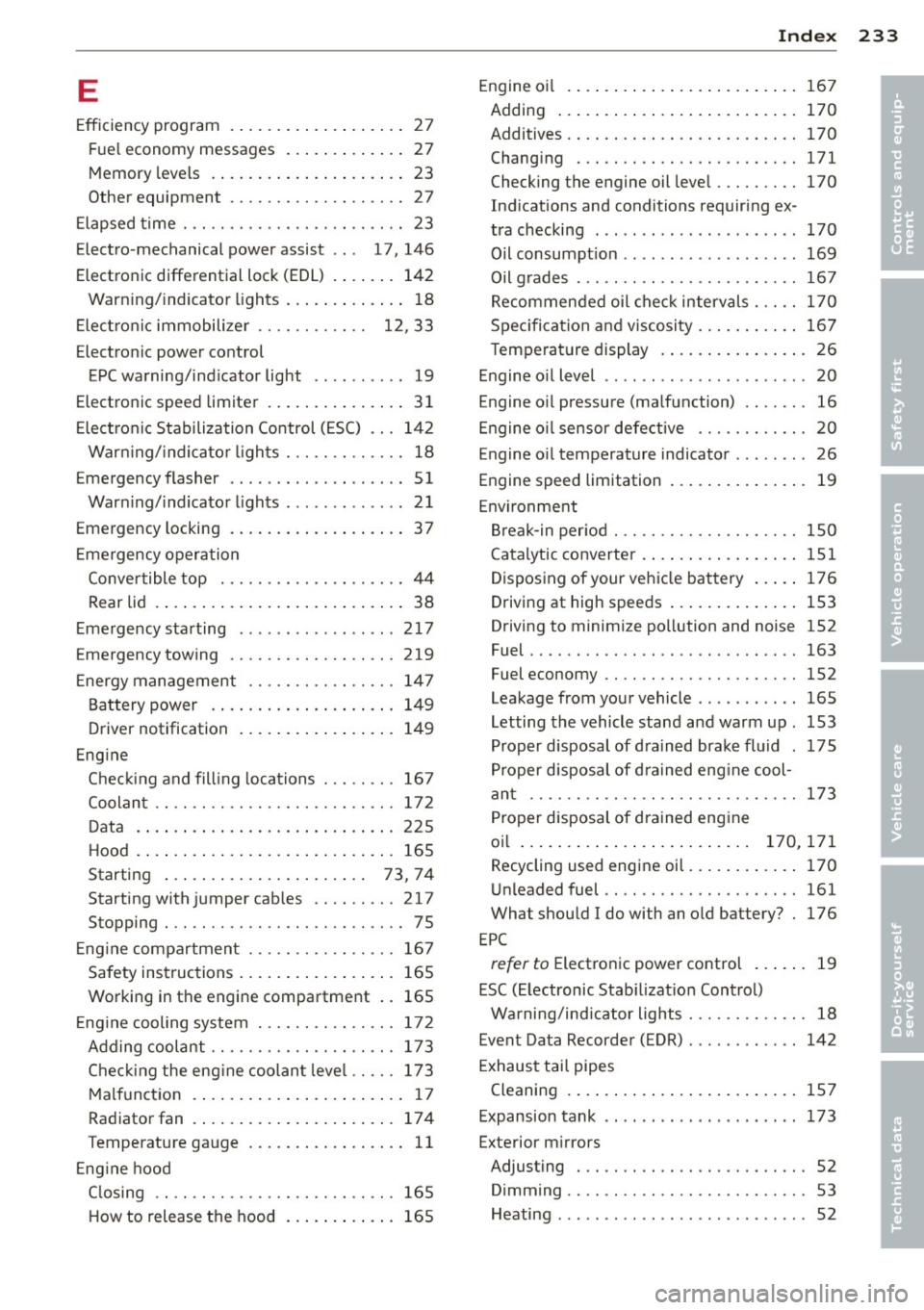
E
Efficiency program ...... ... .. .. .. .. .. 27
F ue l economy messages ... .. .. .. .. .. 27
Memory leve ls . . . . . . . . . . . . . . . . . . . . . 23
Other equ ipment .. ....... .. .. .. .. .. 2 7
E lapsed t ime . .. .... .... ... .. .. .. .. .. 23
E lectro -mechanical power assist . . . 17, 146
El ectronic differential lock (EDL) . ... ... 142
Warn ing/ indicato r lights ... .. ...... .. 18
E lect ro nic immobilize r . . . . . . . . . . . . 12, 33
Electro nic power control
EPC warning/ind icator light .. ... .... . 19
El ectro nic speed limite r .. ... .. .. .. .. .. 31
E lec tronic Stabilization Control ( ESC) .. . 142
War ning/ indicator ligh ts ... .. .. .. .. .. 18
E mergency fla sher . . . . . . . . . . . . . . . . . . . 51
War ning/ indicato r lights ............ . 21
Emergency locking . ..... ... .. .. .... .. 37
E me rgency opera tion
Conve rtible top ........ .. .. .. .. .. .. 44
Rear lid . . . . . . . . . . . . . . . . . . . . . . . . . . . 38
E mergency sta rting . ....... .. .. .. .. . 217
Emergen cy towing ..... .. .. .. .. .. .. . 219
Energy management ....... .. .. .. .. . 14 7
B attery power . . . . . . . . . . . . . . . . . . . . 1 49
D river notification ..... ... .. .. .. .. . 149
E ng ine
C hec king and fill ing locations . .. .. .. . 167
Coolan t .. .. .... .. . .... .. .... .. .. . 172
D ata . ..... .. .. .. .. .... ... .. .. .. . 225
Hood .. .. .. .. .. .. .. .... ... .. .. ... 165
Starting . . . . . . . . . . . . . . . . . . . . . . 73, 74
Startingwith jumpercab les .. .. .. .. . 21 7
Stopping . .. ............. .... .. .. .. 75
E ng ine compartmen t ..... .. .. .. .. .. . 16 7
Safety ins tructions ..... ... .. .. .. .. . 165
Wo rking in the engine compartment .. 165
E ng ine cooling system ...... .. .. .. .. . 17 2
Adding cool ant ........... .. .. .. .. . 173
Chec king the eng ine coolan t leve l .. .. . 173
M alfunct ion . . . . . . . . . . . . . . . . . . . . . . . 17
Radiator fan . . . . . . . . . . . . . . . . . . . . . . 17 4
T emperature ga uge .... ... .. .. .. .. .. 11
E ng ine hood
C losing .. .. ............. .... .. ... 165
H ow to release the hood ... .. .. .. .. . 165
Inde x 233
Engine o il . ... .... .. . .. .. ..... ... . .
167
Adding ... .. .. .... . ... ...... ... . . 170
Additives . ... .. .. .. . .. ... .... ... . . 170
Changi ng ... .. .. ........ ........ . 171
Checking the engine oil leve l ....... . . 170
Ind ications and conditions requir ing ex -
t ra checking ... .. .. . .. ... ... .. .. . . 170
Oil consumpt ion ... ............... . 169
Oil g rades . .. .. .. .. . ... .......... . 16 7
Recommende d oi l che ck intervals . .. . . 170
Spec ificat ion and viscosity .... ... .. . . 167
Temperature display . .. ..... ... .. .. . 26
Engine o il leve l .. .. .. ............... . 20
Engine o il pressure (ma lfunction) .. .. .. .
16
Engine o il sensor defective ......... .. . 20
E ngine o il temperature indicato r ...... . . 26
Engine speed limitation ... .... ... .. .. . 19
En vir onment
Br eak-in per iod . .. .... .... ..... .. .. 150
C atalytic converter . .. .. ..... ... .. .. 151
Disposing of your vehic le battery ... .. 176
Driving at high speeds .. ..... ... .. .. 153
Driving to minimi ze po llution and noise 152
Fuel ...... .. .. .. .. .. .... ....... .. 163
Fuel economy . . . . . . . . . . . . . . . . . . . . . 152
Leakage from your vehicle ........... 165
Letting the vehicle stand a nd warm up . 153
Proper disposal of dra ined brake flu id . 175
P roper disposal of d ra ined eng ine cool-
an t ...... .. .. .. ................. 173
Proper disposal of d rained eng ine
oi l .. ... .. .. .. .... . ... ...... 170,171
Recycling used engine oil ..... ... .. .. 170
Un leaded fuel .. .. .. ............... 161
Wha t shou ld I do with an o ld bat tery? . 176
E PC
refer to E lect ronic power control ... ... 19
ESC (E lectronic Stab ilizat io n Control)
Wa rning/ind icator lights ... ..... .. .. . 18
Event Da ta Recorder (EDR) .......... .. 142
E xhaus t tai l pipes
Cleaning . ... .... .. . .. .. ..... ... .. 157
Expansion tank . . . . . . . . . . . . . . . . . . . . . 173
Exterior m irrors
Adjusting . . . . . . . . . . . . . . . . . . . . . . . . . 52
Dimming .. .. .. .... .......... ...... 53
Heating ..... .. .... .......... ...... 52
•
•
Page 242 of 244
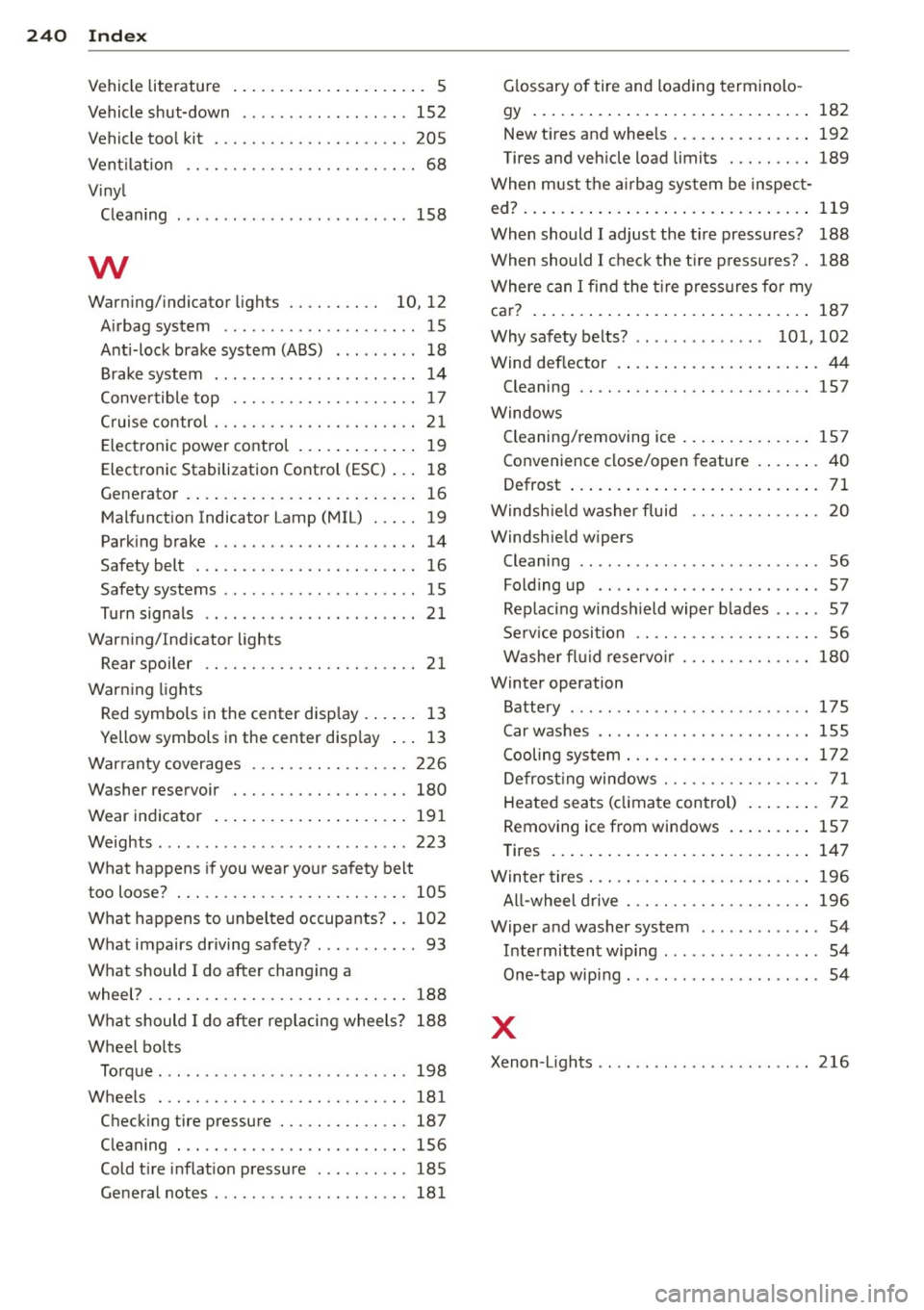
24 0 Index
Vehicle literature . . . . . . . . . . . . . . . . . . . . . 5
Vehicle shut-down ............. .. ... 152
Veh icle too l kit ... ...... ..... .. .. .. . 205
Vent ilation
Vinyl Cleaning ·
... .... .... .... ... .. .. .. 68
158
w
War ning/ ind ic a tor ligh ts . . . . . . . . . . 10, 12
Airbag system .............. ... .... 15
Anti-lock brake system (ABS) .... ..... 18
Brake system . . . . . . . . . . . . . . . . . . . . . . 14
Conve rtible top . . . . . . . . . . . . . . . . . . . . 17
Cruise control . . . . . . . . . . . . . . . . . . . . . . 21
E lectronic power contro l ... .. .. .... .. 19
Elec tronic Stabilizat ion Control (ESC) . . . 18
Gen erator .. ............ ... .. .... .. 16
M alfunction Ind icator Lamp (M IL) . .. .. 19
Pa rk ing br ake . .... .... ..... .. .. .. .. 14
Safety belt . .... ...... ... .... .. .. .. 16
Safety sy stems .............. ... .... 15
Turn signals .................. ..... 21
Warn ing/ Ind icato r lights
Re ar spoile r . . . . . . . . . . . . . . . . . . . . . . . 21
Warn ing lights
Red symbols in the center disp lay .... .. 13
Yellow symbols in the cente r disp lay ... 13
Warranty coverages ........ .. .. .. .. . 226
w h . as e r reservoir ... ... .. .. .. .. .. .. . 180
Wear indicator .... ....... ... .. .... . 191
Weights ... .. ... ... .... ..... .. .. .. . 223
Wh at happens if you wear your s afety be lt
t oo loose? . .... ... ..... ... .. .. .. .. . 105
What happens to unbelted occupants? .. 102
What impairs driving safety? ........... 93
What should I do aft er chang ing a
wheel? .. .. .. .... .. ... ...... .. .. .. . 188
What should I do after rep lacing wheels? 188
Wheel bolts Torque ... .. ... ... .... ... .. .. .. .. . 198
Wheels . .. .... ..... ... ... .. .. .. .. . 181
Che ck ing tir e pre ssure ..... .. .. .. .. . 187
Cleaning . ...... ... .. ...... .. .. .. . 156
Cold t ire inflat ion pressure ...... .... 185
General notes ......... ........ .... 181 G
lossary of tir e and loading terminolo-
gy ... .. .. .... .. .. ... .. ..... ... .. 182
New t ires and whee ls . .. ..... ... .. .. 192
Ti res and veh icle lo ad limi ts . .... .... 189
When must the a irbag system be inspec t-
ed? . ... .. .. .... .. .. ... .. ..... ... .. 119
When should I adjust the t ire pressures? 188
When should I check the tire press ures? . 188
Where can I find the t ire pressures for my
car? ... .. .. .... .. ... .. .. ..... ... .. 187
Why safety belts? . . . . . . . . . . . . . . 101, 102
Wind deflector .... ... .. ..... ... .. .. . 44
Cleaning .. .. .. .. ... ... .... ... .... 157
Windows Cleaning/removing ice .. ..... ... .. .. 157
Convenience close/open feature . ... .. . 40
D efrost ... .... .. ... .. .. ..... .. . .. . 71
Windsh ie ld washer fluid ... .. .. .. .. .. . 20
Windsh ie ld wiper s
Cleaning . . . . . . . . . . . . . . . . . . . . . . . . . . 56
Fold ing up .. .. ....... ........... .. 57
Replacing windsh ield wiper b lades .. .. . 57
Se rv ice posi tion . . . . . . . . . . . . . . . . . . . . 56
W ashe r fl uid reservo ir . ..... .... .. .. 180
Winter operation Battery . . . . . . . . . . . . . . . . . . . . . . . . 175
Car was hes .. .. .. .. ... ..... .... ... 155
Cooling system . ... ........ ... ..... 172
Defrost ing windows . .... .... ... .. .. . 71
Heated seats (climate control) ... .. .. . 72
Removing ice from windows ... ... . .. 157
Tires ... .. .... .. .. ... .. ..... ... .. 147
Win ter tires . .. .. .. ...... ....... .... 196
All-wheel drive . .. ....... ..... ..... 196
Wiper and washer system . ............ 54
Intermittent wiping . . . . . . . . . . . . . . . . . 54
One-tap wiping . .. ................ .. 54
X
Xenon -Lights .. .. ....... ........... . 216