flat tire AUDI TT ROADSTER 2014 Owner's Manual
[x] Cancel search | Manufacturer: AUDI, Model Year: 2014, Model line: TT ROADSTER, Model: AUDI TT ROADSTER 2014Pages: 244, PDF Size: 60.87 MB
Page 203 of 244
Inflate the tire pressure to the proper
pressure as indicated on the vehicle's tire
pressure label¢
page 185. Driving on a
significantly under-inflated tire causes
the tire to overheat and can lead to tire
failure . Under-inflation also is likely to
impair the vehicle's handling and stop
ping ability.
- The driver is responsible for mainta ining
the correct tire pressures. You must
check the tire pressures regularly.
- Under certain conditions (such as a spor
ty driving style, wint er conditions or un
paved roads), the pressure monitor indi
cator may be delayed .
- Ask your authorized Audi dealer if run
flat tires may be used on your vehicle.
Your vehicle registration becomes invalid if you use these tires when not permit
ted. Damage to your vehicle or accidents
could also result.
- If you switch between standard and run
flat tires, an authorized Audi dealer or
qualified workshop must reprogram the
control module .
@ Tips
-The tire pressure monitoring system
stops working when there is an ESC/ABS
malfunction.
- Using snow chains may result in a system
malfunction.
- The tire pressure monitoring system on
your Audi was developed using tires with the "AO" or "RO" identification on the
tire sidewall¢
page 192. We recom
mend using these tires.
Tires and wheels 201
Reset tire pressure monitoring system
(Stepl)
Appl ies to vehicles: wi th tire p ress ure mo nito ring system
If the tire pressure is adjusted, wheels ore ro
tated or changed, the TPMS must be reset in
the menu display.
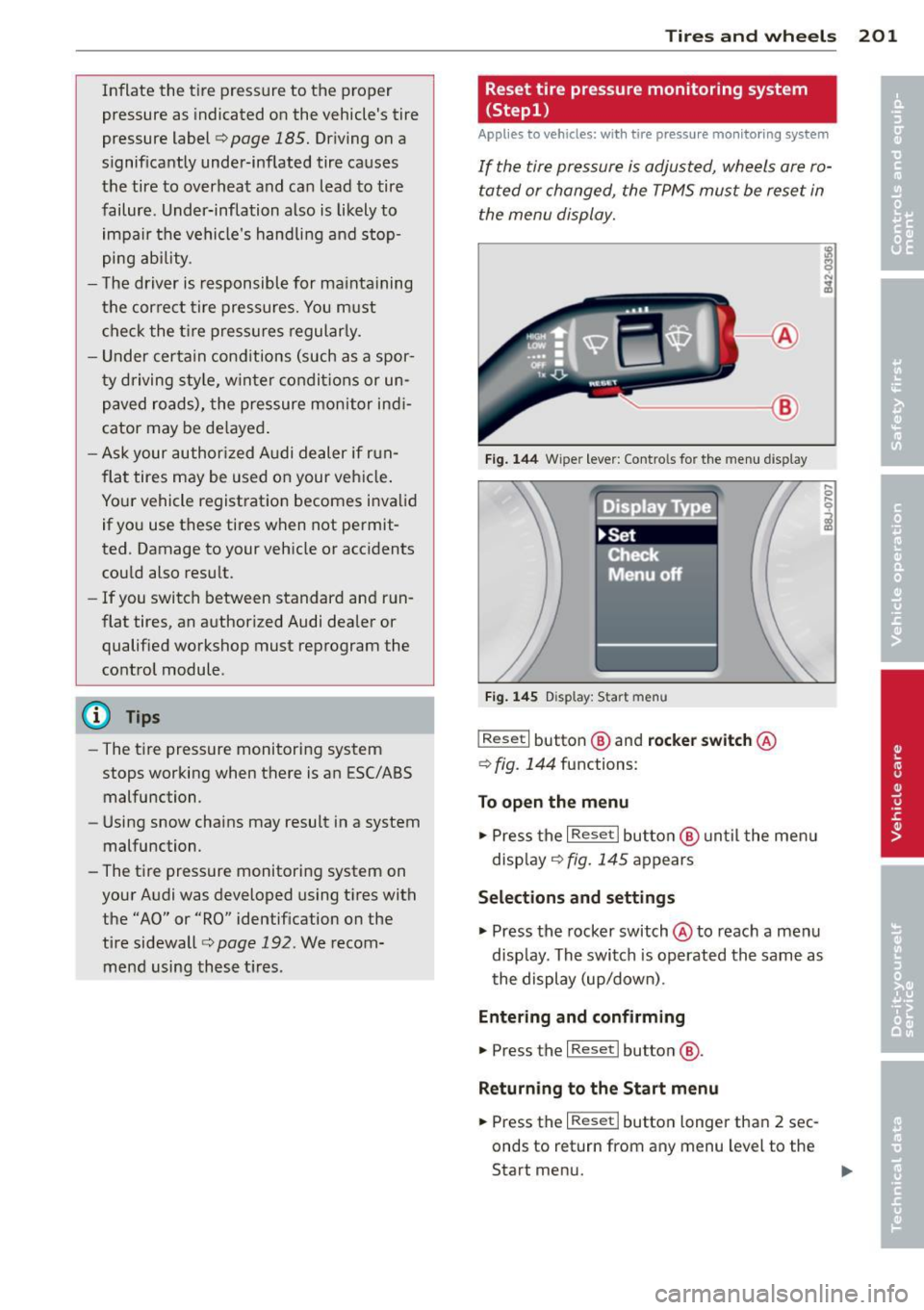
--- ®
Fig. 144 Wiper lever : Controls for the menu display
Fig. 145 Display: Start menu
I Reset I button @ and rocker switch @
¢
fig. 144 functions:
To open the menu
.,. Press the I Reset I button @ until the menu
disp lay
9 fig. 145 appears
Selections and settings
.,. Press the rocker switch@ to reach a menu
disp lay. The switch is operated the same as
the display (up/down) .
Entering and confirming
.,. Press the I Reset I button @.
Returning to the Start menu
.,. Press the I Reset I button longer than 2 sec
onds to return from any menu level to the
Start menu. "'
Page 204 of 244
202 Tires and wheels
@ Tips
-Before resetting the TPMS, the current
pressures of
all four tires must corre
spond to the specif ied values. Adjust the
tire pressure and reset the pressure in
the tire pressure mon itor ing system ac
cord ing to the load you are carry ing
¢page 185.
- Do not store the tire pressure if there are
snow chains on the tire.
Reset tire pressure monitoring system
(Step2)
Ap plies to vehicles: with tire pressure mo nit oring sys te m
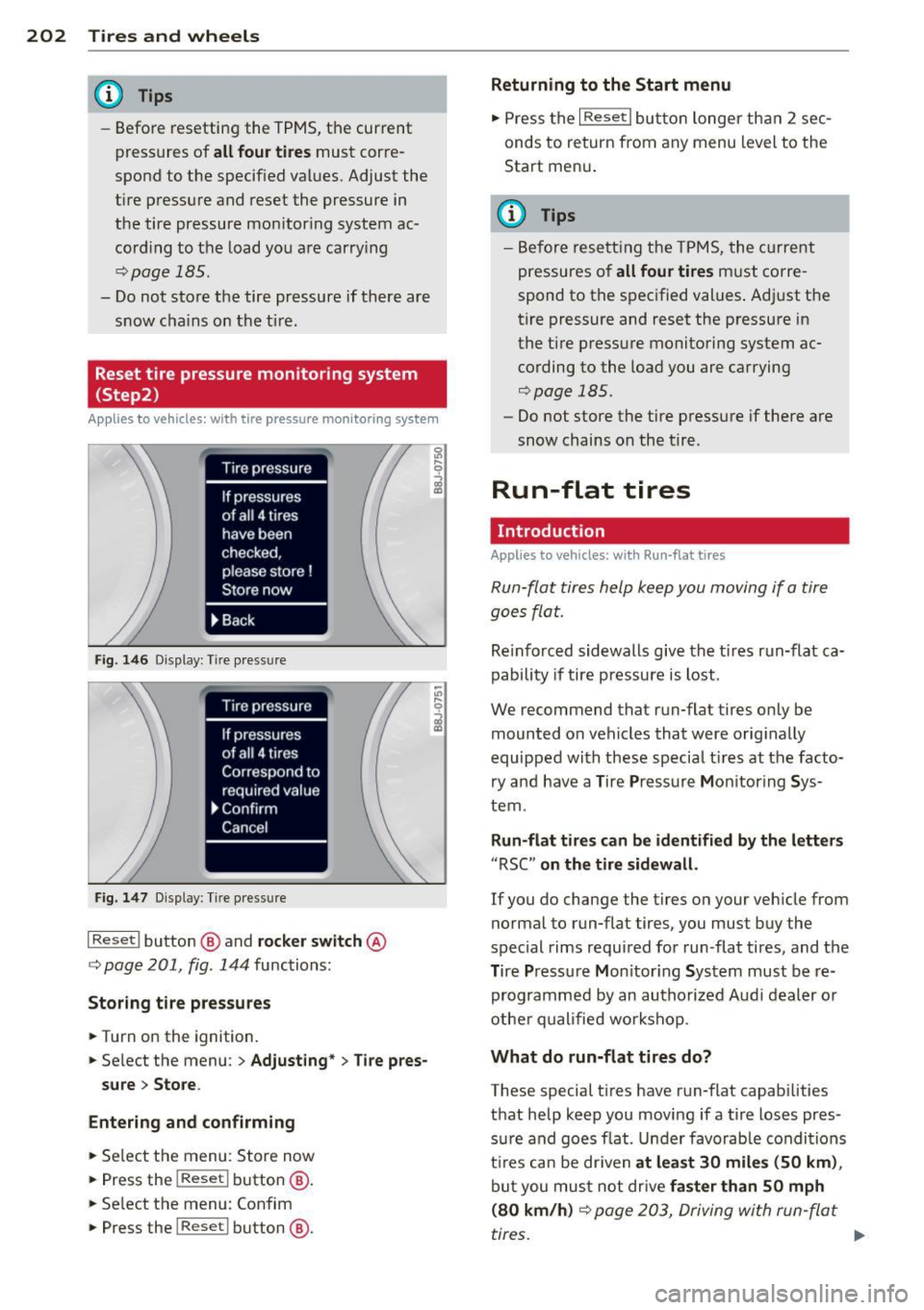
F ig. 146 Display: Tire pressure
Fig. 147 Display: Tire pres sure
I Reset I button @ and rocker switch @
c::, page 201, fig . 144 functions:
Storing tire pres sures
.. Turn on the ignition.
.. Se lect the menu :
> Adjust ing * > Tire pres
sure > Store.
Entering and confirming
.. Select the menu: Store now
.. Press the
I Reset ! button @.
.. Se lect the menu : Confim
.. Press the
I Reset ! button @.
Returning to the Start menu
.. Press the I Reset I button longer than 2 sec
onds to return from any menu level to the
Start men u.
(D Tips
-Before resetting the TPMS, the current
pressures o f
all four tires must corre
spond to the specified values . Adjust the
tire pressure and reset the pressure in
the tire pressure monitoring system ac
cording to the load you are carrying
c::, page 185.
-Do not store the tire pressure if there are
snow chains on the tire .
Run-flat tires
Introduction
Applies to vehicl es: wi th Run-fla t tires
Run-flat tires help keep you moving if a tire
goes flat.
Re inforced sidewalls give the ti res run-flat ca
pability if tire pressure is lost .
We recommend that run-flat tires only be
mounted on vehicles that were originally
equipped with these special t ires at the facto
ry and have a Tire Pressure Monitoring Sys
tem.
Run-flat tires can be identified by the letters
"RSC " on the tire sidewall.
If you do change the tires on your veh icle from
normal to run-flat tires., you must buy the
special rims required for run-flat tires, and the
T ire Pressu re M on itor ing System must be re
programmed by an authorized Audi dealer or
other qualified workshop .
What do run-flat tires do?
These special t ires have run-flat capabilities
that help keep you moving if a tire loses pres
su re and goes f lat . Under favorab le condit ions
t ir es can be dr iven
at least 30 miles (50 km) ,
but you must not drive faster than 50 mph
(80 km/h)
c::, page 203, Driving with run-flat
tires .
IJI>
Page 205 of 244
When it i s not po ssibl e to co ntinu e
d riv ing, even with run-fl at ti res?
-If the E lectronic Stabilization Control (ESC)
is not working or keeps coming on.
- If the Tire P ressure Monitoring System does
not work .
- If the tire has been severely damaged, in a
crash, for example. The tread can separate
from a damaged tire as the whee l turns, and
hit parts of the vehicle, such as the fuel tank
filler neck, fuel lines or brake lines.
- Do not continue dr iving if severe vibration
occurs or if the tire starts to smoke because
the tire is runn ing hot .
- Do not continue driving if damage to the
tire, such as cracks in the sidewall, appears.
A WARNING
Improper use of run-flat t ires can cause
vehicle damage that can lead to loss of ve
hicle control, a crash and serious personal
injury.
- Run-flat tires can only be used with spe
c ial rims.
- Run-flat tires must always be mon itored
with a properly programmed Tire Pre
ss ure Mon itor ing System.
- Always inspect a tire that has lost air to
make su re it is safe to drive w ith the t ire
in the run-flat mode.
- Never drive with run-flat tires that have
been damaged in a collision.
- Never drive with run-flat tires if heat
build-up causes the t ire to give off
smoke.
- Never drive with run-flat tires if the vehi
cle shakes or v ibrates severely.
- Never drive with a run-flat tire that de
velops sidewall cracks or other damage
wh ile in use .
- If you switch between standard and run
flat tires, an author ized Audi dealer or
qualified wo rkshop must reprogram the
control module.
Tire s an d wheel s 203
@ Note
Run-f lat ti res have special characteristics
and requirements, that are very different
from convent ional tires. Run-flat tires re
quire special rims for run-flat use and can
not be used on conventional whee l rims .
(D Tips
- If you are not able to cont inue driving
w ith run-flat tires, please seek professio
nal ass istance.
- Please contact your authorized Audi
dealer or Aud i of America, Inc . if you
have questions about t ires and rims.
Driving with run-flat tires
Applies to veh icles: w it h Run -flat t ires
Handling characteristics change when tire
pressure is low.
Driving on tires with low tire pressure changes
the way a veh icle handles, particularly when
corner ing and braking. The handling charac
teristics of run -flat tires do not seem to
change a lot even when driving on low pres
sure or in the run-flat mode . Nevertheless you
must still take specia l precautions whe n oper
at ing a veh icle on run-flat tires when t ire pres
s u re is low o r the tire(s) is flat:
" The Electronic Stabilization Contro l (E SC)
must be switched on.
" Never drive fas ter than 50 mph (80 km/h)
q .&_ .
"Plan ahead when driving and anticipate
what you will have to do considering traffic
and road conditions up ahead.
" Accelerate carefully.
" Avo id unnecessary and sudden steering and
braking maneuvers.
" Reduce your speed in plenty of t ime before
intersections, curves and other places where
you may have to react quickly .
Please see:
q page 203, When it is not possi
ble to continue driving, even with run-flat tires?
•
•
...
Page 206 of 244
204 Tires and wheels
Handling characteristics change when
dr iving with low air pressure or with flat
tires even with special run-flat tires
A low pressure or flat front tire affects vehicle
handling characteristics by pulling the vehicle
slightly to the side where the tire is mounted
and reduces braking performance.
A low pressure or flat
rear tire also affects
driving characteristics by pul ling to the side
where the tire is mounted and also reduces
brak ing performance. The effect on vehicle
handling is most not iceable when driving
around curves.
& WARNING
Changed vehicle handling characteristics
when driving in the run -flat mode can
cause loss of vehicle contro l, a c rash and
serious personal in jury.
- Driving on special run-flat tires in the
run-flat mode will change vehicle han
dling characteristics during braking,
when cornering and under heavy acceler
ation .
- Never drive faster than the maximum
rated speed of 50 mph (80 km/h) when
dr iv ing in the run-flat mode .
- Always adjust vehicle speed to traffic,
road and weather cond itions and drive
slower than the max imum rated speed if
necessary weather and road conditions
are taken into account.
- Always obey speed limits and other traf
fic laws.
(D Note
We a lways recommend driving w ith even
more care when using these specia l tires in
the run-flat mode. Always avo id sudden
maneuvers.
Replacing run-flat tires and rims
Applies to veh icles: w it h Run -flat tires
Your vehicle was especially designed to use
special run-flat tires .
You may use and combine only approved run
flat tires and special matching rims that have
been designed for run -flat tires . Mounting
special run-flat tires on standard whee ls will
not work and will not provide the advantages
fo the run-falt feature. Never use special run
flat tires on standa rd whee l rims.
After dr iving w ith a t ire in the run-flat mode,
always have the veh icle and affected tire(s)
and rim(s) inspected by an author ized Audi
dealer. Tires that have been dr iven in the run
flat mode must be rep laced .
& WARNING
=
Use of damaged run-flat tires and rims can
cause vehicle damage that can lead to loss
of vehicle control, a crash and serious per
sonal injury.
- Always have the vehicle and affected
tire(s) and r im(s) inspected by an author
ized Audi dealer after driving a tire in the
run-flat mode.
- Tir es that have been dr iven in the run
flat mode must be replaced.
Page 209 of 244
@ For the sake of the environment
Used sealant bottles can be dropped off at
a recycling facility .
@ Tips
-If sealant has run out, allow it to dry.
Then you can peel it off.
- Have the tire sealant replaced every 4
years at a dealership .
Preliminary steps
Applies to vehicles: with Tire Mobil ity System
Some preliminary steps are necessary for tire
repair.
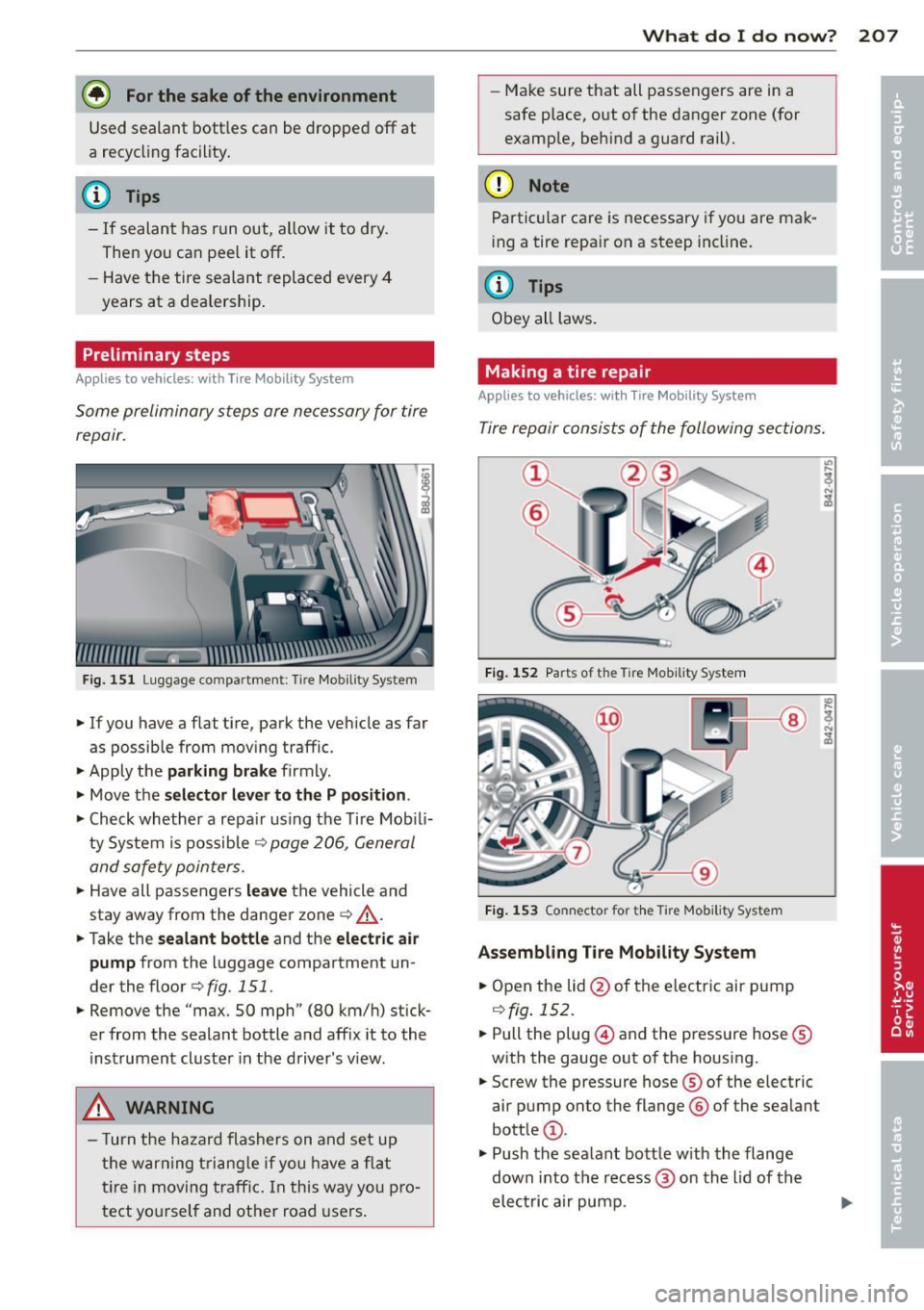
Fig. 151 Luggage co mpa rt ment : Tir e Mobil ity System
1> Jf you have a flat tire, park the veh icle as far
as possible from mov ing traffic .
.,. Apply the
parking brak e firmly .
.,. Move the
se le ctor l ever to the P po sit ion .
.,. Check whether a repa ir using the Tire Mob ili
ty System is possible ¢
page 206, General
and safety poin ters .
.,. Have all passengers leave the vehicle and
stay away from the danger zone ¢
A.
.,. Take the se alant bottle and the ele ctri c air
pump
from the luggage compartment un
der the floor¢
fig. 15 l .
.,. Remove the "max. 50 mph" (80 km/h) stick
er from the sealant bottle and aff ix it to the
inst rument cluste r in the driver's v iew .
..&, WARNING
-Turn the ha zard flashers on and set up
th e war ning t ria ng le if you have a fla t
t ire in moving t raff ic. In this way you p ro
tect yo urself and other road users .
-
What do I do now ? 207
-Make sure that all passengers are in a
safe place, out of the danger zone (for
example, behind a guard rail).
(D Note
Particular care is necessary if you are mak
ing a tire repair on a steep incline.
(D Tips
Obey all laws.
Making a tire repair
Applies to vehicles : wit h Tire Mob ility System
Tire repair consists of the following sec tion s.
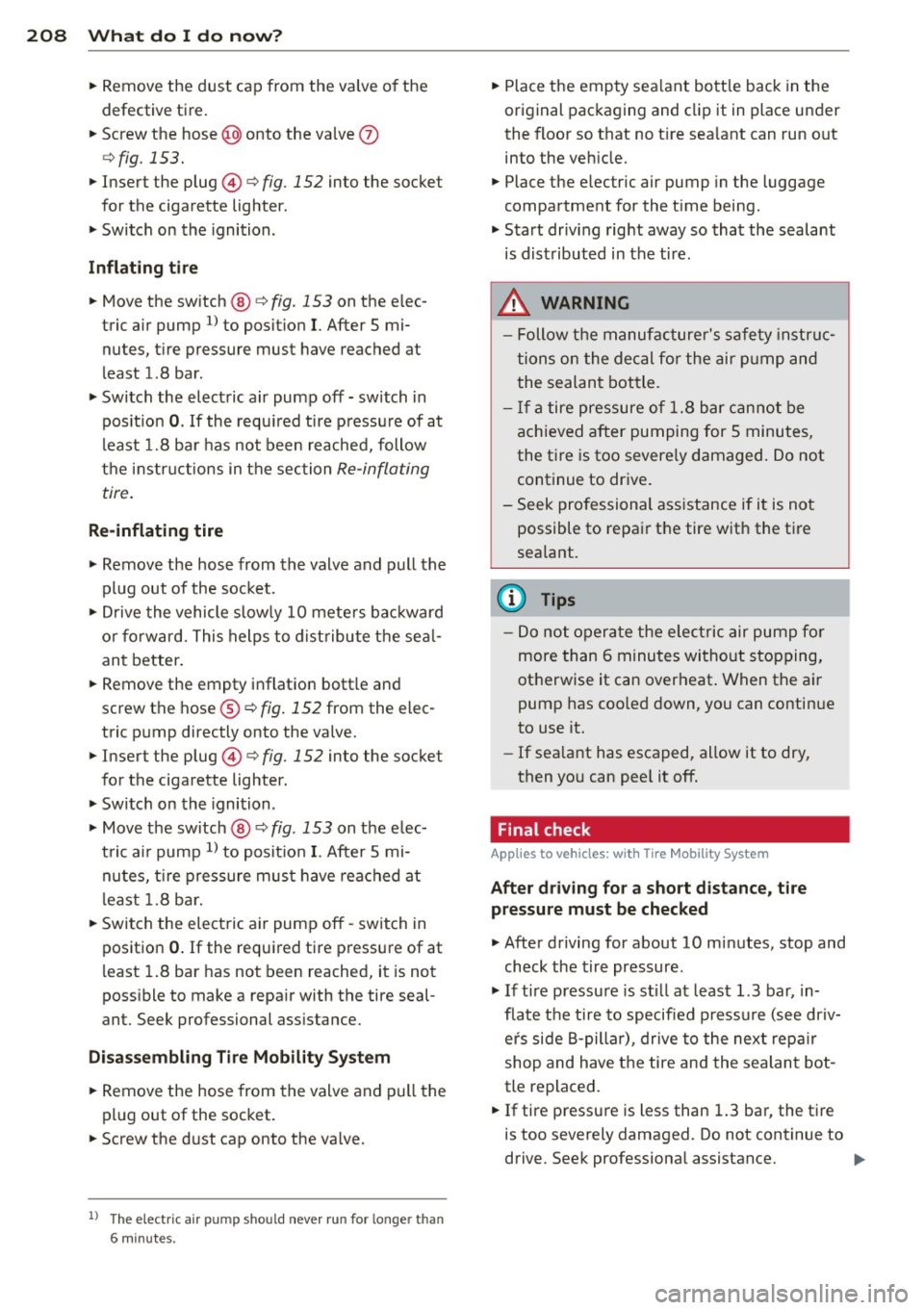
Fi g. 1 52 Parts of t he T ire Mobility System
Fi g. 1 53 Connector for th e Tire Mob ility System
Assembling Ti re Mobility System
.,. Open the lid @of the electr ic air p ump
¢ fig. 152 .
.,. Pull the plug@) and the pressure hose®
w ith the gauge out of the housing .
.,. Screw the pressure hose® of the e lectric
air pump onto the flange ® of the sealant
bott le @ .
.,. Push the sealant bott le w ith the flange
down into the recess @ on th e lid of th e
elec tric air pump.
IJ,-
Page 210 of 244
208 What do I do now?
• Remove the dust cap from the valve of the
defective tire.
• Screw the hose@) onto the valve
(J)
¢fig . 153.
• Insert the plug@¢ fig. 152 into the socket
for the cigarette lighter.
• Switch on the ignition .
Inflating tire
• Move the switch@¢ fig. 153 on the e lec
tric air pump
l ) to position I. After 5 mi
nutes, tire pressure must have reached at
least 1.8 bar .
• Switch the electric air pump off -switch in
pos it ion
0 . If the requ ired tire pressure of at
least 1.8 bar has not been reached, follow
the instructions in the section
Re-inflating
tire.
Re -inflating tire
• Remove the hose from the valve and pull the
plug out of the socket.
• Drive the vehicle slow ly 10 meters backward
or forward. This helps to distribute the seal
ant better .
• Remove the empty inflation bott le and
screw the hose®¢
fig. 152 from the elec
tric pump directly onto the valve.
• Insert the plug@¢
fig. 152 into the socket
for the cigarette lighter.
• Switch on the ignition .
• Move the switch @¢
fig. 153 on the e lec
t ric air pump
l) to posit ion I. After 5 mi
nutes, tire pressure must have reached at
least 1.8 bar.
• Switch the electric air pump off -switch in
position
0. If the required tire pressure of at
l east 1.8 bar has not been reached, it is not
poss ible to make a repair with the tire seal
ant. Seek professional ass istance.
Disassembling Tire Mobility System
• Remove the hose from the valve and pull the
plug out of the socket.
• Screw the dust cap onto the va lve.
1l The electric air p ump sho uld never ru n fo r long er than
6 min utes.
• Place the empty sea lant bott le back in the
original packaging and clip it in place under
the floor so that no t ire sea lant can run out
into the veh icle.
• Place the electric air pump in the luggage
compartment for the t ime being .
• Start driv ing right away so that the sealant
is distributed in the tire.
_&. WARNING
- Follow the manufacturer's safety instruc
tions on the decal for the air pump and
the sealan t bottle.
- If a tire pressure of 1.8 bar cannot be
achieved after pumping for 5 minutes,
the tire is too severe ly damaged. Do not
continue to drive.
- Seek professional assistance if it is not
possible to repair the tire with the tire
sealant.
(D Tips
- Do not operate the electric air pump for
more than 6 minutes without stopping,
otherwise it can overheat . When the air
pump has cooled down, you can continue
to use it.
- If sea lant has escaped, allow it to dry,
then you can pee l it off.
Final check
App lies to vehicles: wit h Tire Mobility System
After driving for a short distance, tire
pressure must be checked
• After driving for about 10 minutes, stop and
check the tire pressure .
• If tire pressure is still at least 1.3 bar, in
flate the tire to specified pressure (see driv
ers side B-pillar), drive to the next repa ir
shop and have the tire and the sealant bot
tle replaced.
• If tire pressure is less than 1.3 bar, the tire
is too severely damaged. Do not continue to
drive . Seek professional assistance. .,.
Page 212 of 244
210 What do I do now?
• Close your grip around the end of the
wrench handle for maximum torque and
turn the wheel bolts
counter-clockwise
about one single turn in the direction of ar
row
¢ fig. 156.
Tightening
• Fit the wheel bolt wrench over the wheel
bolt and push it down as far as it will go .
• Close your grip around the
end of the
wrench handle for maximum torque and
turn each wheel bolt
clockwise until it sits
t ight.
A WARNING
- Us ing force without control to speed the
wheel change up can cause the veh icle to
slip off the jack and cause serious per
sonal inju ries.
-Do not loosen the wheel bolts more than
one turn
before you raise the vehicle with
the jack. -Risk of injury!
- Never t ry and use the hexagonal socket
in the handle of the screwdriver to loos
en or tighten the wheel bolts.
- If a wheel bolt sits very t ight, you may
find i t eas ier to loosen by carefully push
i ng down on the end of the whee l bolt
wrench with
one foot only. As yo u do,
hold on to the car to keep yourself stable
and take care not to slip .
Raising the vehicle
The vehicle must be lifted with the jack first
before the wheel con be removed .
a
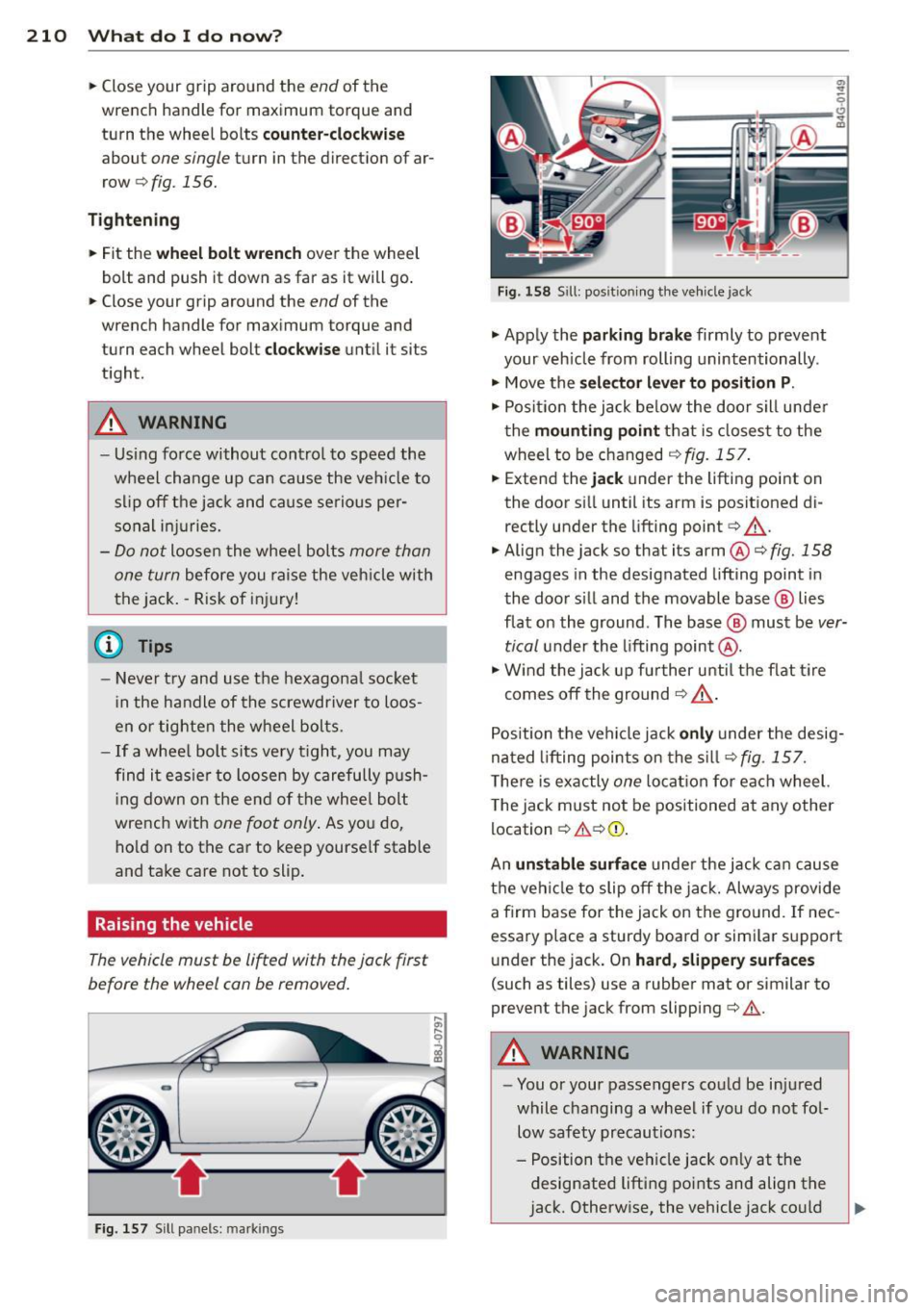
Fig. 157 Sill pa nels : m ar kings
Fig. 158 Sill : posit ioning the vehicle jac k
• Apply the parking brake firmly to prevent
your veh icle from roll ing unintentionally.
• Move the
selector lever to position P .
• Position the jack be low the door sill under
t he
mounting point that is closest to the
wheel to be changed ¢
fig. 157.
• Extend the jack under the lifti ng point on
the door s ill until its arm is positioned di
rectly under the lifting point ¢,&. .
• Align the jack so that its arm®¢
fig. 158
engages in the designated lifting point in
the door s ill and the movable base ® lies
flat on the ground . The base @ must be
ver
tical
under the lifting point@.
• Wind the jack up further unti l the flat tire
comes off the ground ¢
.&,.
Position the vehicle jack only under the desig
nated lifting points on the sill
¢fig . 157.
T he re is exactly one locat ion for eac h wheel.
T he jack must not be positioned at any other
location ¢
.&,¢(D .
An unstable surface under the jack can cause
the vehicle to slip off the jack. Always provide
a firm
base for the jack on the ground. If nec
essary p lace a sturdy board or simi lar support
under the jack. On
hard, slippery surfaces
(such as tiles) use a rubber mat or similar to
prevent the jack from slipping ¢
.&,.
A WARNING
--You or your passengers cou ld be injured
while changing a wheel if you do not fol
low safety precautions:
- Position the vehicle jack on ly at the
designated lifting points and align the
jack. Otherwise, the vehicle jack could
Page 214 of 244
212 What do I do now?
When removing or installing the wheel,
the rim could hit the brake rotor and dam
age the rotor. Work carefully and have a
second person help you.
Never use the hexagonal socket in the han
dle of the screwdriver to loosen or t ighten
the wheel bolts.
- Pull the reversible b lade from the screw
driver before yo u use the hexagonal
socket in the handle to turn the whee l
bo lts.
- When mounting tires with
unid irectional
tread design
make sure the tread pat
tern is pointed the r ight way
~page 212.
- The wheel bolts should be clea n and easy
to tu rn . Check for d irt and corrosion on
the mat ing su rfaces of both th e whee l
and the h ub. Remove a ll dirt from these
su rfaces before remo unti ng the wheel.
Notes on wheel change
Pl ease read the informa tion ~ page 192, New
tires and replacing tires and wheels,
if you are
going to use a spare t ire which is different
from the tires on your vehicle.
After you change a tire :
-Check the tire pressure on the spare imme
diately after mounting .
- Have the wheel bolt tightening torque
che ck e d with a torqu e wrench a s soon as
possible b y your auth orized Audi dealer or
a qualified ser vice station .
- With steel and alloy wheel rims , the wheel
bolts are correctly tightened at a torque of
90 ft lb (1 20 Nm ).
- If y ou notice while changing a tire that the
wheel bolts are co rroded and difficult to
turn , then the y should be repl aced befo re
you check the t ightening torque . -
Repla ce the flat ti re with a new one and
have it installed on your veh icle a s soon as
possible. Remount the wheel cove r.
Until then , dr ive with extra care and at re
duced speed s.
_& WARNING
-
- If you are going to eq uip your vehicle
wit h tires or rims which differ from those
which were factory installed, then be
sure to read the information
9 page 192,
New tires and replacing tires and
wheels.
- Always store the tools secu rely i n lug
gage compartment. Othe rwise, in a n ac
cident or s udden maneuver they cou ld fly
forwa rd, causi ng injury to passengers in
the vehicle.
Tires with unidirectional tread design
Tires with unidirectional tread design must be
mounted with their tread pattern pointed the
right direction.
A un idirectional tire can be identified by ar
rows on the sid ewall ,
which point in the direc
tion of the rota tion. Yo u m ust follow the
specified direction of rota tion. This is ne ces sa
r y in order fo r these tires to develop t heir op
timum character istics regard ing grip, road
noise, wear, and hydrop laning.
Page 233 of 244
Important warnings ... ... .. .. .. .. . 177
Location 177
Low ... .. .. .. ... ....... ... .. .. .. . 147
Replacing the battery ........... .. . 176
State of charge . . . . . . . . . . . . . . . . . . . . 147
W inter operation . . . . . . . . . . . . . . . . . . 17 5
Wo rking on the battery . . . . . . . . . . . . . 177
Before driving . . . . . . . . . . . . . . . . . . . . . . . 92
Blended gasoline .......... .. .. .. ... 16 1
Boost . .... .. ................. .. .... 26
Booster seats . .... ..... ... .. .. .. ... 137
Boost pressure ind icator ........... ... 26
Brake fl uid
Changing the brake fluid ... .. .. .. .. .
175
Checking the brake fluid level . ....... 174
What is the correct brake flu id level? .. 174
What should I do if the brake fl uid warn-
ing light comes o n? ................
174
Brake system ... ........... .. .. .. ... 174
Anti-lock brake system ........ ... ... 18
Brake ass ist system ........... ... .. 142
Brake fl uid ................. ... ... 174
Brake fluid spec ifi cat ions for refill and re
p lacemen t . . . . . . . . . . . . . . . . . . . . . . .
17 5
Brake ligh t de fect ive ................ 20
Brake pads . . . . . . . . . . . . . . . . . . . . . . . 150
General i nformation ... ... .. .. .. .. . 145
How does the moisture or road sa lt affect
the brakes? . ............. .... .. .. .
145
Malfunct ion . . . . . . . . . . . . . . . . . . . . . . . 14
Warn ing/ indicato r lights ....... ... ... 14
Wo rn brake pads symbol ....... ... ... 19
Brea k-in pe riod ... .. .... ... .. .. .... . 150
Brake pads . ............. .... .. ... 150
Tires
Bulbs
C
Ca lifo rnia Proposit io n 65 Wa rning
150
2 16
166
B att ery specific .......... .. .. .. .. . 178
Capac it ies ......................... 224
Carbon parts
Clean ing . . . . . . . . . . . . . . . . . . . .
157, 158
Care .. .. .. .. .. .. ........... .. .. ... 155
Cargo area
refer to Luggage compartment . . . . . . . . 97
Cata lytic converter .................. 151
Inde x 231
CD changer ... .... .. . .. .. ..... ... .. . 66
Certif ication ...... .. ............... 229
Changing a flat tire . ............. .. .. 209
Ch ang ing engine oil ................. 171
Checking
Battery ac id level ............. .... .
178
Engine coolant level ........... .... . 173
Checking t ire pressure ............... 187
Child res train t
Danger of using child res train ts in the
front seat
110
Child rest rain ts
Where can I ge t addi tional in format io n
abo ut child res train ts and the ir use? ..
1 4 1
Child safety .............. .......... 130
Convertible locking retractor ......... 138
Important safety instructions for using
c hi ld safety seats . .. .. ......... .. ..
133
Important t hings to know whe n driving
with children .. .... . ... ...... ... ..
130
Child safety seat .... ........... .... . 135
Convertib le locking retractor ......... 138
Installing . .. .. .. ................. 138
Child safety seats
Booster seats .. .. .. ...............
137
Co nve rtib le child seats ... ... ..... .. 135
How do I properly install a child safety
. h' l ? 133 sea t m my ve 1c e ................. .
Infan t seats . .. .. .... ........... ..
135
Safety instr uctions . .. .. ..... ... .. .. 133
Cigarette lighter ... .. . .. .. ... ..... .. . 65
Cleaning ..... .. ...... ............. 155
C limate controls . .. .. ........... .... . 68
A/C opera tion .. .. .... ............. . 71
Air distribution . . . . . . . . . . . . . . . . . . . . . 70
Air recircu lation mode . . . . . . . . . . . . . . . 71
Automat ic mode ... .. .. .... ... .. .. . 71
Controls . . . . . . . . . . . . . . . . . . . . . . . . . . 68
Defrost . .. .. .. .. .. ............... . 71
Economica l use .. .. . .. .. ... ..... .. . 72
Fan ................... ........... 69
Heated seats . . . . . . . . . . . . . . . . . . . . . . 72
Heating ... .. .. .. .... ........... .. . 68
Pollu tant fi lter . . . . . . . . . . . . . . . . . . . . . 68
Rea r window defogger .. ..... ... .. .. . 71
Switc hing on and off .... .... ... .. .. . 69
•
•
Page 234 of 244
232 Index
Temperature ............ ... .. .... .. 69
Ventilation .... ........... ... .... .. 68
C lock . . . . . . . . . . . . . . . . . . . . . . . . . . . . . . 11
Clutch overheating . . . . . . . . . . . . . . . . . . . 87
Cold ti re inflation pressure ..... ... ... . 185
Com ing home .............. .... ..... 49
Compass mirror ............ ... .... .. 58
Compl iance .. ............. .. .. .. .. . 229
Consumer Information . . . . . . . . . . . 99, 226
Contacting NHTSA .......... ... .... .. 99
Controls Cleaning . .... ........... .. .. .... . 157
Controls and displays .................. 8
Convenience close/open feature Pow er top . . . . . . . . . . . . . . . . . . . . . . . . . 43
Windows . ................. ..... .. 40
Conve rtible child safety seats .. .. .... . 135
Convertible locking retractor Activating .................... ... . 140
Deactivating .................. .... 140
Using to secure a ch ild safety seat 138, 140
Convertible top .. .......... .. .. .... .. 41
Automatic convertible top ............ 43
Eme rgency operation . . . . . . . . . . . . . . . . 44
General information ........... ..... 41
manual convertible top ........ .. .. .. 42
Warn ing/ indictor lights .............. 17
W ind deflecto r ..................... 44
Cooling system . . . . . . . . . . . . . . . . . . . . . 172
Expansion tank ... ..... ..... .. .. .. . 173
Cornering light ............ .. .. .. .. .. 49
C ruise control . . . . . . . . . . . . . . . . . . . . . . . 78
Changing speed . . . . . . . . . . . . . . . . . . . . 79
Pr esetting your speed . . . . . . . . . . . . . . . 79
Switching
off .............. .. .... .. 79
Sw itching on ....................... 78
Warning/indicator lights ... .. .. .. .. . . 21
Cup holder . . . . . . . . . . . . . . . . . . . . . . . . . . 64
Current fuel mileage 23
D
Damping
refer to Audi magnetic ride . .. .. .. .. . . 80
Data recorder . . . . . . . . . . . . . . . . . . . . . . 142
Date display . . . . . . . . . . . . . . . . . . . . . . . . 11
Daytime running lights ................ 48 D
ecla ration of compliance
Cell phone package ................ 229
E lectronic immob ilizer .............. 229
Homelink universal remote control ... 229
Remote control key ............ .... 229
D ecorative decals
Cleaning . ..... .. ............. .... 157
D eco rative parts/tr im
Cleaning .. .... .. ............. .... 157
def What does this mean when it appears in
the tr ip odometer display? ........... 12
Defective light bulb warning ........... 20
Defrosting the windows .......... .. .. . 71
Determining correct load limit ........ 190
Digital clock . . . . . . . . . . . . . . . . . . . . . . . . 11
Dig ital compass . . . . . . . . . . . . . . . . . . . . . 58
Dimensions . .... .. ............. .... 224
Dimming the rearview mirror .......... 53
Dipst ick
Reading the dipst ick properly ........ 170
Displays Cleaning .. .... .. ............. .... 157
D istance ......... .. .............. .. 23
Driver information system
Boost ........ .. .. ................ 26
Engine oil temperature .............. 26
Menu button . . . . . . . . . . . . . . . . . . . . . . 25
Menu display . . . . . . . . . . . . . . . . . . . . . . 24
Open door or front lid warning ........ 22
Outside temperature display . . . . . . . . . . 22
Red symbo ls ... ... ................ . 13
Service interval display . . . . . . . . . . . . . . 28
Setting ........................... 26
Sound system display . . . . . . . . . . . . . . . 22
Tr ip computer .. .................. .. 23
yellow symbols . . . . . . . . . . . . . . . . . . . . . 13
Driver seat
refer to Seating position . . . . . . . . . . . . . 93
Driving Run-flat tires .... ............. .... 203
Driving safely . .. .. ... .......... .... . 92
Driving through water ............... 151
Duplicat e key ..... ............. ..... 32
Dust filter . . . . . . . . . . . . . . . . . . . . . . . . . . 69