stop start AUDI TT ROADSTER 2014 Owner's Manual
[x] Cancel search | Manufacturer: AUDI, Model Year: 2014, Model line: TT ROADSTER, Model: AUDI TT ROADSTER 2014Pages: 244, PDF Size: 60.87 MB
Page 202 of 244
200 Tires and wheels
remain continuo usly illuminated . This se
quence will continue upon subsequent vehicle
start-ups as long as the ma lfunction ex ists.
When the malfunction indicator is illuminat
ed, the system may not be able to detect or
signal low tire pressure as intended. TPMS
malfunctions may occur for a variety of rea
sons, including the installation of replace ment or alternate tires or wheels on the vehi
cle that prevent the TPMS from functioning properly . Always check the TPMS malfunction
tellta le after replacing one or more t ires or
wheels on your veh icle to ensure that the re
placement or alternate tires and wheels allow
the TPMS to continue to function properly.
Tire pressure indicator appears
Applies to vehicles: with tire pressure monitoring system
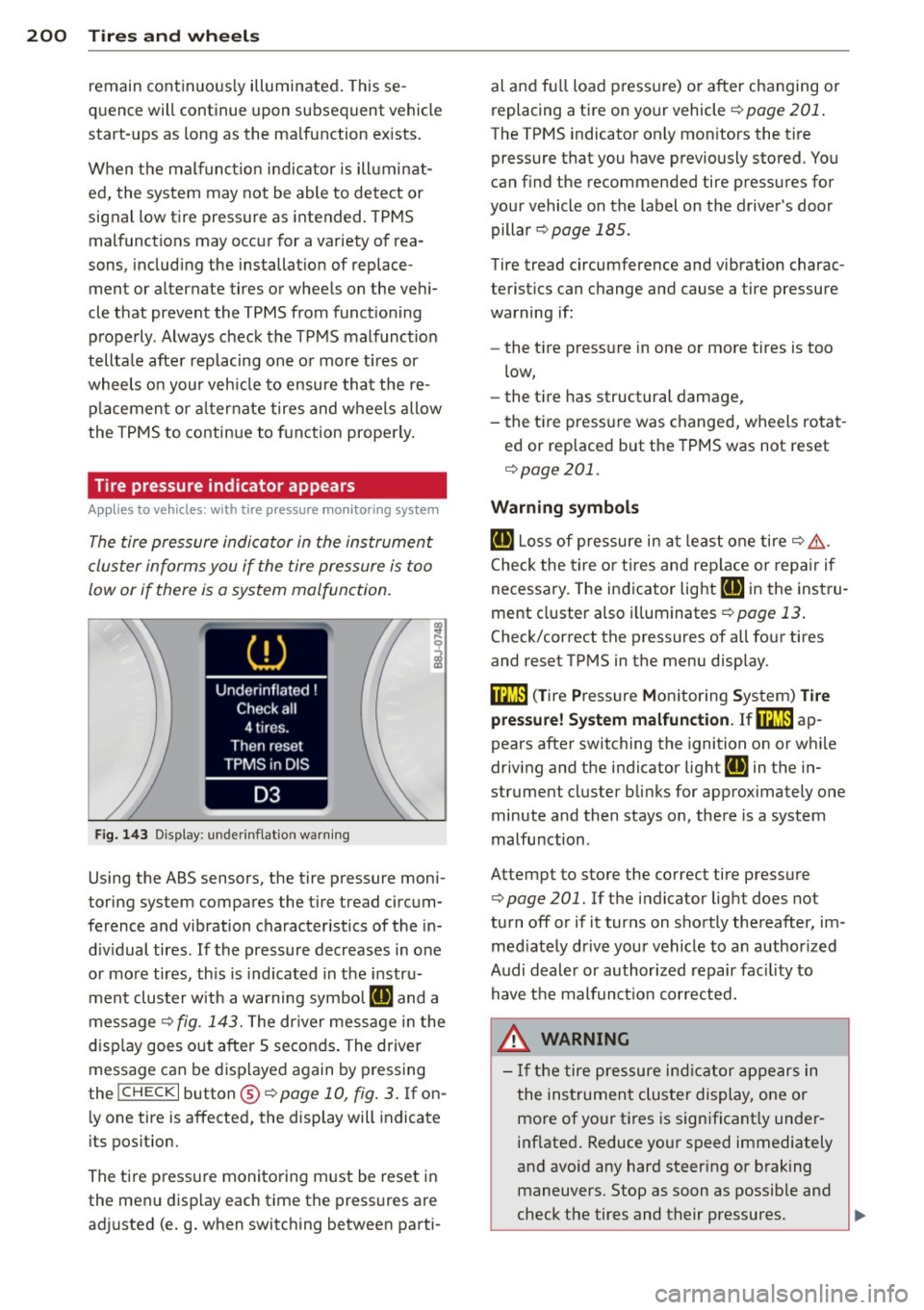
The tire pressure indicator in the instrument
cluster informs you if the tire pressure is too
low or if there is a system malfunction.
F ig. 143 Display : underi nflat io n warn ing
Using the ABS sensors, the tire pressure moni
toring sys tem compares the t ire tread circum
ference and vibration characteristics of the in
d iv idual tires . If the pressure decreases in one
or more tires, th is is indicated in the instru
ment clus ter with a warning symbo l
ail and a
message<>
fig. 143. The dr iver message in the
display goes out after 5 seconds . The driver
message can be displayed again by pressing
the
! CHECK I button @¢ page 10, fig . 3 . If on
l y one tire is affected, the display will indicate
its pos ition.
The tire press ure monitoring m ust be reset in
the menu display each time the pressures are
ad justed (e.g. when switching between parti- al and fu
ll load pressure) or after changing or
replacing a tire on your vehicle<>
page 201.
The TPMS indicator only mon itors the t ire
pressure that you have previously stored . You
can find the recommended tire pressures for
your vehicle on the label on the driver's door
pillar
¢ page 185.
Tire tread circumference and vibration charac
teristics can change and cause a tire pressure
warning if:
- the t ire pressure in one or more tires is too
low,
- the tire has structural damage,
- the tire pressure was changed, wheels rotat -
ed or replaced but the TPMS was not reset
¢ page 201.
Warning symbols
ail Loss of pressure in at least one tire¢& .
Check the tire or tires and replace or repa ir if
necessary . The indicator light
HE in the instru
ment cluster also illuminates
<>page 13.
Check/correct the pressures of all four tires
and reset TPMS in the menu display .
ffim (T ire Pressure Monitoring System) Tire
pressure! System malfunction. Ifffim
ap
pears after switching the ignition on or while
driv ing and the indicator lig ht
HE in the in
strument cluster blinks for approx ima tely one
minute and then stays on, there is a system
malfunction .
At tempt to store the correct tire pressure
¢ page 201. Ifthe indicator light does not
turn
off or if it turns on shortly thereafter, im
med iate ly drive your vehicle to an author ized
Audi dealer or author ized repair facility to
have the malfunction corrected.
_&. WARNING
-
- If the tire pressure indicat or appears in
the instrument cluster display, one or
more of your tires is significant ly under
inflated . Reduce your speed immediately
and avoid any hard steer ing or braking
maneuvers. Stop as soon as possible and
check the tires and their pressures.
IJJ,,
Page 203 of 244
Inflate the tire pressure to the proper
pressure as indicated on the vehicle's tire
pressure label¢
page 185. Driving on a
significantly under-inflated tire causes
the tire to overheat and can lead to tire
failure . Under-inflation also is likely to
impair the vehicle's handling and stop
ping ability.
- The driver is responsible for mainta ining
the correct tire pressures. You must
check the tire pressures regularly.
- Under certain conditions (such as a spor
ty driving style, wint er conditions or un
paved roads), the pressure monitor indi
cator may be delayed .
- Ask your authorized Audi dealer if run
flat tires may be used on your vehicle.
Your vehicle registration becomes invalid if you use these tires when not permit
ted. Damage to your vehicle or accidents
could also result.
- If you switch between standard and run
flat tires, an authorized Audi dealer or
qualified workshop must reprogram the
control module .
@ Tips
-The tire pressure monitoring system
stops working when there is an ESC/ABS
malfunction.
- Using snow chains may result in a system
malfunction.
- The tire pressure monitoring system on
your Audi was developed using tires with the "AO" or "RO" identification on the
tire sidewall¢
page 192. We recom
mend using these tires.
Tires and wheels 201
Reset tire pressure monitoring system
(Stepl)
Appl ies to vehicles: wi th tire p ress ure mo nito ring system
If the tire pressure is adjusted, wheels ore ro
tated or changed, the TPMS must be reset in
the menu display.
--- ®
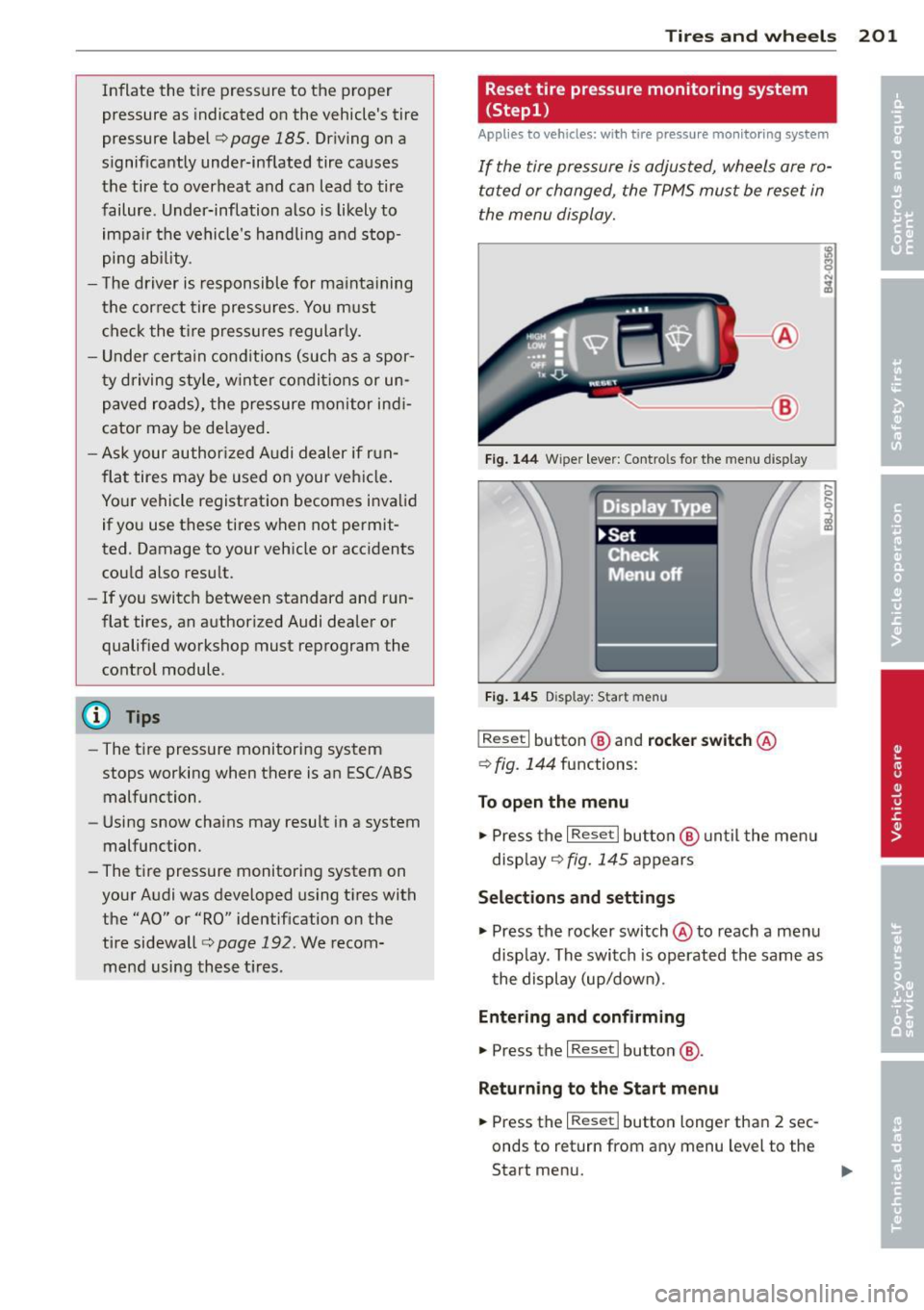
Fig. 144 Wiper lever : Controls for the menu display
Fig. 145 Display: Start menu
I Reset I button @ and rocker switch @
¢
fig. 144 functions:
To open the menu
.,. Press the I Reset I button @ until the menu
disp lay
9 fig. 145 appears
Selections and settings
.,. Press the rocker switch@ to reach a menu
disp lay. The switch is operated the same as
the display (up/down) .
Entering and confirming
.,. Press the I Reset I button @.
Returning to the Start menu
.,. Press the I Reset I button longer than 2 sec
onds to return from any menu level to the
Start menu. "'
Page 210 of 244
208 What do I do now?
• Remove the dust cap from the valve of the
defective tire.
• Screw the hose@) onto the valve
(J)
¢fig . 153.
• Insert the plug@¢ fig. 152 into the socket
for the cigarette lighter.
• Switch on the ignition .
Inflating tire
• Move the switch@¢ fig. 153 on the e lec
tric air pump
l ) to position I. After 5 mi
nutes, tire pressure must have reached at
least 1.8 bar .
• Switch the electric air pump off -switch in
pos it ion
0 . If the requ ired tire pressure of at
least 1.8 bar has not been reached, follow
the instructions in the section
Re-inflating
tire.
Re -inflating tire
• Remove the hose from the valve and pull the
plug out of the socket.
• Drive the vehicle slow ly 10 meters backward
or forward. This helps to distribute the seal
ant better .
• Remove the empty inflation bott le and
screw the hose®¢
fig. 152 from the elec
tric pump directly onto the valve.
• Insert the plug@¢
fig. 152 into the socket
for the cigarette lighter.
• Switch on the ignition .
• Move the switch @¢
fig. 153 on the e lec
t ric air pump
l) to posit ion I. After 5 mi
nutes, tire pressure must have reached at
least 1.8 bar.
• Switch the electric air pump off -switch in
position
0. If the required tire pressure of at
l east 1.8 bar has not been reached, it is not
poss ible to make a repair with the tire seal
ant. Seek professional ass istance.
Disassembling Tire Mobility System
• Remove the hose from the valve and pull the
plug out of the socket.
• Screw the dust cap onto the va lve.
1l The electric air p ump sho uld never ru n fo r long er than
6 min utes.
• Place the empty sea lant bott le back in the
original packaging and clip it in place under
the floor so that no t ire sea lant can run out
into the veh icle.
• Place the electric air pump in the luggage
compartment for the t ime being .
• Start driv ing right away so that the sealant
is distributed in the tire.
_&. WARNING
- Follow the manufacturer's safety instruc
tions on the decal for the air pump and
the sealan t bottle.
- If a tire pressure of 1.8 bar cannot be
achieved after pumping for 5 minutes,
the tire is too severe ly damaged. Do not
continue to drive.
- Seek professional assistance if it is not
possible to repair the tire with the tire
sealant.
(D Tips
- Do not operate the electric air pump for
more than 6 minutes without stopping,
otherwise it can overheat . When the air
pump has cooled down, you can continue
to use it.
- If sea lant has escaped, allow it to dry,
then you can pee l it off.
Final check
App lies to vehicles: wit h Tire Mobility System
After driving for a short distance, tire
pressure must be checked
• After driving for about 10 minutes, stop and
check the tire pressure .
• If tire pressure is still at least 1.3 bar, in
flate the tire to specified pressure (see driv
ers side B-pillar), drive to the next repa ir
shop and have the tire and the sealant bot
tle replaced.
• If tire pressure is less than 1.3 bar, the tire
is too severely damaged. Do not continue to
drive . Seek professional assistance. .,.
Page 220 of 244
218 Emergency situations
@ Tips
The discharged battery must be properly
connected to the vehicle's electrical sys
tem.
Use of jumper cables
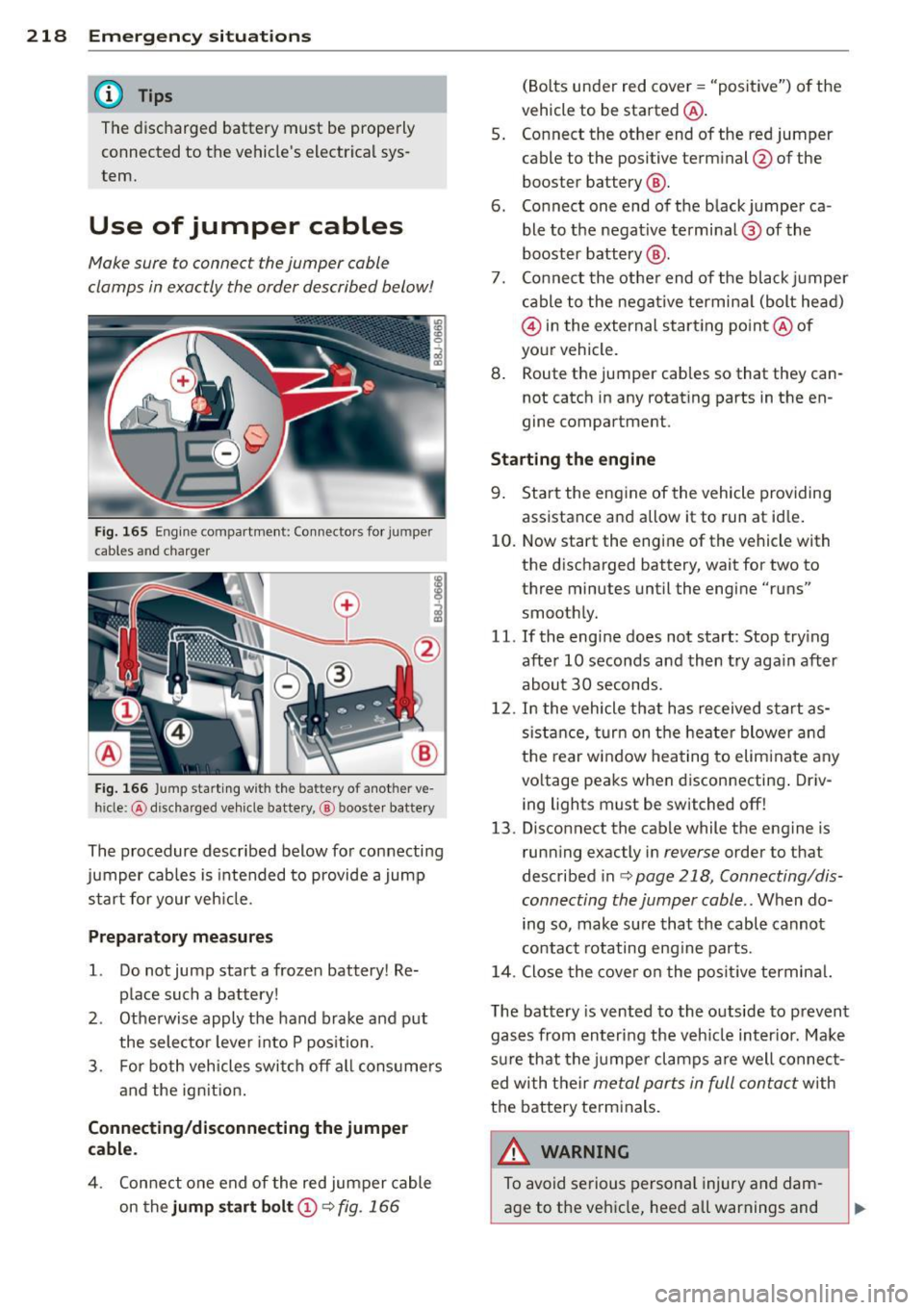
Make sure to connect the jumper coble
clomps in exactly the order described below!
Fig. 165 Engine compart ment: Co nnectors for jumper
cables and charger
Fig. 166 Jump starting with the battery of another ve
hicle: @discharged veh icle batte ry,® booste r battery
The procedure described below for connecting
jumper cables is intended to provide a jump
start for your veh icle.
Preparatory measures
1. Do not jump start a frozen battery! Re
place such a battery!
2 . Otherwise apply the hand brake and put
the selector lever into P position.
3. For both vehicles switch off all consumers
and the ign ition.
Connecting/disconnecting the jumper
cable .
4. Connect one end of the red jumper cable
on the
jump start bolt@q fig. 166
(Bolts under red cover = "positive") of the
vehicle to be started @.
5. Connect the other end of the red jumper
cable to the positive terminal @of the
booster battery @.
6. Connect one end of the black jumper ca
ble to the negat ive terminal @of the
booster battery @.
7. Connect the other end of the black jumper
cable to the negative terminal (bolt head)
@ in the external start ing point @ of
your vehicle.
8. Route the jumper cables so that they can
not catch in any rotating parts in the en
gine compartment.
Starting the engine
9. Start the engine of the vehicle providing
assistance and allow it to run at id le .
10. Now start the engine of the vehicle with
the discharged battery, wait for two to
three minutes until the engine "runs"
smoothly.
11. If the eng ine does not start: Stop try ing
after 10 seconds and then try again after
about 30 seconds.
12. In the vehicle that has received start as
sistance, turn on the heater blower and
the rear window heating to elim inate any
vo ltage peaks when disconnecting . Driv
ing lights must be switched off!
13 . Disconnect the cable while the engine is
running exactly in
reverse order to that
described in¢
page 218, Connecting/dis
connecting the jumper coble ..
When do
ing so, make sure that the cable cannot
contact rotating eng ine parts.
14. Close the cover on the positive terminal.
The battery is vented to the outside to prevent
gases from entering the vehicle inter ior. Make
sure that the jumper clamps are well connect
ed with their
metal parts in full contact with
the battery terminals.
A WARNING ~
To avoid serious personal injury and dam-
age to the vehicle, heed all warnings and
Page 235 of 244
E
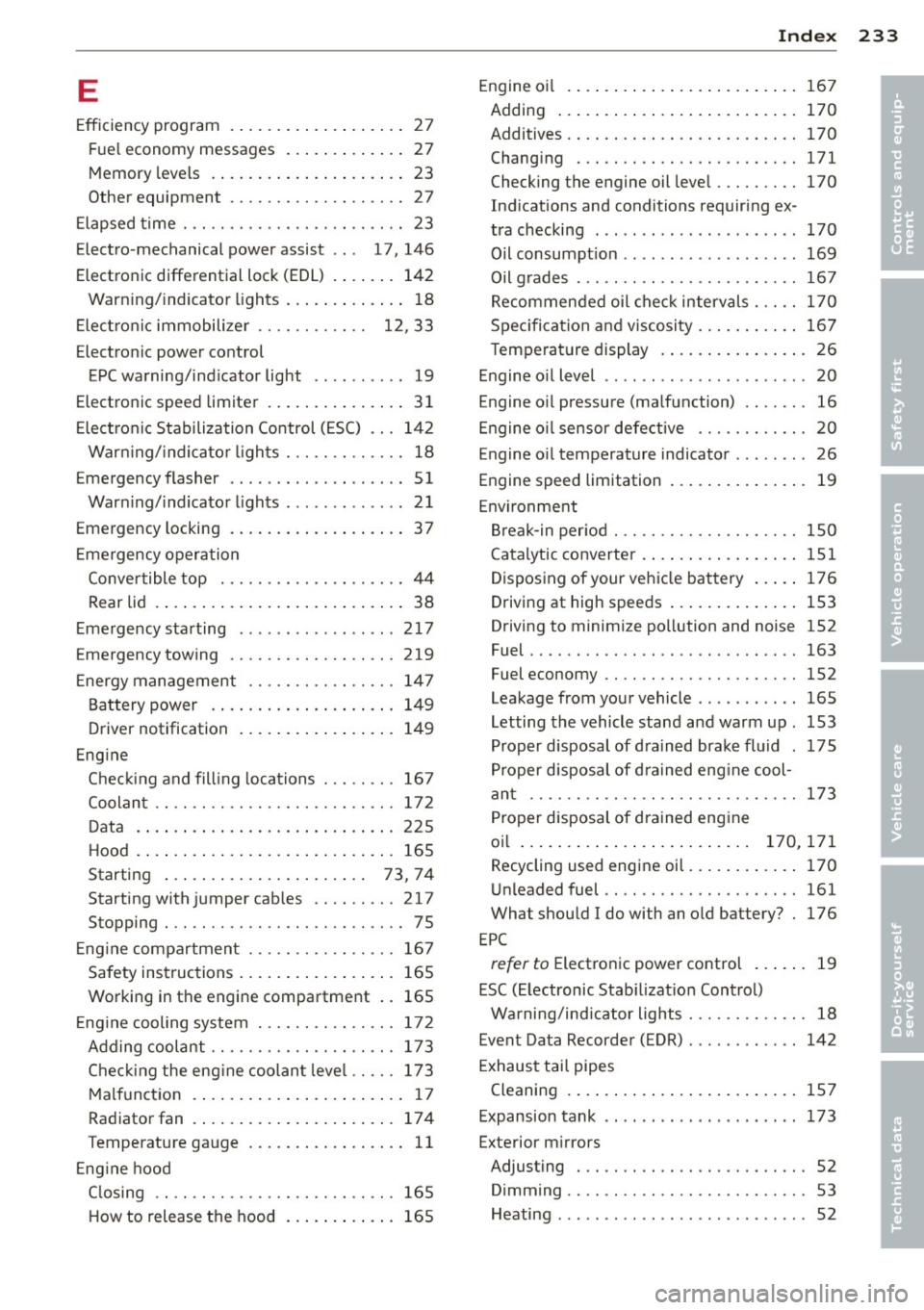
Efficiency program ...... ... .. .. .. .. .. 27
F ue l economy messages ... .. .. .. .. .. 27
Memory leve ls . . . . . . . . . . . . . . . . . . . . . 23
Other equ ipment .. ....... .. .. .. .. .. 2 7
E lapsed t ime . .. .... .... ... .. .. .. .. .. 23
E lectro -mechanical power assist . . . 17, 146
El ectronic differential lock (EDL) . ... ... 142
Warn ing/ indicato r lights ... .. ...... .. 18
E lect ro nic immobilize r . . . . . . . . . . . . 12, 33
Electro nic power control
EPC warning/ind icator light .. ... .... . 19
El ectro nic speed limite r .. ... .. .. .. .. .. 31
E lec tronic Stabilization Control ( ESC) .. . 142
War ning/ indicator ligh ts ... .. .. .. .. .. 18
E mergency fla sher . . . . . . . . . . . . . . . . . . . 51
War ning/ indicato r lights ............ . 21
Emergency locking . ..... ... .. .. .... .. 37
E me rgency opera tion
Conve rtible top ........ .. .. .. .. .. .. 44
Rear lid . . . . . . . . . . . . . . . . . . . . . . . . . . . 38
E mergency sta rting . ....... .. .. .. .. . 217
Emergen cy towing ..... .. .. .. .. .. .. . 219
Energy management ....... .. .. .. .. . 14 7
B attery power . . . . . . . . . . . . . . . . . . . . 1 49
D river notification ..... ... .. .. .. .. . 149
E ng ine
C hec king and fill ing locations . .. .. .. . 167
Coolan t .. .. .... .. . .... .. .... .. .. . 172
D ata . ..... .. .. .. .. .... ... .. .. .. . 225
Hood .. .. .. .. .. .. .. .... ... .. .. ... 165
Starting . . . . . . . . . . . . . . . . . . . . . . 73, 74
Startingwith jumpercab les .. .. .. .. . 21 7
Stopping . .. ............. .... .. .. .. 75
E ng ine compartmen t ..... .. .. .. .. .. . 16 7
Safety ins tructions ..... ... .. .. .. .. . 165
Wo rking in the engine compartment .. 165
E ng ine cooling system ...... .. .. .. .. . 17 2
Adding cool ant ........... .. .. .. .. . 173
Chec king the eng ine coolan t leve l .. .. . 173
M alfunct ion . . . . . . . . . . . . . . . . . . . . . . . 17
Radiator fan . . . . . . . . . . . . . . . . . . . . . . 17 4
T emperature ga uge .... ... .. .. .. .. .. 11
E ng ine hood
C losing .. .. ............. .... .. ... 165
H ow to release the hood ... .. .. .. .. . 165
Inde x 233
Engine o il . ... .... .. . .. .. ..... ... . .
167
Adding ... .. .. .... . ... ...... ... . . 170
Additives . ... .. .. .. . .. ... .... ... . . 170
Changi ng ... .. .. ........ ........ . 171
Checking the engine oil leve l ....... . . 170
Ind ications and conditions requir ing ex -
t ra checking ... .. .. . .. ... ... .. .. . . 170
Oil consumpt ion ... ............... . 169
Oil g rades . .. .. .. .. . ... .......... . 16 7
Recommende d oi l che ck intervals . .. . . 170
Spec ificat ion and viscosity .... ... .. . . 167
Temperature display . .. ..... ... .. .. . 26
Engine o il leve l .. .. .. ............... . 20
Engine o il pressure (ma lfunction) .. .. .. .
16
Engine o il sensor defective ......... .. . 20
E ngine o il temperature indicato r ...... . . 26
Engine speed limitation ... .... ... .. .. . 19
En vir onment
Br eak-in per iod . .. .... .... ..... .. .. 150
C atalytic converter . .. .. ..... ... .. .. 151
Disposing of your vehic le battery ... .. 176
Driving at high speeds .. ..... ... .. .. 153
Driving to minimi ze po llution and noise 152
Fuel ...... .. .. .. .. .. .... ....... .. 163
Fuel economy . . . . . . . . . . . . . . . . . . . . . 152
Leakage from your vehicle ........... 165
Letting the vehicle stand a nd warm up . 153
Proper disposal of dra ined brake flu id . 175
P roper disposal of d ra ined eng ine cool-
an t ...... .. .. .. ................. 173
Proper disposal of d rained eng ine
oi l .. ... .. .. .. .... . ... ...... 170,171
Recycling used engine oil ..... ... .. .. 170
Un leaded fuel .. .. .. ............... 161
Wha t shou ld I do with an o ld bat tery? . 176
E PC
refer to E lect ronic power control ... ... 19
ESC (E lectronic Stab ilizat io n Control)
Wa rning/ind icator lights ... ..... .. .. . 18
Event Da ta Recorder (EDR) .......... .. 142
E xhaus t tai l pipes
Cleaning . ... .... .. . .. .. ..... ... .. 157
Expansion tank . . . . . . . . . . . . . . . . . . . . . 173
Exterior m irrors
Adjusting . . . . . . . . . . . . . . . . . . . . . . . . . 52
Dimming .. .. .. .... .......... ...... 53
Heating ..... .. .... .......... ...... 52
•
•
Page 240 of 244
238 Index
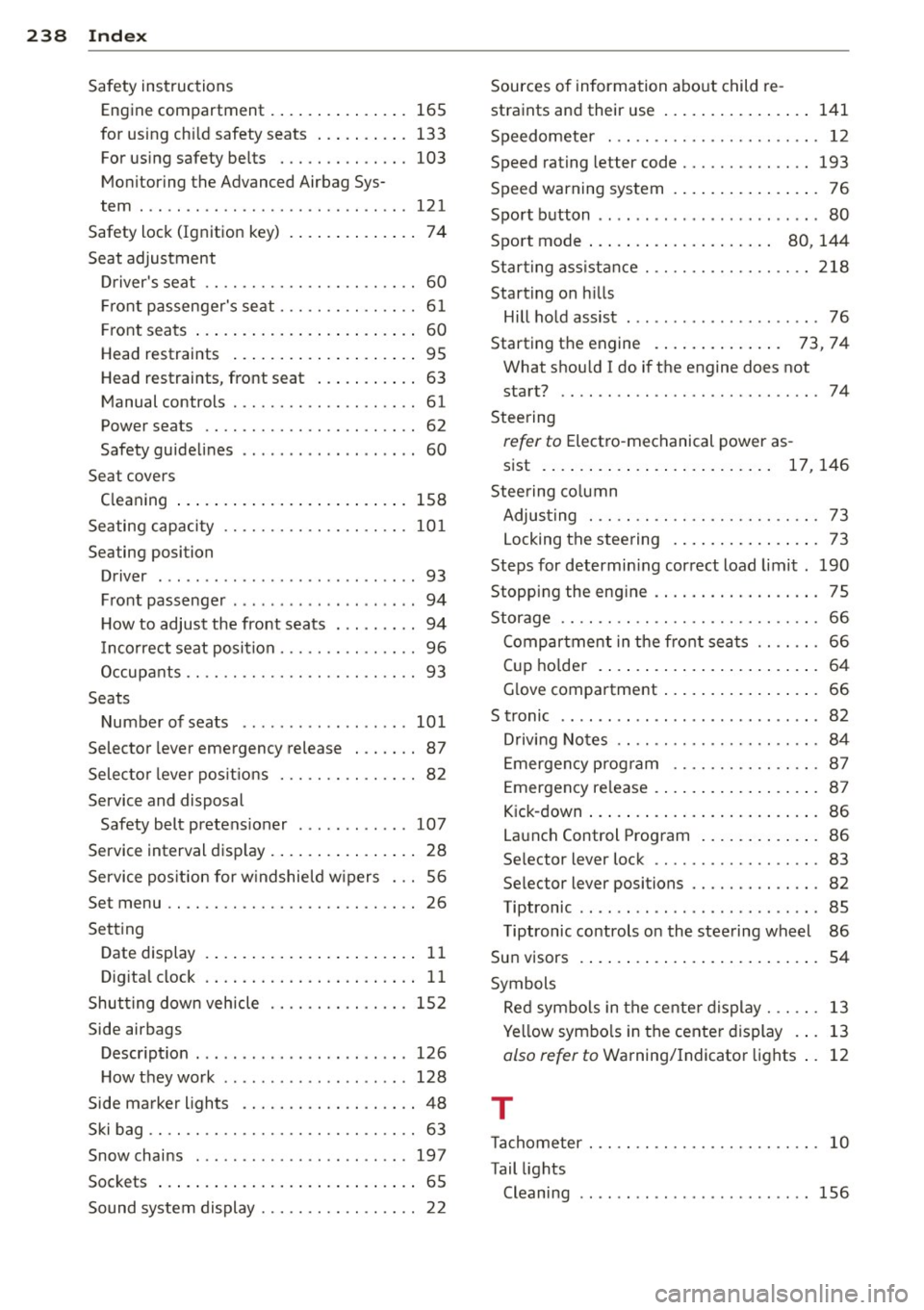
Safety instructions
Engine compartment . ... .. .. ... ... . 165
for using ch ild safety seats ... .. .... . 133
For using safety belts ..... .. .. .... . 103
Monitoring the Advanced Airbag Sys-
tem ... .. .. ................ ... ... 121
Safety lock (Ignition key) . ... .. .. .... . . 74
Seat adjustment Driver's seat . . . . . . . . . . . . . . . . . . . . . . . 60
Fr ont passenger's se at ... .. .. .. .. .. .. 6 1
Fr ont seats . . . . . . . . . . . . . . . . . . . . . . . . 60
Head restraints . . . . . . . . . . . . . . . . . . . . 95
H ead restraints, front seat . . . . . . . . . . . 63
Manual controls .......... .. .. .. .. .. 61
Power seats . . . . . . . . . . . . . . . . . . . . . . . 62
Safety guidelines .............. ..... 60
Seat covers Cleaning ... ... . ...... ... .. .. .... . 158
Seating capacity
Seating position 10
1
Driver ... .. ................ ... .... 93
F ront passenger . . . . . . . . . . . . . . . . . . . . 94
H ow to adjust the front seats . . . . . . . . . 94
I n co rrect seat posi tion . . . . . . . . . . . . . . . 96
Occup ants .. .. . .......... .. .. .. .. .. 93
Seats Number of seats ... ...... .. .. .. .. . 10 1
Selector lever emergency release . . . . . . . 87
Selecto r leve r pos it ions . . . . . . . . . . . . . . . 8 2
Service and disposal
Safety belt pretens ioner ....... .. ... 107
Service interval disp lay . ... .. .. ... ... .. 28
Service pos it ion for w indshie ld w ipers . .. 56
Set menu .. ................. .. .... .. 26
Sett ing
Date display . . . . . . . . . . . . . . . . . . . . . . . 1 1
Dig ita l clock . . . . . . . . . . . . . . . . . . . . . . . 11
Shut ting down veh icle ............... 152
Side airbags
Descr ipt ion . .............. ... .. ... 126
H ow t hey wo rk ..... ...... .. .. .. .. . 128
Side marker lights ................... 48
Ski bag .. .... ... .......... .. .. .. .. .. 63
Snow chai ns .... .... ...... .. .. .. .. . 197
Sockets ..... ... .. ..... ... .. .. .... .. 65
Sound system display . . . . . . . . . . . . . . . . . 2 2 Sources of informa
tion abo ut child re -
stra ints and their use .... ..... ... .. .. 141
Speedometer . . . . . . . . . . . . . . . . . . . . . . . 12
Speed rating letter code .......... .... 193
Speed warning system . .. ..... ... .. .. . 76
S po rt button . . . . . . . . . . . . . . . . . . . . . . . . 80
Sport mode . . . . . . . . . . . . . . . . . . . . 80, 144
Star ting ass ist ance . ............. .. .. 218
Starting on hills
Hill ho ld assist . . . . . . . . . . . . . . . . . . . . . 76
Starting the engine . . . . . . . . . . . . . . 73, 74
What should I do if the engine does not
start? .. .. .. .. .. ............. .. .. . 74
Stee ring
refer to Electro -mechanical power as -
sist . . . . . . . . . . . . . . . . . . . . . . . . . 17, 146
Stee ring co lumn
Adjus ting . .... .. .. ........... .... . 73
L ocking the stee ring . . . . . . . . . . . . . . . . 73
Steps for determin ing cor rect load limit . 190
Stopping the engine . ... ...... ... .. .. . 75
Storage .. .. .. .. .. .. ... ........ .. .. . 66
C ompartmen t in t he front sea ts . . . . . . . 66
C up ho lde r .... .. .. ... ..... ... .. .. . 64
G love compartment . . . . . . . . . . . . . . . . . 66
S t ronic ..... ... .. .. ........ ...... .. 82
Dr iving Note s .. .. ............. .... . 84
Emergen cy prog ram ........... .. .. . 87
E mergency release . .. .. ..... .... . .. . 87
Kick-down . . . . . . . . . . . . . . . . . . . . . . . . . 86
La unch Control Program ..... ... .. .. . 86
Se lector lever lock . . . . . . . . . . . . . . . . . . 83
Se lector lever positions . . . . . . . . . . . . . . 82
Tiptronic . . . . . . . . . . . . . . . . . . . . . . . . . . 85
T iptronic co ntrols o n the steering wheel 86
Sun visors . ..... .. .. ... ..... ... .. .. . 54
Symbols Re d symbo ls in the ce nte r d isplay . .... . 13
Ye llow symbo ls in the cente r display . .. 13
also refer to Warning/Indicator lights .. 12
T
Tacho meter . . . . . . . . . . . . . . . . . . . . . . . . . 10
Tail lights
Cleaning ......... ............... . 156