tow AUDI TT ROADSTER 2014 Owner's Manual
[x] Cancel search | Manufacturer: AUDI, Model Year: 2014, Model line: TT ROADSTER, Model: AUDI TT ROADSTER 2014Pages: 244, PDF Size: 60.87 MB
Page 153 of 244
Avoid damaging the
vehicle
When you are driving on poor roads, or over
curbs, steep ramps, etc., make certain that
low-lying parts such as spoilers and exhaust
system parts do not bottom out and get dam
aged.
T his is especially true for vehicles with low
slung chassis (sports chassis) and fully loaded
vehicles .
Driving through water
on roads
Note the following to avoid vehicle damage
when driving through water, for example on
flooded roads:
- T he water must not be any higher than the
bottom of the veh icle body.
- Do not d rive faster than wa lking speed.
..&, WARNING
After driving through wate r, m ud, slush,
etc., the brakes may be slow to take effect
because of wet brake rotors and pads . Dry
the brakes first by braking carefully to re
store the full braking effect.
(D Note
Vehicle components such as the engine,
transmiss ion, suspension or electrical sys
tem can be severely damaged by driving
through water.
- Check the depth of the water before driv
ing through it.
- Do not s top the veh icle, drive in reverse
or switch the engine off when driving
through water.
- Keep in mind that oncoming vehicles may create waves that raise the water
level and make it too deep for your vehi
cle to drive through safely.
- Avoid driving thro ugh sa lt water because
it can cause corrosion.
-
Dri vin g and en vironm ent 151
Catalytic converter
It is very important that your emission con
trol system (catalytic converter) is function
ing properly to ensure that your vehicle is run
ning in an environmentally sound manner .
.,. Always use lead-free gasoline¢ page 161 ,
Fuel supply.
.,. Never run the tank down all the way to emp
ty.
.,. Never put too much motor o il in your engine
c:::> page 170, Adding engine oil 9::71 .
.,. Never try to push- or tow-sta rt you r vehicle.
The catalytic converter is an efficient "clean
up" dev ice built into the exhaust system of
the vehicle. The cata lytic conve rter bu rns
many of the pollutants in the exha ust gas be
f ore they are re leased into the atmosphere .
T he exclusive use of unleaded fuel is critically
important for the life of the catalyt ic convert
er and prope r fu nct ion ing of the engine .
A WARNING
-
- Do not park or operate the vehicle in
areas where the hot exha ust system may
come in contact with dry grass, brush,
fue l spill or other materia l wh ich can
cause a fire .
- Do not apply additional undercoating or
rustproof ing on or near the exhaust
manifold, exhaust pipes, catalytic con
verter or heat shields. Dur ing driving, the
substance used for undercoating could
overheat and cause a fire .
(I) Note
-Be aware that just one tank filling with
leaded fuel w ill already ser iously de
grade the performance of the catalytic
converte r.
- Do not exceed the correct eng ine oil level
c:::> page 170.
- Do not drive until the fue l tank becomes
completely empty . The engine could m is-
fire. Unburned fuel could also get into
IJ,,
•
•
Page 156 of 244
154 Driving and environment
Fewer short trips
Fuel consumption will always be relatively
high on short trips .
.,. Try to avo id driving short distances with a
cold eng ine.
The engine and catalyt ic converte r have to
reac h their optimal
operating temperature to
reduce fuel consumption and noxious emis
sions effect ively .
- Just after starting, a co ld engine in a m id
s iz e car burns the fuel at a poor rate of 6-8
miles per gallon (30-40 l/l00km). Half a
mile dow n the road, the m ileage imp roves
to 12 M PG (20 l/100 km) . It will take t he
engi ne no less than
two and a half mil es
(4 km) of driving to warm up to its prope r
oper ating tempe ra tur e and ope rate at an
e conomi c mileage. This explains w hy taking
t h e car for s hort tr ips is a rat her wastef ul
co nvenience.
- T he
outside temperature is also cr itica l in
t h is regard. Yo ur car consumes more fuel in
t h e winter than in t he summer .
Trailer towing
General information
Your Audi TT Roadster is not designed to tow
a trailer .
Towing a tra iler with yo ur Audi n Roadster is
n ot recommended and can ca use damage to
the car . Damaged caused by towing a t railer is
n ot cove red by your Aud i Warran ty .
Page 192 of 244
190 Tires and wheels
Determining correct load limit
Use the example below to cal
culate the total weight of the
passengers and luggage or oth
er things that you plan to trans
port so that you can make sure
that your vehicle will not be overloaded.
Steps for Determining
Correct Load Lim it
1 . Locate the statement "THE
COMB INED W EIGHT OF OC
CUPANTS AND CARGO
SHOULD NEVER EXCEED XXX KG OR XXX LBS"on your vehi
cle's placard (tire inflation
pressure label) ¢
page 185,
fig. 138.
2.
Determ ine the comb ined
weight of the driver and pas
sengers that will be riding in
your vehicle .
3. Subtract the combined weight of the dr iver and pas
sengers from
"XXX " kilo
grams or
"XXX" pounds
shown on the sticker
¢ page 185, fig . 138 .
4. The resulting figure equals
the available amount of cargo and luggage load capaci
ty . F or examp le, if the "XXX"
amount equals 1400 lbs. and there will be five 150
lbs . passengers in your vehi
cle, the amount of available
cargo and luggage load ca pacity is 650 lbs . (1400 -750
(5
X 150) = 650 lbs .)
5 . D etermine the combined
weight of luggage and cargo be ing loaded on the vehicle.
That we ight may not safely
exceed the available cargo
and luggage load capacity
calculated in Step
4 .
6. If your vehicle will be towing
a trailer, load from your trail
er will be transferred to your
vehicle . Consult this manual
to determine how this re
duces the available cargo
and luggage load capacity of
your vehic le .
... Chec k the tire sidewall
(¢ page 192, fig. 142) to de
termine the designated load rating for a specific tire .
Page 207 of 244
What do I do now? Trunk escape handle
In case of an emergency, the rear lid can be
opened from the inside using the trunk es
cape handle .
Fig. 148 Luggage compa rtment: Tr unk escape handle
"' To open the trunk lid pu ll the handle down
as indicated by the -arrow-~
fig. 148.
The trunk escape handle inside the storage
compartment is made of fluorescent materia l
to g low in the dark.
& WARNING
The trunk escape handle is to be used only
in an emergency .
Vehicle tool kit
The tools ore stored underneath the floor
panel in the luggage compartment.
F ig. 1 49 Luggage co mpa rt ment : veh icle tool ki t
"'Swing the luggage compartment floor up
wards.
"' Remove the vehicle tool k it.
The onboard tool kit includes:
What do I d o now ? 205
- Hook for removing wheel covers*
- Plastic clip to remove wheel bo lt covers*
- Wheel bolt w rench
- Alignment pin for changing wheels
- Screwdriver with reversible blade
- Replacement bit (reversible Torx bit for changing lamps)
- Open ended wrench 10 x 13
- Towing eye
- Jack*
Some of the on board items listed above are
provided on ce rtain mode ls only or are option
al ext ras.
Before returning the jack* to its place, retract
the jack arm fu lly.
& WARNING
Improper use of the vehicle jack can cause
serious pe rsonal injuries .
- Never use the screw drive r hex head to
tighten wheel bo lts, since the bolts can
not attain the necessary tighte ning tor
que if you use the hex head, potentially
causing an accident.
- The factory-supplied jack is intended on
ly for yo ur vehicle model. Under no ci r
cumstances should it be used to lift
heavy veh icles or other loads; you risk in
juring yourself .
- Never start the engine when the vehicle
is raised, wh ich could cause an accident.
- Support the vehicle securely with appro
priate stands if work is to be performed
underneath the vehicle; otherwise, there
is a potential risk for injury.
- Never use the jack supplied with your Audi on another vehicle, particularly on a heav ier one . The jack is only suitable for
use on the veh icle it came with .
Page 219 of 244
Emergency situations
General
This chapter is intended for trained emer
gency crews and working personnel who
have the necessary tools and equipment to
perform these operations.
Starting by pushing or
towing
(D Note
Vehicles with an automatic transmission
cannot be started by pushing or towing .
Starting with jumper
cables
If necessary, the engine can be started by
connecting it to the battery of another vehi
cle.
If the engine should fail to start because of a
discharged or weak battery, the battery can be
connected to the battery of
another vehicle,
using a
pair of jumper cables to start the en
g ine.
Jumper cables
Use only jumper cables of sufficiently
largecross section to safely carry the starter
current. Refer to the manufacturer's specifica
tions.
Use only jumper cables which have
insulated
termina l clamps and are properly marked for
distinction :
plus(+) cable in most cases colored red
minus(-) cable
in most cases colored black.
_& WARNING
Batteries contain electricity, acid, and gas.
Any of these can cause very serious or fatal
injury. Follow the instructions below for
safe handling of your vehicle's battery.
- Always shield you r eyes and avoid lean
ing over the battery whenever possible.
Emergency situations 21 7
-A discharged battery can already freeze
at temperatures just below 32 °F (0 °C).
Before connect ing a jumper cable, the
frozen battery must be thawed com
pletely, otherwise it could explode .
- Do not allow battery acid to contact eyes
or skin . Flush any contacted area with
water immediately .
- Improper use of a booster battery to
start a vehicle may cause an explosion.
- Vehicle batter ies generate explosive gas
es. Keep sparks, flame and lighted c iga
rettes away from batteries.
- Do not try to jump start any veh icle w ith
a low ac id level in the battery.
- The voltage of the booster battery must
also have a 12-Volt rating. The capacity
(Ah) of the booster battery should not be
lower than that of the discharged bat
tery. Use of batteries of diff erent voltage
or substantially different "Ah" rat ing
may cause an exp losion and personal in
jury.
- Never charge a frozen battery. Gas trap
ped in the ice may cause an explosion.
- Never charge or use a battery that has
been frozen . The battery case may have
be weakened.
- Use of batter ies of different voltage or
substantially different capacity (Ah) rat
ing may cause an exp losion and injury .
The ca pa city (Ah) of the booster battery
should not be lower than that of the dis
charged battery.
- Before you check anything in the engine
compartment, always read and heed all
WARNINGS
c::;,page 165, Working in the
engine compartment.
(D Note
- App lying a higher voltage booster bat
tery will cause expensive damage to sen
sit ive electronic components, such as
control units, relays, rad io, etc .
- There must be no electrical contact be
tween the vehicles as otherwise current
could already start to flow as soon as the
posit ive(+) terminals are connected. ..,. •
•
Page 221 of 244
instructions of the jumper cable
manufacturer. If in doubt, call for road
service.
- Jumper cables must be long enough so
that the vehicles do not touch.
- When connecting jumper cables, make
sure that they cannot get ca ught in any
moving parts in the eng ine compart
ment.
- Before you check anything in the engine
compartment, always read and heed all
WARNINGS
Q page 165, Working in the
engine compartment.
(D Note
Improper hook-up of jumper cables can ru
in the generator.
-Always connect POSITIVE(+) to POSI TIVE(+), and NEGATIVE( -) to NEGATIVE
( - ) ground post of the battery manager
control unit.
- Check that all screw plugs on the battery
cells are screwed in firmly . If not, tighten
plugs prior to connecting clamp on nega
tive battery terminal.
- Please note t hat the procedure for con
nect ing a jumper cable as described
above applies spec ifically to the case of
your vehicle be ing j ump started. When
you are giv ing a jump start to anothe r ve
hi cle, do
not connect the negat ive (-) ca
ble to the negative(- ) terminal on the
discharged battery ©- Instead, securely
connect the negative (-) cable to either a
solid metal component that is firmly bo lted to the engine block or to the en
gine block itself. If the battery that is be
i ng charged does not vent to the outside,
es caping ba tte ry gas cou ld ig nite and ex
plo de!
Em erg en cy si tuation s 219
Emergency towing
with commercial tow
truck
General hints
Your Audi requires special handling for tow
ing.
T he following information is to be used by
commercial tow truck operators who know
how to operate their equipment safely.
- Never tow your Audi , towing will cause
damage t o the engine a nd transmi ssion.
- Never wrap th e safet y chain s or winch ca
ble s ar ound the brak e lin es.
- To preven t unne cess ary dam age, your Aud i
mu st be transported with a car carrier
(flatbed truck ).
- To load th e vehi cle on to the fl at bed , use
the towing lo op found in the vehicle to o ls
and attach to the front o r rear anchorage
Q poge 220 and Qpoge 221.
A WARNING
A veh icle being towed is not safe for pas
sengers. Never allow anyone to ride in a
vehicle be ing towed, for any reason.
-
•
•
Page 222 of 244
220 Emergency situations
Front towing loop (Version A)
Do not install the front towing loop until it is
needed.
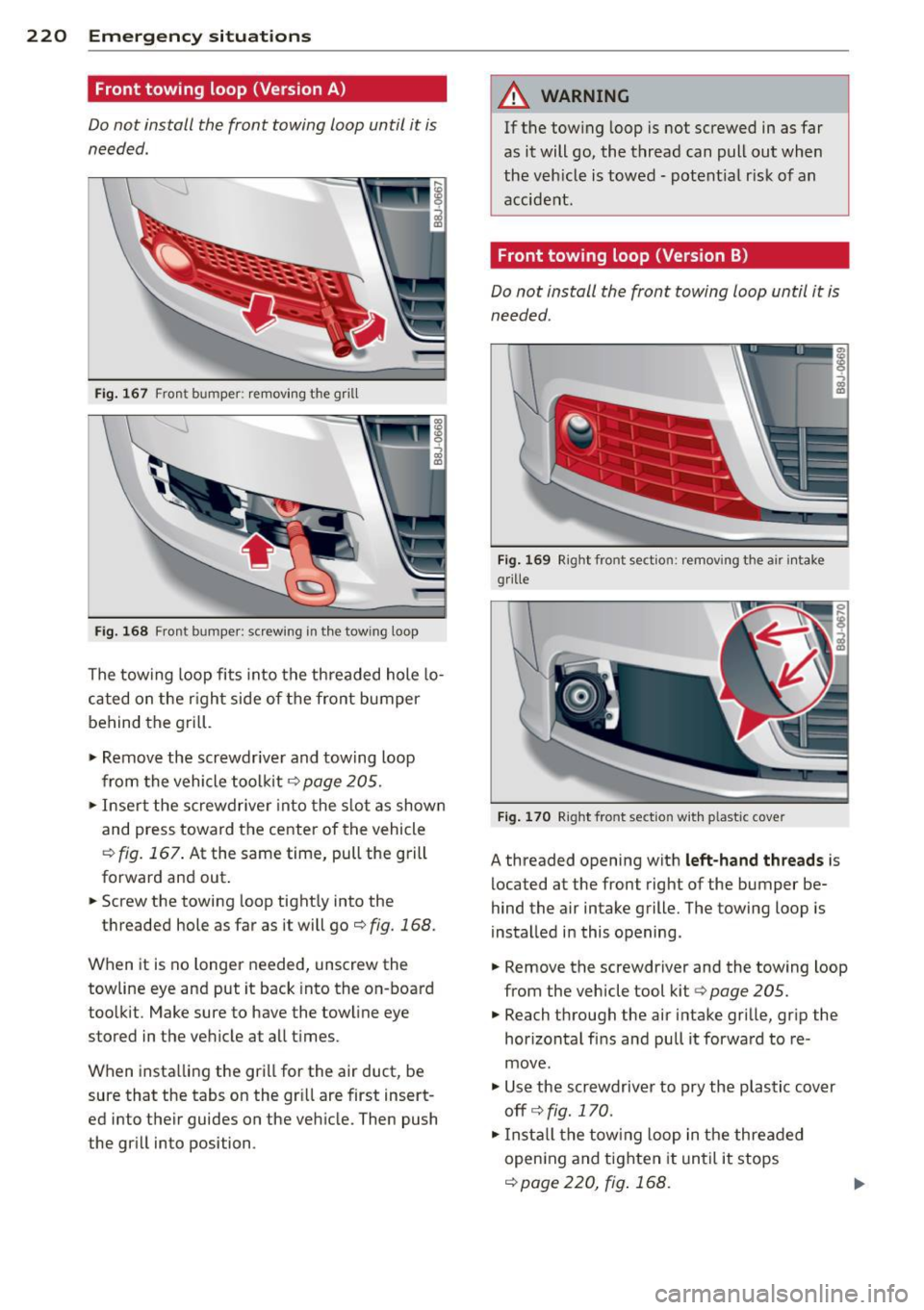
Fig. 1 67 Fro nt bumper : rem ov ing t he grill
Fi g. 16 8 Fron t bumper: screw ing in the tow ing loop
The towing loop fi ts into the th readed hole lo
c at ed on the r igh t si de of the fron t bumper
behind the g rill .
... Remove the screwdrive r and tow ing loop
from the vehicle tool kit
~ page 205 .
... Inse rt the screw driver into the s lot as show n
and press toward the ce nte r of the vehicle
¢
fig. 167 . At the same time, pull the grill
forward and out .
.,. Screw the towing loop tight ly into the
t h readed hole as far as it will go¢
fig. 168.
When it is no longer needed, unscrew the
towline eye and put it back into the on -board
too lkit . Make sure to have the towline eye
stored in the vehicle at a ll times.
When insta lling the gri ll for the air duct, be
sure that the tabs on the gr ill are first insert
ed into the ir guides on the veh icle. Then push
the gr ill into position .
A WARNING
-
If the towing lo op is not screwed in as far
as it will go, the t hread can pull out when
the veh icle is towed - potent ia l risk of an
accident.
Front towing loop (Version B)
Do not install the front towing loop until it is
needed .
Fig. 169 Right fro nt sect io n : r em ov ing the air in take
g ri lle
Fi g. 170 Rig ht fro nt sect io n w it h plastic cove r
A threaded opening with left-hand threads is
located at the front right of the bumper be
hind the air intake grille. The towing loop is
insta lled i n this opening .
.,. Remove the screwdriver and the towing loop
from the vehicle tool kit¢
page 205 .
... Reach through the air intake grille, grip the
hor izontal fi ns and pull it forward to re
move.
... Use the screwdrive r to pry the plastic cov er
off ¢
fig. 170.
... In stall th e tow ing loop in the threade d
open ing and tighten it un til it stops
¢ page 220, fig . 168 . .,..
Page 223 of 244
Remove the towing loop when you are done
using it and place it back in the vehicle tool
kit. A lways keep the tow ing loop in the vehi
cle.
When insta lling the air intake grille, insert the
tabs on the grille in the mounts on the vehicle
first . Then press the gri lle in to secure it.
A WARNING
If the towing loop is not tightened until it
stops when installing, the threads may be
pulled out when tow ing the veh icle and
that could cause an accident.
Rear towing loop
Do not install the rear towing loop until it is
needed.
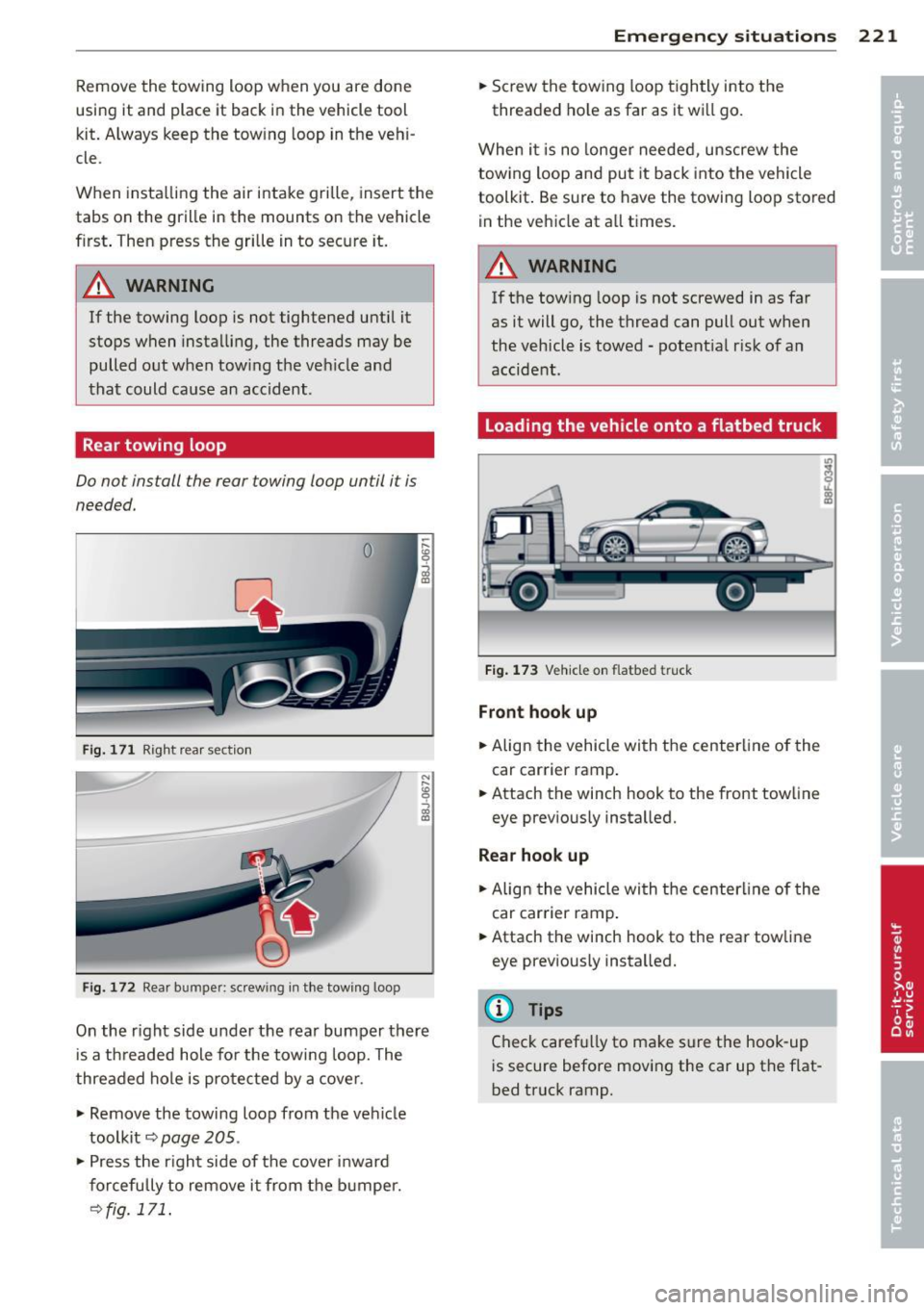
Fig. 171 Right rea r sect ion
Fi g. 17 2 Rear bumper: screwing in t he tow ing loop
On the r ight side under the rear bumper there
i s a t hreaded hole for the tow ing loop. The
threaded hole is pro tected by a cover.
"' Remove the towing loop from the vehicle
toolkit~
page 205 .
"'Press the right side of the cover i nward
f orcefully to remove it from the b umper.
¢fig. 171.
Emergenc y situ ation s 221
"'Screw the towing loop t ightly into the
threaded ho le as far as it wi ll go.
When it is no longe r needed, unscrew the
towing loop and put it back into the vehicle
toolkit . Be sure to have the towing loop sto red
in the vehicle at all times.
A WARNING
If t he tow ing loop is not screwed in as far
as it will go, the thread can pull out when
the vehicle is towed -potent ia l risk of an
accident.
loading the vehicle onto a flatbed truck
Fi g. 17 3 Vehicle on flatbed truck
Front hook up
"'Align the vehicle wi th the centerline of the
car carrier ramp.
"' Attach the winch hook to the front towline
eye prev iously insta lled.
Rear hook up
"' Alig n the vehicle wi th the center line of the
car car rier ramp .
"' Attach the winch hook to the rear tow line
eye previously insta lled.
(D Tips
Check caref ully to ma ke s ure the hook-up
i s secure before moving the car up the flat
bed truck ramp.
Page 235 of 244
E
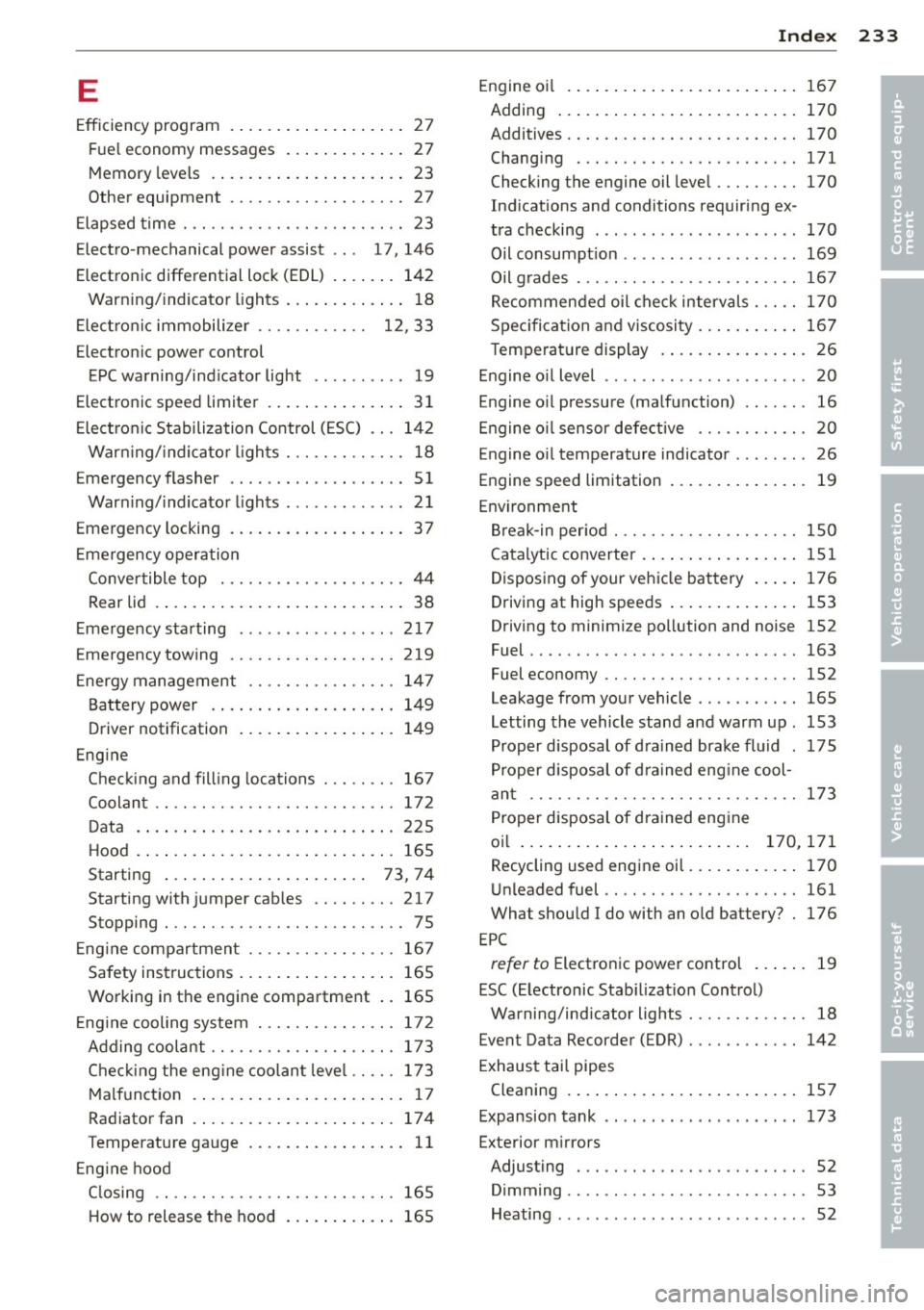
Efficiency program ...... ... .. .. .. .. .. 27
F ue l economy messages ... .. .. .. .. .. 27
Memory leve ls . . . . . . . . . . . . . . . . . . . . . 23
Other equ ipment .. ....... .. .. .. .. .. 2 7
E lapsed t ime . .. .... .... ... .. .. .. .. .. 23
E lectro -mechanical power assist . . . 17, 146
El ectronic differential lock (EDL) . ... ... 142
Warn ing/ indicato r lights ... .. ...... .. 18
E lect ro nic immobilize r . . . . . . . . . . . . 12, 33
Electro nic power control
EPC warning/ind icator light .. ... .... . 19
El ectro nic speed limite r .. ... .. .. .. .. .. 31
E lec tronic Stabilization Control ( ESC) .. . 142
War ning/ indicator ligh ts ... .. .. .. .. .. 18
E mergency fla sher . . . . . . . . . . . . . . . . . . . 51
War ning/ indicato r lights ............ . 21
Emergency locking . ..... ... .. .. .... .. 37
E me rgency opera tion
Conve rtible top ........ .. .. .. .. .. .. 44
Rear lid . . . . . . . . . . . . . . . . . . . . . . . . . . . 38
E mergency sta rting . ....... .. .. .. .. . 217
Emergen cy towing ..... .. .. .. .. .. .. . 219
Energy management ....... .. .. .. .. . 14 7
B attery power . . . . . . . . . . . . . . . . . . . . 1 49
D river notification ..... ... .. .. .. .. . 149
E ng ine
C hec king and fill ing locations . .. .. .. . 167
Coolan t .. .. .... .. . .... .. .... .. .. . 172
D ata . ..... .. .. .. .. .... ... .. .. .. . 225
Hood .. .. .. .. .. .. .. .... ... .. .. ... 165
Starting . . . . . . . . . . . . . . . . . . . . . . 73, 74
Startingwith jumpercab les .. .. .. .. . 21 7
Stopping . .. ............. .... .. .. .. 75
E ng ine compartmen t ..... .. .. .. .. .. . 16 7
Safety ins tructions ..... ... .. .. .. .. . 165
Wo rking in the engine compartment .. 165
E ng ine cooling system ...... .. .. .. .. . 17 2
Adding cool ant ........... .. .. .. .. . 173
Chec king the eng ine coolan t leve l .. .. . 173
M alfunct ion . . . . . . . . . . . . . . . . . . . . . . . 17
Radiator fan . . . . . . . . . . . . . . . . . . . . . . 17 4
T emperature ga uge .... ... .. .. .. .. .. 11
E ng ine hood
C losing .. .. ............. .... .. ... 165
H ow to release the hood ... .. .. .. .. . 165
Inde x 233
Engine o il . ... .... .. . .. .. ..... ... . .
167
Adding ... .. .. .... . ... ...... ... . . 170
Additives . ... .. .. .. . .. ... .... ... . . 170
Changi ng ... .. .. ........ ........ . 171
Checking the engine oil leve l ....... . . 170
Ind ications and conditions requir ing ex -
t ra checking ... .. .. . .. ... ... .. .. . . 170
Oil consumpt ion ... ............... . 169
Oil g rades . .. .. .. .. . ... .......... . 16 7
Recommende d oi l che ck intervals . .. . . 170
Spec ificat ion and viscosity .... ... .. . . 167
Temperature display . .. ..... ... .. .. . 26
Engine o il leve l .. .. .. ............... . 20
Engine o il pressure (ma lfunction) .. .. .. .
16
Engine o il sensor defective ......... .. . 20
E ngine o il temperature indicato r ...... . . 26
Engine speed limitation ... .... ... .. .. . 19
En vir onment
Br eak-in per iod . .. .... .... ..... .. .. 150
C atalytic converter . .. .. ..... ... .. .. 151
Disposing of your vehic le battery ... .. 176
Driving at high speeds .. ..... ... .. .. 153
Driving to minimi ze po llution and noise 152
Fuel ...... .. .. .. .. .. .... ....... .. 163
Fuel economy . . . . . . . . . . . . . . . . . . . . . 152
Leakage from your vehicle ........... 165
Letting the vehicle stand a nd warm up . 153
Proper disposal of dra ined brake flu id . 175
P roper disposal of d ra ined eng ine cool-
an t ...... .. .. .. ................. 173
Proper disposal of d rained eng ine
oi l .. ... .. .. .. .... . ... ...... 170,171
Recycling used engine oil ..... ... .. .. 170
Un leaded fuel .. .. .. ............... 161
Wha t shou ld I do with an o ld bat tery? . 176
E PC
refer to E lect ronic power control ... ... 19
ESC (E lectronic Stab ilizat io n Control)
Wa rning/ind icator lights ... ..... .. .. . 18
Event Da ta Recorder (EDR) .......... .. 142
E xhaus t tai l pipes
Cleaning . ... .... .. . .. .. ..... ... .. 157
Expansion tank . . . . . . . . . . . . . . . . . . . . . 173
Exterior m irrors
Adjusting . . . . . . . . . . . . . . . . . . . . . . . . . 52
Dimming .. .. .. .... .......... ...... 53
Heating ..... .. .... .......... ...... 52
•
•
Page 241 of 244
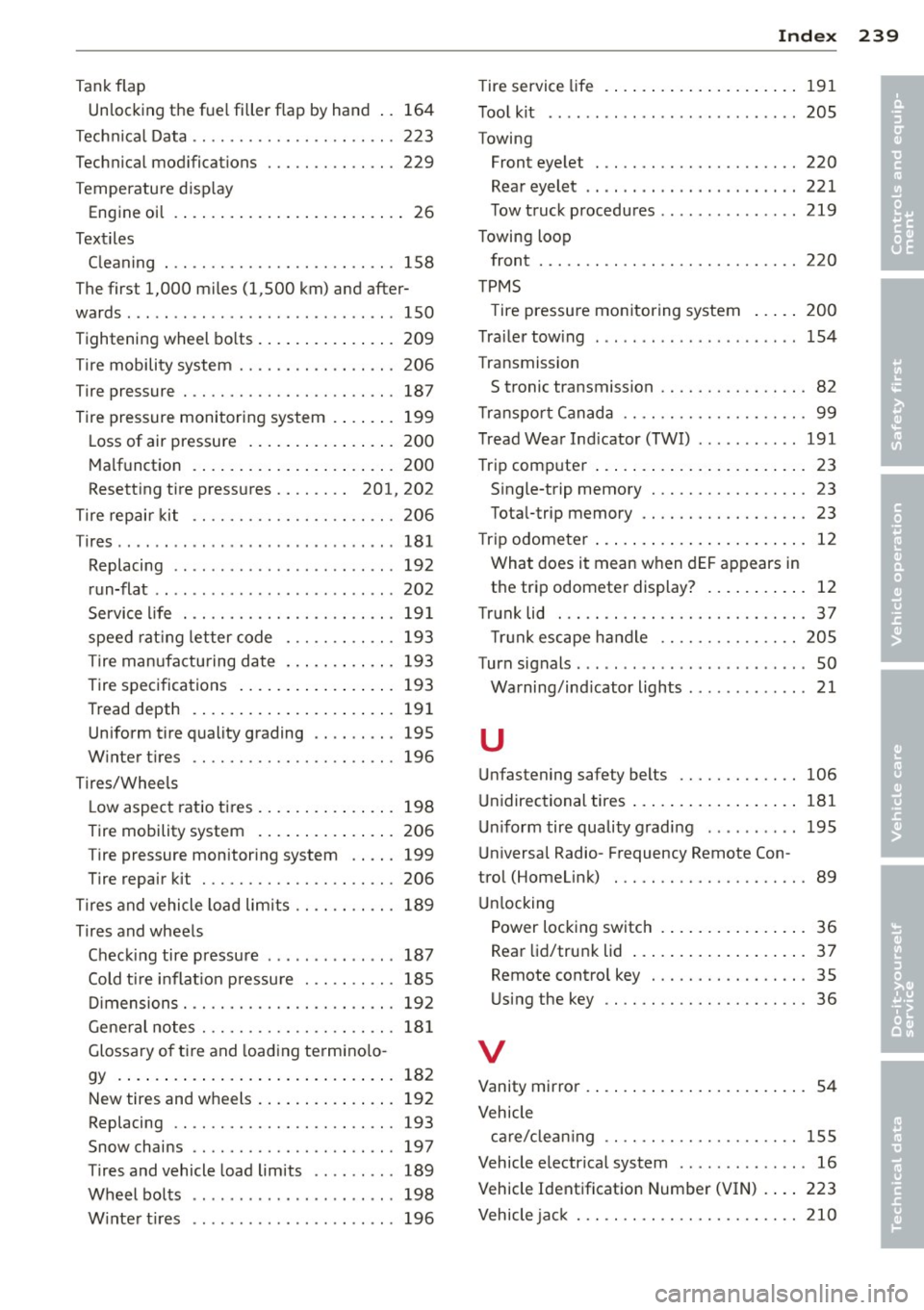
Tank flap Unlocking the fue l filler flap by hand 164
Techn ical Data ............. .... .. ... 223
Technical mod ificat ions ..... .. .. .. .. . 229
Temperature d isp lay
Eng ine oi l .. ... .. ..... ... .. .. .. .... 26
Textiles Clean ing . .. .. ........... .. .. .. ... 158
The first 1,000 miles (1,500 km) and after-
wards . . . . . . . . . . . . . . . . . . . . . . . . . . . . . 1 SO
Tightening wheel bo lts ... ... .. .. .. .. . 209
T ire mobility system ........ .. .. .. .. . 206
Tire pressure . ............. .... .. .. . 187
Tire pressure monitoring system . ... .. . 199
L oss of air pressure .... ... .. .. .. .. . 200
M alf unction . ... ...... ... .. .. .. ... 200
Resett ing tire pressures . . . . . . . . 201, 202
T ire repai r kit ............. .... .. ... 206
T ires ...... ... ...... ............. .. 181
Replacing . . . . . . . . . . . . . . . . . . . . . . . . 192
run-flat .................... ... ... 202
Service life . . . . . . . . . . . . . . . . . . . . . . . 19 1
spee d rating letter code ... .. .. .. .. . 193
Tire man ufacturing date ... .. .. .. .. . 193
Tire specifica tions ..... ... .. .. .. .. . 193
Tread depth . ..... .... ... .. .. .. ... 191
Uniform t ire quality grading .. .. .. .. . 195
W inte r tires ............. .... .. ... 196
T ires/Whee ls
L ow aspec t ratio tires ... ... .. .. .. .. . 198
Tire mobility system ... ... .. .. .. .. . 206
T ire pressure monitoring system .. .. . 199
Tire repa ir kit ............ .... .. .. . 206
T ires and vehicle load lim its .. .. .. .. .. . 189
Tires and whee ls
Checking tire pressu re ...... ... ... .. 187
Cold t ire inflat ion p ressu re . .. .. .. .. . 185
Di mensions . .. ........... .. .. .. ... 19 2
Ge neral notes ............ .... .. .. . 18 1
Glossary of t ire and load ing termino lo -
gy . ..... .. .. ... .. ..... ... .. .. ... 182
New tires and wheels . . . . . . . . . . . . . . . 192
Replacing .. ............. .... .. ... 193
Snow chains .. ........... .. .. .. ... 197
T ires and vehicle load limits .. .. .. .. . 189
Wheel bol ts . . . . . . . . . . . . . . . . . . . . . . 198
W inte r tir es .............. ... ... .. 196
Inde x 239
Tire service life . ..... . .. .. ..... ... .. 191
Tool kit .......... .. ............... 205
Towing Front eye let . .. .. ................. 220
Rear eyelet .. .. .. .. . ... ...... ... .. 221
T ow t ruck procedures .......... .... . 219
Towing loop front ....... .. .. .... ............. 220
T PMS
T ire pressure monitoring system ... .. 200
T ra iler tow ing ... .. .. . .. .... .... .. .. 154
Transmission S tronic transmission ........... .. .. . 82
T ran spo rt Canada .. .. . .............. . 99
T read Wea r Ind icator (TWI) ........... 191
T rip comp ute r . .... .. . .. .. ..... ... .. . 23
S ingle-trip memory ................ . 23
Tota l-trip memory ................. . 23
T rip odometer ... .. .. .. .. ...... ... .. . 12
Wha t does it mean w hen dEF appears in
the trip odometer display? ... ... .. .. . 12
T runk lid ... .. .. .. ................. . 37
T ru nk escape ha ndle ........... .. .. 205
Turn signals . .. .. .... ... ....... ...... SO
Warning/ind icator lights . .......... .. 21
u
Unfastening safety belts
106
U nidirectional tires ... . ... .... ... .. .. 181
Uniform tire quality grading ......... . 195
U niversa l Radio- F requency Remote Con -
trol (Homelink) . .. ................. . 89
Unl ocking
Power locking switc h .... .... ... .. .. . 36
Rea r lid/trunk lid .... .. ..... ... .. .. . 37
Remote contro l key . ........... .... . 35
U sing the key .. .. .... ........... .. . 36
V
Vanity mirror . . . . . . . . . . . . . . . . . . . . . . . . 54
Vehicle car e/clea n in g .. ...... ......... .. .. 155
Vehicle electrica l system . .. .. ... ... .. . 16
Vehicle Identification Number (VIN) . ... 223
Vehicle jac k ... .. .... ... .......... .. 210
•
•