oil AUDI TT ROADSTER 2014 Owner's Guide
[x] Cancel search | Manufacturer: AUDI, Model Year: 2014, Model line: TT ROADSTER, Model: AUDI TT ROADSTER 2014Pages: 244, PDF Size: 60.87 MB
Page 175 of 244
Checking the engine coolant level
The engine coolant level can be checked with
a quick glance .
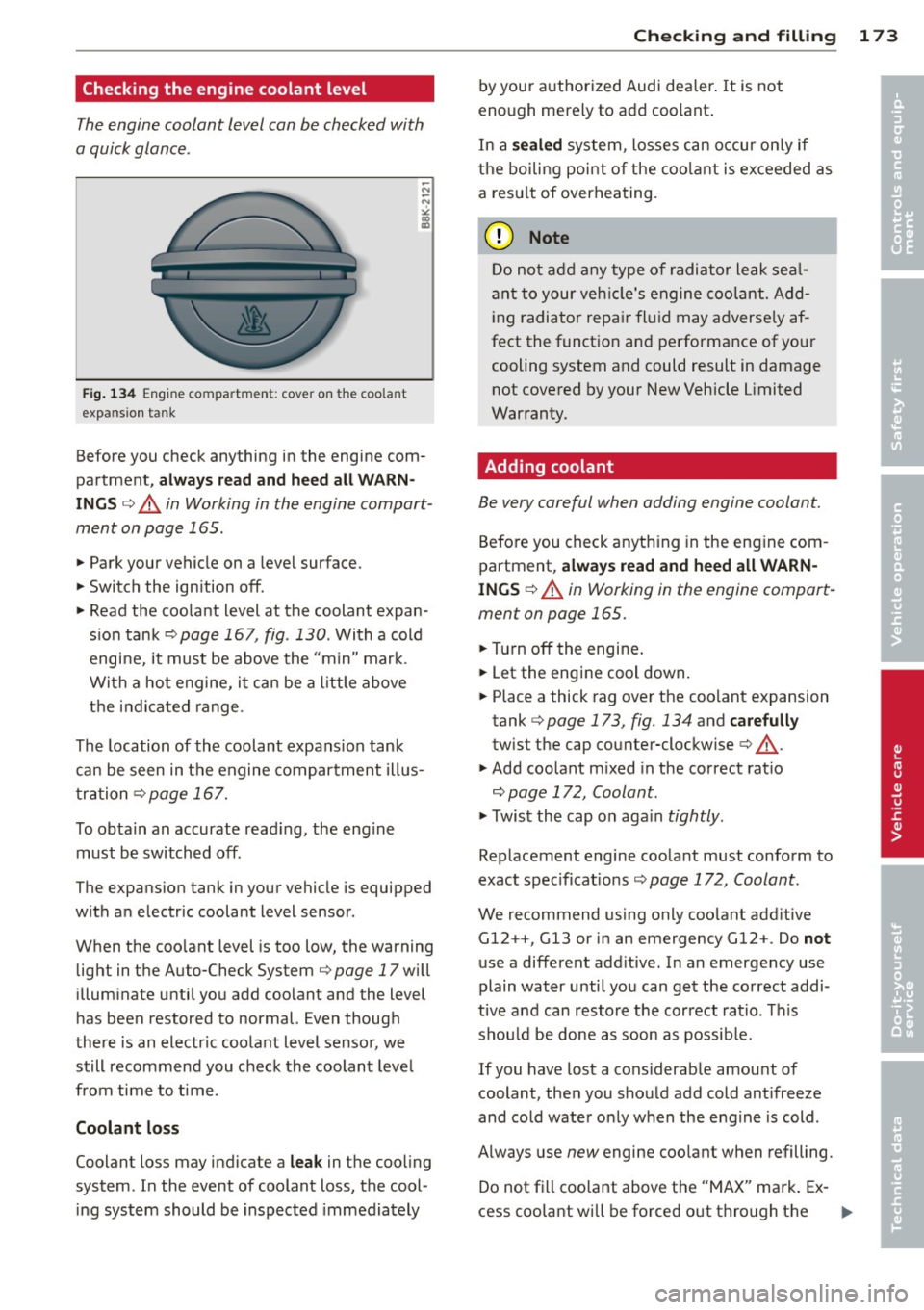
Fig. 134 Eng ine compartme nt: cover o n the coolant
expansion tank
Before you check anything in the engine com
partment,
a lway s read and he ed all WARN
INGS ¢ A in Working in the engine compart
ment on page 165.
.,. Park your vehicle on a level surface.
.,. Switch the ignition
off .
.,. Read the coola nt level at the coolant expan
s ion tank
¢ page 167, fig . 130. With a cold
engine, it must be above the "min" mark.
With a hot engine, it can be a l ittle above
the indica ted range.
The location of the coolant expans ion tank
can be seen in the engine compar tment illus
tration
¢page 167.
To obtain an accurate read ing, the eng ine
must be switched
off.
The expans ion tank in your vehicle is equipped
with a n electric coolant level sensor.
When the coo lant level is too low, the warning
light in the Auto-Check System¢
page 17 will
illum inate until you add coolant and the level
has been restored to normal. Even though
there is an electric coolant level sensor, we
still recommend you check the coolant leve l
from time to time.
Coolant loss
Coolant loss may indicate a leak in the cool ing
system. In the event of coolant loss, the cool
i ng system should be inspected immediately
Checkin g and fillin g 173
by your authorized Audi dea ler . It is not
enough merely to add coo lant .
In a
s ealed system, losses can o ccu r on ly if
the boiling point o f the coo lant is exceeded as
a res ult of overheating.
(D Note
Do not ad d any type of radiator leak sea l
ant to your veh icle's engine coo lant. Add
ing radiator repa ir flui d may adverse ly af
fect the function and performance of yo ur
cooling system and could result in damage
not covered by your New Vehicle Limited
War ranty.
Adding coolant
Be very careful when adding engine coolant.
Before you check anyth ing in the engine com
partment,
alway s read and heed alt WARN
INGS ¢ A in Working in the engine compart
ment on page 165.
... Tu rn off the engine .
.,. Let the engine cool down.
.,. Place a thick rag ove r the coolant expansion
tank ¢
page 173, fig. 134 and carefully
twist the cap counter-clockwise ¢_& .
.,. Add coo lant m ixed in the correct rat io
¢ page 172, Coolant .
.,. Twist the cap on aga in tightly.
Rep lacement engine coo lant must conform to
exact specificat ions¢
page 172, Coolant.
We recommend using only coolant add itive
Gl2 ++, Gl3 or in an emergency Gl2+. Do not
use a different additive. In an emergency use
plain water until you can get the correct addi
tive and can resto re the correct ratio . Th is
shou ld be done as soon as possib le.
If you have lost a cons iderab le amount of
coolant, then you should add cold ant ifreeze
and co ld wate r on ly when the engine is cold.
Always use
new engine coolant when refilling.
Do not fill coolant above the "MAX" mark. Ex-
cess coolant will be fo rced o ut through the ..,_
•
•
Page 184 of 244
182 Tire s and wheel s
-Never mount used tires on yo ur vehicle if
yo u are not sure of their "previous histo
ry." Old used tires may have been dam
aged even though the damage cannot be
seen that can lead to sudden t ire failure
and loss of vehicle control.
- If you notice unusual vibration or if the
vehicle pulls to one side when driving, al
ways stop as soon as it is safe to do so
and check the wheels and tires for dam
age.
(D Note
Please note that summer and wi nte r tires
are designed for the cond itions that are
Glossary of tire and loading terminology
Accessory weight
means t he comb ined we ight (in excess of
those sta ndard items which may be rep laced)
of au toma tic tra nsmission, power s teer ing,
power brakes, power windows, power seats,
ra dio, and heater, to the extent that th ese
items are availab le as factory -installed equip
ment (whether installed or not) .
Aspect ratio
means t he ratio of the he ight to the w idth of
the tire in percent . Numbers of 55 or lower in
dicate a low sidewall for improve d steering re
sponse and better overall handling on dry pavement .
Bead
means the part of the ti re that is made of
steel wires, wrapped or reinforced by ply cords
and that is shaped to fit the rim.
Bead separation
means a b reakdown of the bond between
components in the bead.
Cord
means the strands forming the plies in the
tire . typ
ica l in those seasons . Aud i recommends
using winter tires during the winter
months . Low temperatures signif icant ly
decrease the e lasticity of summer tires,
which affects tract ion a nd brak ing ability.
If summer tires are used in very co ld tem
peratures, cracks ca n form on the tread
bars, res ulting in permanent tire damage
that can cause loud driving no ise and un
balan ced t ires. Audi i s not responsible for
th is type of damage .
Cold tire inflation pressure
means the tire p ress ure recommended by t he
vehicle manufacture r fo r a tire of a des igna ted
s iz e t hat has not bee n driven for more than a
coup le of miles (k ilometers) at low speeds in
t h e three hour period before the tire pressure
is measured or adjusted.
Curb weight
mea ns the we ight of a motor ve hicle with
standard equipment in clu din g the max imum
capacity of fuel, oil, and coolant, air condi
tioning and additional weight of optiona l
equipment.
Extra load tire
me ans a tire designed to ope rate a t higher
loads and at highe r inflation p ress ures than
the corresponding standard tire. Extra load
tires my be identified as "XL", "xl", "EXTRA
LOAD", or "RF" on the sidewall.
Gross Axle Weight Rating ("GAWR ")
me ans the lo ad -c a rry ing c apac ity of a s ingle
axle system , measured a t the tire-ground in
terfaces.
Gross Vehicle Weight Rating ("GVWR ")
mea ns the max imum total loaded we ight of
t h e ve hicl e. .,.
Page 191 of 244
-If the tire pressure is too low or too high,
the tires w ill wear prematurely and the
vehicle will not handle we ll.
- If the tire is not flat and you do not have
to change a wheel immed iate ly, drive at
reduced speed to the nearest service sta
t ion to check the tire pressure and add
air as required.
([) Note
Driving without va lve stem caps ca n cause
damage to the tire va lves . To prevent this ,
always make su re that facto ry installed
valve stem caps on all wheels a re secure ly
mounted on the va lve.
@ For the sake of the environment
Underinflated tires will a lso increase the
fue l consumption .
Tires and vehicle load limits
There are limits to t he amount of load or
weight that any veh icle and any t ire can carry.
A veh icle that is overloaded w ill no t handle
well and is more diff icult to stop. Overloading
can not on ly lead to loss of veh icle contro l,
but can a lso damage important parts of the
ve hicle and can lead to sudden tire failure, in
cluding a blowout and sudden deflation that
can cause the veh icle to crash .
Your safety and that of yo ur passengers a lso
depends on making sure that load limits are
no t exceeded. Vehicle load includes everybody
and everyth ing in and on the vehicle . These
load limits a re techn ica lly refer red to as the
ve hicle's
Gro ss Vehicl e W eight Rat ing
(" GVWR ").
T he "GVWR " includes the we ight of the basic
vehicle, all factory installed accesso ries , a full
tank of fue l, oil, coo lant and other fluids pl us
maximum load. The maximum load includes
the number of passengers th at the ve hicl e is
i ntended to carry ("seating capacity") with an
assumed weight of 150 lbs (68 kg) for eac h
passenger at a designated seating position
Tire s an d wheel s 189
and the total weight of any luggage i n the ve
hicle .
T he
Gro ss Ax le Weight Rating ( " G AWR ") is
the max imum load th at can be applied at each
of the vehicle's two axles .
T he Gross Vehicle Weight Rat ing and the
G ross Ax le Weig ht Ra ting are l iste d on the
s af ety comp liance s ticke r label lo cated on the
driver's side 8-pillar . Your Audi has 2 seating
positions. Each seating position has a safety
belt ~
page 101, Safety belts.
The fac t that there is an upper limit to yo ur
vehicle's G ross Vehicle Weight Rating means
that the total weight of whatever is being car ried in the vehicle is lim ited . The more passen
gers in the vehicle or passengers who are
heavier than the standard we ights assumed
mea n that less we ight can be carried as lug
gage .
The tire pressure label on your Audi also lists
the maximum combined weight of a ll of the
occupants and luggage or other cargo that
t h e ve hicle can ca rry . Fo r th e locat ion of the
label
~ page 185, fig . 138 .
_&. WARNING
Overloading a veh icle can cause loss of ve
h icl e co ntro l, a crash or o ther accide nt, se
rio us pe rsonal inj ury, and even dea th.
- Ca rrying more we igh t tha n your ve hicle
was des igned to carry wi ll prevent the
veh icle from handling properly an d in
crease the risk of the loss of vehicle con
trol.
- T he b rakes on a vehicle that has been
overloaded may not be able to stop the
veh icle w ith in a safe distance .
- Tires on a vehicle that has been over load
ed can fail suddenly, incl uding a blowo ut
and sudden deflation, causing loss of
control and a crash.
•
•
Page 194 of 244
192 Tires and whe els
& WARNING
Sudden tire failure can lead to loss of con
trol, a crash and serious persona l injury!
- Never drive a vehicle when the tread on
any tire is worn down to the wear indica
tors .
- Worn tires are a safety hazard, they do
not grip well on wet roads and increase
yo ur risk of "hydroplan ing" and loss of
control.
- Always keep chemicals that can cause tire damage, such as grease, oil, gasoline and brake fluid away from t ires.
- Tires age even if they are not be ing used
and can fail suddenly , especially at high
speeds . T ir es that are more t han 6 years
o ld can only be used in an emergency
and then with special care and at lower
speeds.
- Never mount used ti res on yo ur vehicle if
yo u are not sure of their "previous histo
ry." Old used tires may have been dam
aged even though the damage cannot be
seen that can lead to sudden tire failure
and loss of vehicle control.
New tires and replacing tires and wheels
New tires and wheels have to be broken in .
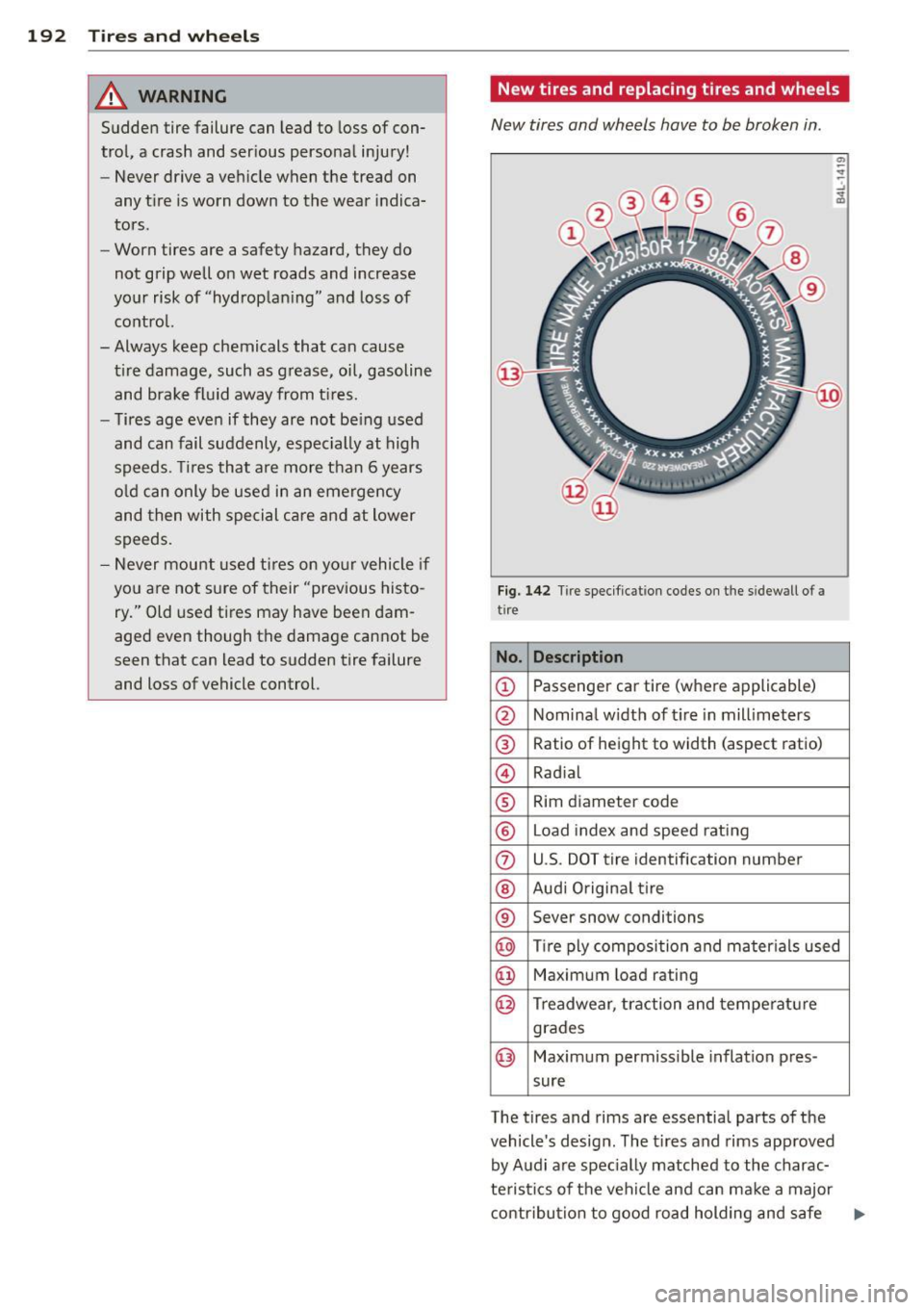
Fig. 142 Tir e specificat ion codes on t he s idew all o f a
t ire
No. De scription
® Ratio of height to width (aspect ratio)
© Rad ial
® Rim diamete r code
® Load index and speed rating
(J) U.S . DOT tire ident ification number
® Aud i Origina l t ire
® Seve r snow cond it ions
@ T ire ply composi tion and mater ials used
@ Max imum load ra ting
@ Treadwear, traction and tempe rature
grades
@ Maximum permiss ible inflation pres -
sure
The tires and rim s are essential parts of the
vehicle's design . The t ires and rims app roved
by Audi a re spec ially matched to the charac
teristics of the vehicle and can make a major contribu tion to good road holding and safe .,..
Page 200 of 244
198 Tire s and wheel s
snow cha ins a re suitab ly covered. Check
the position of the snow chains after driving a few yards and correct if neces
sary. Follow the instr uctions from the
snow cha in manufacturer when doing so.
{O) Tips
Where snow cha ins are mandatory oncer
tain roads, this norma lly also applies to
veh icles with all-wheel dr ive.
Wheel bolts
Wheel bolts must always be tightened to the
correc t torque .
The design of whee l bolts is matched to the
factory installed r ims . If different rims are fit
ted, the correct wheel bolt s with the r ight
length and correctly shaped bol t heads mus t
be used . This ensures that wheel s are fitted
securely and that the brake system functions
correctly .
In certain circumstances, you may not use
wheel bolts from a d iffe rent vehicle -even if it
i s the same model
Q page 228.
A WARNING
Imprope rly tig htened o r maintained whee l
bolts can be come loose ca using loss of
cont ro l, a co llision and serious person al in
jury .
- Always keep the w heel bol ts and the
t h reads in t he wheel hubs clean so the
wheel bolts can t urn easily and be p rop
er ly t ightened .
- N ever grease or oil the wheel bo lt s an d
the threads in the wheel h ubs. They can
become loose w hile d riving if greased or
oi led, even if tightened to the specif ied
torque.
- Only use whee l bolts that be long to the
rim being installed.
- Never use different whee ls bolts on your
vehicle .
- Always mai ntai n the co rrect tighte ning
torq ue for the wheel bolts to reduce the
risk of a wheel loss. If the tightening tor- que of the whee
l bolts is too low, they
can loosen and come out when the vehi
cle is mov ing. If the tig hte ning torq ue is
too high, the w heel bolts a nd threads
can be damaged and the whee l can be
come loose.
(D Note
The specified torque for t he whee l bolts is
90 ft lb (120 Nm) with a tolerance of± 7,4
ft lb(± 10 Nm). Torque whee l bolts diago
nally . After changing a whee l, the to rq ue
must be checked as soon as possible with a
torque w rench - prefe rably by an author
iz ed A udi dealer or quali fied workshop .
Low aspect ratio tires
Your Audi is factory-eq uipped w ith low aspect
ratio tires. These tires have b een tho ro ughly
tested and been se lected specifically for your
model for their supe rb performance, road fee l
and hand ling under a variety of driving condi
t ions . Ask your author ized Audi dealer for
more de tails .
The low aspect ratio of these t ires is ind icated
by a numeral of
55 or less in the tire 's s ize
designation . The numera l rep resents the ratio
of the tire 's s idewa ll height in relation to its
t read width exp ressed in percentage. Conven
tiona l tire s have a he igh t/w idth rat io of 60 or
more.
The p erformance of low-a spect-ratio tire s is
particularly sensitiv e to improper inflation
pre ssure. It i s ther efore important that low
aspect ratio tires are inflated to the specified
pre ssure and that the inflation pre ssure i s
regularly checked and maintained. Tire pre s
sures should be checked at least once a month and always before a long trip
Q page 187, Checking tire pressure.
What you can do to avo id tire and rim
damage
Low aspect ratio tires can be damaged mo re
easily by impact w ith po tholes, curbs, gul lies ..,.
Page 216 of 244
214 Fuses and bulbs
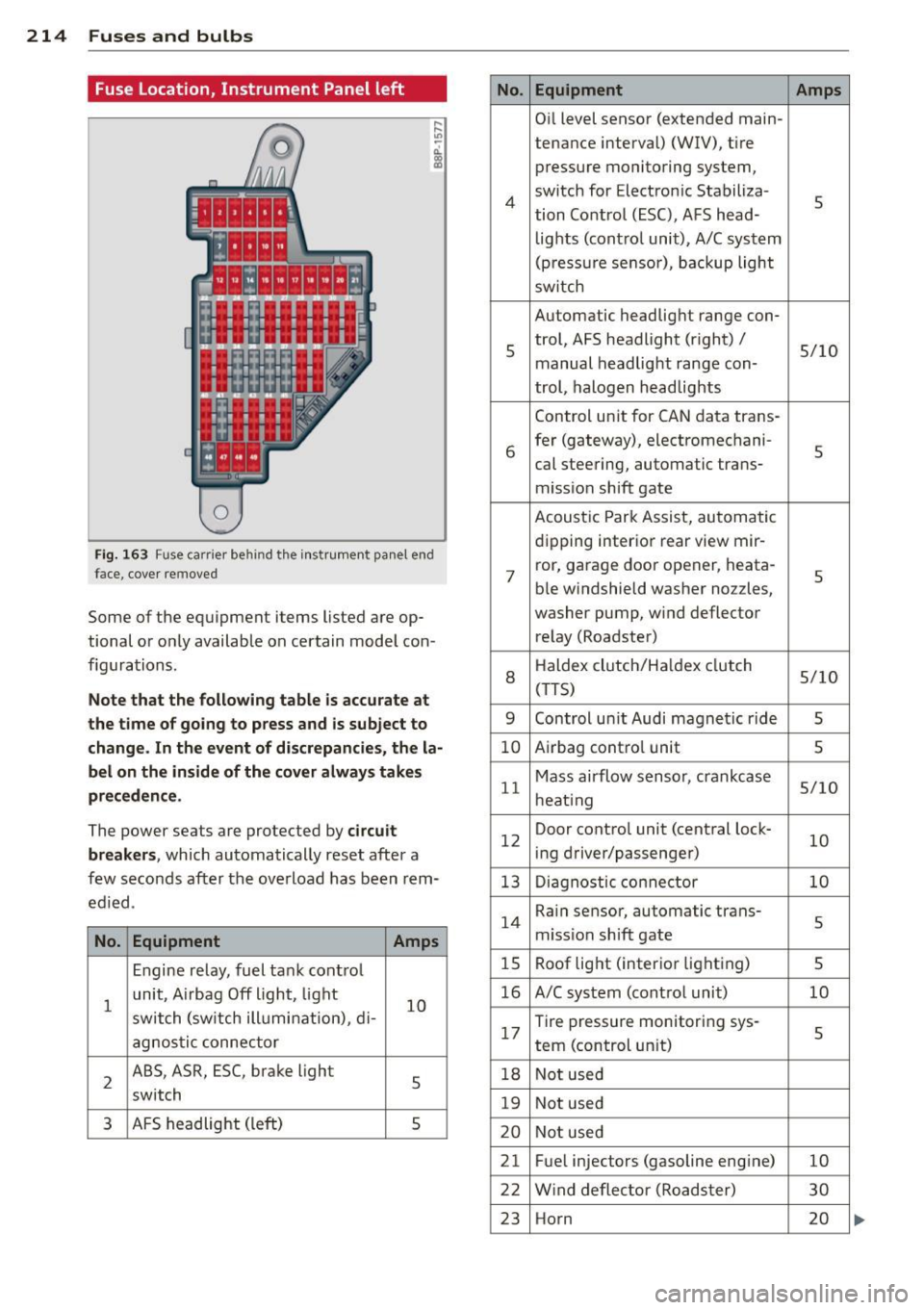
Fuse Location, Instrument Panel left
0
Fi g. 163 Fuse carrier behind the instrument panel end
face, cove r removed
Some of the equipment items listed are op
tional or only available on certain model con
figurations .
Note that the following table is accurate at
the time of going to press and is subject to
change. In the event of discrepancies, the la
bel on the inside of the cover always takes
preceden ce .
The power seats are protected by circuit
breaker s,
which automatically reset after a
few seconds after the overload has been rem
ed ied.
No . Equipment Amps
Engine relay, fuel tank control
1
unit, A irbag Off light, light
10 switch (sw itch illumination), d i-
agnos tic connector
2
ABS, ASR, ESC, brake light
5 switch
3 AFS headlight (left) s
No.
4
5
6
7
8
9
10
11
12
13
14
15
16
17
18
19
20
21
22
23
Equipment Amps
Oil level sensor (extended main-
tena nce interval) (WIV), tire
pressure monitoring system,
switch for Electronic Stabiliza-
s tion Control (ESC), AFS head-
lights (control unit), A/C system
(pressure sensor), backup light
sw itch
Automatic headlight range con-
trol, AFS headlight (right) /
5/10
manual headlight range con-
trol, halogen headlights
Control unit for CAN data trans-
fer (gateway), electromechani-
s cal steering, automatic trans-
mission shift gate
Acoustic Park Assist, automatic
dipping interior rear view mir- ror, garage door opener, heata-
s ble windshield washer nozzles,
washer pump, wind deflector
relay (Roadster)
H aldex clutch/Ha ldex clutch
5/10 (T TS)
Control un it Audi magnetic ride
s
Airbag contro l unit s
Mass airflow sensor, crankcase 5/10
heating
Door control unit (central lock-
10 ing driver/passenger)
Diagnostic connector
10
Rain sensor, automatic trans-
s miss ion shift gate
Roof light (interior lighting)
5
A/C system (control unit) 10
Tire pressure monitoring sys-
5 tern (control un it)
Not used
Not used
Not used
Fuel injectors (gasoline engine)
10
Wind deflector (Roadster) 30
Horn 20
Page 217 of 244
No. Equipment 24 Transmission (control unit)
25 Heater rear window Coupe/
heated rear window Roadster
26 Driver's side power window
27 Passenger's s ide power window
28 Not used
29 Washer pump
30 Cigarette lighter
31 Starter
32 Steering column module
33 Instrument cluster
34 Radio navigation system, radio
35 Audio amplifier
36 Engine (control un it)
37 CAN (Gateway)
38 Cigarette lighter
39 Not used
40 Not used
41 Not used
42 Not used
43 Not used
44 Not used
45 Not used
46 Not used
47 SOARS
tuner, cell phone pack-
age, TV tuner
48 VOA inte rface
49 Not used
Fuse location, left side of engine
compartment Amps
15
30/20
30
30
15
20
40
5
5
20/15
30 10
5
20
5
5
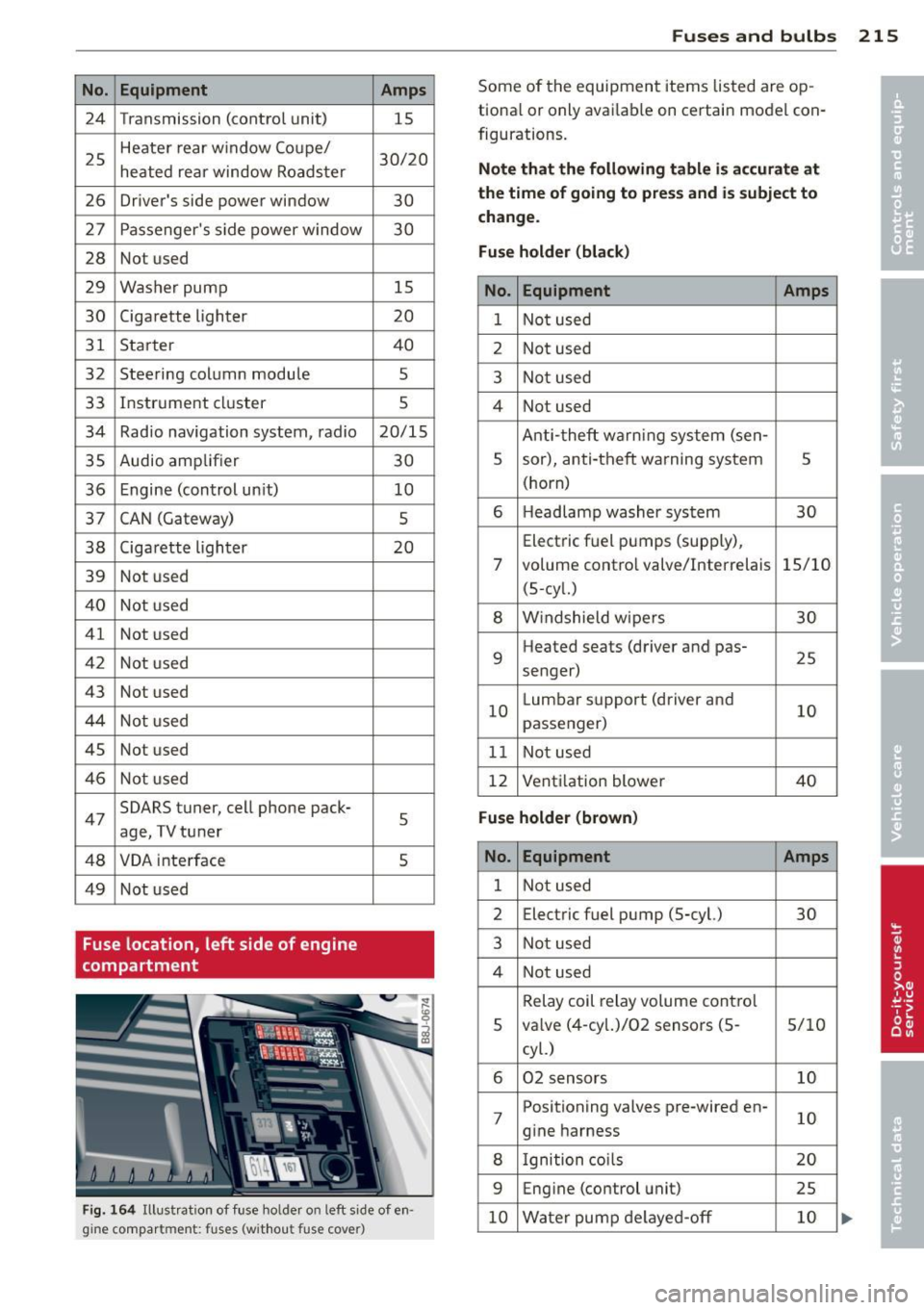
Fig. 164 Illustrat ion of fuse ho lder on left side of en
gine compart ment: fuses (without fuse cover)
Fuse s and bulb s 215
Some of the equipment items listed are op
tiona l or only avai lab le on certain model con
figurations.
Note th at the foll owing t abl e is ac cur ate at
the time of going t o pre ss and i s subject to
ch ang e.
Fus e holder (bla ck )
No. Equipment Amps
1 Not used
2 Not used
3 Not used
4 Not used
Anti-theft warning system (sen-
5 sor), anti-theft warning system
5
(horn)
6 H
eadlamp washer system
30
Electric f uel pumps (supp ly),
7 volume contro l valve/Interrelais 15/10
(5-cy l.)
8 W indshield w ipers 30
9 Heated
seats (driver and pas-
25
senger)
10 L
umbar support (driver and
10
passenger)
11 Not used
12 Vent
ilation blower
40
Fu se holder (brown )
No. Equipment Amps
1 Not used
2 Electric
fuel pump (5-cyl.)
30
3 Not used
4 Not used
Relay coil relay volume cont ro l
5 va
lve (4-cy l.)/02 sensors (5 -
5/10
cyl.)
6 02 sensors 10
7 Positioning valves pre-wired en-
10
g ine harness
8 Ignition coi ls 20
9 Eng
ine (control unit)
25
10 Water pump de layed-off 10
Page 224 of 244
222 Emergency situations
Lifting vehicle
Lifting with workshop hoist and with
floor jack
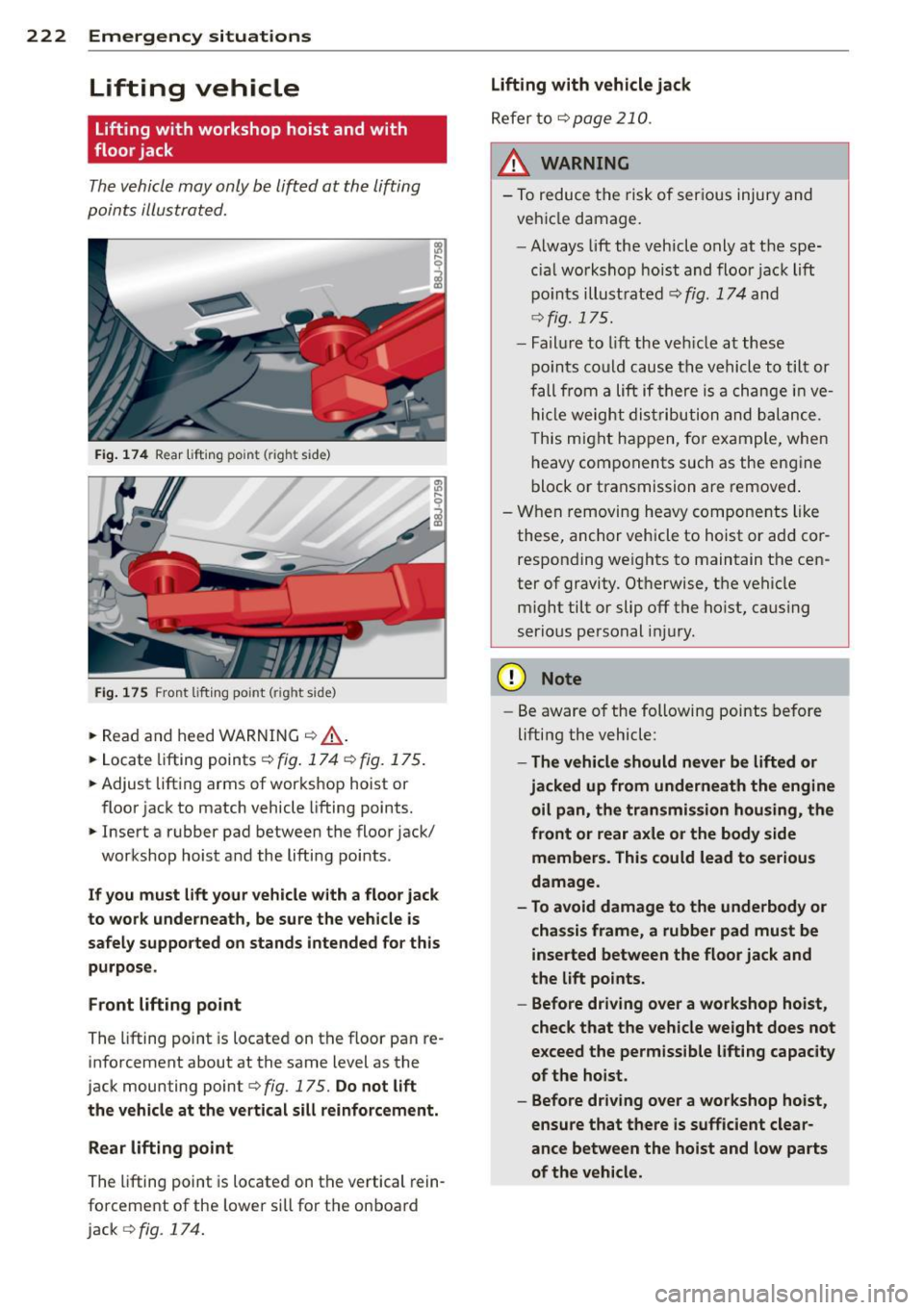
The vehicle may only be lif ted at the lifting
points illustra ted.
F ig. 174 Rear lift in g poin t (ri gh t side)
Fi g. 1 75 Fro nt lift in g po int (r ig ht s ide)
• Read and heed WARNI NG ¢,& .
• Locate lifting points
r=> fig . 174 r=> fig . 1 75 .
• Adjust lift ing arms of wor ks h op hoist or
floor jack to match vehicle lifting points.
• In se rt a rubber pad between the floor jack/
workshop hoist and the lifti ng po ints.
If you must lift your vehicle with a floor jack
to work underneath, be sure the vehicle is safely supported on stands intended for this
purpose.
Front lifting point
The lifting point is locate d on t he floor pan re
info rcement about at the same level as the
jac k mounting point
r=> fig. 175. Do not lift
the vehicle at the vertical sill reinforcement.
Rear lifting point
The lifting point is locate d on t he vertical rein
forceme nt of the lower s ill for t he on boa rd
j ac k
t:!>fig . 174.
Lifting with vehicle jack
Refer to r=>page 210.
/n.. WARNING
-To re duce the risk of ser ious injury and
ve hicl e damage .
- Always lift th e ve hicle o nly at t he spe
c ia l works hop hoist and floor jac k lift
p o ints illust rated
t:!> fig . 17 4 and
r=> fig. 175.
- Fa il u re to lift th e veh icle at th ese
p oi nts co ul d cau se the vehicle to tilt or
f a ll from a li ft if th ere is a ch an ge in ve
h icl e weig ht distr ib utio n an d ba lan ce.
T his mi ght happ en, for ex ample, when
h eavy com ponent s such as the engine
b lock o r tra nsmissi on are remove d.
- Wh en removin g heavy c ompone nts like
these , anch or vehicle to hoist or ad d co r
respon ding we ights to maintain t he cen
ter of gravity. Ot herwise , th e ve hicle
might tilt or slip off the ho ist, causing
serio us pe rsonal injury.
(D Note
-Be aware o f the followin g points bef ore
liftin g the vehicle:
- The vehicle should never be lifted or
jacked up from underneath the engine
oil pan, the transmission housing, the
front or rear axle or the body side members. This could lead to seriou s
damage.
- To avoid damage to the underbody or
chassis frame, a rubber pad must be inserted between the floor jack and
the lift points.
- Before driving over a workshop hoist,
check that the vehicle weight does not
exceed the permissible lifting capacity
of the hoist .
- Before driving over a workshop hoist,
ensure that there is sufficient clear
ance between the hoist and low parts
of the vehicle.
-
Page 226 of 244
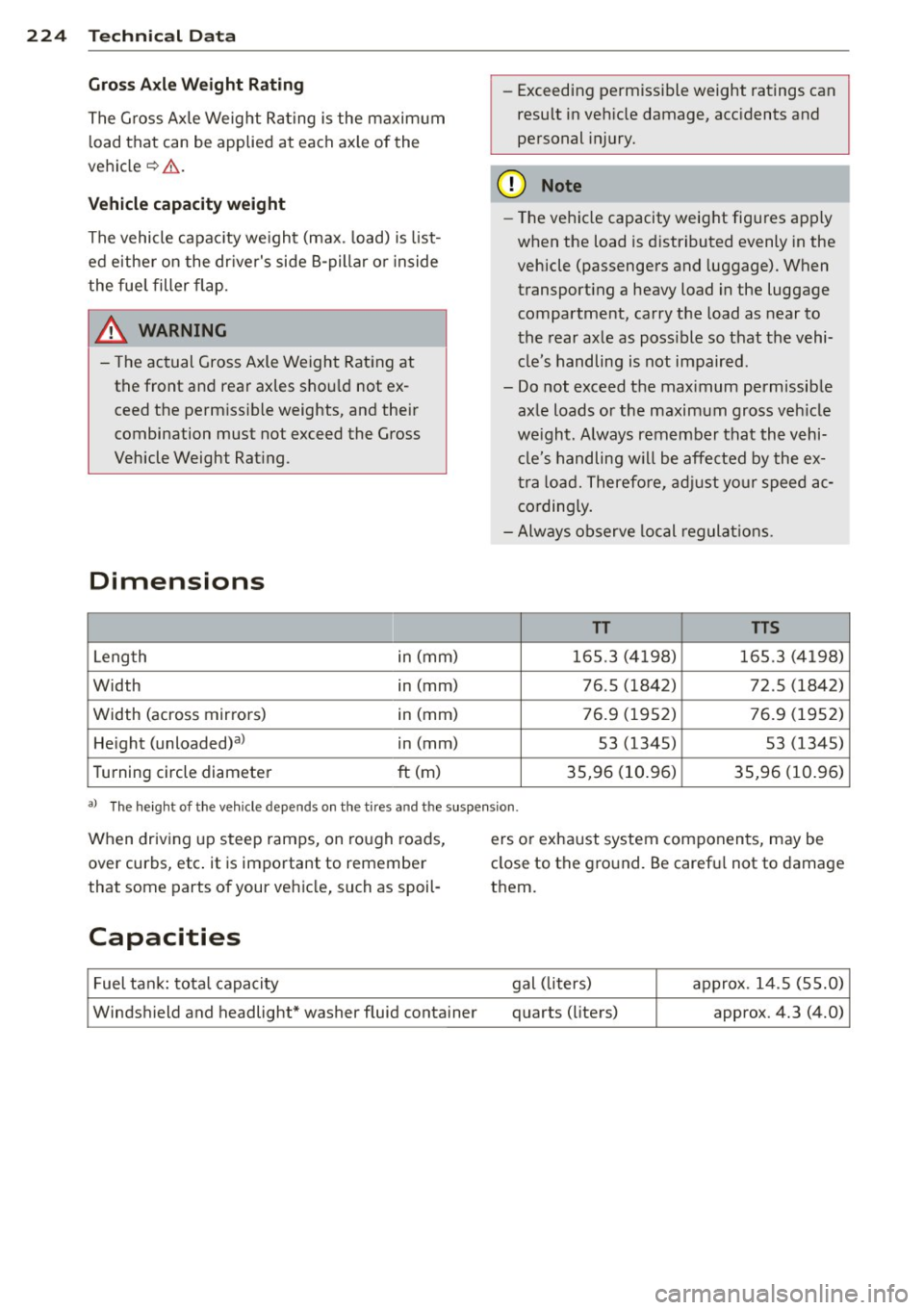
224 Technical Dat a
Gross Ax le Weight R atin g
The Gross Axle Weight Rating is the maximum
l oad that can be applied at each axle of the
vehicle
c::> &. .
Vehicle capacity weight
The vehicle capac ity we ight (max. load) is list
ed eithe r on the dr iver's side B-pillar or inside
the fuel filler flap.
A WARNING
-
- The actual Gross Axle Weight Rat ing at
the front and rear axles sho uld not ex
ceed the perm iss ible weights, and their
combination must not exceed the Gross
Vehicle Weight Rat ing.
Dimensions
Leng th in (mm)
Width in (mm)
Width (across mir rors) in (mm)
He ight (unloaded)a) in (mm)
T urning circle diameter
ft (m) -
Exceeding permissible weight ratings can
result in vehicle damage, accidents and
personal injury.
(D Note
- The vehicle capacity weig ht figu res apply
when the load is distributed evenly in the
vehicle (passengers and luggage). When
transport ing a heavy load in the luggage
compartment, carry the load as near to
the rear axle as poss ible so that the vehi
cle's handling is not impaired.
- Do not exceed the maximum permissib le
axle loads or the maximum gross veh icle
we ight. Always remember that the vehi
cle's handling w il l be affected by the ex
t ra load. Therefo re, ad just your speed ac
cordingly.
- Always observe local regulat ions.
TT TIS
165.3 (4198) 165.3 (4 198)
76.5 (1842) 72 .5 (1842)
76.9 (1952) 76.9 (1952)
53 (1345) 53 (1345)
35,96 (10.96) 35,96 (10.96)
a) The height of the veh icle depends on the tires and the suspension.
When driv ing up steep ramps, on rough roads,
over curbs, etc. it is important to remember
that some parts of your vehicle, such as spoil-
Capacities
Fuel ta nk: total capacity
Windsh ield and headlight* washer fluid container ers
or exha ust system componen ts, may be
close to the ground. Be carefu l not to damage
them.
gal ( liters)
approx. 14.5 (55.0)
quarts (liters) approx. 4.3 (4.0)
Page 227 of 244
Technical Dat a 225
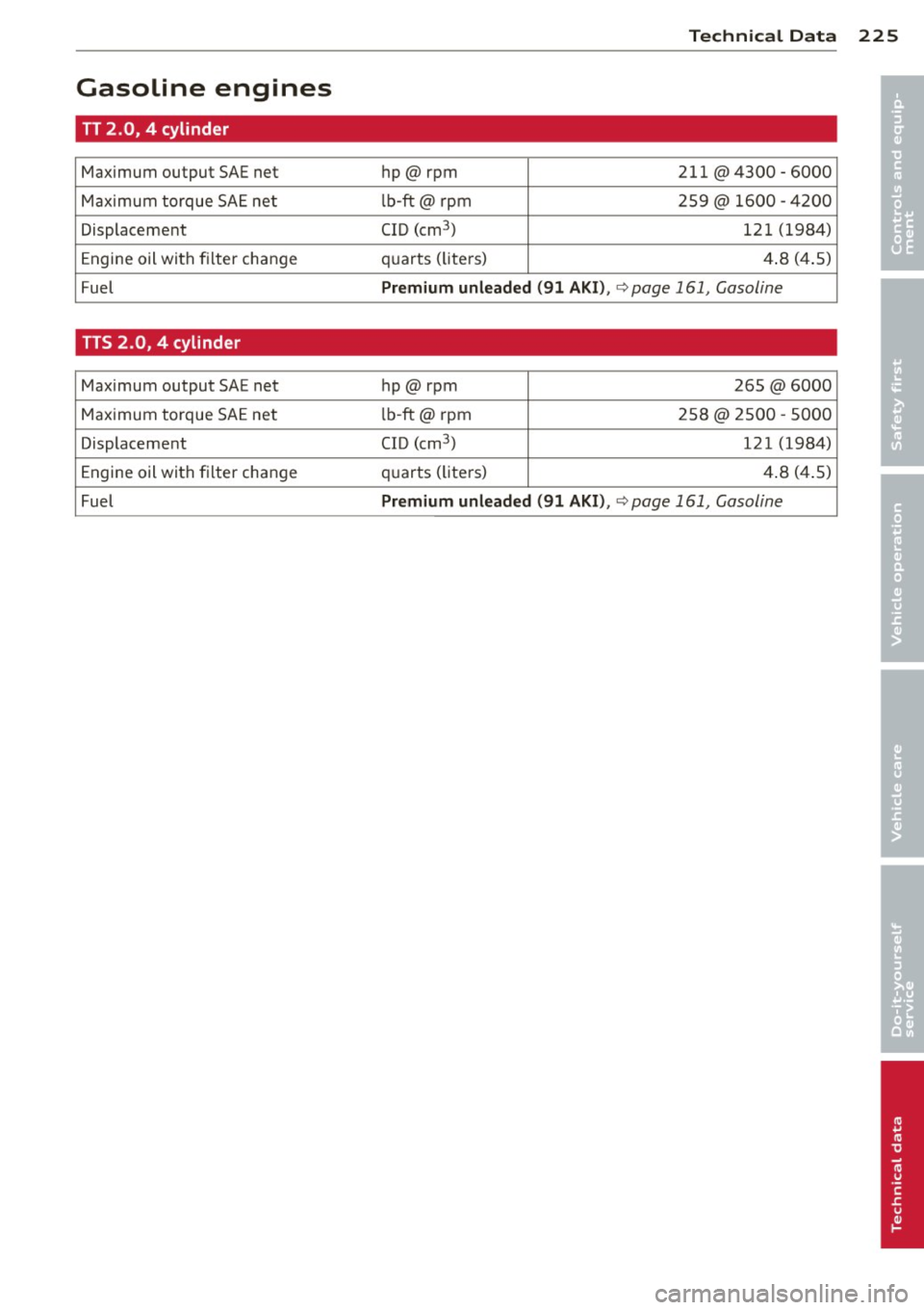
Gasoline engines
•
TT 2.0, 4 cylinder •
Maximum output SAE net hp@rpm 211 @4300 - 6000
Maximum torque SAE net lb-ft@ rpm 259@ 1600 - 4200
Displacement CID (cm
3
) 121 (1984)
Engine oil with f ilter change q
uarts (liters) 4.8 (4 .5)
Fuel
Prem ium unleaded (91 AKI) , ¢page 161, Gasoline
TTS 2.0, 4 cylinder
Maximum output SAE net hp@rpm 265 @6000
Maximum torque SAE net l
b -ft@ rpm 258@ 2500 -5000
Displacement CID (cm
3
) 121 (1984)
Engine oil with filter change q
uarts (li ters) 4.8 (4 .5)
Fuel
Premium unleaded (91 AKI) , ¢page 161, Gasoline