change time AUDI TT ROADSTER 2015 User Guide
[x] Cancel search | Manufacturer: AUDI, Model Year: 2015, Model line: TT ROADSTER, Model: AUDI TT ROADSTER 2015Pages: 244, PDF Size: 60.74 MB
Page 170 of 244
168 Checking and filling
Detergent additives in the o il will make fresh
oil look dark after the engine has been run
n ing for a short time . This is norma l and is not
a reason to change the oil more often than recommended.
D am ag e o r m alfun ction s due to lack of
m ainten ance
It is essent ial that yo u change your oil at the
recommended intervals using only engine oil
that complies with Audi oi l standard
VW 502 00 . Your Lim ited New Vehicle War
ranty does not cover damage or malfunctions
due to failure to follow recommended mainte
nance and use requ irements as set forth in
the Audi Owner's Manual and Warranty
&
M aintenance book let . Your dea ler will have to
deny warranty coverage un less you p resen t to
the dea ler proof in the form of Servi ce or Re
pa ir Orde rs that all schedu led maintenance
was performed in a timely manner.
Engine oil consumption
The engine in your vehicle depends on an ade
quate amount of oil to lubricate and cool all
of its moving ports.
I n o rder to prov ide effective lubr ication and
cooling of internal engine components, a ll in
ternal comb ustion engines consume a certain
amount of oil. Oi l consumption varies from
engine to engine and may change significantly
over the life of the eng ine . Typically, eng ines
with a specif ied break-in per iod (see
c::> page 149) consume more oil during the
break-in per iod than they consume after oil
consumption has stabilized .
Under normal conditions, the rate of oil con
sumpt io n depends on the quality and viscosity
of the oil, the RPM (revolutions per m inute) at
which the engine is operated, the ambient
temperature and road cond it io ns. Furthe r fac
tors are the amo unt of o il d ilution from wate r
condensation or fuel residue and the ox ida
tion level of the oi l. As any engine is subject to
wear as mileage bui lds up, the oil consump
tion may increase over t ime until replacement
of worn components may become necessary. Wi
th a ll these variab les coming into p lay, no
standard rate of oil consumption can be es
tab lished or spec ified. There is no alte rnative
to regular and frequent check ing of the o il lev
el, see
Note .
If the yellow engine oil leve l warning symbo l
in the instr ument cluster
1\1 lights up, you
sho uld check the oil leve l as soon as possib le
with the oil dipstick c::> page 169. Top off the
o il at your earliest conven ience
c::> page 169 .
A WARNING
-Before you chec k anything in the eng ine
compartment, a lways read and heed a ll
WAR NINGS
c::> .& in Working in the engine
comportment on page 164.
CI) Note
D riving with an insufficient o il level is like
l y to cause sever e damage to the engine.
(D Tips
- The oil pressure warn ing display. is
not an indicator of the oil level. Do not
rely on it . Instead, check the oil level in
your engine at r egular intervals, pr ef
erably ea ch time you refuel, and alway s
before going on a long trip.
- If you have the impression yo ur engine
cons umes excessive amoun ts of oil, we
recommend that you consult your Aud i
dea ler to have the cause of your concern
properly diagnosed. Keep in mind that
the accurate meas urement of o il con
sumption requires great care and may
take some t ime . Your Audi dea ler has in
st ruct ions about how to measure oil con
sumption acc urately.
Page 172 of 244
170 Checking and filling
-The oil filler cap must be properly se
cured to prevent oil from being sprayed
on the hot engine and exhaust system
when the engine is running -fire hazard!
- If your skin has come in contact with the
engine oil, you must subsequently
cleanse it thoroughly .
(D Note
-The oil level must not be above range G)
-danger of converter or engine damage!
Contact an authorized Audi dealer to
draw off oil, if necessary.
-Audi does not recommend the use of oil
additives. They may damage the engine
and adversely affect your New Vehicle
Warranty.
@ For the sake of the environment
- Under no circumstances can the oil come
in contact with the sewage network or
the soil.
- Observe and follow legal regulations
when disposing of empty oil containers.
Changing the engine oil
We recommend that have your oil changed by
an authorized Audi dealer or a qualified serv
ice station .
Before you check any thing in the engine com
partment,
always read and heed all WARN
INGS ~ .& in Working in the engine compart
ment on page 164 .
The engine oil mus t be changed according to
the intervals specified in your Warranty
&
Maintenance booklet. This is very important
because the lubricating properties of oil di
minish gradually during normal vehicle use .
Under some circumstances the engine oil
should be changed more frequently . Change
oil more often if you drive mostly short dis
tances , operate the vehicle in dusty areas or
under predominantly stop-and-go traffic con
ditions , or have your vehicle where tempera- tu
res remain below freezing for extended pe
riods.
Detergent additives in the oil will make fresh
oil look dark after the engine has been run
ning for a short time. This is normal and is not
a reason to change the oil more often than
recommended.
Because of the problem of proper disposal,
along with the special tools and necessary ex
pertise required, we strongly recommend that
you have your oil changed by an authorized
Audi dealer or a qualified service station.
If you choose to change your oil yourself ,
please note the following important informa
tion:
A WARNING
To reduce the risk of personal injury if you
must change the engine oil in your vehicle
yourself:
- Wear eye protection.
- To reduce the risk of burns from hot en-
gine oil, let the engine cool down to the
touch.
- When removing the oil drain plug with
your fingers, stay as far away as possible.
Always keep your forearm parallel to the ground to help prevent hot oil from run
ning down your arm.
- Drain the oil into a container designed
for this purpose, one large enough to hold at least the total amount of oil in
your engine .
- Engine oil is poisonous. Keep it well out
of the reach of children.
- Continuous contact with used engine oil
is harmful to your skin. Always protect
your skin by washing oil off thoroughly
with soap and water.
(D Note
Never mix oil additives with your engine
oil. These additives can damage your en
gine and adversely affect your Audi Limit
ed New Vehicle Warranty.
Page 176 of 244
17 4 Che cking and filling
Brake fluid
Checking brake fluid level
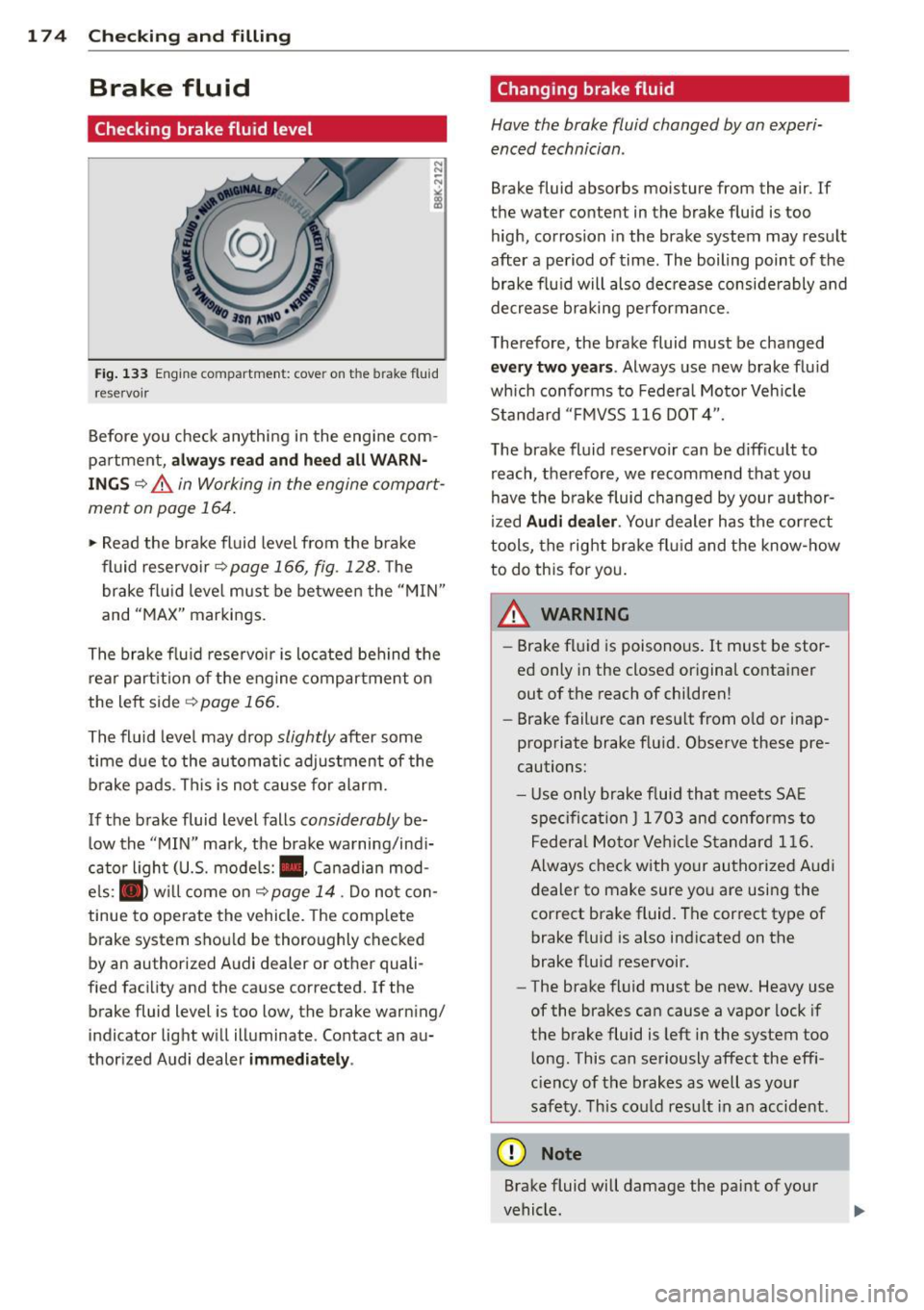
Fig . 133 Engine compa rtment: cove r on the brake fluid
reservo ir
Before you check anything in the engine com
partment,
a lw ays read and h eed all WA RN
ING S ¢&. in Working in the engine compart
ment on page 164.
,.. Read the brake fluid level from the brake
fluid reservoir¢
page 166, fig . 128. T he
brake flu id leve l must be between the "MIN"
and "MAX" markings.
The brake flu id rese rvo ir is located behind the
rear part ition of the eng ine compartment o n
the left side ¢
page 166.
The fluid level may drop slightly after some
time due to the automatic adjustment of the b rake pads . This is not cause for alarm.
If the brake fluid level falls
considerably be
low the "MIN" mark, the brake warning/indi
cator light (U.S. models: . , Canadian mod
e ls: . ) w ill come on
¢page 14. Do not con
tinue to operate the vehicle. The comp lete
brake system shou ld be thoroughly checked
by an authorized A udi dealer or other quali
fied facility and the cause corrected.
If the
brake fluid level is too low, the brake warn ing/
indicator light w ill illuminate. Contact an au
thor ized Audi dealer
imm ediatel y.
Changing brake fluid
Have the brake fluid changed by an experi
enced technician .
Brake fluid absorbs moisture from the air. If
the water content in the brake fluid is too high, corrosion in the brake system may result
after a period of time . The boiling point of the
brake flu id will also decrease conside rably and
decrease braking pe rformance.
Therefore, the brake fluid must be changed
eve ry two y ears. Always use new brake flu id
which conforms to Federal Motor Veh icle
Standard "F MVSS 116 DOT 4".
The brake fluid reservoir can be diff icult to
reach, therefore, we recommend that you
have the brake fluid changed by your author
ized
Audi dealer . Your dealer has the correct
tools, the right brake fl uid and the know -how
to do this for you.
A WARNING
- Brake fluid is poisonous . It must be stor
ed only in the closed original container
out of the reach of children!
- Brake failure can resu lt from o ld or inap
propriate brake flu id. Observe these pre
cautions:
- Use only brake f luid that meets SA E
specifica tion
J 1 7 03 and conforms to
Federa l Moto r Ve hicl e Standard 1 16.
Always check with yo ur authorized Aud i
dealer to make sure yo u are using the
correct brake fluid. The correct type of brake f lu id is also ind icated on the
brake flu id reservoir.
- The brake fluid must be new. Heavy use
of the brakes can cause a vapor lock if
the brake fluid is left in the system too
l ong. This can seriously affect the effi
c iency of the brakes as well as your
safety. This cou ld resu lt in an accident.
(D Note
Brake fluid will damage the paint of your
vehicle .
Page 179 of 244
-Do not interchange the positive and neg
ative cables .
- When working on the battery , be sure
not to short-circuit the terminals with
tools or other metal objects. This would cause the battery to heat up very quickly,
which could lead to damage or explosion and personal injury.
- When a battery is charged, it produces
hydrogen gas which is explosive and
could cause personal injury .
- Always keep the battery well out of the reach of children .
- Before work is done on the electrical sys
tem, disconnect the negative ground ca
ble .
- Before performing any work on the elec
trical system , switch off the engine and
ignition as well as any electrical equip
ment. The negative cable on the battery
must be disconnected. If you are just go
ing to replace a light bulb, then it is
enough to switch off the lights.
- Before disconnecting the battery , switch
off the anti-theft alarm system! Other
wise you will set off the alarm.
- When disconnecting the battery, first
disconnect the negative cable and then
the positive cable.
- Before reconnecting the battery, make
sure all electrical consumers are switch
ed off. Reconnect the positive cable first
and then the negative cable. Never inter
change the cables - this could start a fire!
- Never charge a fro zen or a thawed-out
battery. It could explode! If a battery has
frozen, then it must be replaced. A dis
charged battery can freeze over at 32 °F
(0 °C) .
-Make sure the vent hose is always attach
ed to the opening on the side of the bat
tery.
- Never use batteries which are damaged.
Danger of explosion! Always replace a
damaged battery.
Checking and filling 177
A WARNING
California Proposition 65 Warning:
- Battery posts, terminals and related ac cessories contain lead and lead com
pounds, chemicals known to the State of
California to cause cancer and reproduc
tive problems . Wash hands after han
dling.
Q) Note
- Do not disconnect the vehicle battery
when the ignition is switched on or when
the engine is running, otherwise , you will
damage electronic components in the
electrical system.
- If your vehicle is going to stand for a
long period of time without being driven,
protect the battery from "freezing", oth
erwise it will be damaged and will then
have to be replaced.
Checking the battery acid level on magic
eye batteries*
The battery acid level in the battery can be
checked through the clear inspection window .
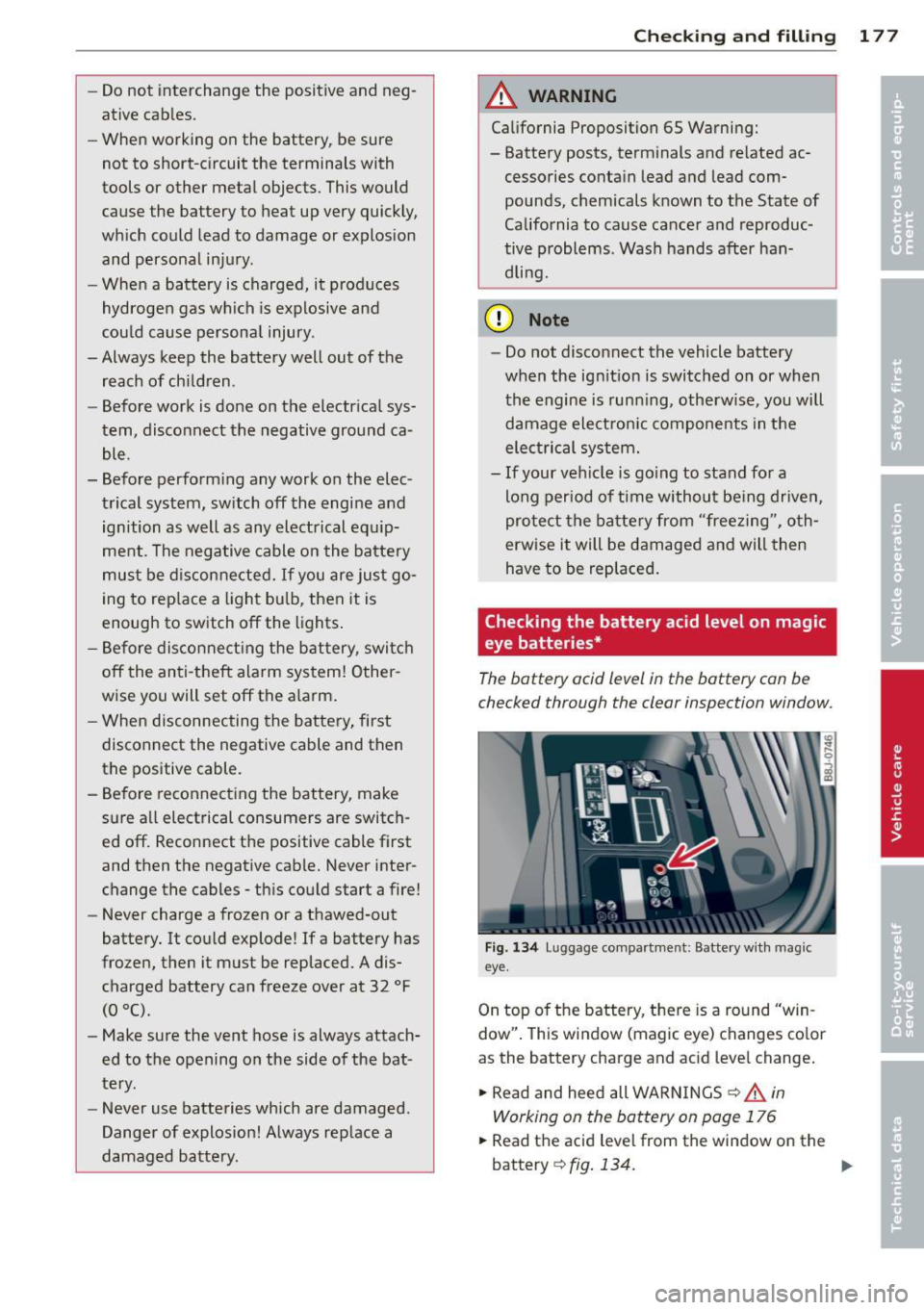
Fig. 134 Lugg age compar tme nt: Battery w ith mag ic
e ye .
On top of the battery, there is a round "win
dow". This window (magic eye) changes color
as the battery charge and acid level change.
.,. Read and heed all WARNINGS
~.&_ in
Working on the battery on page 176
.. Read the acid level from the window on the
battery ~
fig. 134. Ill>-
Page 184 of 244
182 Tires and wheels
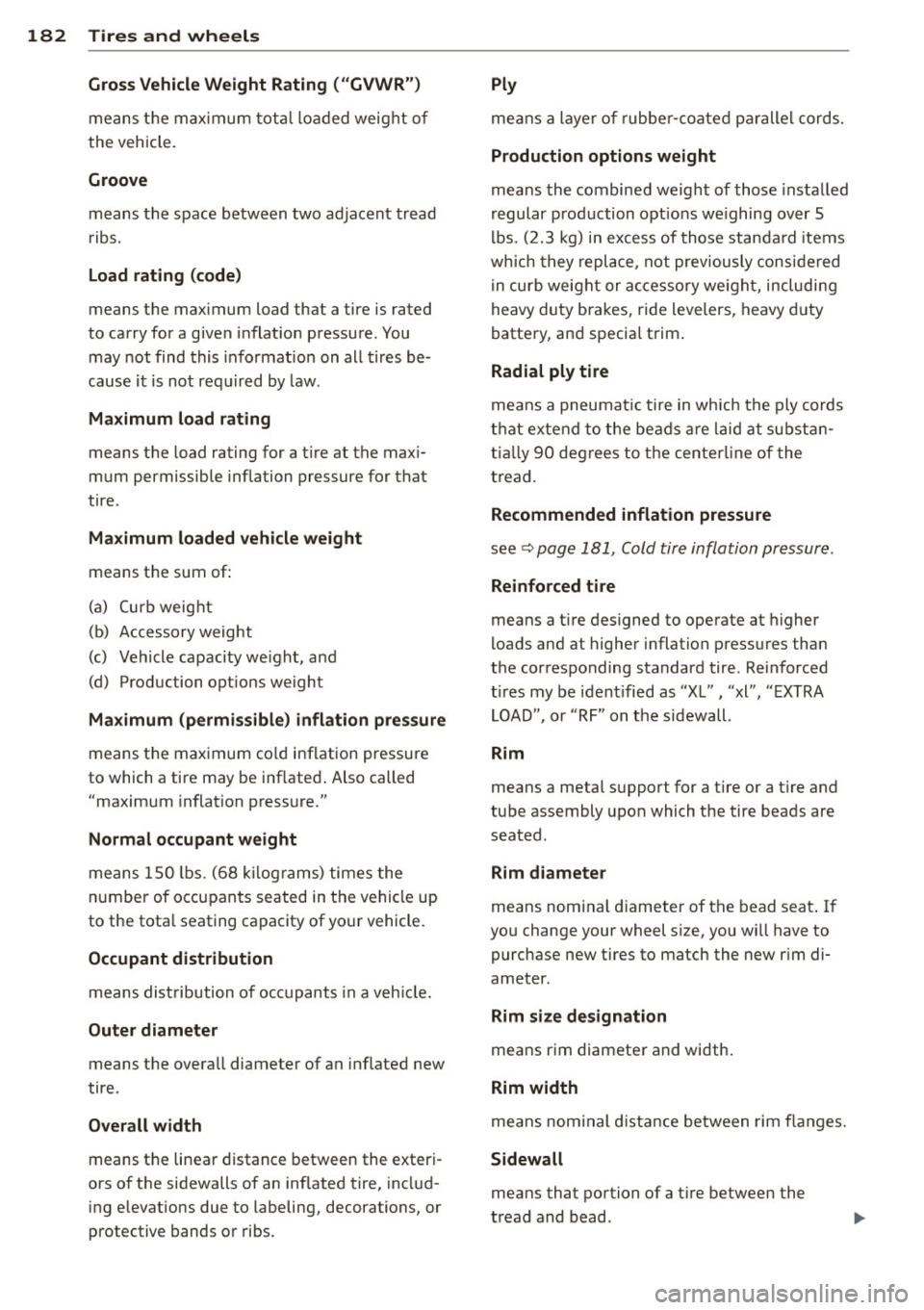
Gross Vehicle Weight Rating ("GVWR")
means the maximum total loaded weight o f
the vehicle.
Groove
means the space between two adjacent tread
ribs.
Load rating (code)
means the maximum load that a tire is rated
to carry for a given inflat ion pressure. You
may not find this informat ion on all tires be
cause it is not requ ired by law .
Maximum load rating
means the load rating for a t ire at the maxi
mum permissible inflation pressure for that
tire .
Maximum loaded vehicle weight
means the sum of:
(a) Curb weight
(b) Accessory weight
(c) Vehicle capacity we ight, and
(d) Production opt ions weight
Maximum (permissible) inflation pressure
means the maximum cold inflation pressure
to which a tire may be inflated . Also called
"maximum inflation press ure."
Normal occupant weight
means 150 lbs. (68 kilog rams) times the
number of occupants seated in the vehicle up
to the tota l seating capacity of your vehicle.
Occupant distribution
means distribution of occupants in a veh icle.
Outer diameter
means the overall diameter of an inflated new
tire.
Overall width
means the linear distance between the exteri
ors of the sidewalls of an inflated tire, includ
ing elevations due to labeling, decorations, or
protective bands or ribs .
Ply
means a layer of rubbe r-coated parallel cords.
Production options weight
means the combined weight of those installed
regular production opt ions we ighing over 5
lbs. (2.3 kg) in excess of those standa rd items
wh ich they replace, not previously considered
in curb weight or accessory weight, including
heavy duty brakes, ride levelers, heavy duty
battery, and specia l trim .
Radial ply tire
means a pneumat ic tire in which the ply cords
that extend to the beads are laid at substa n
tially 90 deg rees to the centerline of the
tread.
Recommended inflation pressure
see <=;> page 181, Cold tire inflation pressure .
Reinforced tire
means a tire designed to operate at higher
loads and at higher inflation pressures than
the corresponding standard tire. Re inforced
t ir es my be identified as "XL", "xl", "EXTRA
LOAD", or "RF" on the sidewall.
Rim
means a metal support for a tire or a t ire and
tube assembly upon which the tire beads are
seated .
Rim diameter
means nominal diameter of the bead seat. If
you change your wheel s ize, you will have to
purchase new tires to match the new r im di
ameter .
Rim size designation
means rim diameter and width.
Rim width
means nom inal distance between rim flanges.
Sidewall
means that portion of a t ire between the
tread and bead .
Page 201 of 244
remain continuous ly illuminated . This se
quence will continue upon subsequent vehicle
start-ups as long as the ma lfunction ex ists.
When the malfunct ion indicator is ill uminat
ed, the system may not be able to detect or
signa l low tire pressure as intended. TPMS
malfunct ions may occur for a variety of rea
sons, including the installat ion of replace
ment or alternate tires or wheels on the veh i
cle that prevent the TPMS from funct io ni ng
properly. Always check the TPMS malfunct ion
tellta le afte r replacing one or more t ires or
wheels on your veh icle to ensure that the re
p lacement or a lternate tires and wheels allow
the TPMS to continue to function properly.
Tire pressure indicator appears
Applies to vehicles: with tire pressure monitoring system
The tire pressure indicator in the instrument
cluster informs you if the tire pressure is too
low or if there is a system malfunction.
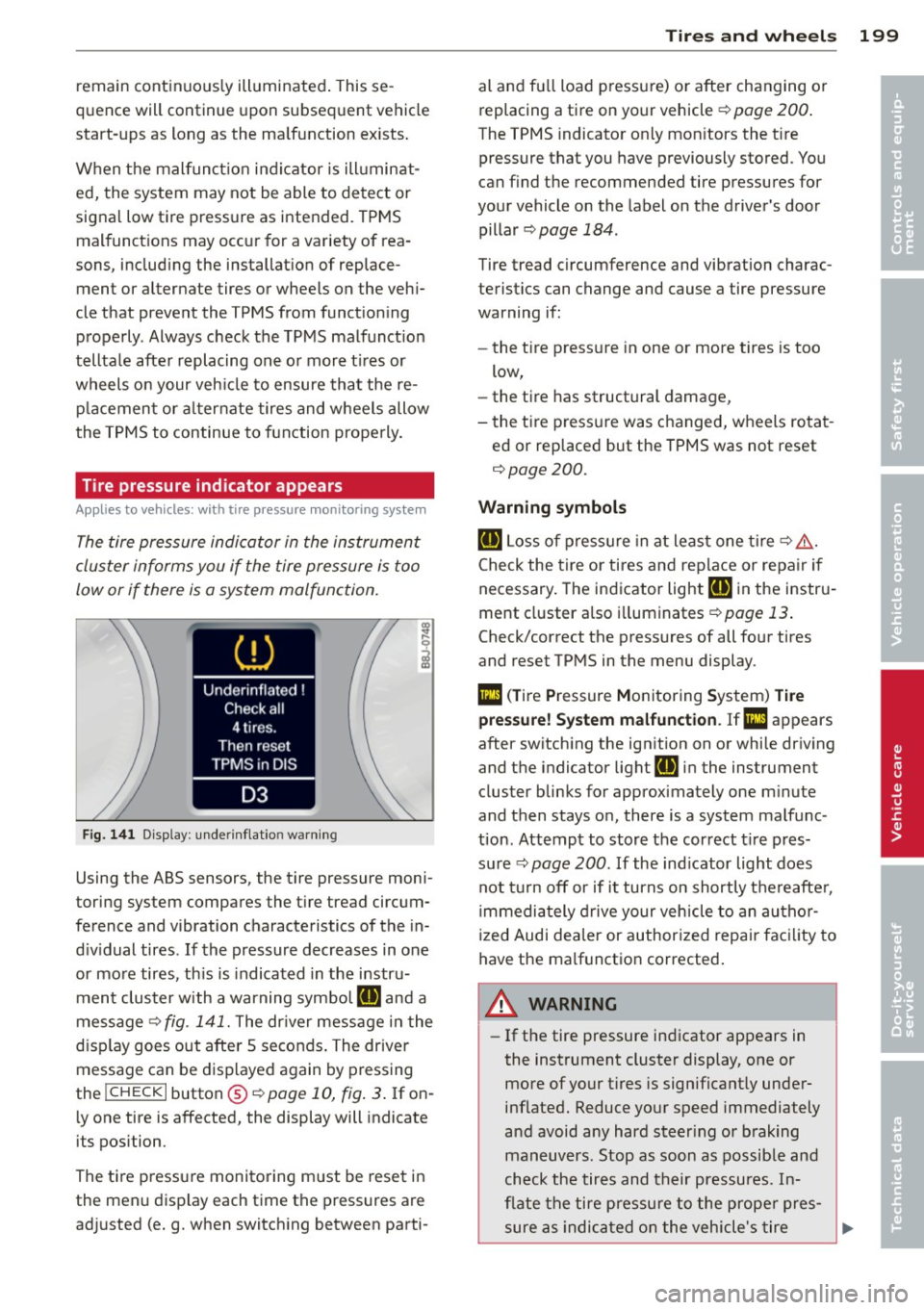
F ig. 1 41 Disp lay : under in fla tion warn ing
Using the ABS sensors, the tire pressure moni
toring system compares the t ire tread circum
fe rence and vibration characteristics of the in
d iv idual tires . If the pressure decreases in one
or mo re tires, th is is indicated in the instru
ment clus ter with a warning symbol
[I] and a
message
'* fig. 141. The dr iver message in the
d isp lay goes out after 5 seconds . The driver
message can be d isplayed again by pressing
the
! CHECK I button @¢ page 10, fig . 3 . If on
ly one tire is affected, the display will indicate
its pos ition.
The ti re pressure monito ring m ust be reset in
the menu display each time the pressures are
ad justed (e.g. when switching between parti-
Tire s an d wheel s 199
al and fu ll load pressure) or after changing o r
replacing a tire on your vehicle '*
page 200.
The TPMS indicator on ly mon itors the t ire
pressure that you have previously stored . You
can f ind the recommended tire pressures for
your vehicle on the label on the driver's door
pillar ¢
page 184 .
Tire tread circumference and vibration charac
teristics can change and cause a tire pressure
warning if:
- the t ire press ure in one or more tires is too
low,
- the tire has structural damage,
- the t ire press ure was changed, wheels rotat -
ed or rep laced but the TPMS was not reset
¢ page 200.
Warning symbo ls
[I] Loss of press ure in at least one tire'*& .
Check the tire or tires and rep lace or repa ir if
necessary . The indicator light
[I] in the instru
ment cluster a lso i lluminates
¢ page 13.
Check/correct the press ures of all four tires
and reset TPMS in the menu display .
mm (T ire Pressure Monitoring System) Ti re
pre ssure! System malfun ction . Ifll appears
after switching the ign it ion on or while dr iving
and the indicator light
[I] in the instrument
clus ter blinks fo r approximately one m inute
and then stays on, there is a system malfunc
tion . Attemp t to store the correct t ire pres
su re '*
page 200 . If the ind icator light does
not turn off or if i t turns on shortly thereafte r,
immedia tely drive your vehicle to an au thor
ized Audi dea ler or author ized repai r fac ility to
have the malfunction corrected .
A WARNING
=
-If the tire pressure indicator appears in
the instrument cluster display, one or
more of your t ires is significant ly under
inflated. Reduce your speed immediately
and avoid any hard steer ing or b rak ing
maneuvers. Stop as soon as possib le and
check the tires and their pressu res . In
flate the tire pressure to the prope r pres-
sure as indicated on the vehicle's tire .,..
•
•
Page 204 of 244
202 Tires and wheels
(80 km/h)
¢ page 202, Driving with run -flat
tires .
When it is not possible to continue
driving, even with run-flat tires?
- If the E lectronic Stabilization Control (ESC)
is not working or keeps coming on.
- If the Tire Pressure Monitoring System does
not work .
-If the tire has been severely damaged, in a
crash, for example. The tread can separate
from a damaged tire as the whee l turns , and
hit parts of the vehicle , such as the fuel tank
filler neck, fuel lines or brake lines.
- Do not continue driving if severe vibration
occurs or if the tire starts to smoke because
the tire is running hot.
- Do not continue driving if damage to the
tire, such as cracks in the sidewall, appears.
A WARNING
Improper use of run-flat t ires can cause
veh icle damage that can lead to loss of ve
hicle control, a crash and serious pe rsonal
injury.
- Run-flat tires can only be used with spe cial rims.
- Run-flat tires must always be mon itored
with a properly programmed Tire
P re
ssure Mon itor ing System.
- Always inspect a tire that has lost air to
make sure it is safe to drive with the tir e
in the run-flat mode.
- Never drive with run-flat tires that have
been damaged in a collision .
- Never drive with run-flat tires if heat
build-up causes the tire to give off
smoke .
- Never drive with run-flat tires if the vehi
cle shakes or v ibrates severely.
- Never drive with a run-flat tire that de
velops sidewall cracks or other damage
wh ile in use .
- If you switch between standard and run
flat tires, an authorized Audi dealer or qualified workshop must reprogram the
control module .
-
(D Note
Run-flat tires have specia l characteristics
and requirements, that are very different
from conventional tires. Run-flat tires re
quire special rims for run-flat use and can
not be used on conventional wheel rims.
(D Tips
- If you are not able to cont inue driving
with run-flat tires, please seek professio
nal assistance.
- Please contact your authorized Audi
dealer or Audi of America, Inc. if you
have questions about tires and rims .
Driving with run-flat tires
Applies to vehicles: wit h Run -flat tires
Handling characteristics change when tire
pressure is low .
Driving on tires with low tire pressure changes
the way a vehicle handles, particularly when
cornering and braking. The handling charac
teristics of run-flat tires do not seem to
change a lot even when driving on low pres
sure or in the run-flat mode . Nevertheless you
must still take specia l precautions when ope r
at ing a vehicle on run-flat tires when tire pres
sure is low o r the tire(s) is flat:
.,. The Electronic Stabilization Control (ESC)
must be switched on.
.,. Never drive faster than 50 mph (80 km/h)
¢&_ .
.,. Plan ahead when driving and anticipate
what you will have to do considering traffic
and road conditions up ahead .
.,. Accelerate carefully.
.,. Avo id unnecessary and sudden steering and
brak ing maneuvers.
.,. Reduce your speed in plenty of time before
intersections, curves and other places where
you may have to react quickly.
Please see :
¢ page 202, When it is not possi
ble to continue driving, even with run-flat
tires?
Page 215 of 244
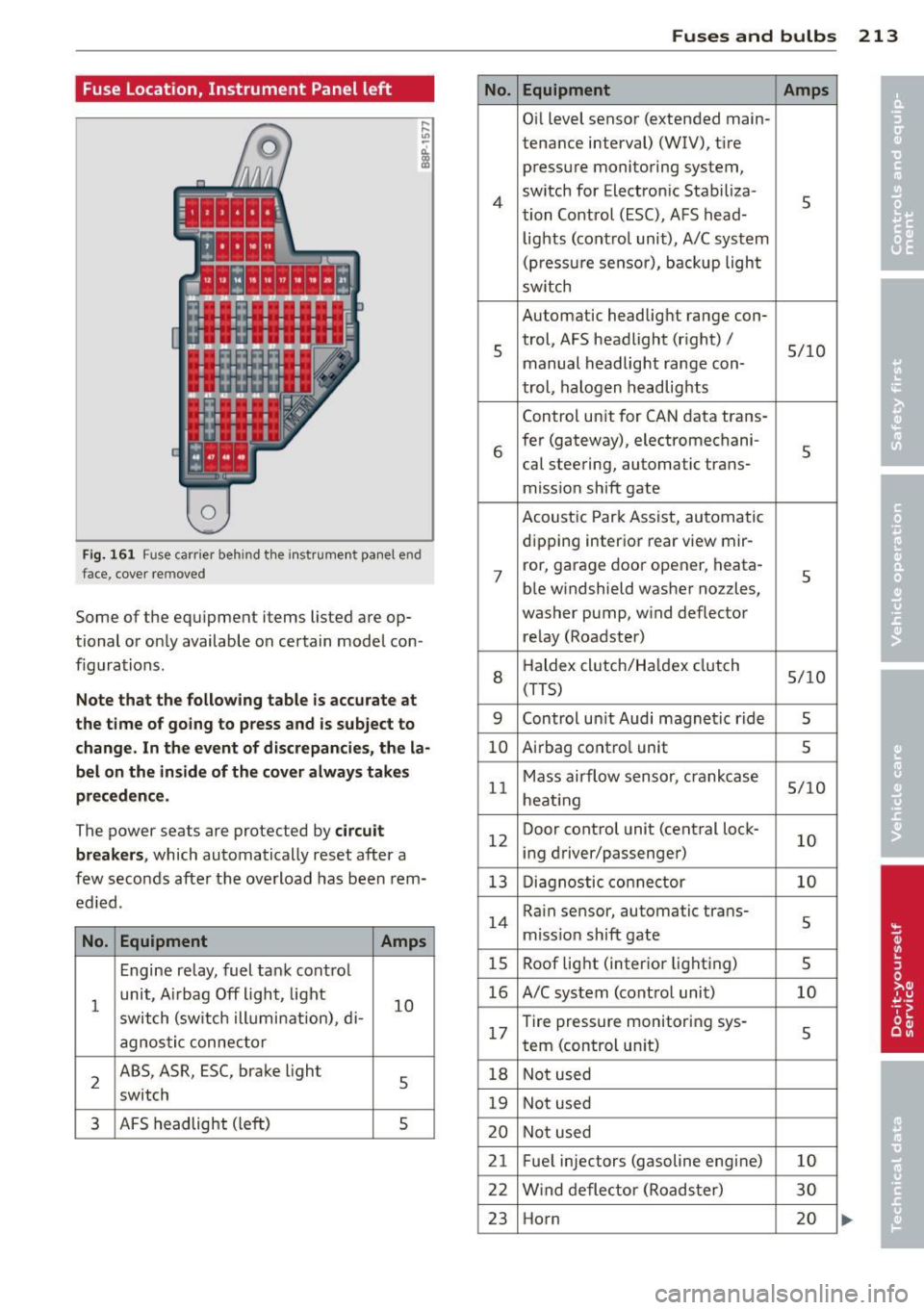
Fuse Location, Instrument Panel left
0
Fig. 161 Fuse carrier behind the instrument panel end
face, cover removed
Some of the eq u i prnent items listed a re op
tional or only available on certain model con
f igurations.
Note that the following table is accurate at
the time of going to press and is subject to
change. In the event of d iscrepancies, the la
bel on the in side of the cover always takes
precedence .
The power seats are protected by circuit
breakers ,
which automatically reset after a
few seconds after the overload has been rem
ed ied.
No. Equipment Amps
Engine relay, fuel tank cont ro l
1
unit, A irbag Off light, light
10 switch (sw itch illumi nation), di-
agnostic connector
2
ABS, ASR, ESC, brake light
5 switch
3 AFS headlight (left) 5
No.
4
5
6
7
8
9
10
11
12
13
14
15
16
17
18
19
20
21 22
23
Fuses and bulbs 213
Equipment Amps
Oil level sensor (extended main-
tenance interval)
(WIV), t ir e
press ure monitoring system,
sw itch for Electron ic Stabiliza-
5 tion Control (ESC), AFS head-
lights (control unit), A/C system
(pressure sensor), backup light
sw itch
Automatic headlight range con- trol, AFS headlight (right) /
5/10
manual headlight range con-
trol, halogen headlights
Control unit for CAN data trans-
fer (gateway), electrornechani-
5 cal steering, automatic trans-
miss ion shift gate
Acoustic Park Assist, automatic
d ip ping interior rear
view rnir-
ror, garage door opener, heata-
5 ble windshield washer nozzles,
washer pump, w ind deflector
relay (Roadster)
H aldex clutch/Ha ldex clutch
5/10 (TTS)
Control un it Audi magnetic ride
5
A irbag contro l unit 5
Mass airflow sensor, crankcase 5/10
heating
Door control unit (central lock -
10 ing driver/passenger)
Diagnostic connector
10
Rain sensor, automatic trans-
5 miss ion sh ift gate
Roof light (interior lighting)
5
A/C system (contro l unit) 10
Tire pressure monitoring sys -
5 tern (control un it)
Not used
Not used
Not used
Fuel injectors (gasoline eng ine)
10
Wind deflector (Roadster) 30
Horn 20
Page 216 of 244
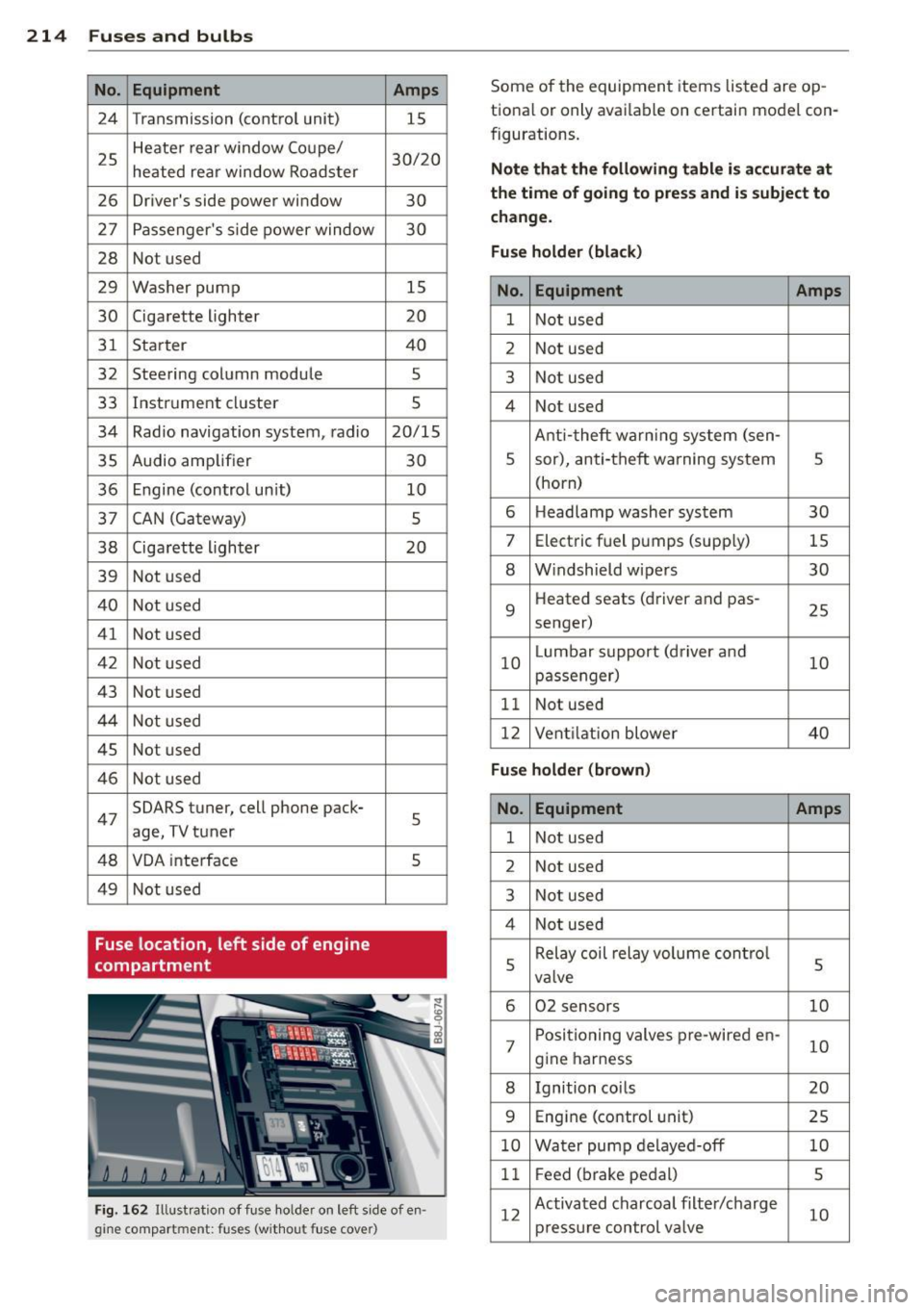
214 Fuses and bulb s
No. Equipment
24 Transmi ssion (contro l un it)
25 Heate
r rear window Coupe /
heated rear window Roadster
26 Driver'
s side power window
27 Passenger's s ide power window
28 No
t used
29 Washer pump
30 Cigarette lighter
31 Start er
32 Steering column module
33 Instrument clust er
34 Radio navigation system , radio
35 Aud io amplifi er
36 Engine (control un it)
37 CAN (Gat
eway)
38 Ciga
rette lighter
39 Not us ed
40 Not used
4 1 Not u sed
42 Not used
43 No t used
44 Not used
45 No
t used
46 Not used
47 SOARS tuner, cell phone pack-
age,
TV tuner
48 VOA interface
49 Not used
Fuse location, left side of engine
compartment Amps
15
30/ 20
30 30
15
20
40 5
5
20/15
30 10
5
20
5 5
Fi g. 162 Ill ustra tion of fus e ho lde r on l eft side o f en·
gi ne compar tment: fuse s (withou t fuse c over)
Some of the equipment items listed are op
tiona l or only avai lable on c ertain mod el con
figurations.
Note tha t the foll owing table i s ac cur ate at
the time of going to pre ss and is subject to
change .
Fus e holder (bla ck )
No . Equipment Amps
1 Not used
2 Not used
3 Not used
4 No t used
Anti- theft warning system (sen -
5 sor), ant
i-theft warn ing system
5
(horn)
6 Headlamp washer system
30
7 Elec
tric fuel pumps (supp ly)
15
8 W
indshield wipers
30
9 H
eat ed seats (dr iver and pas-
25
senger)
10 L
umbar support (d river and
10
passenger)
11 Not u sed
12 Vent ilation blower 40
Fus e holder (brown )
No. Equipment Amps
1 Not used
2 Not used
3 Not used
4 Not used
5 Relay coil
relay volume cont ro l
5
va lve
6 02
sensors
10
7 P
ositioning valves pre-wired en-
10
gine harness
8 Ignition coi ls 20
9 Eng
in e (cont rol unit)
25
10 Water pump de layed-off 10
1 1 F
e e d (brak e pedal)
5
1 2 Activated charcoal filter/charge
10
p ress ure control va lve
Page 243 of 244
It has always been Audi's policy to continu
ously improve its products . Audi, therefore,
reserves the right to make changes in design
and specifications, and to make additions or improvements in its products, without incur
r ing any obligation to install them on prod
ucts previously manufactured.
Text, illustrat ions and specifications in th is
manual are based on the most up-to-date in
formation available at the time of printing.
All rights reserved. May not be reproduced or
translated in whole or in part without the written consent of AUDI AG
. Specifications are
subject to change witho ut notice .
Editorial deadline: 10/08/2013
@ For the sake of the environment
Printed on environmentally friendly paper
(bleached without chlorine, recyclable).
Printed in Germany
© 2014 AUDI AG