child restraint AUDI TT ROADSTER 2015 User Guide
[x] Cancel search | Manufacturer: AUDI, Model Year: 2015, Model line: TT ROADSTER, Model: AUDI TT ROADSTER 2015Pages: 244, PDF Size: 60.74 MB
Page 115 of 244
States Federal Motor Vehicle Safety Standard
208 as applicable at the time your vehicle was
manufactured.
The front Advanced A irbag System supp le
ments the safety belts to provide additiona l
protection for the driver's and front passeng
er's heads and upper bodies in fronta l crashes.
The airbags inflate only in frontal impacts
when the vehicle deceleration is high enough.
The front Advanced Airbag System for the
front seat occupants is not a substitute for
your safety belts. Rather, it is part of the over all occupant restraint system in your veh icle.
Always remember that the airbag system can
only help to protect you, if you are s itting up
right, wearing your safety belt and wea ring it
prope rly. This is why you and you r passenge rs
must always be properly restr ained , not just
because the law requires yo u to be.
The Advanced Airbag System in your veh icle
h as been certified to meet the "low ris k" re
qu irements for
3 and 6 year-o ld childre n on
the passenger side and very small adu lts on
the driver side. The low risk dep loyment crite
ria are intended to he lp reduce the risk of in
jury through interaction with the front airbag that can occur, for example, by be ing too
close to the steer ing wheel and instrument
panel when the airbag inflates.
In addition, the system has been certif ied to
comply w ith the "suppression" requ irements
of the Safety Standard, to turn
off the front
airbag for infants
12 months old and younger
who are restra ined o n the front passenger
seat in c hild restra ints that a re listed in the
Standa rd
¢page 131, Child restraints and
Advanced Airbags.
"Suppression" requires the front airbag on the passenger side to be turned
off i f:
- a ch ild up to about one year of age is re
stra ined on the front passenger seat in one
of the rear-facing or forward-fac ing infant
rest raints listed in Federa l Motor Veh icle
Safe ty S tanda rd 208 w it h which t he Ad
vanced Airbag System in your vehicle was certified . For a listing of the child rest raints
A irbag system 113
that were used to certify your vehicle's com
pliance with the US Safety Standard
¢ page 131,
-weight less than a thresho ld level stored in
the control unit is detected on the front pas
senger seat.
When a person is detected on the front pas
senger seat, weighing more than the total
weight of a chi ld that is about
1 year old re
stra ined in one of the rear-facing or forward
facing infant restraints (listed in Federal Mo
tor Vehicle Safety Standard 208 w ith which
the Advanced A irbag System in your vehicle
was certified), the front airbag on the passen ger side may or may not deploy.
The
PAS SENGER AIR BAG OFF lig ht comes on
when the electron ic contro l unit detects a to
ta l we ight on the front passenger seat that re
quires the front airbag to be tu rned
off. If the
PASSENGER AIR BAG OFF light does no t
come on, the fron t ai rbag on the passe nger
s ide has not been t urned
off by the contro l
u nit and can dep loy if the control unit senses
an impact that meets the cond itions stored in
its memory.
If the total weight on the front passenge r
seat is more than that of a typical
1 year-o ld,
but less than the we ight of a small ad ult, the
front a irbag on the passenger side may dep loy
(the
PASSENGER AIR BAG OFF light does not
come on) .
For example , the airb ag m ay deploy if:
- a small ch ild that is heav ier t han a typical 1
year -old chi ld is on the front passenger seat
(regard less of whether the child is in one of
the child safety seats listed
¢page 131),
-a child who has outgrown chi ld restraints is
on the front passenger seat .
If the fron t passenger airbag is turned
off, the
PASSENGER AIR BAG OFF light in the cen ter
of the instrument panel will come on and stay
on .
T he front airbag on the passenge r side may
not deploy (the PASSENGER AIR BAG OFF
light does not illuminate and stay lit) i f:
•
•
Page 116 of 244
114 Airbag sys te m
- a small adu lt or teenager is on the front pas
senger seat
- a passenger who is not sitting upright with
their back against a non-reclined backrest
with their feet on the vehicle floor in front
of the seat is on the front passenger seat.
I f the front passenger airbag deploys, the
Federal Standard requires the airbag to meet
the " low risk" deployment criteria to help re
duce the risk of in jury through interaction
with the airbag . "Low risk" deployment occurs
in those cr ashes that take place at lower de
celerations as defined in the electronic control un it
Q page 118 .
Always rem ember : Please be sure to read the
impor tant informa tion in the sections tha t
follow and be sure to heed all of the WARN
INGS .
A WARNING
To reduce the r isk of injury when an airbag
inf lates , a lways wear safety belts prope rly.
- If you are unrestrained, lean ing forward,
sitting sideways or out of position in any
way, your risk of in jury is much higher.
- You w ill also receive serious inju ries and
cou ld even be killed if you are up against
the a irbag or too close to it whe n it in
flates - even with an Advanced Airbag
Q page 108.
A WARNING
-
A child in a rearward-facing child safety
seat insta lled on the front passenger seat
w ill be seriously injured and can be k illed if
the front a irbag inflates - even with an Ad
vanced Airbag System .
- Although the Advanced A irbag System in
your vehicle is designed to turn off the
front a irbag when a rearward -fac ing
child restraint has been installed on the
front passenger seat, nobody can abso l u te ly guarantee that deployment is im
poss ible in a ll conce ivable situations th at
may happen d uring the useful life of your
vehicle. -
The inflating airbag will h it the ch ild
safety seat or infant carrier with great
force and will smash the child safety seat and child aga inst the backrest, door, or
roof.
- If you must install a rearward fac ing
child safety seat on the front passenger
seat because of exceptiona l circumstan
ces and t he
PASSENGER AIR BAG OFF
light does not come on and s tay on have
the airbag system inspecte d by your Audi
dealer.
A WARNING
--=
If, in exceptiona l circumstances, you m ust
i nstall a forward -facing child restraint on
the front passenger's seat:
- Always make sure the forward- facing
seat has been designed and certified by
its manufacturer for use on a front seat
wit h a passenger front and s ide a irbag.
- Never p ut the fo rward-facing chi ld re
straint up against or very near the instru
ment panel.
- Always move the passenger seat into its
rea rmost pos ition in the seat's fore and
aft ad justment range, as far away from
the airbag as possible, before install ing
the forward-fac ing ch ild restra int . The
backrest must be ad justed to an up right
position.
- Make sure that the
PASSENGER AIR BAG
OFF
li ght comes on a nd stays o n all the
time wheneve r the ignit ion is switched
on .
Advanced Airbag System components
The front passenge r seat in yo ur vehicle has a
lot of very important parts of the Advanced
Airbag System in it . These parts i nclude the
weight-sensing mat, sensors, wiring, brack ets, and more. The funct ion of the system in
the front passenger seat is checked by the electron ic control unit when the ignition is on .
The cont rol unit monito rs the Advanced A ir
bag System and turns the airbag indicato r
li ght on w hen a malfun ct io n in t he system
Page 117 of 244
components is detected . The function of the
airbag indicator light is described in greater
deta il below . Because the front passenger
seat contains important parts of the Ad
vanced Airbag System, you must take care to
prevent it from being damaged. Damage to
the seat may prevent the Advanced A irbag for
the front passenger seat from doing its job in
a crash.
The f ront Ad vanc ed Airb ag S ystem
consists of the following:
- Crash sensors in the front of the veh icle that
measu re ve hicle acceleration/deceleration
to provide information to the Advanced Air
bag System about the severity of the crash.
- An electronic control unit, with integrated
c rash sensors for front and side impacts.
T he contro l unit "decides" whether to fire
the front airbags based on the information
received from the crash sensors . The control
unit also "decides" whether the safety belt
pretensioners should be activated.
- An Advanced Airbag with gas generator for
the driver ins ide the steer ing wheel hub.
- An Advanced Airbag with gas generator in
side the instr ument panel for the front pas
senger.
- A weight-sensing mat under the upholstery
padding of the front passenger seat cushion
that measures the total weight on the seat.
The information registered is sent continu
ously to the electron ic control unit to regu
late dep loyment of the front Advanced Air
bag on the passenger side.
- An a irbag monitoring system and indicator
li ght in the instrument cluster
¢page 118.
-The PASSENGER AIR BAG OFF light comes
on and stays on in the center of the instru
ment pane l
¢page 119, fig. 113 and te lls
you when the front Adv anced Airbag on the
passenge r side has been turned off.
- A senso r below the safety belt latch for the
front seat passenger to me asure the tension
on the safety belt . The tens ion on the safety
belt and the weight registered by the
weight-sensing mat help the control unit
"dec ide" whether the front airbag for the
Airbag system 11 5
front passenger seat should be turned off or
not
¢ page 109, Child restraints on the
front seat -some important things to
know.
- A sensor in the safety belt latch for the driv
er and for the front seat passenger that
senses whether that safety belt is latched or
not and transmits this information to the
electronic control unit .
.&, WARNING
Damage to the front passenger seat can
prevent the front airbag from wor king
properly.
- Improper repai r or d isassembly of the
front passenge r and dr iver seat will pre
vent the Advanced Airbag System from
functioning properly.
- Repairs to the front passenge r seat must
be pe rformed by qualified and p roperly
trained workshop personne l.
- Never remove the front passenger o r
driver seat from the vehicle .
- Never remove the upholstery from the
front passenger seat.
- Neve r d isassemble o r remove parts from
the seat or disconnec t wires from it.
- Never carry sharp objects in you r pockets
or place t hem on the seat. If the weight
sens ing ma t in the passenge r seat is
punctured it cannot work properly .
- Neve r carry things on you r lap or carry
objects on the passenger seat. Such
items can increase the weight registered
by the weight-sensing mat and send the
wrong information to the airbag co ntrol
un it.
- Never store items under the front pas
senger seat. Parts o f the Advanced Air
bag System under the passenger seat
could be damaged, preventing them and
the airbag system from working proper ly.
- Never p lace seat covers or rep lacement
upholstery that have not been specifica l
ly approved by Audi on the front seats.
- Seat covers can prevent the Advanced
Airbag System from recognizing chi ld
Ill>
•
•
Page 118 of 244
116 Airbag sys te m
res traints or occupants on the fr ont pas
senger seat and prevent the sid e airbag
in t he seat backrest from deploying prop
erly.
- Never use cushions, pillows, blankets or
similar items on t he front passenger
seat . The add itional padd ing will prevent
the weight-sensing mat in the seat from
accurately reg istering the ch ild restra int
or person on the seat and prevent the
Advanced Airbag System from function ing properly .
- If you mus t use a child restra int on the
front passenger seat and the ch ild re
straint manufacturer's instructions re
quire the use of a towel, foam cushion or
something else to properly position the
child restraint, make certa in that the
PA SSENGER AIR BAG OFF light comes
on and stays on whenever the child re
st raint is installed on the front passen
ger seat .
- If the
PA SSENGER AIR BAG OFF light
does not come on and stay on, have the
airbag system inspected by your Audi
dealer.
How the Advanced Airbag System
components work together
The front Advanced Airbag System and the
side airbags s upplement the protection of
fered by the front three-point safety be lts
with pretensioners and load limiters and the
adjustab le head restra ints to he lp reduce the
risk of injury in a w ide range of acc ident and
crash situat ions . Be sure to read the impo r
tant information about safety and heed the
WARNINGS i n this chapter .
Deployment of the Advanced Airbag System
and the activat ion of the safety be lt preten
sione rs depend on t he dece le rat ion meas ured
by the c rash senso rs and regis tered by the
e lectronic control un it . Crash severity depends
on speed and dece leration as well as the mass
and stiffness of the vehicle o r object involved
in the crash. When the e
lectronic contro l unit registe rs a
low severity cras h and the safety belt is being
u sed, the airbag will not dep loy.
If the sa fety
belt is not being used, the first stage deploys,
followed by the second stage after a much lat er t ime in t he crash sequence.
If the electron ic contro l unit registers a crash
of medium severity, the first stage of the air
bag deploys followed by the second stage at a
much later time in the crash sequence -re
gardless of whether the safety belt is be ing
u sed or not . In higher sever ity c rashes as reg
i ste red by the elec tronic con tro l un it, bo th the
first and se con d stages dep loy almost at the
same t ime.
On the passeng er side, rega rdless of safety
belt use, t he a irbag w ill be tu rned off if the
we ight on the passenger seat is less th an the
amount programmed in the e lectronic control
u nit . The front airbag on the passenge r side
will a lso be turned off if one of the child safe
ty seats that has been certified under Federal
Motor Vehicle Safety Standard 208 has been
recogni zed on the seat . The
PASSENGER AIR
BAG OFF light comes on and stays on to tell
yo u when the front Advanced A irbag on the
passenge r side has been turned off
¢ page 109, Child restraints on the front seat
- some important things to know .
.&_ WARNING ~
To reduce the risk of in ju ry when an a irba g
inflates , always wear safety be lts p roperly.
- If you are unrestra ined, leaning forw ard ,
sitt ing s ideways or o ut o f position in any
way, your risk of injury is m uch higher.
- You will a lso receive se rious injuries and
could even be killed if you a re up against
the airbag or too close to it when it in
f lates - even with an Advanced A irbag
¢page 108.
Page 119 of 244
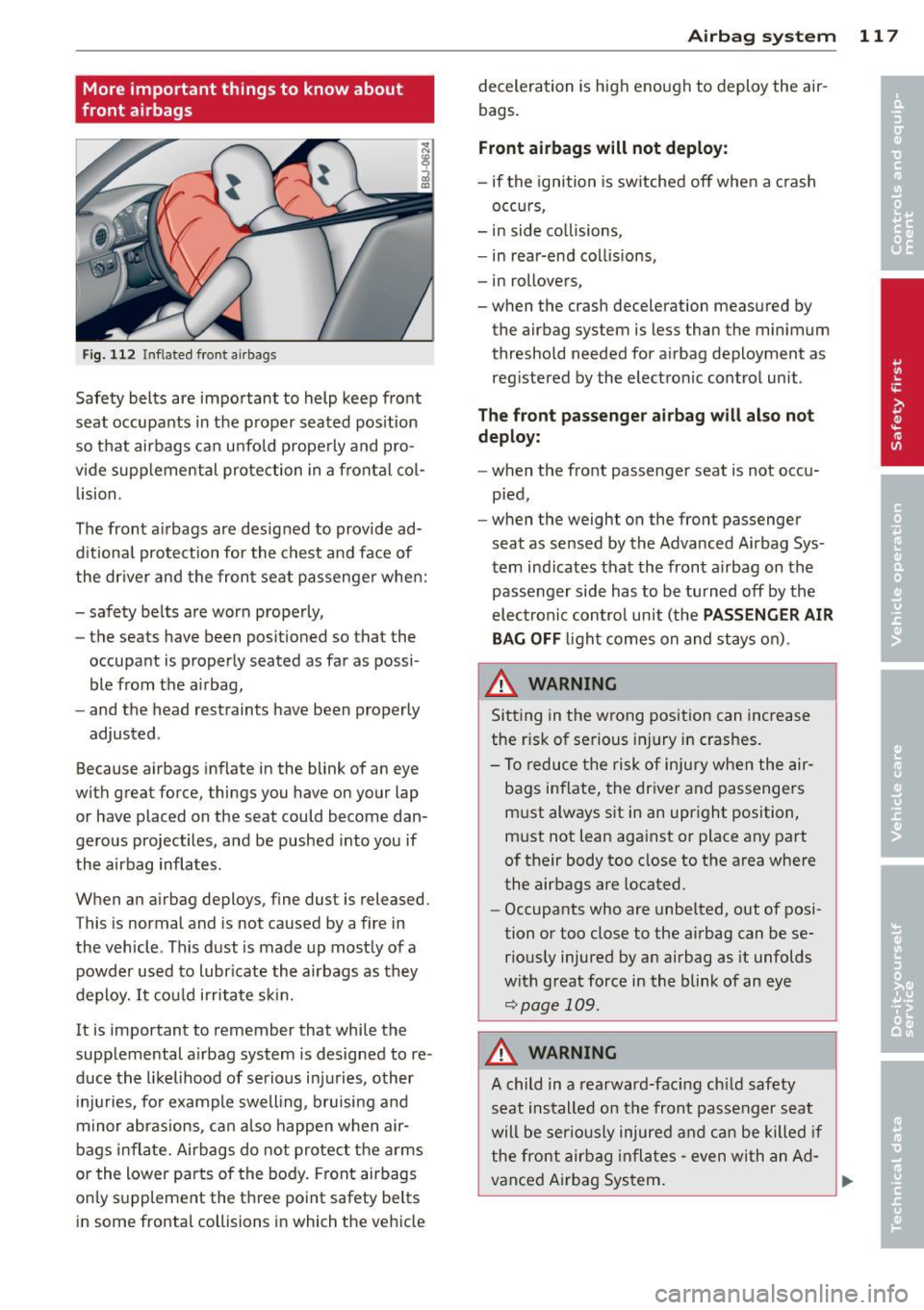
More important things to know about
front a irbags
F ig. 112 Inflated front airba gs
Safety belts are important to help keep front
seat occupants in the proper seated pos it ion
so that airbags can u nfold prope rly and pro
v ide supp lemental protection in a fronta l co l
lision .
The front a irbags are designed to provide ad
d itiona l protect io n for the chest and face of
the dr iver and the fron t seat passenger whe n:
- safety belts are wor n prope rly,
- the seats have been posit ioned so tha t the
occupant is proper ly seated as far as possi
ble from the a irbag,
- and the head restraints have been properly
adjusted .
Because airbags inflate in the blink of an eye
with great force, things you have on your lap or have placed on the seat could become dan
gerous projectiles, and be pushed into you if
the airbag inflates .
When an a irbag deploys, fine dust is released.
This is normal and is not caused by a fire in
the vehicle . This dust is made up most ly of a
powder used to lubr icate the airbags as they
deploy. It cou ld i rritate s kin .
It is important to remember that while the
supp lemental airbag system is designed to re
duce the likelihood of serious i njuries, other
inj uries, fo r example swell ing, bru isi ng a nd
minor abrasions, ca n also happen when air
bags inflate. Airbags do not protect the a rms
or the lower pa rts of the body. Front airbags
only s upplement the t hree point safety be lts
in some frontal collisions in which the vehicle
A irba g sy stem 11 7
deceleration is high eno ugh to deploy the air
bags .
Front airbags will not deploy :
-if t he ignition is sw itched off when a crash
occu rs,
- in side co llisions,
- in rear-end co llis ions,
- in rollovers,
- when the crash dece leration measured by
the airbag system is less than the minimum
threshold needed for a irbag deployment as
reg istered by the electronic con tro l unit .
The front pa ssenger airbag will also not
deploy:
- when the front passenge r seat is not occu
pied,
- when the weight on the front passenger
seat as sensed by the Advanced Airbag Sys
tem ind icates that the front a irbag on the
passenger side has to be tu rned off by th e
elec tronic con trol un it (the
PASSENGER AIR
BAG OFF
li ght comes on and st ays o n).
&_ WARNING ~
Si tti ng in the wrong pos ition can inc rease
the r isk of se rious in ju ry in crashes.
- To reduce t he ris k of injury when the air
ba gs inflate, the drive r and passenge rs
must always s it in an upr ight position,
m ust not lean against or place any part
of their body too close to the area whe re
the airbags a re located.
- Occupants who are unbe lted, out of posi
tion or too close to the airbag can be se rious ly injured by an airbag as it unfolds
with g reat force in the blink of an eye
~page 109 .
&_ WARNING
-
A child in a rearwar d-fac ing ch ild safety
seat installed on th e front passe nger seat
will be ser ious ly injured a nd ca n be killed if
the front ai rb ag inflate s - even wi th an Ad-
vanced Ai rbag Sys tem.
Ill-
Page 121 of 244
- comes on while driving.
I f an airbag system malfunct io n is dete cted ,
the ind icator light will firs t start flashing to
catch the driver 's attention and then stay on
continuously to serve as a constant reminder
to have the system inspected immed iately.
If a malfunction occurs tha t tur ns the fron t
ai rbag on the passenger side off, the
PA SSEN
GER AIR BAG OFF
li ght wi ll come on and stay
on wheneve r the ignition is on.
A WARNING
An airbag system that is not funct ioning
properly cannot provide supplemental pro
tection in a frontal crash.
- If the airbag indicator light comes on, it
means that the re may be somet hing
wrong with the Adva nced Airbag System .
It is possible that the airbag will inflate
w hen it is not s upposed to, or w ill not in
flate when it should.
- Have the airbag system inspected imme
diately by your Aud i dealer .
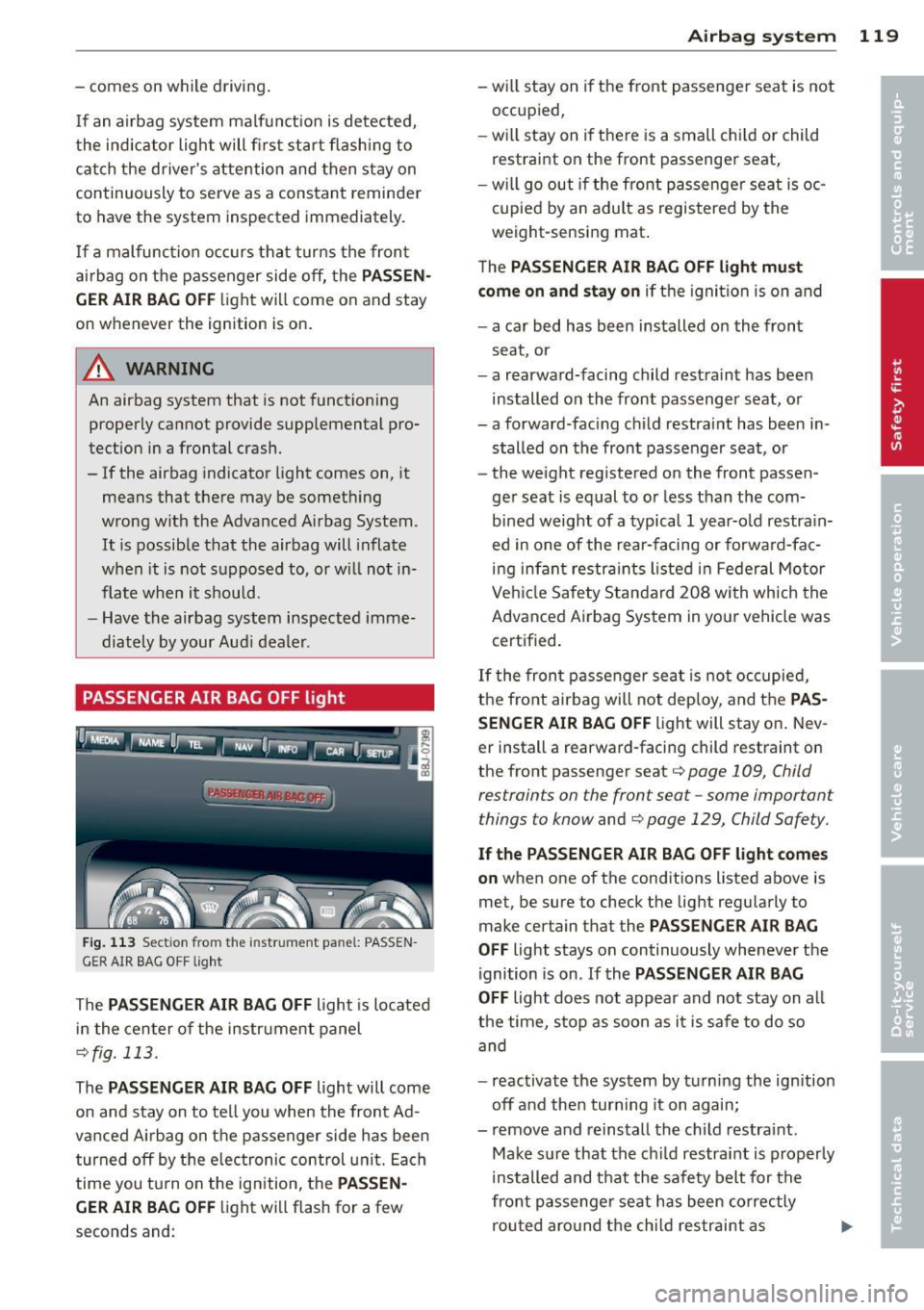
PASSENGER AIR BAG OFF light
Fig. 11 3 Section fr om the inst ru men t pa nel: PASS EN
G ER AIR BAG O FF light
The PASSENGER AIR BAG OFF light is located
i n the cen ter of the instrument panel
c:> fig. 113 .
The PASSENGER AIR BAG OFF light will come
on and stay on to tell you when the front Ad
vanced A irbag on the passenger side h as been
turned off by t he e lectronic control u nit. Each
time you tu rn on the ign ition, the
PASSEN
GER AIR BAG OF F
light will flash for a few
seconds and:
A irba g sy stem 119
- will stay on if the front passenger seat is not
occupied,
-w ill stay on i f there is a small ch ild or child
restraint on the front passenger seat,
- will go out if the fron t passenger seat is oc
cupied by an adult as registered by the
weight-sensing mat .
T he
PAS SENGER AIR BAG OFF light must
com e on and sta y on
if t he igni tion is on and
- a car bed has been installed on the front
seat , or
- a rearward-facing child restraint has been installed on the front passenger seat, or
- a forward -fac ing ch ild restra int has been in
stalled on the front passenger seat, or
- the weight reg istered on the front passen
ger seat is equal to or less than the com
bi ned weight of a typical 1 year-old restra in
ed in one of the rear-facing or forward-fac
ing infant restra ints listed in Federal Motor
Ve hicle Safety Standa rd 208 wi th which the
Advanced Airbag System in you r veh icle was
certified.
If t he fron t passenger seat is not occupied,
the fro nt airbag will not deploy, and the
PAS
SENGER AIR BAG O FF
light will stay on . Nev
er install a rearward-facing child restraint on
the front passenger seat
c:> page 109 , Child
res train ts on the front sea t-some important
things to know
and c:> page 129, Child Safe ty .
If the PASSENGER AIR BAG OFF light come s
o n
when one of the cond itions listed above is
met, be sure to check the light regularly to
make certain that the
PASSENGER AIR BAG
OFF
light stays on continuously wheneve r the
ignition is on .
If the PASSENGER A IR BAG
OFF
light does not appear and not stay on all
the time, stop as soon as it is safe to do so and
- reactivate the system by turn ing the ign ition
off and then turn ing it on again;
- remove and reinstall the ch ild restra int .
Make s ure that the ch ild restraint is proper ly
installed and that the safety belt for the
front passenge r seat has been correc tly
rou ted aro und t he chi ld restraint as
Page 122 of 244
120 Airbag sys te m
described in the child restraint manufactur
er 's instructions;
- make sure that the convertible locking fea
ture on the safety be lt for the front passen
ger seat has been activated and that the
safety belt has been pulled tight. The belt
must not be loose or have loops of slack so
that the sensor below the safety belt latch
on the seat can do its job
c> page 13 7.
- make sure that things that may increase the
weight of the child and child safety seat are
not being transported on the front passen
ger seat;
- make sure that the safety belt tension sen sor is not blocked . Shake the safety belt
latch on the front passenger seat back and
forth;
- If a strap or tether is bei ng used to tie the
child safety seat to t he front passenger
seat, make sure t hat it is no t so tight that it
ca uses the we ight -sensing mat to meas ure
more weight than is actua lly on the seat .
If the PASSENGER AIR BAG OFF light still
doe s not come on and does not stay on con
tinuously (when the igni tion is sw itched on),
- take the ch ild restraint off the front passen-
ger seat and have the ai rbag system inspect
ed by you r A udi dealer immediate ly .
The PASSEN GER AIR BAG OFF light should
NO T come on when the ign ition is on and an
adult is sitt ing in a p rope r seating pos it ion on
the front passenger seat. If the PASSENGER
AIR BAG OFF ligh t comes on and stays on or
flashes for about 5 seconds whi le driving, un
der these circumstances, make s ure that:
- the ad ult on the front passenger seat is
properly seated on the center of the seat
c u shion with his or her back up against the
backrest and the backrest is not reclined
c> page 92, Prop er occupant seating posi
tions,
- th e ad ult is not taking weight off the seat by
ho lding on to the passenger assist handle
above the front passenger door, - the sa
fety belt is being properly wo rn and
that there is not a lot of s lack in the safety
be lt webb ing,
- accessory seat covers or cushions or other
things that may cause an incorrect reading
or impression on the weight-sensing mat
under the upho lstery of the seat have been
removed from the fron t passenger seat,
- a safety belt extender has not been left in the safety belt latch for the front passenger
seat .
In addition to the PASSENGER AIR BAG O FF
li ght in the center of the instr ument panel,
the message PASSENGER AIR BAG OFF or
PASSENGER AIR BAG ON will briefly appear
i n the i nstr ument cluster d isplay. This is to i n
form the dr iver of the current front passenge r
airbag status.
Important safety instructions on
monitoring the Advanced Airbag System
A WARNING
An a irbag system that is not functioning
p roperly cannot p rovide supplemental pro
tection in a frontal c rash.
- If the airbag ind icator light comes on, i t
means that there may be something
wrong with t he Advanced Airbag System.
It is poss ible that the ai rbag w ill inflate
when it is not supposed to, or will not in
f late when it sho uld .
- Have the airbag system inspected imme
d iate ly by yo ur Audi dealer.
A WARNING
If the front airbag inflates, a child without
a child restraint, in a rea rward-facing child
safety seat or in a forward-facing child re
straint that has not been properly installed
will be serious ly injured and can be killed.
- Even tho ugh your vehicle is equipped
with an Advanced A irbag System, make
certain that all children, espec ially 12
yea rs and younger, always ride properly
restrained fo r their age and size.
-
Page 127 of 244
-Always make sure that the knee airbag
can inflate without interference. Objects
between you and the airbag can increase
the risk of injury in an accident by inter
fering with the way the airbag deploys or by being pushed into you as the airbag
deploys.
- Never let anybody, especially children
or animals ride in the footwell in front
of the passenger seat.
If the airbag de
ploys, this can result in serious or fatal
injuries.
- Never carry objects of any kind in the
footwell area in front of the driver's or passenger's seat. Bulky objects (shop
ping bags, for example) can interfere
with or prevent proper deployment of
the airbag. Small objects can be
thrown through the vehicle if the air
bag deploys and injure you or your pas
sengers.
- Make sure there are no cracks, deep
scratches or other damage in the area of
the instrument panel where the knee air
bags are located.
- If children are incorrectly seated, their
risk of injury increases in a collision
Q page 129, Child Safety.
Side airbags
Description of side airbags
The airbag system can provide supplemental
protection to properly restrained front seat occupants.
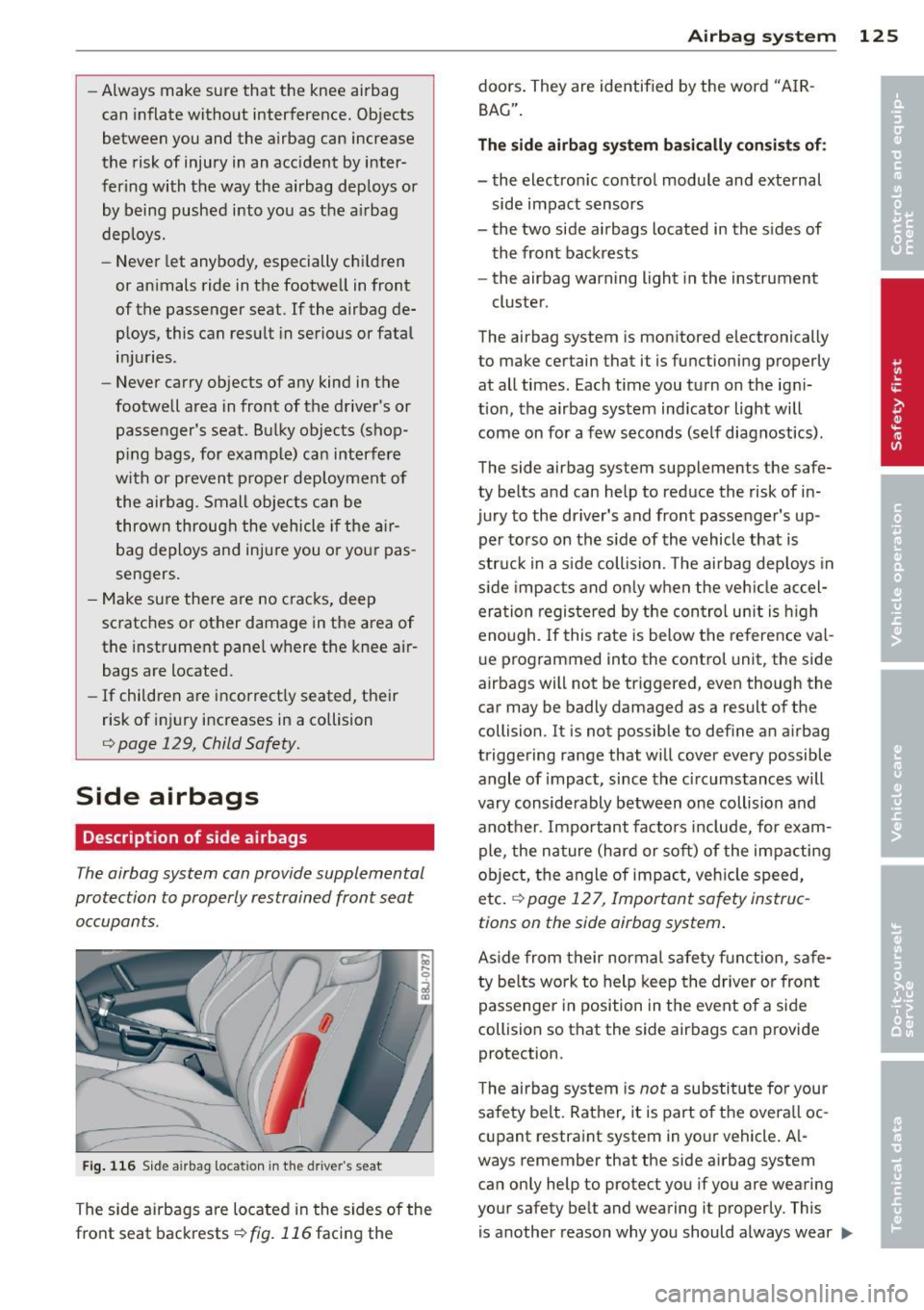
Fig . 116 Side airbag location in the driver 's seat
The s ide airbags are located in the sides of the
front seat backrests
¢ fig. 116facing the
Airbag system 125
doors. They are identified by the word "AIR
BAG".
The side airbag system basically consists of:
- the electron ic control module and external
side impact sensors
- the two side airbags located in the sides of the front backrests
- the airbag warning light in the instrument
cluster.
The airbag system is monitored electronically
to make certain that it is functioni ng properly
at all times. Each time you turn on the igni
tion, the airbag system indicator light will
come on for a few seconds (self diagnostics).
The side airbag system supplements the safe
ty belts and can help to reduce the risk of in
jury to the driver's and front passenger's up
per torso on the s ide of the vehicle that is
struck in a side collision. The airbag deploys in
side impacts and only when the vehicle accel
eration registered by the control unit is high
enough. If this rate is below the reference val
ue programmed into the control unit, the side
airbags will not be triggered, even though the
car may be badly damaged as a result of the
collision . It is not possible to define an airbag
triggering range that will cover every possible
angle of impact, since the circumstances will
vary considerably between one collision and
another. Important factors include, for exam
ple, the nature (hard or soft) of the impacting
object, the angle of impact, vehicle speed,
etc.
¢ page 127, Important safety instruc
tions on the side airbag system .
Aside from their normal safety function, safe
ty belts work to help keep the driver or front
passenger in position in the event of a side
collision so that the side airbags can provide
protection.
The airbag system is
not a substitute for your
safety belt. Rather, it is part of the overall oc
cupant restraint system in your vehicle. Al
ways remember that the side airbag system
can only help to protect you if you are wearing
your safety belt and wearing it properly. This is another reason why you should always wear
IIJJ,
Page 129 of 244
Important safety instructions on the
side airbag system
Airbags are only supplemental restraints. Al
ways properly wear safety belts and ride in a
proper seating position.
There is a lot that you and your passengers
must know and act accordingly to help the
safety belts and airbags do their job to pro
vide supplemental protection .
A WARNING
An inflating side airbag can cause serious
or fatal injury. Improperly wearing safety
belts and improper seating positions in
crease the risk of serious personal injury
and death whenever a vehicle is being
used .
- In order to reduce the risk of injury when
the supplemental side airbag inflates:
-Always sit in an upright position and
never lean against the area where the
supplemental side airbag is located.
- Never let a child or anyone else rest
their head against the side trim panel
in the area where the supplemental
side airbag inflates.
- Always make sure that safety belts are worn correctly,
- Do not let anyone sitting in the front
seat put their hand or any other parts
of their body out of the window.
- Always make sure that the side airbag can inflate without interference.
- Never install seat covers or replace
ment upholstery over the front seat backs that have not been specifically
approved by Audi.
- Never use additional seat cushions that
cover the areas where the side airbags
deploy.
- Damage to the original seat covers or
to the seam in the area of the side air bag module must always be repaired
immediately by an authorized Audi
dealer.
Airbag system 127
- Objects between you and the airbag can
increase the risk of injury in an accident
by interfering with the way the airbag
unfolds or by being pushed into you as
the airbag inflates.
- Never place or attach accessories or
other objects (such as cup holders, tel ephone brackets, or even large, bulky
objects) on the doors, over or near the
area marked "AIRBAG" on the seat backrests .
- Such objects and accessories can be come dangerous projectiles and cause injury when the supplemental side air
bag deploys.
- Never carry any objects or pets in the
deployment space between them and
the airbags or allow children or other passengers to travel in this position .
- Always prevent the side airbags from be
ing damaged by heavy objects knocking
against or hitting the sides of the seat backs.
- The airbag system can only be triggered
once . If the airbag has been triggered,
the system must be replaced by an au
thorized Audi dealership.
- Damage (cracks, deep scratches etc.) to
the original seat covers or to the seam in
the area of the side airbag module must
always be repaired immediately by an au
thorized Audi dealer.
- If children are seated improperly , their
risk of injury increases in the case of an
accident
c:> page 129, Child Safety.
- Never attempt to modify any compo
nents of the airbag system in any way .
- In a side collision, side airbags will not
function properly if sensors cannot cor
rectly measure increasing air pressure in
side the doors when air escapes through
larger , unclosed openings in the door
panel.
- Never drive with interior door trim pan
els removed.
- Never drive when parts have been re
moved from the inside door panel and
•
•
Page 131 of 244
Child Safety
Important things to know
Introduction
The physical principles o f what happens when
your ve hicle is in a crash app ly also to chi ldren
c::> page 101, What happens to occupants not
wearing safety belts? .
But unlike adults and
teenagers, the ir muscles and bones are no t
fully developed . In many respects children are
at greater risk of serious injury in crashes than
adu lts.
Because children's bod ies are no t fully devel
oped, they require restra int systems especial
l y designed for the ir size, weight, and body
structure . Many count ries and all states of the
United States and provinces of Canada have
l aws req uiring the use of approved ch ild re
straint systems for in fants and small chi ldren.
I n a fronta l crash at a speed of 20-35 mph
(30-56 km/ h) the fo rces acting on a 13-po und
(6 kg) inf ant will be more than 20 t imes the
weight of the child. This means the weight of
the child would suddenly be more than
260 pounds ( 120 kg) . Under these conditions,
only an appropriate chi ld restraint properly
used can reduce the risk of ser ious injury.
C hi ld restra ints, like adult safety belts, must
be used properly to be effective . Used improp
erly , they can increase the risk of ser ious in
ju ry in an accident.
Consult the child safety seat manufacturer's i nstructions in order to be sure the seat is
right fo r you r ch ild 's s ize
c::> page 132, Impor
tant safety instructions for using child safety
sea ts.
P lease be su re to read and heed all of
the impo rtan t informat io n a nd WAR NINGS
about child safety, Advanced A irbags, and the
installation of child rest raints in this chapter .
There is a lot you need to know abou t the Ad
vance d Airbags in yo ur vehicle and how they
wo rk when infants and children in child re
straints are o n the front passenger seat. Be
cause of the large amount of important infor -
Child Safet y 129
mation, we cannot repeat it a ll here . We urge
yo u to read the detai led information in this
owner 's man ua l about ai rbags and the Ad
vanced Airbag System in your vehicle and the
very important information about transport
ing ch ildren on the front passenger seat.
Please be sure to heed the WARNINGS -they
ar e extremely importa nt for your safety and
the safety of you r passenge rs, especially in
f an ts a nd small chi ld ren.
A WARNING
-
A ll vehicle occupants and especially chi l
d ren must be restra ined properly w henev
er riding in a vehicle. An unrestrained or
improperly restra ined child could be in
jured by str iking the interior or by being
e jected from the vehicle dur ing a sudden
maneuve r or impact. A n unrestra ined o r
improperly restr ained child is also at great
e r r isk of inju ry or d eath thro ugh contact
wi th an inflat ing a irbag.
_& WARNING
C hildren on the front seat of any car even
wi th Advanced Airbag s can be ser io usly in
j ur ed or even kil led when an a irba g in
flates. A child in a rearwar d-fac ing ch ild
safety seat insta lled on t he front passen
ger seat will be ser iously injured and can
be killed if the front airbag inflates .
- The inflating airbag will h it the ch ild
safety seat or infant carrier with great
force and will smas h the child safety seat
a nd chi ld agai nst the bac krest , door or
roof.
- Never i nstall a rearward faci ng child
safety seat on the front passenger s eat
un less the
PASSENGER AIR BAG OFF
light comes o n and stays on. If the PAS·
SENGER AIR BAG OFF
l ight does no t
come on and st ay on, have the air bag
sys tem inspected immediately by your
Aud i dea le r.
•
•