seats AUDI TT ROADSTER 2015 Owner's Guide
[x] Cancel search | Manufacturer: AUDI, Model Year: 2015, Model line: TT ROADSTER, Model: AUDI TT ROADSTER 2015Pages: 244, PDF Size: 60.74 MB
Page 138 of 244
136 Child Safet y
Booster seats and safety belts
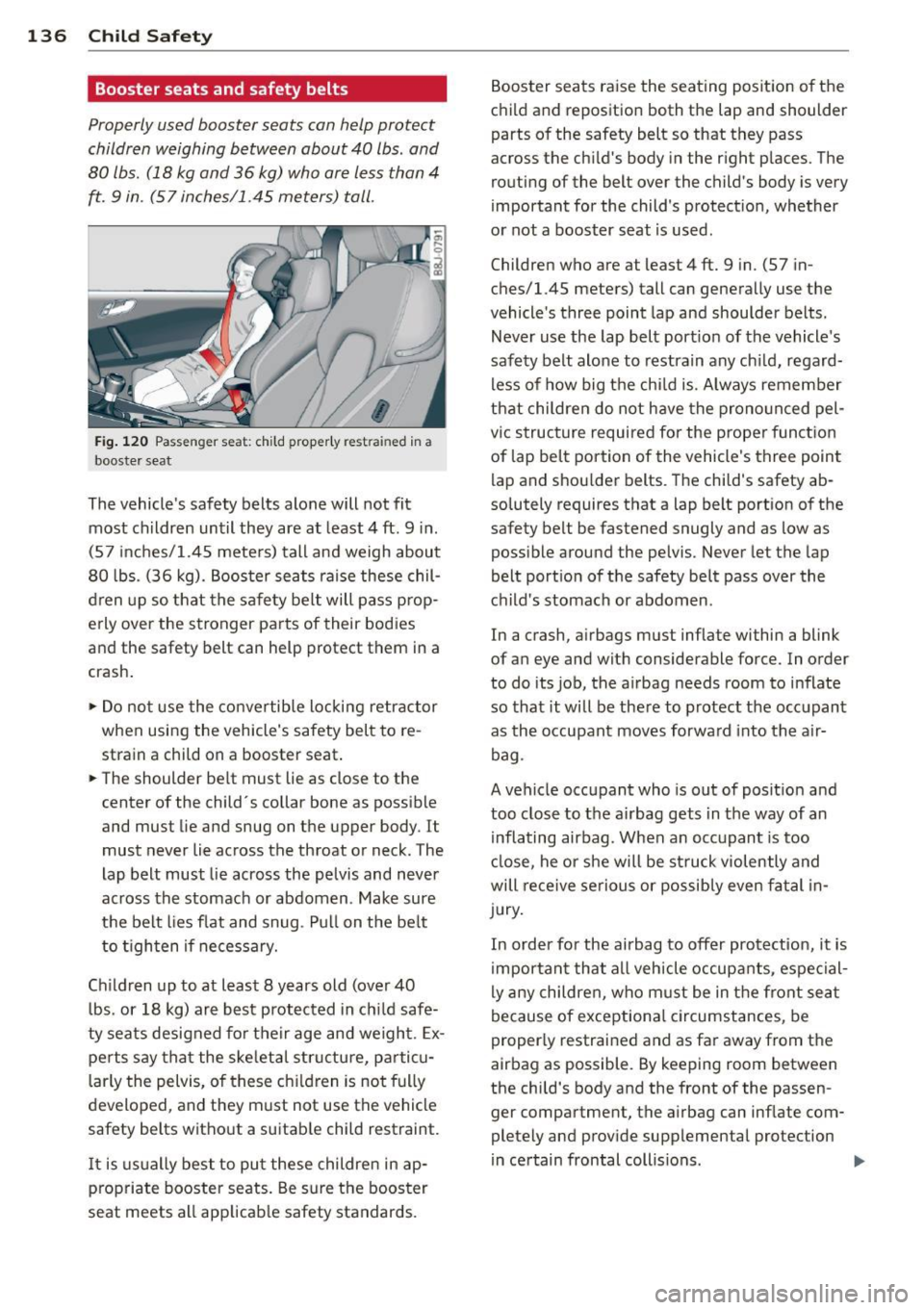
Properly used booster s eats can help protect
children weighing between about 40 lbs . and
80 lbs . (18 kg and 36 kg) who are less than 4
ft. 9 in. (57 inches/1 .45 meters) tall.
Fig . 120 Passenger seat: child proper ly rest ra in ed in a
booster seat
The vehicle's safety belts alone will not fit
most children until they are at least 4
ft. 9 in .
(57 inches/1.45 mete rs) tall and weigh about
80 lbs . (36 kg). Booster seats ra ise these chil
dren up so that the sa fety belt will pass p rop
erly over the stronger pa rts of their bodies
and the safety belt can help protect them in a
crash.
.. Do no t use the co nvertible locki ng retractor
when using the vehicle's safety belt to re strain a chi ld on a booster seat .
.. The shoulder be lt must lie as close to the
center of the child 's collar bone as possible
and must lie and snug on the upper body. It
must never lie across the throat or neck . The
lap belt must
lie across the pelvis and never
across the stomach or abdomen . Make sure
the belt lies f lat and snug . Pull on the be lt
to t ighten if necessary.
Ch ildren up to at least 8 years old (over 40
l bs. or 18 kg) are best protected in ch ild safe
ty seats designed fo r their age and weight . Ex
pe rts say that the ske leta l structure, pa rticu
larly the pelvis, of these ch ildren is not ful ly
developed , and they m ust not use the vehicle
safety belts without a suitab le child restraint.
It is us ually best to put these childre n in ap
propriate booster seats . Be sure the booster
seat meets all applicab le safety standards. Booster seats raise the seating position of the
c
h ild and reposition both the lap and shoulder
parts of the safety belt so that they pass
across the ch ild's body in the right p laces. The
ro uting of the belt over the child's body is very
important for the child's protect ion, whether
o r not a booster seat is used .
Children who are at least 4
ft. 9 in. (57 in
ches/1.45 meters) tall can generally use the
vehicle's three point lap and shoulder belts .
Never use the lap belt port io n of the vehicle's
safety belt alone to restrain any ch ild, regard
less of how big the chi ld is. A lways remember
that children do not have the prono unced pel
vi c structure required for the proper funct ion
of lap be lt portion of the vehicle's three point
lap and shou lde r belts . T he child 's safety ab
solutely requires that a lap belt port ion of the
safety belt be fastened snugly and as low as
possible around the pelvis. Never let the lap
belt portion of the safety be lt pass over the
c hi ld 's stomach or abdomen.
In a crash, a irbags must inflate within a blink
of a n eye and wi th considerable force. In order
to do its job, the airbag needs room to inflate
so that it will be the re to protect t he occupant
as the occupant moves forwa rd into the a ir
bag .
A vehicle occupant who is out of posit ion and
too close to the a irbag gets in t he way of an
inflating airbag . When an occupant is too
cl ose, he or she w ill be struck v iolently and
will receive serious or possibly even fatal in
Jury .
In order for the airbag to offer prote ction, it is
importan t that a ll vehicle occupa nts, espe cial
ly any childre n, who m ust be in t he front se at
because of exceptiona l circumstances , be
proper ly restrained and as fa r away from the
airbag as possible. By keeping room between
the chi ld's body and the front of the passen
ger compartment, the airbag can inf late com
pletely and prov ide supplemental protection
in certain frontal collisions .
..
Page 139 of 244
A WARNING ,~ ~
Not using a booster seat, us ing the boos
ter seat improperly, incorrectly install ing a
booster seat or using the vehicle safety
belt improperly increases the risk of seri
ous pe rsonal injury and death in a co llision
or other emergency s ituation. To help re
duce t he risk of serious persona l injury
and/or death:
- T he shoulder be lt mus t lie as close to t he
center o f the child's co llar bone as poss i
ble and must lie and snug on the upper
body . It must never lie across the throat
or neck. The lap belt must lie across the
pelvis and never across the stomach or
abdomen. Make sure the belt lies f lat
and snug . Pull on the belt to t ighten if
necessary .
- Failure to properly route safety belts over a ch ild's body will cause severe inju
ries in an acc ident or other emergency
situation
¢ page 100 .
-Children on the front seat of any car ,
even with Adva nced A irbags, can be seri
o usly injured or eve n killed when an a ir
bag inf lates.
- Never let a child stand or knee l on the
sea t.
- Never let a child ride in the ca rgo a rea of
yo ur vehicle .
- Always remember that a ch ild lean ing
forwar d, sit tin g s ideways o r out of posi
tio n in any way during an a ccident ca n be
stru ck by a deploying airbag. This will re
s u lt in serious personal injury or deat h.
- If you mus t inst all a b oos ter sea t on the
front passenger seat because of excep
tional circumstances the
PASSENGER
AIR BAG OFF
light must come on and
stay on, whenever the ignition is switch
ed on.
- If the
PASSENGER AIR BAG O FF light
does not come on and stay on, perform
the checks described
¢page 118, Moni
toring the Advanced Airbag System .
-If the PASSENGER AIR BAG OFF light
does not come on and stay on whenever
Child Sa fet y 137
the ignition is switched on the inflating
airbag w ill hit the child safety seat or in
fant carrier wit h great force and will
smash the child safety seat and child
aga inst the backrest, door o r roof . Have
the airbag system ins pected immed iately
by your Audi dea ler.
- Always read and heed all WAR NINGS
wheneve r us ing a child restrained in ave
hicle is being u sed
¢ page 100, Safety
bel ts,
¢ page 108, Airbag system and
¢ page 129, Important things to know .
Installing a child safety
seat
Securing a child safety seat using a
safety belt
Safety belts for the front passenger can be
Locked with the conver tible Locking retractor
to properly secure child safety seats .
The safety belts eme rgency locking retracto rs
for t he front passenger's seat safety belt h ave
a conver tible locking re trac to r f or c hild re
stra ints. The safety be lt must be locked so
that belt webb ing cannot unree l. The retrac
tor can be act ivated to lock the safety belt and
prevent the safety be lt webb ing from loosen
i ng up duri ng normal dr iv ing . A child safety
seat can only be properly insta lled when the
safe ty belt is locked so that the chi ld and child
safety seat w ill stay in place.
Always remember: Even tho ugh your vehicle is
equipped with an Advanced Airbag system, a
c hi ld should always ride in the seat prope rly
r est rained for its age and s ize .
A WARNING
Im properly installed chi ld safety seats in
cre ase the risk of serious personal injury
and deat h in a co llision.
- Always ma ke sure tha t the safe ty belt re
tr act or is lo cked w hen insta lling a chil d
safety sea t. An unlocke d safety bel t re
tracto r cannot hold the child safety seat
•
•
Page 140 of 244
138 Child Safety
in place during normal driving or in a
crash.
- Always buckle the child safety seat firmly
in place even if a child is not sitting in it.
A loose child safety seat can fly around
during a sudden stop or in a collision
- The inflating airbag will hit the child safety seat or infant carrier with great
force and will smash the child safety seat and child against the backrest, door or
roof.
- Forward-facing child safety seats or in
fant carriers installed on the front pas
senger's seat may interfere with the de
ployment of the airbag and cause serious
injury to the child.
- Always read and heed all WARNINGS
whenever using a child restrained in ave
hicle is being used
~page 129. Special
precautions apply when installing a child
safety seat on the front passenger seat
~ page 109, Child restraints on the front
seat -some important things to know.
A WARNING
-
Always take special precautions if you
must install a forward or rearward-facing
child restraint on the front passenger's
seat in exceptional situations:
- Whenever a forward or rearward-facing
child restraint is installed on the front
passenger seat, the
PASSENGER AIR
BAG OFF
light must come on and stay on
whenever the ignition is switched on.
- If the
PASSENGER AIR BAG OFF light
does not come on and stay on, perform
the checks described
~ page 118, Moni
toring the Advanced Airbag System.
- If the PASSENGER AIR BAG OFF light
does not come on and stay on whenever
the ignition is switched on the inflating
airbag will hit the child safety seat or in
fant carrier with great force and will smash the child safety seat and child
against the backrest, door or roof . Have
the airbag system inspected immediately by your Audi dealer . -
Improper installation of child restraints
can reduce their effectiveness or even
prevent them from providing any protec
tion .
- An improperly installed child restraint
can interfere with the airbag as it de
ploys and seriously injure or even kill the
child.
- Always carefully follow the manufactur
er's instructions provided with the child
safety seat or carrier.
- Never place additional items on the seat that can increase the total weight regis
tered by the weight-sensing mat and can
cause injury in a crash.
A WARNING
Forward-facing child restraints:
- Always make sure the forward-facing
seat has been designed and certified by
its manufacturer for use on a front seat
with a passenger front and side airbag.
- Never put the forward-facing child re
straint up, against or very near the in
strument panel.
- Always move the passenger seat into its
rearmost position in the seat's fore and
aft adjustment range, as far away from
the airbag as possible before installing
the forward-facing child restraint. The
backrest must be adjusted to an upright position.
- Make sure that the
PASSENGER AIR BAG
OFF
light comes on and stays on all the
time whenever the ignition is switched
on .
A WARNING ~
Rearward-facing child restraints:
- A child in a rearward-facing child safety
seat installed on the front passenger
seat will be seriously injured and can be
killed if the front airbag inflates - even
with an Advanced Airbag System.
- The inflating airbag will hit the child
safety seat or infant carrier with great
force and will smash the child safety seat
Ill>
Page 142 of 244
140 Child Saf ety
Always let the safety belt retract complete ly
into its stowed pos ition . The safety belt can
now be used as an ordinary safety belt with
out the convert ible lock ing retractor for chi ld
restra ints .
If the convertible locking retractor shou ld be
activated inadvertently , the safety belt must
be unfastened and guided completely back in
to its stowed pos ition to deactivate th is fea
ture .
If the convertible locking retractor is not
deactivated, the safety belt will gradually be
come tighter a nd u ncomfortab le to wear .
A WARNING
Improperly insta lled child safety seats in
crease the risk of ser ious personal inju ry
and death in a collision.
- Never unfaste n the sa fe ty belt to deac ti
va te the convert ible lo ck ing retractor fo r
child restraints while the veh icle is mov
ing. You would not be restrained and
cou ld be seriously injured in an accident.
- Always read and heed all WARNI NGS
whenever using a child restrained in ave
hicle is being used ¢page 129. Special
precautions apply when installing a ch ild
safety seat on the front passenger seat
¢ page 109, Child restraints on the front
seat -some important things to know .
Additional Information
Sources of information about child
restraints and their use
.
There are a number of sources of additional
information abou t ch ild restrai nt select ion, in
stallat io n and use:
NH TSA advises that the best child safety seat
is the one that fits your child and fits i n your
ve hicle, and that you w ill use correctly and
consistently .
Try before you buy!
U.S Nation al Highway Traffic Safet y Admin
i s trat ion
Te l.: 1-888-327 -4236 ( TTY : 1-800-424-9 153)
www .nhtsa .gov
National SAFE KIDS Campaign
T el.: (202) 662-0600
www.safek ids.o rg
Safet y BeltSafe U .S.A
T el.: (800) 745 -SAFE (English)
T el.: (800) 747-SANO (Spanis h)
www.ca rseat.org
Transport Can ada Information Centre
Tel.: 1 (800) 333 -037 1 or call
1 (613) 998-8616 if you are in the Ottawa
area
http://www .tc.gc.ca/eng/roadsafety/
menu. htm
Audi Cu stomer Relation s
Tel.: (800) 822-2834
Page 150 of 244
148 Intelligent technology
To bring the energy balance back into equilibrium, consumers which require especia lly
l arge amo unts of energy are temporari ly c ut
back or switched off. Heating systems in par
ticular requ ire a great dea l of energy. If you
n otice, for example, that the heated seats * or
the heated rea r window a re not heating, they
have been temporar ily cut back o r switched
off. These sys tems will be ava ilable again as
soon as the energy ba lance has bee n restored.
You will also not ice that engine idle speed has
been inc reased slightly. This is no rma l and not
a cause fo r concern . By increas ing engine idle
spee d the add itiona l ene rgy required is gener
ated and the ba ttery is charged .
Driver notification in the instrument
cluster display
If battery power drops into the range where it
can limit the ability of the engine to start, th is
i s shown in the instrument cluster display
with the following driver message:
(•) Low battery charge : battery will be
cha rged while dri ving
This notification reminds you that the starti ng
capability of the engine may be limited. As
soon as you start driving aga in, the battery
will be recharged and the notification will go
out .
Driv er notificat ion appears and goes out
again
If t his driver notification appears after the ig
ni tion is turned on or while driv ing and it goes
out again after a while, the battery has been
adequately rec harged.
Driver notification appears and does not
go out again
If t his driver notification appears after the ig
n ition is turn ed on or while driv ing and does
n ot go ou t aga in, t he battery's s tate of charge
is not i n the opt imal range. St arting ability is
restricte d. Have the bat tery checked as soon
as possible by a n authorized Audi dealer or
q ua lified workshop.
Page 183 of 244
-Never mount used tires on yo ur vehicle if
yo u are not sure of their "previous histo
ry." Old used tires may have been dam
aged even though the damage cannot be
seen that can lead to sudden tire failure
and loss of vehicle control.
- If you notice unusual vibration or if the
vehicle pulls to one side when d riving, al
ways stop as soon as it is safe to do so
and check the wheels and tires for dam
age .
(D Note
-Please note that summer and winter
tires are designed for the cond itions that
are typ ic al in those seasons. Aud i recom
mends using w inter t ires du ring the win-
Glossary of tire and loading terminology
Accessory weight
means the comb ined weight (in excess of
those standard items which may be replaced)
of automatic tra nsmission, power steering,
power brakes, power windows, power seats,
radio, and heater, to the extent that these
items are availab le as factory-installed equip
ment (whether installed or not) .
Aspect ratio
means the ratio of the height to the width of
the tire in percent . Numbers of 55 or lower in
d icate a low sidewall for improved steering re
sponse and better overall handling on dry
pavement .
Bead
means the pa rt of the ti re that is made of
steel wires, wrapped or reinforced by ply cords
and that is shaped to fit the rim.
Bead s eparation
means a b reakdown of the bond between
components in the bead.
Cord
means the strands forming the plies in the
tire.
Tire s an d wheel s 181
ter months . Low temperatu res signifi
cantly decrease the elastic ity of summer
t ires, which affects traction and braking
ability. If summer tires are used in very
co ld temperatures, cracks can form on
the tread bars, res ulting in permanent
ti re damage that can cause loud drivi ng
noise and unbalanced tires. Aud i is not
responsib le for this type of damage.
- Burn ished, polished or chromed rims
must not be used in winter weather. Th e
surfa ce of the rims does not have suffi
c ien t cor rosion pro te cti on for this and
c o ul d be pe rmanen tly damaged by road
salt or similar substances. This damage
is not covered by warranty.
Cold tir e inflation pressure
me ans the t ire press ure re commended by the
vehicle manufacturer fo r a tire o f a des igna ted
size that has not bee n driven for more than a
coup le of miles (k ilomete rs) at low speeds in
the three hour pe riod before the tire press ure
is measured or adjusted.
Curb weight
means the weight o f a motor vehicle with
standard equipment including the maximum
capacity of fuel, o il, and coolant, air cond i
tion ing and additional weight of optiona l
equipment.
E xtra load tire
means a tire designed to operate at higher
l oads and at higher inflation press ures than
the corresponding standard tire. Extra load
tires my be ident ified as "XL", "xl", "EXTRA
LOAD", or "RF" on the sidewall.
Gross Axle Weight Rating ("GAWR")
means the load-carrying capacity of a single
axle system, measured at the tire-ground in-
ter~ces.
~
•
•
Page 215 of 244
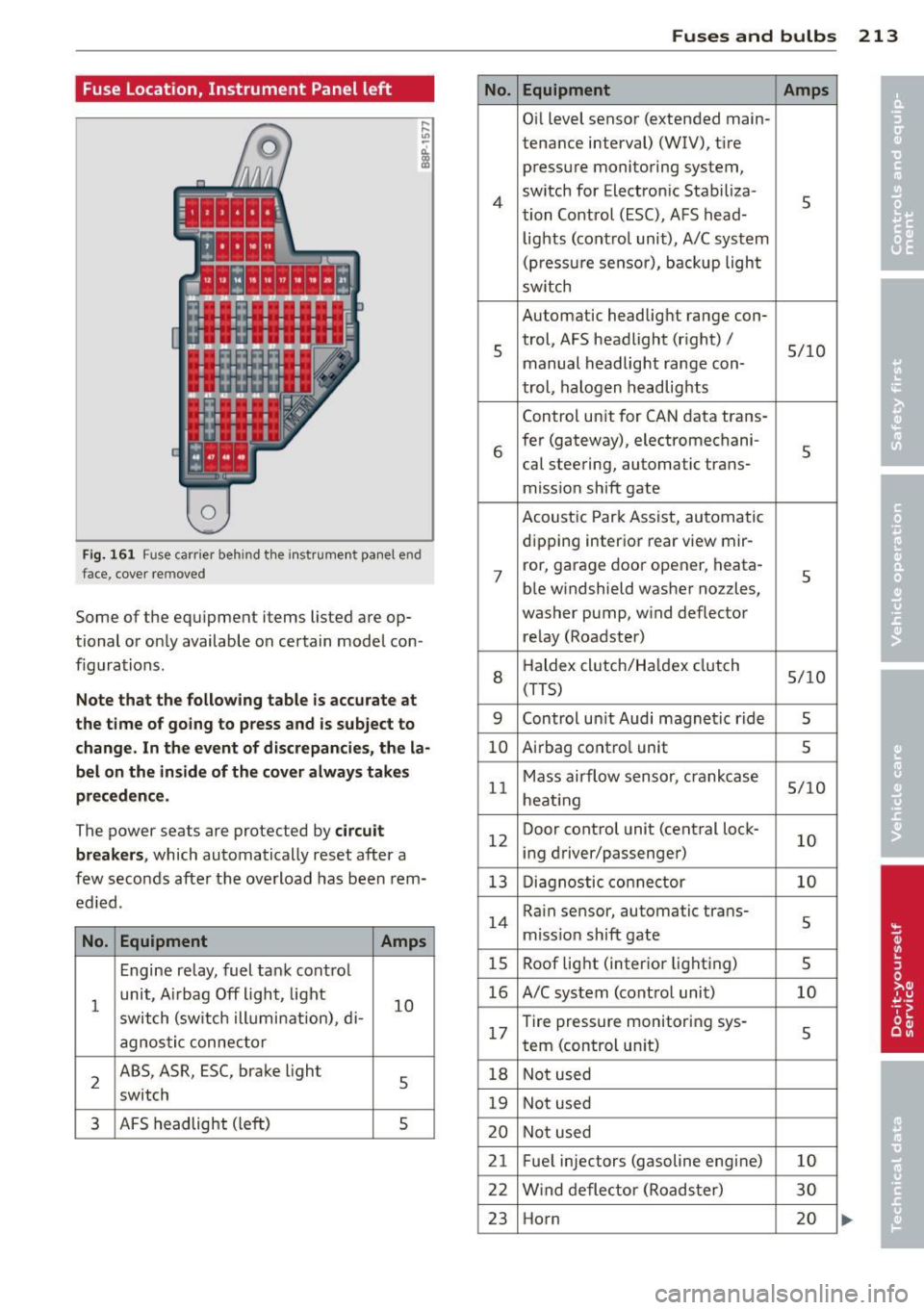
Fuse Location, Instrument Panel left
0
Fig. 161 Fuse carrier behind the instrument panel end
face, cover removed
Some of the eq u i prnent items listed a re op
tional or only available on certain model con
f igurations.
Note that the following table is accurate at
the time of going to press and is subject to
change. In the event of d iscrepancies, the la
bel on the in side of the cover always takes
precedence .
The power seats are protected by circuit
breakers ,
which automatically reset after a
few seconds after the overload has been rem
ed ied.
No. Equipment Amps
Engine relay, fuel tank cont ro l
1
unit, A irbag Off light, light
10 switch (sw itch illumi nation), di-
agnostic connector
2
ABS, ASR, ESC, brake light
5 switch
3 AFS headlight (left) 5
No.
4
5
6
7
8
9
10
11
12
13
14
15
16
17
18
19
20
21 22
23
Fuses and bulbs 213
Equipment Amps
Oil level sensor (extended main-
tenance interval)
(WIV), t ir e
press ure monitoring system,
sw itch for Electron ic Stabiliza-
5 tion Control (ESC), AFS head-
lights (control unit), A/C system
(pressure sensor), backup light
sw itch
Automatic headlight range con- trol, AFS headlight (right) /
5/10
manual headlight range con-
trol, halogen headlights
Control unit for CAN data trans-
fer (gateway), electrornechani-
5 cal steering, automatic trans-
miss ion shift gate
Acoustic Park Assist, automatic
d ip ping interior rear
view rnir-
ror, garage door opener, heata-
5 ble windshield washer nozzles,
washer pump, w ind deflector
relay (Roadster)
H aldex clutch/Ha ldex clutch
5/10 (TTS)
Control un it Audi magnetic ride
5
A irbag contro l unit 5
Mass airflow sensor, crankcase 5/10
heating
Door control unit (central lock -
10 ing driver/passenger)
Diagnostic connector
10
Rain sensor, automatic trans-
5 miss ion sh ift gate
Roof light (interior lighting)
5
A/C system (contro l unit) 10
Tire pressure monitoring sys -
5 tern (control un it)
Not used
Not used
Not used
Fuel injectors (gasoline eng ine)
10
Wind deflector (Roadster) 30
Horn 20
Page 216 of 244
214 Fuses and bulb s
No. Equipment
24 Transmi ssion (contro l un it)
25 Heate
r rear window Coupe /
heated rear window Roadster
26 Driver'
s side power window
27 Passenger's s ide power window
28 No
t used
29 Washer pump
30 Cigarette lighter
31 Start er
32 Steering column module
33 Instrument clust er
34 Radio navigation system , radio
35 Aud io amplifi er
36 Engine (control un it)
37 CAN (Gat
eway)
38 Ciga
rette lighter
39 Not us ed
40 Not used
4 1 Not u sed
42 Not used
43 No t used
44 Not used
45 No
t used
46 Not used
47 SOARS tuner, cell phone pack-
age,
TV tuner
48 VOA interface
49 Not used
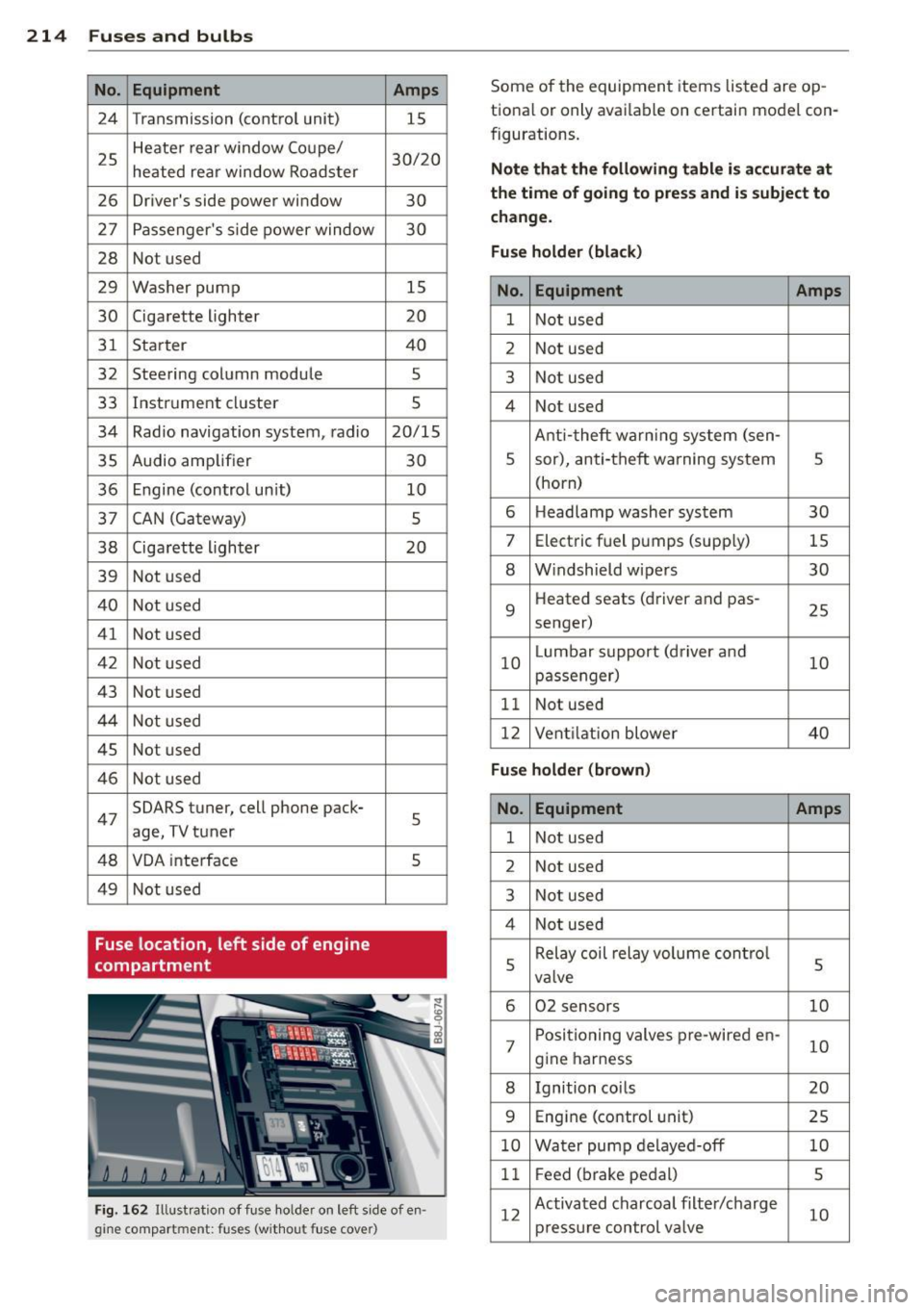
Fuse location, left side of engine
compartment Amps
15
30/ 20
30 30
15
20
40 5
5
20/15
30 10
5
20
5 5
Fi g. 162 Ill ustra tion of fus e ho lde r on l eft side o f en·
gi ne compar tment: fuse s (withou t fuse c over)
Some of the equipment items listed are op
tiona l or only avai lable on c ertain mod el con
figurations.
Note tha t the foll owing table i s ac cur ate at
the time of going to pre ss and is subject to
change .
Fus e holder (bla ck )
No . Equipment Amps
1 Not used
2 Not used
3 Not used
4 No t used
Anti- theft warning system (sen -
5 sor), ant
i-theft warn ing system
5
(horn)
6 Headlamp washer system
30
7 Elec
tric fuel pumps (supp ly)
15
8 W
indshield wipers
30
9 H
eat ed seats (dr iver and pas-
25
senger)
10 L
umbar support (d river and
10
passenger)
11 Not u sed
12 Vent ilation blower 40
Fus e holder (brown )
No. Equipment Amps
1 Not used
2 Not used
3 Not used
4 Not used
5 Relay coil
relay volume cont ro l
5
va lve
6 02
sensors
10
7 P
ositioning valves pre-wired en-
10
gine harness
8 Ignition coi ls 20
9 Eng
in e (cont rol unit)
25
10 Water pump de layed-off 10
1 1 F
e e d (brak e pedal)
5
1 2 Activated charcoal filter/charge
10
p ress ure control va lve
Page 231 of 244
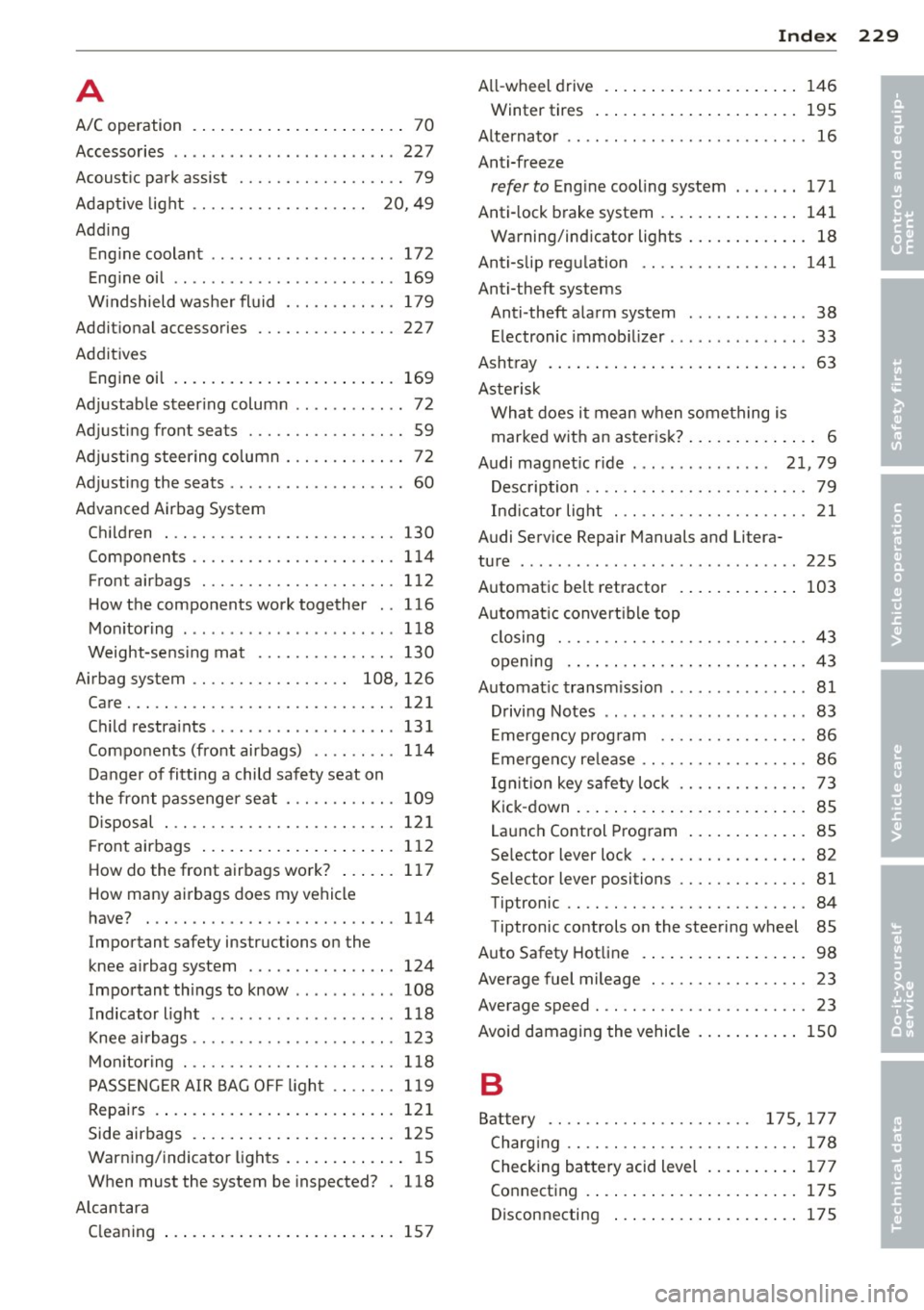
A
A/C operation . . . . . . . . . . . . . . . . . . . . . . . 70
Accessories .. ... .. .. ... ... .. .. .. .. . 227
Acoustic park assist . . . . . . . . . . . . . . . . . . 79
Adapt ive light . . . . . . . . . . . . . . . . . . . 20, 49
Adding Eng ine coolant .................. .. 172
Eng ine oi l ...................... .. 169
W indshield washer flu id . . . . . . . . . . . . 179
Addit ional accessories ............... 227
Additives Engine oil . ... .... .... ... .. .. .. .. .
Ad justab le steer ing column ........... .
Ad justing front seats ................ . 169
72
59
Ad justing s teering co lumn ... .. .. .. .. .. 72
Adjust ing the seats ................... 60
Advanced Airbag System Ch ildren
130
Components ............. .... .. ... 114
Front airbags . . . . . . . . . . . . . . . . . . . . . 112
H ow the components work together .. 116
Mon itoring . . . . . . . . . . . . . . . . . . . . . . . 118
Weight -sens ing mat ............... 130
Airbag system . . . . . . . . . . . . . . . . . 108, 126
Care ... .. .. ................. .. ... 121
Ch ild restra ints .................. .. 131
Components (front airbags) . . . . . . . . . 114
Danger of fitting a child safety seat on
the front passenger seat . .. .. .. .. .. . 109
Di sposal . .. ............. .... .. .. .
Fr ont airbags .. .. ..... ... .. .. .. .. .
How do the front airbags work? ... .. .
How many airbags does my vehicle
have? . ... . .... ............. .. .. .
Important safety instructions on the
knee airbag system ........ ... .. .. .
Important th ings to know .......... .
Indicator light ... .. ... ... .. .. .. .. . 12
1
112
1 17
114
124
108
118
Knee ai rbags ............. .... .. .. . 123
M oni tor ing . ............. .. .. .. .. . 118
P ASSENG ER AIR BAG O FF ligh t .. .. .. . 119
Repai rs .. .. ... .. ..... ... .. .. .. .. . 121
Side airbags . . . . . . . . . . . . . . . . . . . . . . 125
Warning/ indicato r lights ... .. ...... .. 15
When must the system be inspected? . 118
A lcantara
C leaning ... .. ... ..... ... .. .. .. .. . 157
Inde x 229
All-wheel drive . ..... . .. .. ..... ... .. 146
Winter tires ... .... . ... ...... ... .. 195
Alternato r .. .. .. .. ................. . 16
Anti-free ze
refer to Engine cool ing system ....... 171
Anti -lock brake system . .. ..... ... .. .. 141
Warning/indicator lights ..... ... .. .. . 18
Anti-s lip reg ulation ............. .... 141
Anti-theft systems
Anti -theft alarm system ............. 38
E lectronic immob il izer .. .. ..... ... .. . 33
Ashtray . ... .. .. .. .. .. ... ..... ... .. . 63
Aste ris k
Wha t does i t mean when something is
marked w ith an aster isk? . . . . . . . . . . . . . . 6
Audi magnet ic r ide . . . . . . . . . . . . . . . 21, 79
Desc ription .. .. .. .... ........... .. . 79
Ind icator light . .. .. .. ........... .. . 21
Audi Service Repair Manuals a nd Litera-
ture .......... ... .. .............. . 225
Automatic be lt retractor .. .... ... .. .. 103
Automat ic convert ible top
cl osing
... .. .. .. .... ........... .. . 43
opening . ... .. .. .. . .. ... .... ... .. . 43
Automat ic transm iss ion ......... .... .. 81
Driving Notes . . . . . . . . . . . . . . . . . . . . . . 83
E mergency p rog ram ........... .. .. . 86
E mergency re le a se .................. 86
Ign it ion key safety loc k ......... .... . 73
K ick -down ... .... .. . .. .. ..... ... .. . 85
La unc h Control Program
..... ... .. .. . 85
Se lector lever lock
82
Se lector lever positions ......... .. .. . 81
Tiptronic .. .. .. .. ................. . 84
Tiptronic controls on the steering wheel 85
Auto Safety Hot line . .. .. ..... ... .. .. . 98
Ave rage fuel mileage . . . . . . . . . . . . . . . . . 23
Average speed . . . . . . . . . . . . . . . . . . . . . . . 23
Avoid damaging the vehicle .... ... .. .. 150
B
Bat tery . . . . . . . . . . . . . . . . . . . . . . 175, 17 7
Charg ing .. .. .. .. ................. 178
Checking ba ttery acid level ... ... .. .. 177
Connect ing . ... .... . ... ...... ... .. 175
Disconnecting 175
•
•
Page 232 of 244
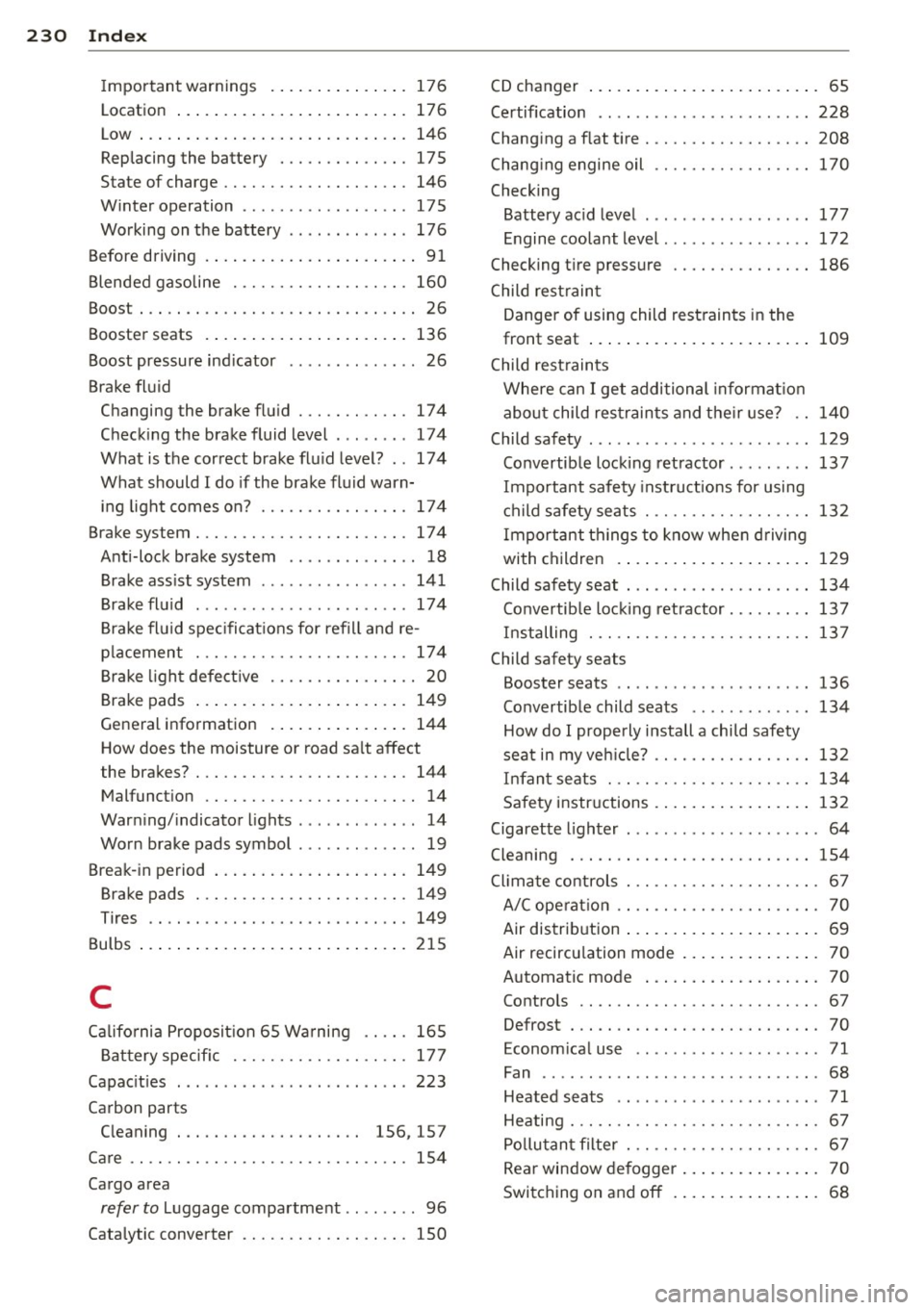
230 Index .:..:..:..::....::.....:..._ ___________________________ _
Important warn ings 176
Location . . . . . . . . . . . . . . . . . . . . . . . . . 176
Low ... .. .. ................ ..... . 146
Replacing the battery . . . . . . . . . . . . . . 17 5
State of charge . . . . . . . . . . . . . . . . . . . . 146
Winter operation ............. .. ... 175
Working on the battery .... .. .. .. .. . 176
Before driving . . . . . . . . . . . . . . . . . . . . . . . 91
Blended gasoline .......... .. .. .... . 160
Boost ... .. .. .. . .......... .. .. .... .. 26
Booster seats .............. ... .... . 136
Boost pressure indicator ........ .. .. .. 26
Brake fluid Changing the brake fluid ... .. .. .. .. . 174
Checking the brake fluid level . .. .. .. . 17 4
What is the correct brake fluid level? .. 174
What should I do if the brake fluid warn-
ing light comes on? ....... .. .. .... . 174
Brake system ................ .. .... . 174
Anti-lock brake system . . . . . . . . . . . . . . 18
Brake assist system ........ ..... .. . 141
Brake fluid . .............. ... .. ... 174
Brake fluid spec ificat ions for refill and re-
p lacement . ... .......... .. .. .. .. . 17 4
Brake light defective ........ .. .. .. .. 20
Brake pads ............... ... .... . 149
General information ....... ..... .. . 144
How does the moisture or road salt affect
the brakes? .............. .. .. .. .. . 144
Malfunction . . . . . . . . . . . . . . . . . . . . . . . 14
Warning/indicator lights .... ..... .. .. 14
Worn brake pads symbol . ........ .. .. 19
Break-in period ................ .. .. . 149
Brake pads .............. .... .... . 149
Tires .. .. .. ............. .. .. .. ... 149
Bulbs 215
C
California Proposition 6S Warning .... . 165
Battery specific .......... .. .. .. .. . 177
Capacities . .. ................ ... ... 223
Carbon parts Cleaning . . . . . . . . . . . . . . . . . . . . 156, 157
Care .. .. .. .. ... .......... .. .. .. .. . 154
Cargo area
refer to Luggage compartment . . . . . . . . 96
Catalytic converter ......... .. .. .... . 150 CD changer
..... .. ............. ..... 65
Certification ...... ................ . 228
Changing a flat tire . ... .......... .. .. 208
Changing engine oil ............. .... 170
Checking Battery acid level ...... ........... . 177
Engine coolant level .... ........... . 172
Checking tire pressure ........... .... 186
Child restraint Danger of using child restraints in the
front seat ..... .. ................ . 109
Child restraints
Where can I get additional informat ion
about child restraints and their use? .. 140
Child safety ..... .. .......... ...... . 129
Convertible locking retractor . .. ... ... 137
Impo rtant safety instructions for using
child safety seats ... ........... .. .. 132
Important things to know when driving
with children .... ................ . 129
Child safety seat ... ..... ........... . 134
Convertible locking retractor . .. .. .. .. 137
Installing . .... .. ............. .... 137
Child safety seats
Booster seats .. .. ................ . 136
Convertible child seats ... ...... .. .. 134
How do I properly install a child safety . h' l
? 132
seat in my ve 1c e . ............... . .
Infant seats . .. .. ... .......... .. .. 134
Safety instructions ................ . 132
Cigarette lighter . . . . . . . . . . . . . . . . . . . . . 64
Cleaning ... .... .. ............. .... 154
Climate controls ... ............. .. .. . 67
A/C operat ion . . . . . . . . . . . . . . . . . . . . . . 70
Air distribution ... ................ .. 69
Air recircu lation mode ............... 70
Automatic mode . . . . . . . . . . . . . . . . . . . 70
Controls . . . . . . . . . . . . . . . . . . . . . . . . . . 67
Defrost . .. .. .. .. ............. .. .. . 70
Economical use .. ....... ...... .. .. . 71
Fan .. ..... ... .. .. .............. .. 68
Heated seats .. .. .......... ...... .. 71
Heating ... .. .. .. .. ... ........ .... . 67
Pollutant filter ... ............. .. .. . 67
Rear window defogger ............... 70
Switching on and off .............. .. 68