seats AUDI TT ROADSTER 2015 User Guide
[x] Cancel search | Manufacturer: AUDI, Model Year: 2015, Model line: TT ROADSTER, Model: AUDI TT ROADSTER 2015Pages: 244, PDF Size: 60.74 MB
Page 73 of 244

The rear window defogger works only when
the engine is running. The indicator light in
the button illuminates when the rear w indow
defogger is turned on .
The rear window defogger is switched off au
tomatically after approx . 10 minutes .
@) For the sake of the environment
As soon as the rear window is clear, yo u
should switch the rear window de fogger
off . The reduced power consumption has a
beneficial effect on fuel consumption.
Heated seats~
Applies to vehicles: with heated seats
The seat cushion and the seotbock of the
front seats con be heated electrically .
.,. Press the heated seats b utton I-J + I
Q page 67, fig. 78 to set the level of heating
desired .
The range of controls goes from 1 to 3. The heat setting se lected is shown by LEDs above
the button .
A WARNING
Individuals with reduced sensitivity to pain
or temperature could develop burns when
using the seat heating function. To reduce
the risk of inju ry, these individuals should
not use seat heat ing .
(D Note
To avo id damage to the heating elements
in the seats, do not kneel on the seats or
place heavy loads on a small area of the
seat .
Using the climate controls economically
Economical use of the climate controls helps
to save fuel .
When climate control is working in coo ling
mode, engine performance is reduced and
fuel consumption is affected . To keep the time
Warm and c old 71
the air conditioning is on as short as possible,
you should do the following:
.,. If you would like to save fuel, switch the ai r
condi tioning off .
.,. If you open the windows while driving,
switch the air conditioning off .
.,. If the veh icle is extremely hot d ue to the
heat of the sun, br iefly open doors and w in
dows .
@) For the sake of the environment
When you save fuel, you reduce emissions
from the vehicle.
Page 93 of 244
Driving Safely
General notes
Safe driving habits
Please remember -safety first!
This chapter contains important information,
tips, instructions and warnings that you need
to read and observe for your own safety, the
safety of your passengers and others . We have
summarized here what you need to know
about safety belts, airbags, child restraints as
well as child safety. Your safety is for us
priori
ty number 1.
Always observe the information
and warnings in this section - for your own
safety as well as for that of your passengers.
The information in this section applies to all
model versions of your vehicle . Some of the
features described in this sections may be
standard equipment on some models, or may
be optional equipment on others. If you are
not sure, ask your authorized Audi dealer.
A WARNING
- Make certain that you follow the instruc
tions and heed the WARNINGS in this
Manual. It is in your interest and in the
interest of your passengers.
- Always keep the complete Owner's Liter
ature in your Audi when you lend or sell
your vehicle so that this important infor
mation will always be available to the
driver and passengers.
- Always keep the Owner's literature handy
so that you can find it easily if you have
questions.
Safety equipment
The safety features are part of the occupant
restraint system and work together to help
reduce the risk of injury in a wide variety of
accident situations .
Your safety and the safety of your passengers
should not be left to chance. Advances in
technology have made a variety of features
available to help reduce the risk of injury in an
Driving Safely 91
accident. The following is a listing of just a
few of the safety features in your Audi:
- sophisticated safety belts for driver and all
passenger seating positions,
- safety belt pre-tensioners,
- front airbags,
- knee airbags for the front seats,
- side airbags in the front seats,
- LATCH anchorages for child restraints,
- adjustable steering column.
These individual safety features can work to
gether as a system to help protect you and
your passengers in a wide range of accidents.
These features cannot work as a system if
they are not always properly adjusted and
properly used!
Safety is everybody's responsibility!
Important things to do before driving
Safety is everybody's job! Vehicle and occu
pant safety always depends on the informed and careful driver.
For your safety and the safety of your passen
gers,
before driving always:
~ Make sure that all lights and signals are op
erating correctly .
~ Make sure that the tire pressure is correct.
~ Make sure that all windows are clean and af
ford good visibility to the outside.
~ Secure all luggage and other items carefully
c::> page 65.
~ Make sure that nothing can interfere with
the pedals.
~ Adjust front seat, head restraint and mirrors
correctly for your height .
~ Instruct passengers to adjust the head re
straints according to their height .
~ Make sure to use the right child restraint
correctly to protect children¢
page 129,
Child Safety.
~ Sit properly in your seat and make sure that
your passengers do the same¢
page 59,
General recommendations. .,..
•
•
Page 95 of 244
~ Always keep both feet in the footwell so
that you are in control of the vehicle at all
times.
For detailed information on how to adjust the
driver's seat, see
c:> page 60.
A WARNING
Drivers who are unbelted, out of position
or too close to the airbag can be seriously
injured by an airbag as it deploys. To help
reduce the risk of serious personal injury:
- Always adjust the driver's seat and the
steering wheel so that there are at least
10 inches (25 cm) between your breast
bone and the steering wheel.
- Always adjust the driver's seat and the
steering wheel so that there are at least
4 inches (10 cm) between the knees and
the lower part of the instrument panel.
- Always hold the steering wheel on the
outside of the steering wheel rim with
your hands at the 9 o'clock and 3 o'clock positions to help reduce the risk of per
sonal injury if the driver's airbag inflates.
- Never hold the steering wheel at the
12 o'clock position or with your hands at
other positions inside the steering wheel
rim or on the steering wheel hub. Hold
ing the steering wheel the wrong way
can cause serious injuries to the hands,
arms and head if the driver's airbag in
flates
- Pointing the steering wheel toward your
face decreases the ability of the supple
mental driver's airbag to protect you in a
collision .
- Always sit in an upright position and nev
er lean against or place any part of your
body too close to the area where the air
bags are located.
- Before driving, always adjust the front
seats and head restraints properly and make sure that all passengers are prop
erly restrained.
- Never adjust the seats while the vehicle
is moving. Your seat may move unexpect-
Driving Safely 93
ed ly and you could lose control of the ve
hicle .
- Never drive with the backrest reclined or
tilted far back! The farther the backrests
are tilted back, the greater the risk of in
jury due to incorrect positioning of the safety belt and improper seating posi
tion .
- Children must always ride in child seats
c:> page 129 . Special precautions apply
when installing a child seat on the front passenger seat
c:> page 108.
Proper seating position for the front
passenger
The proper front passenger seating position
is important for safe, relaxed driving .
For your own safety and to reduce the risk of
injury in the event of an accident, we recom
mend that you adjust the seat for the front
passenger to the following position :
~ Adjust the angle of the seatback so that it is
in an upright position and your back comes
in full contact with it whenever the vehicle is
moving.
~ Adjust the head restraint so that the upper
edge is as even w ith the top of your head as
possible but not lower than eye level and so
that it is as close to the back of your head as
possible
c:> page 94.
~ Keep both feet flat on the floor in front of
the front passenger seat .
~ Fasten and wear safety belts correctly
c:> page 103.
For detailed information on how to adjust the
front passenger's seat, see
c:> page 59 .
A WARNING
Front seat passengers who are unbelted,
out of position or too close to the airbag
can be seriously injured or killed by the air
bag as it unfolds. To help reduce the risk of
serious personal injury:
•
•
Page 96 of 244
94 Driving Safely
-Passengers must always sit in an upright
position and never lean against or place
any part of their body too close to the
area where the airbags are located.
- Passengers who are unbelted, out of po
sition or too close to the airbag can be
seriously injured by an airbag as it un
folds with great force in the blink of an
eye.
- Always make sure that there are at least
10 inches (25 cm) between the front
passenger's breastbone and the instru
ment panel.
-Always make sure that there are at least
4 inches (10 cm) between the front pas senger's knees and the lower part of the
instrument panel.
- Each passenger must always sit on a seat
of their own and properly fasten and
wear the safety belt belonging to that
seat.
- Before driving, always adjust the front
passenger seat and head restraint prop
erly.
- Always keep your feet on the floor in
front of the seat. Never rest them on the
seat, instrument panel, out of the win
dow, etc. The airbag system and safety
belt will not be able to protect you prop
erly and can even increase the risk of in
jury in a crash .
- Never drive with the backrest reclined or
tilted far back! The farther the backrests
are tilted back, the greater the risk of in
jury due to incorrect positioning of the
safety belt and improper seating posi
tion.
- Children must always ride in child seats
¢
page 129. Special precautions apply
when installing a child seat on the front
passenger seat ¢
page 108.
Proper adjustment of head restraints
Correctly adjusted head restraints are an im
portant port of your vehicle's occupant re straint system and can help to reduce the risk
of injuries in occident situations.
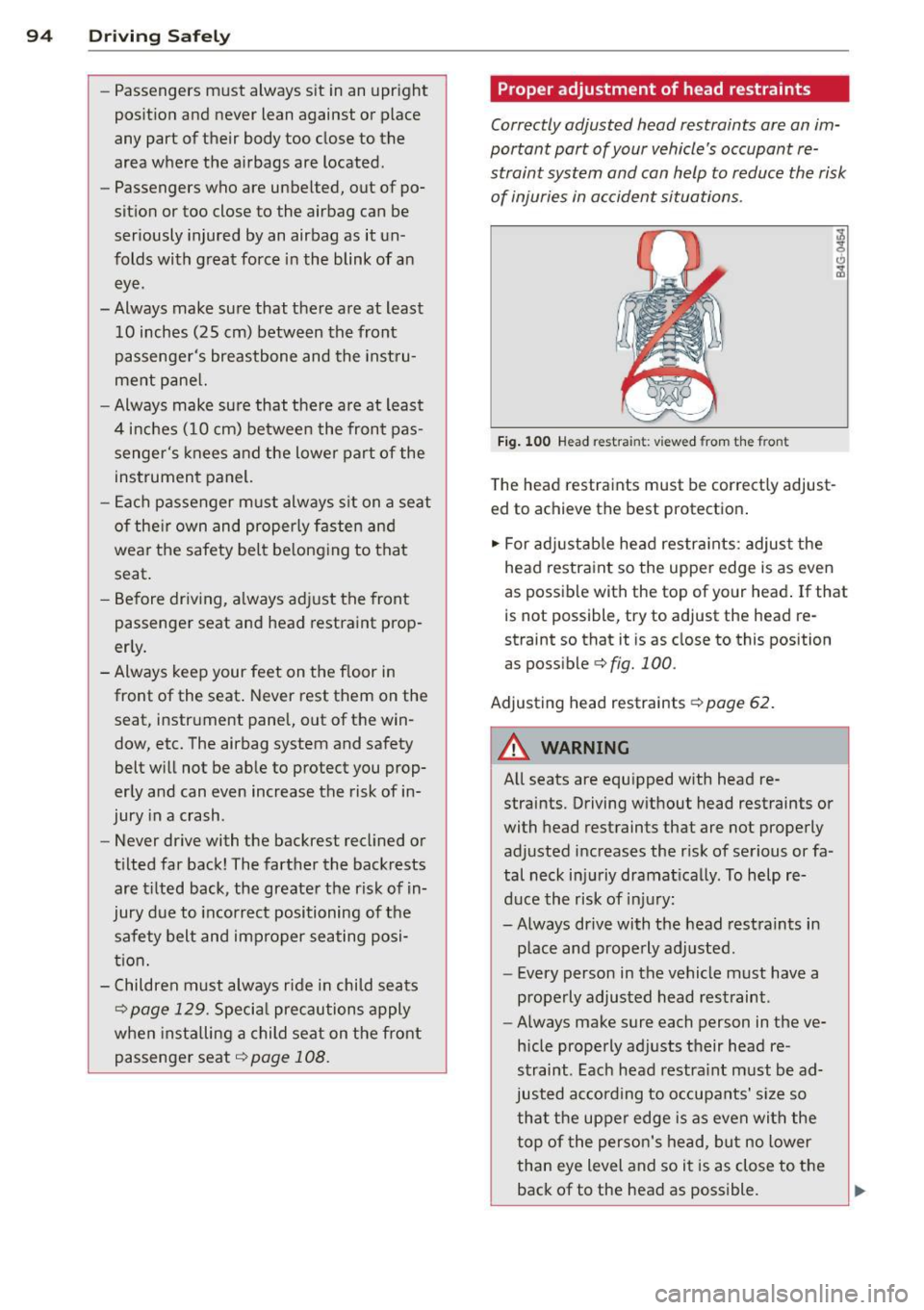
Fig. 100 Head restra int: v iewed from the front
The head restraints must be correctly adjust
ed to achieve the best protection.
" For adjustable head restraints: adjust the
head restraint so the upper edge is as even
as possible with the top of your head. If that
is not possible, try to adjust the head re
straint so that it is as close to this position
as possible¢
fig. 100.
Adjusting head restraints ¢ page 62.
A WARNING
-
All seats are equipped with head re-
straints. Driving without head restraints or
with head restraints that are not properly
adjusted increases the risk of serious or fa
tal neck injuriy dramatically . To help re
duce the risk of injury:
- Always drive with the head restraints in
place and properly adjusted.
- Every person in the vehicle must have a
properly adjusted head restraint.
- Always make sure each person in the ve
hicle properly adjusts their head re
straint . Each head restraint must be ad
justed according to occupants' size so
that the upper edge is as even with the
top of the person's head, but no lower
than eye level and so it is as close to the
back of to the head as possible.
Page 97 of 244
-Never attempt to adjust head restraint
while driving. If you have driven off and
must adjust the driver headrest for any
reason, first stop the vehicle safely be
fore attempting to adjust the head re
straint.
- Children must always be properly re
strained in a child restraint that is appro
priate for their age and size¢
page 129.
Examples of improper seating positions
The occupant restraint system can only re
duce the risk of injury if vehicle occupants are
properly seated.
Improper seating positions can cause serious
injury or death . Safety belts can only work
when they are properly positioned on the body. Improper seating positions reduce the
effectiveness of safety belts and will even in
crease the risk of injury and death by moving
the safety belt to critical areas of the body.
Improper seating positions also increase the
risk of serious injury and death when an air
bag deploys and strikes an occupant who is
not in the proper seating position. A driver is
responsible for the safety of all vehicle occu
pants and especially for children. Therefore:
.. Never allow anyone to assume an incorrect
seating position when the vehicle is being
used ¢,&. .
T he following bullets list only some sample
positions that will increase the risk of serious
injury and death. Our hope is that these exam
ples will make you more aware of seating po
sitions that are dangerous .
Therefore, whenever the vehicle is
moving :
-never stand up in the vehicle
- never stand on the seats
- never kneel on the seats
- never ride with the seatback reclined
- never lie down on the rear seat
- never lean up against the instrument panel
- never sit on the edge of the seat
- never sit sideways
Driving Safely 95
- never lean out the window
- never put your feet out the window
- never put your feet on the instrument panel
- never rest your feet on the seat cushion or
back of the seat
- never ride in the footwell
- never ride in the cargo area
A WARNING ,~
Improper seating positions increase the
risk of serious personal injury and death
whenever a vehicle is being used.
- Always make sure that all vehicle occu
pants stay in a proper seating position
and are properly restrained whenever the
vehicle is being used.
Driver and passenger
side footwell
Important safety instructions
A WARNING ~
Always make sure that the knee airbag can
inflate without interference. Objects be
tween yourself and the airbag can increase
the risk of injury in an accident by interfer
ing with the way the airbag deploys or by
being pushed into you as the airbag de
ploys.
- No persons (children) or animals should
ride in the footwell in front of the pas
senger seat. If the airbag deploys, this
can result in serious or fatal injuries.
- No objects of any kind should be carried
in the footwell area in front of the driv
er's or passenger's seat. Bulky objects
(shopping bags, for example) can ham
per or prevent proper deployment of the
airbag. Small objects can be thrown
through the vehicle if the airbag deploys
and injure you or your passengers.
-
•
•
Page 102 of 244
100 Safety belts
Safety belts
General notes
Always wear safety belts!
Wearing safe ty bel ts correctly saves lives!
This chapter exp lains why safety be lts are nec
essary, how they work and how to adjust and
wear them correctly .
.. Read a ll the information that fo llows and
heed all of the instructions and WARNINGS.
A WARNING
Not wearing safety belts or wearing them
improperly increases the risk of ser ious
personal in jury and death .
- Safety belts are the sing le most effective
means avai lab le to reduce the risk of se
r ious injury and dea th in a utomob ile acci
dents . For your protection and that of
yo ur passenge rs, always co rrectly wear
safety belts when the vehicle is moving .
- Pregnant women, injured, or physically
im paired perso ns m ust also use safety
belts . Lik e all veh icle occup ants, they are
more like ly to be ser iously injured if they
do not wea r safety be lts . The best way to
protect a fetus is to protect the mother -
throughout the entire pregnancy.
Number of seats
Your Audi TT Roadster has two seating posi tions. Each sea ting pos it ion has a sa fety be lt .
A WARNING
Not wearing safety belts or weari ng them
improperly increases the risk of ser io us
personal i njury and death.
- Never st rap more than one pe rson, in
cluding small ch ild ren, into any belt. It is
especially dange rous to place a safety
belt over a child s itting on y our lap.
- Never l et mo re peop le ride in the ve hicl e
than there are safety be lts ava ilable. -
Be s ure everyone riding in the vehicle is
properly restrained w ith a separate safe
ty belt or child restra int.
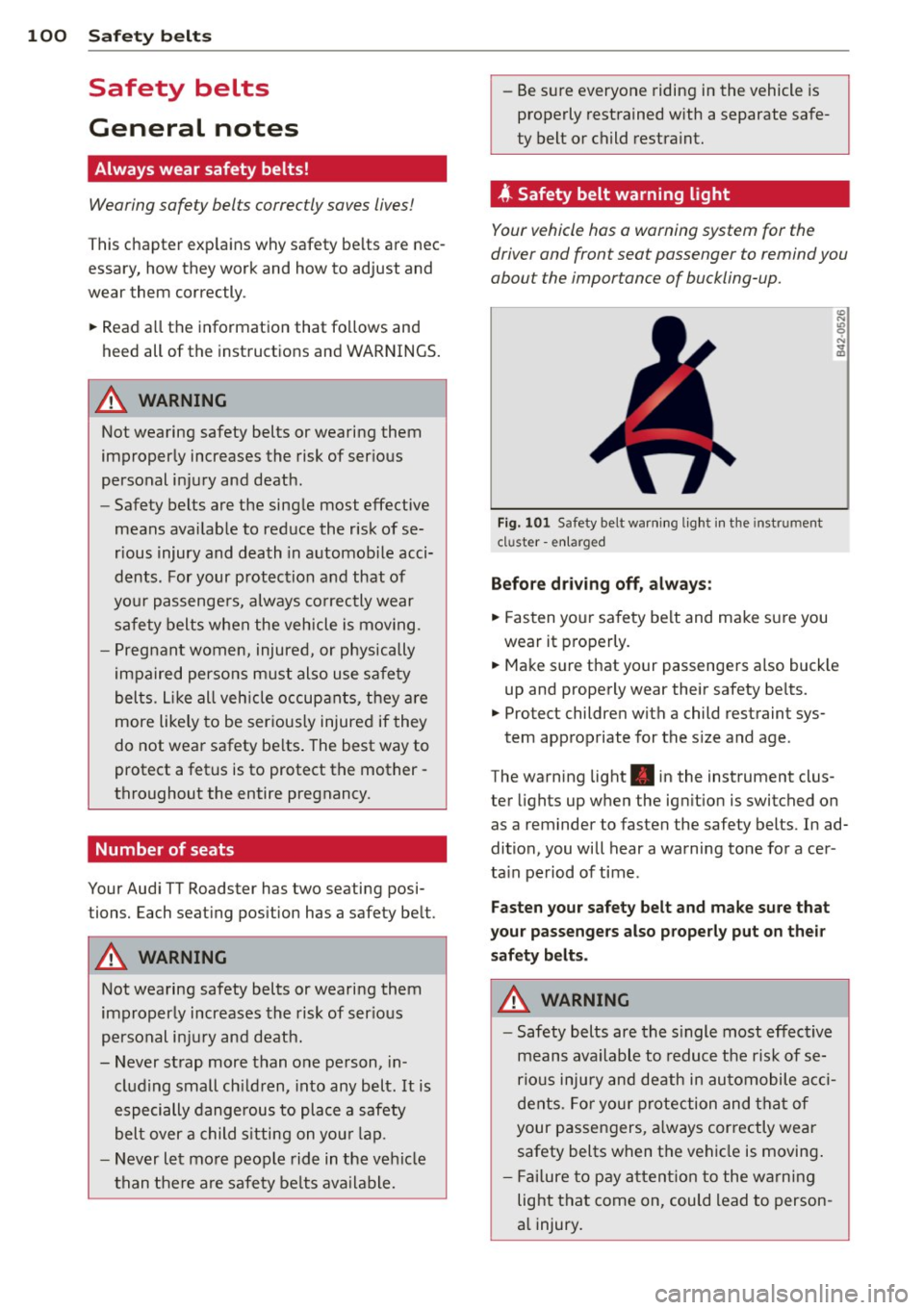
4 Safety belt warning light
Your vehicle hos o warning system for the
driver and front seat passenger to remind you
abou t the importance of buckling-up.
Fi g. 101 Safety bel t warni ng lig ht in the instr ument
cl uster -e nla rg ed
Befor e driv ing off, always:
.. Fas ten yo ur safe ty belt and make sure you
wear it properly.
.. Make s ure that your passenge rs also buck le
up and properly wear their safety be lts.
.. Protect children with a child restraint sys-
tem appropriate for the s ize and age .
T he warning light . in the instrument clus
ter lights up when the ig nition is switched on
as a reminder to fasten the safety belts . In ad
dition, you will hear a warning tone for a cer
ta in period of time .
Fasten your safety belt and make sure that
your passengers also properl y put on the ir
safety belt s.
A WARNING
-Safety belts are the s ingle most effec tive
means ava ilable to reduce the risk of se
rio us inju ry and death in au tomobile a cci
dents . Fo r you r protection and tha t of
your passengers, a lways cor rectly wear
safety belts when t he vehi cle is moving .
- F ailure to p ay a tten tion to the w arn ing
light that come on, could lead to person
a l injury.
Page 104 of 244
102 Safet y belt s
Remember too, that airbags wi ll deploy on ly
once and that your safety belts are always
there to offer protect ion in those accidents in
which airbag s are not suppo sed to deploy or
when they have already deployed . Unbelted
occupants can also be thrown out of the vehi
cle where even more severe o r fatal inju ries
can occu r.
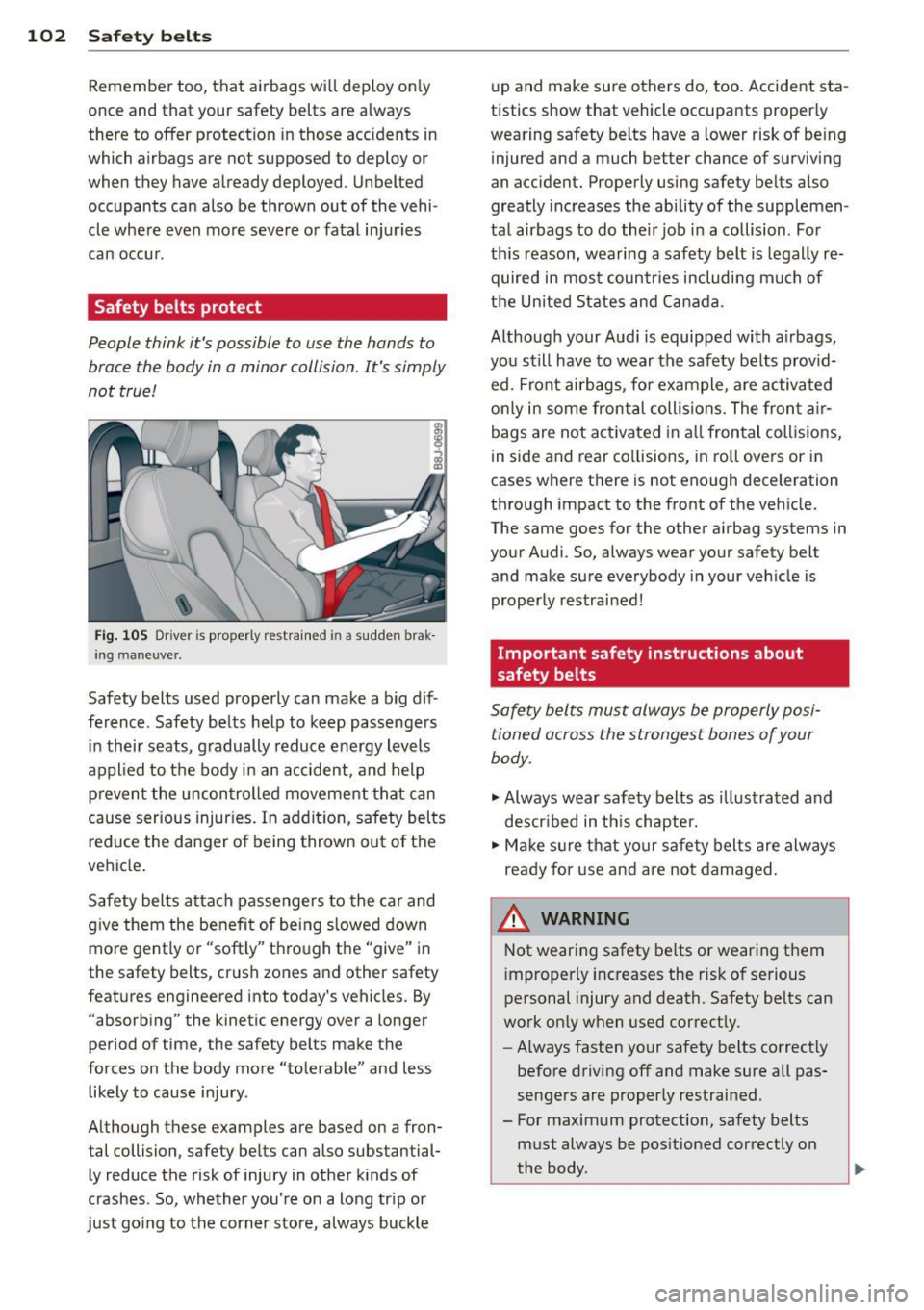
Safety belts protect
People think it's possible to use the hands to
brace the body in a minor collision. It's simply
not tru e!
Fig . 10 5 Driver is properl y re strain ed in a sudd en br ak
ing man euve r.
Safety belts used properly can make a big dif
ference . Safety be lts help to keep passengers
in their seats , g radually reduce energy levels
applied to the body in an accident, and help
preven t the uncontro lled moveme nt that can
cause serious injur ies . In additio n, safety belts
reduce the danger of being thrown out of the
ve hicle .
Safety belts attach passengers to the car and
g ive them the benefit of being s lowed down
more gently or "softly" t hrough t he "give" in
the safety belts , crush zones and other safety
fe atures engineered into today's vehicles. By
"absorb ing" the kinetic energy over a longer
period of time, the safety belts make the
forces on the body more "to lerable" and less
likely to cause injury .
Although these examples are based on a fron tal collision , safety belts can also subs tan tial
ly reduce the risk of injury in other k inds of
crashes . So, whether you' re on a long tr ip or
just going to the corner store, always buckle u
p and make sure others do, too. Accident sta
tist ics show that veh icle occupants properly
wearing safety belts have a lower risk of be ing
injured and a much better chance of surviving
an accident. Properly using safety belts also
greatly increases the ability of the supplemen
tal airbags to do the ir job i n a collision . Fo r
t hi s reason, wea ring a safety belt is legally re
quired in mos t countr ies includi ng m uch of
t h e Un ited States and Canada .
Although your Aud i is equipped wi th a irbags,
you still have to wear the safety be lts prov id
ed. Front ai rbags , fo r example , a re activated
only in some front al collisions. The fron t air
bags are not act ivated in a ll frontal coll is ions,
in side and rear co llisions, in roll overs or in
cases where there is not eno ugh deceleration
through impact to the front of the veh icle.
The same goes for the other a irbag systems in
your Aud i. So, always wear yo ur safety belt
and make su re everybody in your veh icle is
properly restrai ned!
Important safety instructions about
safety belts
Safety belts must always be properly posi
tioned across the strongest bones of your
body.
" Always wear safety belts as illust rated and
descr ibed in th is chapte r.
" Ma ke su re that yo ur safety belts are always
ready for use and are not damaged.
A WARNING
-
Not wear ing safety be lts or wearing them
i mproperly i ncreases the r is k of se rious
personal injury and death. Safety belts can
work on ly when used correctly.
- Always fasten your safety belts correct ly
befo re driving off and make sure all pas
sengers are properly restrained.
- For maximum protection, safety belts
must always be pos itioned c orrectly on
the body .
Page 106 of 244
104 Safety belts
During normal driving the belt lets you move
freely.
Safety belt pretensioners
The safety belts are equipped with a belt pre
tensioner that helps to tighten the safety belt
and remove slack when the pretensioner is ac
tivated. The function of the pretensioner is
monitored by a warning light
q page 15.
Switchable locking feature
Every safety belt except the one on the driver
seat is equipped with a switchable locking fea
ture that
must be used when the safety belt is
used to attach a child seat. Be sure to read the
important information about this feature
¢ page 137.
.&_ WARNING
Improperly positioned safety belts can
cause serious injury in an accident
¢ page 104, Safety belt position .
-Safety belts offer optimum protection
only when the seatback is upright and
belts are properly positioned on the
body .
-
- Never attach the safety belt to the buck
le for another seat. Attaching the belt to
the wrong buckle will reduce safety belt
effectiveness and can cause serious per
sonal injury.
- A passenger who is not properly restrain
ed can be seriously injured by the safety
belt itself when it moves from the stron-
ger parts of the body into critical areas
like the abdomen.
- Always lock the convertible locking re
t ractor when you are securing a child
seat in the vehicle
q page 139.
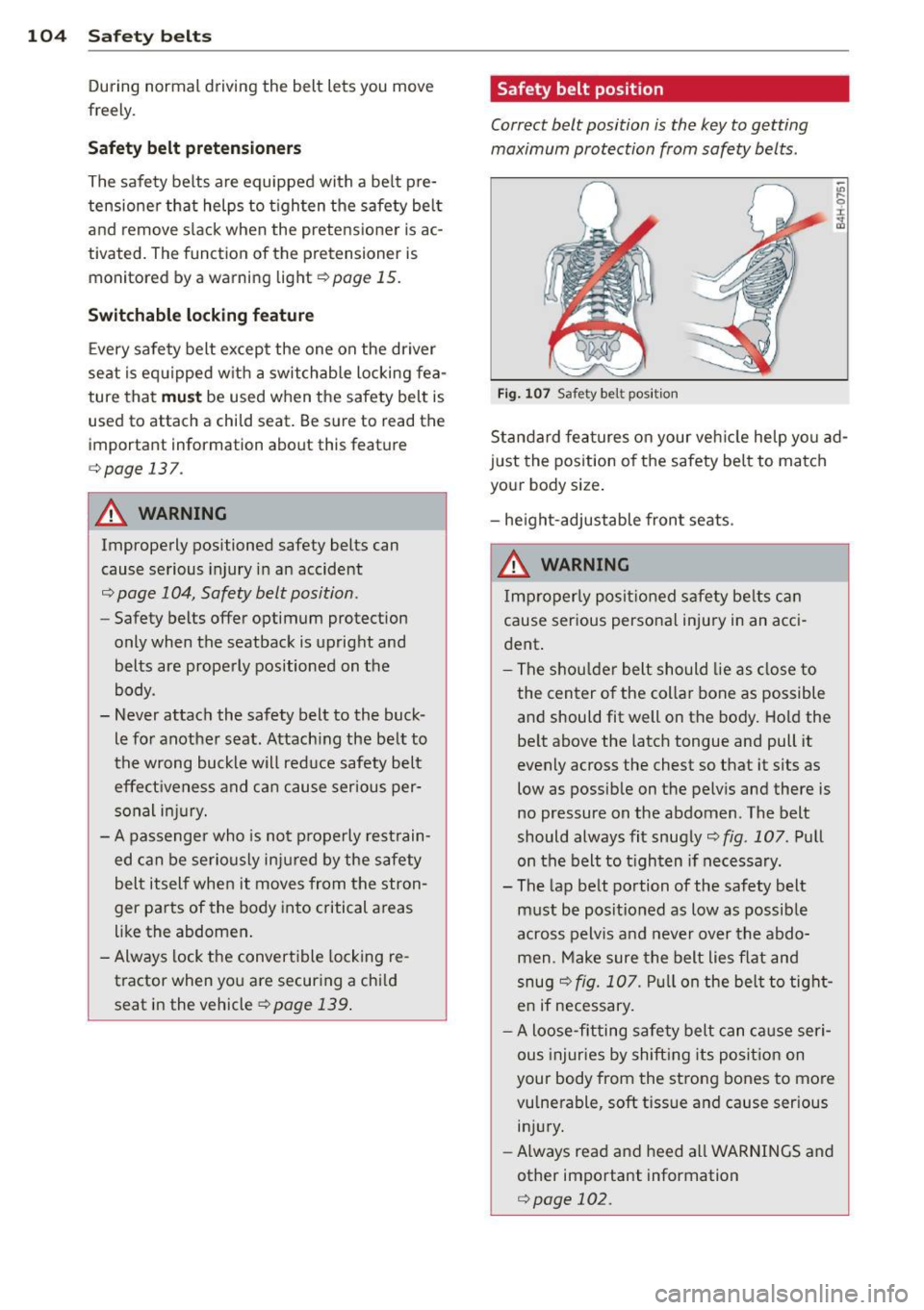
Safety belt position
Correct belt position is the key to getting
maximum protection from safety belts.
Fig. 107 Safety belt position
Standard features on your vehicle help you ad
just the position of the safety belt to match
your body size .
- height-adjustable front seats .
.&_ WARNING
Improperly positioned safety belts can
cause serious personal injury in an acci
dent.
-
- The shoulder belt should lie as close to
the center of the collar bone as possible and should fit well on the body. Hold the
belt above the latch tongue and pull it
evenly across the chest so that it sits as
low as possible on the pelvis and there is
no pressure on the abdomen . The belt
should always fit snugly
¢ fig . 10 7. Pull
on the belt to tighten if necessary .
- The lap belt portion of the safety belt
must be positioned as low as possible
across pelvis and never over the abdo
men . Make sure the belt lies flat and
snug
q fig. 107. Pull on the belt to tight
en if necessary.
- A loose-fitting safety belt can cause seri
ous injuries by shifting its position on
your body from the strong bones to more vulnerable, soft tissue and cause serious
injury.
- Always read and heed all WARNINGS and
other important information
¢page 102.
Page 111 of 244
angle of impact that will always trigger the
airbags, since the circumstances will vary con
siderably between one collision and another.
Important factors include, for example, the nature (hard or soft) of the object which the
car hits, the angle of impact, vehicle speed,
etc. The front airbags will also not inflate in
side or rear collisions, or in ro ll-overs .
A lwa ys
rem ember : Airbags will deploy only
once, and only in certa in kinds of collisions .
Your safety belts are always there to offer pro
tection in those s ituations in which airbags
are not supposed to deploy , or when they have
a lready deployed ; fo r example , when yo ur ve
h icle strikes or is struck by another after the
first collision .
This is just one of the reasons why an a irbag is
a supplementary restra int and is not a s ubst i
tute for a safety belt . The airbag system
works most effectively when used with the
safety belts. Therefore, always properly wear
your safety belts
¢ page 100.
A WARNING
Sitting too close to the steer ing wheel or
instrument panel will decrease the effec
tiveness of the airbags and will increase
the risk of pe rsonal injury in a co llision .
- Never sit closer than 10 inches (25 cm)
to the stee ring wheel or instrument pan
el.
- If you cannot sit more than 10 inches
(25 cm) from the steer ing whee l, investi
gate whether adaptive equipment may
be available to held you reach the pedals
and increase your seating dis tance from
the steering wheel.
- If you are unrestrained, lean ing fo rward,
sitting sideways or out of position in any
way, yo ur risk of inj ury is much highe r.
- You w il l also receive serio us inju ries and
cou ld even be killed if you are up against
the airbag or too close to it when it in
flates -even with an Advanced Airbag.
- To reduce the r isk o f injury when an air
bag inflates, a lways wear safety belts
proper ly ¢
page 103, Safety belts .
Airbag sys tem 109
-If ch ildren are not prope rly restrained,
they may be severely injured or killed
when an airbag inflates.
- Never let ch ildren ride unrestra ined or
improperly restrained in the vehicle. Ad
just the front seats properly.
- Always sit as far as possible from the steer ing whee l or the instrument panel
¢ page 92, Proper occupant seating po
sitions.
- Always sit upright with your back against
the backrest of your seat.
- Never p lace your feet on the instrument
panel or on t he seat. Always keep both
feet on the f loor in front of the seat to
help prevent serious in ju ries to the legs
a nd hips if the airbag inflates.
A WARNING
A irbags that have deployed in a crash must
be replaced.
- Use on ly orig inal equipment airbags ap
proved by Aud i and i nstalled by a trai ned
technician who has the ne cessary too ls
and d iagnost ic equipment to properly re
place any airbag in your vehicle and as
sure system effectiveness in a crash.
- Never perm it salvaged or recycled air
bags to be installed in you r vehicle .
Child restraints on the front seat - some
important things to know
.. Be s ure to read the important in forma tion
and head the WARNINGS for important de
tails about ch ildren and Advanced A irbags
¢ page 129.
The airbag on the passenger side makes the
front seat a pote ntially dange rous place for a
c hi ld to ride . The front seat is not the safest
pla ce for a child in a fo rward-facing child safe
ty seat.
It can be a very d angerous place for a n
infant or a chi ld in a rearwa rd -fa cing seat.
The Advanced A irbag System in you r vehicle
has been ce rtified to comply wit h the Require
ments of United States Fede ral Motor Vehicle
1111>
•
•
Page 112 of 244
110 Airbag sys te m
Safety Standard 208 as applicable at the time
your vehicle was manufactured.
The Standard requires the front a irbag on t he
passenger side to be turned off ("sup
pressed") if a child up to about one year of
age restrained in one of the rear-facing or for
ward -facing infant restra ints listed in Federal
Motor Vehicle Safety Standard 208 with which
the Advanced A irbag System in your vehicle
was certified has been installed on the front passenger seat . For a listing of the child re
straints that were used to certify compliance
with the US Safety Standard¢
page 131.
The PASSENG ER AIR BAG OFF light in the in
strument panel tells you when the front Ad
vanced A irbag on the passenger side has been
turned off by the e lectronic control unit.
Each t ime you turn on the ignition, the
PAS
SENGER AIR BA G OFF
light w ill come on for a
few seconds and:
- will stay on if the front passenger seat is not
occupied,
- will stay on if there is a small child or child
restraint on the front passenger seat,
- wi ll go off if the front passenger seat is oc
cupied by an adult as registered by the
weight-sensing mat
¢ page 118, Monitor
ing the Advanced Airbag System .
The PASSEN GER AIR BAG OFF light comes on
when the control un it detects a total weight
on the front passenger seat that requires the
front airbag to be turned off .
If the tota l weight on the front passenger
seat is more than that of a typical 1 year-old
child but less than the weight of a small
adult, t he front airbag on the passenger s ide
can dep loy (the
PAS SENGER AIR BAG OFF
light does not come o n). If the PASSENGER
AIR BAG OFF
l igh t does not come on , the
front airbag on the passenger side has not
been turned off by the electronic control unit
and can dep loy if the control unit senses an
impact that meets the conditions stored in its
memory .
For example , the airb ag ma y depl oy if :
- a small ch ild tha t is heav ier than a typical 1
year-old chi ld is on the front passenger seat
(regard less of whether the child is in one of
the child safety seats listed
¢ page 131), or
- a child who has outgrown child restraints is
on the front passenger seat.
If the front passenger airbag is turned off, the
PASSENGER AIR BAG OFF light comes on in
t h e instr ument pane l and stays on.
T he front airbag on the passenge r side may
not dep loy (the PASSENGER AIR BAG OFF
li ght does not illum inate and stay lit) even if a
small adult or teenager, or a passenger who is
not sitt ing upright w ith their back against a
non-recl ined backrest w it h their feet on the
vehicle floor in front of the seat is on the front
passenger seat¢
page 92, Proper seating po
sition for the driver .
If the front passenger airbag deploys, the
Federal Standard requ ires the airbag to meet
the "low risk" deployment cr iteria to reduce
the risk of injury th rough interact ion w ith the
airbag. "Low risk" deployment occurs in those
crashes that ta ke pla ce at lower dece le rat io ns
as de fined in t he electronic control uni t
¢ page 119, PASSENGER AIR BAG OFF light.
Always remember, a child safety seat or infant
ca rrier in stalled on the fron t seat may be
stru ck and knoc ked out of posit ion by the rap
idly in flat ing passenger 's airbag in a fronta l
collision. The a irbag co uld great ly red uce the
effectiveness of the ch ild restraint and even
seriously in jure the chi ld during inflation .
A WARNING
-
A child in a rearward-fac ing ch ild safety
seat installed on the front passenger seat
will be serious ly injured and can be killed if
the front airbag inflates -even with an Ad
van ced A irbag System.
- The inflating airbag will h it the ch ild
safety seat or infant carrie r with great
for ce and will smash the child safety seat
a nd child ag ai nst t he backrest, door or
roof.