adding oil AUDI TT ROADSTER 2015 Owners Manual
[x] Cancel search | Manufacturer: AUDI, Model Year: 2015, Model line: TT ROADSTER, Model: AUDI TT ROADSTER 2015Pages: 244, PDF Size: 60.74 MB
Page 152 of 244
150 Driving and en vironm ent
Avoid damaging the
vehicle
When you are driving on poor roads, or over
curbs, steep ramps, etc ., make certain that
low-lying parts such as spoilers and exhaust
system parts do not bottom out and get dam
aged.
This is especially true for vehicles with low
slung chassis (sports chassis) and fully loaded
vehicles .
Driving through water
on roads
Note the following to avoid vehicle damage
when driving through water, for example on
flooded roads:
- T he water must not be any highe r tha n the
bottom of the vehi cle body.
- Do no t drive faster than wa lking speed.
_& WARNING
After d riving through water, m ud, slush,
etc., the brakes may be slow to take effect
because o f wet brake ro tors and pads . Dry
the brakes fi rst by braking carefully to re
store the full braking effect.
(]) Note
Vehicle components such as the engine,
transmiss ion, suspension or electrical sys
tem can be severely damaged by driving
through water.
- Check the depth o f the water before driv
ing through it.
- Do not stop the veh icle, dr ive in reverse
or switch the engine
off when driving
through water.
- Keep in mind that oncoming vehicles may c reate waves that raise the water
l evel and make it too deep for your vehi
cle to drive through safely.
- Avoid driving thro ugh salt water because
it can ca use corrosion.
-
Catalytic converter
It is very important that your emission con
trol system (catalytic converter) is function
ing properly to ensure that your vehicle is run
ning in an environmentally sound manner.
.. Always use lead-free gasoline¢ page 160,
Fuel supply .
.. Never run the tank down all the way to emp
ty.
.. Never put too much moto r o il in yo ur eng ine
¢ page 169, Adding engine oil ~-
.. Never try to push- or tow-st art you r vehicle.
The catalytic co nverter is an efficient "clean
u p" dev ice built into the exhaust system of
t h e vehi cle. The cata lytic conve rter bu rns
many of the pollutan ts in the exha ust gas be
f ore they are re leased into the atmosphere.
T he exclusive use of unleaded fuel is critically
impor tant for the life of the catalyt ic convert
er and prope r funct ion ing of the engi ne.
A WARNING
- Do not park or operate the vehicle in
areas where the hot exha ust system may
come in contact with dry g rass, brush,
fue l spill or other material wh ich can
cause a fire.
- Do not app ly additiona l undercoating or
r u stproofing on or near the exhaust
manifold, exhaust pipes, catalytic con
verter or heat sh ields. Dur ing driv ing, the
substance used fo r undercoating could
overheat and cause a fire.
(D Note
- Be aware that just one tank filling with
leaded fuel will already ser iously de-
grade the performance of the catalytic
converte r.
- Do not exceed the correct engi ne oil level
¢page 169.
-Do not drive until the fuel tank becomes
completely empty . The engine co uld mis-
fire. Unburned fuel could also get into ..,.
Page 167 of 244
-Apply the parking brake.
- Move selector lever to "P" (Park).
- Always let the engine cool down. Hot
components will burn skin on contact.
- To reduce the risk of being burned, never
open the hood if you see or hear steam
or coolant escaping from the engine
compartment. Wa it until no steam or
coolant can be seen or heard before care
fully opening the hood.
- Keep children away from the engine com
partment .
- Never spill fluids on hot engine compo
nents. They can cause a fire.
- Never touch the radiator fan. The auxili
ary electric fan is temperature controlled
and can switch on suddenly.
- Never open the coolant reservoir cap
when the engine is still warm. The cool
ant system is pressurized and hot cool
ant could spray out .
- Protect your face, hands and arm from
steam or hot engine coolant by placing a
thick rag over the cap when you open the
coolant reservoir .
- Do not remove the engine cover under
any circumstances . This increases the
risk of burns.
- If work on the fuel system or the electri
cal system is necessary:
- Always disconnect the battery .
- Never smoke or work near heaters or
open flames. Fluids in the engine com
partment could start a fire.
- Keep an approved fire extinguisher im
mediately available.
- To avoid electrical shock and personal in
jury while the engine is running or being
started, never touch:
- Ignition cables
- Other components of the high voltage
electronic ignition system.
- If you must perform a check or repair
with the engine running:
Checking and filling 165
- First, fully apply the parking brake,
move selector lever to "P" (Park) .
- Always use extreme caution to prevent
clothing, jewelry, or long hair from get
ting caught in the radiator fan, V-belts
or other moving parts, or from contact
ing hot parts . Tie back hair before
starting, and wear no clothing that will hang or droop into the engine.
- Minimize exposure to emission and
chemical hazards~&. .
A WARNING
California Proposition 65 Warning:
- Engine exhaust, some of its constituents,
and certain vehicle components contain
or emit chemicals known to the State of
California to cause cancer and birth de
fects and reproductive harm. In addition,
certain fluids contained in vehicles and
certain products of component wear con
tain or emit chemicals known to the State of California to cause cancer and
birth defects or other reproductive harm.
- Battery posts, terminals and related ac
cessories contain lead and lead com
pounds, chemicals known to the State of
California to cause cancer and reproduc
tive harms. Wash hands after handling.
Q) Note
When adding fluids, always make sure that
they are poured into the proper container
or filler opening, otherwise serious dam
age to vehicle systems will occur .
@ For the sake of the environment
To detect leaks in time, inspect the vehicle
floor pan from underneath regularly . If
you see spots from oil or other vehicle flu ids, have your vehicle inspected by an au
thorized Audi dealer. •
•
Page 171 of 244
Checking the engine oil level
Fig . 12 9 Illust rat ion of principle 1: Ma rkers on o il dip
st ick
F ig . 13 0 Illust rat io n of principle 2: Markers o n oil dip·
st ic k
Before you check anything in the engi ne com
partment,
always read and heed all WARN
INGS ¢ A in Working in the engine compart
ment on page 164.
Determining oil level
• Park your vehicle on a level surface.
• While at operati ng state temperature, brief
l y let the eng ine run at id le and then shut it
off .
• Wait approx. two minutes.
• Pullout the oil dipstick. Wipe off the oil d ip
stick with a clean cloth, and slide it back in
as far as it wi ll go.
• Pu ll it bac k out and read off the oil level
¢ fig. 1 29 or ¢ fig. 130 . Top off the engine
oi l, if app licable ¢
page 169.
Oil level within range~
• Do not add o il.
Oil level with in range @
• You can add oil. Afterwards, the o il level
shou ld be w ith in range @.
Checking and filling 169
Oil level within range 0
• Yo u must add oil. Af terwards, the oil leve l
should be wi thin range @.
T he oil leve l needs to be checked at regu lar in
terva ls. The best t ime s to do th is are w henev
er yo u ref uel and p rior to long trips.
Depend ing on the way the vehicle is dr iven
and the ope rat ing cond it ions, oi l consumption
c a n be up to 1/ 2 quart per 6 00 miles (0. 5 lite r
per 1,000 km) . Cons umption m ay be highe r
wi thin the first 3,000 miles (5,000 km) .
Adding engine oil ci::,,.
0 N ;.
>< (D m
Fig . 131 Engine compa rtment: cover on the engi ne oil
filler neck
Before you check anyth ing in the engine com
partment,
alw ays read and heed all WARN
INGS ¢ A in Working in the engine compart
ment on page 164.
• Shut the eng ine off.
• Unscrew the cap
"f:7. to the engine o il filling
hole
¢ page 166, fig . 128.
• Carefully top off with 0 .5 quarts (0 .5 liters)
of the appropr iate oil
¢ page 166.
• Check the oil level aga in aft er two minutes
¢ page 169, Che cking the engine oil level.
• Top off the oil again, if necess ary.
• Sc rew the cap back on the filling hole and
slide the oil dips tick in as far as it wi ll go.
..&_ WARNING
-W hile topping off, the o il m ust not come
in contact with hot e ngine parts -fire
hazard ! .,.
Page 173 of 244
@ For the sake of the environment
-Before changing your oil, first make sure
you know where you can properly dispose
of the used o il.
- Always dispose of used engine oil proper
l y. Do not dump it on garden soi l, wood
ed areas, into open streams or down
sewage dra ins.
- Recycle used engine oil by taking it to a
used engine oil collection facility in your
area, or contact a service station .
Engine cooling system
Coolant
The engine coolant performs two functions: it
keeps the engine from overheating and it pro tects the engine from freezing in the winter.
The cooling system is sea led and generally re
q uir es lit tle atten tion .
The cooling system has been filled at the fac
tory with a pe rmanent coo lant which does not
need to be c hanged. The coolant consists of a
mixture o f spec ial ly conditioned water and the
manuf acturer 's glyco l-basedcoolan t addi -
tiv e G13 antifreeze with ant icorros ion addi
tives (50% for USA models ; 60% for Canadian
mod els) . This mixture both assures the neces
sary
frost protection and p rotects metal com
ponents in the engine's coo ling system from
corrosion and scaling . It a lso raises the boil
i ng point of the coolant .
Do not reduce the concentration o f the coo l
ant in the summer by adding plain water.
The
proportion of coolant add it ive must be at
l e a st 50 % but not mor e than 60 %
to main
tain antifreeze protection and coo ling efficien
cy .
If the coolant frost protect io n is too low,
the coolant cou ld free ze and dam age the veh i
cle heating and eng ine cooling system.
For yea r-round driving, antifreeze is added at
the fac to ry for tempera tures down to:
-- 31°F( -35°C)USA
- -40 °F ( -40 °C) Canada.
Checkin g and fillin g 171
If you must add coo lant, use a mixture of wa
ter and coolant additive . Mix ing the coo lant
additive with distilled water is recommended.
_& WARNING
Before you c heck anything in the engine
compartment, always read and heed a ll
WARNINGS
c> .& in Working in the engine
comportment on page 164.
Q) Note
- Before winter sets in, have the coo lant
checked to see if the coolant additive in
your vehicle is sufficient to meet the cli mate condi tions. This is especi ally impor
tan t if you live i n a region wher e th e win
ter is ex treme ly co ld . If necessary, i n
crease t he p ropo rtion of coo lant add itive
to 60% .
- Whe n ad ding coolant additive t o yo ur
c ooling sys tem, reme mbe r:
- We recommend using on ly coolant ad
d itive G12++ or G13 for your vehicle .
This coolant additive is availab le at au
thor ized Audi dealers . O ther types of
a ntifreeze can s ignifica ntly reduc e cor
rosion prote ction. The result ing cor ro
sion can cau se a loss o f coolan t and se
rio us engine d amage .
- Do not add any ty pe of rad iator leak seal
a nt to yo ur vehicle 's engine c oolant .
A dd ing radia tor repair fl uid may adverse
ly affect the f unction and pe rformance of
your coolin g system and co uld resu lt in
damage not covered by your New Ve hicle
L imited Warranty.
-
•
•
Page 231 of 244
A
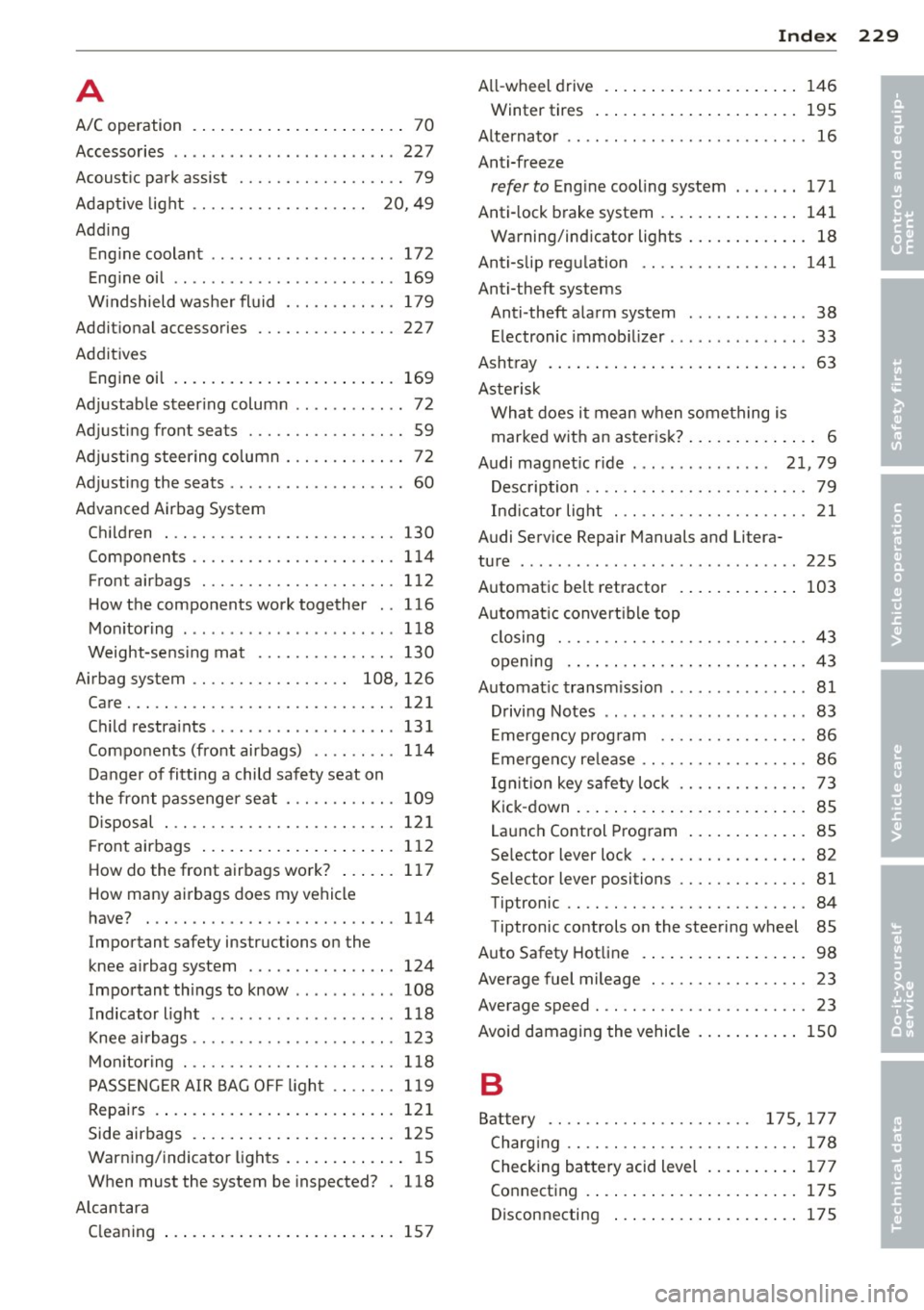
A/C operation . . . . . . . . . . . . . . . . . . . . . . . 70
Accessories .. ... .. .. ... ... .. .. .. .. . 227
Acoustic park assist . . . . . . . . . . . . . . . . . . 79
Adapt ive light . . . . . . . . . . . . . . . . . . . 20, 49
Adding Eng ine coolant .................. .. 172
Eng ine oi l ...................... .. 169
W indshield washer flu id . . . . . . . . . . . . 179
Addit ional accessories ............... 227
Additives Engine oil . ... .... .... ... .. .. .. .. .
Ad justab le steer ing column ........... .
Ad justing front seats ................ . 169
72
59
Ad justing s teering co lumn ... .. .. .. .. .. 72
Adjust ing the seats ................... 60
Advanced Airbag System Ch ildren
130
Components ............. .... .. ... 114
Front airbags . . . . . . . . . . . . . . . . . . . . . 112
H ow the components work together .. 116
Mon itoring . . . . . . . . . . . . . . . . . . . . . . . 118
Weight -sens ing mat ............... 130
Airbag system . . . . . . . . . . . . . . . . . 108, 126
Care ... .. .. ................. .. ... 121
Ch ild restra ints .................. .. 131
Components (front airbags) . . . . . . . . . 114
Danger of fitting a child safety seat on
the front passenger seat . .. .. .. .. .. . 109
Di sposal . .. ............. .... .. .. .
Fr ont airbags .. .. ..... ... .. .. .. .. .
How do the front airbags work? ... .. .
How many airbags does my vehicle
have? . ... . .... ............. .. .. .
Important safety instructions on the
knee airbag system ........ ... .. .. .
Important th ings to know .......... .
Indicator light ... .. ... ... .. .. .. .. . 12
1
112
1 17
114
124
108
118
Knee ai rbags ............. .... .. .. . 123
M oni tor ing . ............. .. .. .. .. . 118
P ASSENG ER AIR BAG O FF ligh t .. .. .. . 119
Repai rs .. .. ... .. ..... ... .. .. .. .. . 121
Side airbags . . . . . . . . . . . . . . . . . . . . . . 125
Warning/ indicato r lights ... .. ...... .. 15
When must the system be inspected? . 118
A lcantara
C leaning ... .. ... ..... ... .. .. .. .. . 157
Inde x 229
All-wheel drive . ..... . .. .. ..... ... .. 146
Winter tires ... .... . ... ...... ... .. 195
Alternato r .. .. .. .. ................. . 16
Anti-free ze
refer to Engine cool ing system ....... 171
Anti -lock brake system . .. ..... ... .. .. 141
Warning/indicator lights ..... ... .. .. . 18
Anti-s lip reg ulation ............. .... 141
Anti-theft systems
Anti -theft alarm system ............. 38
E lectronic immob il izer .. .. ..... ... .. . 33
Ashtray . ... .. .. .. .. .. ... ..... ... .. . 63
Aste ris k
Wha t does i t mean when something is
marked w ith an aster isk? . . . . . . . . . . . . . . 6
Audi magnet ic r ide . . . . . . . . . . . . . . . 21, 79
Desc ription .. .. .. .... ........... .. . 79
Ind icator light . .. .. .. ........... .. . 21
Audi Service Repair Manuals a nd Litera-
ture .......... ... .. .............. . 225
Automatic be lt retractor .. .... ... .. .. 103
Automat ic convert ible top
cl osing
... .. .. .. .... ........... .. . 43
opening . ... .. .. .. . .. ... .... ... .. . 43
Automat ic transm iss ion ......... .... .. 81
Driving Notes . . . . . . . . . . . . . . . . . . . . . . 83
E mergency p rog ram ........... .. .. . 86
E mergency re le a se .................. 86
Ign it ion key safety loc k ......... .... . 73
K ick -down ... .... .. . .. .. ..... ... .. . 85
La unc h Control Program
..... ... .. .. . 85
Se lector lever lock
82
Se lector lever positions ......... .. .. . 81
Tiptronic .. .. .. .. ................. . 84
Tiptronic controls on the steering wheel 85
Auto Safety Hot line . .. .. ..... ... .. .. . 98
Ave rage fuel mileage . . . . . . . . . . . . . . . . . 23
Average speed . . . . . . . . . . . . . . . . . . . . . . . 23
Avoid damaging the vehicle .... ... .. .. 150
B
Bat tery . . . . . . . . . . . . . . . . . . . . . . 175, 17 7
Charg ing .. .. .. .. ................. 178
Checking ba ttery acid level ... ... .. .. 177
Connect ing . ... .... . ... ...... ... .. 175
Disconnecting 175
•
•
Page 234 of 244
232 Index
E
Efficiency program ....... .. .. .. .... .. 27
F ue l economy messages ... .. .. .... .. 27
Memory levels . . . . . . . . . . . . . . . . . . . . . 23
Other equipment .. ......... .. .. .. .. 2 7
E lapsed time ... .... ....... .. .. .. .. .. 23
Electro -mechanical power assist . . . 17 , 145
Elect ronic differential lock (EDL) . . . . . . . 141
Warn ing/ indicato r lights ... .. .. .... .. 18
E lect roni c immobili ze r . . . . . . . . . . . . 12, 33
Electronic power co ntrol
EPC warning/ind icator light .. .. .. .... 19
Electronic speed limiter . . . . . . . . . . . . . . . 30
E lect ron ic S tabilization Control ( ESC) .. . 141
War ning/ indica tor l ights . .. .. .. .. .. .. 17
E mergency flasher . . . . . . . . . . . . . . . . . . . 51
War ning/ indicator lights . ...... .. .. .. 21
Emergency locking . . . . . . . . . . . . . . . . . . . 3 7
E mergency opera tion
Conve rtible top .......... .. .. .. .. .. 44
Rear lid . . . . . . . . . . . . . . . . . . . . . . . . . . . 38
E mergency sta rting .. ... ... .. .. .. .. . 216
Emergency towing ......... .. .. .. .. . 218
Ene rgy management ....... .. .. .. .. . 14 6
B att ery power . . . . . . . . . . . . . . . . . . . . 148
D river notification . . . . . . . . . . . . . . . . . 148
Eng ine
C he ckin g and fill ing locations . .. .. .. . 166
Coolan t .. .. ............. .... .. .. . 17 1
D ata .... .. ... ... .... ... .. .. .... . 224
Hood . ..... ... . ...... ... .. .. .... . 164
Starting . . . . . . . . . . . . . . . . . . . . . . 72, 73
Starting with jumper cab les .. .. .... . 216
Stopping . ................. ...... .. 74
E ng ine compartmen t ....... .. .. .. .. . 166
Safety instructions ... ... .. .. .. .... . 164
Working in the engine compa rtment .. 164
E ng ine cooling system ...... .. .. .. .. . 17 1
A dding coolant ........... .. ...... . 17 2
Chec king the eng ine coolan t leve l .. .. . 172
M alfunc tion . . . . . . . . . . . . . . . . . . . . . . . 17
Radiato r fan . .. .. ..... ... .. .. .... . 173
Temperature ga uge .. ... .. .. .. .... .. 11
E ng ine hood
C losing .. ............... .... .... . 164
H ow to release the hood ... .. .. .... . 164 E
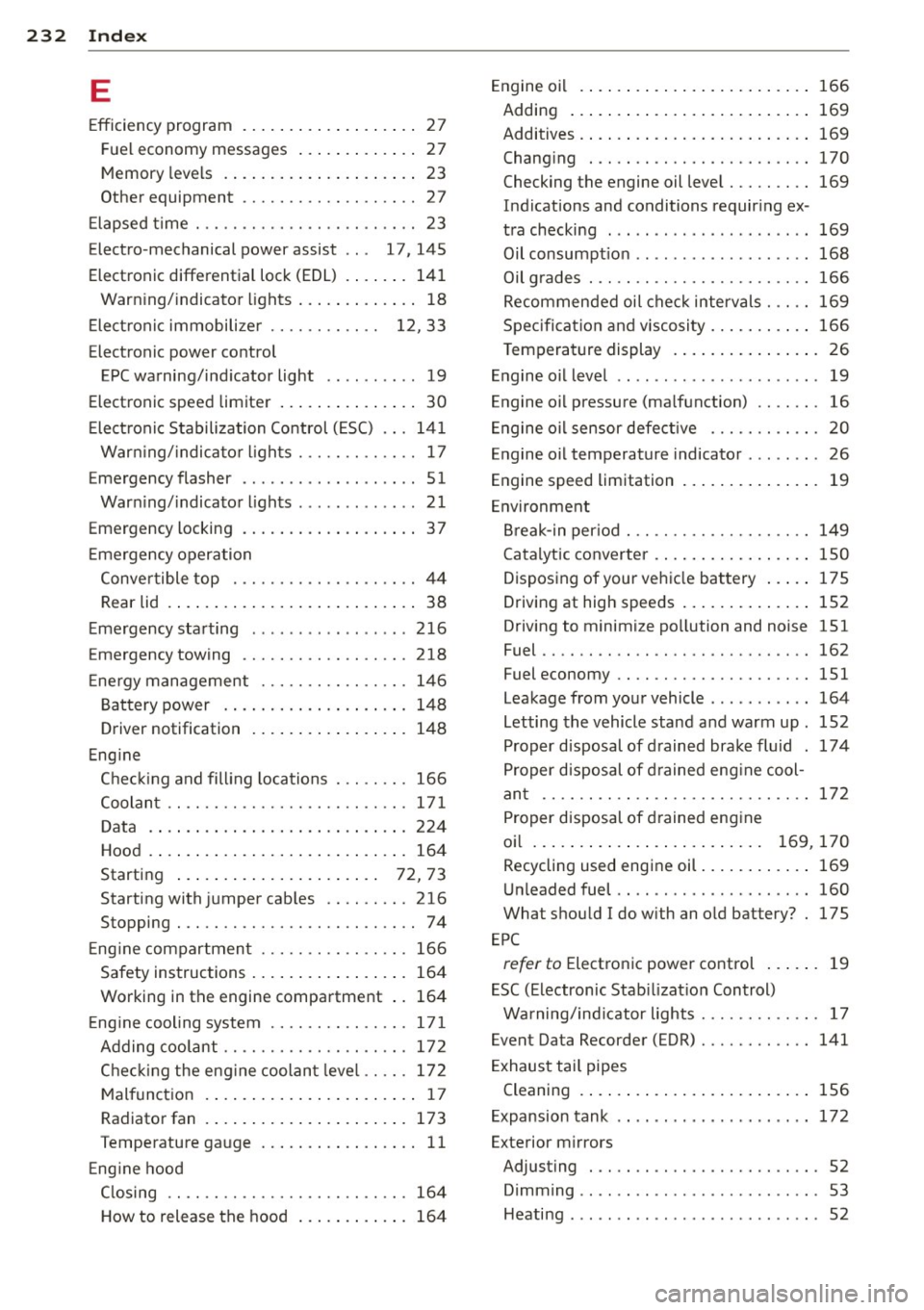
ngine oi l .. .... .. ... .. ..... .... . .. 166
Adding ... .... .. .. ... ..... ... .. .. 169
Additives . ... .. .. ... .. ..... ... .. .. 169
Changi ng ..... .. ............. .... 170
Checking the engine oil level ..... .... 169
Indications and conditions requir ing ex -
tra checking ... .. ... .. .. ... ..... .. 169
Oil consumpt io n .. .......... ...... . 168
Oil g rades . .. .... ............. .. .. 166
Recommende d oi l c he ck interv als . .. .. 169
Spec ifi cat ion an d viscosity .. ... .. .. .. 166
T emperature display . .. ..... .... . .. . 26
En gine o il level .. .. ................ .. 19
Engine oi l pressure (ma lfunction) .. .. .. . 16
En gine oi l sensor defective . . . . . . . . . . . . 20
Engine oil temperature indicator ........ 26
Engine speed limitation .. ..... ... .. .. . 19
En vironment
Br eak-in per io d ... ............. .. .. 149
Catalytic converter . .. .. ..... ... .. .. 150
Disposing of your veh icle ba ttery ... .. 175
Driving at high speeds . . . . . . . . . . . . . . 152
Driving to minimi ze po llution and noise 151
Fuel ...... .... .. .. ............... 162
Fuel economy .... ................. 151
Leakage from your vehicle ..... ... ... 164
L etting the vehicle stand a nd warm up . 152
Proper disposal of d rained brak e flu id . 174
P roper d isposal of d rained eng ine cool-
an t ...... .... .. ................. 172
Proper disposal of d rained eng ine
oi l . . . . . . . . . . . . . . . . . . . . . . . . . 169, 170
Recycling used engine oil ..... ... .. .. 169
Un leaded fuel .. .. ............. .. .. 160
What shou ld I do with an o ld battery? . 175
EP C
refer to Elect ronic power co ntrol ... .. . 19
E SC (Electronic Stab ilizat io n Control)
Warning/ind icator lights ........ .. .. . 17
Event Data Recorder (EDR) ........ .... 141
E xhaust tail pipes
Cleaning . ..... .. ... .. ..... .... . .. 156
E xpansion tank . . . . . . . . . . . . . . . . . . . . . 172
Exterior m irrors
Adjust ing . .... .. ............. .... . 52
Dimming ...... .. ..... ....... ... .. . 53
Heating ....... .. ..... ....... ... .. . 52