airbag AUDI TT ROADSTER 2017 User Guide
[x] Cancel search | Manufacturer: AUDI, Model Year: 2017, Model line: TT ROADSTER, Model: AUDI TT ROADSTER 2017Pages: 314, PDF Size: 76.54 MB
Page 184 of 314
Safe driving
What impairs driving safety?
Safe driving is directly related to the condition of
the vehicle, the driver as well as the driver's abili
ty to concentrate on the road without being dis
tracted.
The driver is respons ible for the safety of the ve
hicle and all of its occupants. If your ability to
drive is impaired, safety risks for everybody in the
vehicle increase and you also become a hazard to
everyone else on the road
c:::> .&_. Therefore :
~ Do not let yourself be distracted by passenger
or by using a cellular telephone.
~ NEVER drive when your driving ability is im
paired (by medications, alcohol, drugs, etc.).
~ Observe all traffic laws, rules of the road and
speed limits and plain common sense.
~ ALWAYS adjust your speed to road, traffic and
weather conditions.
~ Take frequent breaks on long trips. Do not drive
for more than two hours at a stretch.
~ Do NOT drive when you are tired, under pres
sure or when you are stressed.
..&, WARNING
Impaired driving safety increases the risk of
serious personal injury and death whenever a
vehicle is being used.
Correct passenger
seating positions
Proper seating position for the driver
The proper driver seating position is important
for safe, relaxed driving.
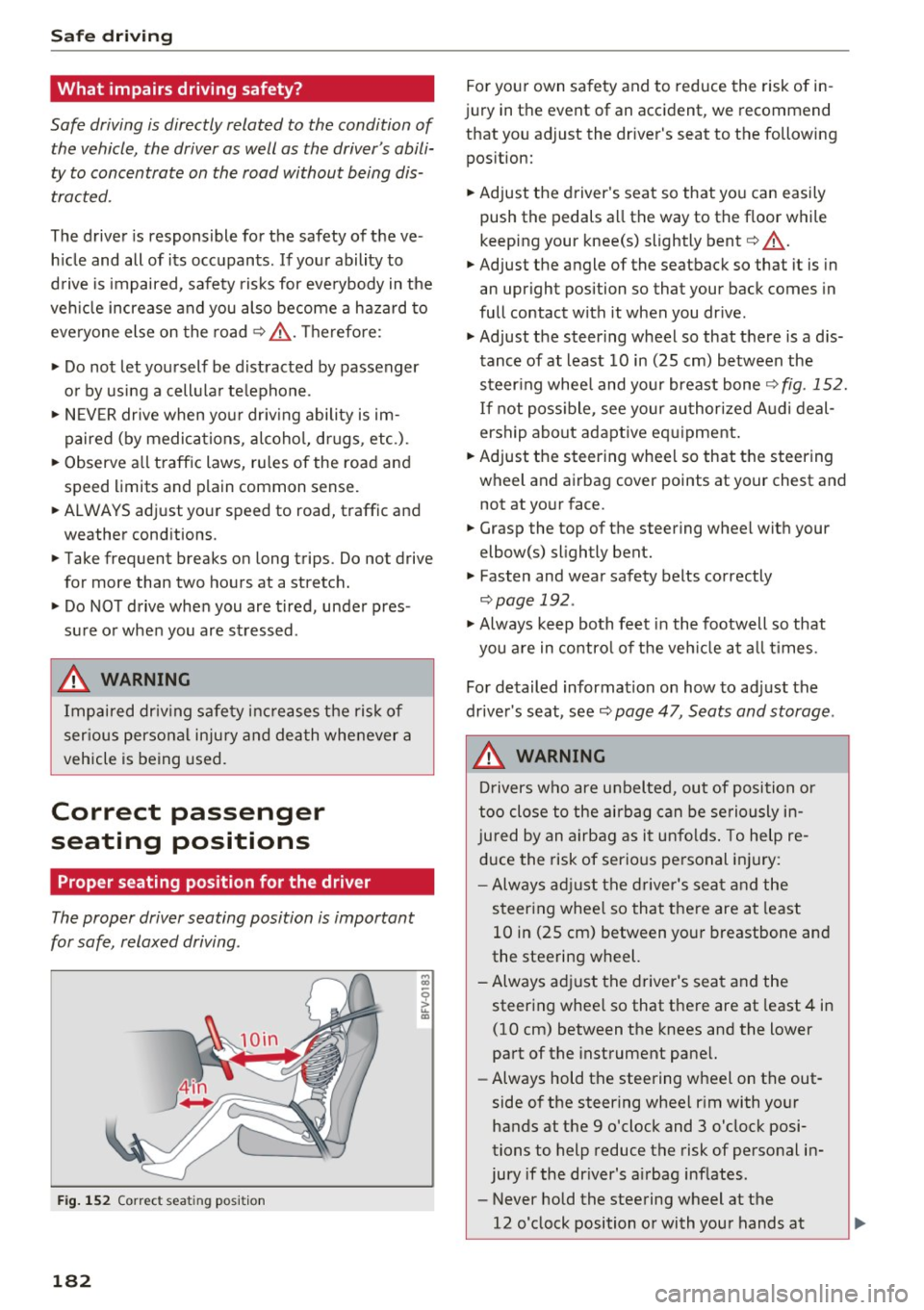
Fig. 152 Correct seating position
182
For your own safety and to reduce the risk of in
jury in the event of an accident, we recommend
that you adjust the driver's seat to the following
position:
~ Adjust the driver 's seat so that you can easily
push the pedals all the way to the floor while
keeping your knee(s) slightly bent
c:::> .&_.
~ Adjust the angle of the seatback so that it is in
an upright position so that your back comes in
full contact with it when you drive.
~ Adjust the steering wheel so that there is a d is
tance of at least 10 in (25 cm) between the
steering wheel and your breast bone
c:::>fig. 152.
If not possible, see your authorized Audi deal
ership about adaptive equipment.
~ Adjust the steering wheel so that the steering
wheel and airbag cover points at your chest and not at your face.
~ Grasp the top of the steering wheel with your
elbow(s) slightly bent.
~ Fasten and wear safety belts correctly
c:::> page 192.
~ Always keep both feet in the footwell so that
you are in control of the vehicle at all times .
For detailed information on how to adjust the
driver's seat, see
c:::> page 47, Seats and storage.
..&, WARNING
Drivers who are unbelted, out of position or
too close to the airbag can be seriously in
jured by an airbag as it unfolds. To help re
duce the risk of serious personal injury:
- Always adjust the driver's seat and the
steering wheel so that there are at least
10 in (25 cm) between your breastbone and
the steering wheel.
-Always adjust the driver's seat and the
steering wheel so that there are at least 4 in
(10 cm) between the knees and the lower
part of the instrument panel.
- Always hold the steering wheel on the out
side of the steering wheel rim with your
hands at the 9 o'clock and 3 o'clock posi
tions to help reduce the risk of personal in
jury if the driver's airbag inflates.
- Never hold the steering wheel at the
12 o'clock position or with your hands at
-
Page 185 of 314
co
co
.... N
" N .... 0
" "' c:o
other positions inside the steering wheel
rim or on the steering wheel hub. Holding
the steering wheel the wrong way can cause
serious injuries to the hands, arms and head if the driver's airbag inflates
- Pointing the steering wheel toward your
face decreases the ability of the supplemen
tal driver's airbag to protect you in a colli
sion.
- Always sit in an upright position and never lean against or place any part of your body
too close to the area where the airbags are
located.
- Before driving, always adjust the front seats
properly and make sure that all passengers
are properly restrained.
- Never adjust the seats while the vehicle is
moving. Your seat may move unexpectedly
and you could lose control of the vehicle.
- Never drive with the backrest reclined or
tilted far back! The farther the backrests are
tilted back, the greater the risk of injury due
to incorrect positioning of the safety belt
and improper seating position.
- Children must always ride in child seats
¢
page 218. Special precautions apply
when installing a child seat on the front
passenger seat¢
page 196 .
Proper seating position for the front
passenger
The proper front passenger sea ting posi tion is
important for safe, relaxed driving .
For your own safety and to reduce the risk of in
jury in the event of an accident, we recommend
that you adjust the seat for the front passenger
to the following position:
• Adjust the angle of the seatback so that it is in
an upright position and your back comes in full
contact with it whenever the vehicle is moving .
• Keep both feet flat on the floor in front of the
front passenger seat .
• Fasten and wear safety belts correctly
¢ page 192.
For detailed information on how to adjust the
front passenger's seat, see¢
page 47 .
Safe driving
A WARNING
Front seat passengers who are unbelted, out
of position or too close to the airbag can be
seriously injured or killed by the airbag as it unfolds . To help reduce the risk of serious
personal injury:
- Passengers must always sit in an upright po
sition and never lean against or place any
part of their body too close to the area
where the airbags are located.
- Passengers who are unbelted, out of posi
tion or too close to the airbag can be seri
ously injured by an airbag as it unfolds with
great force in the blink of an eye .
- Always make sure that there are at least
10 in (25 cm) between the front passen
ger's breastbone and the instrument panel.
- Always make sure that there are at least 4 in
(10 cm) between the front passenger's
knees and the lower part of the instrument
panel.
- Each passenger must always sit on a seat of
their own and properly fasten and wear the
safety belt belonging to that seat .
- Before driving, always adjust the front pas
senger seat proper ly.
- Always keep your feet on the floor in front
of the seat. Never rest them on the seat, in
strument panel, out of the window, etc. The
airbag system and safety belt will not be
able to protect you properly and can even in
crease the risk of injury in a crash.
- Never drive with the backrest reclined or
tilted far back! The farther the backrests are
tilted back, the greater the risk of injury due
to incorrect positioning of the safety be lt
and improper seating position.
- Children must always ride in child seats
¢
page 218 . Special precautions apply
when install ing a child seat on the front
passenger seat
c:> page 196.
183
Page 186 of 314
Safe dri ving
Examples of improper seating positions
The occupant restraint system can only reduce
the risk of injury if vehicle occupants are properly
seated.
Improper seating positions can cause serious in
jury or death . Safety belts can only work when
they are properly positioned on the body . Im
proper seating positions reduce the effect iveness
of safety belts and w ill even increase the r isk of
inj ury and death by moving the safety be lt to crit
ical areas o f the body . Improper seating positions
also increase the risk of serious injury and death
when an airbag deploys and strikes an occupant
who is not in the proper seating position. A driver
is responsible for the safety of all vehicle occu
pants and especially for children. Therefore :
~ Never allow anyone to assume an incorrect
seating position when the vehicle is being used
c:> .&_ .
The fo llowing bulletins list only some sample po
sitions that will increase the risk of serio us inj ury
and death. Our hope is that these examples will
make you more aware of seating posit ions that
are dangerous .
Therefore, whenever the vehicle is moving:
- never stand up in the ve hicle
- never stand on the seats
- never knee l on the seats
- never r ide with the seatback reclined
- never lean up against the instrument panel
- never sit on the edge of the seat
- never sit s ideways
- never lean out the window
- never put yo ur feet out the window
- never put yo ur feet on the instrument panel
- never rest your feet on the seat cushion or back
of the seat
- never ride in the footwell
- never r ide in the cargo area
A WARNING
Improper seating posit ions increase the r isk
of se rious personal injury and death wheneve r
a vehicle is being used.
184 -
Always make sure that all vehicle occupants
stay in a proper seating posit ion and are
properly restrained whenever the vehicle is
be ing used .
Driver and passenger
side footwell
Important safety instructions
A WARNING
A lways make sure that the knee airbag can in
flate without interfe rence. Objects between
yourself and the airbag can increase the risk
of injury in an accident by interfering with the
way the ai rbag dep loys o r by being pushed in
to you as the airbag dep loys.
- No persons (chi ldren) or animals should ride
in the footwell in front of the passenger
seat. If the airbag deploys, this can res ult in
serious or fatal injuries.
- No objects of any kind should be carried in
the footwell area in front of the driver's or
passenger 's seat. Bu lky objects (shopping
bags, for examp le) can hamper or prevent
proper deployment of the airbag. Small ob
jects can be thrown through the vehicle if
the airbag deploys and injure you or your
passengers.
Pedal area
' Pedals
The pedals must always be free to move and
must never be interfered with by a floor mat or
any other object.
Make sure that all pedals move free ly without in
terference and that nothing prevents them from
returning to their original positions.
Only use floor m ats that leave the pedal area free
and can be secured with floor mat fasteners.
If a brake circuit fails , in creased brake pedal trav-
el is required to bring the vehicle to a fu ll stop. .,..
Page 192 of 314
Safety belts
Why safety belts?
Frontal collisions and the law of physics
Frontal crashes create very strong forces for peo
ple riding in vehicles .
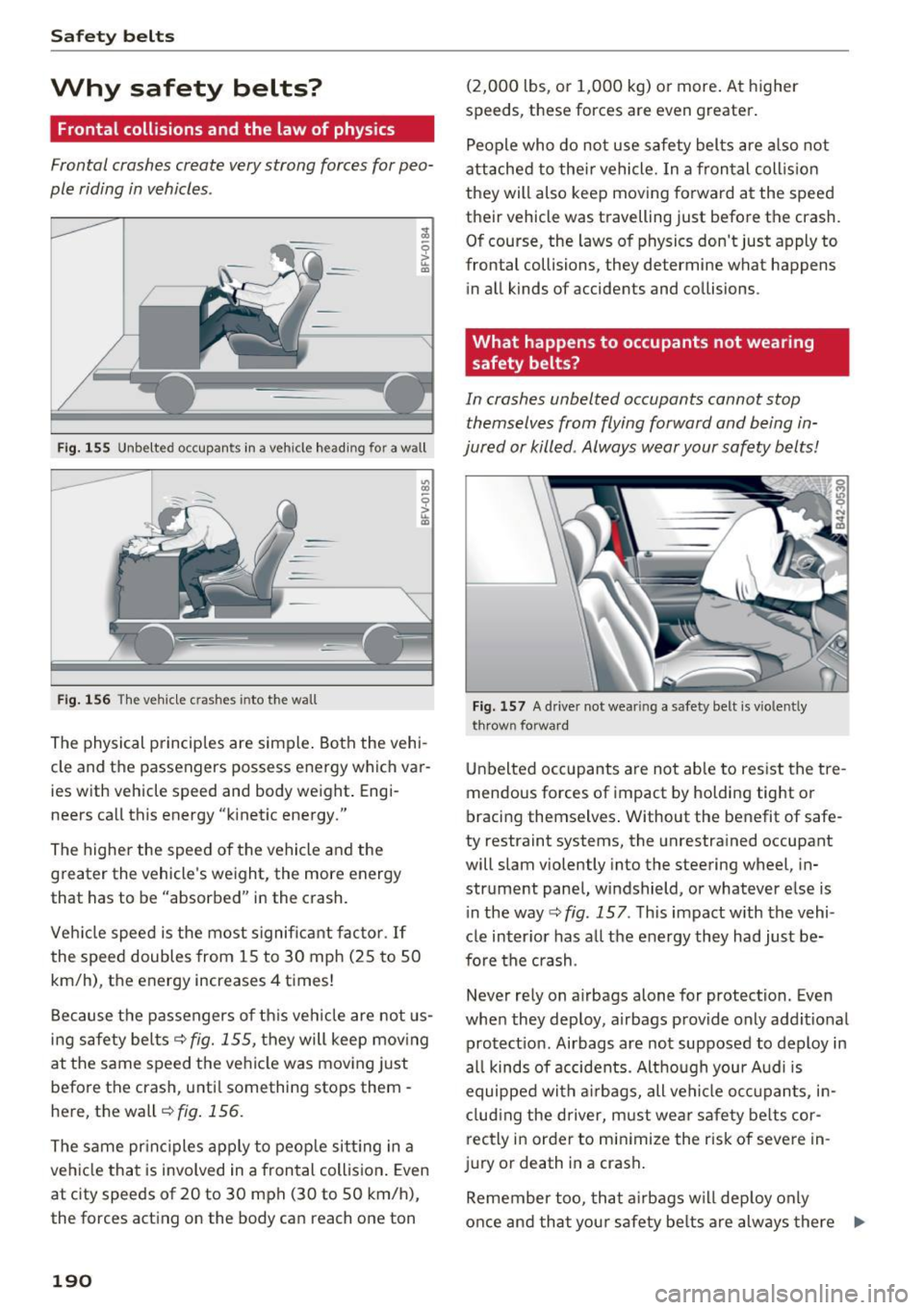
Fig. 155 Unbelted occupants in a veh icle headi ng fo r a wall
Fig. 156 The vehicle c rashes into the wall
The physical principles are simple. Both the vehi
cle and the passengers possess energy which var
ies w ith vehicle speed and body weight . Engi
neers call this energy "k inetic energy."
The higher the speed of the vehicle and the
greater the vehicle's weight, the more energy
that has to be "absorbed" in the crash.
Vehicle speed is the most significant factor .
If
the speed doubles from 15 to 30 mph (25 to 50
km/h), the energy increases 4 times!
Because the passengers of this vehicle are not us
ing safety belts
c::> fig. 155, they will keep moving
at the same speed the vehicle was moving just
before the crash, unti l something stops them -
here, the wall
c::> fig . 156.
The same principles apply to people sitting in a
vehicle that is involved in a frontal collision . Even
at c ity speeds of 20 to 30 mph (30 to 50 km/h),
the forces acting on the body can reach one ton
190
(2,000 lbs, or 1,000 kg) or more . At higher
speeds, these forces are even greater.
People who do not use safety belts are also not
attached to their vehicle. In a frontal collision
they will also keep moving forward at the speed
their vehicle was travelling just before the crash.
Of course, the laws of physics don't just apply to
frontal collisions, they determine what happens
in all kinds of accidents and collisions .
What happens to occupants not wearing
safety belts?
In crashes unbelted occupants cannot stop
themselves from flying forward and being in
jured or killed . Always wear your safety belts!
Fig. 157 A drive r not wea ring a safety belt is vio len tly
t hrow n forward
Unbelted occupants are not ab le to resist the tre
mendous forces of impact by holding tight o r
bracing themselves . Without the benefit of safe
ty restraint systems, the unrestrained occupant
will slam violently into the steering wheel, in
strument panel, windshield, or whatever else is i n the way
c::> fig . 157 . This impact w ith the vehi
cle inter ior has all the energy they had just be
fore the crash.
Never rely on a irbags alone for protection. Even
when they deploy, a irbags provide only addit ional
protection. Airbags are not supposed to deploy in
all kinds of accidents. Although your Audi is
equipped with airbags, all vehicle occupants, in
cluding the driver, must wear safe ty belts cor
rectly in order to minimize the risk of severe in
ju ry or death in a crash.
Remember too, that airbags will deploy only
once and that your safety be lts are always there .,...
Page 193 of 314
CD
CD
.... N
" N ...... 0 r--. V, co
to offer protection in those accidents in which
airbags are not supposed to deploy or when they have a lready deployed. Unbelted occupants can
also be thrown out of the vehicle where even more severe or fatal injuries can occur.
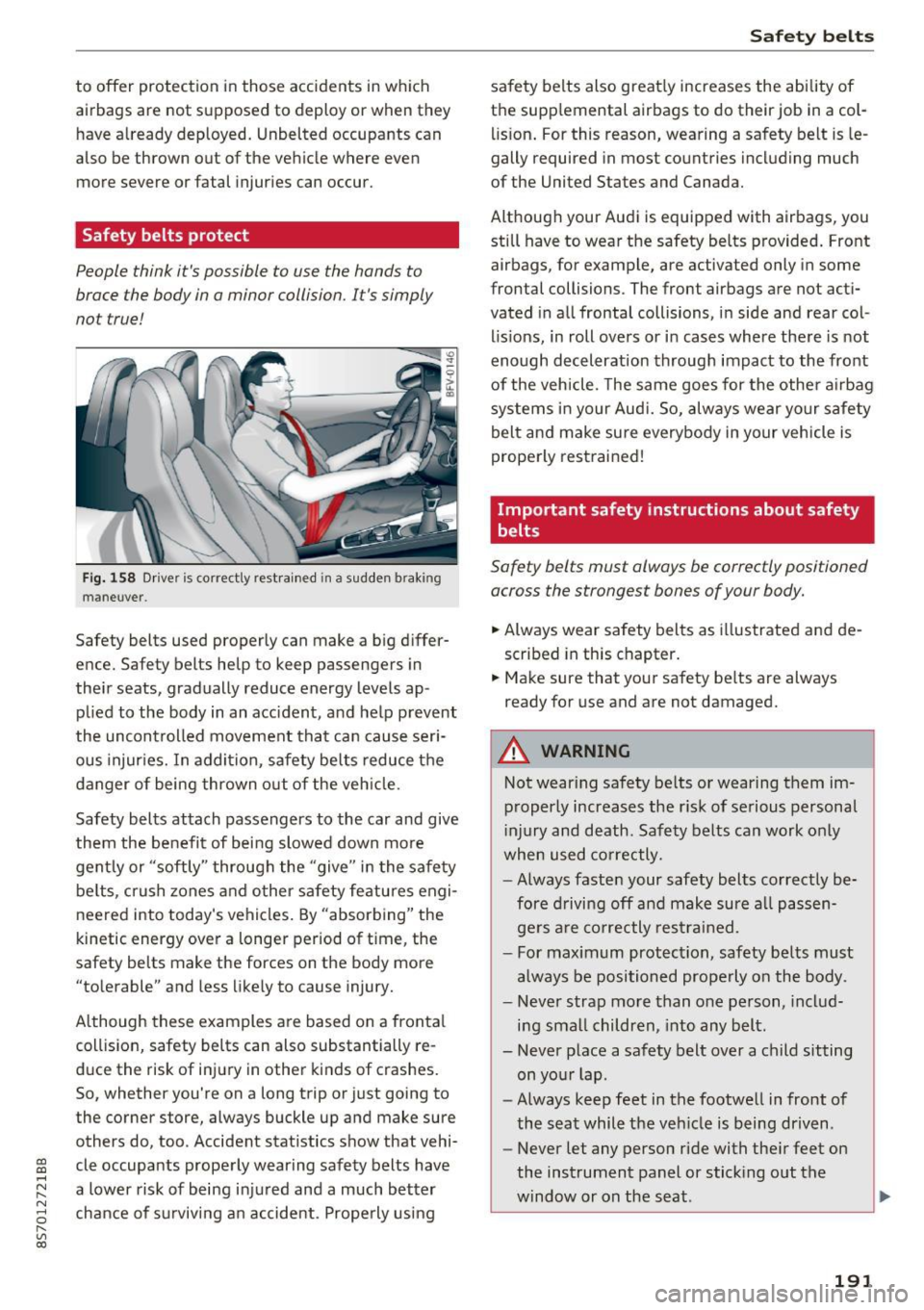
Safety belts protect
People think it's possible to use the hands to
brace the body in a minor collision. It's simply
not true!
Fi g. 158 Driver is correctly restra ined in a sudde n braking
maneuver .
Safety belts used properly can make a big differ
ence. Safety belts help to keep passengers in
their seats, gradually reduce energy levels ap plied to the body in an acc ident, and help prevent
the uncon trolled movement tha t can cause seri
ous injur ies. In addi tion, safety belts reduce the
danger of being thrown out of the veh icle.
Safety belts attach passengers to the car and give
them the be nefi t of bei ng slowed down more
gent ly or "softly" through the "give" in the safe ty
be lts, crush zones and other safety features engi
neered into today's vehicles . By "absorbing" the
kinetic energy over a longer period of time, the
safety belts make the forces on the body more
"to lerable" and less likely to cause injury.
Although these examples are based on a fronta l
coll is ion, safety belts can also substantially re
duce the risk of inj ury in other k inds of crashes.
So, whether you're on a long trip or just going to
the corner store, always buckle up and make sure
others do, too . Accident stat istics show that vehi
cle occupants prope rly wearing safety belts have
a lower risk of being in ju red and a much better
chance of s urviv ing a n accide nt. Prope rly using
Safet y bel ts
safety belts also great ly increases the ability of
the supp lemental airbags to do their job in a col
lis ion . For this reason, wearing a sa fety be lt is le
gally required in most countries including much
of the United States and Canada.
Although your Audi is equipped with airbags, you still have to wear the safety be lts p rovided . Front
airbags, for example, are activated only in some
frontal collisions. The front airbags are not acti
vated in a ll frontal collisions, i n side and rear col
lis ions, in roll overs or i n cases where there is not
enough decelerat ion through impact to the front
of the vehicle. The same goes for the othe r air bag
systems in your Aud i. So, always wear yo ur safe ty
belt and make sure everybody in your vehicle is
prope rly restrained!
Important safety instructions about safety
belts
Safety belts must always be correctly positioned
across the strongest bones of your body.
.. Always wear safety belts as i llustrated and de
scribed in this chapter .
.. Make sure that your safety be lts a re always
ready for use and are not damaged.
A WARNING
Not wear ing safety be lts o r wearing t hem im
p roperly increases the r is k of serious personal
i njury and death. Safety belts can work only
when used correctly.
- Always faste n your safety belts correctly be
fore d riving off and make sure a ll passen
ge rs a re co rrectly res trained.
- For maximum protection, safety belts must
a lways be positioned properly o n the body.
- Never strap more than one person, includ
i n g sma ll children, into any belt.
- Never p lace a safety belt over a child sitting
on yo ur lap.
- Always keep feet in the footwe ll in front of
the seat while the veh icle is being driven.
- Never let any person ride with the ir feet on
the instrument panel or stick ing o ut the
w indow or on the seat.
191
Page 196 of 314
Safe ty belts
• Insert the tongue into the correct buckle of
your seat until you hear it latch secure ly
r:!> page 192, fig. 159 .
•Pullon the belt to make sure that it is securely
latched in the buckle.
A WARNING
Improperly positioned safety belts can cause
ser ious personal injury in an c1ccident.
- Expectant mothers must always wear the
lap portion of the safety belt as low as pos
sible across the pelvis and below the round ing of the abdomen .
- Always read and heed all WARNINGS and
othe r important information
c:> .&. in Fasten
ing safety belts on page 193.
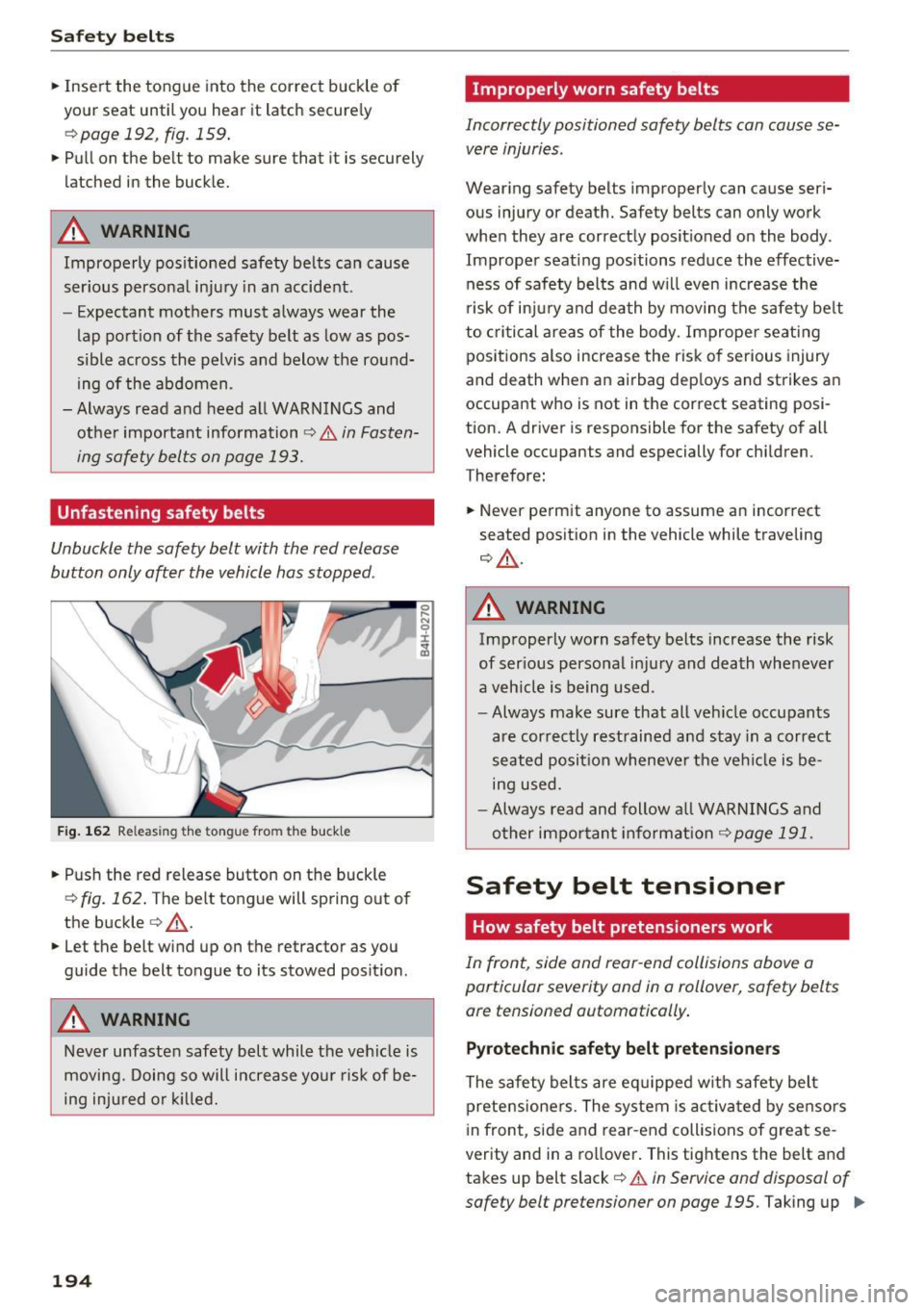
Unfastening safety belts
Unbuckle the safety belt with the red release
button only after the vehicle has stopped.
F ig . 162 Releasi ng the tongue fro m the buckle
• Push the red release button on the buckle
r:!> fig. 162 . The belt tongue will spring out of
the buckle
c:> _& .
• Let the belt wind up on the retractor as you
guide the belt tongue to its stowed posit ion .
A WARNING
Never unfasten safety belt while the vehicle is
moving. Doing so will increase your risk of be
ing injured o r kil led.
194
Improperly worn safety belts
Incorrectly positioned safety belts can cause se
vere injuries.
Wearing safety belts improperly can cause seri
ous injury or death. Safety belts can only work
when they are correctly posit ioned on the body .
Improper seating positions reduce the effective ness of safety bel ts and w ill even increase the
risk of inju ry and death by moving the safety be lt
to criti cal areas of the body . Imprope r seating
positions also increase the risk of serious injury
and death when an airbag dep loys and strikes an
occupant who is not in the correct seating posi
tion. A driver is responsible for the safety of all
vehicle occupants and especially for children.
Therefore:
• Never pe rm it anyone to assume an incor rect
seated position in the vehicle while traveling
<=> _& .
A WARNING
Improperly worn safety belts increase the risk
of ser ious perso nal injury and death whenever
a veh icle is being used .
- Always make sure that all veh icle occupants
are correctly restrained and stay in a correct
seated posit ion wheneve r the ve hicle is be
ing used.
- Always read and follow a ll WARNINGS and
other impo rtant informat ion
r:!> page 191.
Safety belt tensioner
How safety belt pretensioners work
In front, side and rear -end collisions above a
particular severity and in a rollover, safety belts ore tensioned automatically.
Pyrotechnic safety belt pretensioners
The safety belts are eq uipped w ith safety belt
prete nsione rs. The system is ac tiva ted by sensors
i n front, side and rear-end collisions of great se
verity and in a rollover . This tightens the belt and
takes up belt slack¢.&.
in Service and disposal of
safety belt pretensioner on page 195.
Taking up IJ,-
Page 197 of 314
co
co
.... N
" N .... 0
" "' c:o
the slack helps to reduce forward occupant movement during a collision .
A WARNING
-It is possible for the pretensioners to deploy
incorrectly.
- The pyrotechnic system can only provide
protection for one collision.
If the pyrotech
nic pretensioners deploy, the pretensioning
system must be replaced .
(D Tips
The pyrotechnic safety be lt pretensioners can
only deploy once.
- The safety belt pretensioners do not dep loy
i n minor fronta l, side and rear-end colli
s ions.
- A fine dust is released when the pyrotechnic
safety be lt pretens ioners deploy. This is nor
mal and is not caused by a fire in the vehi
cle.
- The re levant safety requirements must be
observed when the veh icle or components
of the system are scrapped. A qualified
dealersh ip is familiar w ith these regulations
and will be p leased to pass on the informa
tion to you.
- Be sure to observe all safety, environmental
and other regulations if the veh icle or indi
v idual parts of the system, particularly the
safety be lt o r airbag, a re to be disposed. We
recommend yo u have your author ized Audi
dealer perform this serv ice for you.
Service and disposal of safety belt preten
sioner
The safety belt pretens ioners are parts of the
safety belts on your Audi . Installing, removing,
servic ing o r repa iring of belt p retensioners can
damage the safety belt system and prevent it
from wor king cor rec tly in a collision .
There are some important th ings you have to
know to make sure that the effectiveness of the
system w ill not be impaired and that discarded
components do not cause injury or poll ute the
env ironmen t .
S afet y be lts
A WARNING
-
Improper care, servicing and repair proce
dures can increase the risk of personal injury
and death by preventing a safety belt preten
sione r from activating when needed or act i
vati ng it unexpectedly:
- The belt pretensioner system can be activat
ed only once. If belt pretens ioners have
been activated, the system must be re
p laced.
- Never repair, adjust, or change any parts of
the safety belt system.
- Safety belt systems including safety belt
pre tensioners cannot be repai red. Spe cial
p rocedures are required fo r removal, instal
lation and disposal of this system .
- For any wo rk on the safety belt system, we
s trong ly recommend that you see yo ur au
thorized Audi dealer or qualified technician
who has an Audi approved repair manual,
tra ining and special equipment necessary.
@ For the sake of the environment
U ndeployed airbag modules and p retension
ers might be classif ied as Pe rchlorate Materi
al -special handling may apply, see
www.dtsc.ca.gov/hazardouswaste/perchlo rate. When the vehicle or parts of the re
straint system including airbag modu les safe
ty belts with pretensioners are scrapped, all
applicable laws and regu lations must be ob
se rved . Your authorized Audi dealer is familiar
with these requirements and we recommend
that you have your dealer perform this service
for you .
195
Page 198 of 314
Airbag syste m
Airbag system
Important information
Importance of wearing safety belts and
sitting properly
Airbags are only supplemental restraints . For
airbags to do their job, occupants must always
properly wear their safety belts and be in a prop
er seating position.
For your safety and the safety of your passen
ge rs , before driving off, always :
"' Adjust the driver's seat and steering wheel
properly ¢
page 182,
"'Adjust the front passenge r's seat properly
¢ page 183,
"'Wear safety belts p roperly ¢ page 191,
"'Always properly use the proper child restraint
to protect children
¢ page 218.
In a coll is io n ai rbags must inflate wi thin the b link
of an eye and with cons iderable force . The sup
p lemental airbags can ca use inj uries if the driver
or th e front seat passenger is not seated proper·
Ly. T herefore in order to help the airbag to do its
job, it is important, both as a dr iver and as a pas
senger to sit properly at all t imes .
By keeping room between your body and the
steering whee l and the front of the passenger
compartment, the a irbag can inflate fully and
completely and provide supplemental protect ion
in certain frontal collisions ¢
page 182, Correct
passenger seating positions .
For details on the
operation of the seat adjustment con trols
¢ page 47.
It's especially important that children are proper
ly restra ined
¢ page 218.
There is a lot that the driver and the passenger
can and must do to help the ind iv idual safety fea
tures installed in your Audi work together as a
system .
Proper seating posit ion is important so that the
front airbag on the drive r side can do its job. If
you have a physical impairment or cond ition that
prevents you from s itting properly on the driver
seat with the safety be lt properly fastened and
196
reaching the peda ls, or if yo u have concerns w ith
regard to the function or operation of the Ad
vanced Airbag System, please contact you r au
thori zed Audi dea ler or qua lified workshop, or
ca ll Audi Customer Relations at 1 (800)
822 -2834 for possib le mod ificat ions to your ve
hicle .
When the airbag system dep loys, a gas generator
will fill the airbags, break open the padded cov
ers, and inflate between the steeri ng wheel and
t h e d river and between the instrument pane l and
the front passenger . Th e a irbags w ill deflate im
med iate ly after deployment so that the front oc
cupan ts can see t hrou gh the windsh ield again
without interruption.
A ll of th is takes p lace in the b link of an eye, so
fast tha t many people don 't even rea lize that the
a irbags have deployed. The air bags also infl ate
with a great deal of force and no thing should be
in the ir way when they dep loy. Front airbags in
combination with properly worn safety belts slow
down and lim it the occupant's forward move
ment . Together they help to prevent the driver
and passenger from hitting pa rts of the inside
the ve hicle while reducing the forces acti ng on
the occ upant d uri ng the crash . In this way they
help to reduce the risk of in ju ry to the head and
u pper body in the crash . A irb ags do not p rotec t
t h e arms o r th e lowe r parts of the body .
Both front airbags will not inflate in all frontal
collisions. The trigge ring of the a irbag system de
pends on the veh icle deceleration rate caused by
t h e coll is ion and regis tered by the ele ctroni c con
tro l unit. If this ra te is be low the reference value
programmed into the contro l unit, the airbags
will not be t riggered, even tho ugh the car may be
badly damaged as a resu lt of the co llision . Vehi
cle damage, repa ir costs or even the lack of vehi
cle damage is not necessarily an indication of
whether an a irbag should inflate or not .
Since the c ircumstances will vary cons iderably
between one co llision and another, it is not possi
ble to define a range of veh icle speeds that will
cover every poss ible kind and angle of impact
that w ill always trigge r the a irbags . Importa nt
facto rs i nclude, for examp le, the nat ure (hard or
soft) of the objec t which the car h its, the angle of.,.
Page 199 of 314
co
co
.... N
" N .... 0
" "' c:o
impact, vehicle speed, etc. The front airbags will
also not inflate in side or rear collisions, or in roll-overs.
A lwa ys remember : Airbags will deploy only once,
and only in certain kinds of collisions . Your safety
be lts are always there to offer protection in those
situations in which airbags are not supposed to
deploy, or when they have already deployed; for
example, when your vehicle str ikes or is struck by
another vehicle after the first collis ion.
This is just one of the reasons why an airbag is a
supp lementary restraint and is not a substitute
for a safety belt. The airbag system works most
effect ively when used with the safety belts .
Therefore, always properly wear your safety belts
¢ page 189.
.8, WARNING
Sitting too close to the steer ing whee l o r i n
strument panel will decrease the effect ive
ness of the airbags and will increase the risk
of persona l injury in a co llision.
- Never sit closer than 1 0 in (25 cm) to the
steering wheel or instrument pane l.
-If you cannot si t mo re than 10 in (25 cm)
from the steer ing whee l, inves tigate wheth
er adaptive equipment may be avai lab le to
held yo u reach the pedals and increase your
seating distance from the steering wheel.
- If you are unrestrained, leaning forward, s it
ting s ideways or out of position in any way,
your risk of in jury is much h igher.
- Yo u will also receive serious injur ies and
cou ld even be killed if you are up against the
airbag or too close to it when it inf lates -
even with an Advanced Airbag.
- To reduce the risk of in jury when an airbag
inflates, a lways wear safety belts p roperly
¢ page 192, Safety belts .
- If children are not properly restrained, they
may be severely injured or killed when an
airbag inflates.
- Never let children ride unrestrained or im
properly restrained in the veh icle. Adjust the
front seats proper ly .
-
Airb ag sys tem
-Always sit as fa r as possible from the steer
ing wheel or the instrument panel
¢page 182.
-Always sit upright w ith your back against
the backrest of your seat.
- Never p lace your feet on the instrument
panel or on the seat. Always keep both feet
on the floor in front of the seat to help pre
vent ser ious injuries to the legs and hips if
the airbag inflates.
.8, WARNING
A irbags that have deployed in a crash must be
r eplaced.
- Use o nly orig inal equipment ai rbags ap
proved by A udi and installed by a trained
technician who has the necessary tools and
d iagnostic equipment to prope rly replace
any airbag in yo ur vehicle and ass ure system
effe ct iveness in a crash .
- Never permit salvaged or recycled airbags to
be installed in you r vehicle.
Child restra ints on the front seat -some
important things to know
.. Be sure to read the important informat ion and
head the WARNINGS for important details
about ch ildren and Advanced A irbags
¢page 218.
The airbag on the passenger side makes the front
seat a potent ially dangerous place for a child to
ride. The front seat is not the safest place for a
c h ild in a forward-fac ing c hild safety seat. It can
be a ve ry dange rous p lace for an infant or a ch ild
i n a rearward-fac ing seat.
The Advanced A irbag System in your vehicle has
been certified to com ply wit h the Requ irements
of United States Fede ral Motor Ve hicle Safety
Standa rd 208 as applicable at t he t ime you r vehi
cl e was manufac tured.
The Standard requires the front airbag on the passenger side to be turned off ("supp ressed") if
a ch ild up to abou t one yea r of age rest rained i n
one of the rear-fac ing o r forward-f acing infant re-
straints lis ted in Fede ral Motor Vehicle Sa fe ty ..,.
197
Page 200 of 314
Airbag system
Standard 208 with which the Advanced Airbag
System in your vehicle was cert ified has been in
stalled on the front passenger seat. For a listing
of the child restraints that were used to certify
compliance with the US Safety Standard
¢page 220.
The PASSENGER AIR BAG OFF~; light in the
headliner tells you when the front Advanced Air
bag on the passenger side has been turned off by
the electronic control unit.
Each t ime you turn on the ignition, the
PASSEN·
GER AIR BAG OFF,-;; ON ~
light will come on
for a few seconds and:
- PASSENGER AIR BAG OFF~; will come on if
the front passenger seat is not occupied,
- PASSENGER AIR BAG OFF ~; will come on if
the e lectrical capacitance measured by the ca
pacitive passenger detection system for the
front passenger seat equals the combined ca pacitance of an infant up to about one year of
age and one of the rearward-facing or forward
facing child restraints listed in Federal Motor
Vehicle Safety Standard 208 with which the Ad
vanced Airbag System in your vehicle was certi
fied. For a listing of the child restraints that
were used to certify your vehicle's compliance
with the U.S. Safety Standard¢
page 220.
-PASSENGER AIR BAG OFF ~; will come on if
there is a small child or chi ld restraint on the
front passenger seat,
- PASSENGER AIR BAG ON @will go off if the
front passenger seat is occupied by an adult as
registered by the capacitive passenger detec
tion system ¢
page 20 7, Monitoring the Ad
vanced Airbag System.
The PASSENGER AIR BAG OFF~; light comes on
when electrical capacitance registered on the
front passenger seat is equa l to or less than the
comb ined capacitance of a typ ica l 1 year-old in
fant and one of the rearward-fac ing or forward
facing ch ild restraints listed in Federal Motor Ve
h icle Safety Standard 208 with wh ich the Ad
vanced Ai rbag System in your vehicle was cert i
fied.
If the total electrical capac itance registered on
the front passenger seat is more than that of a
198
typical 1 year -old chi ld but less than the weight
of a sma ll adult, the front airbag on the passen
ger side can deploy (the
PASSENGER AIR BAG
OFF ~;
light does not come on).
If the
PASSENGER AIR BAG OFF~; light does
not come on, the front airbag on the passenger
s ide has not been turned off by the e lectron ic
contro l unit and can deploy if the control unit
senses an impact that meets the conditions stor
ed in its memory .
For example, the airbag may deploy if :
-a small child that is heav ier than a typical 1
year -old child is on the front passenger seat
(regard less of whether the child is in one of the
child safety seats listed¢
page 220), or
- a child who has outgrown child restraints is on
the front passenger seat.
If the front passenger airbag is turned off, the
PASSENGER AIR BAG OFF,-;; light comes on in
the headliner and stays on .
If the front passenger airbag deploys, the Feder
al Standard requ ires the airbag to meet the " low
risk" deployment criteria to reduce the risk of in
jur y through interaction with the airbag. "Low
risk" deployment occurs in those crashes that
take place at lower decelerations as defined in
the electronic control unit¢
page 208, PASSEN
GER AIR BAG OFF~; ON~ light.
Always remember, a child seat or infant carrier
installed on the front seat may be struck and
knocked out of posit ion by the rapidly inflating
passenger's airbag in a frontal collision. The a ir
bag could greatly reduce the effectiveness of the
ch ild restraint and even ser iously injure the child
during inflation.
.&, WARNING
-
A child in a rearward-facing child seat instal
l ed on the front passenger seat will be seri
ously injured and can be killed if the front air
bag inflates - even with an Advanced Airbag
System.
- The inflating airbag will hit the ch ild seat or
infant carrier with great force and will .,.