ECU AUDI TT ROADSTER 2017 Owner's Guide
[x] Cancel search | Manufacturer: AUDI, Model Year: 2017, Model line: TT ROADSTER, Model: AUDI TT ROADSTER 2017Pages: 314, PDF Size: 76.54 MB
Page 230 of 314
Child safet y
A WARNING
Always take spec ial precaut ions if you must
install a forward or rearward-fac ing ch ild re
straint on the front passenger's seat in excep
tional situations:
- Whenever a forward or rearwa rd-facing
child restraint is insta lled on the front pas
senger seat, t he
PASSENGER AIR BAG OFF
~; light mus t come on and stay on whenev
e r t he ignition is sw itche d on.
- If the
PASSENGER AIR BAG OFF~; light
does not come on and stay on, perform the
checks described~
page 207, Monitoring
the Advanced Airbag System.
- If the PASSENGER AIR BAG OFF~; light
does not come on and stay on whenever the
ignition is switched on the inflating air bag
will hit the c hild safety seat o r infant carrier
with great force and will smash the child
safety seat and child against the backrest, center armrest, door or roof. Have the air
bag system inspected immediately by your
Audi dealer.
- Improper installation of ch ild restraints can
red uce their effect iveness or even prevent
t h em from p roviding any p rotection .
-An improperly installed c hild rest raint can
interfere w ith the airbag as it deploys and
seriously injure or even kill the child.
- Always carefully follow the manufac turer 's
instructions p rovided w ith the ch ild safety
seat or car rier.
- After checking to ma ke sure that the child
restra int is prope rly installed, ma ke certai n
t h at the child res traint is co rrec tly recog
ni ze d by the c apac it ive passenger detec tion
system in the front passenger sea t and that
the
PASSENGER AIR BAG OFF~. light sig
nals the correct front passenger frontal air
bag status.
A WARNING
Forward-fac ing ch ild rest raints:
- Always make sure the forward-facing seat
has been designed and cert ified by its man
ufact urer for use on a front seat with a pas
senger front and side a irbag .
228
-Never put the fo rwa rd-facing child restraint
up, against o r very near the instrument pan
el.
- Always move the passenge r seat into its
rearmost posit ion in the seat's fo re and aft
ad justment range , as far away from the a ir
bag as poss ible before installing the for
ward-facing chi ld restraint. The back res t
m ust be adjusted to an upr ight position.
- Ma ke sure that the
PASSENGER AIR BAG
OFF ~;
light comes on and stays on all the
time w heneve r the ig nition is switched o n.
A WARNING
R earward-faci ng chi ld restrain ts:
- A child in a rearward-fac ing ch ild safety seat
installed on the fron t passenger seat will be
serious ly injure d and can be killed if t he
front airbag infl ates -even with an Ad
vance d Ai rb ag System.
- The infl ating air bag will h it t he ch ild safety
sea t or i nfan t car rier with great force an d
w ill smash the child safety seat and child
aga inst the backrest, center a rm rest, door
or roof.
- Always be especially carefu l if yo u must in
stall a rea rward facing child safety seat on
the front passenge r seat in exceptiona l cir
cumstances.
- Make sure that the
PASSENGER AIR BAG
OFF ~;
light comes on and stays on all the
time wheneve r the ign it ion is switched on.
- If the
PASSENGER AIR BAG OFF~; light
does not come on and stay on, have the air
bag system inspected by you r Audi dealer.
Activating the convertible locking retractor
Use the convertible locking retractor to secure a
child restraint.
A lways heed the chi ld safety seat manufacturer's
i nst ruct ions when insta lling a child restra int i n
yo ur vehicle. To activate the convertib le locking
r etractor:
.,. Place the chi ld restraint on a seat .
.,. Slowly p ull the belt
all the way out .
Page 238 of 314
Checking and Filling
-Engine exhaust, some of its constituents,
and certain vehicle components contain or
emit chemicals known to the State of Cali
fornia to cause cancer and birth defects and reproduct ive harm . In addition, certain flu
ids contained in veh icles and certain prod
ucts of compo nent wear con tain or emit
c hemicals known to the State of Califo rnia
to cause cance r and birth defects or other
reproductive harm .
- Battery posts, termina ls and re lated acces
sories contain lead and lead compounds, chemicals known to the State of California
to cause cancer and reproductive harms .
Wash hands after handling .
(D Note
When fil lin g flu ids, be sure not to mix the flu
ids up . Otherwise severe ma lfunctions and en
gine damage w ill occur .
@ For the sake of the environment
You shou ld regularly chec k the ground under
your vehicle in order to detect leaks qu ickly. If
there are visible spots from oil or other fluids,
bring your vehicle to an authorized Aud i deal
er or author ized Audi Se rvice Facility to be
checked.
Opening/closing the hood
The hood is released from inside the vehicle.
F ig . 17 9 Sect io n from the driv er' s s ide footwell: relea se
l ever
236
~ 0 0
ct Q)
F ig. 1 80 Unlocked hood : lev er
Make su re the wiper a rms are not raised up from
the windshie ld. Otherw ise the paint could be
dam aged .
Opening the engine compartment lid
"With the driver's door open, pull the lever be -
low the instrument pane l in the direction of the
arrow
9 fig . 179 .
" Raise the hood slightly 9 ,& .
"Press the lever 9 fig. 180 in the direct ion of the
arrow . This releases the hooks .
" Open the hood.
Closing the engine compartment lid
" Push the hood down u ntil yo u over ride the
for ce of the s truts .
" Let the hood fa ll lightly into the latch .
Do not
press it in.
~ ,& .
&_ WARNING
-Never open the hood when there is steam o r
coo lant escaping from the engine compart
ment, because there is a risk that yo u could
be burned. Wait unt il no steam or coolant is
escaping.
- For safety reasons, the hood must always be
closed securely while dr iving . Because of
this, always chec k the hood after closing i t
to make sure it is latched correctly . T he
hood is lat ched if the front corners canno t
be lifted .
- If you notice that the hood is not latched
while you are d riving, s top imme diate ly and
close it, because d riving when the hood is
no t latched increases the r isk o f an accident .
Page 243 of 314
co
co
.... N
" N .... 0
" "' c:o
Cooling system
Coolant
The engine cooling system is filled with a mixture
of pur ified water and coolant additive at the fac
tory. This coo lant must not be not changed.
The coolant level is monitored through the. in
dicator light
¢page 12. However , we do recom
mend occasionally check ing the coo lant level
manually.
If you must add coolant, use a mixture of water
and coolant addit ive. Mixing the coolant additive
with distilled water is recommended.
Coolant additive
The coolant additive is made of anti-freez ing and
corros ion protection agents. Only use the follow
ing coolant addit ives . These additives may be
mixed with each other.
Coolant additive Specification
G13 TL 774
J
G12++ TL 774 G
The amount of coo lant add itive that needs to be
mixed with water depends on the climate where
the vehicle will be operated. If the coolant addi tive percentage is too low, the coolant can freeze
and damage the engine.
Coolant addi- Freeze protec-
tive tion
Warm regions min. 40%, m in. -13 °F
max. 45% (-25 °C)
Cold regions min. 50%, max
. -40 °F
max. 55% (-40 °C)
(D Note
- Before the start of winter, have your author
ized Audi dealer or authorized Audi Service
Facility check if the coolant additive in your
vehicle matches the percentage appropriate
for the climate . Th is is especially important
when driving in colder climates.
- If the appropriate coolant additive is not
available in an emergency, do not add any
other additive . You could damage the en-
Checking and Filling
gine. If this happens, only use water and re
store the correct mixture ratio with the
specified coolant add it ive as soon as possi
ble.
- Only refill with new coolant .
- Radiator sealant must not be mixed with
the coolant.
Adding coolant
Fig. 184 Engine compartment: coolant expansio n ta nk
cover
-N
-N
"" CD co
Observe the safety precautions ¢ A in Working
in the engine comportment on page 235.
Checking the engine coolant level
.,. Park your vehicle on a leve l surface .
.,. Switch the ignition off.
.,. Read the coolant level on the coolant expansion
tank
¢ page 237, fig . 181. The coolant level
must be between the markings when the en
gine in cold . When the engine is warm it can be
slightly above the upper mark ing .
Adding coolant Requirement: there must be a residual amount of
coolant in the expansion tank
¢ (D .
.,. Let the engine cool down.
.,. Place a cloth over the coolant expansion tank
cap and unscrew the cap counterclockw ise
Q .&, .
.,. Add coolant m ixed in the correct rat io
¢ page 241 up to the upper marking .
.,. Make sure that the fluid level remains stable.
Add more coolant if necessa ry .
.,. Close the cap securely .
Coo lant loss usually indicates there is a leak. Im-
mediately drive your vehicle to an author ized .,..
241
Page 274 of 314
Emerg ency assis ta nce
Emergency assistance
Trunk escape latch
In cas e of an emergency , the r ear lid can be
opened from the inside using the trunk escape
latch.
Fig. 192 Luggage compartment: Trunk escape latc h
• Pu sh the latch in the direction of the arrow un
til the lock releases .
The trunk escape latch inside the rear lid is made
of fluorescent material to g low in the dark.
_& WARNING
The trunk escape latch is to be used only in an
emergency.
General information
• Park the vehicle as far as poss ible from moving
traff ic in the event of a breakdown . In the event
of a flat tire , park the vehicle on a level surface .
It you are on a steep hi ll, be especially careful.
• Set the parking brake.
• Place the selector lever in the P position.
• Switch the emergency flashers on.
• Have the passengers exit the vehicle. They
should move to a safe place, for example be
hind a guard rail.
_& WARNING
Follow the steps given above . This is for your
protection and the for the safety of other driv
ers .
272
Equipment
Vehicle tool kit/tire mobility kit/
compressor
I
n
AUD I }
Fig. 193 Lu ggage compa rtmen t: cargo floor closed
The vehicle tool kit, t ire mobility kit and com
pressor are stored in the luggage compartment
u nder the cargo floo r cover .
• Push on the plastic handle and lift up the cargo
floor .
• Open the cargo floor.
Completely retract the vehicle jack a rm before
stor ing the veh icle jack* .
_& WARNING
Improper use of the veh icle jack can cause se
rious pe rsonal injuries.
- Never use the screw driver hex head to
tighten wheel bolts, since the bo lts cannot
attain the necessa ry tightening torque if yo u
use the hex head, potentially causing an ac
cide nt.
- The factory-supplied jack is intended only
for your vehicle mode l. Under no circum
stances should it be used to lift heavy
vehicles or other loads; you risk injuring
yourse lf.
- Never start the engine when the vehicle is
raised , which cou ld cause an accident .
- Support the vehicle securely with appropri
ate stands if work is to be performed under neath the vehicle; otherwise, there is a po
tential risk for injury.
- Never use the jack supplied with your Aud i
on another vehicle, particularly on a heavier
one. The jack is only su itab le for use on the
vehicle it came with .
Page 278 of 314
Emergency assistance
Loosening the wheel bolts
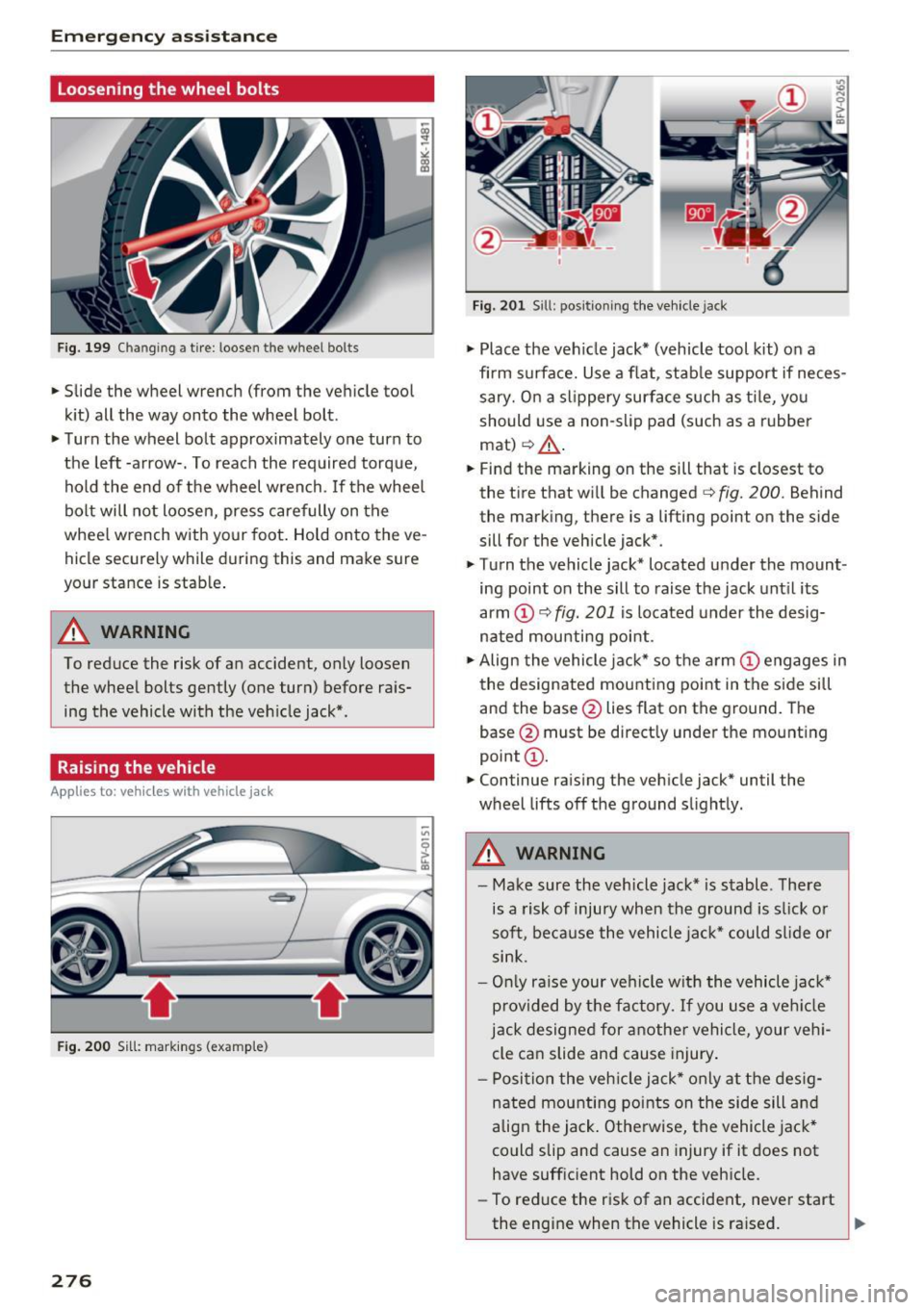
Fig. 199 Changing a tire: loosen the wheel bolts
• Slide the wheel wrench (from the vehicle tool
kit) all the way onto the wheel bolt.
• Turn the wheel bolt approximately one turn to
the left -arrow-. To reach the required torque,
hold the end of the wheel wrench. If the wheel
bolt will not loosen, press carefully on the
whee l wrench with your foot. Hold onto the ve
hicle securely while during this and make sure
your stance is stable .
A WARNING
To reduce the risk of an accident, only loosen
the wheel bolts gently (one turn) before rais
ing the vehicle with the veh icle jack*.
Raising the vehicle
Appl ies to: ve hicles w ith vehicle jack
- ,tr.-----,:
Fig. 200 Sill: markings (examp le)
276
Fig. 201 Sill: positio ning the vehicle jack
• Place the veh icle jack* (vehicle tool kit) on a
firm s urface. Use a flat, stable support if neces
sary. On a slippery surface such as tile, you
should use a non-slip pad (such as a rubber
mat)
c:> & .
• Find the marking on the sill that is closest to
the tire that will be changed
c:> fig. 200. Behind
the marking, there is a lifting point on the side
sill for the vehicle jack*.
• Tu rn the vehicle jack* located u nder the mount
ing point on the sill to raise the jack until its
arm
(D c:> fig. 201 i s located under the desig
nated mou nting point .
• Align the vehicle jack* so the arm @engages in
the designated mounting point in the side sill
and the base @lies flat on the ground. The
base @must be direct ly under the mounting
point @.
• Continue raising the vehicle jack* until the
wheel lifts off the ground slightly.
A WARNING
- Make sure the vehicle jack* is stable. There
is a risk of injury when the ground is slick or
soft, because the vehicle jack* could slide or
sink.
- Only raise your vehicle w ith the vehicle jack*
provided by the factory. If you use a vehicle
jack designed for another vehicle, your vehi
cle can slide and cause injury .
- Pos ition the vehicle jack* only at the desig
nated mounting points on the side sill and
align the jack . Otherwise, the vehicle jack*
co uld slip and cause an injury if it does not
have sufficient hold on the vehicle.
- To reduce the risk of an accident, never start
the engine when the vehicle is raised.
Page 279 of 314
CD
CD
.... N
" N .... 0 r--. V, co
-To reduce the risk of injury, support the ve
hicle securely with suitable stands if work is
to be performed underneath the vehicle.
- To help prevent injury to yourself and your
passengers:
- Do not raise the vehicle until you are sure
the jack is securely engaged .
- Passengers must not remain in the vehicle
when it is jacked up.
- Make sure that passengers wait in a safe
place away from the vehicle and well away
from the road and traffic.
- Make sure jack position is correct, adjust
as necessary and then continue to raise
the jack.
- If work has to be done under the vehicle,
ensure that it is safely supported on suita
ble stands -risk of injury!
- Never start the engine when the vehicle is
on the jack -risk of accident!
(D Note
Do not lift the vehicle by the sill . Position the
vehicle jack* only at the designated mounting points on the side sill. Otherwise, your vehicle
will be damaged.
Removing and mounting a wheel
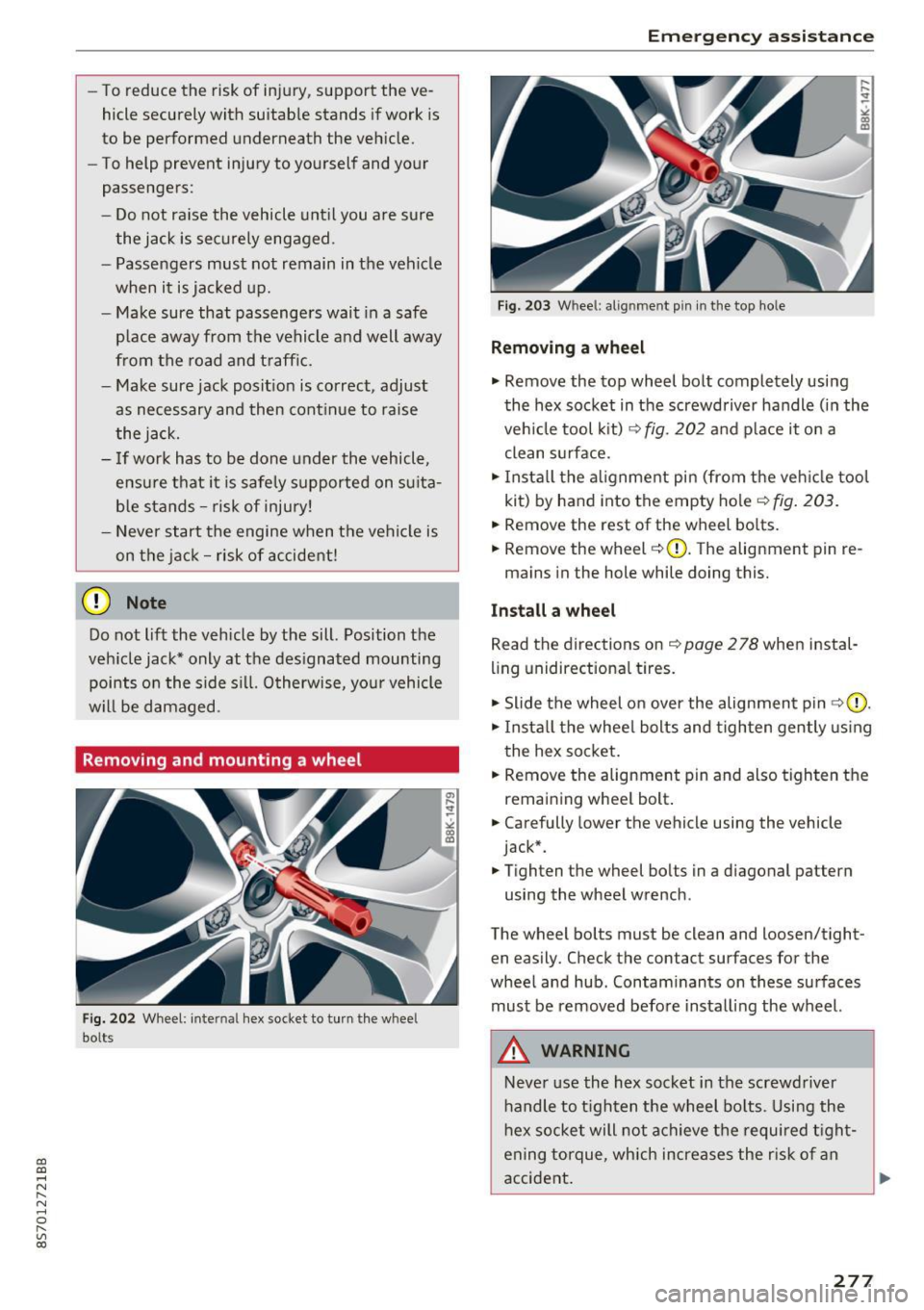
Fig. 202 Wheel : internal hex socket to turn the wheel
bolts
Emergency assistance
Fig. 203 W hee l: alignment pin in the top ho le
Removing a wheel
.,. Remove the top wheel bolt completely using
the hex socket in the screwdriver handle (in the
vehicle tool kit)
c::> fig. 202 and place it on a
clean surface.
.,. Install the alignment pin (from the vehicle tool
kit) by hand into the empty hole
c::>fig. 203 .
.,. Remove the rest of the wheel bolts.
.,. Remove the wheel
c::>0. The alignment pin re-
mains in the hole while doing this.
Install a wheel
Read the directions on c::> page 2 78 when instal
ling unidirectional tires.
.,. Slide the wheel on over the alignment pin
c::>(D.
.,. Install the wheel bolts and tighten gently using
the hex socket.
.,. Remove the alignment pin and also tighten the
remai ning wheel bolt .
.,. Carefully lower the vehicle using the vehicle
jack* .
.,. Tighten the wheel bolts in a diagonal pattern
using the wheel wrench .
The wheel bolts must be clean and loosen/tight
en easily. Check the contact surfaces for the
wheel and hub . Contaminants on these surfaces
must be removed before installing the wheel.
A WARNING
-
Never use the hex socket in the screwdriver
handle to tighten the wheel bolts . Using the
hex socket will not achieve the required tight
ening torque, which increases the risk of an
accident .
277
Page 281 of 314
CD
CD
.... N
" N .... 0 r--. V, co
-Always store damaged whee l, jack and too ls
securely in the luggage compartment. Oth erwise, in an accident or sudden maneuver
they could fly forward, causing injury to pas
sengers in the vehicle .
Spare tire
General information
Applies to: veh icles with space-saving spa re t ire (compact
spare tire)
A U DI
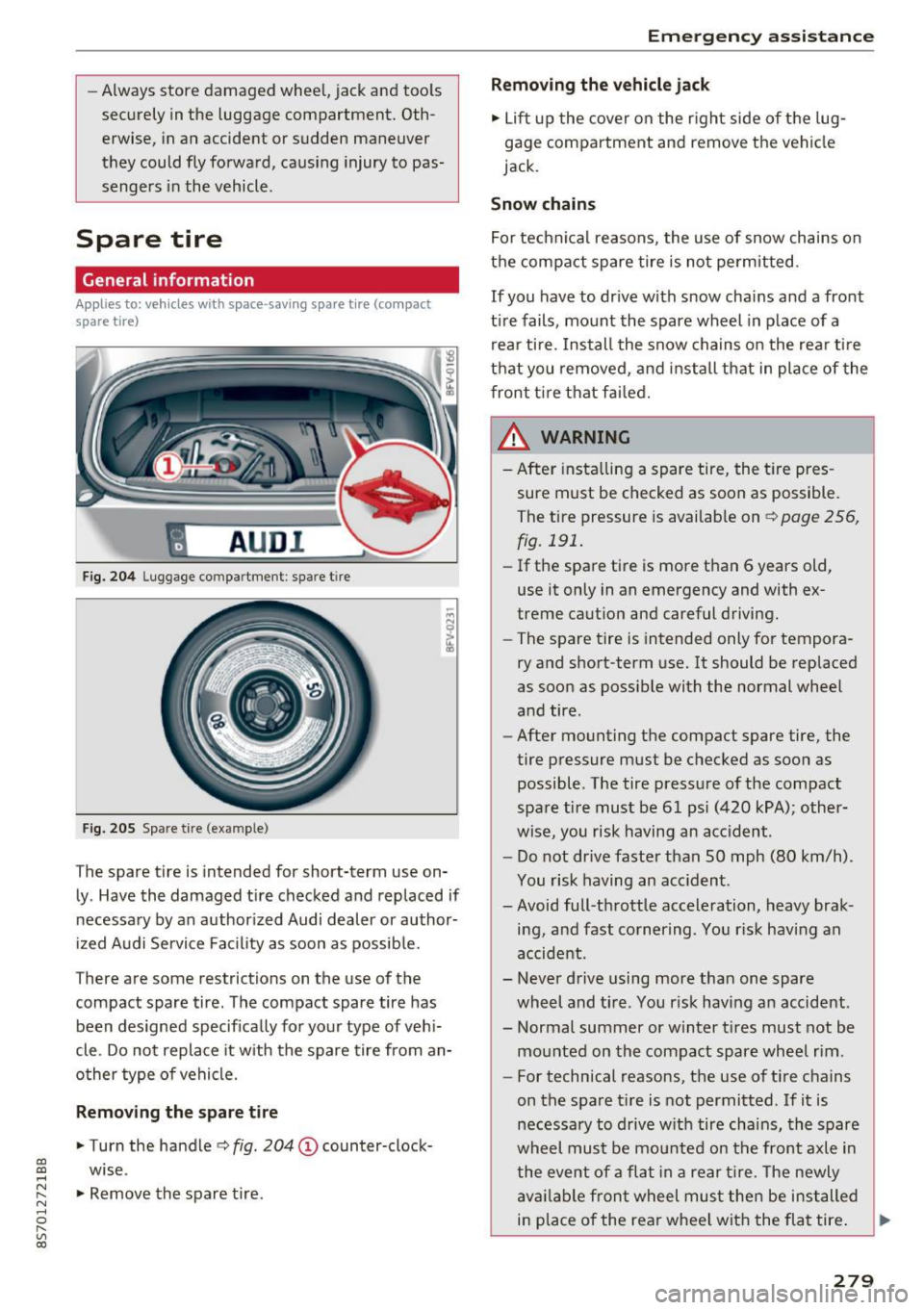
Fig. 204 Luggage co mpa rtment : spar e tir e
Fig. 205 Sp are t ire (ex ample)
The spare tire is intended for short-term use on
ly . Have the damaged t ire checked and replaced if
necessary by an author ized Audi dealer or author
ized Audi Service Fac ility as soon as possib le.
T here are some restrictions on the use of the
compact spare tire . The compact spare tire has
been designed specifica lly for your type of veh i
cle . Do not replace it w ith the spare tire from an
o ther type of vehicle.
Removing the spare t ire
.. Turn the handle c:> fig . 204 © counter-clock
wise .
.. Remove the spare tire .
Emergen cy a ssis tanc e
Removing the vehicle jack
.. Lift up the cover on the right side of the lug
gage compartment and remove the vehicle
jack.
Snow chains
For technical reasons, the use of snow chains on
t h e compact spare tire is not pe rmitted.
If you have to dr ive with snow chains and a front
t ire fails , mount the spare wheel in p lace of a
rear tire . Install the snow chains on the rea r tir e
t h at you removed, and i nstall that in place of the
front t ire that fai led.
A WARNING
-
- After insta lling a spare tire, the tire pres
sure must be checked as soon as possible .
The tire pressure is availab le on ¢
page 256,
fig. 191.
-If the spare tire is more t han 6 years old,
use it only in an emergency and with ex
treme caut ion and careful driving.
- The spare tire is intended only for tempora
ry and short-term use. It should be replaced
as soon as poss ible with the normal whee l
and tire .
- After mounting the compact spare tire, the
tire pressure must be checked as soo n as
possible . The tire pressure of the compact
spa re ti re must be 61 ps i (420 kPA); other
wise, you risk having an accident.
- Do not dr ive faster than SO mph (80 km/h) .
You risk having an acc ident.
-Avoid full -th rottle acceleration, heavy brak
ing, and fast corner ing . You r isk hav ing an
accident .
- Never drive using more than one spare wheel and ti re . You r isk having an accident .
- Normal summer or winter t ires must not be
mounted on the compact spare wheel rim .
- For technical reasons, the use of ti re chains
on the spare t ire is not permitted .
If it is
necessa ry to drive w it h tire cha ins, the spare
wheel mus t be mounted on the front axle in
the event of a flat in a rear t ire. The newly
a vailab le fro nt wheel mus t the n be ins talled
i n place o f the rear wheel wit h the flat tire .
~
279
Page 288 of 314
Emergency situations
(D Note
Improper hook -up of ju mper cables can r uin
the generato r.
- Always con nect P OSITIVE( +) to POS ITI VE
( + ), and NEG ATI VE( -) to NEGATIVE( -)
ground post of t he battery manage r contro l
u nit .
- Check that a ll sc rew p lugs on the battery
cells are sc rewed in firmly . If not, t ighten
plugs p rior to connect ing clamp o n negat ive
b attery t erminal.
- Please note t hat the procedure fo r con nect
i ng a jumper cable as desc rib ed above ap
plies specifica lly to the case of yo ur vehicle
being jum p starte d. When you a re giv ing a
ju mp sta rt to anothe r vehicle, do
not con
n e ct t he neg ative( -) ca b le to the neg ative
(- ) termin al o n t he dis ch arged battery @
¢
fig . 21 1. In ste ad, securely connec t the
negative (-) cab le to either a so lid metal
compo nent that is f irm ly bolted to the e n
gine block o r to the engine bloc k itself. If
the battery that is bei ng cha rged does not
vent to the outside, escap ing battery gas
could ignite an d exp lode!
Towing with a tow truck
General hints
Your Audi requires special handling for towing.
The fo llow ing informa tion is to be used by com
mercial tow truck operators who know how to op
era te the ir equipmen t sa fe ly .
- Never tow your Audi. Towing will cause dam
age to the engine and transmi ssion.
- Never wrap the safety chains or winch cables
around the brake l ines .
- To prevent unnecessary damage, your Audi
must be transported with a flat bed truck.
- To load the vehicle on to the flat bed , use the
towing loop found in the vehicle tools and at
tach to the front or rear anchorage
¢ page 286 and ¢ page 287.
286
A WARNING
A veh icle being towed is not safe for passe n
ge rs . Neve r allow a nyone to ride in a vehicle
be ing towed, fo r any reason .
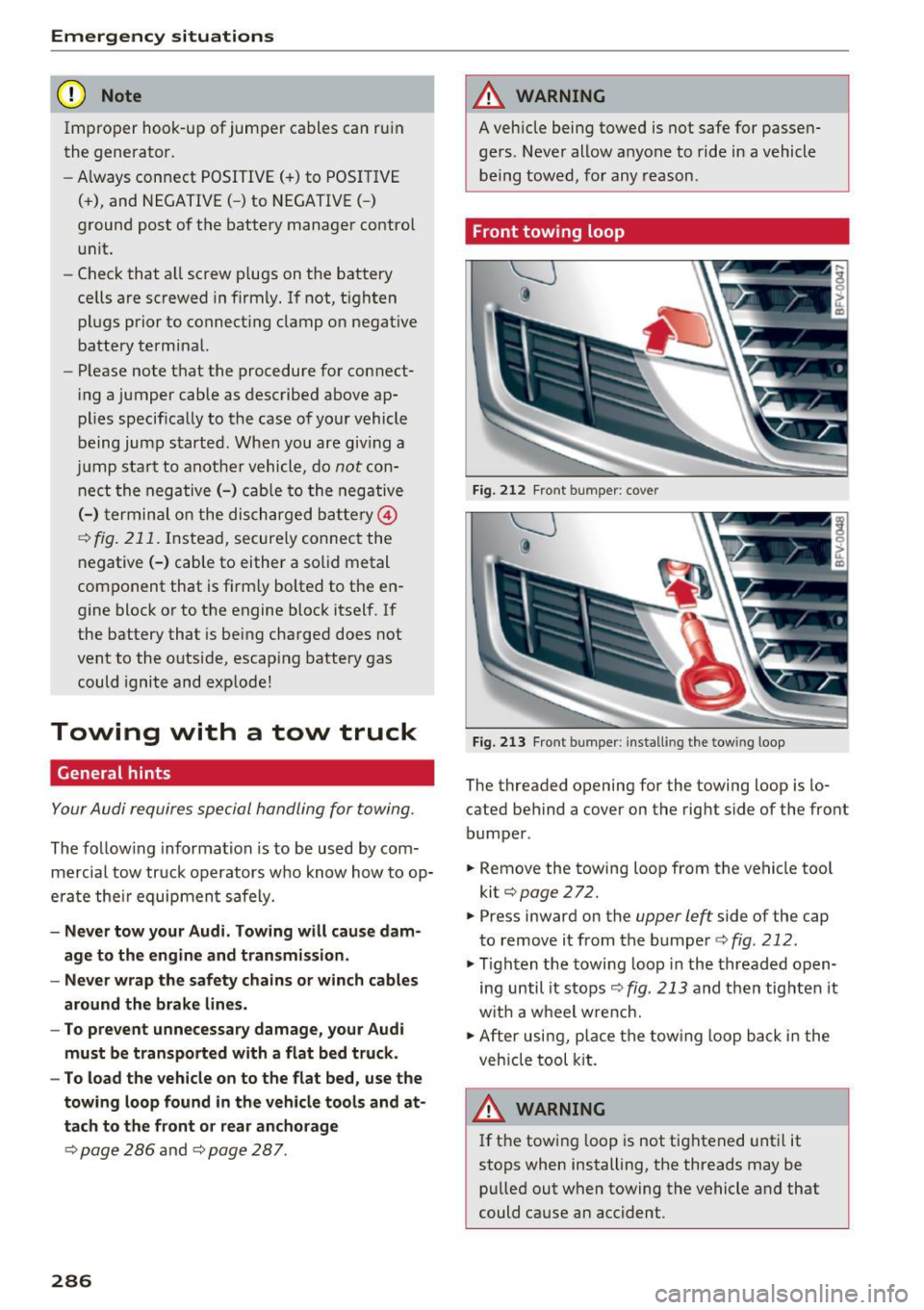
Front towing loop
Fig. 212 Fron t bumper : cover
Fi g. 2 13 Fron t bumper : install ing the tow ing loop
The threaded opening for the towing loop is lo
cated behind a cover on the rig ht side of the front
bumper .
.. Remove the towing loop f rom the vehicle too l
kit¢
page 272.
.. Press inward on the
upper left side of the cap
to remove i t from the bumper ¢
fig. 212 .
.,. Tighten the towing loop in the threaded o pen
ing until it s tops ¢
fig. 213 and then tig hten it
w it h a wheel w re nch.
.,. After usi ng, p lace the tow ing loop b ack in the
veh icle tool kit.
A WARNING
If t he t ow ing l oop is not tig htened unt il it
stops when installing, the threads may be pu lled out when towing the vehicle and that
could cause an accident .
-
Page 289 of 314
CD
CD
.... N
" N .... 0
" V, co
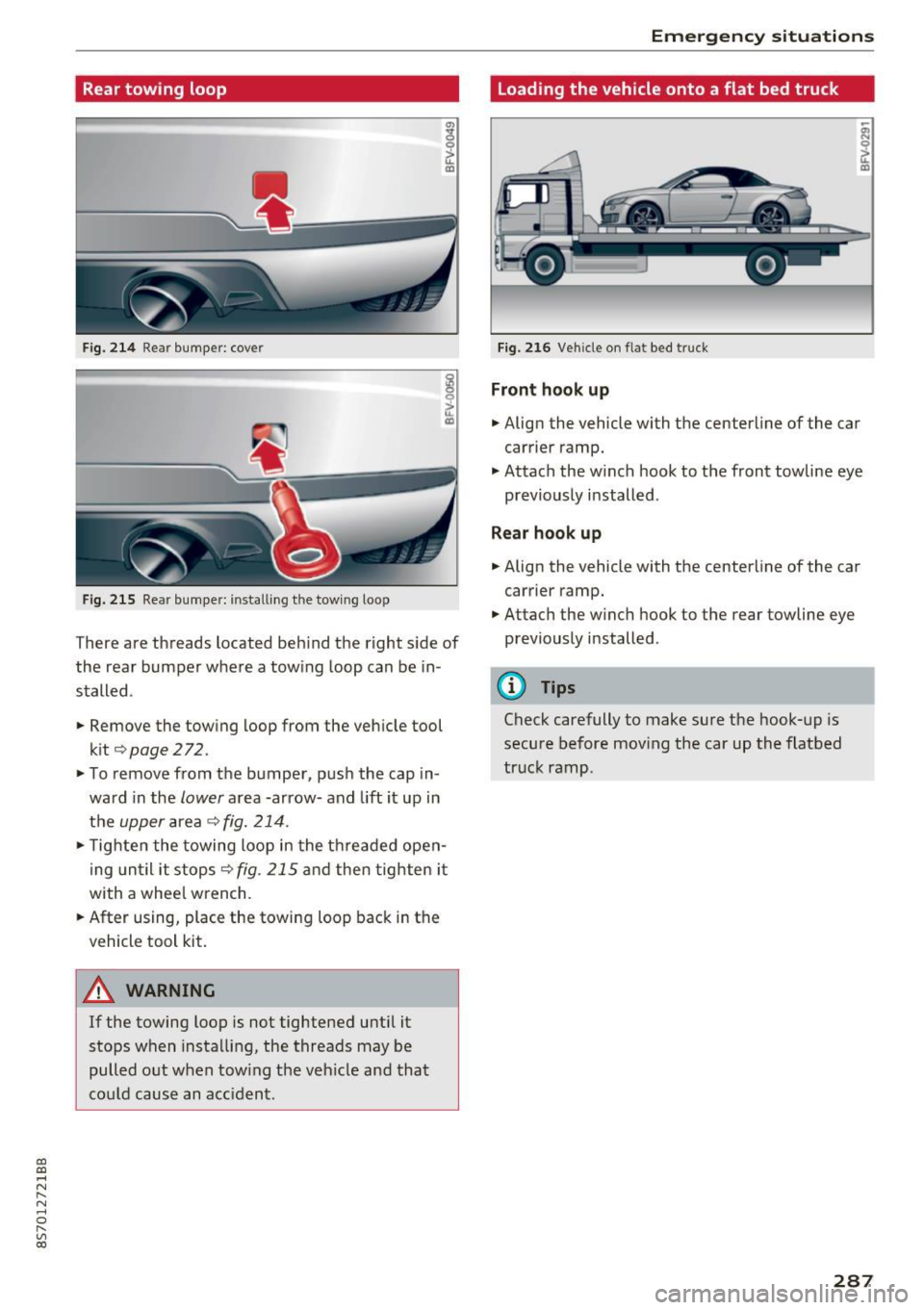
Rear towing loop
Fig. 214 Rea r bumper: cove r
Fig. 215 Rear bumper: installing the towing loop
There are threads located beh ind the right side of
the rear bumper where a tow ing loop can be in
stalled .
• Remove the tow ing loop from the vehicle tool
kit
¢ page 272.
• To remove from the bumper, push the cap in
ward in the
lower area -arrow- and lift it up in
the
upper area ~ fig. 214 .
"Tighte n the towing loop in the threaded open
ing until it stops
~ fig . 215 and then tighten it
with a whee l wrench.
"A fter using, place the towing loop back in the
vehicle tool kit .
.&_ WARNING
If the towing loop is not tightened until it
stops when installing, the threads may be
pulled o ut when tow ing t he veh icle and that
could cause an acc ident.
-
Emergency situations
Loading the vehicle onto a flat bed truck
Fig. 216 Veh icle on flat bed truck
Front hook up
• Align the vehicle with the centerline of the car
carrier ramp.
" Attach the winch hook to the front towline eye
previously installed .
Rear hook up
.. Align the vehicle with the centerline of the car
carrier ramp.
" Attach the winch hook to the rear towline eye
previously installed .
@ Tips
Check carefully to make sure the hook-up is
secure before moving the car up the flatbed
truck ramp .
287
Page 296 of 314
Consumer information
scope of maintenance and repairs which can be
carried out by vehicle owners.
Also, safety and
environmental
concerns place very strict limits
on the nature of repairs and adjustments to en
gine and transmission parts which an owner can
perform .
Maintenance, adjustments and repairs usually re
quire special tools, testing devices and other
equipment available to specially trained work
shop personnel in order to assure proper per
formance, reliability and safety of the vehicle and
its many systems .
Improper maintenance, adjustments and repairs
can impair the operation and reliability of your
vehicle and even void your vehicle warranty.
Therefore, proof of servicing in accordance with
the maintenance schedule may be a condition for
upholding a possible warranty claim made within
the warranty period.
Above all, operational safety can be adversely af
fected, creating unnecessary risks for you and
your passenger.
If in doubt about any servicing, have it done by
your authorized Audi dealer or any other properly
equ ipped and qualified workshop. We strongly
urge you to give your authorized Audi dealer the
opportunity to perform all scheduled mainte
nance and necessary repairs. Your dealer has the
facilities, original parts and trained specialists to keep your vehicle running properly.
Performing limited maintenance yourself
The following pages describe a limited number of procedures which can be performed on your vehi
cle with ordinary tools, should the need arise and
trained personnel be unavailable. Before per
forming any of these procedures, always thor
oughly read all of the applicable text and careful
ly follow the instructions given. Always rigorously
observe the
WARNINGS provided.
Before you check anything in the engine com
partment, always read and heed all WARNINGS
c> & and c> & in Working in the engine compart
ment on page 235.
294
A WARNING
-
- Serious personal injury may occur as a result
of improperly performed maintenance, ad
justments or repairs .
- Always be extremely careful when working
on the vehicle. Always follow commonly ac
cepted safety practices and general com
mon sense. Never risk personal injury.
- Do not attempt any of the maintenance,
checks or repairs described on the following pages if you are not fully familiar with these
or other procedures with respect to the ve hicle, or are uncertain how to proceed.
- Do not do any work without the proper tools
and equipment. Have the necessary work
done by your authorized Audi dealer or an
other properly equipped and qualified work
shop.
- The engine compartment of any motor vehi
cle is a potentially hazardous area. Never
reach into the area around or touch the radi
ator fan. It is temperature controlled and
can switch on suddenly - even when the en
gine is off. The radiator fan switches on au
tomatically when the coolant reaches a cer
tain temperature and will continue to run
until the coolant temperature drops.
- Always switch off the ignition before anyone
gets under the vehicle.
- Always support your vehicle with safety
stands if it is necessary to work underneath
the vehicle. The jack supplied with the vehi
cle is not adequate for this purpose and
could collapse causing serious personal in
Jury.
- If you must work underneath the vehicle
with the wheels on the ground, always make
sure the vehicle is on level ground, that the
wheels are always securely blocked and that
the engine cannot be started.
- Always make sure the transmission selector
lever (automatic transmission) is in P (Park
position) and the park brake is applied. ..,