ECU AUDI TT ROADSTER 2017 Owner's Manual
[x] Cancel search | Manufacturer: AUDI, Model Year: 2017, Model line: TT ROADSTER, Model: AUDI TT ROADSTER 2017Pages: 314, PDF Size: 76.54 MB
Page 171 of 314
co
co
.... N
" N .... 0
" "' c:o
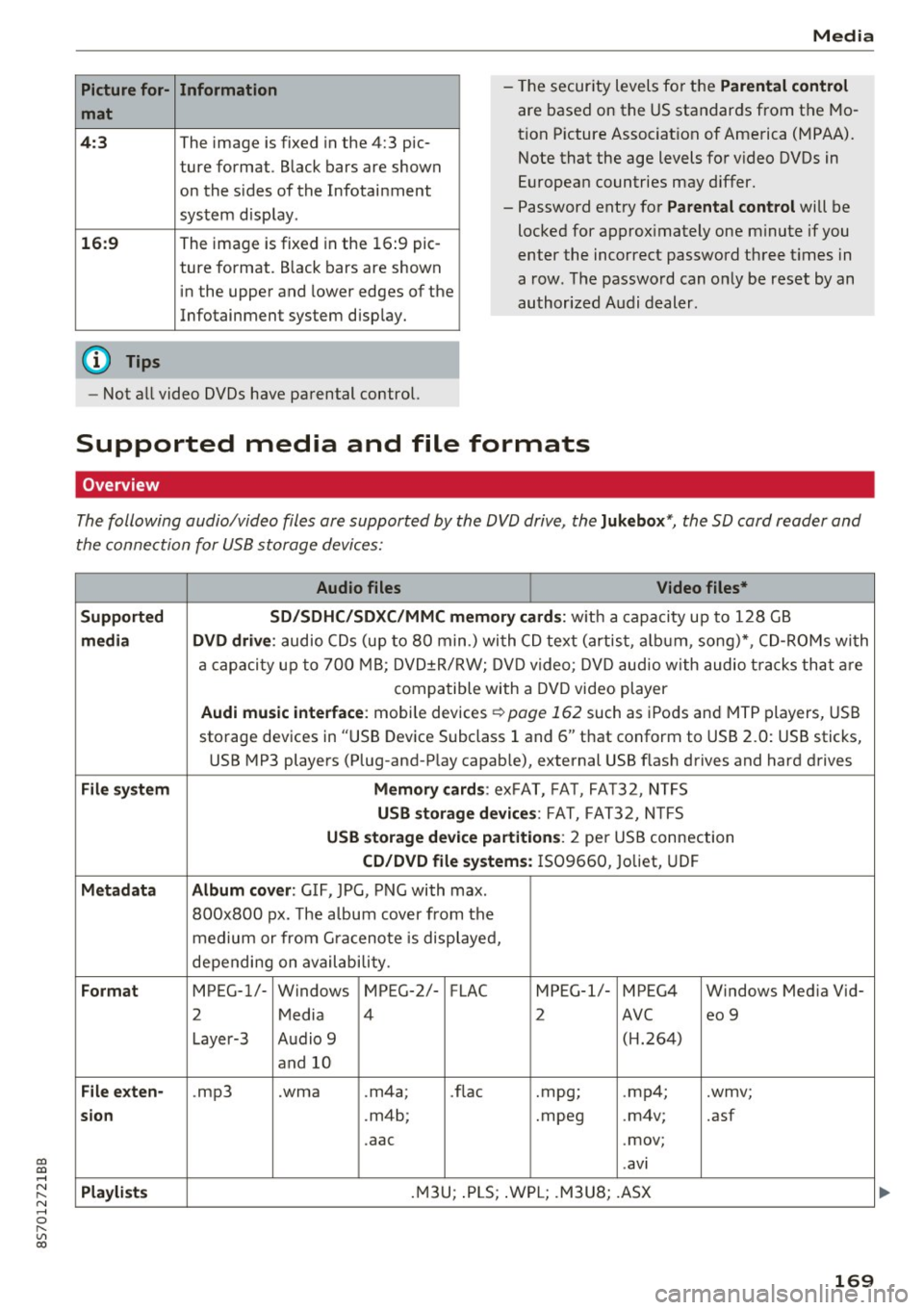
Picture for-
mat
4:3
16: 9
(D Tips Information
The image is fixed in the 4:3 pie-
ture format.
Black bars are shown
on the s ides of the Infotainment
system display.
The image is fixed in the 16 :9 pie-
ture format . B lack bars are shown
in the upper and lower edges of the
Infotainment system display.
Media
- The security levels for the Parental cont rol
are based on the US standards from the Mo
tion P icture Associat ion of America (MPAA).
Note that the age levels for v ideo DVDs in
European countries may differ.
- Password entry for
P ar ental contro l will be
locked for approx imately one m inute if you
enter the incorrect password three t imes in
a row. The password can only be reset by an
authorized Audi dealer.
- Not a ll video DVDs have parental control.
Supported media and file formats
Overview
The following audio/video files are supported by the DVD drive, the Juk eb ox*, the SD card reader and
the connection for USB storage devices:
Audio fil es Vid eo fil es*
Support ed SD/SDH C/SDX C/MM C me mory ca rds:
w ith a capacity up to 128 GB
m edi a DV D driv e: audio CDs (up to 80 min .) with CD text (artist, a lbum, song)*, CD-ROMs with
a capacity up to 700 MB; DVD±R/RW; DVD video; DVD audio with audio t racks that are
compatible with a DVD video player
Aud i mu sic int erfac e: mobile devices r=>page 162 such as iPods and MTP players, USB
storage devices in "USB Device Subclass 1 and 6" that conform to USB 2.0: USB sticks,
USB MP3 players (Plug-and-Play capable), external USB flash drives and hard drives
File syste m Memory c ard s: exFAT, FA T, FA T32, NTFS
USB sto rag e devices: FAT, FAT32, N TFS
USB stora ge device pa rtition s: 2 per USB connection
CD/DV D file sy ste ms: IS09660, Joliet, UDF
Metadat a Album co ver: GIF, JPG, PNG with max.
800x800 px. The a lbum cover from the
medium or from Gra cenote is displayed,
depending on availability.
Form at MPEG-1/- Windows MPEG-2/- FLAC MPEG-1/- MPEG4 Windows Media Vid-
2 Media 4 2 AVC
eo 9
Layer-3 Audio 9 (H.264)
and 10
Fil e ex ten -.mp3 .wma .m4a;
.flac .mpg;
.mp4; .wmv;
si on .m4b; .mpeg .m4v; .asf
.aac .mov;
.avi
Playlist s .M3U; .PLS; .WPL; .M3U8; .ASX
169
Page 180 of 314
System settings
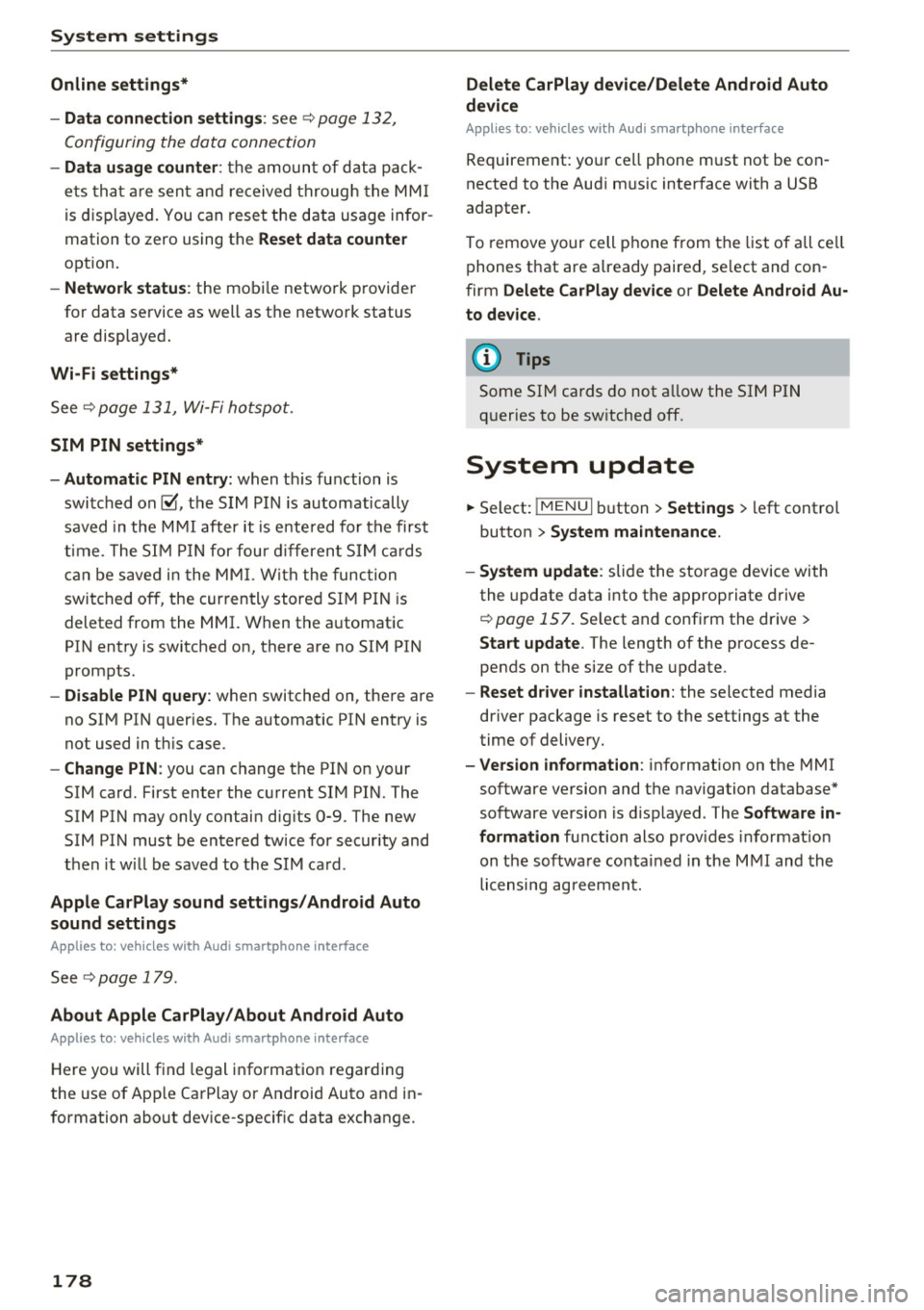
Online settings*
- Data connection setting s:
see~ page 132,
Configuring the data connection
- Data u sage counter : the amount of d ata p ack
e ts tha t ar e sent and received throug h the MM I
is d isp layed. You can reset the data usage infor
mation to zero using the
Reset data counter
option.
- Network statu s: the mobile netwo rk p rovider
for data se rvice as well as t he network status
are displayed.
Wi -Fi settings*
See Q page 131, Wi- Fi ho tspo t.
SIM PIN settings*
- Automatic PIN entry:
when t his fu nction is
swi tched on@', th e S IM PI N is automatically
saved in the M MI after it is e nte red for the f irst
t im e. The S IM PIN for four dif feren t SIM cards
c a n be save d in t he MM I. W ith the func tion
swi tc h ed o ff, the cur ren tly store d SI M P IN i s
deleted from the MMI. When the a utomatic
PI N entry is switched on, there are no SI M PIN
prompts.
- Disable PIN query : when switched on, the re are
no SI M PIN queries. The a utomat ic PIN entry is
not used in t his case .
-Change PIN : you can change the PI N on your
SIM card. First enter the c urrent SIM PI N. The
SIM PIN may only contain d ig its 0-9. The new
SIM PIN must be ente red tw ice for secur ity and
then it w ill be saved to t he SIM ca rd .
Apple CarPlay sound settings/ Android Auto
sound settings
A ppl ies to: ve hicles w ith Audi smartpho ne inte rface
See Qpoge 179.
About Apple CarPlay/About Android Auto
Appl ies to: ve hicles w ith Audi smartpho ne inte rface
Here you will f ind lega l in fo rmation regar ding
the use of App le Ca rPlay or Android Auto and in
formation abo ut dev ice-specif ic data excha nge.
178
Delete CarPlay device/Delete Android Auto
device
App lies to: vehicles wi th Audi s m art ph one interface
Requirement: yo ur cell phone m ust not be con
nected to the Aud i m usic interface with a USB
adapter.
To remove your cell phone from t he list of all ce ll
p hones t hat are a lready paired, se lect and con
firm
Delete CarPlay device or Delete Android Au·
to device .
(D Tips
Some SIM cards do not a llow the SI M PIN
qu eries to be sw itche d off.
System update
.,. Select: !ME NUI bu tton> Settings > left control
button >
System maintenance .
- System update :
slide the storage device with
the update data into t he a pprop riate drive
r=> poge 157. Se lect and confi rm the dr ive>
Start update . The length of the process de
pends on the size of the update .
-Reset driver installation: the selecte d media
driver package is reset to the settings at the
time of delivery.
- Version informat ion : info rmation on the MMI
software ve rsion and the navigation database*
so ftware ve rsion is d isp layed . The
Software in
formation
fu nction also prov ides infor mat ion
on t he softwa re contai ned in the M MI and the
li censing ag ree men t.
Page 186 of 314
Safe dri ving
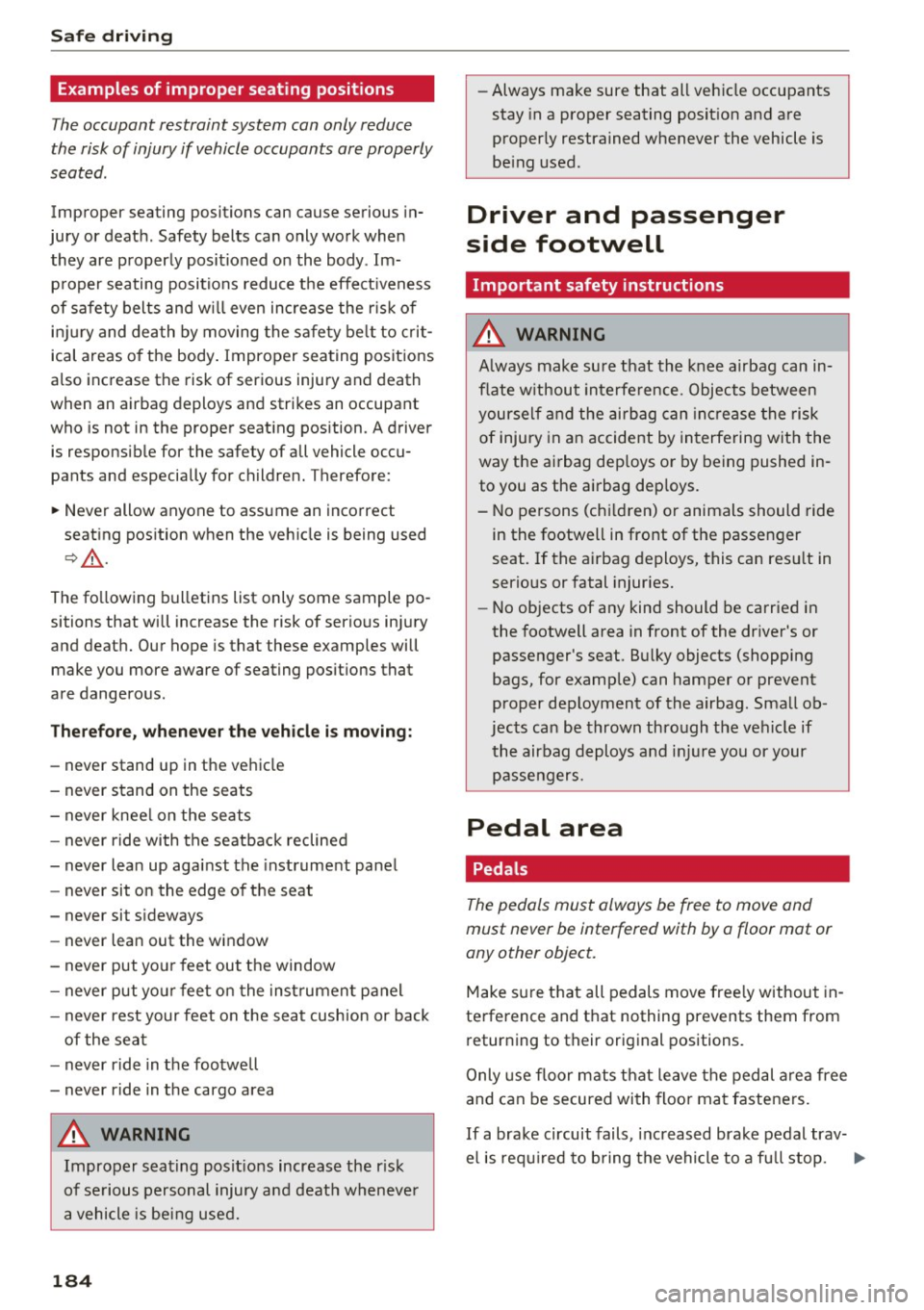
Examples of improper seating positions
The occupant restraint system can only reduce
the risk of injury if vehicle occupants are properly
seated.
Improper seating positions can cause serious in
jury or death . Safety belts can only work when
they are properly positioned on the body . Im
proper seating positions reduce the effect iveness
of safety belts and w ill even increase the r isk of
inj ury and death by moving the safety be lt to crit
ical areas o f the body . Improper seating positions
also increase the risk of serious injury and death
when an airbag deploys and strikes an occupant
who is not in the proper seating position. A driver
is responsible for the safety of all vehicle occu
pants and especially for children. Therefore :
~ Never allow anyone to assume an incorrect
seating position when the vehicle is being used
c:> .&_ .
The fo llowing bulletins list only some sample po
sitions that will increase the risk of serio us inj ury
and death. Our hope is that these examples will
make you more aware of seating posit ions that
are dangerous .
Therefore, whenever the vehicle is moving:
- never stand up in the ve hicle
- never stand on the seats
- never knee l on the seats
- never r ide with the seatback reclined
- never lean up against the instrument panel
- never sit on the edge of the seat
- never sit s ideways
- never lean out the window
- never put yo ur feet out the window
- never put yo ur feet on the instrument panel
- never rest your feet on the seat cushion or back
of the seat
- never ride in the footwell
- never r ide in the cargo area
A WARNING
Improper seating posit ions increase the r isk
of se rious personal injury and death wheneve r
a vehicle is being used.
184 -
Always make sure that all vehicle occupants
stay in a proper seating posit ion and are
properly restrained whenever the vehicle is
be ing used .
Driver and passenger
side footwell
Important safety instructions
A WARNING
A lways make sure that the knee airbag can in
flate without interfe rence. Objects between
yourself and the airbag can increase the risk
of injury in an accident by interfering with the
way the ai rbag dep loys o r by being pushed in
to you as the airbag dep loys.
- No persons (chi ldren) or animals should ride
in the footwell in front of the passenger
seat. If the airbag deploys, this can res ult in
serious or fatal injuries.
- No objects of any kind should be carried in
the footwell area in front of the driver's or
passenger 's seat. Bu lky objects (shopping
bags, for examp le) can hamper or prevent
proper deployment of the airbag. Small ob
jects can be thrown through the vehicle if
the airbag deploys and injure you or your
passengers.
Pedal area
' Pedals
The pedals must always be free to move and
must never be interfered with by a floor mat or
any other object.
Make sure that all pedals move free ly without in
terference and that nothing prevents them from
returning to their original positions.
Only use floor m ats that leave the pedal area free
and can be secured with floor mat fasteners.
If a brake circuit fails , in creased brake pedal trav-
el is required to bring the vehicle to a fu ll stop. .,..
Page 187 of 314
co
co
.... N
" N .... 0
" "' c:o
A WARNING ,~
Pedals that cannot move freely can cause loss
of vehicle control and increase the risk of seri
ous injury .
- Never place any objects in the driver's foot
well. An object could get into the pedal area
and interfere w ith pedal function . In case of
sudden braking or an accident, you would
not be able to brake or accelerate!
- Always make sure that nothing can fall o r
move into the dr iver's footwe ll.
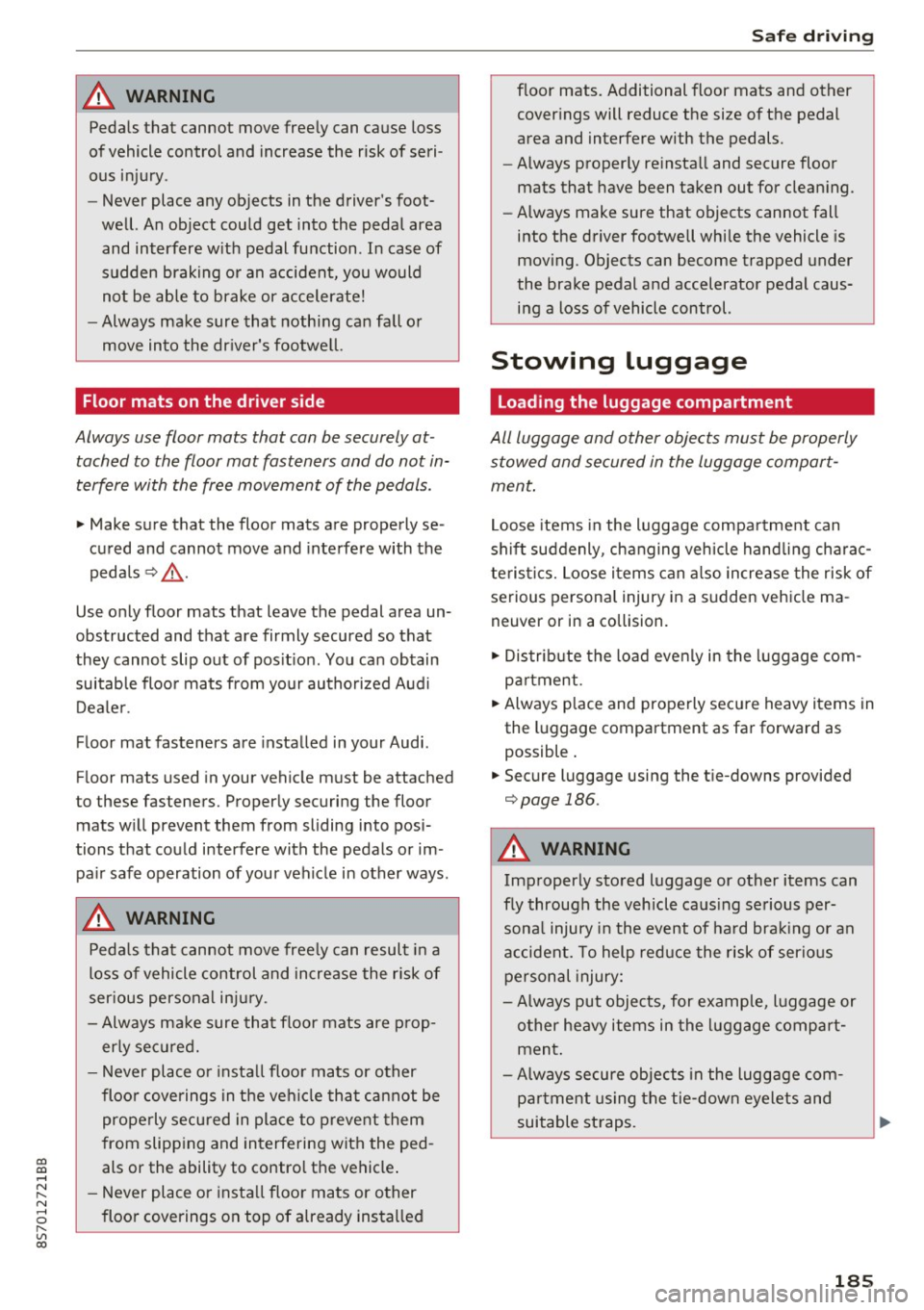
Floor mats on the driver side
Always use floor mats that can be securely at
tached to the floor mat fasteners and do not in
terfere with the free movement of the pedals .
.,. Make sure that the floor mats are properly se
cured and cannot move and interfe re with the
peda ls ¢ ,&. .
Use o nly floor mats that leave the pedal area un
obstructed and that are firmly secured so that
they cannot slip out of pos it ion . You can obtain
suitable floo r mats from yo ur au tho riz ed A ud i
Dea le r.
Floor mat fasteners are installed in your Audi.
F loor mats used in your vehicle must be attached
to these fasteners. Properly securing the floor mats w ill prevent them from sliding into posi
tions that could interfere with the pedals or im
pa ir safe operation of your veh icle in other ways .
A WARNING
Pedals that cannot move free ly can resul t in a
loss of vehicle control and increase the risk of
ser ious personal in jury.
- Always ma ke sure tha t floor mats are p rop
erly se cured.
- Never place o r insta ll floo r mats or other
floo r coverings in the ve hicle tha t cannot be
properly se cured in place to prevent them
from slipp ing and interfering with the ped
als or the ability to control the vehicle .
- Never place or inst all floo r ma ts or o ther
floo r coverings on top of a lready installed
Safe d riv ing
floor mats. Additional floor mats and other
cover ings will reduce the size of the pedal
area and interfere with the pedals.
- Always properly re insta ll and secure floor
mats that have been taken out for clean ing .
- Always make sure that objects cannot fall
into the driver footwell whi le the vehicle is
mov ing . Objects can become trapped under
the brake pedal and accelerator pedal caus i n g a loss of vehicle control.
Stowing luggage
Loading the luggage compartment
All luggage and other objects must be properly
stowed and secured in the luggage compart
ment .
Loose items in the luggage compa rtme nt can
shift suddenly , changing veh icle hand lin g charac
te ris tics. Loose i tems can a lso incre ase the risk of
serious persona l injury in a sudden veh icle ma
neuver or in a collision.
.. Distribute the load evenly in the luggage com
par tment .
.. Always p lace and properly sec ure heavy items in
the l uggage compartment as far forward as
possible .
.. Secure luggage using the t ie-downs provided
¢page 186.
A WARNING ~
Improperly stored luggage or o ther items can
f ly through the veh icle ca using se rious per
sona l injury i n the event of ha rd bra king or an
a ccident. To help reduce the risk of serio us
p ersonal injury:
- Always put objects, for example, l uggage or
o ther heavy items in the l uggage compart
ment .
- Always secure objects in the luggage com
pa rtment us ing the tie-down eyelets and
suitable st raps.
185
Page 188 of 314
Safe driving
_& WARNING
Heavy loads will influence the way your vehi
cle handles. To help reduce the risk of a loss
of control leading to serious personal injury:
- Always keep in mind when transporting
heavy objects, that a change in the center of
gravity can also cause changes in vehicle
handling:
- Always distribute the load as evenly as
possible .
- Place heavy objects as far forward in the luggage compartment as possible.
- Never exceed the Gross Axle Weight Rating
or the Gross Vehicle Weight Rating specified
on the safety compliance sticker on the left
door jamb. Exceeding permissible weight
standards can cause the vehicle to slide and hand le differently .
- Please observe information on safe driving
c';> page 181.
_& WARNING
To help prevent poisonous exhaust gas from
being drawn into the vehicle, always keep the
rear lid closed while driving.
- Never transport objects larger than those
fitting completely into the luggage area be cause the rear lid cannot be fully closed .
- If you absolutely must drive with the rear lid open, observe the following notes to reduce
the risk of poisoning:
- Close all windows,
- Close the convertible top,
- Open all air outlets in the instrument pan-
el,
- Switch off the air recirculation,
- Set the fresh air fan to the highest speed .
_& WARNING
'
-
Always make sure that the doors, all win
dows, the convertible top and the rear lid are
securely closed and locked to reduce the risk
of injury when the vehicle is not being used.
- After closing the rear lid, always make sure
that it is properly closed and locked.
186 -
Never leave your vehicle unattended espe
cially with the rear lid left open. A child
could crawl into the vehicle through the lug
gage compartment and close the rear lid be
coming trapped and unable to get out . Be
ing trapped in a vehicle can lead to serious
personal injury.
- Never let children play in or around the vehi
cle.
- Never let passengers ride in the luggage compartment . Vehicle occupants must al
ways be properly restrained in one of the ve hicle 's seating positions.
{1) Tips
- Air circulation helps to reduce window fog
ging . Stale air escapes to the outside
through vents in the trim panel, on the left
side of the luggage compartment. Be sure
to keep these slots free and open.
- The tire pressure must correspond to the
load. The tire pressure is shown on the tire
pressure label. The tire pressure label is lo
cated on the driver's side B-pillar. The tire
pressure label lists the recommended cold
tire inflation pressures for the vehicle at its
maximum capacity weight and the tires that
were on your vehicle at the time it was man ufactured. For recommended tire pressures
for normal load conditions, please see chap
ter
c';> page 257.
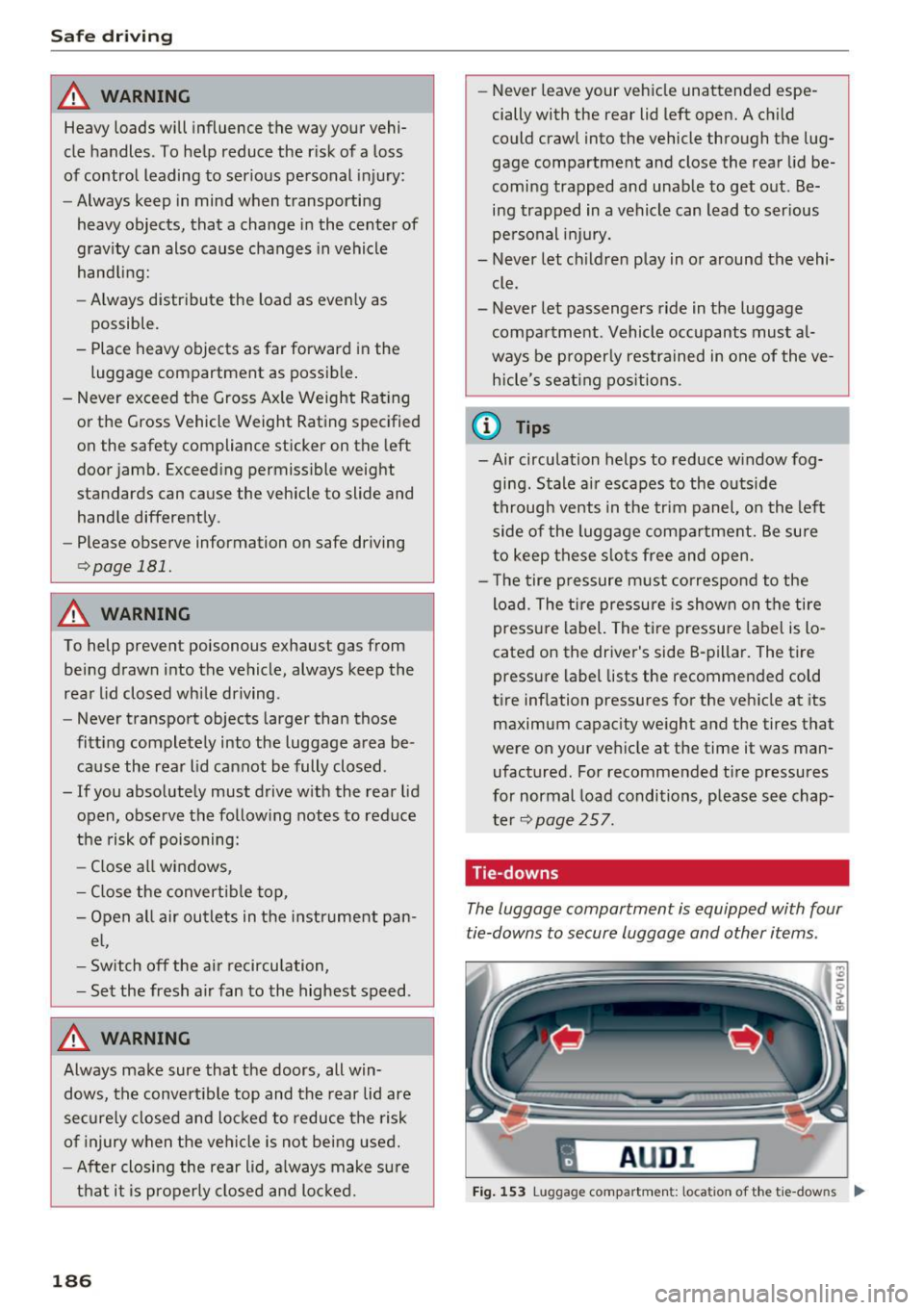
Tie -downs
The luggage compartment is equipped with four
tie-downs to secure luggage and other items .
fl AUD I I
Fig. 153 Lug gage compar tmen t: loca ti on of th e tie-dow ns ....
Page 189 of 314
Use the tie-downs to secure your cargo properly
~page 185, Loading the luggage compartment.
In a coll is ion, the laws of physics mean that even
sma ller i tems that are loose in the vehicle will
become heavy missiles that can cause serious in
jury. Items in the ve hicle possess energy which
vary with vehicle speed and the weight of the
item. Veh icle speed is the most signif icant factor .
F or example, in a frontal collision at a speed o f
30 mph (48 km/h) , the forces acting on a 10 lbs
(4.5 kg) object are about 20 times the norma l
weight of the item. Th is means that the weight
of the item would suddenly be about
200 lbs (90 kg) . You can imagine the injuries that
a 200 lbs (90 kg) item flying freely th rough the
passenger compa rtment cou ld cause in a col li
sion li ke this.
_& WARNING
-
Wea k, damaged o r imp roper straps used to
secure i tems to tie-downs can fail during hard
braking o r in a collision and cause serious per
sonal injury.
- Always use su itab le mounting straps and
properly secure items to the tie-downs in
the luggage compartment to help prevent
items from shifting or f ly ing fo rward as dan
gerous missiles.
- Never attach a child safety seat tether strap
to a tie-down .
Reporting Safety Defects
Applicable to U.S.A.
If you believe that your vehicle
ha s a defect which could cause a
crash or could cause injur y or
death, you should immediatel y in
form the National High way Traffi c
Safet y Admini str ation (NHTSA) in
~ addition to notifying Audi of
....
~ America, Inc . .... 0 r---
"' c:o
Safe d riv ing
If NHTSA re cei ves s imil a r com
pl aint s, it m ay open an in vestiga
tion , and i f it find s that a safet y
defe cts ex ists in a grou p of
v ehicl es, it m ay order a re call and
r e m edy campaign . H ow eve r,
NHTSA cann ot b ecome in vol ved in
ind ivid ual pr oblem s between you,
y our dealer, or Audi of Ameri ca,
In c.
To contact NHTS A, you ma y call
the Vehicle Safety Hotline toll
free at:
T el.: 1 (888) 327-4236 (TTY: 1
( 800) 424 -9153) or 1 (800)
4 24- 9393
or you m ay write to:
Administr ator
NHTSA
1200 Ne w Jerse y Avenue, SE
Wa shington , D.C. 20590
You can als o obtain oth er inf or
mation about motor vehicle safe
t y fro m:
http: //www. saf ercar.gov
Applicable to Canada
If y ou li ve in Canad a and you be
l ie ve that your vehicle has a de
fe ct that could cau se a cra sh, in
jur y or death, you should imm edi-
a tel y inform Transp ort Canada , ..,
187
Page 194 of 314
Safe ty belts
-Never remove a safety be lt while the ve hicle
is mov ing . Do ing so will increase your r isk of
being injured or killed.
- Never wear belts twisted.
- Never wear belts over rigid or breakable ob -
jects in or on your cloth ing, such as eye
glasses, pens, keys, etc., as these may cause
injury.
- Never allow safety be lts to become dam
aged by being caught in door or seat hard
ware.
- Do not wear the shoulder part of the belt
under your arm or otherwise out of position.
- Severa l layers of heavy clothing may inter
fere with cor rect positioning of belts and re
duce the overall effectiveness of t he system.
- Always keep belt buckles free of anything
that may prevent the b uckle from latching
secu rely.
- Never use comfort clips or devices that cre
ate slack in the shoulder belt. However, spe
c ial clips may be requ ired for the prope r use
of some chi ld restraint systems.
- Torn or frayed safety belts can tear and
damaged belt hardware can break in an acc i
dent. Inspect belts regula rly .
If webbing,
bind ings, buckles, or ret rac to rs are dam
aged, have belts repl aced by an auth orized
Audi dealer or quali fied workshop.
- Safety belt s th at have been wo rn a nd loaded
in an accident m ust be rep lace d wi th the
c orrect repl acemen t sa fety be lt by an au
t h o rized Aud i dea le r. Replacement may be
necessary even if damage cannot be clear ly
seen. Anchorages that were loaded m ust al
so be inspected.
- Never remove, modify, disassemble, or try
to repair the safety belts yourself.
- Always keep t he be lts clean . Di rty be lts may
not work properly and can impai r the f unc
tion of the inertia reel¢
table Interior
cleaning on page 268.
192
Safety belts
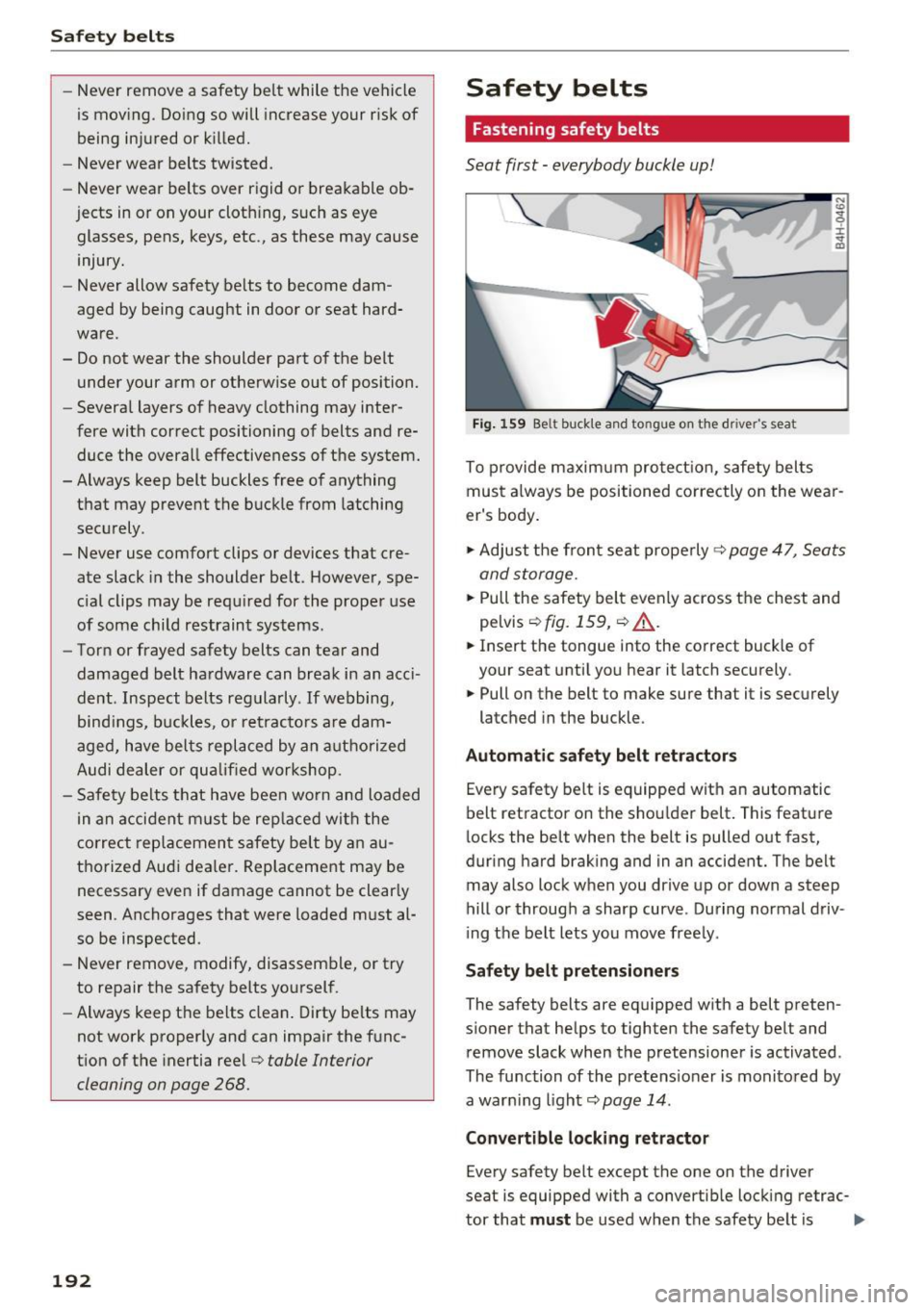
Fastening safety belts
Seat first -everybody buckle up!
Fig. 159 Be lt buc kle and tongue on the driver 's seat
N
CD
~ ::i: .. a,
To p rovide m axim um pro te ct io n, safety belts
must a lways be positioned co rrectly on the wear
er's body .
.., Ad just the fron t se at prope rly ¢
page 47 , Seats
and storage.
.., Pull the safety belt even ly across the chest and
pe lvis
r::!>fig. 159, ¢ _& .
.., Insert the tongue into the correct buck le of
your seat until you hear it latch securely.
.., Pull on the belt to make sure that it is sec urely
latched in the buckle .
Automatic safety belt ret ractors
Every safety belt is equipped wit h an automatic
belt retractor on the shou lder belt . This feature
locks the belt when the belt is pulled out fast,
during hard brak ing and in an accident. The belt
may also lock when you dr ive up or down a steep
hill or through a sharp curve . During normal driv
i ng t he belt lets you move free ly .
S afety belt pretensioners
The safety belts are equ ipped w ith a belt preten
s ioner that he lps to tighten the safety belt and
remove slack when the pretensioner is activated .
The function of the pretens ioner is monitored by
a war ning light¢
page 14 .
Convertible lock ing retractor
Every safety belt except the one on the driver
seat is equipped with a convertib le lock ing retrac-
tor that
mu st be used when the safety be lt is Ill>-
Page 195 of 314
CD
CD
.... N
" N .... 0 r--. V, co
used to attach a child seat. Be sure to read the
important information about this feature
r::!) page 22 7.
.&_ WARNING
Improperly positioned safety belts can cause
serious injury in an accident
<=>page 193,
Safety belt position.
- Safety belts offer optimum protection only
when the seatback is upright and belts are
properly positioned on the body.
- Never attach the safety belt to the buckle
for another seat. Attaching the belt to the
wrong buckle will reduce safety belt effec
tiveness and can cause serious personal in
JUry.
-A passenger who is not properly restrained
can be seriously injured by the safety belt it
self when it
moves from the stronger parts
of the body into critical areas like the abdo
men.
- Always lock the convertible locking retractor
when you are securing a child seat in the ve
hicle
c> page 228.
(D Tips
For information on safety belt pretensioners,
refer tor::!)
page 194.
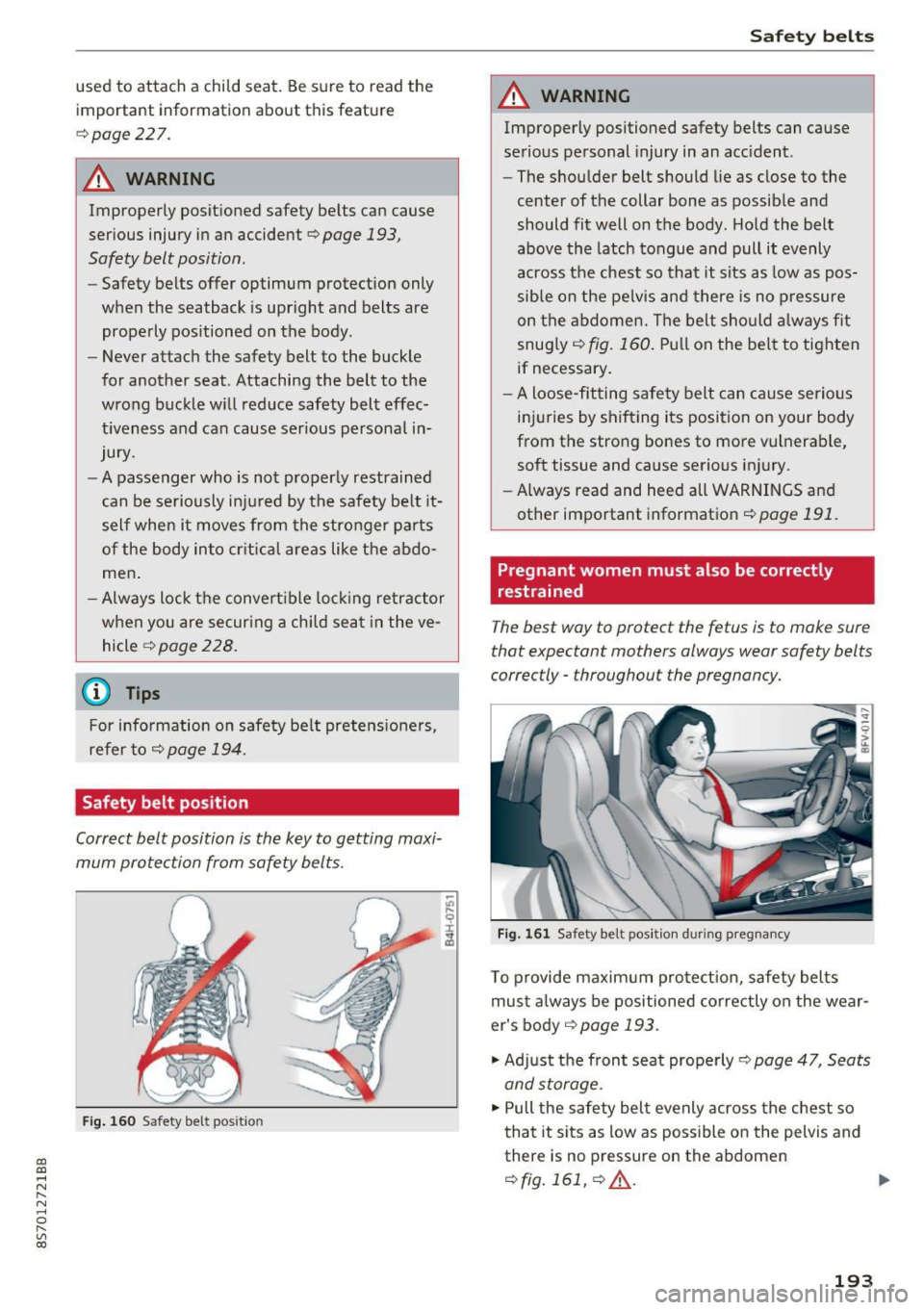
Safety belt position
Correct belt position is the key to getting maxi
mum protection from safety belts.
Fig. 160 Safety belt pos itio n
Safety belts
.&_ WARNING """-iiiiiiiii
Improperly positioned safety belts can cause
serious personal injury in an accident.
- The shoulder belt should lie as close to the
center of the collar bone as possible and
should fit well on the body. Hold the belt
above the latch tongue and pull it evenly
across the chest so that it sits as low as pos
sible on the pelvis and there is no pressure
on the abdomen. The belt should always fit
snugly
c> fig. 160. Pull on the belt to tighten
if necessary.
- A loose-fitting safety belt can cause serious
injuries by shifting its position on your body
from the strong bones to more vulnerable
I
soft tissue and cause serious injury.
- Always read and heed all WARNINGS and
other important information
i=;, page 191.
Pregnant women must also be correctly
restrained
The best way to protect the fetus is to make sure
that expectant mothers always wear safety belts
correctly- throughout the pregnancy.
Fig. 161 Safety belt position during pregnancy
To provide maximum protection, safety belts
must always be positioned correctly on the wear
er's body
<=> page 193.
"'Adjust the front seat properly c> page 47, Seats
and storage.
"' Pull the safety belt evenly across the chest so
that it sits as low as possible on the pelvis and
there is no pressure on the abdomen
c>fig .161 ,r=> .&_ .
193
Page 196 of 314
Safe ty belts
• Insert the tongue into the correct buckle of
your seat until you hear it latch secure ly
r:!> page 192, fig. 159 .
•Pullon the belt to make sure that it is securely
latched in the buckle.
A WARNING
Improperly positioned safety belts can cause
ser ious personal injury in an c1ccident.
- Expectant mothers must always wear the
lap portion of the safety belt as low as pos
sible across the pelvis and below the round ing of the abdomen .
- Always read and heed all WARNINGS and
othe r important information
c:> .&. in Fasten
ing safety belts on page 193.
Unfastening safety belts
Unbuckle the safety belt with the red release
button only after the vehicle has stopped.
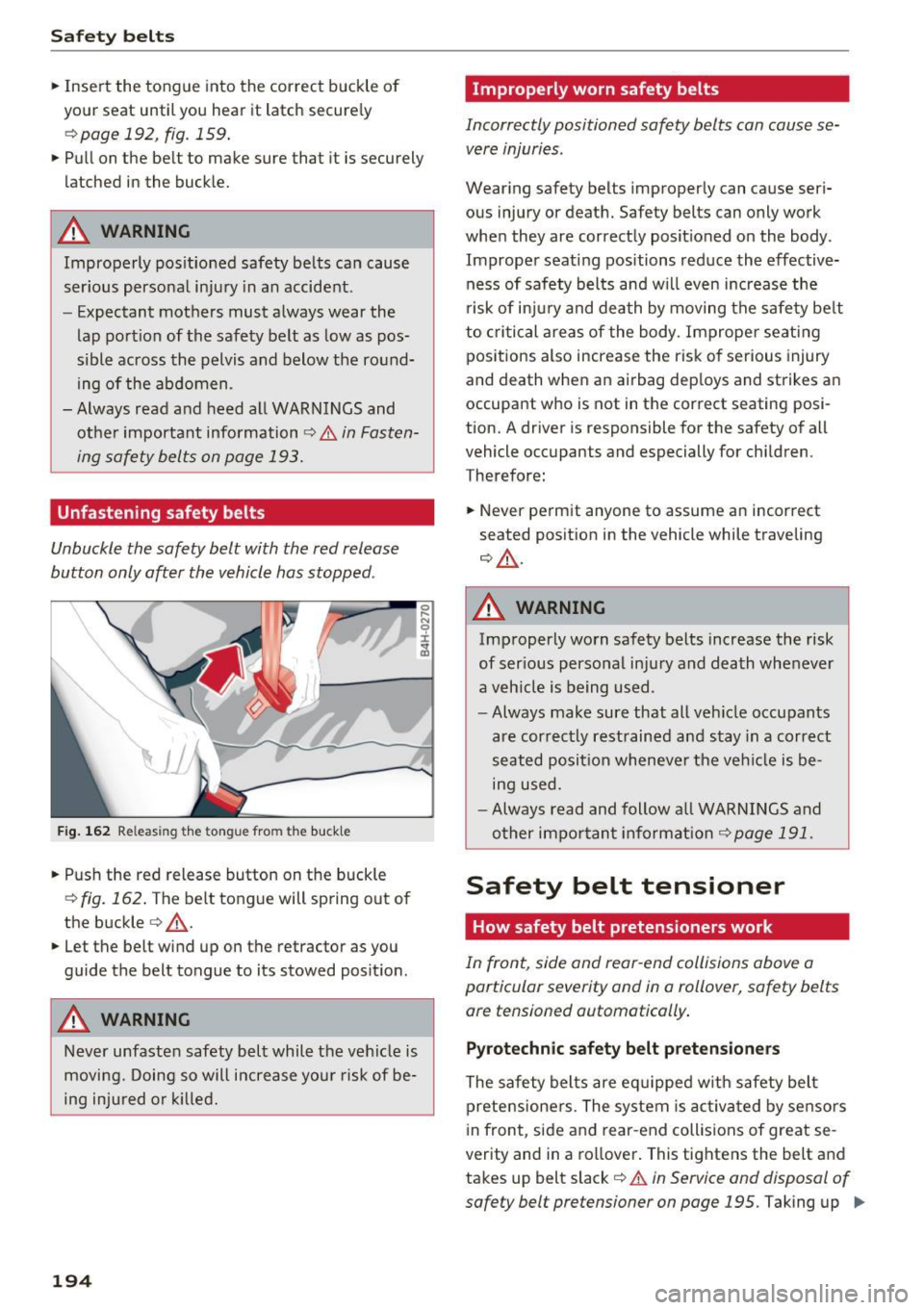
F ig . 162 Releasi ng the tongue fro m the buckle
• Push the red release button on the buckle
r:!> fig. 162 . The belt tongue will spring out of
the buckle
c:> _& .
• Let the belt wind up on the retractor as you
guide the belt tongue to its stowed posit ion .
A WARNING
Never unfasten safety belt while the vehicle is
moving. Doing so will increase your risk of be
ing injured o r kil led.
194
Improperly worn safety belts
Incorrectly positioned safety belts can cause se
vere injuries.
Wearing safety belts improperly can cause seri
ous injury or death. Safety belts can only work
when they are correctly posit ioned on the body .
Improper seating positions reduce the effective ness of safety bel ts and w ill even increase the
risk of inju ry and death by moving the safety be lt
to criti cal areas of the body . Imprope r seating
positions also increase the risk of serious injury
and death when an airbag dep loys and strikes an
occupant who is not in the correct seating posi
tion. A driver is responsible for the safety of all
vehicle occupants and especially for children.
Therefore:
• Never pe rm it anyone to assume an incor rect
seated position in the vehicle while traveling
<=> _& .
A WARNING
Improperly worn safety belts increase the risk
of ser ious perso nal injury and death whenever
a veh icle is being used .
- Always make sure that all veh icle occupants
are correctly restrained and stay in a correct
seated posit ion wheneve r the ve hicle is be
ing used.
- Always read and follow a ll WARNINGS and
other impo rtant informat ion
r:!> page 191.
Safety belt tensioner
How safety belt pretensioners work
In front, side and rear -end collisions above a
particular severity and in a rollover, safety belts ore tensioned automatically.
Pyrotechnic safety belt pretensioners
The safety belts are eq uipped w ith safety belt
prete nsione rs. The system is ac tiva ted by sensors
i n front, side and rear-end collisions of great se
verity and in a rollover . This tightens the belt and
takes up belt slack¢.&.
in Service and disposal of
safety belt pretensioner on page 195.
Taking up IJ,-
Page 229 of 314
co
co
.... N
" N .... 0
" "' c:o
-Children on the front seat of any car, even
with Advanced Airbags, can be seriously in
jured or even killed when an airbag inflates.
- Never let a child stand or kneel on the seat .
- Never let a child ride in the cargo area of
your vehicle.
-Always remember that a child leaning for ward, sitting sideways or out of position in any way during an accident can be struck by
a deploying airbag. This will result in serious
personal injury or death.
- If you must install a booster seat on the
front passenger seat because of exceptional
c ircumstances the
PA SSENGER AIR BAG
OFF ~;
light must come on and stay on,
whenever the ignition is switched on.
- If the
PAS SENG ER AIR BAG OFF~; light
does not come on and stay on, perform the
checks described ¢
page 207, Monitoring
the Advanced Airbag System.
- If the PASSE NGE R AIR BAG OFF~; light
does not come on and stay on wheneve r the
ignition is switched on the infla ting airbag
will hit the child safety sea t or i nfant c arr ier
with great force and will smash the child safety seat and child against the backrest,
center armrest, door or roof . Have the air
bag system inspected immediately by your
Audi dealer.
- Always read and heed all WARNINGS when
ever using a child restrained in a veh icle is
being used¢
page 189, Safety belts,
¢ page 196, Airbag system
and
¢page 218, Important information .
Securing child seats
Securing a child safety seat using a safety
belt
Safety belts for the front passenger con be
locked with the convertible locking retractor to
properly secure child safety seats .
The safety belt emergency locking retractor for
the front passenger's seat safety belt have a con
vertible locking retractor for chi ld restraints . The
safety belt must be locked so that belt webbing
cannot unreel. The retractor can be activated to
Ch ild safety
lock the safety belt and prevent the safe ty be lt
webbing from loosening up during norma l driv
ing. A chi ld safety seat can only be properly in
stalled when the safety belt is locked so that the child and ch ild safety seat will stay in p lace.
Always remember : Even though your vehicle is
equipped with an Advanced Airbag system, a
child should always r ide in the seat properly re
strained for its age and s ize.
A WARNING .,.__
Improperly installed ch ild safety seats in
crease the risk of serious personal injury and
death in a co llision .
-
-Always make sure that the safety belt re
tractor is locked when installing a child
safety seat. An un locked safety be lt retrac
tor cannot hold the ch ild safety seat in place
du ring normal driving or in a c rash.
- Always buckle the child safety seat fi rm ly in
p lace even if a ch ild is not sitt ing in it. A
loose chi ld safety seat can fly around during
a sudden stop or in a co llision.
- If the backrest is not securely latched, the
child and the ch ild restraint will be thrown
forward together with the backrest and will strike parts of the vehicle interior. The child
can be seriously injured or killed.
- The inflating airbag will hit the ch ild safety
seat or infant carrier with great force and
will smash the child safety seat and child aga inst the backrest, center armrest, door
or roof.
- Forward-facing child safety seats or infant
carriers installed on the front passenger's
seat may interfere w ith the deployment of
the airbag and cause serious in ju ry to the
child.
- Always read and heed all WARNINGS when
eve r us ing a child restrained in a vehicle is
be ing used
¢ page 218. Special p recautions
apply when ins ta lli ng a child safety seat on
the front passenge r seat¢
page 197, Child
restraints on the front seat -some impor -
tant things to know . ..,
227