ESP AUDI TT ROADSTER 2019 Workshop Manual
[x] Cancel search | Manufacturer: AUDI, Model Year: 2019, Model line: TT ROADSTER, Model: AUDI TT ROADSTER 2019Pages: 304, PDF Size: 80.77 MB
Page 205 of 304
8S8012721BA
Airbag system
from the airbag as possible. The backrest
must be adjusted to an upright position.
Make sure that the PASSENGER AIR BAG
OFF %; light comes on and stays on all the
time whenever the ignition is switched on.
ZA WARNING
If the PASSENGER AIR BAG OFF %; light does
not go out when an adult is sitting on the
front passenger seat after taking the steps
described above, have the airbag system in-
spected by your Audi dealer before transport-
ing anyone on the front passenger seat.
@ Tips
If the capacitive passenger detection system
determines that the front passenger seat is
empty, the frontal airbag on the passenger
side will be turned off, and the PASSENGER
AIR BAG OFF 3; light will stay on.
Repair, care and disposal of the airbags
Parts of the airbag system are installed at many
different places on your Audi. Installing, remov-
ing, servicing or repairing a part in an area of the
vehicle can damage a part of an airbag system
and prevent that system from working properly
in a collision.
There are some important things you have to
know to make sure that the effectiveness of the
system will not be impaired and that discarded
components do not cause injury or pollute the
environment.
ZA WARNING
Improper care, servicing and repair proce-
dures can increase the risk of personal injury
and death by preventing an airbag from de-
ploying when needed or deploying an airbag
unexpectedly:
— Never cover, obstruct, or change the steer-
ing wheel horn pad or airbag cover or the in-
strument panel or modify them in any way.
— Never attach any objects such as cup holders
or telephone mountings to the surfaces cov-
ering the airbag units.
— For cleaning the horn pad or instrument
panel, use only a soft, dry cloth or one mois-
tened with plain water. Solvents or cleaners
could damage the airbag cover or change
the stiffness or strength of the material so
that the airbag cannot deploy and protect
properly.
— Never repair, adjust, or change any parts of
the airbag system.
— All work on the steering wheel, instrument
panel, front seats or electrical system (in-
cluding the installation of audio equipment,
cellular telephones and CB radios, etc.)
must be performed by a qualified technician
who has the training and special equipment
necessary.
— For any work on the airbag system, we
strongly recommend that you see your au-
thorized Audi dealer or qualified workshop.
— Never modify the front bumper or parts of
the vehicle body.
— Always make sure that the side airbag can
inflate
without interference:
— Never install seat covers or replacement
upholstery over the front seatbacks that
have not been specifically approved by Au-
di.
— Never use additional seat cushions that
cover the areas where the side airbags in-
flate.
— Damage to the original seat covers or to
the seam in the area of the side airbag
module must always be repaired immedi-
ately by an authorized Audi dealer.
— The airbag system can deploy only once. Af-
ter an airbag has been deployed, it must be
replaced with new replacement parts de-
signed and approved especially for your Audi
model version. Replacement of complete
airbag systems or airbag components must
be performed by qualified workshops only.
Make sure that any airbag service action is
entered in your Audi Warranty & Mainte-
nance booklet under AIRBAG REPLACEMENT
RECORD.
— For safety reasons in severe accidents, the
alternator and starter are separated from
203
Page 208 of 304
Airbag system
Mii Selae eet Lamia adele Mol mate dal -1-)
airbag system
Airbags are only supplemental restraints. Always
wear safety belts correctly and ride in a proper
seating position.
There is a lot that you and your passenger must
know and do to help the safety belts and airbags
to provide supplemental protection.
ZA WARNING
An inflating knee airbag can cause serious in-
jury. Wearing safety belts incorrectly and im-
proper seating positions increase the risk of
serious personal injury and death whenever a
vehicle is being used.
— The knee airbag system cannot protect you
properly if you are seated too close to any of
the airbag locations. When adjusting their
seat positions, it is important that both the
driver and the front passenger keep their
upper bodies and knees at the following
minimum safe distances:
—at least 10 in (25 cm) between the chest
and
the steering wheel/instrument panel.
—at least 4 in (10 cm) between the knees
and the lower part of the instrument pan-
el.
— The risk of personal injury increases if you
lean forward or to the side, or if the seat is
improperly positioned and you are not wear-
ing your safety belt. The risk increases even
more should the airbag deploy.
— Always make sure that the knee airbag can
inflate without interference. Objects be-
tween you and the airbag can increase the
risk of injury in an accident by interfering
with the way the airbag deploys or by being
pushed into you as the airbag deploys.
— Never let anybody, especially children or
animals ride in the footwell in front of the
passenger seat. If the airbag deploys, this
can result in serious or fatal injuries.
— Never carry objects of any kind in the foot-
well area in front of the driver's or pas-
senger's seat. Bulky objects (shopping
bags, for example) can interfere with or
prevent proper deployment of the airbag.
206
Small objects can be thrown through the
vehicle if the airbag deploys and injure you
or your passenger.
— Make sure there are no cracks, deep scratch-
es or other damage in the area of the instru-
ment panel where the knee airbags are lo-
cated.
— If children are incorrectly seated, their risk
of injury increases in a collision > page 210,
Child safety.
Side airbags
Description of side airbags
The airbag system can provide supplemental
protection to properly restrained occupants.
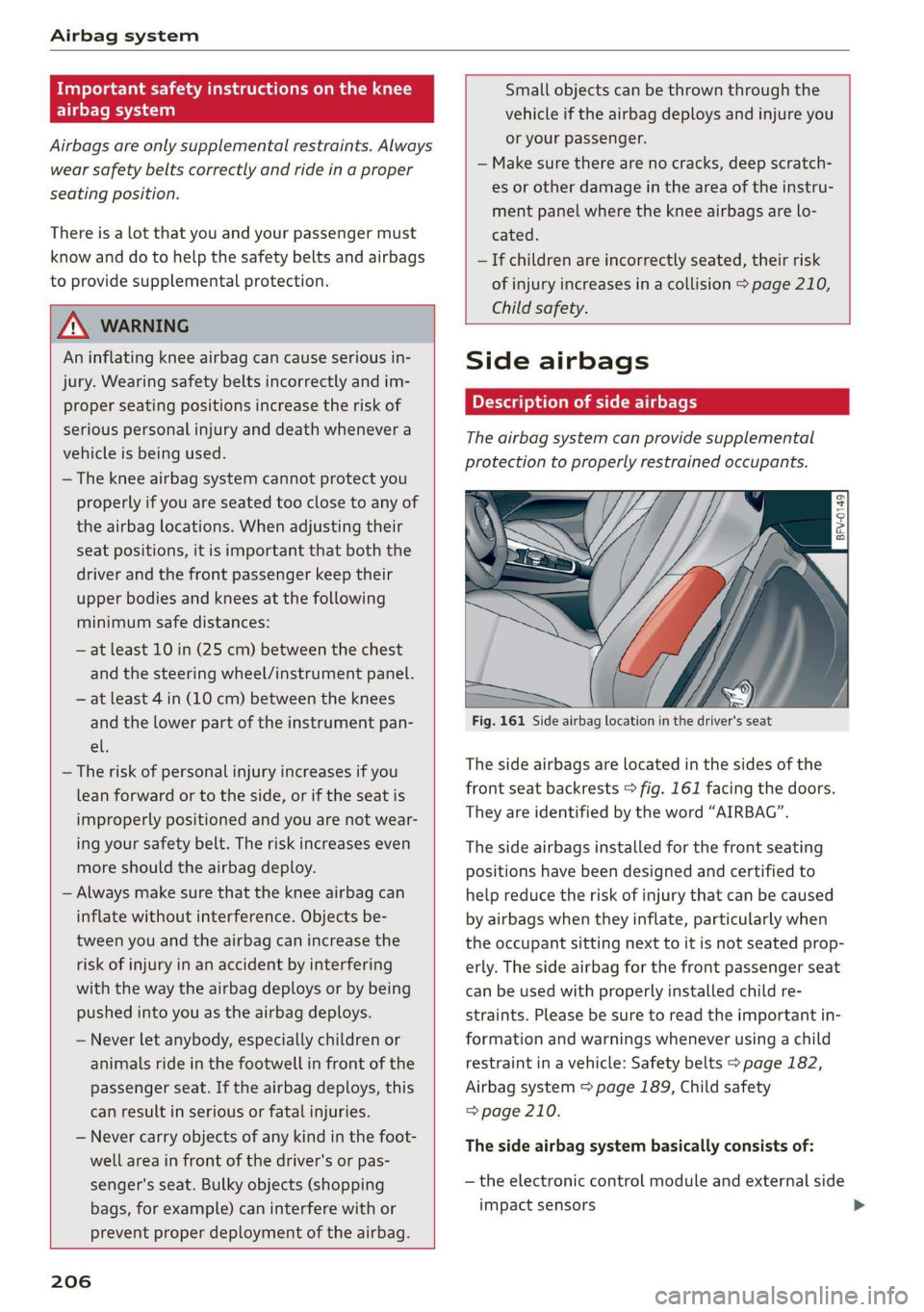
The side airbags are located in the sides of the
front seat backrests > fig. 161 facing the doors.
They are identified by the word “AIRBAG”.
The side airbags installed for the front seating
positions have been designed and certified to
help reduce the risk of injury that can be caused
by airbags when they inflate, particularly when
the occupant sitting next to it is not seated prop-
erly. The side airbag for the front passenger seat
can be used with properly installed child re-
straints. Please be sure to read the important in-
formation and warnings whenever using a child
restraint in a vehicle: Safety belts > page 182,
Airbag system > page 189, Child safety
=> page 210.
The side airbag system basically consists of:
— the electronic control module and external side
impact sensors
Page 210 of 304
Airbag system
How supplemental side airbags work
Side airbags deploy instantly and can help re-
duce the risk of upper torso injuries for occu-
pants who are properly restrained.
S /
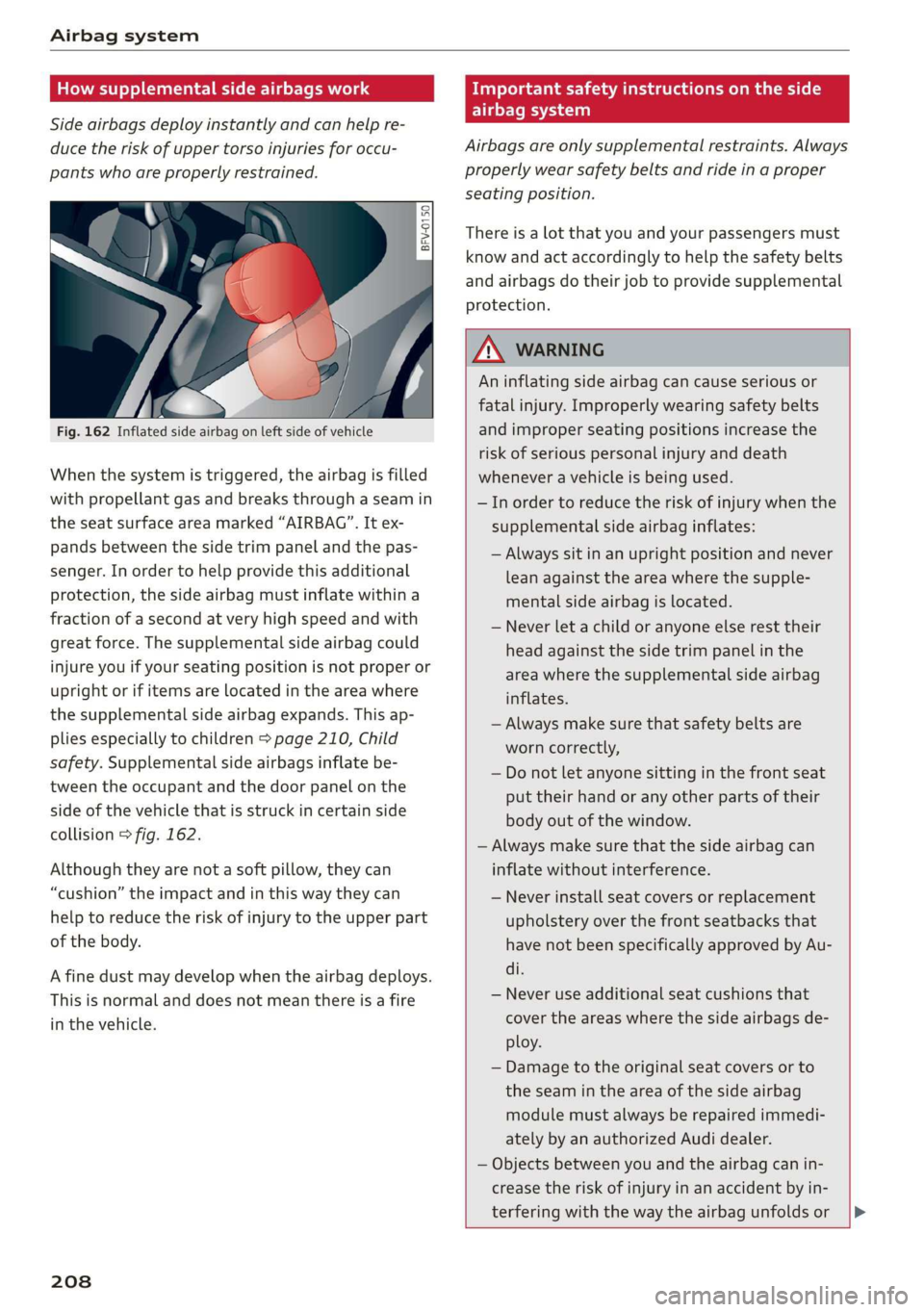
Fig. 162 Inflated side airbag on left side of vehicle
When the system is triggered, the airbag is filled
with propellant gas and breaks through a seam in
the seat surface area marked “AIRBAG”. It ex-
pands between the side trim panel and the pas-
senger. In order to help provide this additional
protection, the side airbag must inflate within a
fraction of a second at very high speed and with
great force. The supplemental side airbag could
injure you if your seating position is not proper or
upright or if items are located in the area where
the supplemental side airbag expands. This ap-
plies especially to children > page 210, Child
safety. Supplemental side airbags inflate be-
tween the occupant and the door panel on the
side of the vehicle that is struck in certain side
collision = fig. 162.
Although they are not a soft pillow, they can
“cushion” the impact and in this way they can
help to reduce the risk of injury to the upper part
of the body.
A fine dust may develop when the airbag deploys.
This is normal and does not mean there is a fire
in the vehicle.
208
Important safety instructions on the side
airbag system
Airbags are only supplemental restraints. Always
properly wear safety belts and ride in a proper
seating position.
There is a lot that you and your passengers must
know and act accordingly to help the safety belts
and airbags do their job to provide supplemental
protection.
Z\ WARNING
An inflating side airbag can cause serious or
fatal injury. Improperly wearing safety belts
and improper seating positions increase the
risk of serious personal injury and death
whenever a vehicle is being used.
— In order to reduce the risk of injury when the
supplemental side airbag inflates:
— Always sit in an upright position and never
lean against the area where the supple-
mental side airbag is located.
— Never let a child or anyone else rest their
head against the side trim panel in the
area where the supplemental side airbag
inflates.
— Always make sure that safety belts are
worn correctly,
— Do not let anyone sitting in the front seat
put their hand or any other parts of their
body out of the window.
— Always make sure that the side airbag can
inflate without interference.
— Never install seat covers or replacement
upholstery over the front seatbacks that
have not been specifically approved by Au-
di.
— Never use additional seat cushions that
cover the areas where the side airbags de-
ploy.
— Damage to the original seat covers or to
the seam in the area of the side airbag
module must always be repaired immedi-
ately by an authorized Audi dealer.
— Objects between you and the airbag can in-
crease the risk of injury in an accident by in-
terfering with the way the airbag unfolds or
Page 212 of 304
Child safety
Child safety
Important information
Introduction
The physical principles of what happens when
your vehicle is in a crash apply also to children
=> page 183, What happens to occupants not
wearing safety belts?. But unlike adults and
teenagers, their muscles and bones are not fully
developed. In many respects children are at
greater risk of serious injury in crashes than
adults.
Because children's bodies are not fully developed,
they require restraint systems especially de-
signed for their size, weight, and body structure.
Many countries and all states of the United
States and provinces of Canada have laws requir-
ing the use of approved child restraint systems
for infants and small children.
Ina frontal crash at a speed of 20-35 mph
(30-56 km/h) the forces acting on a 13 lbs (6 kg)
infant will be more than 20 times the weight of
the child. This means the weight of the child
would suddenly be more than 260 lbs (120 kg).
Under these conditions, only an appropriate child
restraint properly used can reduce the risk of seri-
ous injury. Child restraints, like adult safety belts,
must be used properly to be effective. Used im-
properly, they can increase the risk of serious in-
jury in an accident.
If you must install a child restraint on the front
passenger seat in exceptional circumstances, be
sure to read and heed the important information
and warnings > page 190. Infants and other chil-
dren who are properly restrained in an appropri-
ate child restraint that is for their size and age
can benefit from the protection that supplemen-
tal side airbags provide in some kinds of crashes.
For more information please see information pro-
vided by the:
— National Highway Traffic Safety Administration
(NHTSA), currently at : http://www.safercar.gov
(for the USA)
— Transport Canada Information Centre, currently
at: http://www.tc.gc.ca (for Canada)
210
Consult the child safety seat manufacturer's in-
structions in order to be sure the seat is right for
your child's size > page 213, Important safety
instructions
for using child safety seats. Please
be sure to read and heed all of the important in-
formation and WARNINGS about child safety, Ad-
vanced Airbags, and the installation of child re-
straints in this chapter.
There is a lot you need to know about the Ad-
vanced Airbags in your vehicle and how they work
when infants and children in child restraints are
on the front passenger seat. Because of the large
amount of important information, we cannot re-
peat it all here. We urge you to read the detailed
information in this owner's manual about airbags
and the Advanced Airbag System in your vehicle
and the very important information about trans-
porting children on the front passenger seat.
Please be sure to heed the WARNINGS - they are
extremely important for your safety and the safe-
ty of your passengers, especially infants and
small children.
ZA WARNING
All vehicle occupants and especially children
must be restrained properly whenever riding
in a vehicle. An unrestrained or improperly re-
strained child could be injured by striking the
interior or by being ejected from the vehicle
during a sudden maneuver or impact. An un-
restrained or improperly restrained child is al-
so at greater risk of injury or death through
contact with an inflating airbag.
ZA WARNING
Children on the front seat of any car even with
Advanced Airbags can be seriously injured or
even killed when an airbag inflates. A child in
a rearward-facing child safety seat installed
on the front passenger seat will be seriously
injured and can be killed if the front airbag in-
flates.
— The inflating airbag will hit the child safety
seat or infant carrier with great force and
will smash the child safety seat and child
against the backrest, center armrest, or
door.
Page 215 of 304
8S8012721BA
Child safety
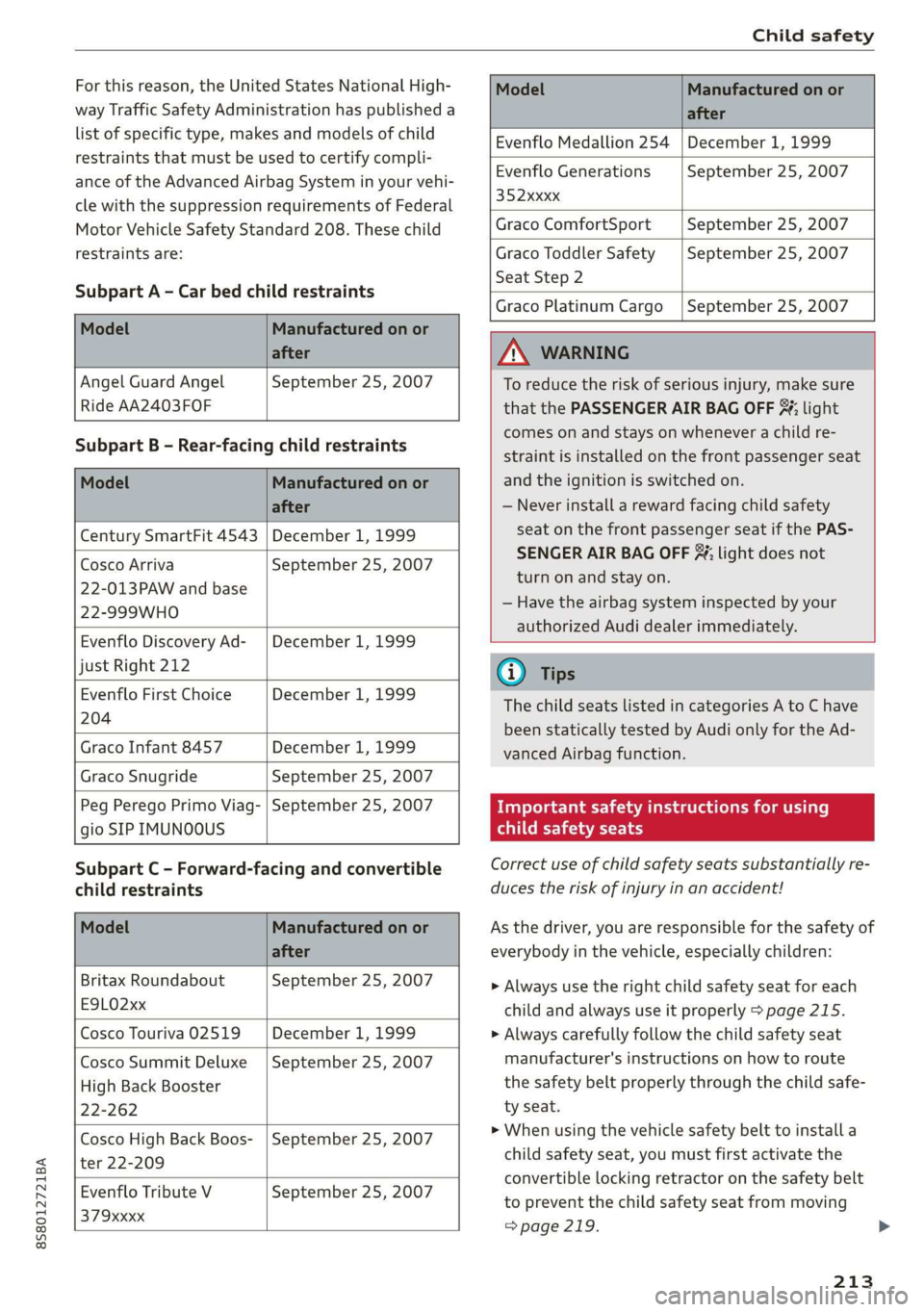
For this reason, the United States National High-
way Traffic Safety Administration has published a
list of specific type, makes and models of child
restraints that must be used to certify compli-
ance of the Advanced Airbag System in your vehi-
cle with the suppression requirements of Federal
Motor Vehicle Safety Standard 208. These child
restraints are:
Subpart A - Car bed child restraints
Model Manufactured on or
after
Evenflo Medallion 254 |December 1, 1999
Evenflo Generations
352xxxx
September 25, 2007
Graco ComfortSport September 25, 2007
Graco Toddler Safety
Seat Step 2
September 25, 2007
Model Manufactured on or
after
Graco Platinum Cargo | September 25, 2007
Angel Guard Angel September 25, 2007
Ride AA2403FOF
Subpart B - Rear-facing child restraints
Model Manufactured on or
after
Century SmartFit 4543 | December 1, 1999
Cosco Arriva
22-013PAW and base
September 25, 2007
ZA WARNING
To reduce the risk of serious injury, make sure
that the PASSENGER AIR BAG OFF %; light
comes on and stays on whenever a child re-
straint is installed on the front passenger seat
and the ignition is switched on.
— Never install a reward facing child safety
seat on the front passenger seat if the PAS-
SENGER AIR BAG OFF 3; light does not
turn on and stay on.
— Have the airbag system inspected by your
authorized Audi dealer immediately.
22-999WHO
Evenflo Discovery Ad- |December 1, 1999
just Right 212
Evenflo First Choice December 1, 1999
204
Graco Infant 8457 December 1, 1999
Graco Snugride September 25, 2007
Peg Perego Primo Viag- | September 25, 2007
gio SIP IMUNOOUS
Subpart C - Forward-facing and convertible
child restraints
Model Manufactured on or
after
Britax Roundabout
ESLO2xx
September 25, 2007
Cosco Touriva 02519 December 1, 1999
Cosco Summit Deluxe
High Back Booster
September 25, 2007
22-262
Cosco High Back Boos- | September 25, 2007
ter 22-209
Evenflo Tribute V September 25, 2007
37 9Xxxx
@ Tips
The child seats listed in categories A to C have
been statically tested by Audi only for the Ad-
vanced Airbag function.
a acetamide om eCd ile)
nema aes TL)
Correct use of child safety seats substantially re-
duces the risk of injury in an accident!
As the driver, you are responsible for the safety of
everybody in the vehicle, especially children:
> Always use the right child safety seat for each
child and always use it properly > page 215.
> Always carefully follow the child safety seat
manufacturer's instructions on how to route
the safety belt properly through the child safe-
ty seat.
> When using the vehicle safety belt to install a
child safety seat, you must first activate the
convertible locking retractor on the safety belt
to prevent the child safety seat from moving
=> page 219.
213
Page 216 of 304
Child safety
> Push the child safety seat down with your full
weight to get the safety belt really tight so that
the seat cannot move forward and sideways
more than 1 in (2.5 cm).
Always remember: Even though your vehicle is
equipped with an Advanced Airbag system, a
child should always ride in the seat properly re-
strained for its age and size.
Z\ WARNING
Not using a child safety seat, using the wrong
child safety seat or improperly installing a
child restraint increases the risk of serious
personal injury and death.
— All vehicle occupants and especially children
must be restrained properly whenever riding
in a vehicle. An unrestrained or improperly
restrained child could be injured by striking
the interior or by being ejected from the ve-
hicle during a sudden maneuver or impact.
An unrestrained or improperly restrained
child is also at greater risk of injury or death
through contact with an inflating airbag.
— Commercially available child safety seats are
required to comply with U.S. Federal Motor
Vehicle Safety Standard (FMVSS) 213 (in
Canada CMVSS 213).
— When buying a child restraint, select one
that fits your child and the vehicle.
— Only use child restraint systems that fully
contact the flat portion of the seat cush-
ion. The child restraint must not tip or
lean to either side. Audi does not recom-
mend using child safety seats that rest on
legs or tube-like frames. They do not pro-
vide adequate contact with the seat.
— Always heed all legal requirements per-
taining to the installation and use of child
safety seats and carefully follow the in-
structions provided by the manufacturer
of the seat you are using.
— Never let more than one child occupy a child
safety seat.
— Never let babies or older children ride ina
vehicle while sitting on the lap of another
passenger.
214
— Holding a child in your arms is never a sub-
stitute for a child restraint system.
— The strongest person could not hold the
child with the forces that exist in an acci-
dent. The child will strike the interior of
the vehicle and can also be struck by the
passenger.
— The child and the passenger can also injure
each other in an accident.
Never install rear-facing child safety seats or
infant carriers on the front passenger seat.
A child will be seriously injured and can be
killed when the passenger airbag inflates -
even with an Advanced Airbag System.
The inflating airbag will hit the child safety
seat or infant carrier with great force and
will smash the child safety seat and child
against the backrest, center armrest, door
or roof.
If exceptional circumstances require the use
of a forward-facing child restraint on the
front passenger's seat, the child's safety and
well-being require that the following special
precautions be taken:
— Make sure the forward-facing seat has
been designed and certified by its manu-
facturer for use on a front seat with a pas-
senger front and side airbag.
— Always carefully follow the manufacturer's
instructions provided with the child safety
seat or carrier.
— Always move the front passenger seat into
the rearmost position of the passenger
seat's fore and aft adjustment range, and
as far away from the airbag as possible be-
fore installing the child restraint.
— Always make sure that nothing prevents
the front passenger's seat from being
moved to the rearmost position in its fore
and aft adjustment range.
— Always make sure that the backrest is in
the upright position.
— Never place or use any electrical device
(such as a laptop, CD player, electronic
games device, power inverter or seat heat-
er for child seats) on the front passenger
seat if the device is connected to the 12-
volt socket or the cigarette lighter socket.
Page 220 of 304
Child safety
The vehicle's safety belts alone will not fit most
children until they are at least 4 ft 9 in (57 in/
1.45 m) tall and weigh about 80 lbs (36 kg).
Booster seats raise these children up so that the
safety belt will pass properly over the stronger
parts of their bodies and the safety belt can help
protect them ina crash.
> Do not use the convertible locking retractor
when using the vehicle's safety belt to restrain
a child on a booster seat.
> The shoulder belt must lie as close to the cen-
ter of the child's collar bone as possible and
must lie flat and snug on the upper body. It
must never lie across the throat or neck. The
lap belt must lie across the pelvis and never
across the stomach or abdomen. Make sure the
belt lies flat and snug. Pull on the belt to tight-
en if necessary.
Children up to at least 8 years old (over 40 lbs or
18 kg) are best protected in child safety seats de-
signed for their age and weight. Experts say that
the skeletal structure, particularly the pelvis, of
these children is not fully developed, and they
must not use the vehicle safety belts without a
suitable child restraint.
It is usually best to put these children in appro-
priate booster seats. Be sure the booster seat
meets all applicable safety standards.
Booster seats raise the seating position of the
child and reposition both the lap and shoulder
parts of the safety belt so that they pass across
the child's body in the right places. The routing of
the belt over the child's body is very important
for the child's protection, whether or not a boos-
ter seat is used.
Never use the lap belt portion of the vehicle's
safety belt alone to restrain any child, regardless
of how big the child is. Always remember that
children do not have the pronounced pelvic struc-
ture required for the proper function of lap belt
portion of the vehicle's three point lap and
shoulder belts. The child's safety absolutely re-
quires that a lap belt portion of the safety belt be
fastened snugly and as low as possible around
the pelvis. Never let the lap belt portion of the
218
safety belt pass over the child's stomach or abdo-
men.
Ina crash, airbags must inflate within a blink of
an eye and with considerable force. In order to do
its job, the airbag needs room to inflate so that it
will be there to protect the occupant as the occu-
pant moves forward into the airbag.
A vehicle occupant who is out of position and too
close to the airbag gets in the way of an inflating
airbag. When an occupant is too close, he or she
will be struck violently and will receive serious or
possibly even fatal injury.
In order for the airbag to offer protection, it is
important that all vehicle occupants, especially
any children, who must be in the front seat be-
cause of exceptional circumstances, be properly
restrained and as far away from the airbag as
possible. By keeping room between the child's
body and the front of the passenger compart-
ment, the airbag can inflate completely and pro-
vide supplemental protection in certain frontal
collisions.
ZA WARNING
Not using a booster seat, using the booster
seat improperly, incorrectly installing a boos-
ter seat or using the vehicle safety belt im-
properly increases the risk of serious personal
injury and death in a collision or other emer-
gency situation. To help reduce the risk of se-
rious personal injury and/or death:
— The shoulder belt must lie as close to the
center of the child’s collar bone as possible
and must lie flat and snug on the upper
body. It must never lie across the throat or
neck. The lap belt must lie across the pelvis
and never across the stomach or abdomen.
Make sure that the belt lies flat and snug.
Pull on the belt to tighten if necessary.
— Failure to properly route safety belts over a
child's body will cause severe injuries in an
accident or other emergency situation
=> page 182.
— The rear side of the child safety seat should
be positioned as close as possible to the
backrest on the vehicle seat.
Page 222 of 304
Child safety
ZA WARNING
Always take special precautions if you must
install a forward or rearward-facing child re-
straint on the front passenger's seat in excep-
tional situations:
— Whenever a forward or rearward-facing
child restraint is installed on the front pas-
senger seat, the PASSENGER AIR BAG OFF
#; light must come on and stay on whenever
the ignition is switched on.
— If the PASSENGER AIR BAG OFF %; light
does not come on and stay on, perform the
checks described > page 200, Monitoring
the Advanced Airbag System.
— If the PASSENGER AIR BAG OFF %; light
does not come on and stay on whenever the
ignition is switched on the inflating airbag
will hit the child safety seat or infant carrier
with great force and will smash the child
safety seat and child against the backrest,
center armrest, door or roof. Have the air-
bag system inspected immediately by your
Audi dealer.
— Improper installation of child restraints can
reduce their effectiveness or even prevent
them from providing any protection.
— An improperly installed child restraint can
interfere with the airbag as it deploys and
seriously
injure or even kill the child.
— Always carefully follow the manufacturer's
instructions provided with the child safety
seat or carrier.
— After checking to make sure that the child
restraint is properly installed, make certain
that the child restraint is correctly recog-
nized by the capacitive passenger detection
system in the front passenger seat and that
the PASSENGER AIR BAG OFF %; light sig-
nals the correct front passenger frontal air-
bag status.
A WARNING
Forward-facing child restraints:
— Always make sure the forward-facing seat
has been designed and certified by its manu-
facturer for use on a front seat with a pas-
senger front and side airbag.
220
— Never put the forward-facing child restraint
up, against or very near the instrument pan-
el,
— Always move the passenger seat into its
rearmost position in the seat's fore and aft
adjustment range, as far away from the air-
bag as possible before installing the for-
ward-facing child restraint. The backrest
must be adjusted to an upright position.
— Make sure that the PASSENGER AIR BAG
OFF #¥; light comes on and stays on all the
time whenever the ignition is switched on.
ZA WARNING
Rearward-facing child restraints:
—Achild in a rearward-facing child safety seat
installed on the front passenger seat will be
seriously injured and can be killed if the
front airbag inflates - even with an Ad-
vanced Airbag System.
— The inflating airbag will hit the child safety
seat or infant carrier with great force and
will smash the child safety seat and child
against the backrest, center armrest, door
or roof.
— Always be especially careful if you must in-
stall a rearward facing child safety seat on
the front passenger seat in exceptional cir-
cumstances.
— Make sure that the PASSENGER AIR BAG
OFF %; light comes on and stays on all the
time whenever the ignition is switched on.
— If the PASSENGER AIR BAG OFF #; light
does not come on and stay on, have the air-
bag system inspected by your Audi dealer.
Nae ee mama adl le Cole deme teeta
Use the convertible locking retractor to secure a
child restraint.
Always heed the child safety seat manufacturer's
instructions when installing a child restraint in
your vehicle. To activate the convertible locking
retractor:
> Place the child restraint on a seat.
> Slowly pull the belt all the way out.
Page 226 of 304
Checking and Filling
— Do not use any gasoline mixture whose
composition cannot be identified.
— Audi does not assume any responsibility for
damage to the fuel system or for perform-
ance problems caused by using gasoline
mixtures different from those specified.
This type of damage also does not fall under
the New Vehicle Limited Warranty or under
the emissions control system warranty.
— If you notice a higher fuel consumption or
poor handling or performance problems due
to such gasoline mixtures, we recommend
fueling with unblended gasoline.
Gasoline additives
An important issue for many automobile manu-
facturers is combustion residue in the engine
that results from the use of certain fuels.
Although types of gasoline differ depending on
the manufacturer, there are similarities. Certain
substances in the gasoline may cause deposits in
the engine. Additives in the gasoline that should
keep the engine and fuel system clean do not all
function equally.
Audi recommends using TOP TIER Detergent Gas-
oline. For additional information on TOP TIER De-
tergent Gasoline, visit www.toptiergas.com.
If you use incorrect fuels over a long period of
time, the maximum engine performance may be
impaired by combustion residue.
@) Note
Damage or malfunctions caused by the use of
incorrect types of gasoline are not covered by
the New Vehicle Limited Warranty.
224
Refueling
Fueling procedure
Your vehicle is equipped with a capless fuel filler
system.
BFV-0225
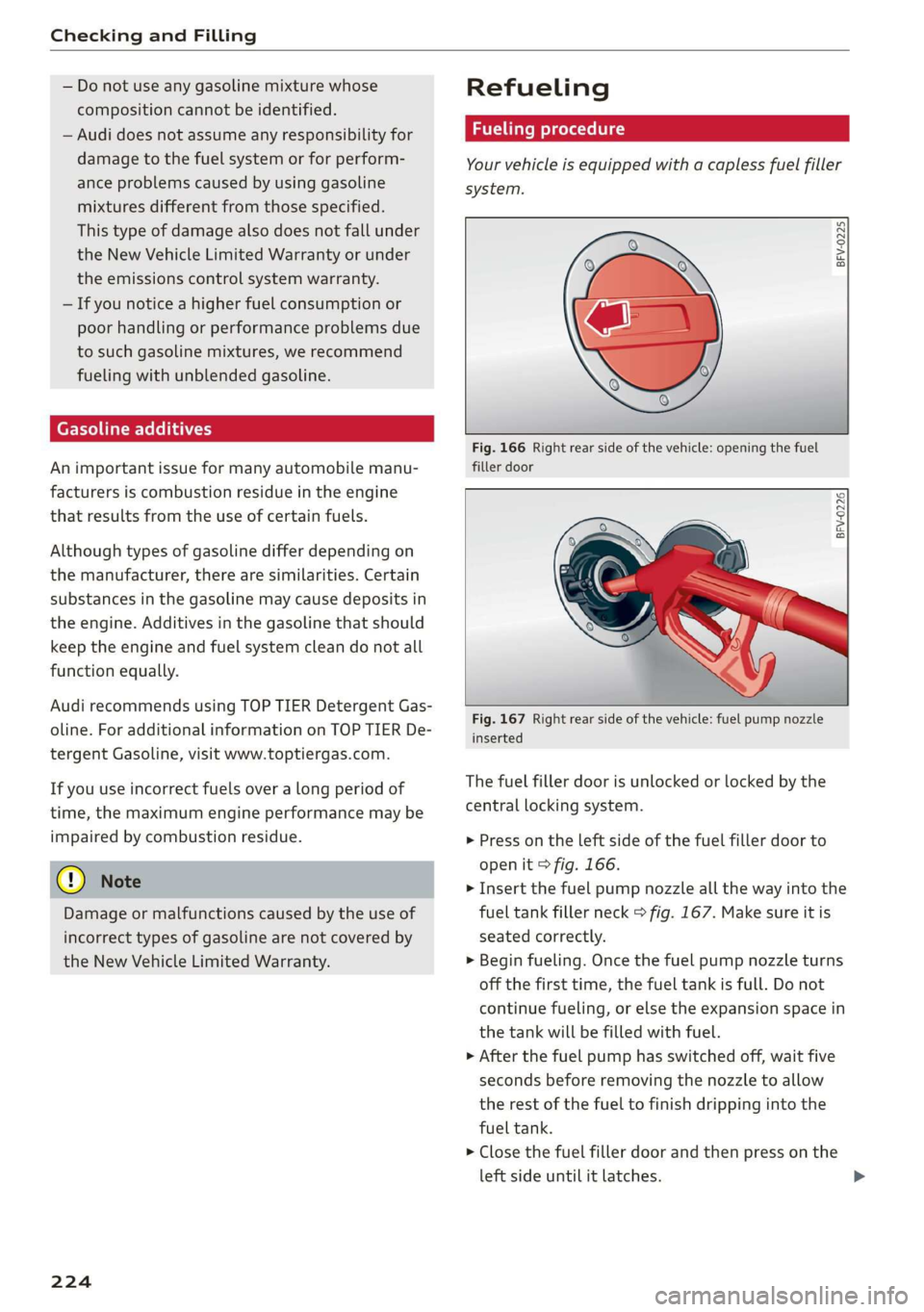
Fig. 166 Right rear side of the vehicle: opening the fuel
filler door
BFV-0226
__ . —|)
Fig. 167 Right rear side of the vehicle: fuel pump nozzle
inserted
The fuel filler door is unlocked or locked by the
central locking system.
> Press on the left side of the fuel filler door to
open it > fig. 166.
> Insert the fuel pump nozzle all the way into the
fuel tank filler neck > fig. 167. Make sure it is
seated correctly.
> Begin fueling. Once the fuel pump nozzle turns
off the first time, the fuel tank is full. Do not
continue fueling, or else the expansion space in
the tank will be filled with fuel.
> After the fuel pump has switched off, wait five
seconds before removing the nozzle to allow
the rest of the fuel to finish dripping into the
fuel tank.
> Close the fuel filler door and then press on the
left side until it latches.
Page 227 of 304
8S8012721BA
Checking and Filling
The correct fuel type for your vehicle can be
found on a label located on the inside of the fuel
filler door. For additional information on fuel, see
=> page 223.
For the tank capacity in your vehicle, refer to the
Technical Data > page 285.
If the central locking system malfunctions, there
is a fuel filler door emergency release
=> page 226.
Z\ WARNING
Improper fueling procedures and improper
handling of fuel can lead to explosions, fires,
severe burns, and other injuries.
— Do not smoke. Keep away from open flames.
— The ignition must be switched off when re-
fueling.
— Mobile devices, radio devices, and other ra-
dio equipment should always be switched
off when refueling. Electromagnetic rays
could cause sparks and start a fire.
— If you do not insert the fuel pump nozzle all
the way into the filler tube, then fuel can
leak out. Spilled fuel can ignite and start a
fire.
— Never get into the vehicle when refueling. If
there is an exceptional situation where you
must enter the vehicle, close the door and
touch a metal surface before touching the
fuel pump nozzle again. This will reduce the
risk of electrostatic discharge that can cause
flying sparks. Sparks can start a fire when
refueling.
cur while refueling and the fuel vapors
could ignite.
— When using fuel containers made of met-
al, the fuel pump nozzle must always re-
main in contact with the container to re-
duce the risk of static charge.
— Insert the fuel pump nozzle as far as pos-
sible into the filler opening while refuel-
ing.
— Follow the applicable legal regulations in
the country where you are driving when
using, storing and transporting fuel con-
tainers.
— Make sure that the fuel container meets
the industry standards, for example ANSI
or ASTM F852-86.
Z\ WARNING
Transporting fuel containers inside the vehicle
is not recommended. Fuel could leak out of
the container and ignite, especially during an
accident. This can cause explosions, fires, and
injuries.
— If you must transport fuel in a fuel contain-
er, note the following:
— Always place the fuel container on the
ground before filling. Never fill the fuel
container with fuel while it is inside or on
the vehicle. Electrostatic discharge can oc-
C) Note
— Remove fuel that has overflowed onto any
vehicle
components immediately to reduce
the risk of damage to the vehicle.
— Never drive until the fuel tank is completely
empty. The irregular supply of fuel that re-
sults from that can cause engine misfires.
Uncombusted fuel may enter the exhaust
system and increase the risk of damage to
the catalytic converter.
@) For the sake of the environment
Do not overfill the fuel tank, or fuel could leak
out when the vehicle is warming up.
@) Tips
— If adverse weather conditions cause the fuel
filler door to freeze shut, press on the cen-
ter of the filler door with the heel of your
hand and then try opening it again.
— The fuel filler door on your vehicle does not
lock if you lock the vehicle from the inside
using the central locking switch.
G) Tips
— Your vehicle is equipped with a misfueling
guard. It allows the vehicle to be fueled only
with the correct fuel pump nozzle.
—Aworn or damaged nozzle or a nozzle that
is too small may not be able to open the
225