index BMW 3 SERIES 1987 E30 Workshop Manual
[x] Cancel search | Manufacturer: BMW, Model Year: 1987, Model line: 3 SERIES, Model: BMW 3 SERIES 1987 E30Pages: 228, PDF Size: 7.04 MB
Page 3 of 228

REPAIRS & OVERHAUL
Engine and Associated Systems
In-car engine repair procedures Page 2A•1
General engine overhaul procedures Page2B•1
Cooling, heating and air conditioning systems Page3•1
Fuel and exhaust systems Page 4•1
Engine electrical systems Page5•1
Engine management and emission control systems Page6•1
Transmission
Manual transmission Page7A•1
Automatic transmission Page7B•1
Clutch and driveline Page 8•1
Brakes
Braking systemPage 9•1
Suspension
Suspension and steering systems Page 10•1
Body Equipment
Bodywork and fittings Page 11•1
Electrical
Body electrical systems Page 12•1
Wiring DiagramsPage 12•10
REFERENCE
MOT Test Checks
Checks carried out from the driver’s seat PageREF•1
Checks carried out with the vehicle on the ground PageREF•2
Checks carried out with the vehicle raised PageREF•3
Checks carried out on your vehicle’s exhaust emission system PageREF•4
Tools and Working Facilities Page REF•5
General Repair Procedures Page REF•8
Fault FindingPage REF•9
Conversion factors PageREF•17
Automotive chemicals and lubricants PageREF•18
Buying spare parts and vehicle identification numbers PageREF•19
Glossary of Technical Terms PageREF•20
IndexPage REF•25
Contents
Page 18 of 228
engine damage. Conversely, overfilling the
engine (adding oil above the upper mark) may
cause oil-fouled spark plugs, oil leaks, or oil
seal failures.
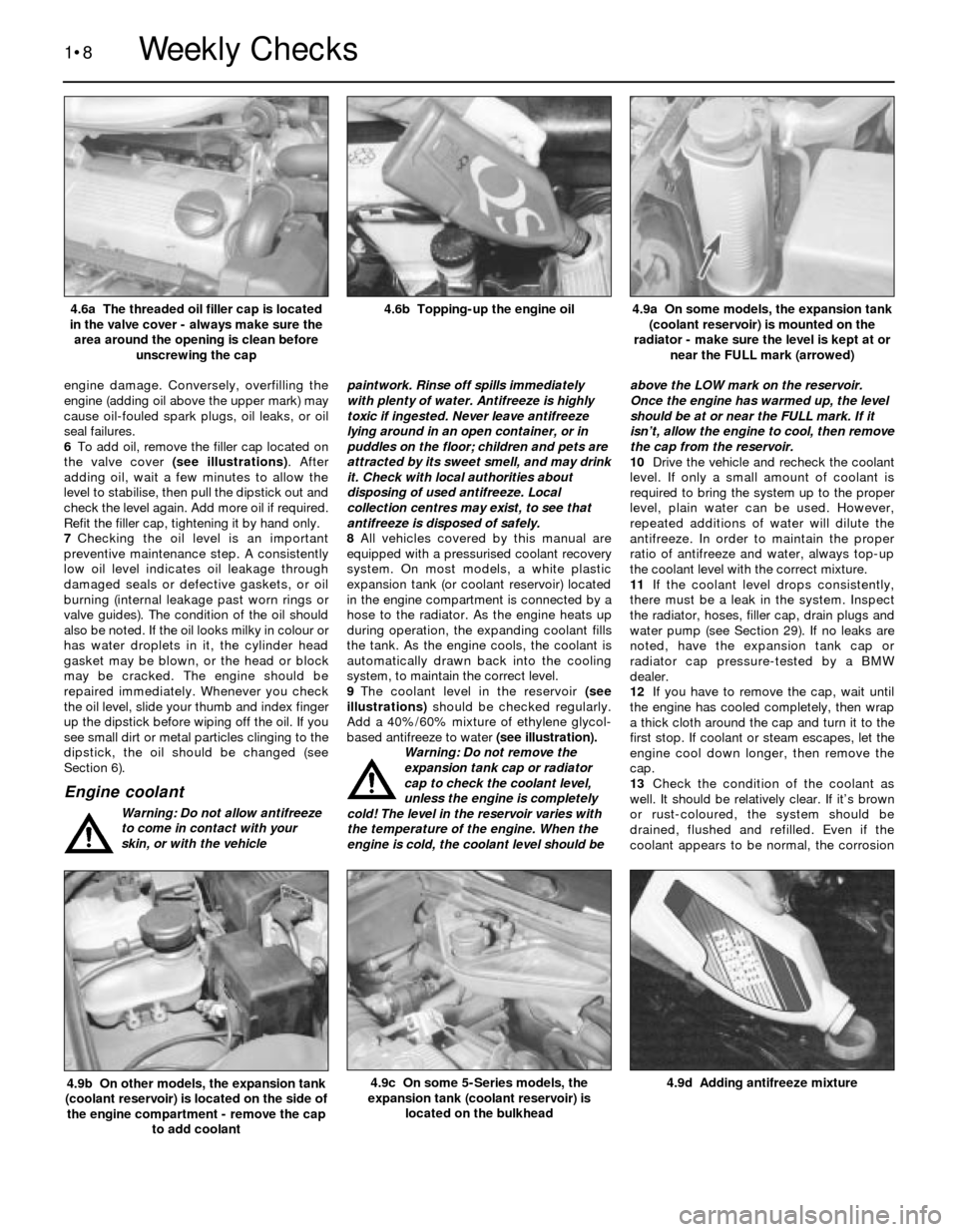
6To add oil, remove the filler cap located on
the valve cover (see illustrations). After
adding oil, wait a few minutes to allow the
level to stabilise, then pull the dipstick out and
check the level again. Add more oil if required.
Refit the filler cap, tightening it by hand only.
7Checking the oil level is an important
preventive maintenance step. A consistently
low oil level indicates oil leakage through
damaged seals or defective gaskets, or oil
burning (internal leakage past worn rings or
valve guides). The condition of the oil should
also be noted. If the oil looks milky in colour or
has water droplets in it, the cylinder head
gasket may be blown, or the head or block
may be cracked. The engine should be
repaired immediately. Whenever you check
the oil level, slide your thumb and index finger
up the dipstick before wiping off the oil. If you
see small dirt or metal particles clinging to the
dipstick, the oil should be changed (see
Section 6).
Engine coolant
Warning: Do not allow antifreeze
to come in contact with your
skin, or with the vehiclepaintwork. Rinse off spills immediately
with plenty of water. Antifreeze is highly
toxic if ingested. Never leave antifreeze
lying around in an open container, or in
puddles on the floor; children and pets are
attracted by its sweet smell, and may drink
it. Check with local authorities about
disposing of used antifreeze. Local
collection centres may exist, to see that
antifreeze is disposed of safely.
8All vehicles covered by this manual are
equipped with a pressurised coolant recovery
system. On most models, a white plastic
expansion tank (or coolant reservoir) located
in the engine compartment is connected by a
hose to the radiator. As the engine heats up
during operation, the expanding coolant fills
the tank. As the engine cools, the coolant is
automatically drawn back into the cooling
system, to maintain the correct level.
9The coolant level in the reservoir (see
illustrations)should be checked regularly.
Add a 40%/60% mixture of ethylene glycol-
based antifreeze to water (see illustration).
Warning: Do not remove the
expansion tank cap or radiator
cap to check the coolant level,
unless the engine is completely
cold! The level in the reservoir varies with
the temperature of the engine. When the
engine is cold, the coolant level should beabove the LOW mark on the reservoir.
Once the engine has warmed up, the level
should be at or near the FULL mark. If it
isn’t, allow the engine to cool, then remove
the cap from the reservoir.
10Drive the vehicle and recheck the coolant
level. If only a small amount of coolant is
required to bring the system up to the proper
level, plain water can be used. However,
repeated additions of water will dilute the
antifreeze. In order to maintain the proper
ratio of antifreeze and water, always top-up
the coolant level with the correct mixture.
11If the coolant level drops consistently,
there must be a leak in the system. Inspect
the radiator, hoses, filler cap, drain plugs and
water pump (see Section 29). If no leaks are
noted, have the expansion tank cap or
radiator cap pressure-tested by a BMW
dealer.
12If you have to remove the cap, wait until
the engine has cooled completely, then wrap
a thick cloth around the cap and turn it to the
first stop. If coolant or steam escapes, let the
engine cool down longer, then remove the
cap.
13Check the condition of the coolant as
well. It should be relatively clear. If it’s brown
or rust-coloured, the system should be
drained, flushed and refilled. Even if the
coolant appears to be normal, the corrosion
1•8
4.9d Adding antifreeze mixture4.9c On some 5-Series models, the
expansion tank (coolant reservoir) is
located on the bulkhead4.9b On other models, the expansion tank
(coolant reservoir) is located on the side of
the engine compartment - remove the cap
to add coolant
4.9a On some models, the expansion tank
(coolant reservoir) is mounted on the
radiator - make sure the level is kept at or
near the FULL mark (arrowed)4.6b Topping-up the engine oil4.6a The threaded oil filler cap is located
in the valve cover - always make sure the
area around the opening is clean before
unscrewing the cap
Weekly Checks
Page 218 of 228

REF•18Automotive chemicals and lubricants
A number of automotive chemicals and
lubricants are available for use during vehicle
maintenance and repair. They include a wide
variety of products ranging from cleaning
solvents and degreasers to lubricants and
protective sprays for rubber, plastic and
vinyl.
Cleaners
Carburettor cleaner and choke cleaner
is a strong solvent for gum, varnish and
carbon. Most carburettor cleaners leave a
dry-type lubricant film which will not harden or
gum up. Because of this film, it is not
recommended for use on electrical
components.
Brake system cleaneris used to remove
grease and brake fluid from the brake system,
where clean surfaces are absolutely
necessary. It leaves no residue, and often
eliminates brake squeal caused by
contaminants.
Electrical cleaner removes oxidation,
corrosion and carbon deposits from electrical
contacts, restoring full current flow. It can also
be used to clean spark plugs, carburettor jets,
voltage regulators and other parts where an
oil-free surface is desired.
Moisture dispersantsremove water and
moisture from electrical components such as
alternators, voltage regulators, electrical
connectors and fuse blocks. They are non-
conductive and non-corrosive.
Degreasersare heavy-duty solvents used
to remove grease from the outside of the
engine and from chassis components. They
can be sprayed or brushed on, and are usually
rinsed off with water.
Lubricants
Engine oilis the lubricant formulated for
use in engines. It normally contains a wide
variety of additives to prevent corrosion and
reduce foaming and wear. Engine oil comes in
various weights (viscosity ratings) from 5 to
60. The recommended weight of the oil
depends on the season, temperature and the
demands on the engine. Light oil is used in
cold climates and under light load conditions.
Heavy oil is used in hot climates, and where
high loads are encountered. Multi-viscosity
(multigrade) oils are designed to have
characteristics of both light and heavy oils,
and are available in a number of weights from
5W-20 to 20W-50.
Gear oilis designed to be used in
differentials, manual transmissions and other
areas where high-temperature lubrication is
required.
Chassis and wheel bearing greaseis a
heavy grease used where increased loads and
friction are encountered, such as for wheel
bearings, balljoints, tie-rod ends and universal
joints.High-temperature wheel bearing grease
is designed to withstand the extreme
temperatures encountered by wheel bearings
in disc brake-equipped vehicles. It usually
contains molybdenum disulphide (moly),
which is a dry-type lubricant.
White greaseis a heavy grease for metal-
to-metal applications where water is a
problem. White grease stays soft at both low
and high temperatures, and will not wash off
or dilute in the presence of water.
Assembly lubeis a special extreme-
pressure lubricant, usually containing moly,
used to lubricate high-load parts (such as
main and rod bearings and cam lobes) for
initial start-up of a new engine. The assembly
lube lubricates the parts without being
squeezed out or washed away until the engine
oiling system begins to function.
Silicone lubricants are used to protect
rubber, plastic, vinyl and nylon parts.
Graphite lubricantsare used where oils
cannot be used due to contamination
problems, such as in locks. The dry graphite
will lubricate metal parts while remaining
uncontaminated by dirt, water, oil or acids. It
is electrically conductive, and will not foul
electrical contacts in locks such as the
ignition switch.
Penetrating oilsloosen and lubricate
frozen, rusted and corroded fasteners and
prevent future rusting or freezing.
Heat-sink greaseis a special electrically
non-conductive grease that is used for
mounting electronic ignition modules where it
is essential that heat is transferred away from
the module.
Sealants
RTV sealantis one of the most widely-
used gasket compounds. Made from silicone,
RTV is air-curing; it seals, bonds, waterproofs,
fills surface irregularities, remains flexible,
doesn’t shrink, is relatively easy to remove,
and is used as a supplementary sealer with
almost all low- and medium-temperature
gaskets.
Anaerobic sealantis much like RTV in that
it can be used either to seal gaskets or to form
gaskets by itself. It remains flexible, is solvent-
resistant, and fills surface imperfections. The
difference between an anaerobic sealant and
an RTV-type sealant is in the curing. RTV
cures when exposed to air, while an anaerobic
sealant cures only in the absence of air. This
means that an anaerobic sealant cures only
after the assembly of parts, sealing them
together.
Thread and pipe sealant is used for
sealing hydraulic and pneumatic fittings and
vacuum lines. It is usually made from a Teflon
compound, and comes in a spray, a paint-on
liquid and as a wrap-around tape.
Chemicals
Anti-seize compoundprevents seizing,
chafing, cold welding, rust and corrosion in
fasteners. High-temperature anti-seize,
usually made with copper and graphite
lubricants, is used for exhaust system and
exhaust manifold bolts.
Anaerobic locking compoundsare used
to keep fasteners from vibrating or working
loose, and cure only after installation, in the
absence of air. Medium-strength locking
compound is used for small nuts, bolts and
screws that may be removed later. High-
strength locking compound is for large nuts,
bolts and studs which aren’t removed on a
regular basis.
Oil additivesrange from viscosity index
improvers to chemical treatments that claim
to reduce internal engine friction. It should be
noted that most oil manufacturers caution
against using additives with their oils.
Fuel additivesperform several functions,
depending on their chemical make-up. They
usually contain solvents that help dissolve
gum and varnish that build up on carburettor,
fuel injection and intake parts. They also serve
to break down carbon deposits that form on
the inside surfaces of the combustion
chambers. Some additives contain upper
cylinder lubricants for valves and piston rings,
and others contain chemicals to remove
condensation from the fuel tank.
Miscellaneous
Brake fluidis specially-formulated
hydraulic fluid that can withstand the heat and
pressure encountered in brake systems. It is
poisonous and inflammable. Care must be
taken so this fluid does not come in contact
with painted surfaces or plastics. An opened
container should always be resealed, to
prevent contamination by water or dirt. Brake
fluid absorbs moisture from the air, if left in an
unsealed container.
Weatherstrip adhesiveis used to bond
weatherstripping around doors, windows and
boot lids. It is sometimes used to attach trim
pieces.
Undersealis a petroleum-based, tar-like
substance that is designed to protect metal
surfaces on the underside of the vehicle from
corrosion. It also acts as a sound-deadening
agent by insulating the bottom of the vehicle.
Waxes and polishesare used to help
protect painted and plated surfaces from the
weather. Different types of paint may require
the use of different types of wax and polish.
Some polishes utilise a chemical or abrasive
cleaner to help remove the top layer of
oxidised (dull) paint on older vehicles. In
recent years, many non-wax polishes
containing a wide variety of chemicals such as
polymers and silicones have been introduced.
These non-wax polishes are usually easier to
apply, and last longer than conventional
waxes and polishes.
Page 225 of 228

REF•25
REF
Index
Note: References throughout this index relate to Chapter•page number
A
ABS - 9•2
Accelerator cable - 4•9
Acknowledgements - 0•4
Aerial - 12•4
Air bags - 0•5
Air cleaner - 4•8
Air conditioning system - 3•2, 3•7, 3•8,
3•9, 3•10
Air filter - 1•20
Air gap - 5•7
Air intake system - 4•2, 4•14
Airflow meter - 4•15, 6•4
Alternator - 5•10
Anti-lock Braking system (ABS) - 9•2
Anti-roll bar - 10•4, 10•9
Anti-theft audio system - 0•7
Antifreeze - 1•3, 1-8, 3•2
Asbestos - 0•5
ATF - 1•3, 1•13, 1•23
Automatic choke - 4•13
Automatic transmission- 7B•1et seq
Automatic transmission fault finding -
7B•4, REF•13
Automatic transmission fluid - 1•3, 1•13,
1•23
B
Backfire - REF•11
Balljoints - 10•7
Battery - 0•5, 1•16, 5•2
Battery fault - REF•11
Big-end bearings - 2B•17, 2B•21
Bleeding brakes - 9•14
Bleeding clutch - 8•4
Bleeding power steering - 10•16Block - 2B•14, 2B•15
Blower motor - 3•7
Body corrosion - REF•4
Body electrical systems- 12•1et seq
Bodywork and fittings- 11•1et seq
Bonnet - 11•4
Boot lid - 11•6
Boots - 8•9, 10•13
Brake fluid - 1•3, 1•9
Brake lines and hoses - 1•22, 9•13
Braking system- 1•22, 9•1et seq,REF•1,
REF•2, REF•3
Braking system fault finding - REF•14
Bulbs - 12•6
Bumpers - 11•6
Burning - 0•5
C
Cables - 4•9, 5•2, 7B•3, 9•12
Calipers - 9•4
Cam followers - 2B•11
Camshaft - 2A•12, 2B•11
Carburettor - 4•10, 4•11
Carpets - 11•2
Catalytic converter - 4•20, 6•6
Central locking - 12•8
Charging - 1•17, 5•9
Chemicals - REF•18
Choke - 4•13
Clutch and driveline- 8•1et seq
Clutch fault finding - REF•12
Clutch fluid - 1•3, 1•9
CO level adjustment - 1•15, REF•4
Coil - 5•5
Coil springs - 10•7, 10•9
Cold start injectors - 4•17, 4•18
Compression check - 2B•4Compressor - 3•8
Condenser - 3•9
Connecting rods -2B•12, 2B•16, 2B•21
Constant velocity (CV) joint - 8•2, 8•8, 8•9
Continuity check - 12•2
Control arm - 10•4, 10•5
Conversion factors - REF•17
Coolant - 1•3, 1•8
Coolant pump - 3•5
Coolant temperature sender unit - 3•6
Coolant temperature sensor - 6•2
Cooling fan - 3•4
Cooling, heating and air conditioning
systems- 1•21, 1•24, 3•1et seq
Cooling system fault finding - REF•12
Crankshaft - 2A•12, 2A•13, 2A•19, 2B•13,
2B•17, 2B•19, 2B•20
Cruise control - 12•3, 12•8
Crushing - 0•5
Cushion - 11•9
CV joints - 8•2, 8•8, 8•9
Cylinder head - 2A•13, 2B•7, 2B•10, 2B•12
Cylinder honing - 2B•15
D
Dents in bodywork - 11•2
Differential (final drive) - 8•2, 8•10, 8•11
Differential oil -1•3, 1•19, 1•26
Direction indicators - 12•2, 12•3
Discs - 1•22, 9•5
Distributor - 1•18, 5•4
Door - 11•6, 11•8, REF•2
Drivebelts - 1•14
Driveplate - 2A•18
Driveshafts - 1•22, 8•2, 8•9
Drums - 1•23
Page 226 of 228

REF•26Index
E
Earth check - 12•2
Electric fan - 3•4
Electric shock - 0•5
Electric windows - 12•9
Electrical equipment - REF•2
Electrical system fault finding - 12•1
Electronic control system - 4•3, 4•14
Electronic control unit (ECU) - 6•1
Engine fault finding - REF•10
Engine tune-up - 1•7
Engine electrical systems- 5•1et seq
Engine electrical systems fault finding -
REF•11
Engine management and emission control
systems- 6•1et seq
Engine oil - 1•3, 1•7, 1•11
Environmental considerations - REF•8
Evaporative emissions control (EVAP)
system - 1•26, 6•5
Evaporator - 3•10
Exhaust emission checks - REF•4
Exhaust manifold - 2A•6
Exhaust system - 1•21, 4•20, REF•3
F
Fan - 3•4, 3•5
Fault finding- REF•9et seq
Fault finding - automatic transmission -
7B•2, REF•13
Fault finding - braking system - REF•14
Fault finding - clutch - REF•12
Fault finding - cooling system - REF•12
Fault finding - electrical system - 12•1,
REF•11
Fault finding - engine - REF•10
Fault finding - fuel system - 4•21, REF•12
Fault finding - manual transmission -
REF•13
Fault finding - suspension and steering -
REF•15
Filling - 11•3
Final drive - 8•2, 8•10, 8•11
Final drive oil - 1•3, 1•19, 1•26
Fire - 0•5
Flexible coupling - 8•7
Fluid level checks - 1•7
Fluid seals - 7B•5
Flywheel - 2A•18
Fuel and exhaust systems- 1•20, 4•1et
seq,REF•4
Fuel system fault finding - REF•12
Fuel filter - 1•25
Fuel hoses - 1•14
Fuel injection system - 4•3, 4•14
Fuel injection system - fault finding - 4•21
Fuel injectors - 4•18
Fuel level sender unit - 4•5, 4•6
Fuel lines and fittings - 4•7
Fuel pressure - 4•3
Fuel pressure regulator - 4•16
Fuel pump - 4•3, 4•4, 4•5
Fuel tank - 4•7, 4•8
Fume or gas intoxication - 0•5
Fuses - 12•2
G
Gaiters - 1•22, 8•9, 10•13
Gashes in bodywork - 11•2
Gaskets - REF•8
Gear lever - 7A•1
Gearbox - SeeManual transmission
Gearbox oil - 1•3, 1•19, 1•25
General engine overhaul procedures-
2B•1et seq
Glass - 11•4, 11•8
Glossary of technical terms - REF•20
Grille - 11•4
H
Handbrake - 1•23, 9•2, 9•12, REF•1
Handbrake fault - REF•14
Handles - 11•8
Hazard warning flasher - 12•2
HC emissions - REF•4
Headlights - 12•3, 12•5, 12•6
Heated rear window - 12•8
Heater - 3•2, 3•7, 3•8
Hinges - 11•4
HT leads - 1•18
Hubs - 10•8, 10•11, REF•3
Hydraulic servo - 9•11
Hydraulic tappets - 2B•11
Hydrofluoric acid - 0•5
I
Idle air stabiliser valve - 4•18
Idle speed adjustment - 1•15
Ignition coil - 5•5
Ignition control unit - 5•6, 5•7
Ignition sensors - 5•8
Ignition switch - 12•3
Ignition system - 5•3
Ignition timing - 5•4
Ignition timing sensors - 6•4
Impulse generator - 5•6, 5•7
In-car engine repair procedures- 2A•1et
seq
Indicators - 12•2, 12•3
Information sensors - 6•2
Injectors - 4•18
Input shaft - 7A•2
Instrument cluster - 12•4
Instrument panel language display - 0•7
Intake manifold - 2A•4
Intermediate shaft - 2A•12, 2B•14, 2B•19
Introduction to the BMW 3- and 5-Series -
0•4
J
Jacking - 0•8
Joint mating faces - REF•8
Jump starting - 0•9
K
Kickdown cable - 7B•3
L
L-Jetronic fuel injection system - 4•14,
4•19
Language display - 0•7
Latch - 11•8
Leaks - 0•10, 7B•3, REF•12, REF•13
Locknuts, locktabs and washers - REF•8
Locks - 11•4, 11•8
Lubricants - REF•18
M
Main bearings - 2B•17, 2B•19
Manifolds - 2A•4, 2A•6
Manual transmission- 7A•1et seq
Manual transmission fault finding - REF•13
Manual transmission oil - 1•3, 1•19, 1•25
Master cylinder - 8•3, 9•9
Mechanical fan - 3•4, 3•5
Mirrors - 11•8, REF•1
Misfire - REF•11
Mixture - REF•4
MOT test checks- REF•1 et seq
Motronic engine management system -
6•1
Motronic fuel injection system - 4•14, 4•19
Mountings - 2A•19, 7A•3
O
Oil - differential - 1•19, 1•26
Oil - engine - 1•3, 1•7, 1•11
Oil - final drive - 1•3
Oil - manual transmission - 1•3, 1•19, 1•25
Oil filter - 1•11, 1•12
Oil pump - 2A•16
Oil seals - 2A•12, 2A•13, 2A•19, 2B•20,
7A•2, 7B•5, 8•10, 8•12, REF•8
Open-circuit - 12•2
Output shaft - 7A•2, 7B•5
Overcooling - REF•12
Overheating - REF•12
Oxygen sensor - 6•2
P
Pads - 9•2, 9•3
Pedals - 8•3, 9•13
Pinion oil - 8•12
Pinking - REF•11
Piston rings - 2B•18
Pistons - 2B•12, 2B•16, 2B•21
Plastic components - 11•3
Poisonous or irritant substances - 0•5
Position sensors - 5•8
Positive crankcase ventilation (PCV)
system - 6•4
Power steering - 1•14, 10•15, 10•16
Power steering fluid - 1•12
Propeller shaft - 8•2, 8•6, 8•8
Pulse sensor - 5•8
Purge valve - 6•5
Page 227 of 228

REF•27
REF
Index
R
Radiator - 3•3, 11•4
Radio - 12•4
Receiver-drier - 3•9
Regulator (voltage) - 5•10
Regulator (window) - 11•8
Relays - 12•2
Repair procedures - REF•8
Respraying - 11•3
Reversing light switch - 7B•4
Rocker arms - 2B•11
Rotor - 1•18
Routine maintenance and servicing- 1•1
et seq
Routine maintenance - air conditioning
system - 3•8
Routine maintenance - bodywork and
underframe - 11•1
Routine maintenance - hinges and locks -
11•4
Routine maintenance - interior trim - 11•2
Routine maintenance - upholstery and
carpets - 11•2
Rust holes in bodywork - 11•2
S
Safety first! - 0•5
Scalding - 0•5
Scratches in bodywork - 11•2
Screw threads and fastenings - REF•8
Seat belt - 11•9, REF•2
Seats - 11•9, REF•2
Selector lever - 7B•3, 7B•5
Selector shaft - 7A•2
Service Indicator (SI) board - 12•4
Service indicator light - 1•26
Servo - 9•2, 9•10, 9•11
Shock absorber - 1•21, 10•7, 10•8, 10•9,
REF•2, REF•3
Shoes - 9•7
Short-circuit - 12•2Silencer - 4•20
Slave cylinder - 8•3
Spares - REF•19
Spark plug - 1•17, 1•18
Speed sensors - 5•8
Springs - 10•7, 10•9, REF•3
Starter inhibitor - 7B•4
Starter motor - 5•12
Starter motor fault - REF•10
Starting system - 5•11
Steering box - 10•15
Steering column - 11•9, 12•3, REF•1
Steering gear - 10•12, 10•13, REF•3
Steering linkage - 10•14
Steering wheel - 10•16, REF•1
Stop-light switch - 9•13
Struts - 1•21, 10•6, 10•7
Sump - 2A•15
Supplemental Restraint System (SRS) -
12•8
Suspension and steering systems- 1•21,
1•22, 10•1et seq, REF•2, REF•3
Suspension and steering fault finding -
REF•15
Switches - 7B•4, 9•13, 12•3
T
Tailgate - 11•6
Tappets - 2B•11
Thermostat - 3•2
Thermotime switch - 4•17, 4•18
Throttle body - 4•16
Throttle linkage - 1•20
Throttle Position Sensor (TPS) - 6•3
Throttle positioner - 4•13, 4•14
Thrust arm - 10•5
Timing - 5•4
Timing belt - 1•26, 2A•8, 2A•9
Timing chain - 2A•6, 2A•8
Timing sensors - 6•4
Tools - REF•5, REF•7, REF•8
Top Dead Centre (TDC) for No 1 piston -
2A•3Torque converter - 7B•5
Towing - 0•8
Track rod ends - 10•13
Trailing arms - 10•10
Transmission - SeeManual transmission or
Automatic transmission
Trim - 11•2, 11•6
Tyres - 1•9, 1•14, 10•16, REF•4, REF•15
U
Underframe - 11•1
Universal joints - 8•8
Upholstery - 11•2
V
Vacuum hoses - 1•14
Vacuum servo - 9•10
Valve clearances - 1•19
Valve cover - 2A•4
Valves - 2B•10, 2B•11
Vehicle identification - REF•2, REF•19
Voltage checks - 12•1
Voltage regulator - 5•10
W
Washer fluid - 1•9
Water pump - 3•5
Weekly checks- 1•7et seq
Wheel alignment - 10•17
Wheel bearings - 10•8, 10•11, REF•3
Wheel changing - 0•8
Wheels - 10•16, REF•4
Windows - 11•8, 12•9
Windscreen - REF•1
Wiper blades - 1•23
Wiper motor - 12•7
Wiring diagrams- 12•9et seq
Working faclities - REF•7