Wire BMW 3 SERIES 1988 E30 User Guide
[x] Cancel search | Manufacturer: BMW, Model Year: 1988, Model line: 3 SERIES, Model: BMW 3 SERIES 1988 E30Pages: 228, PDF Size: 7.04 MB
Page 63 of 228
36Run the engine and check for leaks and
proper operation of all accessories, then refit
the bonnet and test drive the vehicle.
37Where necessary, have the air
conditioning system recharged and leak-
tested.
6 Engine overhaul- alternatives
The do-it-yourselfer is faced with a number
of options when performing an engine
overhaul. The decision to renew the engine
block, piston/connecting rod assemblies and
crankshaft depends on a number of factors,
with the number one consideration being the
condition of the block. Other considerations
are cost, access to machine shop facilities,
parts availability, time required to complete
the project, and the extent of prior mechanical
experience on the part of the do-it-yourselfer.
Some of the alternatives include:
Individual parts - If the inspection
procedures reveal that the engine block and
most engine components are in re-usable
condition, purchasing individual parts may be
the most economical alternative. The block,
crankshaft and piston/connecting rod
assemblies should all be inspected carefully.
Even if the block shows little wear, the
cylinder bores should be surface-honed.
Crankshaft kit- A crankshaft kit (where
available) consists of a reground crankshaft
with matched undersize new main and
connecting big-end bearings. Sometimes,
reconditioned connecting rods and new
pistons and rings are included with the kit
(such a kit is sometimes called an “engine
kit”). If the block is in good condition, but the
crankshaft journals are scored or worn, a
crankshaft kit and other individual parts may
be the most economical alternative.
Short block- A short block consists of an
engine block with a crankshaft and
piston/connecting rod assemblies already
fitted. New bearings are fitted, and all
clearances will be correct. The existing
camshaft, valve train components, cylinder
head and external parts can be bolted to the
short block with little or no machine shop
work necessary.
Full block - A “full” or “complete” block
consists of a short block plus an oil pump,
sump, cylinder head, valve cover, camshaft
and valve train components, timing sprockets
and chain (or belt) and timing cover. All
components are fitted with new bearings,
seals and gaskets used throughout. The
refitting of manifolds and external parts is all
that’s necessary.
Give careful thought to which alternative is
best for you, and discuss the situation with
local machine shops, parts dealers and
experienced rebuilders before ordering or
purchasing new parts.
7 Engine overhaul-
dismantling sequence
1It’s much easier to dismantle and work on
the engine if it’s mounted on a portable
engine stand. A stand can often be hired quite
cheaply from a tool hire shop. Before the
engine is mounted on a stand, the
flywheel/driveplate should be removed from
the engine.
2If a stand isn’t available, it’s possible to
dismantle the engine with it blocked up on the
floor. Be extra-careful not to tip or drop the
engine when working without a stand.
3If you’re going to obtain a rebuilt engine, all
the external components listed below must
come off first, to be transferred to the new
engine if applicable. This is also the case if
you’re doing a complete engine overhaul
yourself. Note:When removing the external
components from the engine, pay close
attention to details that may be helpful or
important during refitting. Note the fitted
position of gaskets, seals, spacers, pins,
brackets, washers, bolts and other small items.
Alternator and brackets
Emissions control components
Distributor, HT leads and spark plugs
Thermostat and housing cover
Water pump
Fuel injection/carburettor and fuel system
components
Intake and exhaust manifolds
Oil filter and oil pressure sending unit
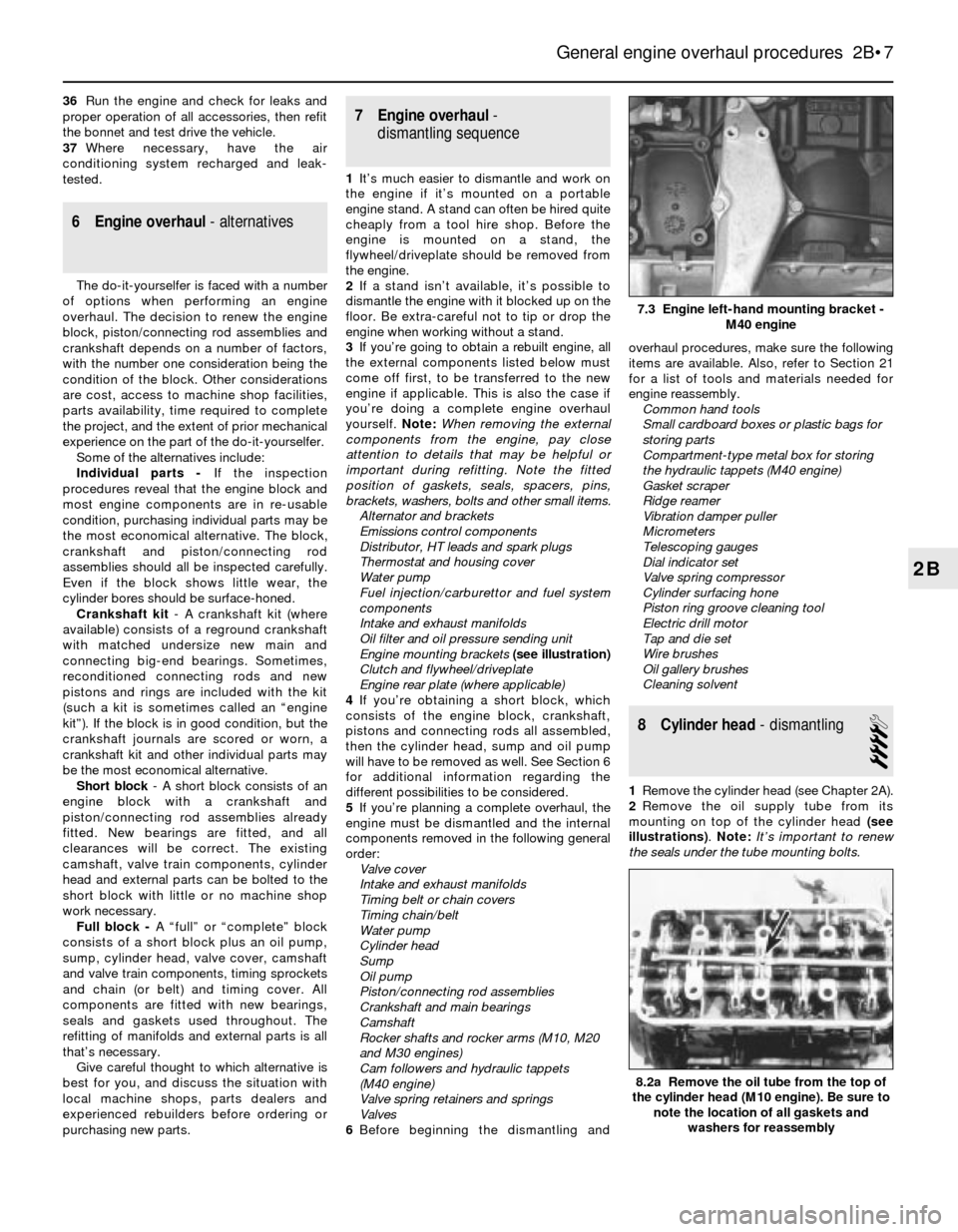
Engine mounting brackets (see illustration)
Clutch and flywheel/driveplate
Engine rear plate (where applicable)
4If you’re obtaining a short block, which
consists of the engine block, crankshaft,
pistons and connecting rods all assembled,
then the cylinder head, sump and oil pump
will have to be removed as well. See Section 6
for additional information regarding the
different possibilities to be considered.
5If you’re planning a complete overhaul, the
engine must be dismantled and the internal
components removed in the following general
order:
Valve cover
Intake and exhaust manifolds
Timing belt or chain covers
Timing chain/belt
Water pump
Cylinder head
Sump
Oil pump
Piston/connecting rod assemblies
Crankshaft and main bearings
Camshaft
Rocker shafts and rocker arms (M10, M20
and M30 engines)
Cam followers and hydraulic tappets
(M40 engine)
Valve spring retainers and springs
Valves
6Before beginning the dismantling andoverhaul procedures, make sure the following
items are available. Also, refer to Section 21
for a list of tools and materials needed for
engine reassembly.
Common hand tools
Small cardboard boxes or plastic bags for
storing parts
Compartment-type metal box for storing
the hydraulic tappets (M40 engine)
Gasket scraper
Ridge reamer
Vibration damper puller
Micrometers
Telescoping gauges
Dial indicator set
Valve spring compressor
Cylinder surfacing hone
Piston ring groove cleaning tool
Electric drill motor
Tap and die set
Wire brushes
Oil gallery brushes
Cleaning solvent
8 Cylinder head- dismantling
4
1Remove the cylinder head (see Chapter 2A).
2Remove the oil supply tube from its
mounting on top of the cylinder head (see
illustrations). Note:It’s important to renew
the seals under the tube mounting bolts.
General engine overhaul procedures 2B•7
7.3 Engine left-hand mounting bracket -
M40 engine
8.2a Remove the oil tube from the top of
the cylinder head (M10 engine). Be sure to
note the location of all gaskets and
washers for reassembly
2B
Page 64 of 228
M10, M20 and M30 engines
3Adjust all valves to their maximum clearance
by rotating the eccentric on the valve end of
the rocker arm towards the centre of the head
(see Chapter 1, if necessary).
4Before removing the thrustplate, measure
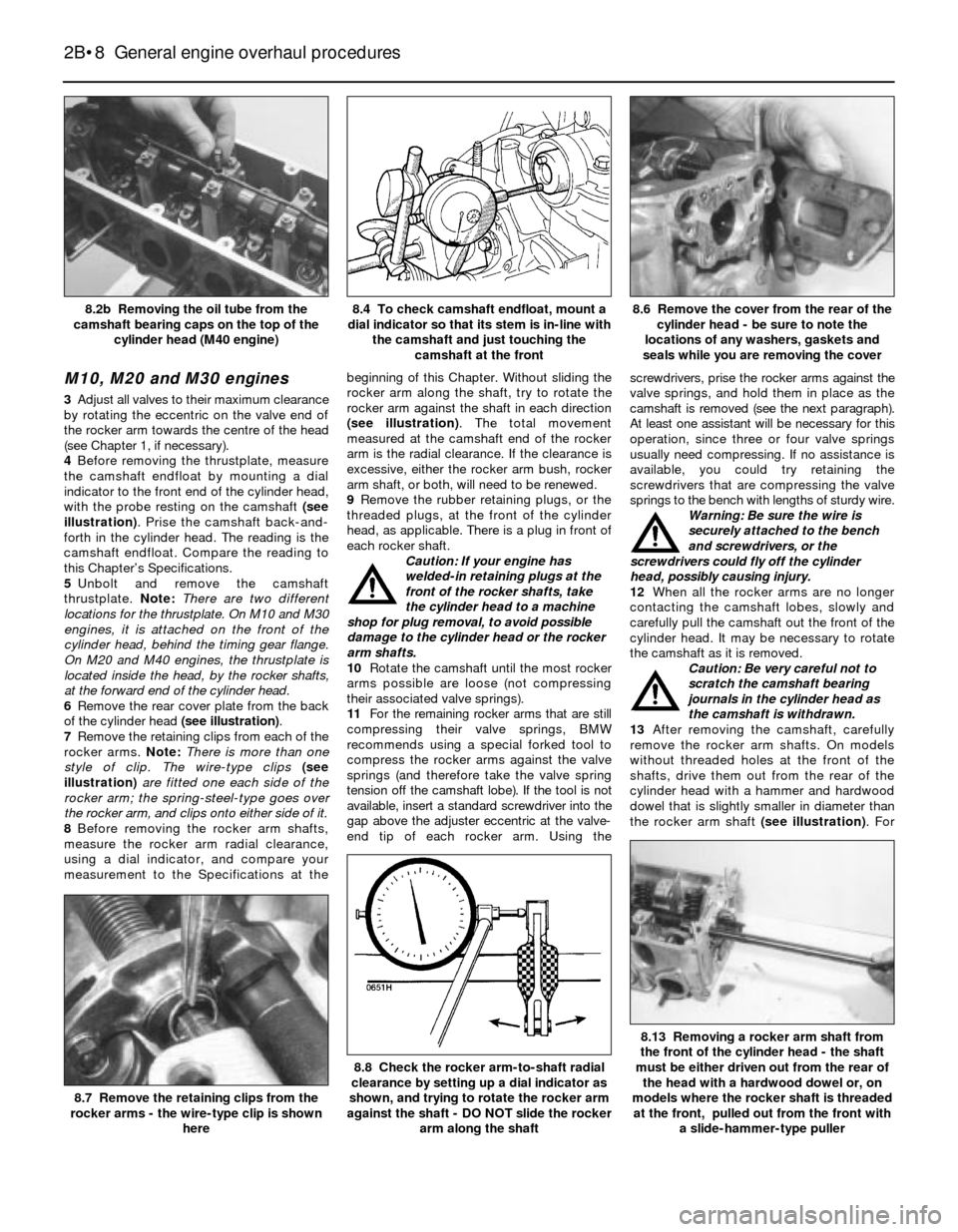
the camshaft endfloat by mounting a dial
indicator to the front end of the cylinder head,
with the probe resting on the camshaft (see
illustration). Prise the camshaft back-and-
forth in the cylinder head. The reading is the
camshaft endfloat. Compare the reading to
this Chapter’s Specifications.
5Unbolt and remove the camshaft
thrustplate. Note:There are two different
locations for the thrustplate. On M10 and M30
engines, it is attached on the front of the
cylinder head, behind the timing gear flange.
On M20 and M40 engines, the thrustplate is
located inside the head, by the rocker shafts,
at the forward end of the cylinder head.
6Remove the rear cover plate from the back
of the cylinder head (see illustration).
7Remove the retaining clips from each of the
rocker arms. Note:There is more than one
style of clip. The wire-type clips (see
illustration)are fitted one each side of the
rocker arm; the spring-steel-type goes over
the rocker arm, and clips onto either side of it.
8Before removing the rocker arm shafts,
measure the rocker arm radial clearance,
using a dial indicator, and compare your
measurement to the Specifications at thebeginning of this Chapter. Without sliding the
rocker arm along the shaft, try to rotate the
rocker arm against the shaft in each direction
(see illustration). The total movement
measured at the camshaft end of the rocker
arm is the radial clearance. If the clearance is
excessive, either the rocker arm bush, rocker
arm shaft, or both, will need to be renewed.
9Remove the rubber retaining plugs, or the
threaded plugs, at the front of the cylinder
head, as applicable. There is a plug in front of
each rocker shaft.
Caution: If your engine has
welded-in retaining plugs at the
front of the rocker shafts, take
the cylinder head to a machine
shop for plug removal, to avoid possible
damage to the cylinder head or the rocker
arm shafts.
10Rotate the camshaft until the most rocker
arms possible are loose (not compressing
their associated valve springs).
11For the remaining rocker arms that are still
compressing their valve springs, BMW
recommends using a special forked tool to
compress the rocker arms against the valve
springs (and therefore take the valve spring
tension off the camshaft lobe). If the tool is not
available, insert a standard screwdriver into the
gap above the adjuster eccentric at the valve-
end tip of each rocker arm. Using thescrewdrivers, prise the rocker arms against the
valve springs, and hold them in place as the
camshaft is removed (see the next paragraph).
At least one assistant will be necessary for this
operation, since three or four valve springs
usually need compressing. If no assistance is
available, you could try retaining the
screwdrivers that are compressing the valve
springs to the bench with lengths of sturdy wire.
Warning: Be sure the wire is
securely attached to the bench
and screwdrivers, or the
screwdrivers could fly off the cylinder
head, possibly causing injury.
12When all the rocker arms are no longer
contacting the camshaft lobes, slowly and
carefully pull the camshaft out the front of the
cylinder head. It may be necessary to rotate
the camshaft as it is removed.
Caution: Be very careful not to
scratch the camshaft bearing
journals in the cylinder head as
the camshaft is withdrawn.
13After removing the camshaft, carefully
remove the rocker arm shafts. On models
without threaded holes at the front of the
shafts, drive them out from the rear of the
cylinder head with a hammer and hardwood
dowel that is slightly smaller in diameter than
the rocker arm shaft (see illustration). For
2B•8 General engine overhaul procedures
8.13 Removing a rocker arm shaft from
the front of the cylinder head - the shaft
must be either driven out from the rear of
the head with a hardwood dowel or, on
models where the rocker shaft is threaded
at the front, pulled out from the front with
a slide-hammer-type puller
8.8 Check the rocker arm-to-shaft radial
clearance by setting up a dial indicator as
shown, and trying to rotate the rocker arm
against the shaft - DO NOT slide the rocker
arm along the shaft
8.7 Remove the retaining clips from the
rocker arms - the wire-type clip is shown
here
8.6 Remove the cover from the rear of the
cylinder head - be sure to note the
locations of any washers, gaskets and
seals while you are removing the cover8.4 To check camshaft endfloat, mount a
dial indicator so that its stem is in-line with
the camshaft and just touching the
camshaft at the front8.2b Removing the oil tube from the
camshaft bearing caps on the top of the
cylinder head (M40 engine)
Page 66 of 228
24Repeat the procedure for the remaining
valves. Remember to keep all the parts for
each valve together, so they can be refitted in
the same locations.
25Once the valves and related components
have been removed and stored in an
organised manner, the head should be
thoroughly cleaned and inspected. If a
complete engine overhaul is being done,
finish the engine dismantling procedures
before beginning the cylinder head cleaning
and inspection process.
9 Cylinder head and
components-
cleaning and inspection
4
1Thorough cleaning of the cylinder head(s)
and related valve train components, followed
by a detailed inspection, will enable you to
decide how much valve service work must be
done during the engine overhaul. Note: If the
engine was severely overheated, the cylinder
head is probably warped (see paragraph 10).
Cleaning
2Scrape all traces of old gasket material and
sealing compound off the cylinder head,
intake manifold and exhaust manifold sealing
surfaces. Be very careful not to gouge the
cylinder head. Special gasket removal
solvents are available at motor factors.
3Remove all built-up scale from the coolant
passages.
4Run a stiff brush through the various holes
to remove deposits that may have formed in
them.
5Run an appropriate-size tap into each of the
threaded holes, to remove corrosion and
thread sealant that may be present. If
compressed air is available, use it to clear the
holes of debris produced by this operation.
Warning: Wear eye protection
when using compressed air!
6Clean the cylinder head with solvent, and
dry it thoroughly. Compressed air will speed
the drying process, and ensure that all holesand recessed areas are clean. Note:
Decarbonising chemicals are available, and
may prove very useful when cleaning cylinder
heads and valve train components. They are
very caustic, however, and should be used
with caution. Be sure to follow the instructions
on the container.
7Clean all the rocker shafts/arms/followers,
springs, valve springs, spring seats, keepers
and retainers with solvent, and dry them
thoroughly. Clean the components from one
valve at a time, to avoid mixing up the parts.
Caution: DO NOT clean the
hydraulic tappets of the M40
engine; leave them completely
immersed in oil.
8Scrape off any heavy deposits that may
have formed on the valves, then use a
motorised wire brush to remove deposits from
the valve heads and stems. Again, make sure
the valves don’t get mixed up.
Inspection
Note: Be sure to perform all of the following
inspection procedures before concluding that
machine shop work is required. Make a list of
the items that need attention.
Cylinder head
9Inspect the head very carefully for cracks,
evidence of coolant leakage, and other
damage. If cracks are found, check with an
machine shop concerning repair. If repair isn’t
possible, a new cylinder head should be
obtained.
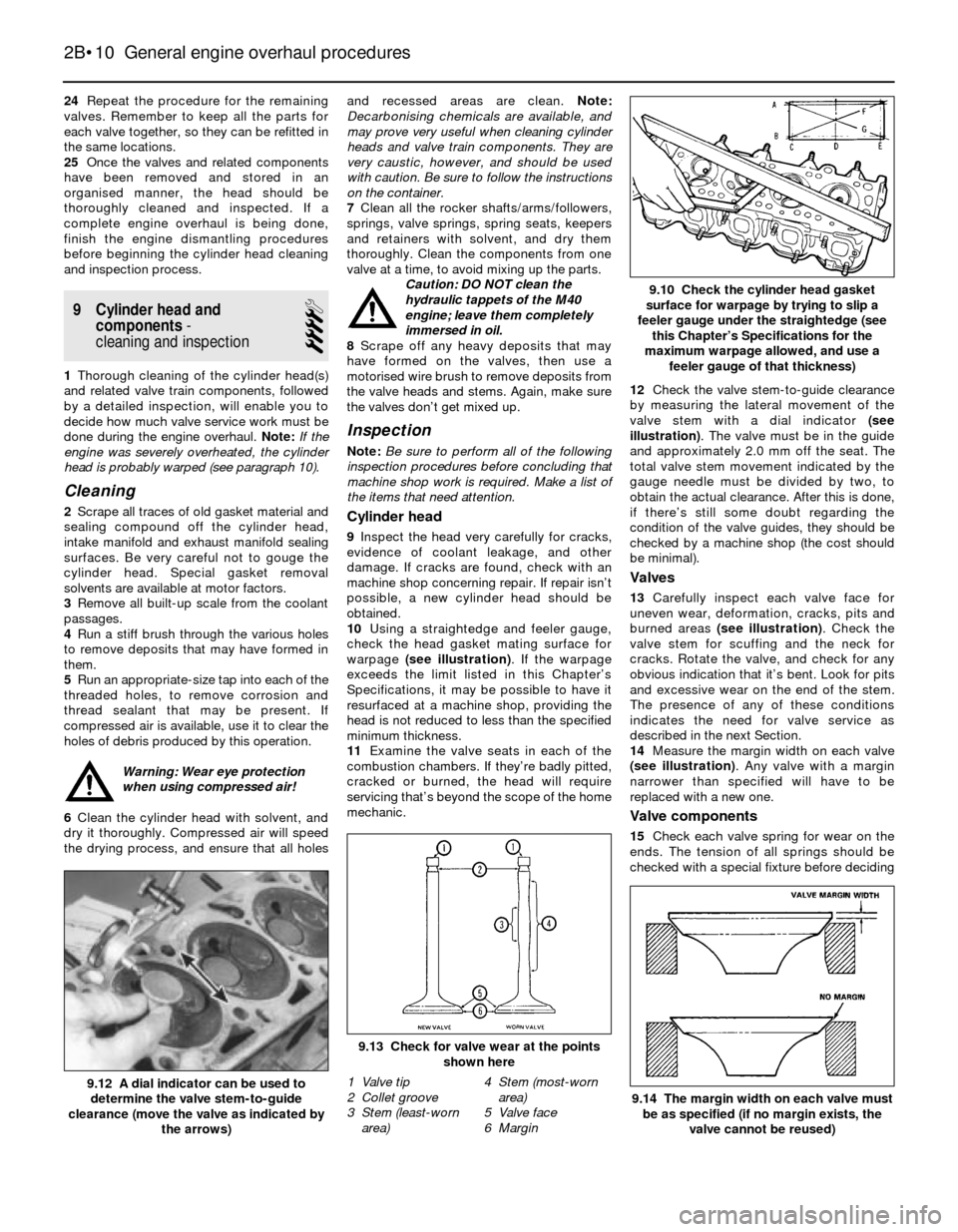
10Using a straightedge and feeler gauge,
check the head gasket mating surface for
warpage (see illustration). If the warpage
exceeds the limit listed in this Chapter’s
Specifications, it may be possible to have it
resurfaced at a machine shop, providing the
head is not reduced to less than the specified
minimum thickness.
11Examine the valve seats in each of the
combustion chambers. If they’re badly pitted,
cracked or burned, the head will require
servicing that’s beyond the scope of the home
mechanic.12Check the valve stem-to-guide clearance
by measuring the lateral movement of the
valve stem with a dial indicator (see
illustration). The valve must be in the guide
and approximately 2.0 mm off the seat. The
total valve stem movement indicated by the
gauge needle must be divided by two, to
obtain the actual clearance. After this is done,
if there’s still some doubt regarding the
condition of the valve guides, they should be
checked by a machine shop (the cost should
be minimal).
Valves
13Carefully inspect each valve face for
uneven wear, deformation, cracks, pits and
burned areas (see illustration). Check the
valve stem for scuffing and the neck for
cracks. Rotate the valve, and check for any
obvious indication that it’s bent. Look for pits
and excessive wear on the end of the stem.
The presence of any of these conditions
indicates the need for valve service as
described in the next Section.
14Measure the margin width on each valve
(see illustration). Any valve with a margin
narrower than specified will have to be
replaced with a new one.
Valve components
15Check each valve spring for wear on the
ends. The tension of all springs should be
checked with a special fixture before deciding
2B•10 General engine overhaul procedures
9.14 The margin width on each valve must
be as specified (if no margin exists, the
valve cannot be reused)
9.13 Check for valve wear at the points
shown here
9.12 A dial indicator can be used to
determine the valve stem-to-guide
clearance (move the valve as indicated by
the arrows)
9.10 Check the cylinder head gasket
surface for warpage by trying to slip a
feeler gauge under the straightedge (see
this Chapter’s Specifications for the
maximum warpage allowed, and use a
feeler gauge of that thickness)
1 Valve tip
2 Collet groove
3 Stem (least-worn
area)4 Stem (most-worn
area)
5 Valve face
6 Margin
Page 72 of 228
7Wipe the oil out of the cylinder, and repeat
the procedure for the remaining cylinders.
8After the honing job is complete, chamfer
the top edges of the cylinder bores with a
small file, so the rings won’t catch when the
pistons are refitted. Be very careful not to nick
the cylinder walls with the end of the file.
9The entire engine block must be washed
again very thoroughly with warm, soapy
water, to remove all traces of the abrasive grit
produced during the honing operation. Note:
The bores can be considered clean when a
lint-free white cloth - dampened with clean
engine oil - used to wipe them out doesn’t
pick up any more honing residue, which will
show up as grey areas on the cloth.Be sure to
run a brush through all oil holes and galleries,
and flush them with running water.
10After rinsing, dry the block, and apply a
coat of light rust-preventive oil to all machined
surfaces. Wrap the block in a plastic bag to
keep it clean, and set it aside until
reassembly.
18 Pistons/connecting rods-
inspection
3
1Before the inspection process can be
carried out, the piston/connecting rod
assemblies must be cleaned and the original
piston rings removed from the pistons.Note:
Always use new piston rings when the engine
is reassembled.
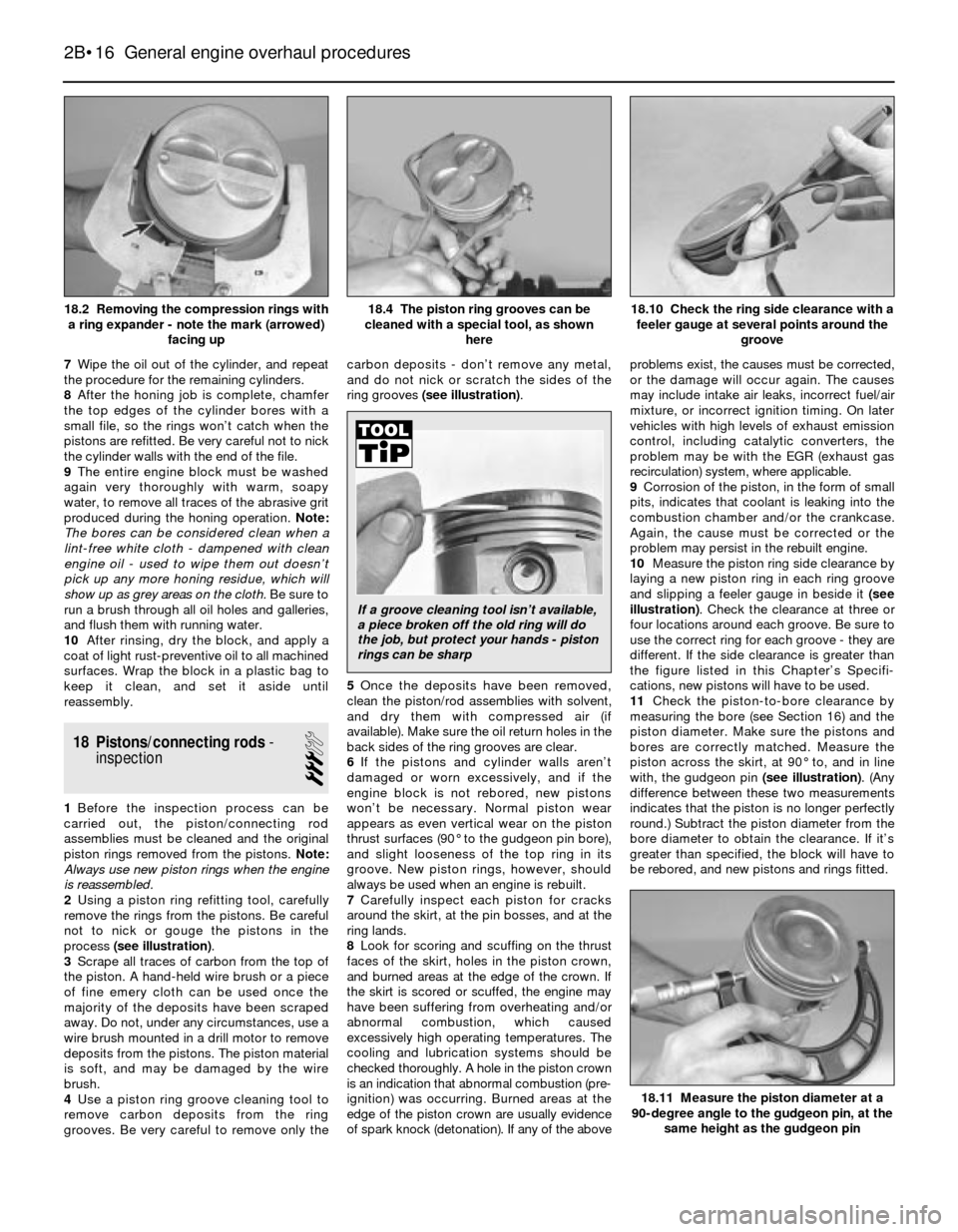
2Using a piston ring refitting tool, carefully
remove the rings from the pistons. Be careful
not to nick or gouge the pistons in the
process (see illustration).
3Scrape all traces of carbon from the top of
the piston. A hand-held wire brush or a piece
of fine emery cloth can be used once the
majority of the deposits have been scraped
away. Do not, under any circumstances, use a
wire brush mounted in a drill motor to remove
deposits from the pistons. The piston material
is soft, and may be damaged by the wire
brush.
4Use a piston ring groove cleaning tool to
remove carbon deposits from the ring
grooves. Be very careful to remove only thecarbon deposits - don’t remove any metal,
and do not nick or scratch the sides of the
ring grooves (see illustration).
5Once the deposits have been removed,
clean the piston/rod assemblies with solvent,
and dry them with compressed air (if
available). Make sure the oil return holes in the
back sides of the ring grooves are clear.
6If the pistons and cylinder walls aren’t
damaged or worn excessively, and if the
engine block is not rebored, new pistons
won’t be necessary. Normal piston wear
appears as even vertical wear on the piston
thrust surfaces (90° to the gudgeon pin bore),
and slight looseness of the top ring in its
groove. New piston rings, however, should
always be used when an engine is rebuilt.
7Carefully inspect each piston for cracks
around the skirt, at the pin bosses, and at the
ring lands.
8Look for scoring and scuffing on the thrust
faces of the skirt, holes in the piston crown,
and burned areas at the edge of the crown. If
the skirt is scored or scuffed, the engine may
have been suffering from overheating and/or
abnormal combustion, which caused
excessively high operating temperatures. The
cooling and lubrication systems should be
checked thoroughly. A hole in the piston crown
is an indication that abnormal combustion (pre-
ignition) was occurring. Burned areas at the
edge of the piston crown are usually evidence
of spark knock (detonation). If any of the aboveproblems exist, the causes must be corrected,
or the damage will occur again. The causes
may include intake air leaks, incorrect fuel/air
mixture, or incorrect ignition timing. On later
vehicles with high levels of exhaust emission
control, including catalytic converters, the
problem may be with the EGR (exhaust gas
recirculation) system, where applicable.
9Corrosion of the piston, in the form of small
pits, indicates that coolant is leaking into the
combustion chamber and/or the crankcase.
Again, the cause must be corrected or the
problem may persist in the rebuilt engine.
10Measure the piston ring side clearance by
laying a new piston ring in each ring groove
and slipping a feeler gauge in beside it(see
illustration). Check the clearance at three or
four locations around each groove. Be sure to
use the correct ring for each groove - they are
different. If the side clearance is greater than
the figure listed in this Chapter’s Specifi-
cations, new pistons will have to be used.
11Check the piston-to-bore clearance by
measuring the bore (see Section 16) and the
piston diameter. Make sure the pistons and
bores are correctly matched. Measure the
piston across the skirt, at 90° to, and in line
with, the gudgeon pin (see illustration). (Any
difference between these two measurements
indicates that the piston is no longer perfectly
round.) Subtract the piston diameter from the
bore diameter to obtain the clearance. If it’s
greater than specified, the block will have to
be rebored, and new pistons and rings fitted.
2B•16 General engine overhaul procedures
18.11 Measure the piston diameter at a
90-degree angle to the gudgeon pin, at the
same height as the gudgeon pin
18.10 Check the ring side clearance with a
feeler gauge at several points around the
groove18.4 The piston ring grooves can be
cleaned with a special tool, as shown
here18.2 Removing the compression rings with
a ring expander - note the mark (arrowed)
facing up
If a groove cleaning tool isn’t available,
a piece broken off the old ring will do
the job, but protect your hands - piston
rings can be sharp
Page 73 of 228
12Check the piston-to-rod clearance by
twisting the piston and rod in opposite
directions. Any noticeable play indicates
excessive wear, which must be corrected. The
piston/connecting rod assemblies should be
taken to a machine shop for attention.
13If the pistons must be removed from the
connecting rods for any reason, they should
be taken to a machine shop. When this is
done, have the connecting rods checked for
bend and twist, since most machine shops
have special equipment for this purpose.
Note:Unless new pistons and/or connecting
rods must be fitted, do not dismantle the
pistons and connecting rods.
14Check the connecting rods for cracks and
other damage. Temporarily remove the rod
caps, lift out the old bearing shells, wipe the rod
and cap bearing surfaces clean, and inspect
them for nicks, gouges and scratches. After
checking the rods, fit new bearing shells, slip the
caps into place, and tighten the nuts finger-tight.
19 Crankshaft- inspection
3
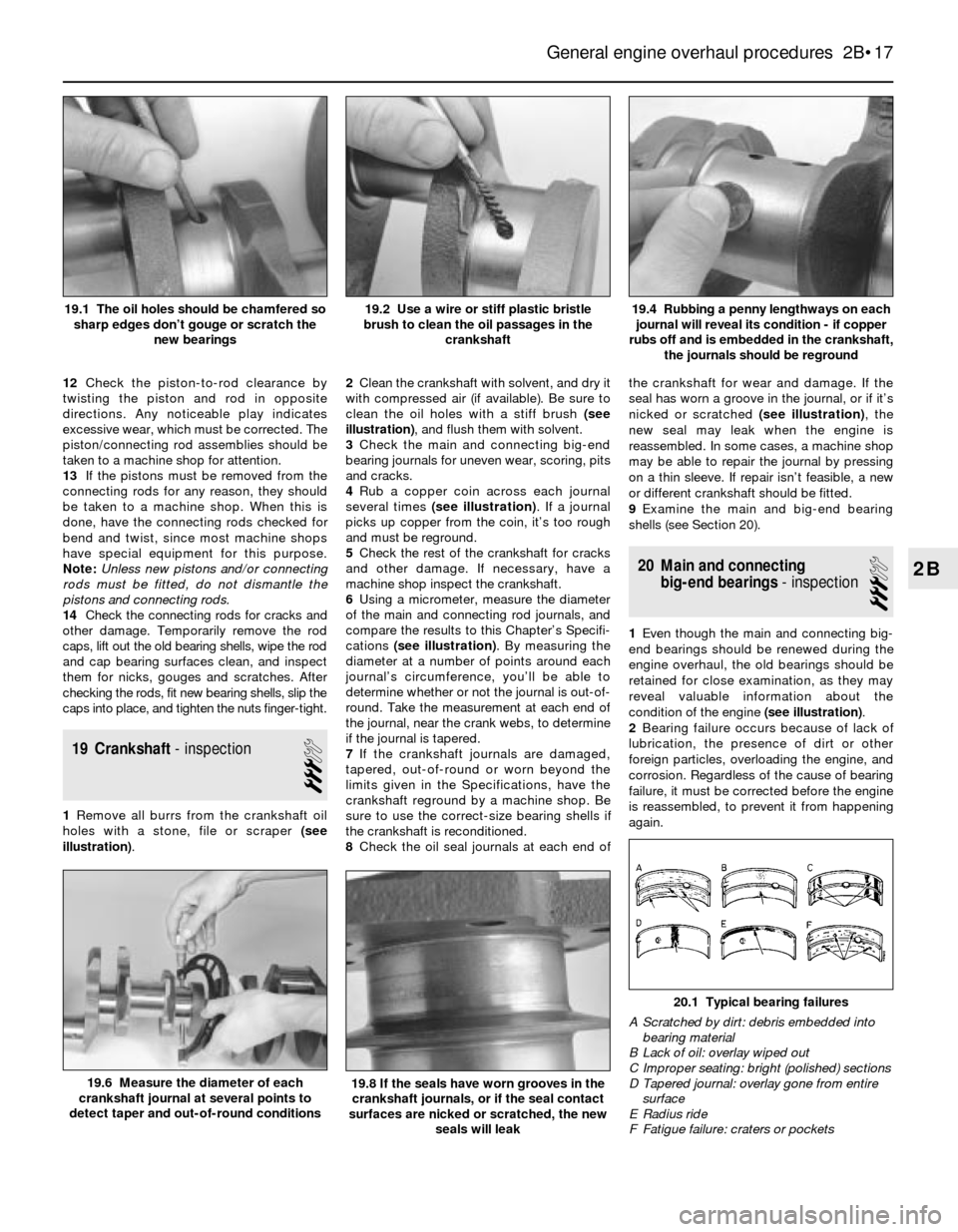
1Remove all burrs from the crankshaft oil
holes with a stone, file or scraper (see
illustration).2Clean the crankshaft with solvent, and dry it
with compressed air (if available). Be sure to
clean the oil holes with a stiff brush (see
illustration), and flush them with solvent.
3Check the main and connecting big-end
bearing journals for uneven wear, scoring, pits
and cracks.
4Rub a copper coin across each journal
several times (see illustration). If a journal
picks up copper from the coin, it’s too rough
and must be reground.
5Check the rest of the crankshaft for cracks
and other damage. If necessary, have a
machine shop inspect the crankshaft.
6Using a micrometer, measure the diameter
of the main and connecting rod journals, and
compare the results to this Chapter’s Specifi-
cations (see illustration). By measuring the
diameter at a number of points around each
journal’s circumference, you’ll be able to
determine whether or not the journal is out-of-
round. Take the measurement at each end of
the journal, near the crank webs, to determine
if the journal is tapered.
7If the crankshaft journals are damaged,
tapered, out-of-round or worn beyond the
limits given in the Specifications, have the
crankshaft reground by a machine shop. Be
sure to use the correct-size bearing shells if
the crankshaft is reconditioned.
8Check the oil seal journals at each end ofthe crankshaft for wear and damage. If the
seal has worn a groove in the journal, or if it’s
nicked or scratched (see illustration), the
new seal may leak when the engine is
reassembled. In some cases, a machine shop
may be able to repair the journal by pressing
on a thin sleeve. If repair isn’t feasible, a new
or different crankshaft should be fitted.
9Examine the main and big-end bearing
shells (see Section 20).
20 Main and connecting
big-end bearings- inspection
3
1Even though the main and connecting big-
end bearings should be renewed during the
engine overhaul, the old bearings should be
retained for close examination, as they may
reveal valuable information about the
condition of the engine (see illustration).
2Bearing failure occurs because of lack of
lubrication, the presence of dirt or other
foreign particles, overloading the engine, and
corrosion. Regardless of the cause of bearing
failure, it must be corrected before the engine
is reassembled, to prevent it from happening
again.
General engine overhaul procedures 2B•17
19.4 Rubbing a penny lengthways on each
journal will reveal its condition - if copper
rubs off and is embedded in the crankshaft,
the journals should be reground19.2 Use a wire or stiff plastic bristle
brush to clean the oil passages in the
crankshaft19.1 The oil holes should be chamfered so
sharp edges don’t gouge or scratch the
new bearings
20.1 Typical bearing failures
A Scratched by dirt: debris embedded into
bearing material
B Lack of oil: overlay wiped out
C Improper seating: bright (polished) sections
D Tapered journal: overlay gone from entire
surface
E Radius ride
F Fatigue failure: craters or pockets
19.8 If the seals have worn grooves in the
crankshaft journals, or if the seal contact
surfaces are nicked or scratched, the new
seals will leak19.6 Measure the diameter of each
crankshaft journal at several points to
detect taper and out-of-round conditions
2B
Page 82 of 228
disconnect the fluid cooler lines from the
radiator. Use a drip tray to catch spilled fluid.
Plug the fluid cooler lines and fittings.
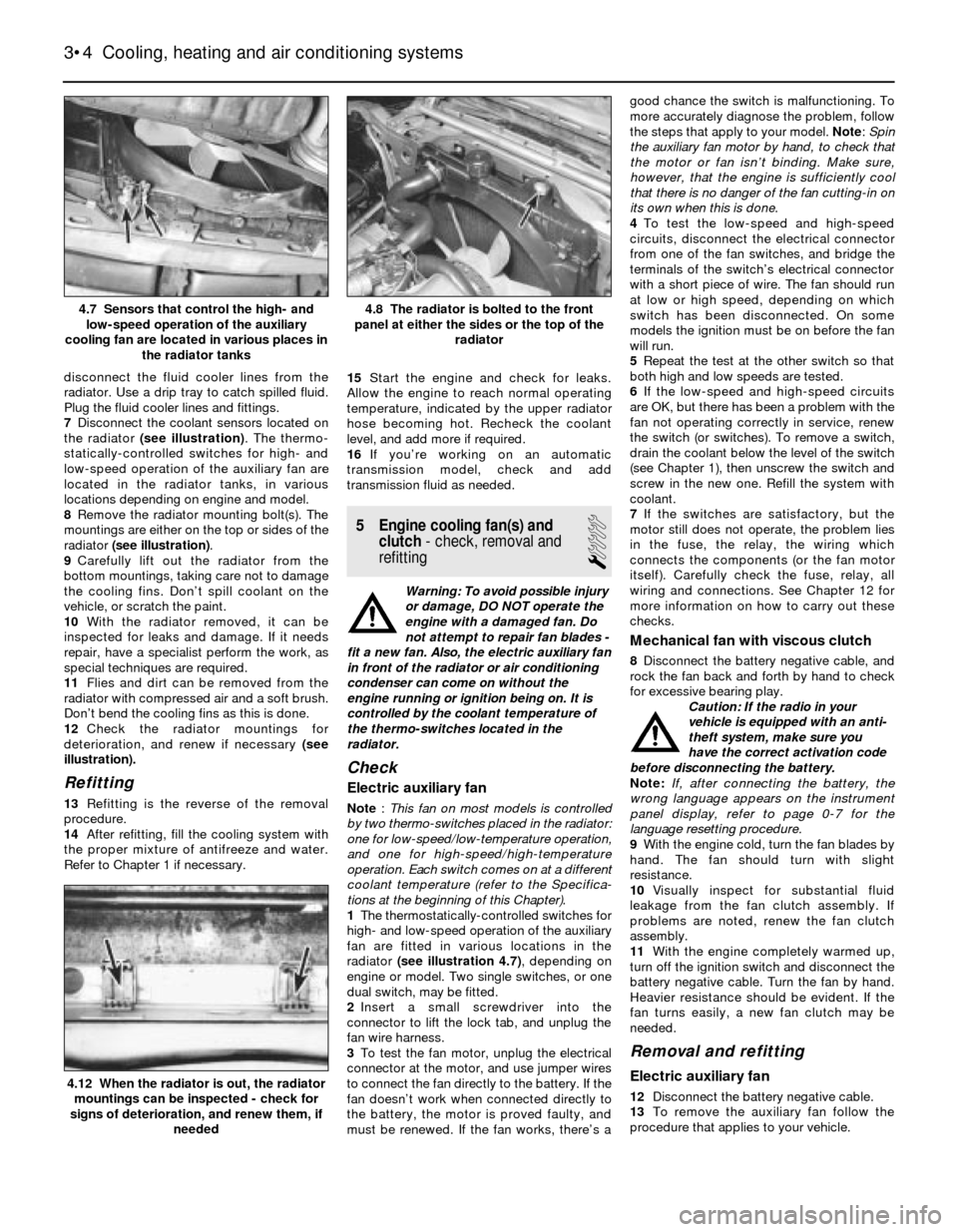
7Disconnect the coolant sensors located on
the radiator (see illustration). The thermo-
statically-controlled switches for high- and
low-speed operation of the auxiliary fan are
located in the radiator tanks, in various
locations depending on engine and model.
8Remove the radiator mounting bolt(s). The
mountings are either on the top or sides of the
radiator (see illustration).
9Carefully lift out the radiator from the
bottom mountings, taking care not to damage
the cooling fins. Don’t spill coolant on the
vehicle, or scratch the paint.
10With the radiator removed, it can be
inspected for leaks and damage. If it needs
repair, have a specialist perform the work, as
special techniques are required.
11Flies and dirt can be removed from the
radiator with compressed air and a soft brush.
Don’t bend the cooling fins as this is done.
12Check the radiator mountings for
deterioration, and renew if necessary (see
illustration).
Refitting
13Refitting is the reverse of the removal
procedure.
14After refitting, fill the cooling system with
the proper mixture of antifreeze and water.
Refer to Chapter 1 if necessary.15Start the engine and check for leaks.
Allow the engine to reach normal operating
temperature, indicated by the upper radiator
hose becoming hot. Recheck the coolant
level, and add more if required.
16If you’re working on an automatic
transmission model, check and add
transmission fluid as needed.
5 Engine cooling fan(s) and
clutch- check, removal and
refitting
1
Warning: To avoid possible injury
or damage, DO NOT operate the
engine with a damaged fan. Do
not attempt to repair fan blades -
fit a new fan. Also, the electric auxiliary fan
in front of the radiator or air conditioning
condenser can come on without the
engine running or ignition being on. It is
controlled by the coolant temperature of
the thermo-switches located in the
radiator.
Check
Electric auxiliary fan
Note: This fan on most models is controlled
by two thermo-switches placed in the radiator:
one for low-speed/low-temperature operation,
and one for high-speed/high-temperature
operation. Each switch comes on at a different
coolant temperature (refer to the Specifica-
tions at the beginning of this Chapter).
1The thermostatically-controlled switches for
high- and low-speed operation of the auxiliary
fan are fitted in various locations in the
radiator (see illustration 4.7), depending on
engine or model. Two single switches, or one
dual switch, may be fitted.
2Insert a small screwdriver into the
connector to lift the lock tab, and unplug the
fan wire harness.
3To test the fan motor, unplug the electrical
connector at the motor, and use jumper wires
to connect the fan directly to the battery. If the
fan doesn’t work when connected directly to
the battery, the motor is proved faulty, and
must be renewed. If the fan works, there’s agood chance the switch is malfunctioning. To
more accurately diagnose the problem, follow
the steps that apply to your model. Note: Spin
the auxiliary fan motor by hand, to check that
the motor or fan isn’t binding. Make sure,
however, that the engine is sufficiently cool
that there is no danger of the fan cutting-in on
its own when this is done.
4To test the low-speed and high-speed
circuits, disconnect the electrical connector
from one of the fan switches, and bridge the
terminals of the switch’s electrical connector
with a short piece of wire. The fan should run
at low or high speed, depending on which
switch has been disconnected. On some
models the ignition must be on before the fan
will run.
5Repeat the test at the other switch so that
both high and low speeds are tested.
6If the low-speed and high-speed circuits
are OK, but there has been a problem with the
fan not operating correctly in service, renew
the switch (or switches). To remove a switch,
drain the coolant below the level of the switch
(see Chapter 1), then unscrew the switch and
screw in the new one. Refill the system with
coolant.
7If the switches are satisfactory, but the
motor still does not operate, the problem lies
in the fuse, the relay, the wiring which
connects the components (or the fan motor
itself). Carefully check the fuse, relay, all
wiring and connections. See Chapter 12 for
more information on how to carry out these
checks.
Mechanical fan with viscous clutch
8Disconnect the battery negative cable, and
rock the fan back and forth by hand to check
for excessive bearing play.
Caution: If the radio in your
vehicle is equipped with an anti-
theft system, make sure you
have the correct activation code
before disconnecting the battery.
Note: If, after connecting the battery, the
wrong language appears on the instrument
panel display, refer to page 0-7 for the
language resetting procedure.
9With the engine cold, turn the fan blades by
hand. The fan should turn with slight
resistance.
10Visually inspect for substantial fluid
leakage from the fan clutch assembly. If
problems are noted, renew the fan clutch
assembly.
11With the engine completely warmed up,
turn off the ignition switch and disconnect the
battery negative cable. Turn the fan by hand.
Heavier resistance should be evident. If the
fan turns easily, a new fan clutch may be
needed.
Removal and refitting
Electric auxiliary fan
12Disconnect the battery negative cable.
13To remove the auxiliary fan follow the
procedure that applies to your vehicle.
3•4 Cooling, heating and air conditioning systems
4.12 When the radiator is out, the radiator
mountings can be inspected - check for
signs of deterioration, and renew them, if
needed
4.8 The radiator is bolted to the front
panel at either the sides or the top of the
radiator4.7 Sensors that control the high- and
low-speed operation of the auxiliary
cooling fan are located in various places in
the radiator tanks
Page 84 of 228
M20 engine
9Remove the distributor cap and HT leads,
ignition rotor and dust shield (see Chapter 1).
10Where applicable, remove the timing
sensor (see Chapter 5).
11Remove the timing belt upper cover (see
Chapter 2A).
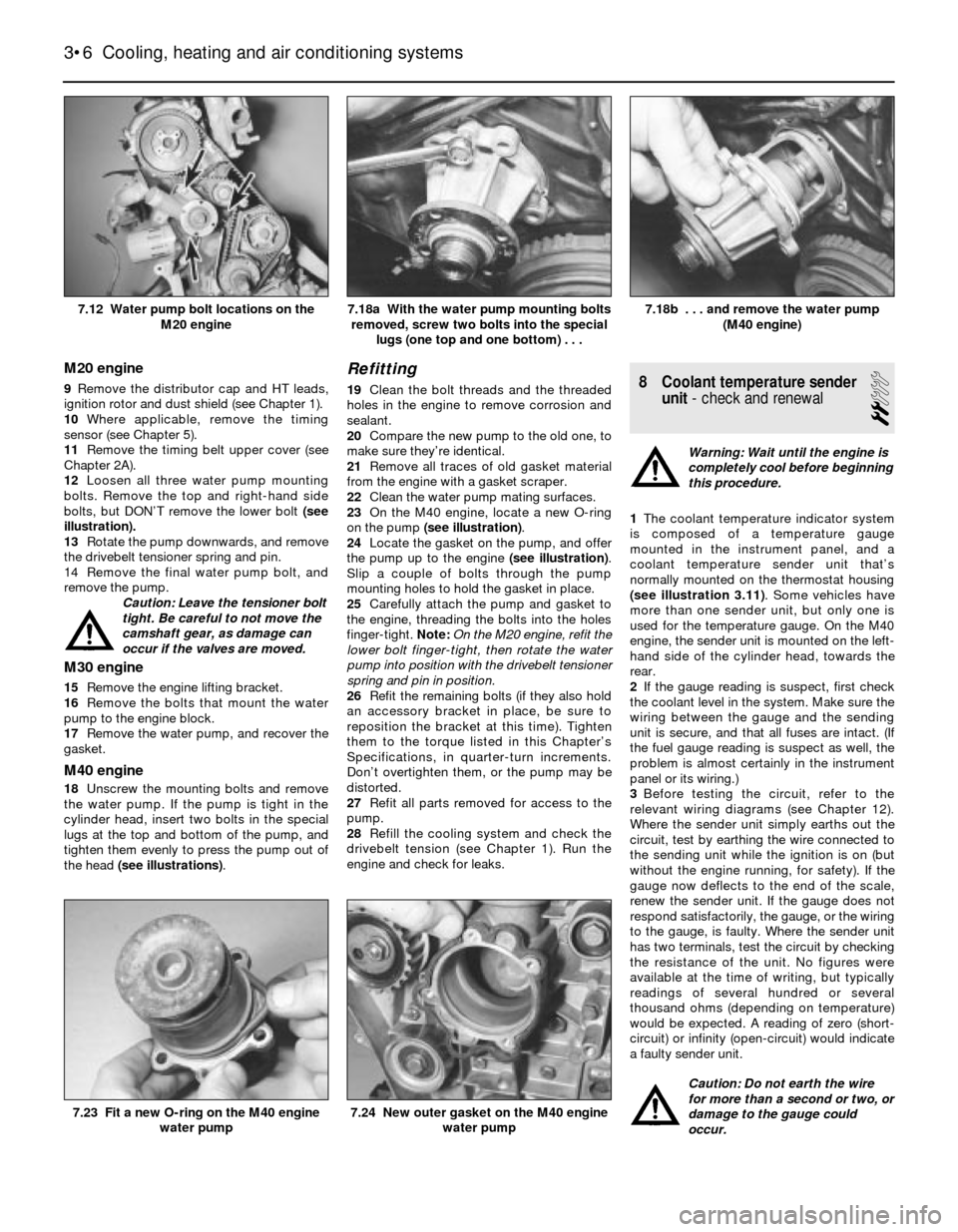
12Loosen all three water pump mounting
bolts. Remove the top and right-hand side
bolts, but DON’T remove the lower bolt (see
illustration).
13Rotate the pump downwards, and remove
the drivebelt tensioner spring and pin.
14 Remove the final water pump bolt, and
remove the pump.
Caution: Leave the tensioner bolt
tight. Be careful to not move the
camshaft gear, as damage can
occur if the valves are moved.
M30 engine
15Remove the engine lifting bracket.
16Remove the bolts that mount the water
pump to the engine block.
17Remove the water pump, and recover the
gasket.
M40 engine
18Unscrew the mounting bolts and remove
the water pump. If the pump is tight in the
cylinder head, insert two bolts in the special
lugs at the top and bottom of the pump, and
tighten them evenly to press the pump out of
the head (see illustrations).
Refitting
19Clean the bolt threads and the threaded
holes in the engine to remove corrosion and
sealant.
20Compare the new pump to the old one, to
make sure they’re identical.
21Remove all traces of old gasket material
from the engine with a gasket scraper.
22Clean the water pump mating surfaces.
23On the M40 engine, locate a new O-ring
on the pump (see illustration).
24Locate the gasket on the pump, and offer
the pump up to the engine (see illustration).
Slip a couple of bolts through the pump
mounting holes to hold the gasket in place.
25Carefully attach the pump and gasket to
the engine, threading the bolts into the holes
finger-tight.Note:On the M20 engine, refit the
lower bolt finger-tight, then rotate the water
pump into position with the drivebelt tensioner
spring and pin in position.
26Refit the remaining bolts (if they also hold
an accessory bracket in place, be sure to
reposition the bracket at this time). Tighten
them to the torque listed in this Chapter’s
Specifications, in quarter-turn increments.
Don’t overtighten them, or the pump may be
distorted.
27Refit all parts removed for access to the
pump.
28Refill the cooling system and check the
drivebelt tension (see Chapter 1). Run the
engine and check for leaks.8 Coolant temperature sender
unit- check and renewal
2
Warning: Wait until the engine is
completely cool before beginning
this procedure.
1The coolant temperature indicator system
is composed of a temperature gauge
mounted in the instrument panel, and a
coolant temperature sender unit that’s
normally mounted on the thermostat housing
(see illustration 3.11). Some vehicles have
more than one sender unit, but only one is
used for the temperature gauge. On the M40
engine, the sender unit is mounted on the left-
hand side of the cylinder head, towards the
rear.
2If the gauge reading is suspect, first check
the coolant level in the system. Make sure the
wiring between the gauge and the sending
unit is secure, and that all fuses are intact. (If
the fuel gauge reading is suspect as well, the
problem is almost certainly in the instrument
panel or its wiring.)
3Before testing the circuit, refer to the
relevant wiring diagrams (see Chapter 12).
Where the sender unit simply earths out the
circuit, test by earthing the wire connected to
the sending unit while the ignition is on (but
without the engine running, for safety). If the
gauge now deflects to the end of the scale,
renew the sender unit. If the gauge does not
respond satisfactorily, the gauge, or the wiring
to the gauge, is faulty. Where the sender unit
has two terminals, test the circuit by checking
the resistance of the unit. No figures were
available at the time of writing, but typically
readings of several hundred or several
thousand ohms (depending on temperature)
would be expected. A reading of zero (short-
circuit) or infinity (open-circuit) would indicate
a faulty sender unit.
Caution: Do not earth the wire
for more than a second or two, or
damage to the gauge could
occur.
3•6 Cooling, heating and air conditioning systems
7.24 New outer gasket on the M40 engine
water pump7.23 Fit a new O-ring on the M40 engine
water pump
7.18b . . . and remove the water pump
(M40 engine)7.18a With the water pump mounting bolts
removed, screw two bolts into the special
lugs (one top and one bottom) . . .7.12 Water pump bolt locations on the
M20 engine
Page 85 of 228
4If a new sender unit is to be fitted, make
sure the engine is completely cool. There will
be some coolant loss when the unit is
unscrewed, so be prepared to catch it, or
have the new unit ready to fit immediately the
old one is removed. Disconnect the wiring,
then unscrew the old unit from the engine,
and fit the new one. Use sealant on the
threads. Reconnect the wiring, and check the
coolant level on completion.
9 Heater and air conditioning
blower motor- removal,
testing and refitting
1
Removal
Note: The 3-Series models covered by this
manual have always used a single blower
motor for ventilation, heating and air
conditioning. “Old-shape” (E28) 5-Series
models use two separate blower motors: one
for ventilation and heating, and another for air
conditioning. “New-shape” (E34) 5-Series
models have a single blower motor, like the 3-
Series. The removal and refitting of the single
blower motor, and the old-shape 5-Series
vent/heat motor, is described below. The
removal and refitting of the old-shape 5-Series
air conditioning blower motor is described in
Section 14 of this Chapter.
Caution: If the radio in your
vehicle is equipped with an anti-
theft system, make sure you have
the correct activation code
before disconnecting the battery.
Note: If, after connecting the battery, the
wrong language appears on the instrument
panel display, refer to page 0-7 for the
language resetting procedure.
1Disconnect the battery negative cable.
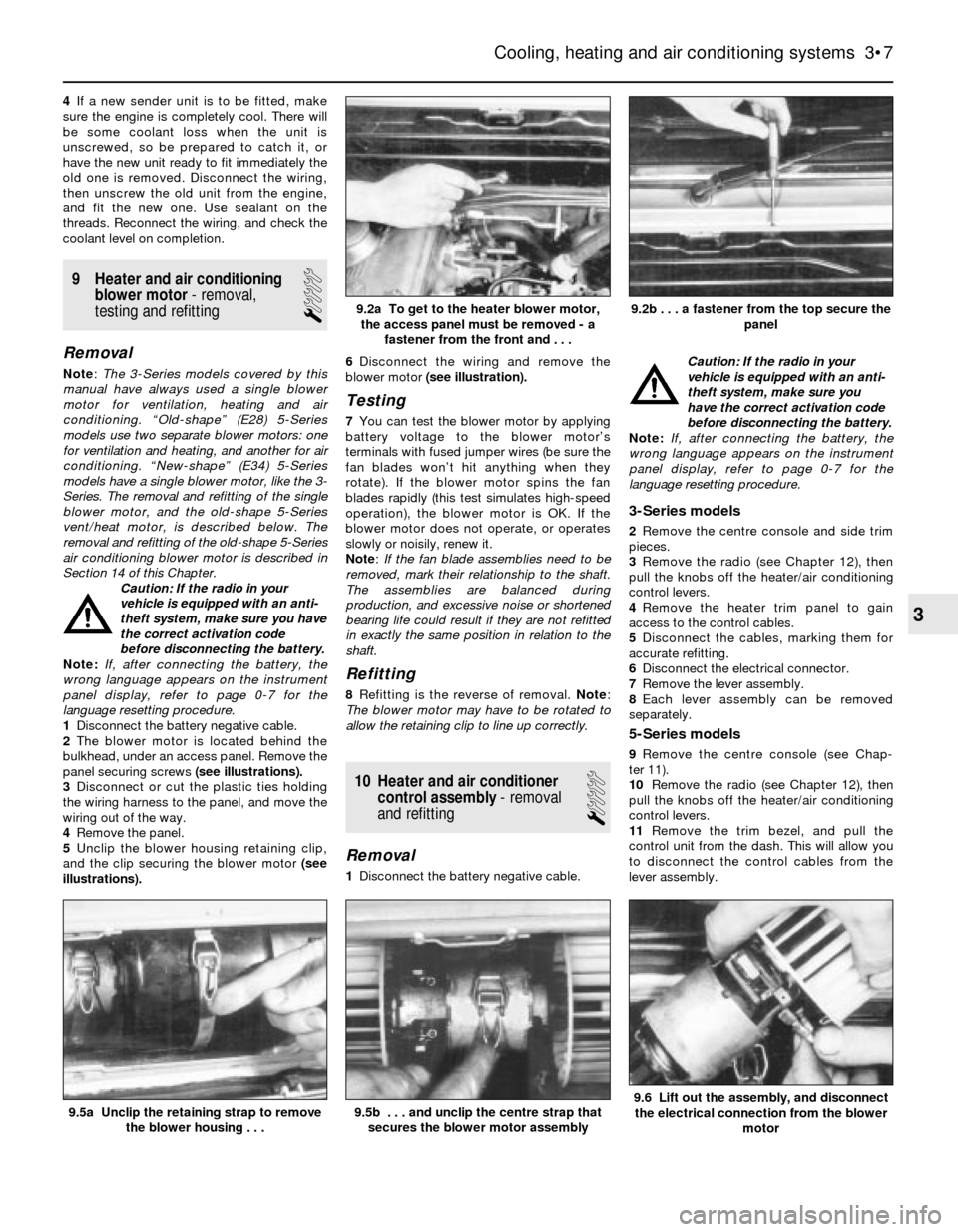
2The blower motor is located behind the
bulkhead, under an access panel. Remove the
panel securing screws (see illustrations).
3Disconnect or cut the plastic ties holding
the wiring harness to the panel, and move the
wiring out of the way.
4Remove the panel.
5Unclip the blower housing retaining clip,
and the clip securing the blower motor (see
illustrations).6Disconnect the wiring and remove the
blower motor (see illustration).
Testing
7You can test the blower motor by applying
battery voltage to the blower motor’s
terminals with fused jumper wires (be sure the
fan blades won’t hit anything when they
rotate). If the blower motor spins the fan
blades rapidly (this test simulates high-speed
operation), the blower motor is OK. If the
blower motor does not operate, or operates
slowly or noisily, renew it.
Note: If the fan blade assemblies need to be
removed, mark their relationship to the shaft.
The assemblies are balanced during
production, and excessive noise or shortened
bearing life could result if they are not refitted
in exactly the same position in relation to the
shaft.
Refitting
8Refitting is the reverse of removal. Note:
The blower motor may have to be rotated to
allow the retaining clip to line up correctly.
10 Heater and air conditioner
control assembly- removal
and refitting
1
Removal
1Disconnect the battery negative cable. Caution: If the radio in your
vehicle is equipped with an anti-
theft system, make sure you
have the correct activation code
before disconnecting the battery.
Note: If, after connecting the battery, the
wrong language appears on the instrument
panel display, refer to page 0-7 for the
language resetting procedure.
3-Series models
2Remove the centre console and side trim
pieces.
3Remove the radio (see Chapter 12), then
pull the knobs off the heater/air conditioning
control levers.
4Remove the heater trim panel to gain
access to the control cables.
5Disconnect the cables, marking them for
accurate refitting.
6Disconnect the electrical connector.
7Remove the lever assembly.
8Each lever assembly can be removed
separately.
5-Series models
9Remove the centre console (see Chap-
ter 11).
10Remove the radio (see Chapter 12), then
pull the knobs off the heater/air conditioning
control levers.
11Remove the trim bezel, and pull the
control unit from the dash. This will allow you
to disconnect the control cables from the
lever assembly.
Cooling, heating and air conditioning systems 3•7
9.5a Unclip the retaining strap to remove
the blower housing . . .
9.2b . . . a fastener from the top secure the
panel9.2a To get to the heater blower motor,
the access panel must be removed - a
fastener from the front and . . .
9.6 Lift out the assembly, and disconnect
the electrical connection from the blower
motor9.5b . . . and unclip the centre strap that
secures the blower motor assembly
3
Page 92 of 228
Note 3:The following checks assume the fuel
filter is in good condition. If you doubt the
condition of your fuel filter, renew it (see
Chapter 1).
Note 4:In order to get accurate test results, it
is recommended that the fuel pressure be
checked from both the main fuel pump and
transfer pump where applicable.
Fuel pump/transfer pump operational
check
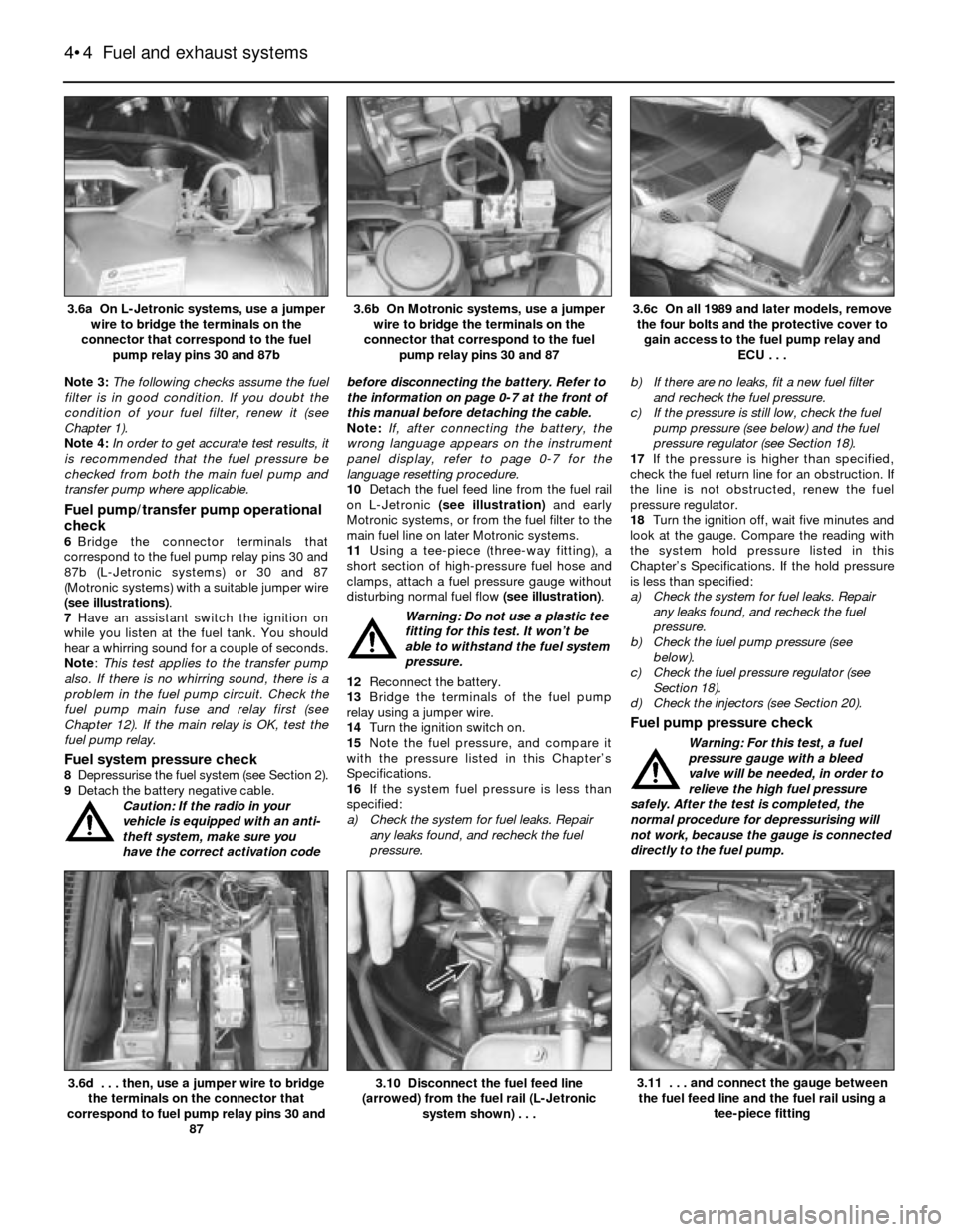
6Bridge the connector terminals that
correspond to the fuel pump relay pins 30 and
87b (L-Jetronic systems) or 30 and 87
(Motronic systems) with a suitable jumper wire
(see illustrations).
7Have an assistant switch the ignition on
while you listen at the fuel tank. You should
hear a whirring sound for a couple of seconds.
Note:This test applies to the transfer pump
also. If there is no whirring sound, there is a
problem in the fuel pump circuit. Check the
fuel pump main fuse and relay first (see
Chapter 12). If the main relay is OK, test the
fuel pump relay.
Fuel system pressure check8Depressurise the fuel system (see Section 2).
9Detach the battery negative cable.
Caution: If the radio in your
vehicle is equipped with an anti-
theft system, make sure you
have the correct activation codebefore disconnecting the battery. Refer to
the information on page 0-7 at the front of
this manual before detaching the cable.
Note: If, after connecting the battery, the
wrong language appears on the instrument
panel display, refer to page 0-7 for the
language resetting procedure.
10Detach the fuel feed line from the fuel rail
on L-Jetronic (see illustration)and early
Motronic systems, or from the fuel filter to the
main fuel line on later Motronic systems.
11Using a tee-piece (three-way fitting), a
short section of high-pressure fuel hose and
clamps, attach a fuel pressure gauge without
disturbing normal fuel flow (see illustration).
Warning: Do not use a plastic tee
fitting for this test. It won’t be
able to withstand the fuel system
pressure.
12Reconnect the battery.
13Bridge the terminals of the fuel pump
relay using a jumper wire.
14Turn the ignition switch on.
15Note the fuel pressure, and compare it
with the pressure listed in this Chapter’s
Specifications.
16If the system fuel pressure is less than
specified:
a) Check the system for fuel leaks. Repair
any leaks found, and recheck the fuel
pressure.b) If there are no leaks, fit a new fuel filter
and recheck the fuel pressure.
c) If the pressure is still low, check the fuel
pump pressure (see below) and the fuel
pressure regulator (see Section 18).
17If the pressure is higher than specified,
check the fuel return line for an obstruction. If
the line is not obstructed, renew the fuel
pressure regulator.
18Turn the ignition off, wait five minutes and
look at the gauge. Compare the reading with
the system hold pressure listed in this
Chapter’s Specifications. If the hold pressure
is less than specified:
a) Check the system for fuel leaks. Repair
any leaks found, and recheck the fuel
pressure.
b) Check the fuel pump pressure (see
below).
c) Check the fuel pressure regulator (see
Section 18).
d) Check the injectors (see Section 20).
Fuel pump pressure check
Warning: For this test, a fuel
pressure gauge with a bleed
valve will be needed, in order to
relieve the high fuel pressure
safely. After the test is completed, the
normal procedure for depressurising will
not work, because the gauge is connected
directly to the fuel pump.
4•4 Fuel and exhaust systems
3.10 Disconnect the fuel feed line
(arrowed) from the fuel rail (L-Jetronic
system shown) . . .3.6d . . . then, use a jumper wire to bridge
the terminals on the connector that
correspond to fuel pump relay pins 30 and
87
3.6c On all 1989 and later models, remove
the four bolts and the protective cover to
gain access to the fuel pump relay and
ECU . . .3.6b On Motronic systems, use a jumper
wire to bridge the terminals on the
connector that correspond to the fuel
pump relay pins 30 and 873.6a On L-Jetronic systems, use a jumper
wire to bridge the terminals on the
connector that correspond to the fuel
pump relay pins 30 and 87b
3.11 . . . and connect the gauge between
the fuel feed line and the fuel rail using a
tee-piece fitting
Page 93 of 228
19Depressurise the fuel system (see Sec-
tion 2).
20Detach the battery negative cable.
Caution: If the radio in your
vehicle is equipped with an anti-
theft system, make sure you
have the correct activation code
before disconnecting the battery. Refer to
the information on page 0-7 at the front of
this manual before detaching the cable.
Note: If, after connecting the battery, the
wrong language appears on the instrument
panel display, refer to page 0-7 for the
language resetting procedure.
21Detach the fuel feed hose from the fuel
rail, and attach a fuel pressure gauge directly
to the hose. Note:If the tee fitting is still
connected to the gauge, be sure to plug the
open end.
22Reconnect the battery.
23Using a jumper wire, bridge the terminals
of the fuel pump relay.
24Turn the ignition switch on to operate the
fuel pump.
25Note the pressure reading on the gauge,
and compare the reading to the fuel pump
pressure listed in this Chapter’s Specifica-
tions.
26If the indicated pressure is less than
specified, inspect the fuel line for leaks
between the pump and gauge. If no leaks are
found, renew the fuel pump.
27Turn the ignition off and wait five minutes.
Note the reading on the gauge, and compare
it to the fuel pump hold pressure listed in this
Chapter’s Specifications. If the hold pressure
is less than specified, check the fuel lines
between the pump and gauge for leaks. If no
leaks are found, renew the fuel pump.
28Remove the jumper wire. Relieve the fuel
pressure by opening the bleed valve on the
gauge and directing the fuel into a suitable
container. Remove the gauge and reconnect
the fuel line.
Transfer pump pressure check
29Depressurise the fuel system (see Sec-
tion 2).
30Detach the battery negative cable.
Caution: If the radio in your
vehicle is equipped with an anti-
theft system, make sure you
have the correct activation code
before disconnecting the battery. Refer to
the information on page 0-7 at the front of
this manual before detaching the cable.
Note: If, after connecting the battery, the
wrong language appears on the instrument
panel display, refer to page 0-7 for the
language resetting procedure.
31Remove the transfer pump access plate
(on some models, it’s located under the rear
seat cushion - on others, it’s located under
the carpet in the luggage compartment).
Disconnect the output hose from the transfer
pump, and connect a fuel pressure gauge to
the outlet pipe.
32Reconnect the battery.33Using a jumper wire, bridge the terminals
of the fuel pump relay.
34Turn the ignition switch on to operate the
fuel pump.
35Note the pressure reading on the gauge,
and compare to the value listed in this
Chapter’s Specifications.
36If the indicated pressure is less than
specified, renew the transfer pump.
Fuel pump relay check
37Switch on the ignition.
38Using a voltmeter, probe the following
terminals from the back of the relay electrical
connector. Check for battery voltage at
terminal 30 (M20 and M30 engines) or
terminal 15 (M10 and M40 engines). Note:If
there is no voltage on models with luggage
compartment-mounted batteries, check for a
faulty fusible link. The 50-amp link is about
6 inches from the battery, in a black wire.
39Turn the ignition off, and disconnect the
relay from the electrical connector. Using a
voltmeter, probe the connector terminals that
correspond to fuel pump relay pins 85 (-) and
86(+) on M20 and M30 engines, or terminal 50
and earth on M10 and M40 engines. Have an
assistant turn the engine over on the starter,
and observe the voltage reading. Battery
voltage should be indicated.
40If there is no voltage, check the fuse(s)
and the wiring circuit for the fuel pump relay. If
the voltage readings are correct, and the fuel
pump only runs with the jumper wire in place,
then renew the relay.
41If the fuel pump still does not run, check
for the proper voltage at the fuel pump
terminals (see Section 4). If necessary, renew
the fuel pump.
4 Fuel pump, transfer pump
and fuel level sender unit-
removal and refitting
2
Warning: Fuel is extremely
flammable, so take extra
precautions when you work on
any part of the fuel system. Don’t
smoke, or allow open flames or bare light
bulbs, near the work area. Also, don’t work
in a garage where a natural gas-type
appliance with a pilot light is present.
Fuel pump (carburettor engines)
1Disconnect the battery negative cable.
Disconnect both hoses from the pump, and
unscrew and remove the two securing nuts
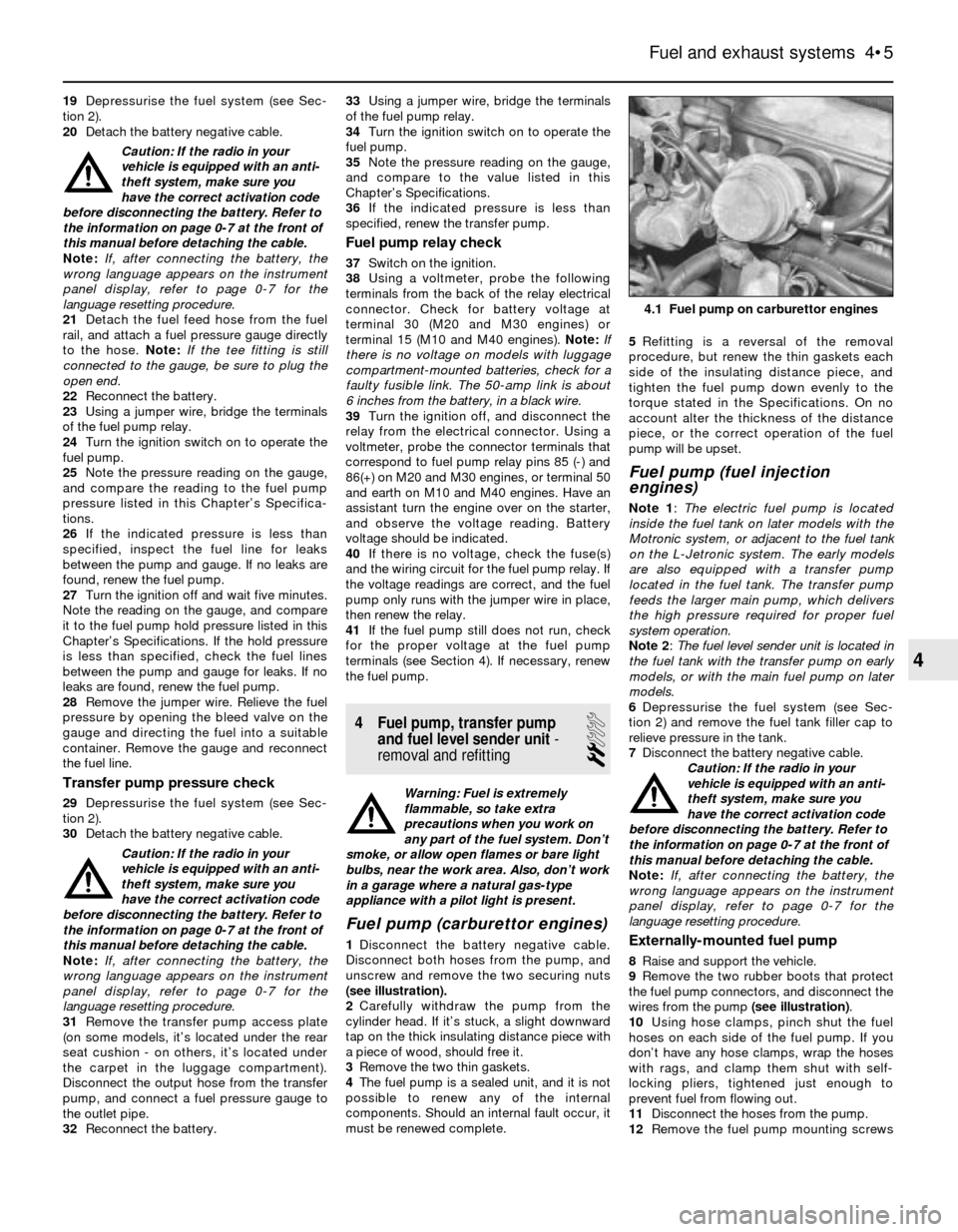
(see illustration).
2Carefully withdraw the pump from the
cylinder head. If it’s stuck, a slight downward
tap on the thick insulating distance piece with
a piece of wood, should free it.
3Remove the two thin gaskets.
4The fuel pump is a sealed unit, and it is not
possible to renew any of the internal
components. Should an internal fault occur, it
must be renewed complete.5Refitting is a reversal of the removal
procedure, but renew the thin gaskets each
side of the insulating distance piece, and
tighten the fuel pump down evenly to the
torque stated in the Specifications. On no
account alter the thickness of the distance
piece, or the correct operation of the fuel
pump will be upset.
Fuel pump (fuel injection
engines)
Note 1: The electric fuel pump is located
inside the fuel tank on later models with the
Motronic system, or adjacent to the fuel tank
on the L-Jetronic system. The early models
are also equipped with a transfer pump
located in the fuel tank. The transfer pump
feeds the larger main pump, which delivers
the high pressure required for proper fuel
system operation.
Note 2: The fuel level sender unit is located in
the fuel tank with the transfer pump on early
models, or with the main fuel pump on later
models.
6Depressurise the fuel system (see Sec-
tion 2) and remove the fuel tank filler cap to
relieve pressure in the tank.
7Disconnect the battery negative cable.
Caution: If the radio in your
vehicle is equipped with an anti-
theft system, make sure you
have the correct activation code
before disconnecting the battery. Refer to
the information on page 0-7 at the front of
this manual before detaching the cable.
Note: If, after connecting the battery, the
wrong language appears on the instrument
panel display, refer to page 0-7 for the
language resetting procedure.
Externally-mounted fuel pump
8Raise and support the vehicle.
9Remove the two rubber boots that protect
the fuel pump connectors, and disconnect the
wires from the pump (see illustration).
10Using hose clamps, pinch shut the fuel
hoses on each side of the fuel pump. If you
don’t have any hose clamps, wrap the hoses
with rags, and clamp them shut with self-
locking pliers, tightened just enough to
prevent fuel from flowing out.
11Disconnect the hoses from the pump.
12Remove the fuel pump mounting screws
Fuel and exhaust systems 4•5
4.1 Fuel pump on carburettor engines
4