body BMW 318i 1994 E36 Repair Manual
[x] Cancel search | Manufacturer: BMW, Model Year: 1994, Model line: 318i, Model: BMW 318i 1994 E36Pages: 759
Page 283 of 759
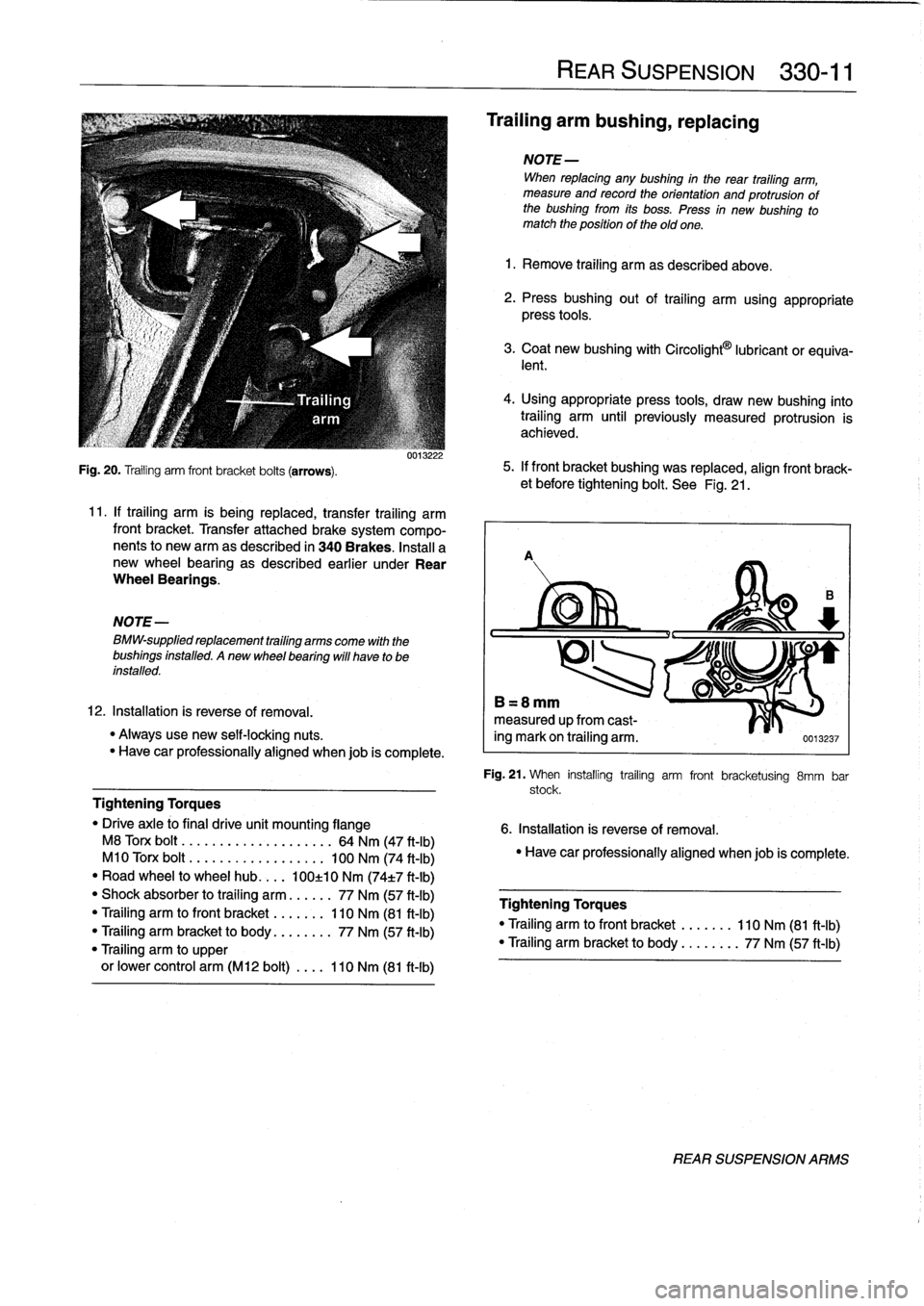
Fig
.
20
.
Trailing
arm
front
bracket
bolts
(arrows)
.
NOTE-
BMW-supplied
replacement
trailing
arms
come
with
the
bushings
installed
.
Anew
wheel
bearing
will
have
to
be
installed
.
0013222
11
.
If
trailing
arm
is
being
replaced,
transfer
trailing
arm
front
bracket
.
Transfer
attached
brake
system
compo-
nents
to
newarm
as
described
in
340Brakes
.
Insta¡¡
a
new
wheel
bearing
as
described
earlier
under
Rear
Wheel
Bearings
.
12
.
Installation
is
reverse
of
removal
.
"
Alwaysuse
new
self-locking
nuts
.
"
Have
car
professionally
aligned
when
job
is
complete
.
Tightening
Torques
"
Drive
axle
#o
final
drive
unit
mounting
flange
M8
Torx
bolt
......
.
...
.....
.
..
..
64
Nm
(47
ft-Ib)
M10
Torx
bolt
.....
...
.
....
.....
100
Nm
(74
ft-Ib)
"
Road
wheel
to
wheel
hub
.
...
100±10
Nm
(74t7
ft-Ib)
"
Shock
absorber
to
trailing
arm
......
77
Nm
(57
ft-Ib)
"
Trailing
arm
tofront
bracket
.......
110
Nm
(81
ft-Ib)
"
Trailing
arm
bracket
to
body
........
77
Nm
(57
ft-Ib)
"Trailing
arm
to
upper
or
lower
control
arm
(M12
bolt)
....
110
Nm
(81
ft-Ib)
REAR
SUSPENSION
330-
1
1
Trailing
arm
bushing,
replacing
NOTE-
When
replacing
any
bushing
in
the
rear
trailing
arm,
measure
and
recordthe
orientation
and
protrusion
of
the
bushing
from
its
boss
.
Press
in
new
bushing
to
match
the
positionof
theold
one
.
1
.
Remove
trailing
arm
as
described
above
.
2
.
Pressbushing
out
of
trailing
arm
using
appropriate
press
tools
.
3
.
Coat
new
bushing
with
Circolight
9
lubricant
or
equiva-
lent
.
4
.
Using
appropriate
press
tools,
draw
new
bushing
into
trailing
arm
until
previously
measured
protrusion
is
achieved
.
5
.
If
front
bracket
bushing
was
replaced,
alignfront
brack-
et
before
tightening
bolt
.
See
Fig
.
21
.
A
B=8mm
measured
upfrom
cast-
ing
mark
on
trailing
arm
.
0013237
Fig
.
21
.
When
installing
trailing
arm
front
bracketuising
8mm
bar
stock
.
6
.
Installation
is
reverse
of
removal
.
"
Have
car
professionally
aligned
when
job
is
complete
.
Tightening
Torques
"
Trailing
arm
tofront
bracket
.......
110
Nm
(81
ft-Ib)
"Trailing
arm
bracket
to
body
......
.
.
77
Nm
(57
ft-Ib)
REAR
SUSPENSION
ARMS
Page 285 of 759
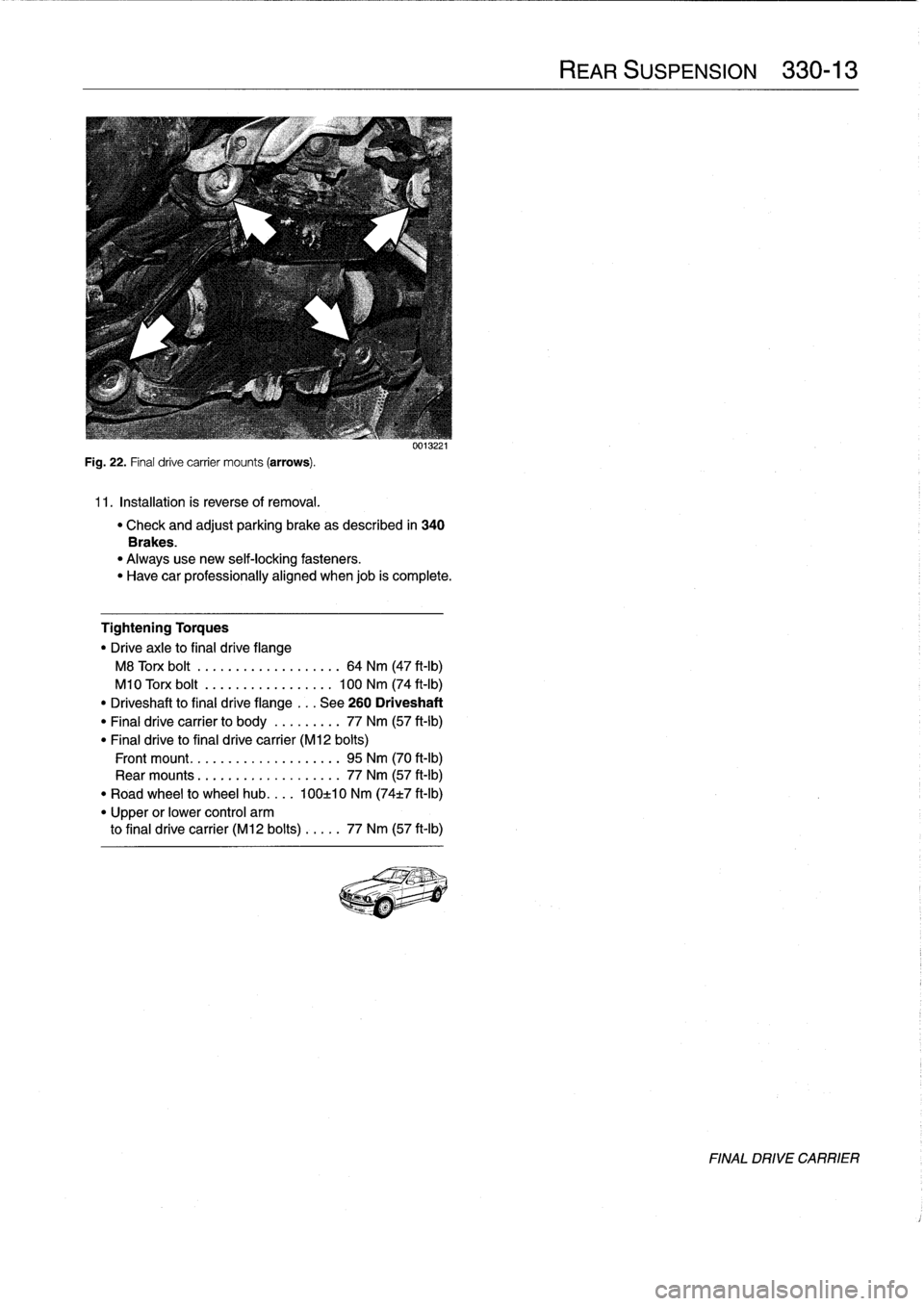
Fig
.
22
.
Final
drive
carrier
mounts
(arrows)
.
11
.
Installation
is
reverse
of
removal
.
uu1J221
"
Check
and
adjust
parking
brake
as
described
in
340
Brakes
.
"
Alwaysuse
new
self-locking
fasteners
.
"
Have
car
professionally
aligned
when
job
is
complete
.
Tightening
Torques
"
Drive
axle
to
final
drive
flange
M8
Torx
bolt
................
...
64
Nm
(47
ft-Ib)
M10
Torx
bolt
..........
..
...
.
.
100
Nm
(74
ft-Ib)
"
Driveshaft
to
final
drive
flange
...
See
260
Driveshaft
"
Final
drive
carrier
to
body
......
...
77
Nm
(57
ft-Ib)
"
Final
drive
to
final
drive
carrier
(M12
bolts)
Front
mount
.................
...
95
Nm
(70
ft-lb)
Rear
mounts
................
...
77
Nm
(57
ft-Ib)
"
Road
wheel
to
wheel
hub
....
100±10
Nm
(74t7
ft-Ib)
"
Upper
or
lower
control
arm
to
final
drive
carrier
(M12
bolts)
....
.
77
Nm
(57
ft-Ib)
Page 288 of 759
331-2
FINAL
DRIVE
Make
sure
that
the
car
is
firm1y
supportedon
Tjack
.
.-
"
:
.-
:
.
n
-
2
.
Detach
drive
axle(s)
from
final
drive
.
See330
Rear
Suspension
.
CA
UTION-
Suspend
the
detached
drive
axlefrom
the
car
body
with
a
stiff
wire
hook
to
prevent
damage
to
the
outer
CV
joint
.
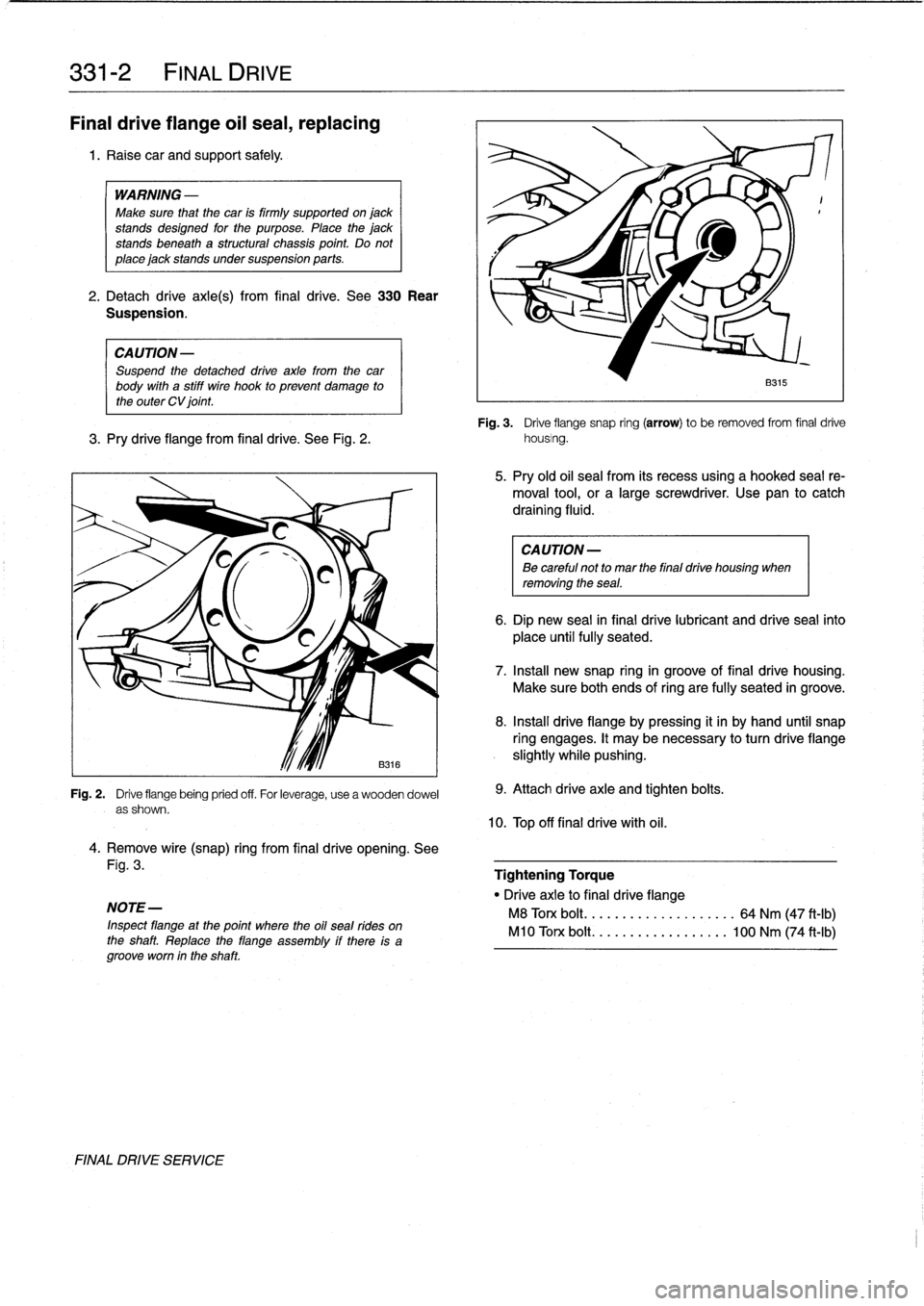
Fig
.
3
.
Drive
flange
snap
ring
(arrow)
to
be
removed
from
final
drive
3
.
Pry
drive
flange
from
final
drive
.
See
Fig
.
2
.
housing
.
Fig
.
2
.
Drive
flange
being
pried
off
.
For
leverage,
use
a
wooden
dowel
as
shown
.
4
.
Remove
wire(snap)
ring
from
final
drive
opening
.
See
Fig
.
3
.
NOTE-
Inspect
flangeat
the
point
where
the
oil
seal
rides
on
the
shaft
.
Replace
the
flange
assembly
if
there
is
agrooveworn
in
the
shaft
FINAL
DRIVE
SERVICE
9
.
Attach
drive
axle
and
tighten
bolts
.
10
.
Top
off
final
drive
with
ofl
.
B315
5
.
Pry
old
oil
sea¡
from
its
recess
using
a
hooked
seal
re-
moval
tool,
or
a
large
screwdriver
.
Use
pan
to
catch
draining
fluid
.
CA
UTION-
Be
careful
not
to
mar
the
final
drive
housing
when
removing
the
sea¡
.
6
.
Dip
new
seal
in
final
drive
lubricant
and
drive
seal
into
place
untilfully
seated
.
7
.
Insta¡¡
new
snap
ringin
groove
of
final
drive
housing
.
Make
sureboth
ends
ofring
are
fully
seated
in
groove
.
8
.
Insta¡¡
drive
flangeby
pressing
it
in
by
hand
until
snap
ring
engages
.
It
may
benecessary
to
turn
drive
flange
slightly
while
pushing
.
Tightening
Torque
"
Drive
axle
to
final
drive
flange
M8
Torx
bolt
..
..................
64
Nm
(47
ft-Ib)
M10
Torx
bolt
.
.................
100
Nm
(74
ft-Ib)
Page 290 of 759
331-
4
FINAL
DRIVE
FINAL
DRIVE
SERVICE
0013242
0013243
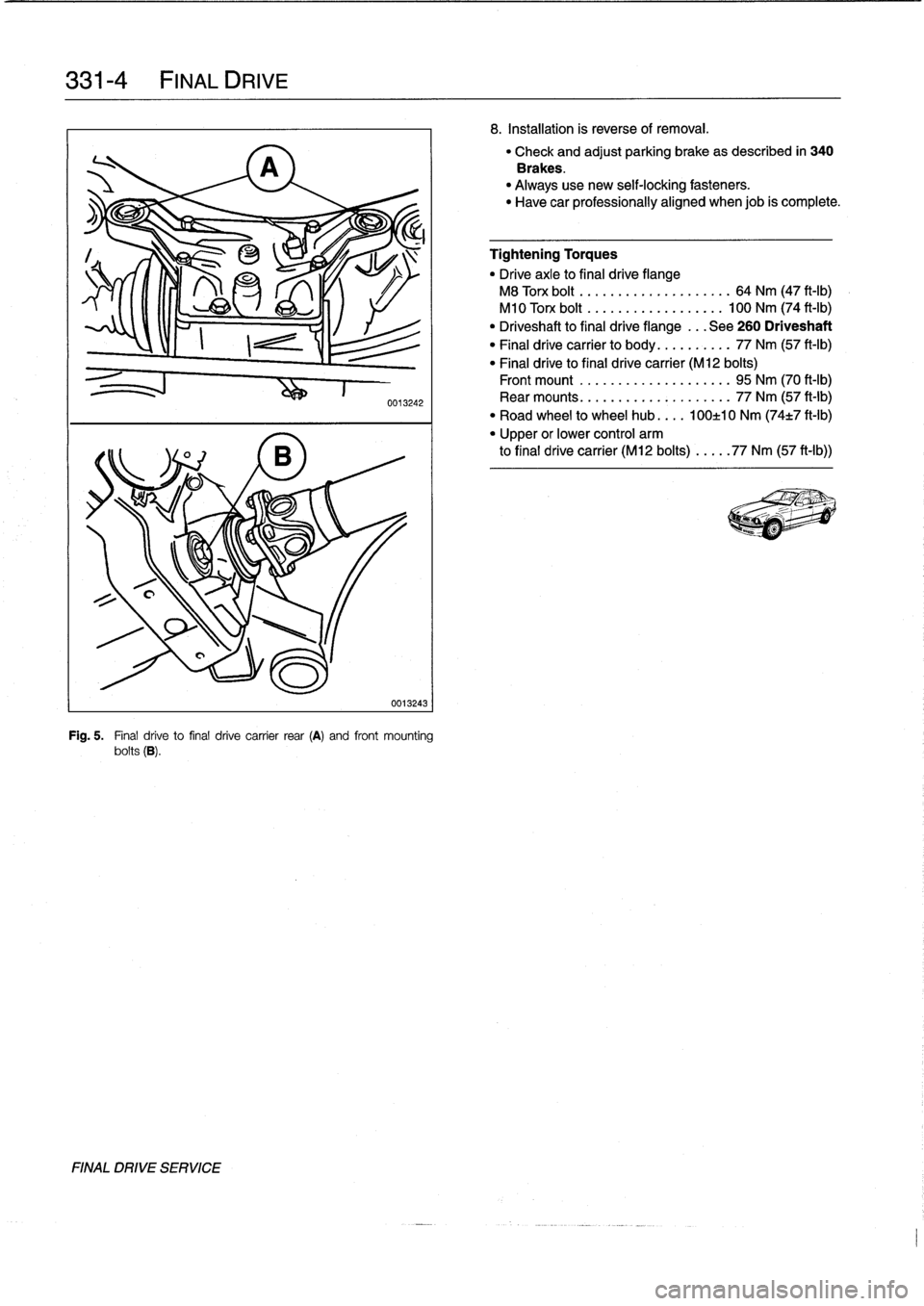
Fig
.
5
.
Final
drive
to
final
drive
carrier
rear
(A)
and
front
mounting
bolts
(B)
.
8
.
Installation
is
reverse
of
removal
.
"
Check
and
adjust
parking
brake
as
described
in
340
Brakes
.
"
Always
use
new
self-locking
fasteners
.
"
Have
car
professionally
aligned
when
job
is
complete
.
Tightening
Torques
"
Drive
axle
to
final
drive
flange
M8
Torx
bolt
..
.
...
...
..
.........
64
Nm
(47
ft-Ib)
M10
Torx
bolt
.
.
...
...
..
........
100
Nm
(74
ft-Ib)
"
Driveshaft
to
final
drive
flange
...
See
260
Driveshaft
"
Final
drive
carrier
to
body
..
........
77
Nm
(57
ft-Ib)
"
Final
drive
to
final
drive
carrier
(M12
bolts)
Front
mount
.....
...
.
...
........
95
Nm
(70
ft-Ib)
Rear
mounts
.....
.......
.
.
.
..
...
77
Nm
(57
ft-Ib)
"
Road
wheel
to
wheel
hub
....
100±10
Nm
(74±7
ft-Ib)
"
Upper
or
lower
control
arm
to
final
drive
carrier
(M12
bolts)
...
..
77
Nm
(57
ft-Ib))
Page 303 of 759
GENERAL
.
....
.
.
.
.
.
.......
.
.
.
.
.
...
.
.
.
400-1
INTERIOR
EQUIPMENT
......
.
.
.
.......
400-4
Seats
and
Seatbelts
.
.
.
.
.
.
.....
.
.
.
.
.
..
.
..
400-4
BODY
ASSEMBLY
.
.
.
.
.
.....
.
.
.
.
.
.
.
.
.
.
.400-2
Instruments
and
Controls
.
..
....
.
.
.
.
.
.
.
...
400-4
Exterior
and
Aerodynamics
....
.
.
.
.
.
.
.
.
.
.
.
400-2
Central
Body
Electronics
.......
.
.
.
...
.
...
400-5
Coupe
Models
..
.
.
.
.
.
.......
.
.
.
.
.
.
.
.
.
..
400-3
Electronic
Immobilization
System
.
.
.
...
.
...
400-5
Convertible
Models
.
.
.
.
.
.
.
.....
.
.
.
.
.
.
.
..
400-3
Heating
and
Air
Conditioning
.
...
.
.
.
.
.
.
.
...
400-6
GENERAL
This
section
covers
system
descriptions
and
general
ser-
vice
information
for
the
repair
groupsfound
in
4
Body
and
5
Body
Equipment
.
When
working
or
servicing
cars
equipped
with
SRS
air-
bag(s),
the
following
precautions
must
be
observed
to
prevent
injury
.
F19
.1
.
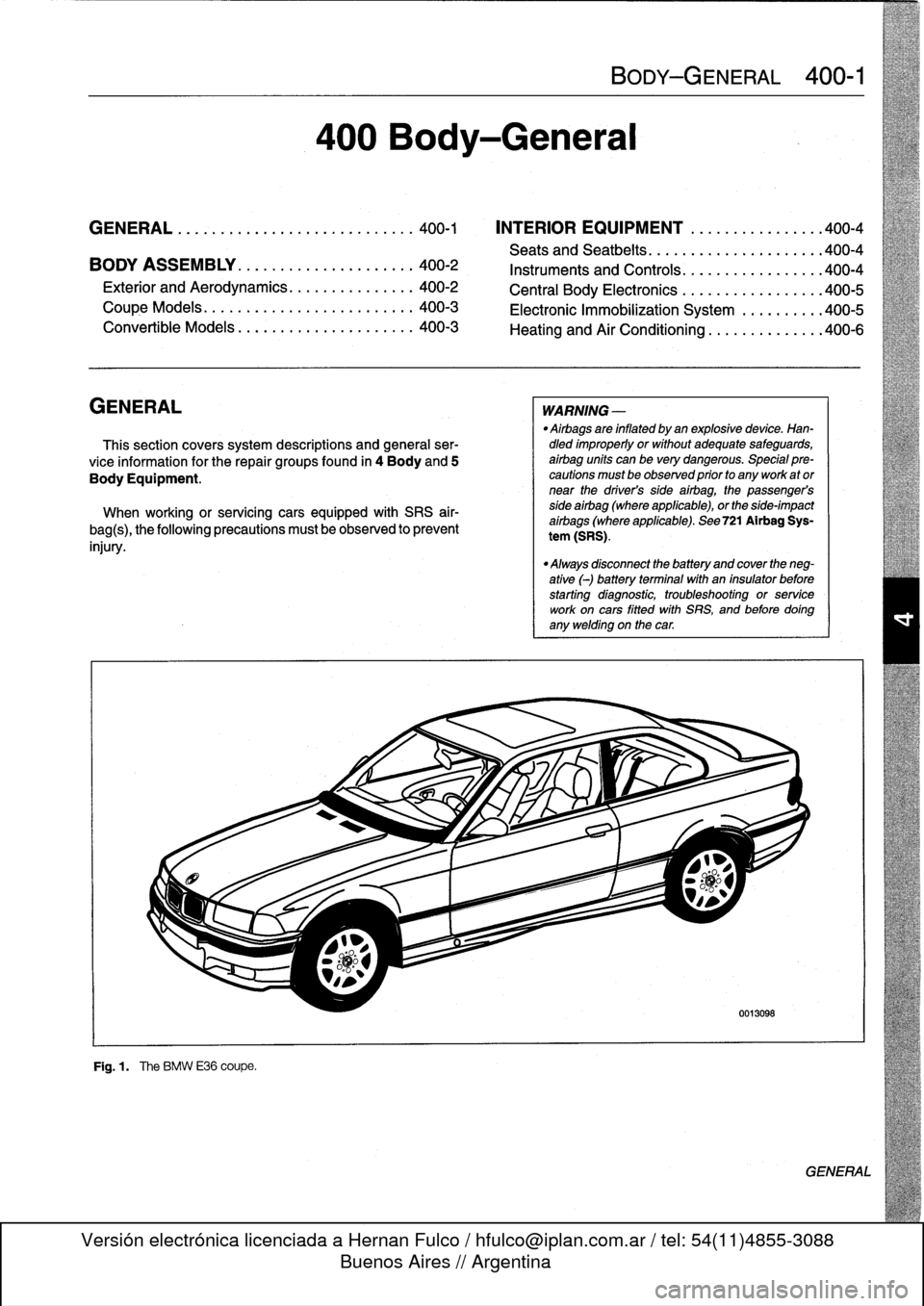
The
BMW
E36
coupe
.
400
Body-General
BODY-GENERAL
400-1
WARNING
-
"
Airbags
are
inflated
by
an
explosivedevice
.
Han-dled
improperly
or
without
adequate
safeguards,
airbag
units
can
be
very
dangerous
.
Special
pre-cautions
must
be
observed
prior
to
any
work
ator
near
the
driver's
side
airbag,
the
passenger's
side
airbag
(where
applicable),
or
the
side-impact
aírbags
(where
applicable)
.
See
721
Airbag
Sys-
tem
(SRS)
.
"
Always
disconnect
the
battery
and
cover
the
neg-
ative
(-)
battery
terminalwith
an
insulator
before
starting
diagnostic,
troubleshooting
or
service
work
oncars
fitted
with
SRS,
and
before
doíng
any
welding
on
the
car
.
0013098
GENERAL
Page 304 of 759
400-2
BODY-GENERAL
4-door
Sedan
Coupe
-
saas3
.7""
351
/
37
.3
O
I
x
`-193
267
o
oa
'3281
model
"M3
model
Convertible
BODYASSEMBLY
55
ass
.e
iss
""
-
66
.9
-
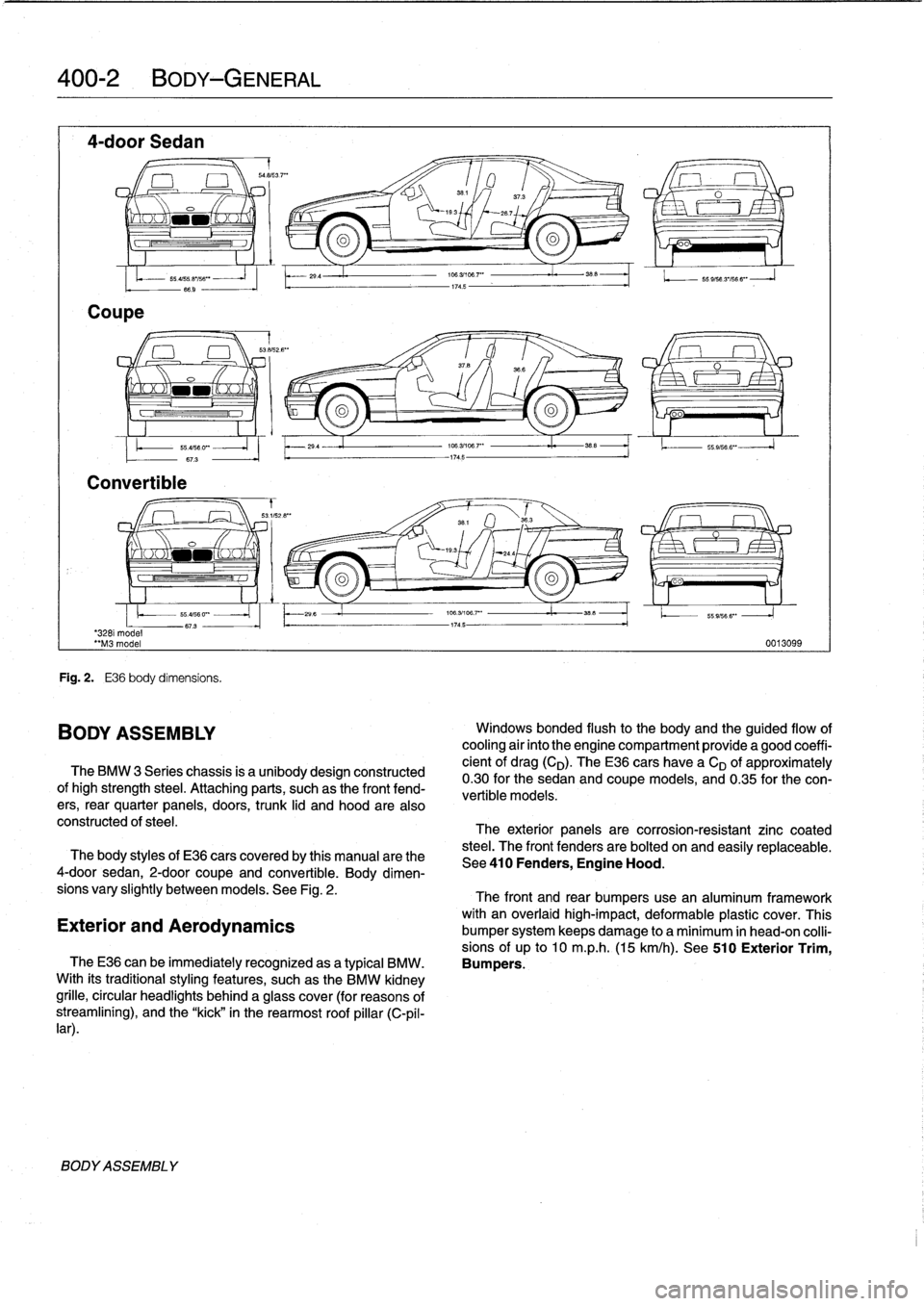
Fig
.
2
.
E36
body
dimensíons
.
BODY
ASSEMBLY
29
.4
29
4
The
BMW
3
Series
chassis
is
a
unibodydesign
constructed
ofhigh
strength
steel
.
Attaching
parts,
suchas
the
front
fend-
ers,
rear
quarter
panels,
doors,
trunk
lid
and
hood
are
also
constructed
of
steel
.
706
.31108
.7"
I
38
.5
174
.5
174
.5
O
oo
196
.3/106
.7'
"
35_5
1.
.
55
.9,566
".
106
.3/196
.7""
i.
358
-1745-
55
9/56
3'/56
6"
-
J
0013099
Windows
bonded
flush
to
the
body
and
the
guided
flow
of
cooling
air
into
the
engine
compartment
provide
a
good
coeffi-
cient
of
drag(CD)
.
TheE36
cars
have
a
CD
of
approximately
0
.30for
the
sedan
and
coupe
models,
and
0
.35
for
the
con-
vertible
models
:
The
exterior
panels
are
corrosion-resistant
zinc
coated
steel
.
The
front
fenders
are
bolted
on
and
easily
replaceabie
.
The
body
styles
of
E36
cars
coveredby
this
manual
arethe
See410
Fenders,
Engine
Hood
.
4-door
sedan,
2-door
coupe
and
convertible
.
Body
dimen-
sions
vary
slightly
betweenmodels
.
See
Fig
.
2
.
The
front
and
rear
bumpers
use
an
aluminum
framework
with
an
overlaid
high-impact,
deformable
plastic
cover
.
This
Exterior
and
Aerodynamics
bumper
system
keeps
damage
to
a
minimum
in
head-on
colli-
sions
of
up
to
10
m
.p
.h
.
(15
km/h)
.
See
510
Exterior
Trim,
TheE36
can
be
immediatelyrecognized
asa
typical
BMW
.
Bumpers
.
With
its
traditionalstyling
features,
suchas
the
BMW
kidney
grille,
circular
headlights
behind
a
glass
cover
(for
reasons
of
streamliníng),
and
the
"kick"
in
the
rearmost
roof
pillar
(C-pil-
lar)
.
Page 305 of 759
TheE36
convertible
is
an
all-season
vehicle
with
a
high
lev-
e¡offunctionality,
excellent
interior
comfort,
and
acoustic
re-
finement
.
Interior
materials
and
colors,
the
soft
top
and
the
light-alloy
wheelshave
been
carefully
matched
.
Various
versions
of
manual
and
automatic
soft
tops
have
been
used,
with
the
fully
automatic
convertible
roof
being
in-
stalled
beginning
in
the
1997
model
year
.
A
hard-top
in
body
color
with
heated
rear
window
is
avail-
ableas
an
option
for
the
cold
season
.
BODY-GENERAL
400-
3
Coupe
Models
The
convertible
body
structure
includes
many
passive
safe-
ty
refinements
over
its
fixed-top
counterparts
.
Some
of
the
en-
TheE36
coupe
is
similar
to
the4-door
sedan,
but
has
a
hancements
include
:
more
stretched
and
sleeker
appearance
.
Thus,
with
the
same
wheelbase
and
identicallength,
it
looks
different
but
still
famil-
"
More
rígíd
underbody
.
iar
.
"
Transverse
seat
members
.
"
Reinforced
windshield
frame
with
bonded
windshield,
The
2-door
variant
differs
from
the
4-door
sedan
by
a
3
.12
and
tubular
door
reinforcements
.
inch
(8
cm)
longer
front
end,
a
flatter
hood
line
with
air
slits,
"
Rollover
protection
system,
which
is
tripped
into
position
and
a
roof
almost
1
.2
inches
(3
cm)
shorter
.
Additional
differ-
in
a
fraction
of
second
.
This
is
available
as
optional
ences
include
wider
doors
with
frameless
Windows,
glass-
equipment
(standard
on
the
1998
328iC)
and
may
be
fit-
covered
door-posts
(B-pillars)
and
a
shorter
and
lower
lug-
ted
to
earlier
convertible
models
.
With
this
feature,
two
gage
compartment
lid
.
bars
fully
independent
of
each
other
come
up
behind
each
rear-seat
backrest
when
the
vehicle
is
in
danger
of
Convertible
Models
turning
over
.
A
convertible
body
normally
flexes
and
vibrates,
transfer-
ring
oscillations
to
the
luggage
compartment
.
In
the
E36
con-
vertible,
BMW
utilizes
a
special
battery
in
the
luggage
compartment,
in
conjunction
with
a
unique
battery
tray,
asa
vibration
dampening
system
to
counteract
thisoscillation
.
CAUTION
-
The
E36
convertible
requires
a
specialbattery
which
is
designed
for
constant
vibration
.
Information
for
the
convertible
top
and
its
related
mecha-
nisms
can
be
found
541
Convertible
Top
.
BODYASSEMBLY
Page 306 of 759
400-
4
BODY-GENERAL
INTERIOR
EQUIPMENT
E36
interiors
have
a
unique
character,
with
a
combínation
of
sporty
features
and
innovative
design
.
Al¡
body
versions
were
made
in
a
wide
choice
of
interior
and
exterior
colors
.
New
colors
with
matching
leather
and/or
fabric
upholstery
were
in-
troduced
for
each
model
year,
including
light-alloy
wheels
in
new
designs
.
Driving
comfort
is
enhanced
by
power
steering,
tilt
steering
wheel
(optional),
height-adjustable
front
seats,
and
electrical-
ly
adjustable
and
heated
rear-view
mirrors
.
Inside
thecar
there
are
reading
lights
at
four
seating
positions
.
Seats
and
Seat
Belts
NOTE-
Theseat
base
usedon
cars
with
pyrotechnic
seatbelt
Anatom¡cal
ly-correct
seats
are
constructed
from
polyure-
tensioners
is
not
interchangeable
with
the
earlier
seat
thane
foam
containing
areas
or
"zones"
of
different
firmness
.
base
.
The
seat
bases
have
steel
springs
for
added
support
and
strength
.
The
power
seats
are
provided
with
conveniently
lo-
Instruments
and
Controls
cated
switches
along
the
outside
edge
of
the
seat
.
Heated
seats
are
an
option
in
all
models
.
See
520
Seats
for
more
de-
Everything
in
the
interior
passenger
compartment
essential
tails
.
to
the
driver
is
logically
grouped
and
easy
to
reach
.
Al¡
instru-
ments
and
controls
havebeen
arranged
ergonomically
and
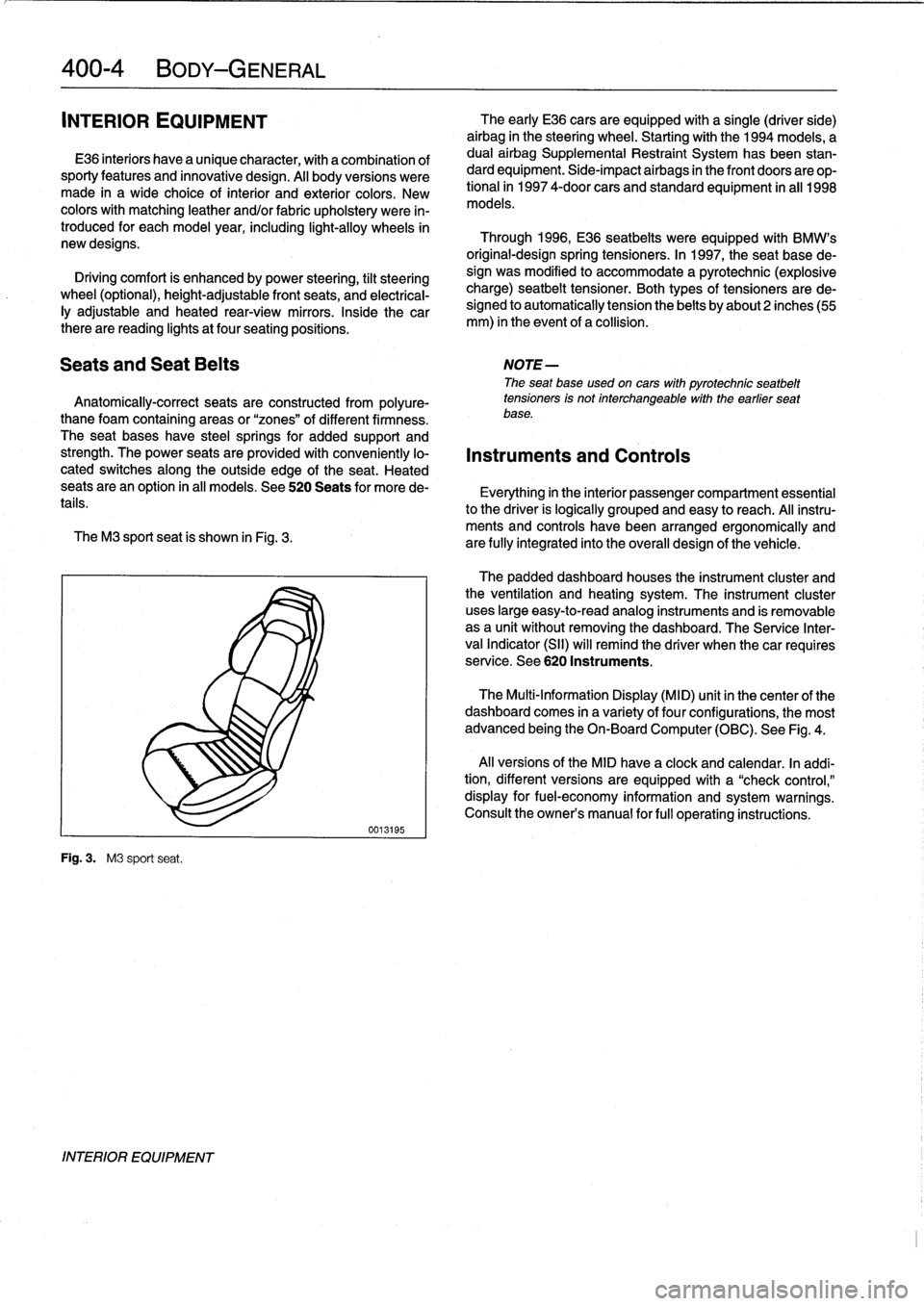
The
M3
sport
seat
is
shown
in
Fig
.
3
.
are
fully
integrated
into
the
overall
design
of
the
vehicle
.
Fig
.
3
.
M3
sport
seat
.
INTERIOR
EQUIPMENT
0013195
The
early
E36
cars
areequipped
with
a
single
(driver
side)
airbag
in
the
steering
wheel
.
Startingwith
the
1994
models,
a
dual
airbag
Supplemental
Restraint
System
has
been
stan-
dard
equipment
.
Side-impact
airbags
in
the
front
doors
are
op-
tional
in
1997
4-door
cars
and
standard
equipment
in
all
1998
models
.
Through
1996,
E36
seatbelts
were
equipped
with
BMW's
original-designspring
tensioners
.
In
1997,
the
seat
base
de-
sign
was
modified
to
accommodate
a
pyrotechnic
(explosive
charge)
seatbelt
tensioner
.
Both
types
of
tensioners
arede-
signed
to
automatically
tension
the
belts
by
about2
inches(55
mm)
in
the
event
of
a
collision
.
The
padded
dashboard
houses
the
instrument
cluster
and
the
ventilation
and
heating
system
.
The
instrument
cluster
uses
large
easy-to-read
analog
instruments
and
is
removable
as
a
unit
without
removing
the
dashboard
.
The
Service
Inter-
val
Indicator
(SII)
will
remind
the
driver
when
thecar
requires
service
.
See
620
Instruments
.
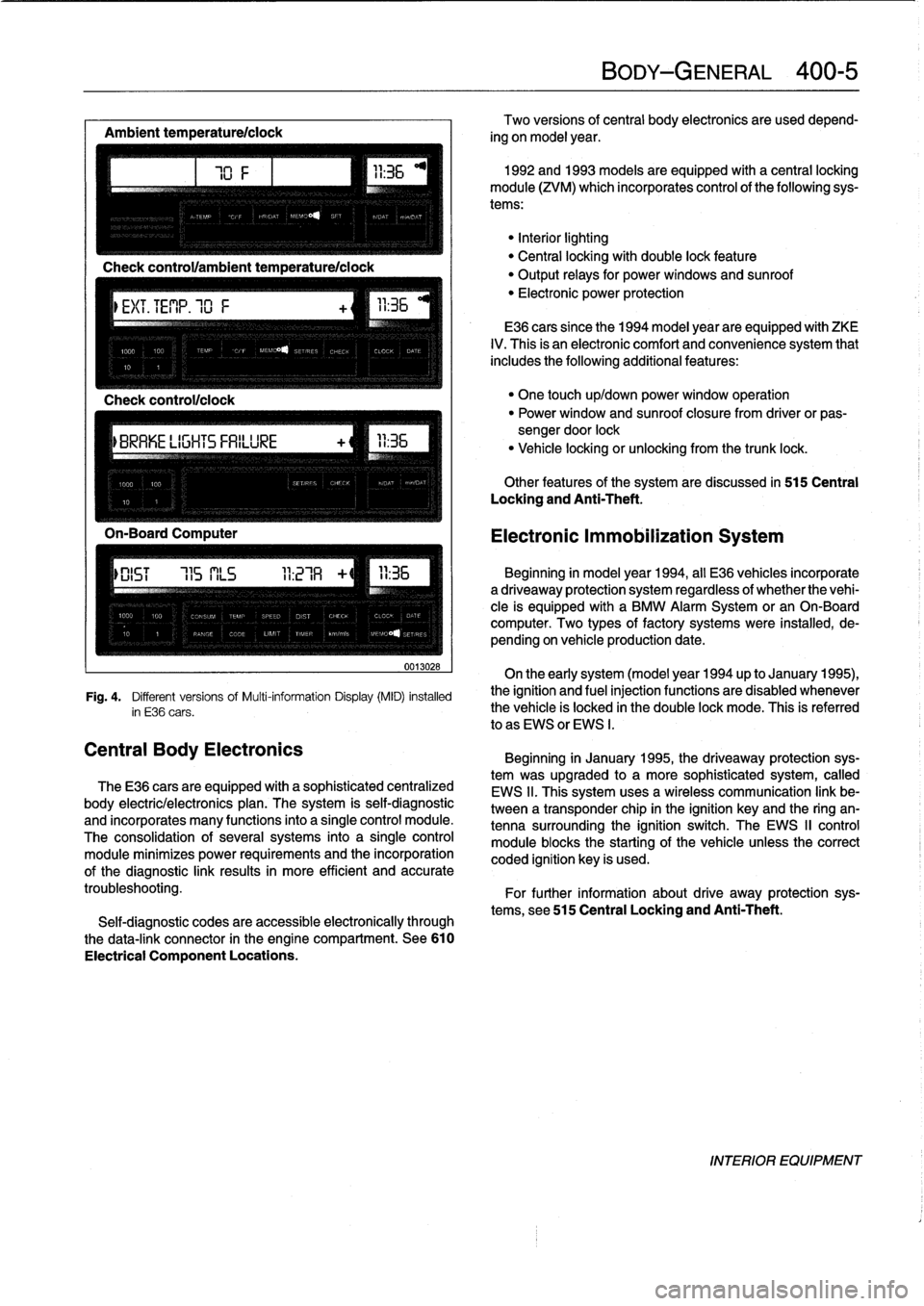
The
Multi-Information
Display
(MID)
unit
in
thecenter
of
the
dashboard
comes
in
a
variety
of
four
configurations,
the
most
advanced
being
the
On-Board
Computer
(OBC)
.
See
Fig
.
4
.
Al¡
versions
of
the
MID
have
a
clock
and
calendar
.
In
addi-
tion,
different
versions
areequipped
with
a
"check
control,"
display
for
fuel-economy
information
and
system
warnings
.
Consult
the
owner's
manual
for
fui¡
operating
instructions
.
Page 307 of 759
Ambient
temperaturelclock
MÍM
Aa
.Mi}rm
-Mil"
IMua~naa~u~itacar
"
za
.~
Central
Body
Electronics
0013028
Fig
.
4
.
Different
versionsof
Multi-information
Display(MID)
installed
in
E36
cars
.
The
E36
cars
are
equipped
with
a
sophisticated
centralized
body
electric/electronics
plan
.
The
system
is
self-diagnostic
and
incorporates
many
functions
into
a
single
control
module
.
The
consolidation
of
several
systems
into
a
single
control
module
minimizes
power
requirements
and
the
incorporation
of
the
diagnostic
link
results
in
more
efficient
and
accurate
troubleshooting
.
Self-diagnostic
codes
are
accessible
electronically
through
the
data-link
connector
in
the
engine
compartment
.
See610
Electrical
Component
Locations
.
BODY-GENERAL
400-
5
Two
versions
of
central
body
electronics
are
used
depend-
ing
on
model
year
.
1992
and
1993
models
are
equipped
with
a
central
locking
module
(ZVM)
which
incorporates
control
of
the
following
sys-
tems
:
"Interiorlighting
"
Central
locking
with
double
lock
feature
"
Output
relays
for
powerwindows
and
sunroof
"
Electronic
power
protection
E36
cars
since
the
1994
model
year
are
equipped
with
ZKE
IV
.
This
is
an
electronic
comfort
and
convenience
system
that
includes
the
following
additional
features
:
"
One
touch
up/down
power
window
operation
"
Power
window
and
sunroof
closure
from
driver
or
pas-
sengerdoor
lock
"
Vehicle
locking
or
unlocking
from
the
trunk
lock
.
Other
features
of
the
system
are
discussed
in
515
Central
Locking
and
Anti-Theft
.
Electronic
Immobilization
System
Beginning
in
model
year
1994,
all
E36
vehicles
incorporate
adriveaway
protection
system
regardless
of
whether
the
vehi-
cle
is
equipped
with
a
BMW
Alarm
System
or
an
On-Board
computer
.
Two
types
of
factory
systems
were
installed,
de-
pending
on
vehicle
production
date
.
On
the
early
system
(model
year
1994
up
to
January
1995),
the
ignition
and
fuel
injection
functions
are
disabled
whenever
the
vehicle
is
locked
in
the
double
lock
mode
.
This
is
referred
lo
as
EWS
or
EWS
I
.
Beginning
in
January
1995,
the
driveaway
protection
sys-
tem
was
upgraded
to
a
more
sophisticated
system,
called
EWS
II
.
This
system
uses
a
wireless
communication
link
be-
tween
a
transponder
chip
in
the
ignition
keyand
the
ring
an-
tenna
surrounding
the
ignition
switch
.
The
EWS
II
control
module
blocksthe
starting
of
the
vehicle
unlessthe
correct
coded
ignition
key
is
used
.
For
further
information
about
drive
away
protection
sys-
tems,
see
515
Central
Locking
and
Anti-Theft
.
INTERIOR
EQUIPMENT
Page 308 of 759
400-
6
BODY-GENERAL
Heating
and
Air
Conditioning
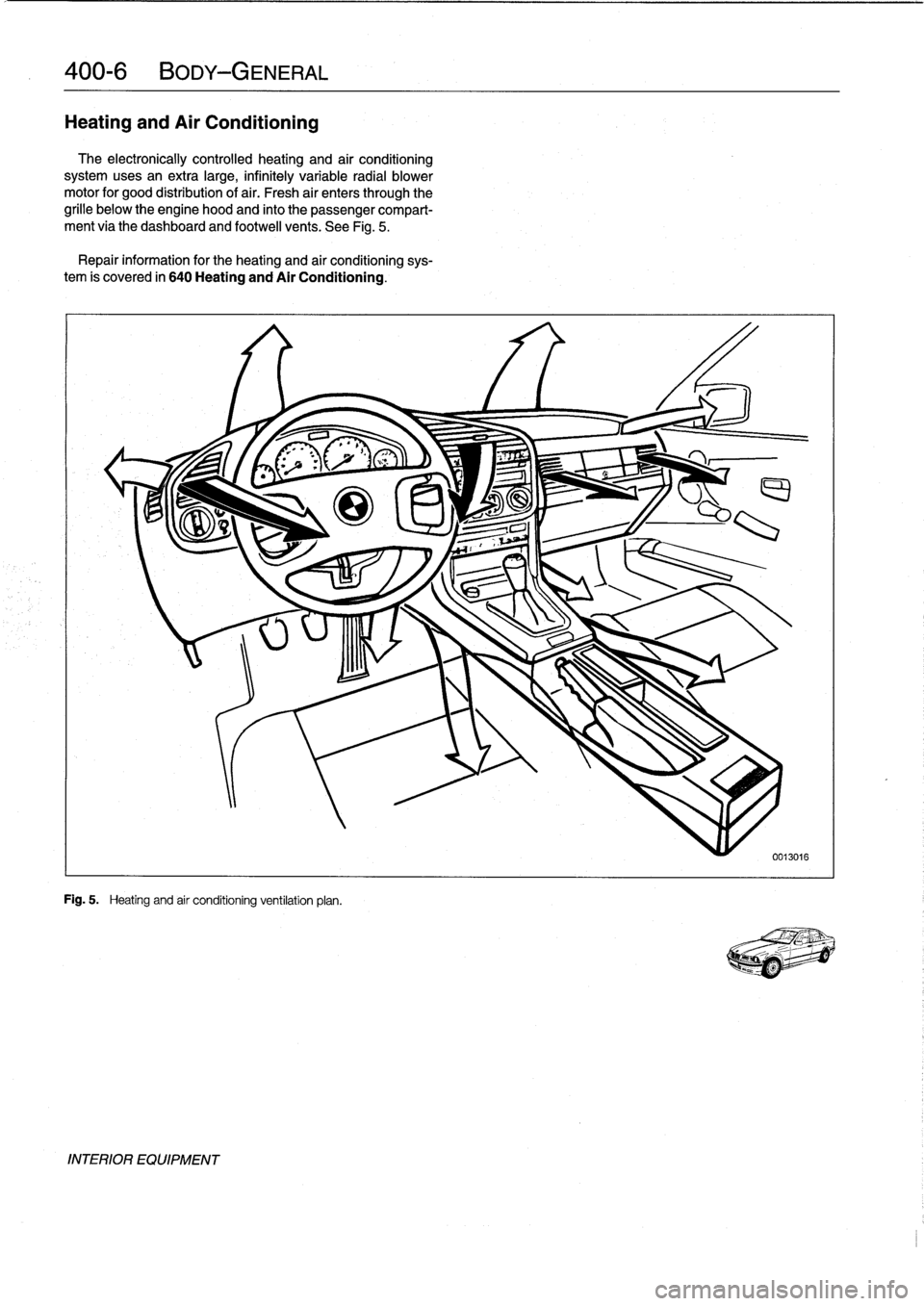
The
electronically
controlled
heating
and
air
conditioning
systemusesan
extra
large,
infinitely
variable
radial
blower
motor
for
good
distribution
of
air
.
Fresh
air
enters
through
the
grille
below
the
engine
hood
and
finto
the
passenger
compart-
ment
via
the
dashboard
and
footwell
vents
.
See
Fig
.
5
.
Repair
information
for
the
heating
and
air
conditioning
sys-
tem
is
covered
in
640
Heating
and
Air
Conditioning
.
Fig
.
5
.
Heating
and
air
conditioning
ventilation
plan
.
INTERIOR
EQUIPMENT