Exhaust BMW 318i 1996 E36 Repair Manual
[x] Cancel search | Manufacturer: BMW, Model Year: 1996, Model line: 318i, Model: BMW 318i 1996 E36Pages: 759
Page 200 of 759
170-6
RADIATOR
AND
COOLING
SYSTEM
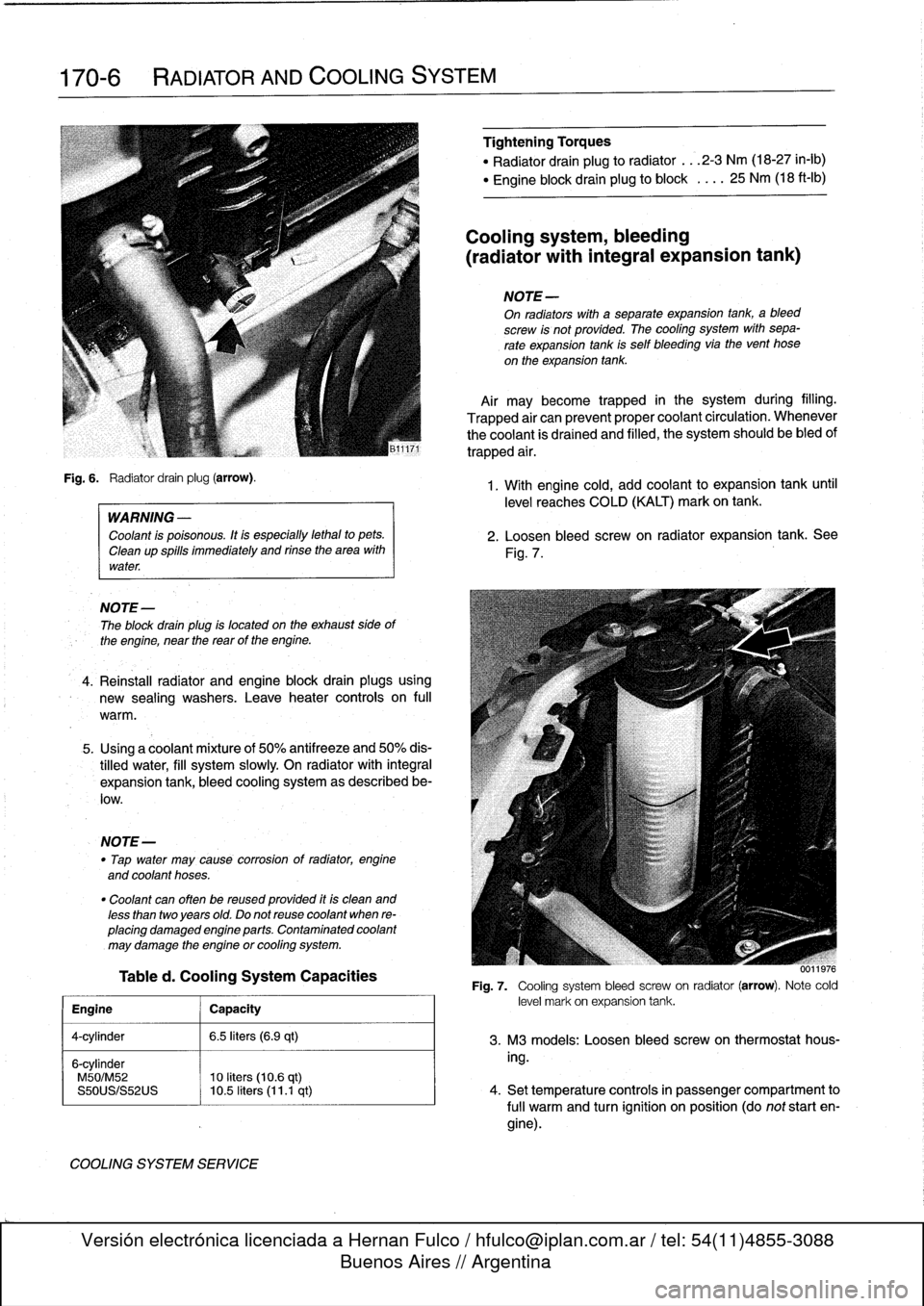
Fig
.
6
.
Radiator
drain
plug
(arrow)
.
WARNING
-
Coolant
is
poisonous
.
Itis
especially
lethal
to
pets
.
Cleanup
spills
immediately
and
rinse
the
area
with
water
.
NOTE
-
The
block
drain
plug
is
located
on
the
exhaust
side
of
the
engine,
near
the
reas
of
the
engine
.
4
.
Reinstall
radiator
and
engine
block
drain
plugsusing
new
sealing
washers
.
Leave
heater
controis
on
full
warm
.
5
.
Using
a
coolantmixture
of
50%
antifreeze
and
50%
dis-
tilled
water,
fill
system
slowly
On
radiator
with
integral
expansion
tank,
bleed
cooling
system
as
described
be-
low
.
NOTE-
"
Tap
water
may
cause
corrosion
of
radiator,
engine
and
coolant
hoses
.
"
Coolant
can
often
be
reused
provided
itis
clean
and
less
than
twoyears
old
.
Do
not
reuse
coolant
when
re-
placing
damaged
engine
parts
.
Contaminated
coolant
may
damage
the
engine
or
cooling
system
.
Tabled
.
Cooling
System
Capacities
Engine
j
Capacity
4-cylinder
1
6
.5
liters
(6.9
qt)
6-cylinder
M50/M52
10
liters
(10
.6
qt)
S50US/S52US
10
.5
liters
(11
.1
qt)
COOLING
SYSTEM
SERVICE
Tightehing
Torques
"
Radiator
drain
plug
to
radiator
...
2-3
Nm
(18-27
in-lb)
"
Engine
block
drain
plug
to
block
.
.
..
25
Nm
(18
ft-Ib)
Cooling
system,
bleeding
(radiator
with
integral
expansion
tank)
NOTE
-
On
radiators
with
a
separate
expansion
tank,
ableed
screw
is
not
provided
.
The
cooling
system
with
sepa-
rate
expansion
tank
is
self
bleeding
via
the
vent
hose
on
the
expansion
tank
.
Air
maybecome
trapped
in
the
system
during
filling
.
Trapped
air
can
prevent
proper
coolant
circulation
.
Whenever
the
coolant
is
drained
and
filled,
the
system
should
be
bled
of
trapped
air
.
1
.
With
engine
cold,
add
coolant
to
expansion
tank
until
level
reaches
COLD
(KALT)
mark
on
tank
.
2
.
Loosen
bleed
screw
on
radiator
expansion
tank
.
See
Fig
.
7
.
0011976
Fig
.
7
.
Cooling
system
bleed
screwon
radiator
(arrow)
.
Note
cold
level
mark
on
expansion
tank
.
3
.
M3
models
:
Loosen
bleed
screw
on
thermostathous-
ing
.
4
.
Set
temperature
controls
in
passenger
compartment
to
fui¡
warm
and
turn
ignition
on
position
(do
not
start
en-
gine)
.
Page 207 of 759
GENERAL
.
.
.......
.
......
.
...
.
.
.
.
.
...
180-1
Exhaust
system,
removing
and
installing
.
...
.180-3
EXHAUST
SYSTEM
REPLACEMENT
.
...
180-1
Exhaust
manifolds,
removing
and
installing
.
.
.180-5
GENERAL
The
exhaust
system
is
designed
to
be
maintenance
free,
al-
though
regular
inspection
is
warranted
due
to
the
harsh
oper-
atingconditions
.
Under
normal
conditions,
the
catalytic
converter
does
not
require
replacement
unless
it
is
damaged
.
On
1996
and
later
cars,
a
pre-
and
post-catalytic
converter
oxygen
sensor
is
used
at
each
catalytic
converter
.
Be
sure
to
take
care
when
removingthe
system
not
to
damage
the
sen-
EXHAUST
SYSTEMREPLACEMENT
sors
.
See
130
Fuel
Injection
for
information
on
testing
oxygen
sensors
.
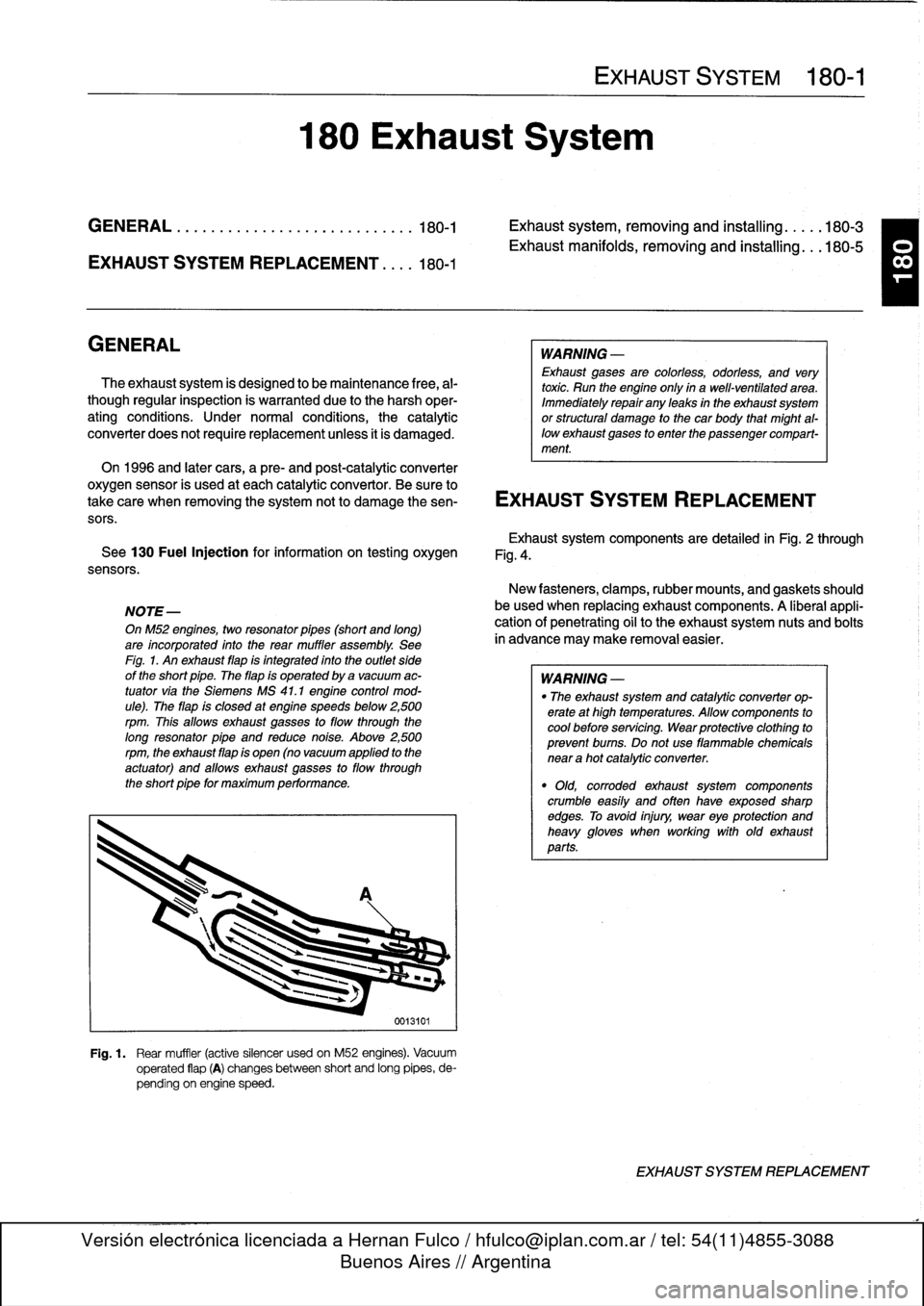
NOTE-
OnM52
engines,
two
resonator
pípes
(short
and
long)
are
incorporated
into
the
rear
muffler
assembly
.
See
Fíg
.
1
.
An
exhaust
flap
is
integrated
into
the
outlet
side
of
the
short
pipe
.
The
flap
is
operated
by
a
vacuum
ac-
tuator
via
the
Siemens
MS
41
.1
engine
control
mod-
ule)
.
The
flap
is
closed
at
engine
speeds
below
2,500
rpm
.
This
allows
exhaust
gasses
to
flow
through
the
long
resonator
pipe
and
reduce
noise
.
Above
2,500rpm,
the
exhaust
flap
is
open
(no
vacuum
applied
to
the
actuator)
and
allows
exhaust
gasses
to
flow
through
the
short
pipe
for
maximum
performance
.
180
Exhaust
System
0013101
Fig
.
1
.
Rear
muffler
(active
silencer
usedon
M52
engines)
.
Vacuum
operated
flap
(A)
changesbetween
short
and
long
pipes,
de-
pending
on
engine
speed
.
EXHAUST
SYSTEM
180-1
WARNING
-
Exhaust
gases
are
colorless,
odorless,
and
very
toxic
.
Run
the
engine
only
ín
a
well-ventilated
area
.
Immediately
repair
any
leaks
in
the
exhaust
system
or
structural
damage
to
the
car
body
that
might
al-
lowexhaust
gases
to
enter
the
passenger
compart-
ment
.
Exhaustsystem
components
are
detailed
in
Fig
.
2
through
Fig
.
4
.
New
fasteners,
clamps,rubber
mounts,
and
gaskets
should
be
used
when
replacing
exhaust
components
.
A
liberal
appli-
cationof
penetrating
oil
to
the
exhaustsystem
nuts
and
bolts
in
advance
may
make
removal
easier
.
WARNING
-
"
The
exhaust
system
and
catalytic
converter
op-
erate
at
high
temperatures
.
Allow
components
to
cool
before
servicing
.
Wear
protectíve
clothíng
to
prevent
bums
.
Do
not
use
flammable
chemicals
near
a
hot
catalytic
converter
.
"
Old,
corroded
exhaust
system
components
crumble
easíly
and
often
have
exposed
sharp
edges
.
To
avoid
injury,
wear
eye
protection
and
heavy
gloves
when
working
with
old
exhaust
parts
.
EXHAUST
SYSTEM
REPLACEMENT
T
Page 208 of 759
180-2
EXHAUST
SYSTEM
a
EXHAUST
SYSTEM
REPLACEMENT
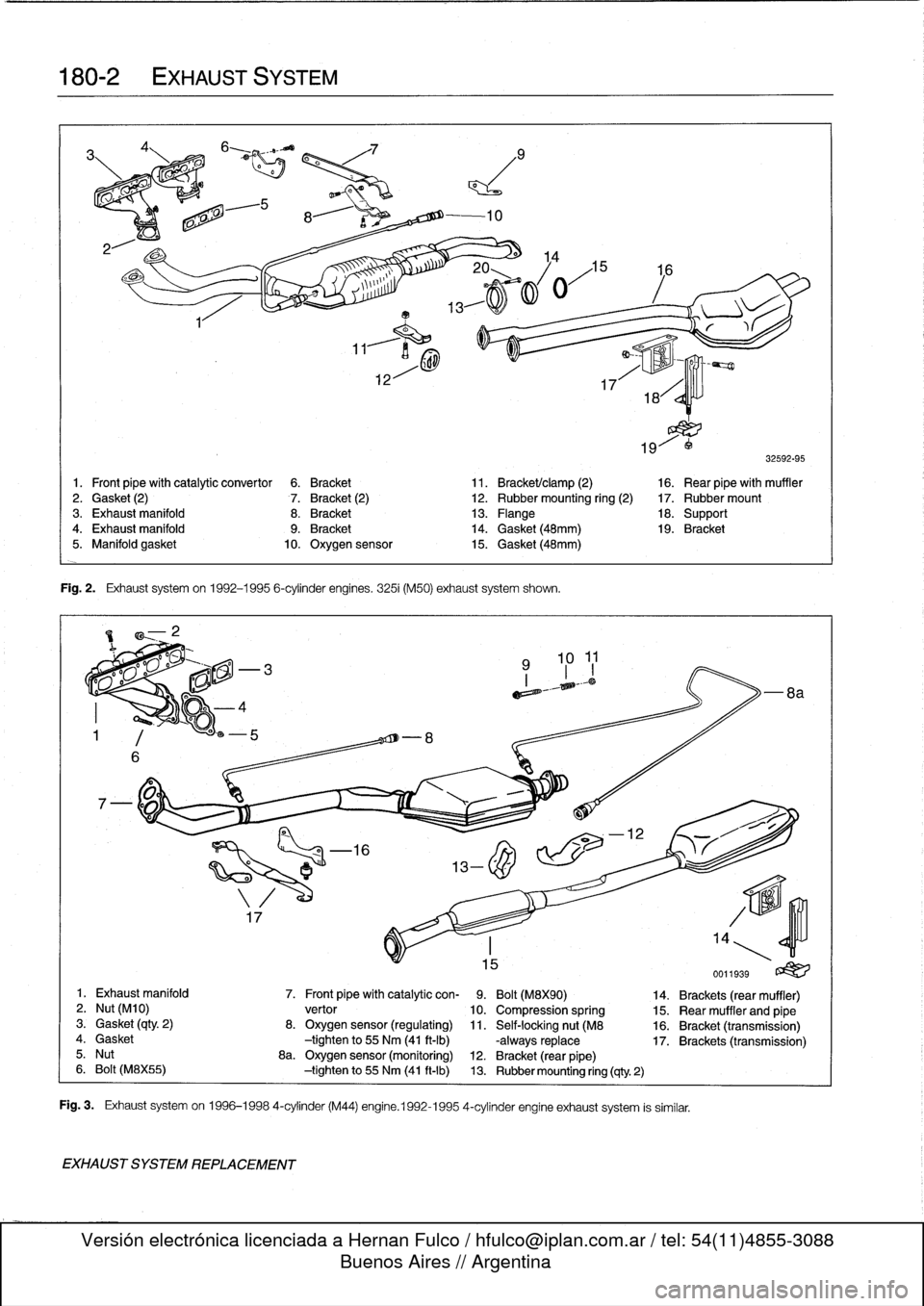
Fig
.
2
.
Exhaust
systemon
1992-1995
6-cylinder
engines
.
3251
(M50)
exhaust
system
shown
.
E~
)l-,malo
m~=
i
32592-95
1
.
Front
pipe
with
catalytic
convertor
6
.
Bracket
11
.
Bracket/clamp
(2)
16
.
Rear
pipewith
muffler
2
.
Gasket
(2)
7
.
Bracket
(2)
12
.
Rubber
mounting
ring
(2)
17
.
Rubber
mount
3
.
Exhaust
manifold
8
.
Bracket
13
.
Flange
18
.
Support4
.
Exhaust
manifold
9
.
Bracket
14
.
Gasket
(48mm)
19
.
Bracket
5
.
Manifold
gasket
10
.
Oxygen
sensor
15
.
Gasket
(48mm)
eme°"
k
:I>
-
8a
1
.
Exhaust
manifold
7
.
Front
pipe
with
catalytic
con-
9
.
Bolt
(M8X90)
14
.
Brackets
(rear
muffier)
2
.
Nut
(M10)
vertor
10
.
Compression
spring
15
.
Rear
muffler
and
pipe
3
.
Gasket
(clty
.
2)
8
.
Oxygen
sensor
(regulating)
11
.
Self-lockingnut
(M8
16
.
Bracket
(transmission)
4
.
Gasket
-tightento
55
Nm
(41
ft-Ib)
-always
replace
17
.
Brackets
(transmission)
5
.
Nut
8a
.
Oxygen
sensor
(monitoring)
12
.
Bracket
(rear
pipe)
6
.
Bolt
(M8X55)
-tightento
55
Nm
(41
ft-Ib)
13
.
Rubber
mounting
ring
(9ty
2)
Fig
.
3
.
Exhaust
systemon
1996-1998
4-cylinder
(M44)
engine
.1992-1995
4-cylinder
engine
exhaust
system
is
similar
.
Page 209 of 759
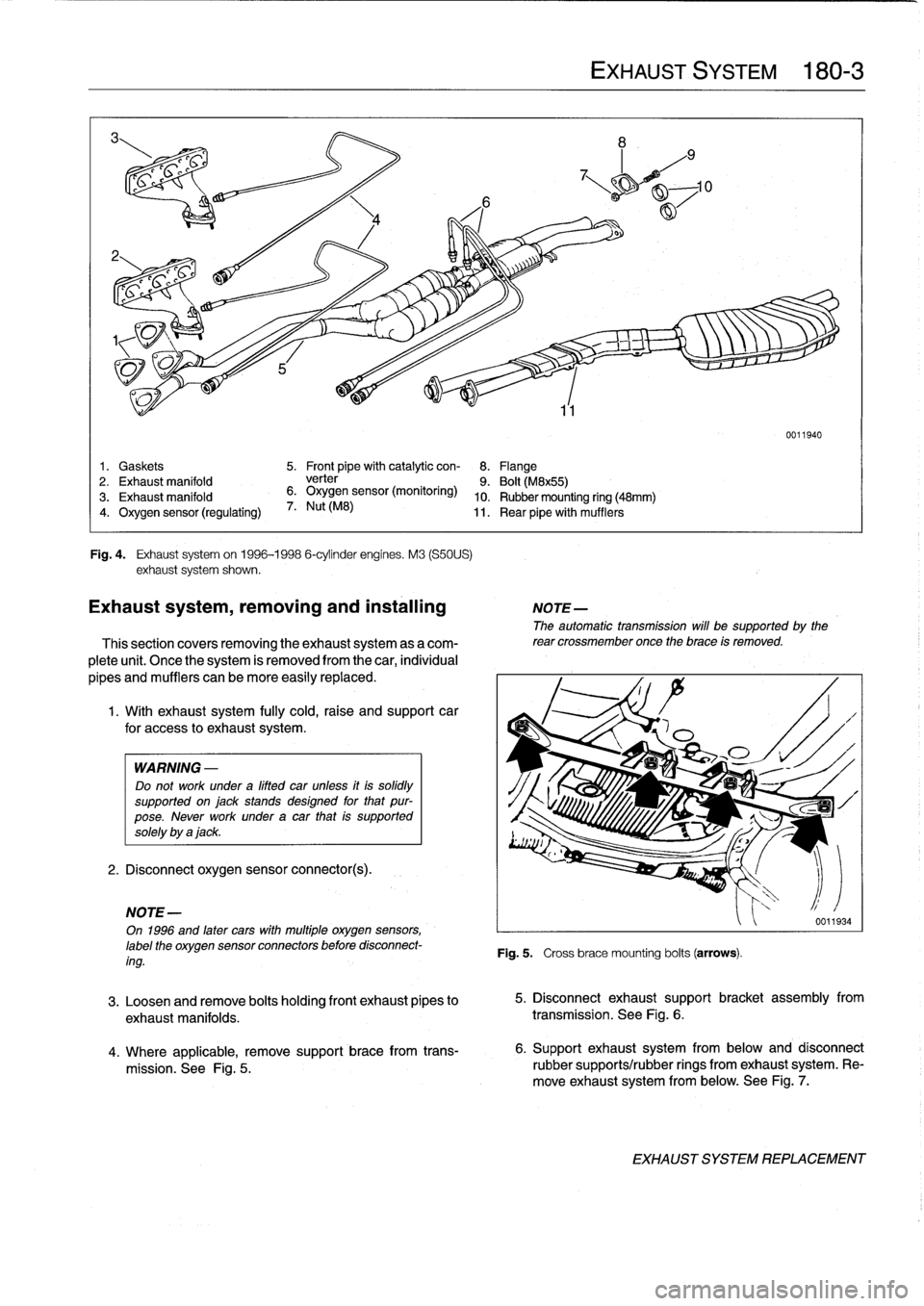
1
.
Gaskets
5
.
Front
pipe
with
catalytic
con-
8
.
Flange
2
.
Exhaust
manifold
verter
9
.
Bolt
(M8x55)
3
.
Exhaust
manifold
6
.
Oxygen
sensor
(monitoring)
10
.
Rubber
mounting
ring
(48mm)
4
.
Oxygen
sensor
(regulating)
7
.
Nut
(M8)
11
.
Rear
pipewith
mufflers
Fig
.
4
.
Exhaust
systemon
1996-1998
6-cylinder
engines
.
M3
(S50US)
exhaust
system
shown
.
Exhaust
system,
removing
and
installing
NOTE-
The
automatic
transmission
will
be
supported
by
the
This
section
covers
removing
the
exhaust
system
as
a
com-
rear
crossmember
once
the
brace
is
removed
.
plete
unit
.
Once
the
system
is
removed
from
the
car,
individual
pipes
and
mufflers
can
be
more
easily
replaced
.
1.
With
exhaust
system
fully
cold,raise
and
support
car
for
access
to
exhaustsystem
.
WARNING
-
Do
not
work
undera
lifted
car
unless
it
is
solidly
supported
on
jack
stands
designed
for
that
pur-
pose
.
Never
work
under
a
car
that
is
supported
solely
by
a
jack
.
2
.
Disconnect
oxygen
sensor
connector(s)
.
NOTE
-
On
1996
and
later
cars
with
multiple
oxygen
sensors,
label
the
oxygen
sensor
connectorsbefore
disconnect-
ing
.
4
.
Where
applicable,
remove
support
brace
from
trans-
mission
.
See
Fig
.
5
.
EXHAUSTSYSTEM
180-
3
3
.
Loosen
andremove
bolts
holding
front
exhaust
pipes
to
exhaust
manifolds
.
transmission
.
See
Fig
.
6
.
0011940
Fig
.
5
.
Crossbracemounting
bolts
(arrows)
.
5
.
Disconnect
exhaust
support
bracket
assembly
from
6
.
Supportexhaustsystem
from
below
and
dísconnect
rubbersupports/rubber
rings
from
exhaust
system
.
Re-
move
exhaust
system
from
below
.
See
Fig
.
7
.
EXHAUST
SYSTEM
REPLACEMENT
Page 210 of 759
180-
4
EXHAUST
SYSTEM
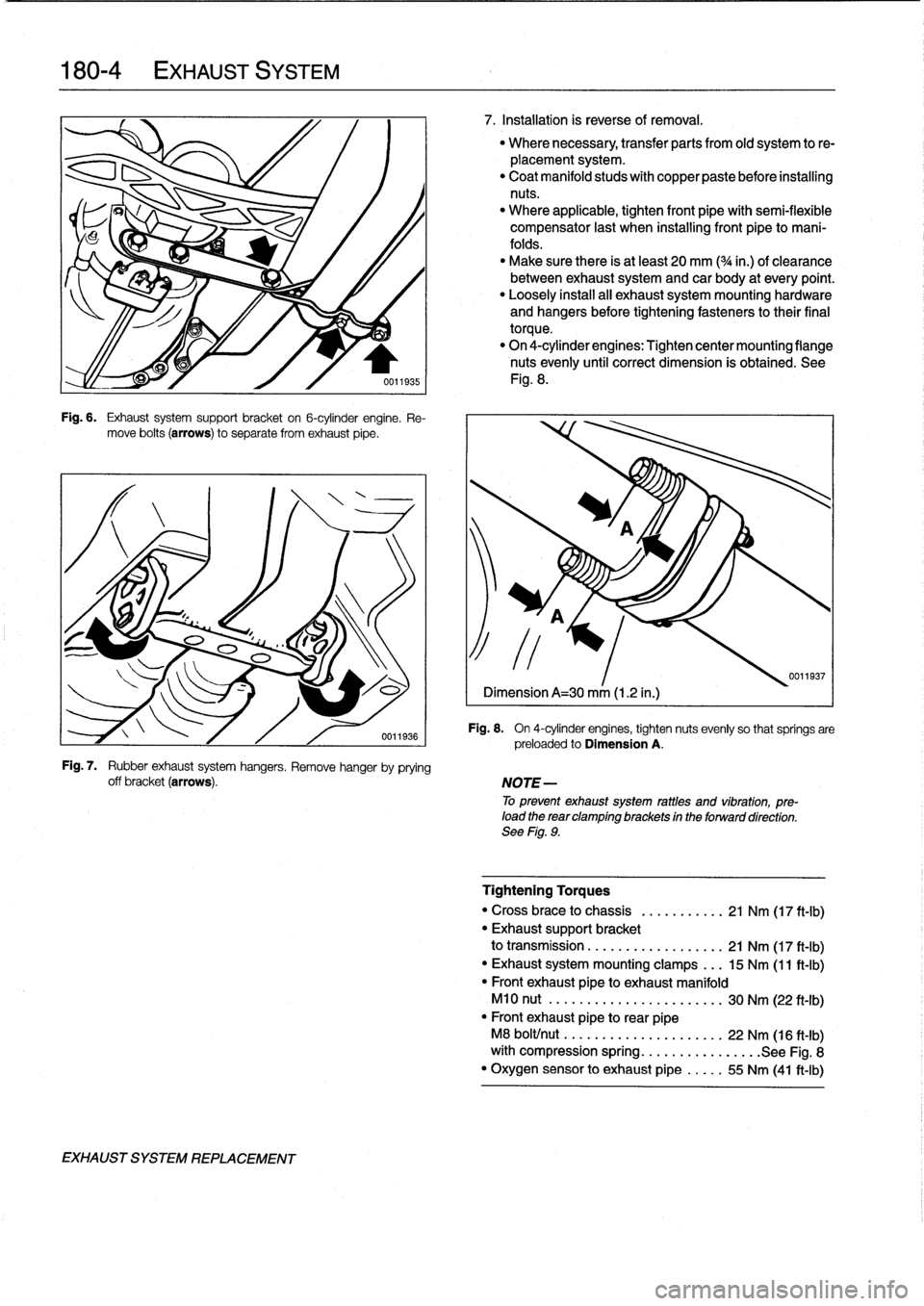
Fig
.
6
.
Exhaust
system
support
bracket
on
6-cylinder
engine
.
Re-
move
bolts
(arrows)
to
separate
from
exhaust
pipe
.
Fig
.
7
.
Rubber
exhaust
system
hangers
.
Remove
hanger
by
prying
off
bracket
(arrows)
.
EXHAUST
SYSTEM
REPLACEMENT
7
.
Installation
is
reverse
of
removal
.
"
Where
necessary,
transfer
parts
from
old
system
to
re-
placement
system
.
"
Coat
manifold
studs
with
copper
paste
before
installing
nuts
.
"
Where
applicable,
tighten
front
pípewith
semi-flexible
compensator
last
when
installing
front
pipe
to
mani-
folds
.
"
Make
sure
there
is
at
least
20
mm
(
3
/4
in
.)
of
clearance
between
exhaust
systemand
car
body
at
every
point
.
"
Loosely
install
all
exhaust
system
mountinghardware
and
hangers
before
tightening
fasteners
to
their
final
torque
.
"
On
4-cylinder
engines
:
Tighten
center
mounting
flange
nuts
evenly
until
correct
dimension
is
obtained
.
See
Fig
.
8
.
ri
J%JJ
w
~~~JJJJ
1
Fig
.
8
.
On
4-cylinder
engines,
tighten
nuts
evenly
so
that
spríngs
are
preloaded
to
Dimension
A
.
NOTE-
To
prevent
exhaust
system
rattles
and
vibration,
pre-load
the
rear
clamping
brackets
in
the
íonaard
direction
.
See
Fig
.
9
.
0011937
Tightening
Torques
"
Cross
brace
to
chassis
..
.
...
.
..
..
21
Nm
(17
ft-Ib)
"
Exhaust
support
bracket
to
transmission
.
.
.
.
.......
.....,.
21
Nm
(17
ft-Ib)
"
Exhaust
system
mounting
clamps
...
15
Nm
(11
ft-Ib)
"
Front
exhaust
pipeto
exhaust
manifold
M10
nut
.
.
.
...
.
..
..............
30
Nm
(22
ft-Ib)
"
Front
exhaust
pipe
torear
pipe
M8
bolt/nut
..
....
.
..............
22
Nm
(16
ft-Ib)
with
compression
spring
................
See
Fig
.
8
"
Oxygen
sensor
to
exhaust
pipe
.....
55
Nm
(41
ft-Ib)
Page 211 of 759
Dimension
A=15mm
(0
.60
in
.)
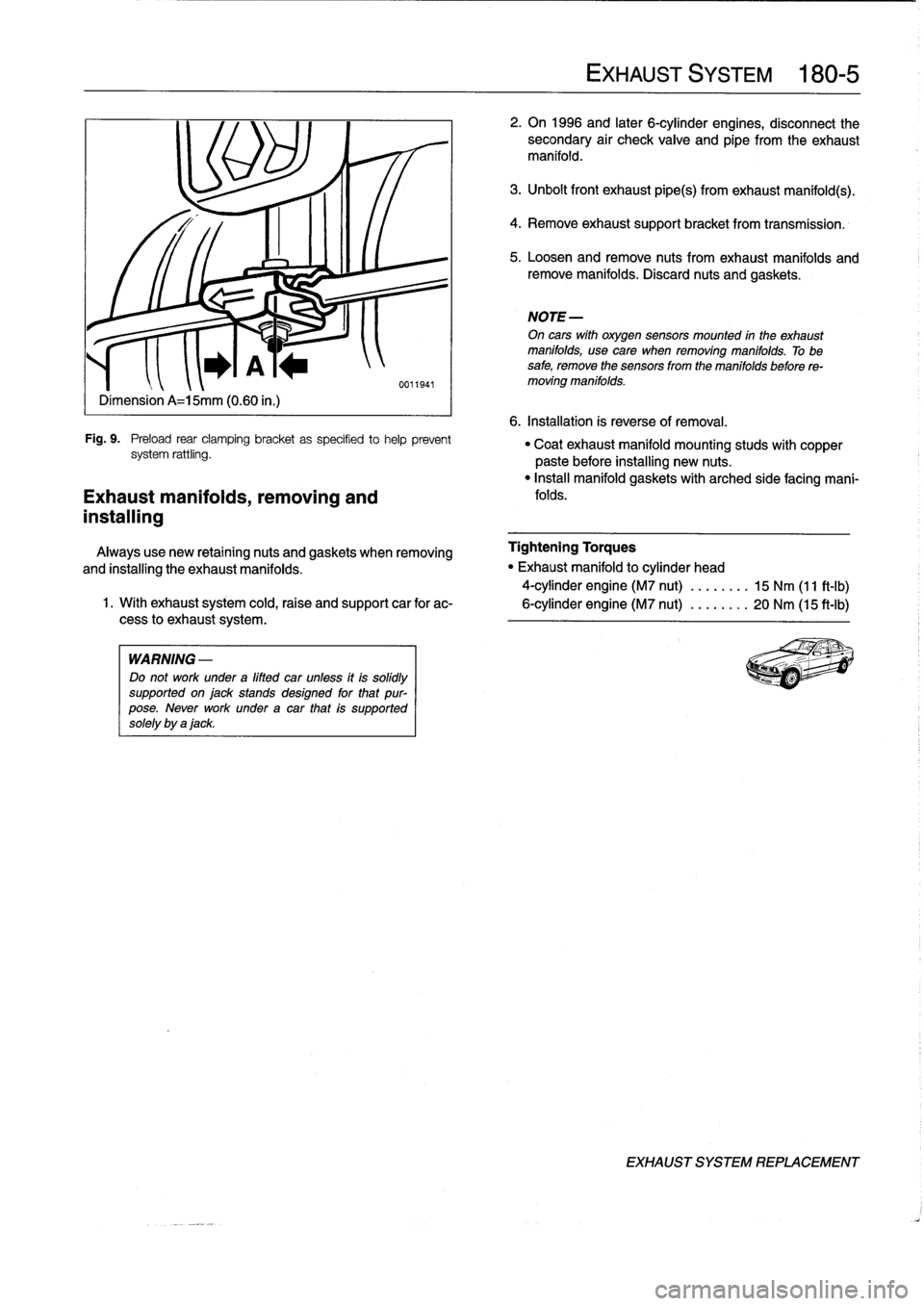
Fig
.
9
.
Preload
rear
clamping
bracket
as
specifíed
tohelp
prevent
system
rattling
.
Exhaust
manifolds,
removing
and
installing
WARNING
-
Do
not
work
under
a
lifted
car
unfess
itis
solidly
supportedonjackstands
designed
for
that
pur-
pose
.
Never
work
underacar
that
is
supported
solely
by
ajack
.
EXHAUST
SYSTEM
180-
5
2
.
On
1996
and
later
6-cylinder
engines,
disconnect
the
secondary
air
check
valve
and
eipe
from
the
exhaust
manifold
.
3
.
Unbolt
front
exhaust
pipe(s)
from
exhaust
manifold(s)
.
4
.
Remove
exhaustsupport
bracket
from
transmission
.
5
.
Loosen
andremove
nuts
fromexhaust
manifolds
and
remove
manifolds
.
Discard
nuts
and
gaskets
.
NOTE-
On
cars
wíth
oxygen
sensors
mounted
in
the
exhaust
manifolds,
usecare
when
removing
manifolds
.
Tobe
safe,
remove
the
sensors
from
the
manifolds
before
re-
moving
manifolds
.
6
.
Installation
is
reverse
of
removal
.
"
Coatexhaust
manifold
mounting
studs
with
copper
paste
before
installing
new
nuts
.
"
Insta¡¡
manifold
gaskets
with
arched
side
facing
mani-
folds
.
Always
use
new
retaining
nuts
and
gaskets
when
removing
Tightening
Torques
and
installing
the
exhaust
manifolds
.
"
Exhaust
manifold
to
cylinder
head
4-cylinder
engine
(M7
nut)
........
15
Nm
(11
ft-Ib)
1
.
With
exhaust
system
cold,raise
and
support
car
for
ac-
6-cylinder
engine
(M7
nut)
........
20
Nm
(15
ft-Ib)
cess
lo
exhaust
system
.
EXHAUST
SYSTEM
REPLACEMENT
Page 226 of 759
230-
6
MANUAL
TRANSMISSION
Transmission,
removing
and
installing
1
.
Disconnect
negative
(-)
cable
from
battery
.
CAUTION-
Prior
to
disconnecting
the
battery,
read
the
battery
disconnection
cautions
given
at
the
front
of
this
manual
onpage
viii
.
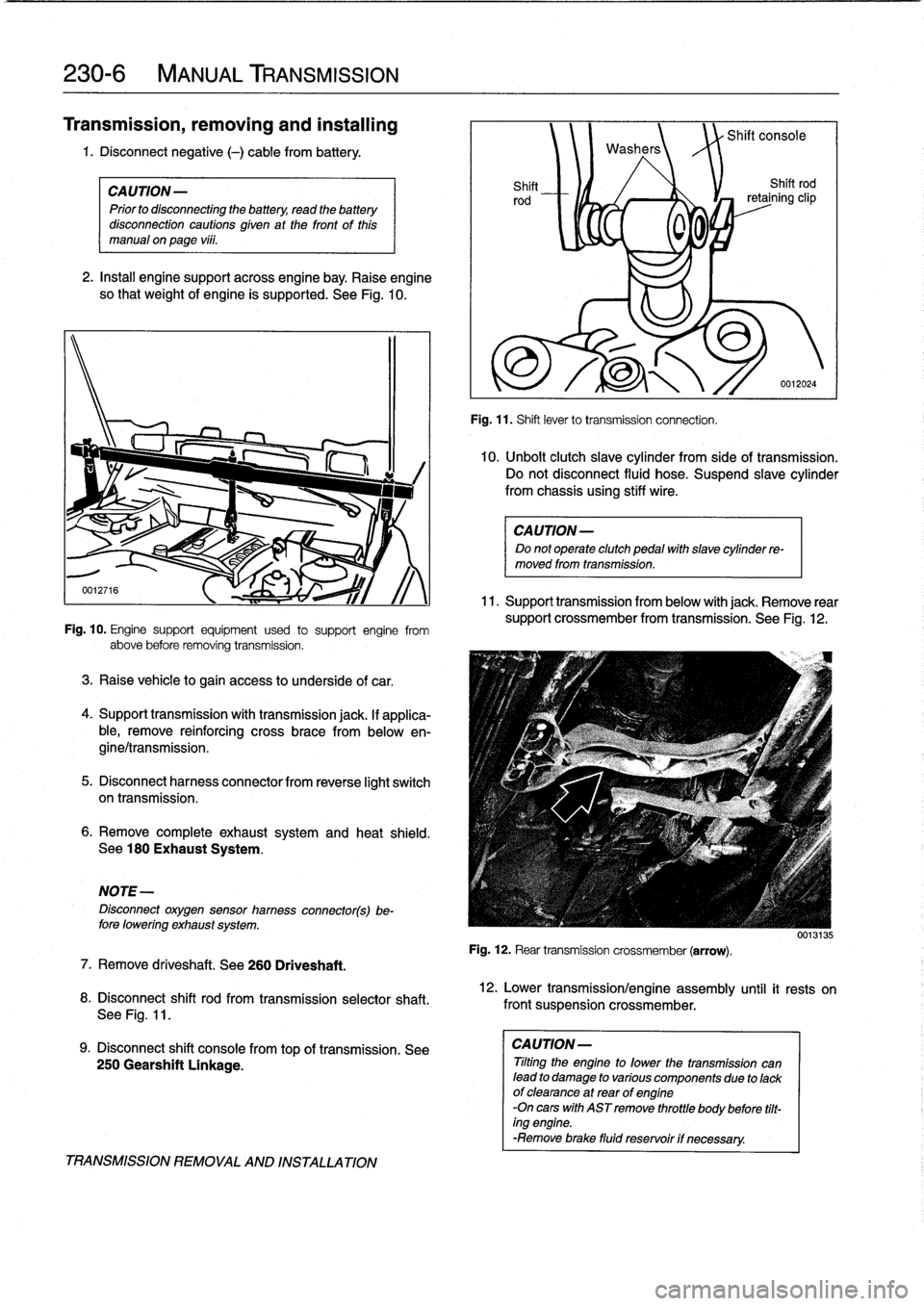
2
.
Insta¡¡
enginesupportacrossengine
bay
.
Raise
engine
so
that
weight
of
engine
ís
supported
.
See
Fig
.
10
.
Fig
.
10
.
Engine
support
equipment
used
to
support
engine
from
above
before
removing
transmission
.
3
.
Raise
vehicle
to
gain
access
to
underside
of
car
.
4
.
Support
transmission
with
transmission
jack
.
lf
applica-
ble,
remove
reinforcing
cross
brace
from
belowen-
gine/transmission
.
5
.
Disconnect
harnesscon
nector
from
reverse
light
switch
on
transmission
.
6
.
Remove
completeexhaustsystem
and
heat
shield
.
See
180
Exhaust
System
.
NOTE-
Disconnect
oxygensensor
hamess
connector(s)be-
fore
lowering
exhaust
system
.
7
.
Remove
driveshaft
.
See260
Driveshaft
.
8
.
Disconnect
shift
rod
from
transmission
selectorshaft
.
See
Fig
.
11
.
9
.
Disconnect
shift
console
fromtop
of
transmission
.
See
250
Gearshift
Linkage
.
TRANSMISSION
REMOVAL
AND
INSTALLATION
Washers
Shift
Shift
rod
rod
retaining
clip
0
0
,
Fig
.
11
.
Shift
lever
to
transmission
connection
.
Shift
console
0012024
10
.
Unbolt
clutch
slave
cylinder
from
sideof
transmission
.
Do
not
disconnect
fluid
hose
.
Suspend
slavecylinder
from
chassis
using
stiff
wire
.
CAUTION-
Do
not
operate
clutch
pedal
with
slave
cylinder
re-
moved
from
transmission
.
11
.
Support
transmission
from
below
with
jack
.
Remove
rear
support
crossmember
from
transmission
.
See
Fig
.
12
.
Fig
.
12
.
Rear
transmission
crossmember
(arrow)
.
12
.
Lower
transmission/engine
assembly
until
it
rests
on
front
suspension
crossmember
.
CAUTION-
Tilting
the
engine
to
lower
thetransmission
can
lead
to
damage
to
various
componente
due
to
lackof
clearance
at
rear
of
engine
-On
cars
with
AST
remove
throttle
body
before
tilt-
ing
engine
.
-Remove
brace
fluid
reservoir
if
necessary
.
0013135
Page 232 of 759
240-
4
AUTOMATIC
TRANSMISSION
TRANSMISSION
REMOVALAND
INSTALLATION
Removal
and
installation
of
thetransmission
is
best
accom-
plished
on
a
lift
using
a
transmission
jack
.
Use
caution
and
safe
workshop
practices
when
working
beneath
car
and
low-
ering
transmission
.
WARNING
-
To
lift
the
vehicle
safely,
see010
Fundamentals
for
the
Do-it-Yourself
Owner
.
CAUTION-
"
Be
sure
the
vehicle
is
properly
supported
.
The
removal
of
the
transmission
may
upset
the
bal-
ance
of
the
vehicle
on
a
lift
.
"
Tilting
the
engine
to
remove
the
transmission
can
lead
to
damage
to
various
components
due
to
lack
of
clearance
.
-On
carswith
AST
remove
throttle
body
.
-Remove
brake
fluid
reservoir
if
necessary
.
Torx-head
bolts
are
used
to
mount
thetransmission
to
the
bellhousing
.
Be
sure
to
have
appropriate
tools
on
hand
before
starting
thejob
.
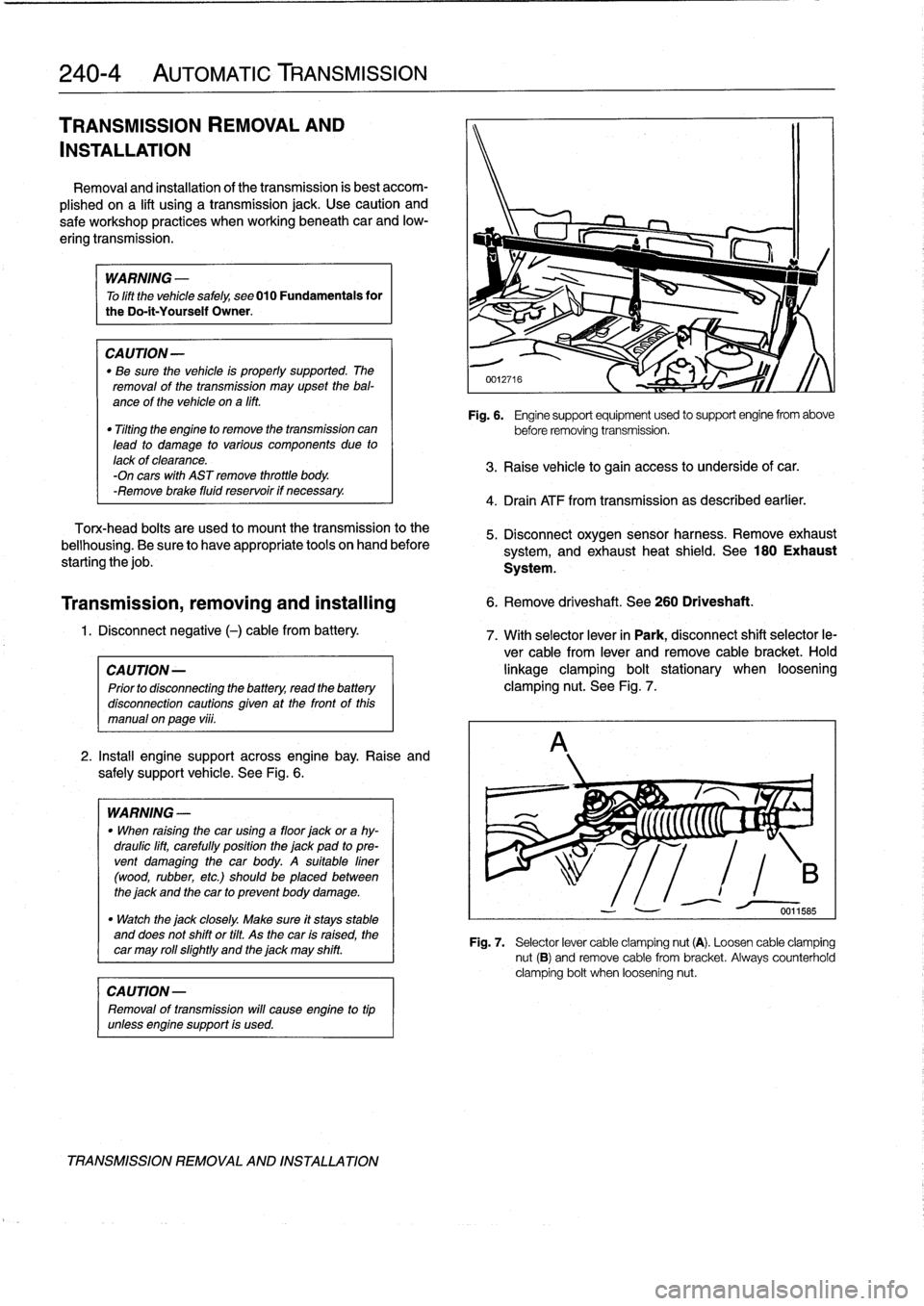
2
.
Install
engine
support
across
engine
bay
.
Raise
and
safely
support
vehicle
.
See
Fig
.
6
.
WARNING
-
"
When
raising
thecar
using
a
floor
jack
or
a
hy-
draulic
lift,
carefully
position
the
jack
pad
to
pre-
vent
damaging
the
car
body
.
A
suitable
liner
(wood,
rubber,
etc
.)
should
be
placed
between
the
jack
and
the
car
to
prevent
body
damage
.
"
Watch
the
jack
closely
.
Make
sure
it
stays
stable
and
does
not
shift
or
tilt
.
As
the
car
is
raised,
the
car
may
roll
slightty
and
the
jack
may
shift
.
CAUTION-
Removal
of
transmission
will
cause
engine
to
tip
unlessengine
support
is
used
.
TRANSMISSION
REMOVAL
AND
INSTALLATION
Fig
.
6
.
Engine
support
equipment
used
to
support
engine
from
above
before
removing
transmission
.
3
.
Raise
vehicle
to
gain
access
to
underside
of
car
.
4
.
Drain
ATF
from
transmission
as
described
earlier
.
5
.
Disconnect
oxygen
sensor
harness
.
Remove
exhaust
system,
and
exhaust
heat
shield
.
See
180
Exhaust
System
.
Transmission,
removing
and
installing
6
.
Remove
driveshaft
.
See
260
Driveshaft
.
1
.
Disconnect
negative
(-)
cable
from
battery
.
7
.
With
selector
lever
in
Park,
disconnect
shift
selector
le-
ver
cable
from
lever
and
remove
cable
bracket
.
Hold
CA
UTION-
linkage
clamping
bolt
stationary
when
loosening
Prior
to
disconnectiog
the
battery,
read
the
battery
clamping
nut
.
See
Fig
.
7
.
disconnection
cautions
given
at
the
front
of
this
manual
on
page
vi¡¡
.
Fig
.
7
.
Selector
lever
cable
clamping
nut
(A)
.
Loosen
cable
clamping
nut
(B)
and
remove
cable
from
bracket
.
Always
counterholdclamping
bolt
when
loosening
nut
.
Page 235 of 759
GENERAL
.
.
.
.
.
.
.
.
.
................
.
.
.
250-1
AUTOMATIC
TRANSMISSION
GEARSHIFT
...
.
.........
.
.
.
.
.
.
.
.
.
.
.
.
.
.
250-3
MANUAL
TRANSMISSION
Gearshift
mechanism,
adjusting
GEARSHIFT
.
.
.
.
.
.
.
.....
.
..........
.
.
.
250-1
(automatictransmission)
..
.
.
.
.
.
.
.
.
.
...
.
.
250-3
Gearshift
lever,
removing
Gear
position/neutral
safety
switch,
replacing
(manual
transmission)
.
.
.
.
...
.
.
.
.......
250-1
(automatic
transmission)
..
.
.
.
.........
.
.
250-4
Gearshift
lever,
installing
Automatic
shiftlock,
checking
function
(manual
transmission)
.
.
.
.
.
.
.
.
.
.
.......
250-2
(automatic
transmission)
..
..
...
.
.
.
....
..
250-5
Shiftinterlock,
checking
function
(automatic
transmission)
.......
.
.
.
.....
.250-6
GENERAL
This
repair
group
covers
transmission
gearshift
and
linkage
service
.
Special
service
tools
are
required
for
some
of
the
proce-
dures
given
here
.
To
gain
access
to
the
complete
gearshift
mechanism
ít
is
necessary
to
remove
the
exhaust
system
and
the
driveshaft
as
described
in
180
Exhaust
System
and260
Driveshaft
.
MANUAL
TRANSMISSION
GEARSHIFT
Gearshift
lever,
removing
(manual
transmission)
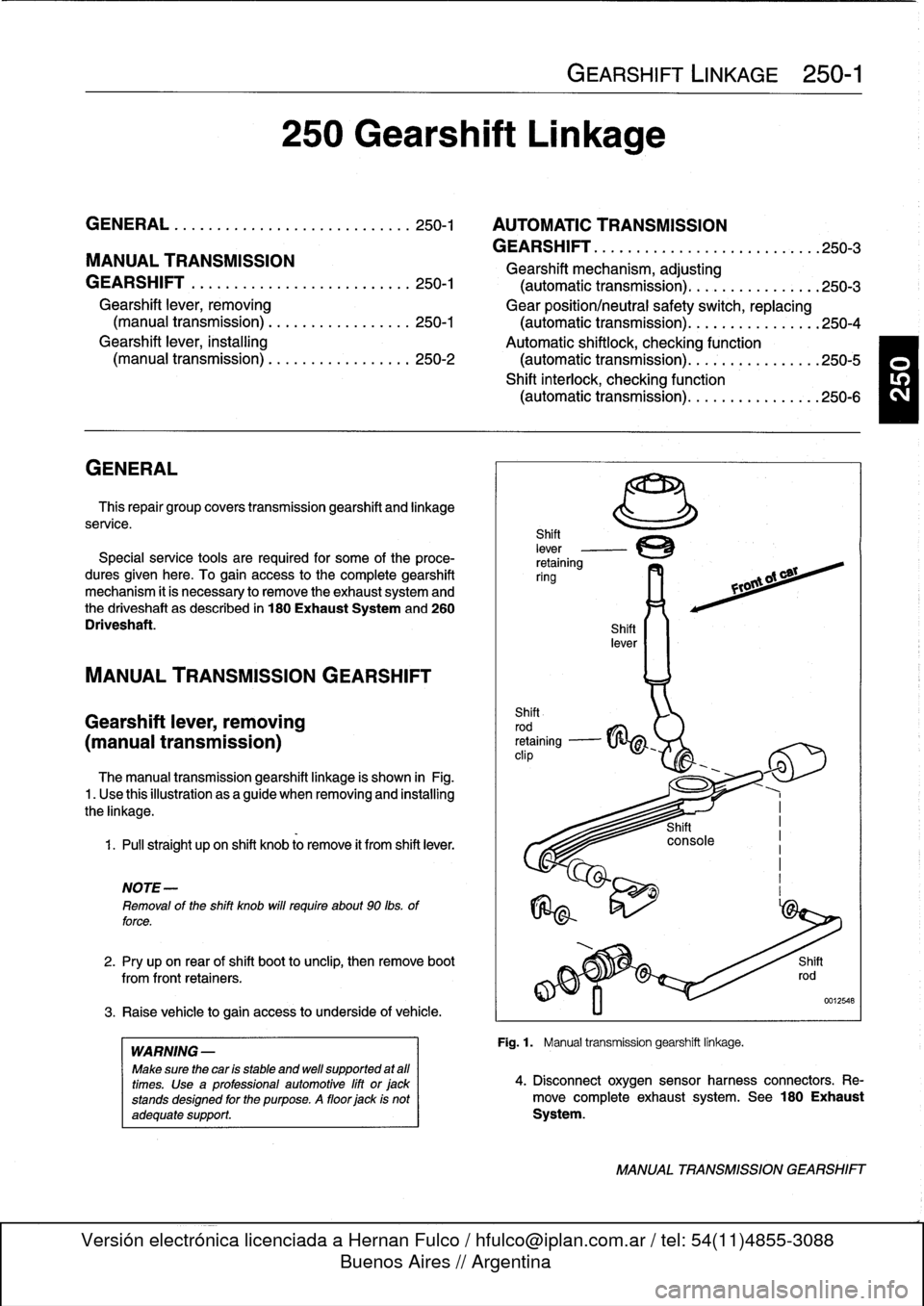
The
manual
transmission
gearshift
linkage
is
shown
in
Fig
.1
.
Use
thisillustration
asaguide
when
removing
and
installing
the
linkage
.
1
.
Pull
straight
upon
shift
knob
lo
remove
it
from
shift
lever
.
NOTE
-
Removal
of
the
shift
knob
will
require
about
90
lbs
.
of
force
.
2
.
Pry
upon
rear
of
shift
boot
tounclip,
then
remove
boot
from
front
retainers
.
3
.
Raise
vehicle
togain
access
to
underside
of
vehicle
.
WARNING
-
Make
sure
thecar
is
stable
and
well
supported
at
afl
times
.
Use
a
professional
automotive
lift
orjackstands
designed
for
the
purpose
.
A
floor
jack
is
not
adequate
support
.
250
Gearshift
Linkage
GEARSHIFT
LINKAGE
250-1
Fig
.1
.
Manual
transmission
gearshift
linkage
.
4
.
Disconnect
oxygen
sensorharness
connectors
.
Re-
move
completeexhaust
system
.
See
180
Exhaust
System
.
MANUAL
TRANSMISSION
GEARSHIFT
Page 237 of 759
2
.
Install
rubber
grommet
with
arrow
pointing
forward
.
In-
AUTOMATic
TRANSMISSION
stall
shift
rod
and
shift
boot
.
GEARSHIFT
NOTE-
Install
rubbergrommet
correctly
so
that
is
seals
outwa-
ter
.
4
.
Install
driveshaft
and
heat
shield
.
See
260
Driveshaft
.
Manual
valveleven
(at
transmission)
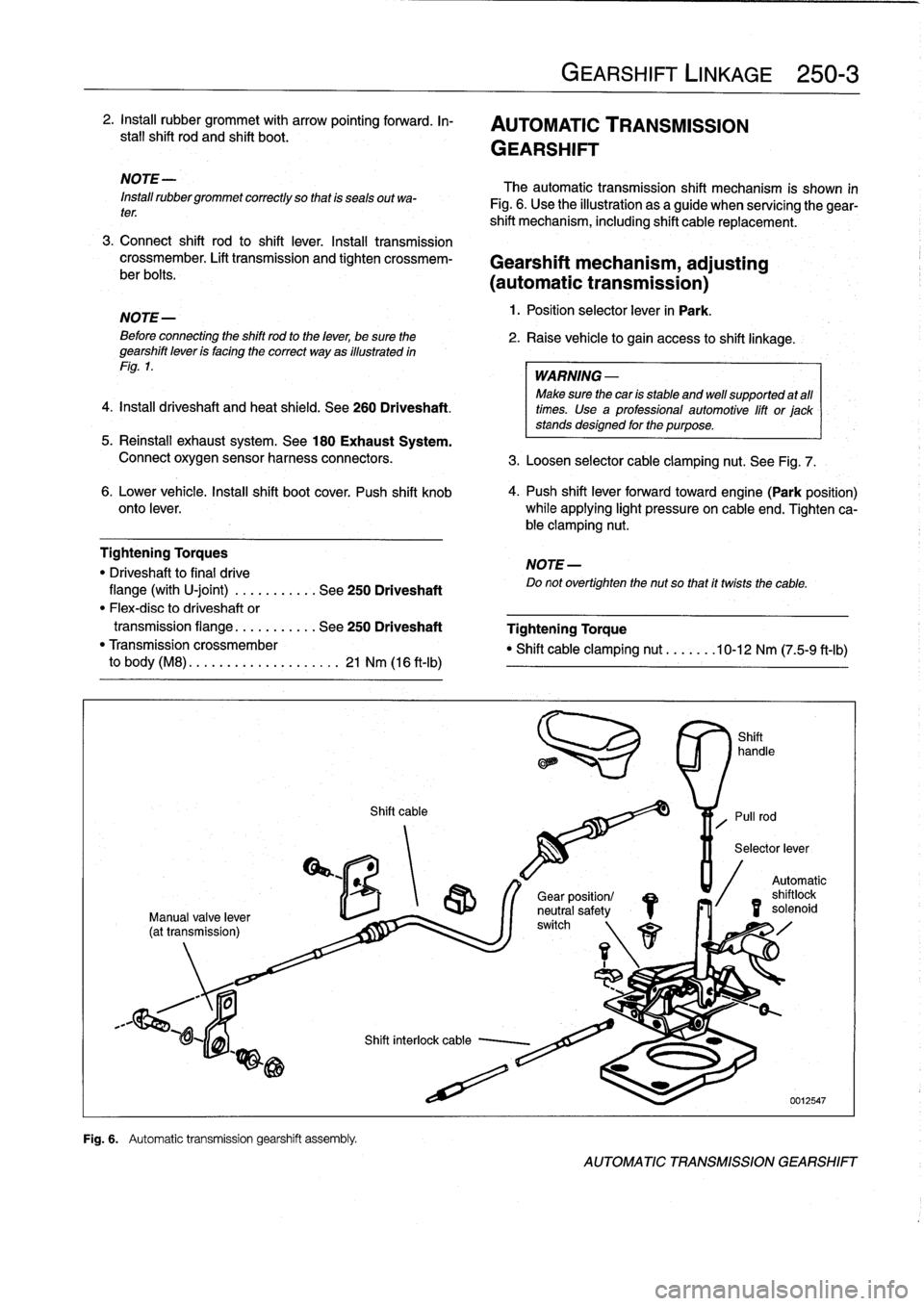
Fig
.
6
.
Automatic
transmission
gearshift
assembfy
.
Shift
cable
GEARSHIFT
LINKAGE
250-
3
The
automatic
transmission
shift
mechanism
is
shown
in
Fig
.
6
.
Use
the
illustration
as
a
guide
when
servícing
the
gear-
shift
mechanism,
including
shift
cable
replacement
.
3
.
Connect
shift
rod
to
shift
lever
.
Install
transmission
crossmember
.
Lift
transmission
and
tighten
crossmem-
Gearshift
mechanism,
adjusting
ber
bolts
.
(automatictransmission)
NOTE-
1
.
Position
selector
lever
in
Park
.
Beforeconnecting
the
shift
rod
to
the
lever,
be
sure
the
2
.
Raise
vehicle
to
gain
access
to
shift
linkage
.
gearshift
leven
is
facing
the
correct
way
as
illustrated
in
Fig
.
1
.
WARNING
-
Make
sure
thecan
is
stable
and
well
supported
at
all
times
.
Use
a
professional
automotive
lift
or
jack
stands
designed
for
the
purpose
.
5
.
Reinstall
exhaust
system
.
See
180
Exhaust
System
.
Connect
oxygen
sensor
harness
connectors
.
3
.
Loosen
selector
cable
clamping
nut
.
See
Fig
.
7
.
6
.
Lower
vehicle
.
Insta¡¡
shift
boot
cover
.
Push
shift
knob
4
.
Push
shift
lever
forwardtoward
engine(Park
position)
onto
lever
.
while
applying
light
pressure
on
cable
end
.
Tighten
ca-
ble
clamping
nut
.
Tightening
Torques
NOTE-
"
Driveshaft
to
final
drive
Do
not
overtighten
the
nut
so
that
it
twists
the
cable
.
flange
(with
U-joint)
.
..
.
.....
.
.
See
250
Driveshaft
"
Flex-disc
to
driveshaft
or
transmission
flange
...
.
.......
See
250
Driveshaft
Tightening
Torque
"
Transmission
crossmember
"
Shift
cable
clamping
nut
.......
10-12
Nm
(75-9
ft-Ib)
to
body
(M8)
.
.
.
...
..............
21
Nm
(16
ft-Ib)
/S
r\
1
1
Gear
position/
neutral
safetyswitch
Automatic
shilo
solenoid
id
AUTOMATIC
TRANSMISSION
GEARSHIFT