maintenance BMW 320i 2003 Owner's Manual
[x] Cancel search | Manufacturer: BMW, Model Year: 2003, Model line: 320i, Model: BMW 320i 2003Pages: 166, PDF Size: 3.16 MB
Page 45 of 166
45
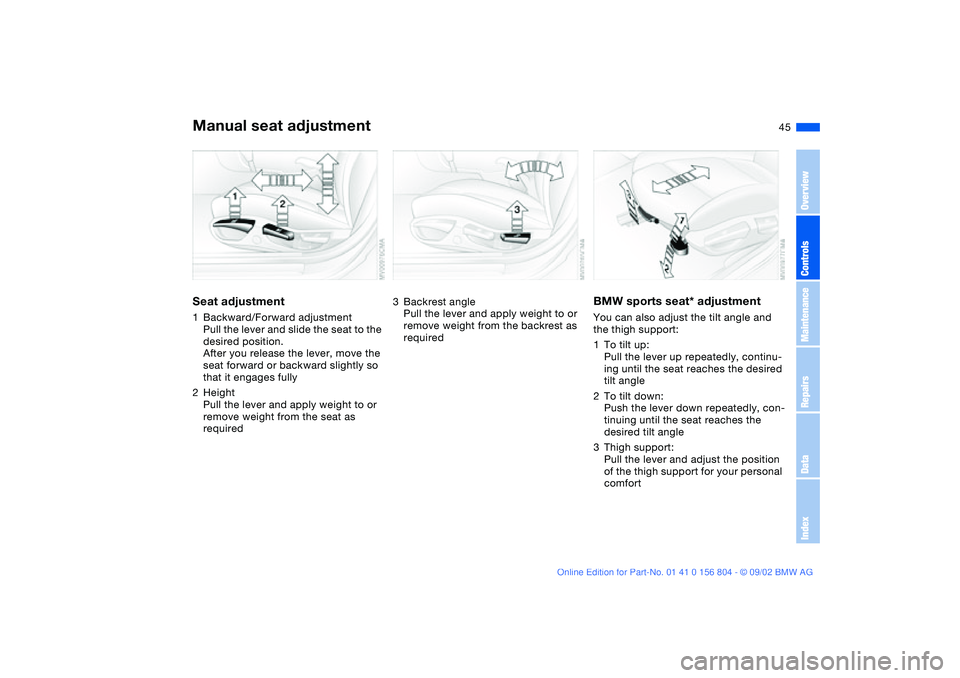
Manual seat adjustmentSeat adjustment1Backward/Forward adjustment
Pull the lever and slide the seat to the
desired position.
After you release the lever, move the
seat forward or backward slightly so
that it engages fully
2Height
Pull the lever and apply weight to or
remove weight from the seat as
required
3Backrest angle
Pull the lever and apply weight to or
remove weight from the backrest as
required
BMW sports seat* adjustmentYou can also adjust the tilt angle and
the thigh support:
1To tilt up:
Pull the lever up repeatedly, continu-
ing until the seat reaches the desired
tilt angle
2To tilt down:
Push the lever down repeatedly, con-
tinuing until the seat reaches the
desired tilt angle
3Thigh support:
Pull the lever and adjust the position
of the thigh support for your personal
comfort
OverviewControlsMaintenanceRepairsDataIndex
Page 47 of 166
47
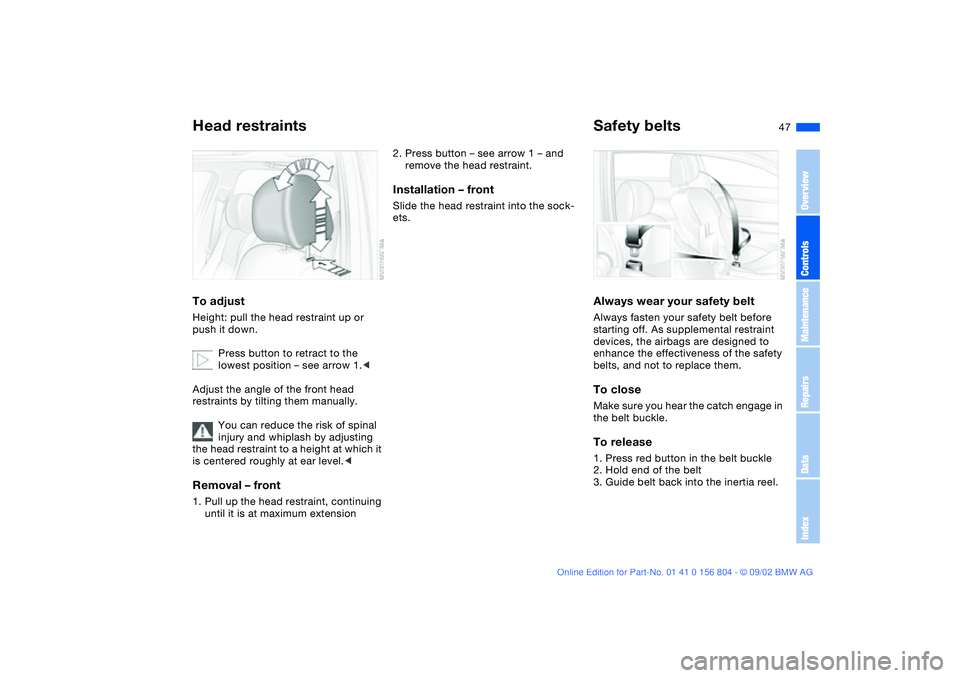
Head restraintsTo adjustHeight: pull the head restraint up or
push it down.
Press button to retract to the
lowest position – see arrow 1.<
Adjust the angle of the front head
restraints by tilting them manually.
You can reduce the risk of spinal
injury and whiplash by adjusting
the head restraint to a height at which it
is centered roughly at ear level.
2. Press button – see arrow 1 – and
remove the head restraint.Installation – frontSlide the head restraint into the sock-
ets.
Safety beltsAlways wear your safety beltAlways fasten your safety belt before
starting off. As supplemental restraint
devices, the airbags are designed to
enhance the effectiveness of the safety
belts, and not to replace them.To closeMake sure you hear the catch engage in
the belt buckle.To release1. Press red button in the belt buckle
2. Hold end of the belt
3. Guide belt back into the inertia reel.
OverviewControlsMaintenanceRepairsDataIndex
Page 49 of 166
49
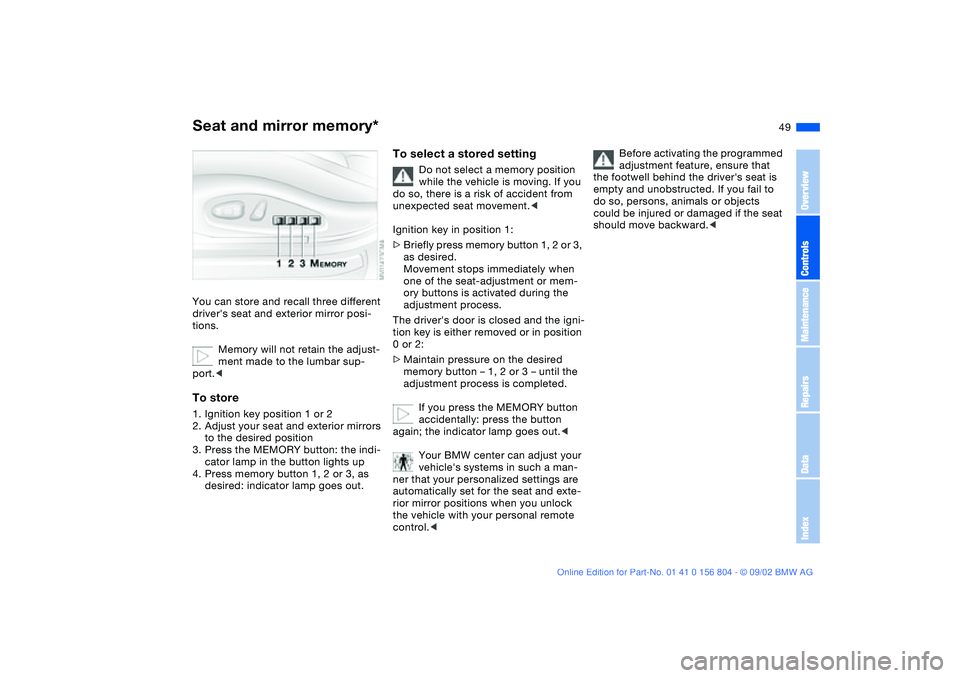
Seat and mirror memory*You can store and recall three different
driver's seat and exterior mirror posi-
tions.
Memory will not retain the adjust-
ment made to the lumbar sup-
port.
to the desired position
3. Press the MEMORY button: the indi-
cator lamp in the button lights up
4. Press memory button 1, 2 or 3, as
desired: indicator lamp goes out.
To select a stored setting
Do not select a memory position
while the vehicle is moving. If you
do so, there is a risk of accident from
unexpected seat movement.<
Ignition key in position 1:
>Briefly press memory button 1, 2 or 3,
as desired.
Movement stops immediately when
one of the seat-adjustment or mem-
ory buttons is activated during the
adjustment process.
The driver's door is closed and the igni-
tion key is either removed or in position
0 or 2:
>Maintain pressure on the desired
memory button – 1, 2 or 3 – until the
adjustment process is completed.
If you press the MEMORY button
accidentally: press the button
again; the indicator lamp goes out.<
Your BMW center can adjust your
vehicle's systems in such a man-
ner that your personalized settings are
automatically set for the seat and exte-
rior mirror positions when you unlock
the vehicle with your personal remote
control.<
Before activating the programmed
adjustment feature, ensure that
the footwell behind the driver's seat is
empty and unobstructed. If you fail to
do so, persons, animals or objects
could be injured or damaged if the seat
should move backward.<
OverviewControlsMaintenanceRepairsDataIndex
Page 51 of 166
51
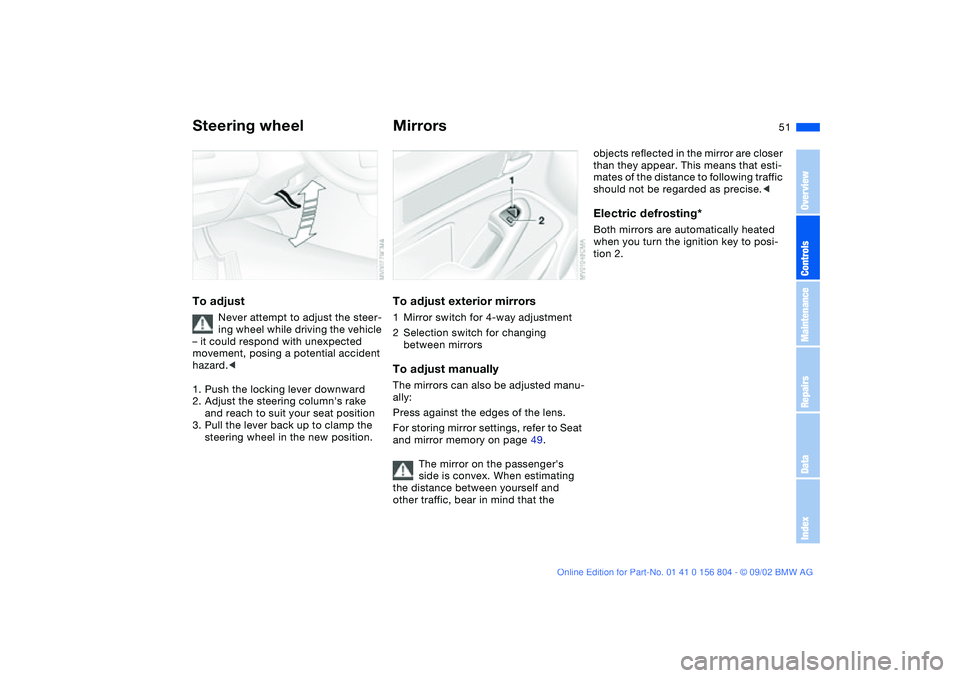
Steering wheelTo adjust
Never attempt to adjust the steer-
ing wheel while driving the vehicle
– it could respond with unexpected
movement, posing a potential accident
hazard.<
1. Push the locking lever downward
2. Adjust the steering column's rake
and reach to suit your seat position
3. Pull the lever back up to clamp the
steering wheel in the new position.
MirrorsTo adjust exterior mirrors1Mirror switch for 4-way adjustment
2Selection switch for changing
between mirrorsTo adjust manuallyThe mirrors can also be adjusted manu-
ally:
Press against the edges of the lens.
For storing mirror settings, refer to Seat
and mirror memory on page 49.
The mirror on the passenger's
side is convex. When estimating
the distance between yourself and
other traffic, bear in mind that the
objects reflected in the mirror are closer
than they appear. This means that esti-
mates of the distance to following traffic
should not be regarded as precise.
tion 2.
OverviewControlsMaintenanceRepairsDataIndex
Page 53 of 166
53 Passenger safety systems
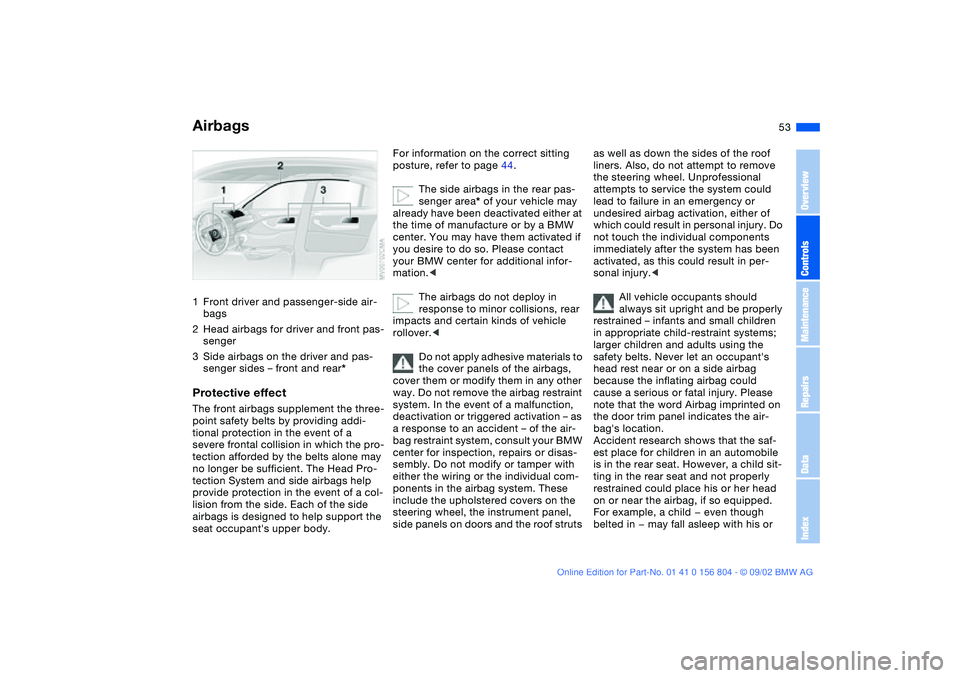
Airbags1Front driver and passenger-side air-
bags
2Head airbags for driver and front pas-
senger
3Side airbags on the driver and pas-
senger sides – front and rear*Protective effectThe front airbags supplement the three-
point safety belts by providing addi-
tional protection in the event of a
severe frontal collision in which the pro-
tection afforded by the belts alone may
no longer be sufficient. The Head Pro-
tection System and side airbags help
provide protection in the event of a col-
lision from the side. Each of the side
airbags is designed to help support the
seat occupant's upper body.
For information on the correct sitting
posture, refer to page 44.
The side airbags in the rear pas-
senger area* of your vehicle may
already have been deactivated either at
the time of manufacture or by a BMW
center. You may have them activated if
you desire to do so. Please contact
your BMW center for additional infor-
mation.<
The airbags do not deploy in
response to minor collisions, rear
impacts and certain kinds of vehicle
rollover.<
Do not apply adhesive materials to
the cover panels of the airbags,
cover them or modify them in any other
way. Do not remove the airbag restraint
system. In the event of a malfunction,
deactivation or triggered activation – as
a response to an accident – of the air-
bag restraint system, consult your BMW
center for inspection, repairs or disas-
sembly. Do not modify or tamper with
either the wiring or the individual com-
ponents in the airbag system. These
include the upholstered covers on the
steering wheel, the instrument panel,
side panels on doors and the roof struts
as well as down the sides of the roof
liners. Also, do not attempt to remove
the steering wheel. Unprofessional
attempts to service the system could
lead to failure in an emergency or
undesired airbag activation, either of
which could result in personal injury. Do
not touch the individual components
immediately after the system has been
activated, as this could result in per-
sonal injury.<
All vehicle occupants should
always sit upright and be properly
restrained – infants and small children
in appropriate child-restraint systems;
larger children and adults using the
safety belts. Never let an occupant's
head rest near or on a side airbag
because the inflating airbag could
cause a serious or fatal injury. Please
note that the word Airbag imprinted on
the door trim panel indicates the air-
bag's location.
Accident research shows that the saf-
est place for children in an automobile
is in the rear seat. However, a child sit-
ting in the rear seat and not properly
restrained could place his or her head
on or near the airbag, if so equipped.
For example, a child — even though
belted in — may fall asleep with his or
OverviewControlsMaintenanceRepairsDataIndex
Page 55 of 166
55
If there is a system malfunction, there is
a risk that the airbags will not be trig-
gered within their normal response
range, even if the level of impact would
normally have triggered them.
Have your BMW center inspect the sys-
tem immediately.
Transporting children safelyCommercially available child-restraint
systems are designed to be secured
with a lap belt or with the lap belt por-
tion of a combination lap/shoulder belt.
Improperly or inadequately installed
restraint systems can increase the risk
of injury to children. Always read and
follow the instructions that come with
the system.Child-restraint system with
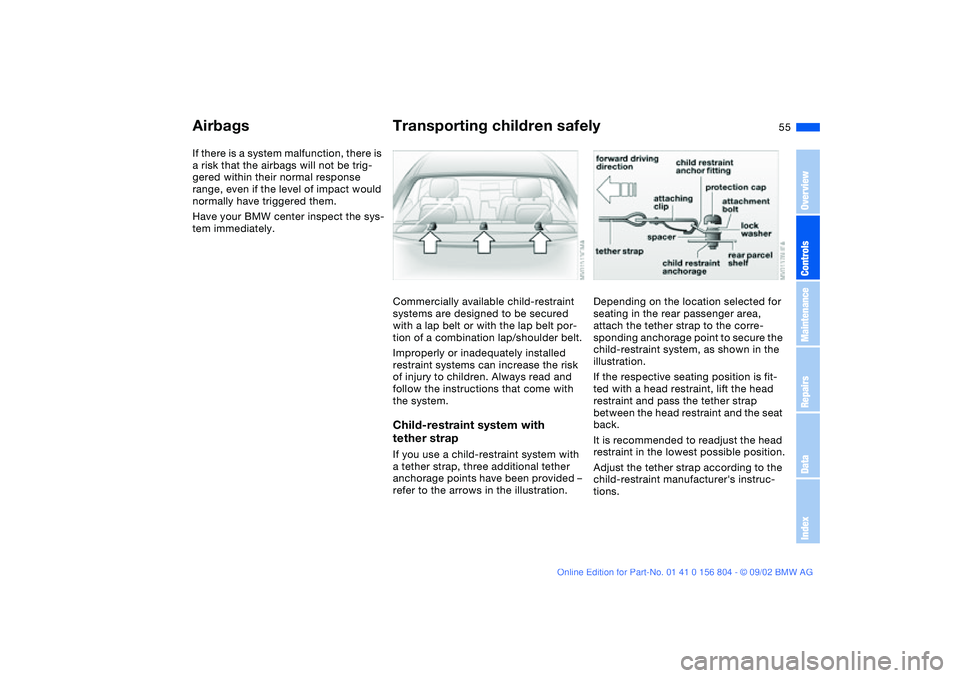
tether strapIf you use a child-restraint system with
a tether strap, three additional tether
anchorage points have been provided –
refer to the arrows in the illustration.
Depending on the location selected for
seating in the rear passenger area,
attach the tether strap to the corre-
sponding anchorage point to secure the
child-restraint system, as shown in the
illustration.
If the respective seating position is fit-
ted with a head restraint, lift the head
restraint and pass the tether strap
between the head restraint and the seat
back.
It is recommended to readjust the head
restraint in the lowest possible position.
Adjust the tether strap according to the
child-restraint manufacturer's instruc-
tions.
Airbags
OverviewControlsMaintenanceRepairsDataIndex
Page 57 of 166
57
The belt cannot be extracted further.
Always observe the installation instruc-
tions provided by the manufacturer of
the child-restraint system.To unlock the safety beltRelease the safety belt, remove the
child seat and retract the safety belt to
its end position on the belt retractor.
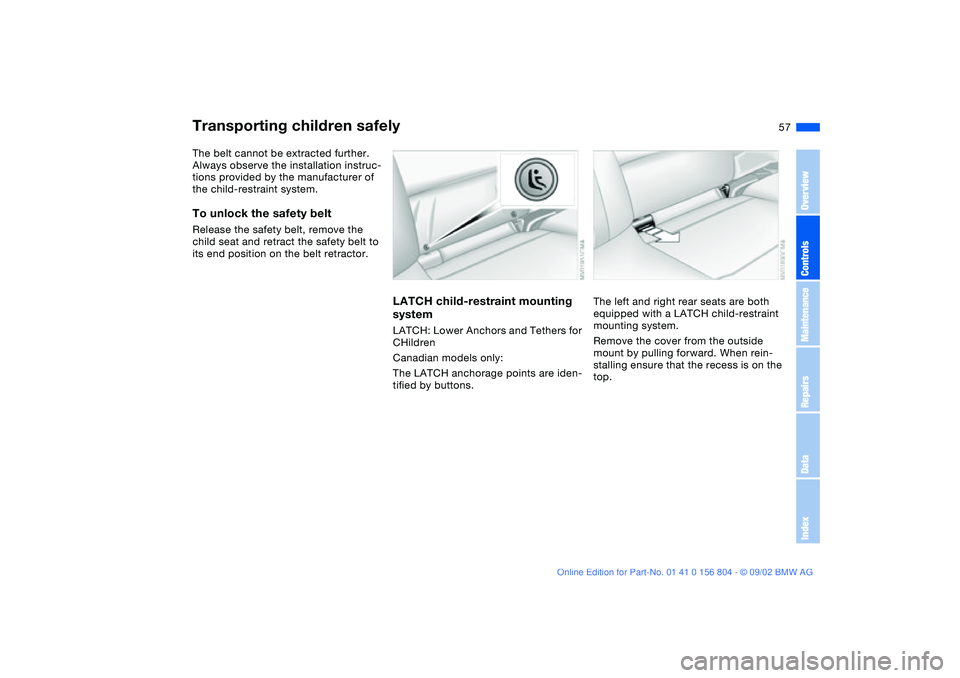
LATCH child-restraint mounting
systemLATCH: Lower Anchors and Tethers for
CHildren
Canadian models only:
The LATCH anchorage points are iden-
tified by buttons.
The left and right rear seats are both
equipped with a LATCH child-restraint
mounting system.
Remove the cover from the outside
mount by pulling forward. When rein-
stalling ensure that the recess is on the
top.
Transporting children safely
OverviewControlsMaintenanceRepairsDataIndex
Page 59 of 166
59
Vehicle Memory, Key MemoryHow the system functionsNo doubt you have reflected at one
time or another on how great it would
be if you could permanently configure
your vehicle's various features and
adjustments to mirror your own individ-
ual preferences. In engineering your
vehicle, BMW has provided for a num-
ber of options for personal adjustment
that can be programmed into your vehi-
cle at your BMW center.
The available configuration data fall into
two categories, according to whether
their primary orientation is the vehicle –
Vehicle Memory – or the individual –
Key Memory. Provided that each per-
son has a separate remote-control key,
you can have your BMW center enter
basic adjustment data for up to four
individuals in the system.
The system then relies on a bilateral
data exchange to identify the individual
user and executes the selected settings
whenever the remote control unit is
used to disengage the door locks.
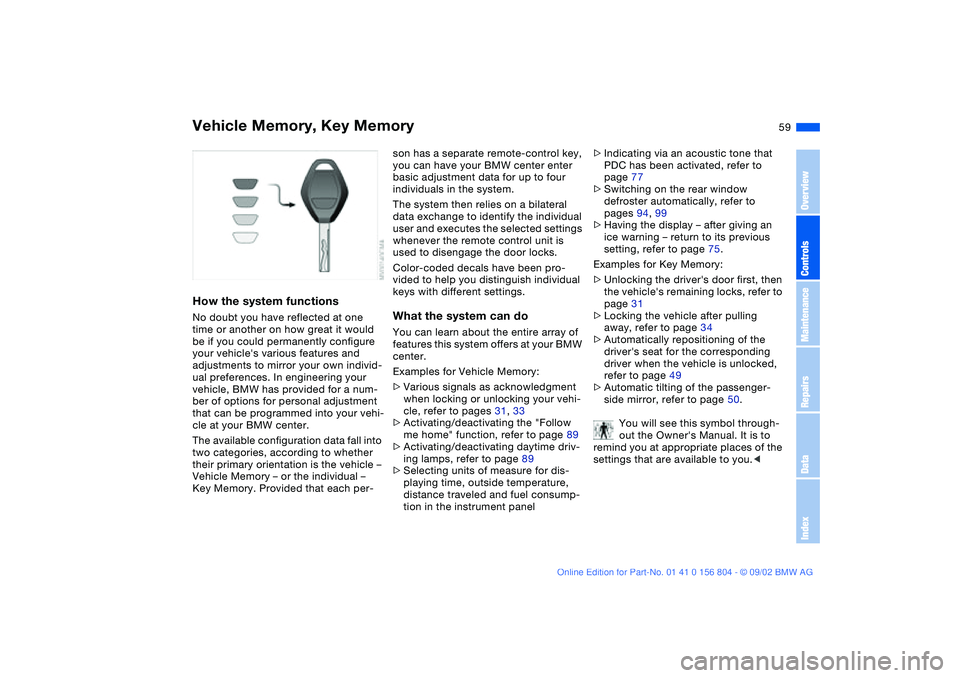
Color-coded decals have been pro-
vided to help you distinguish individual
keys with different settings.What the system can doYou can learn about the entire array of
features this system offers at your BMW
center.
Examples for Vehicle Memory:
>Various signals as acknowledgment
when locking or unlocking your vehi-
cle, refer to pages 31, 33
>Activating/deactivating the "Follow
me home" function, refer to page 89
>Activating/deactivating daytime driv-
ing lamps, refer to page 89
>Selecting units of measure for dis-
playing time, outside temperature,
distance traveled and fuel consump-
tion in the instrument panel>Indicating via an acoustic tone that
PDC has been activated, refer to
page 77
>Switching on the rear window
defroster automatically, refer to
pages 94, 99
>Having the display – after giving an
ice warning – return to its previous
setting, refer to page 75.
Examples for Key Memory:
>Unlocking the driver's door first, then
the vehicle's remaining locks, refer to
page 31
>Locking the vehicle after pulling
away, refer to page 34
>Automatically repositioning of the
driver's seat for the corresponding
driver when the vehicle is unlocked,
refer to page 49
>Automatic tilting of the passenger-
side mirror, refer to page 50.
You will see this symbol through-
out the Owner's Manual. It is to
remind you at appropriate places of the
settings that are available to you.<
OverviewControlsMaintenanceRepairsDataIndex
Page 61 of 166
61
Do not actuate the starter for too
short a time, but do not actuate it
for more than approx. 20 seconds.
Release the ignition key immediately
when the engine starts.
Do not allow the engine to warm up by
leaving it running while the vehicle
remains stationary. Instead, drive off
immediately at a moderate engine
speed.<
If the engine does not start on the first
attempt – if it is very hot or cold, for
instance:
>Press the accelerator pedal halfway
down while engaging the starter.
Cold starts at extremely low tempera-
tures below approx. +57/–156 and at
altitudes over 3,300 ft/1,000 m:
>On the first start attempt, it may be
necessary to engage the starter for a
longer period, but no longer than
20 seconds
>Press the accelerator pedal halfway
down while engaging the starter.
Engine idle speed is controlled by the
engine computer system. Increased
speeds at startup are normal and
should decrease as the engine warms
up. If engine speed does not decrease,
service is required.
To prevent the battery from discharg-
ing, always deactivate electrical
devices that are not in use. Switch the
ignition off when the vehicle is not
being driven.
Extended starting attempts, char-
acterized by excessively frequent
or long periods with the starter
engaged, can damage the catalytic
converter.<
Starting the engine
OverviewControlsMaintenanceRepairsDataIndex
Page 63 of 166
63
If exceptional circumstances
make it necessary to engage the
parking brake while the vehicle is in
motion, do not pull it with excessive
pressure. Keep your thumb pressed
against the release button while care-
fully pulling the lever up.
Excessive pressure can lead to over-
braking and loss of traction – fishtailing
– at the rear axle. The brake lamps do
not come on when the parking brake is
engaged.
Vehicles with manual transmission:
Always engage the parking brake when
parking on slopes and inclined sur-
faces. Placing the lever in gear may not
provide adequate resistance to rolling.
Vehicles with automatic transmission:
Place the selector lever in Park.<
To avoid corrosion and one-sided
braking, apply the parking brake
lightly from time to time when coasting
to a standstill – at a traffic signal, for
example – provided that it is safe to do
so.<
Manual transmission
Do not hold the vehicle in place on
slopes by slipping or "riding" the
clutch. Use the parking brake instead.
Riding the clutch leads to severe and
premature clutch wear.<
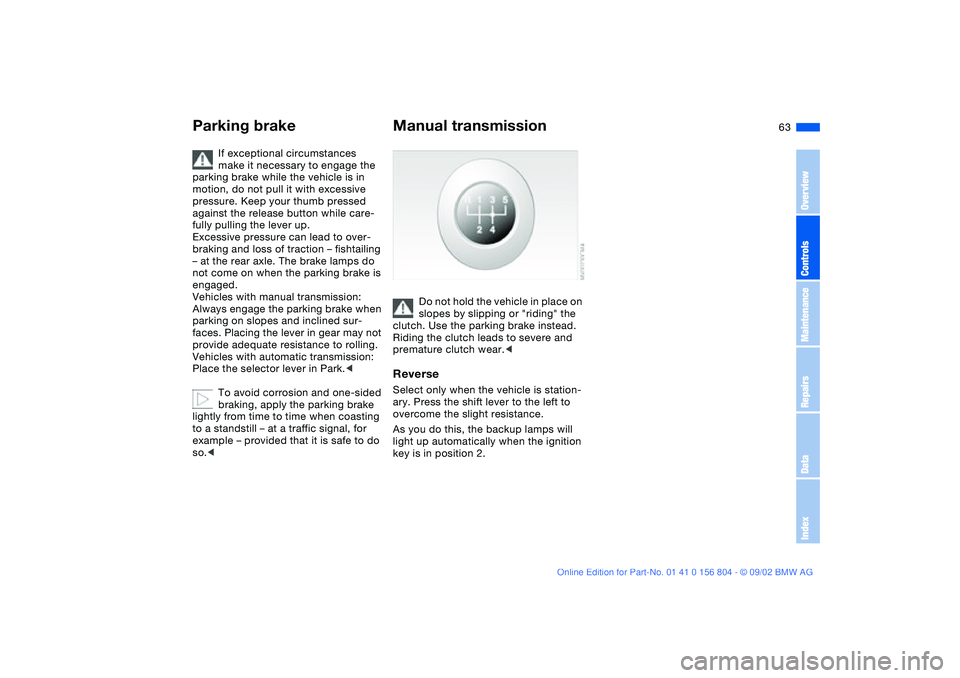
ReverseSelect only when the vehicle is station-
ary. Press the shift lever to the left to
overcome the slight resistance.
As you do this, the backup lamps will
light up automatically when the ignition
key is in position 2.
Parking brake
OverviewControlsMaintenanceRepairsDataIndex