door lock BMW 323Ci 2000 User Guide
[x] Cancel search | Manufacturer: BMW, Model Year: 2000, Model line: 323Ci, Model: BMW 323Ci 2000Pages: 189, PDF Size: 1.68 MB
Page 41 of 189
39n
RepairsIndexOverview Controls Car care Technology Data
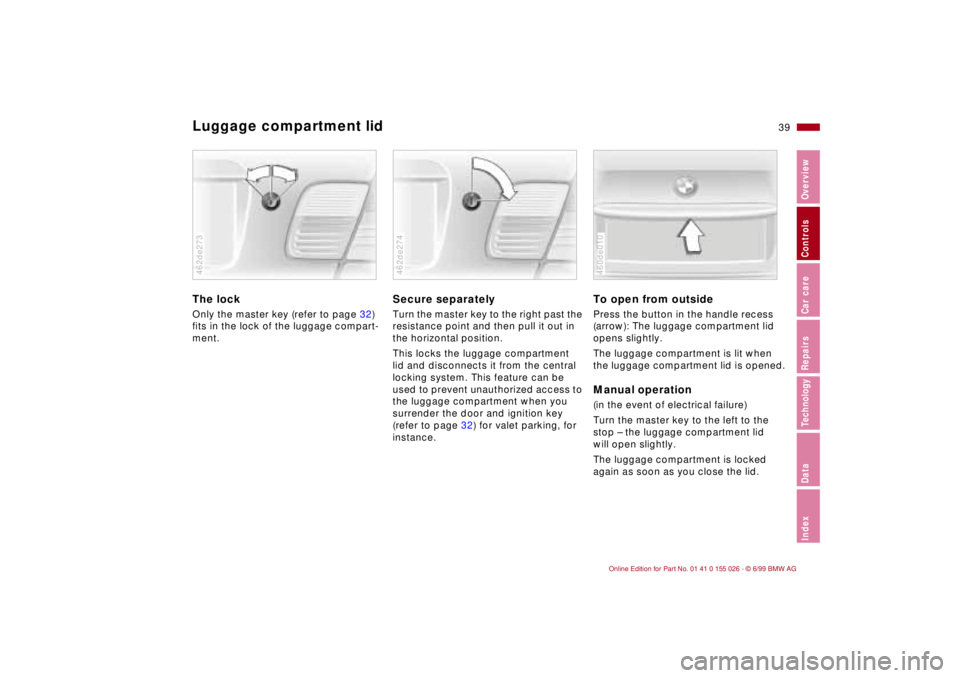
Luggage compartment lid The lock Only the master key (refer to page 32)
fits in the lock of the luggage compart-
ment.462de273
Secure separatelyTurn the master key to the right past the
resistance point and then pull it out in
the horizontal position.
This locks the luggage compartment
lid and disconnects it from the central
locking system. This feature can be
used to prevent unauthorized access to
the luggage compartment when you
surrender the door and ignition key
(refer to page 32) for valet parking, for
instance.462de274
To open from outsidePress the button in the handle recess
(arrow): The luggage compartment lid
opens slightly.
The luggage compartment is lit when
the luggage compartment lid is opened.Manual operation(in the event of electrical failure)
Turn the master key to the left to the
stop – the luggage compartment lid
will open slightly.
The luggage compartment is locked
again as soon as you close the lid.460de010
Page 44 of 189
42n
Alarm system
*
The conceptThe vehicle's alarm system responds:
>When a door, the hood or the lug-
gage compartment lid is opened
>To motion within the passenger com-
partment (interior motion sensor)
>To a change in the inclination of the
vehicle, e. g. during an attempted
wheel theft of unauthorized towing
>To interruption of battery voltage.
The alarm system signals unauthorized
access to the vehicle or an attempted
theft in different ways:
>Sounding an acoustical alarm for
30 seconds
>Activating the hazard warning flash-
ers for approx. five minutes
*.
To activate and deactivate the
alarm systemWhen the vehicle is locked or unlocked
by using a key or with the remote con-
trol, the alarm system is also simulta-
neously armed or disarmed.
The interior motion sensor is activated
approx. 30 seconds after you have fin-
ished locking the car.
If the alarm system has been armed
correctly, the hazard warning flashers
cycle once. An acoustic warning signal
sounds at the same time.
You can have various confirmation
messages set to inform you that
the alarm system has been armed or
disarmed.<
You can also open the luggage com-
partment lid when the system is armed
by pressing button 3 of the remote con-
trol (refer to page 37). When it is closed,
the lid is once again secured.
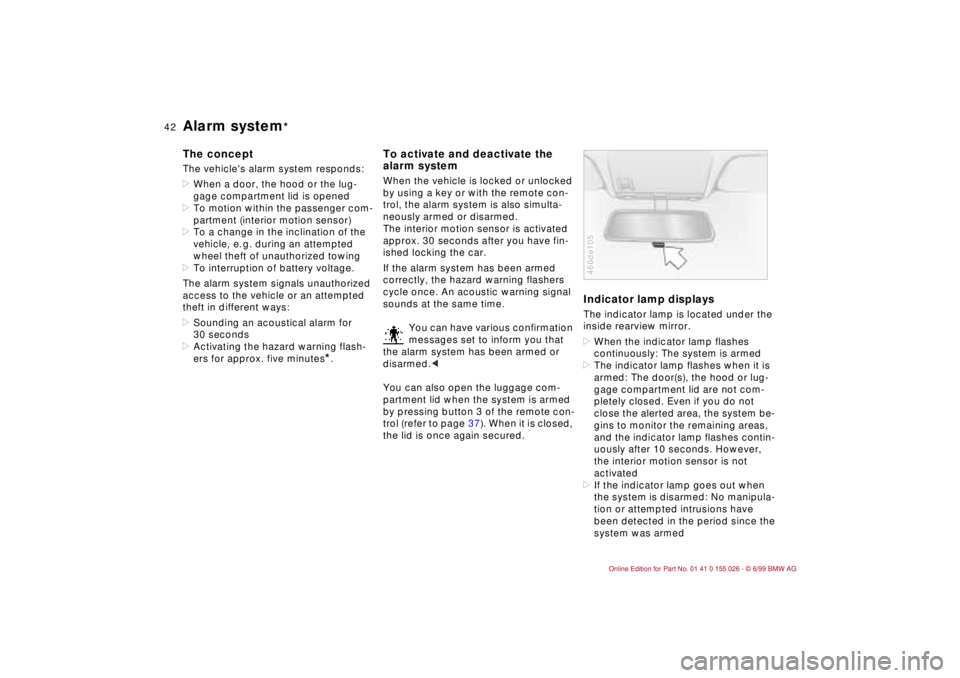
Indicator lamp displaysThe indicator lamp is located under the
inside rearview mirror.
>When the indicator lamp flashes
continuously: The system is armed
>The indicator lamp flashes when it is
armed: The door(s), the hood or lug-
gage compartment lid are not com-
pletely closed. Even if you do not
close the alerted area, the system be-
gins to monitor the remaining areas,
and the indicator lamp flashes contin-
uously after 10 seconds. However,
the interior motion sensor is not
activated
>If the indicator lamp goes out when
the system is disarmed: No manipula-
tion or attempted intrusions have
been detected in the period since the
system was armed460de105
Page 46 of 189
44n
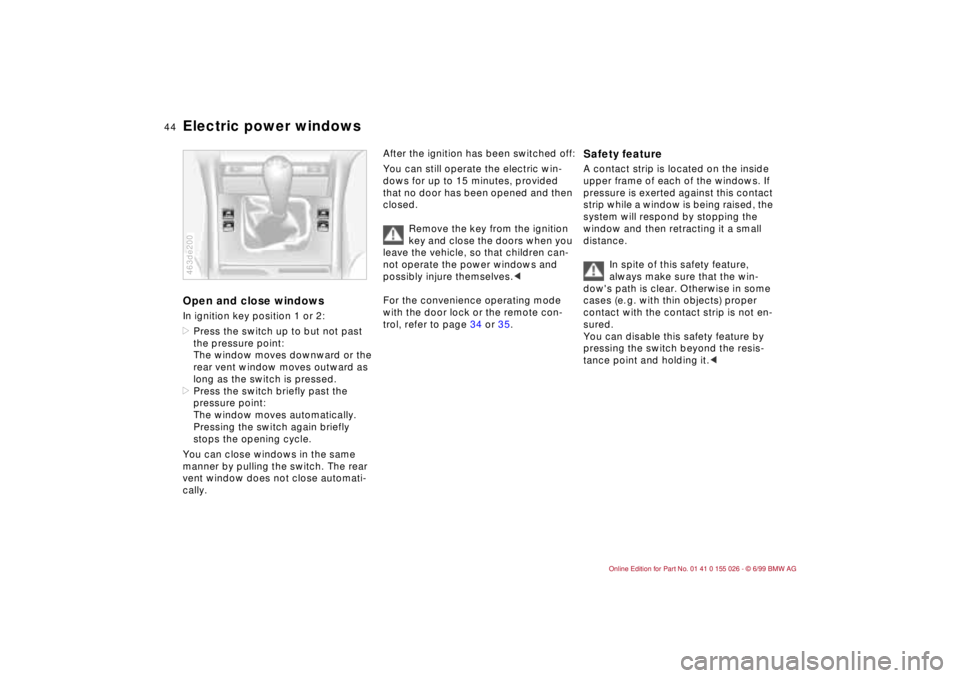
Electric power windowsOpen and close windowsIn ignition key position 1 or 2:
>Press the switch up to but not past
the pressure point:
The window moves downward or the
rear vent window moves outward as
long as the switch is pressed.
>Press the switch briefly past the
pressure point:
The window moves automatically.
Pressing the switch again briefly
stops the opening cycle.
You can close windows in the same
manner by pulling the switch. The rear
vent window does not close automati-
cally.463de200
After the ignition has been switched off:
You can still operate the electric win-
dows for up to 15 minutes, provided
that no door has been opened and then
closed.
Remove the key from the ignition
key and close the doors when you
leave the vehicle, so that children can-
not operate the power windows and
possibly injure themselves.<
For the convenience operating mode
with the door lock or the remote con-
trol, refer to page 34 or 35.
Safety feature A contact strip is located on the inside
upper frame of each of the windows. If
pressure is exerted against this contact
strip while a window is being raised, the
system will respond by stopping the
window and then retracting it a small
distance.
In spite of this safety feature,
always make sure that the win-
dow's path is clear. Otherwise in some
cases (e. g. with thin objects) proper
contact with the contact strip is not en-
sured.
You can disable this safety feature by
pressing the switch beyond the resis-
tance point and holding it.<
Page 47 of 189
45n
RepairsIndexOverview Controls Car care Technology Data
Sliding/tilt sunroof
*
To prevent injuries, exercise care
when closing the sliding/tilt sun-
roof and keep it in your field of vision
until it is completely closed.
Remove the key from the ignition and
close the doors when you leave the
vehicle, so that children cannot operate
the sunroof and possibly injure them-
selves.<
To avoid pressure or drafts in the pas-
senger compartment when the sunroof
is open or raised, keep the air vents in
the dashboard open and increase the air
supply if necessary. Refer to page 91.
When competely opened, the sunroof
may cause unpleasant vibrations in the
vehicle interior. To eliminate these
vibrations, close the sunroof until this
natural effect disappears.
For the convenience operating mode
with the door lock or the remote con-
trol, refer to page 34 or 35.
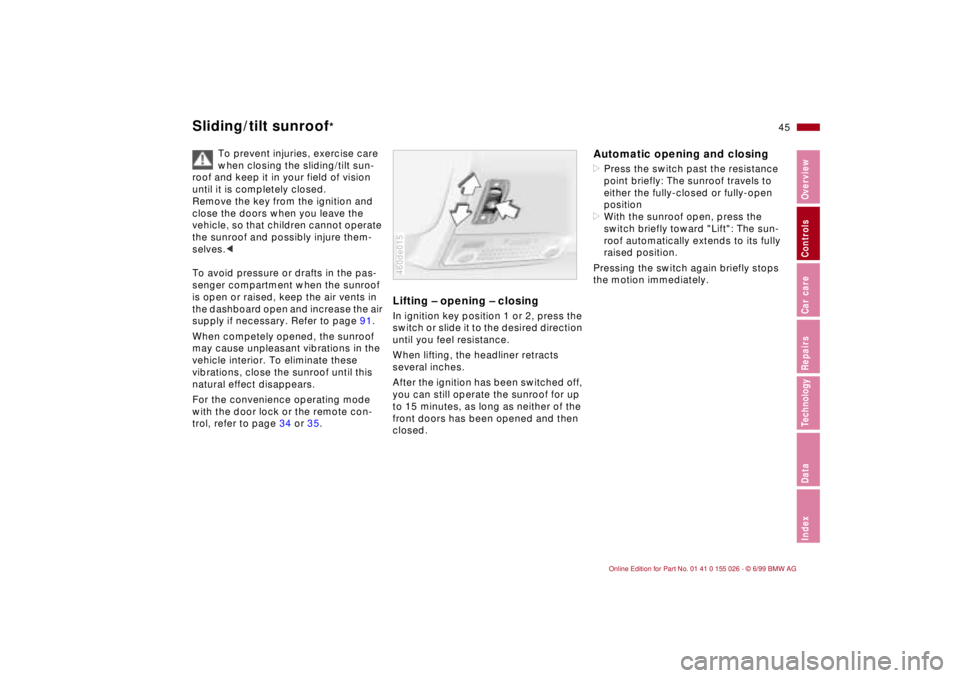
Lifting – opening – closingIn ignition key position 1 or 2, press the
switch or slide it to the desired direction
until you feel resistance.
When lifting, the headliner retracts
several inches.
After the ignition has been switched off,
you can still operate the sunroof for up
to 15 minutes, as long as neither of the
front doors has been opened and then
closed.460de015
Automatic opening and closing>Press the switch past the resistance
point briefly: The sunroof travels to
either the fully-closed or fully-open
position
>With the sunroof open, press the
switch briefly toward "Lift": The sun-
roof automatically extends to its fully
raised position.
Pressing the switch again briefly stops
the motion immediately.
Page 53 of 189
51n
RepairsIndexOverview Controls Car care Technology Data
Seat and mirror memory
*
Adjusting steering wheel
To select a stored setting:Automatic:
1 Open driver's door after unlocking or
ignition key in position 1
2 Briefly press memory button 1, 2 or 3
as desired.
The adjustment cycle is canceled im-
mediately if you press a seat adjust-
ment switch or one of the memory
buttons.
Manual:
1 With driver's door closed and ignition
key either removed or in position
0 or 2
2 Maintain pressure on desired mem-
ory button 1, 2 or 3 until the adjust-
ment process is completed.
If you press the
M
EMORY button acci-
dentally: Press the button a second
time, the indicator lamp goes out.
Do not select a memory position
while the vehicle is moving. There
is a risk of accident from unexpected
seat movement.<
You can adapt the vehicle settings
so that your own personalized
seat setting is initiated when you unlock
the car using your personalized remote
control key.<
When this setting is used, be sure
that the footwell behind the driver's
seat is clear before unlocking the vehi-
cle. Otherwise, persons or objects could
be injured or damaged should the seat
move backward.<
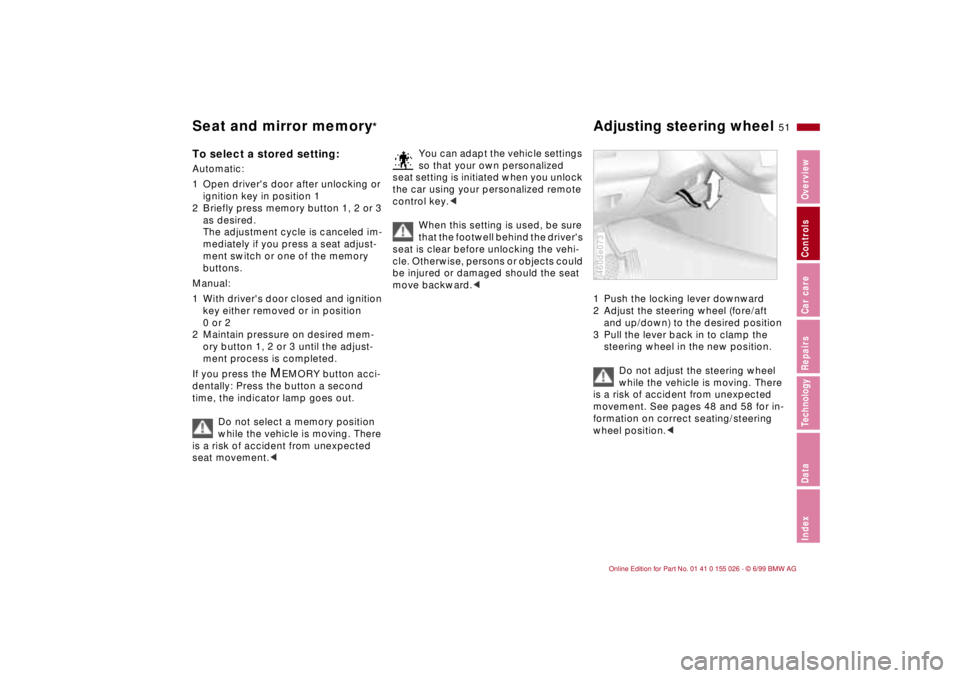
1 Push the locking lever downward
2 Adjust the steering wheel (fore/aft
and up/down) to the desired position
3 Pull the lever back in to clamp the
steering wheel in the new position.
Do not adjust the steering wheel
while the vehicle is moving. There
is a risk of accident from unexpected
movement. See pages 48 and 58 for in-
formation on correct seating/steering
wheel position.<460de073
Page 60 of 189

58n
Airbags
For your own safety, please ob-
serve the following precautions
concerning airbags, as otherwise their
protective function may be impaired
and your personal safety endangered.
The following information pertains to all
occupants:
The airbags are supplemental restraint
devices designed to provide extra pro-
tection; they are not a substitute for
safety belts. Wear your safety belt at all
times. The airbags will not be triggered
in the event of a minor accident, a vehi-
cle roll-over, or collisions from the rear.
In this case, the safety belt offers the
best protection.
Airbags are located under the cover
panels in the steering wheel, in the in-
strument panel, in the side trim panels
in the front and rear
*, in the roof panels,
and in the sides of the inside roof lining.
Select a seat position that is comfort-
able and allows the greatest possible
distance from each of the applicable
airbags. Hold the steering wheel at the
rim (hands at the "9 o'clock and
3 o'clock" positions) in order to avoid
injuries to the hands or arms if the air-
bag is triggered.
Never allow any objects to obstruct the
area between the airbag and an occu-
pant.
Do not use the cover panel above the
front passenger airbag as a storage
area.
Never tape the airbag cover panels,
cover them over or alter them in any
other way.
Never install a rear-facing child restraint
device on the front passenger seat.
Children under 13 years of age and
children who are smaller than 5 feet
(150 cm), should only travel in the rear
seat.
If your vehicle is equipped with side air-
bags in the rear, be sure that child seats
are installed correctly and with the
greatest possible distance from the side
trim panels. Do not allow children to
lean out of the child's seat in the direc-
tion of the side trim panels. Otherwise,
serious injuries could occur if the airbag
is triggered.
At all times, occupants should sit up-
right and be properly restrained (infants
and small children in appropriate child
restraint systems; larger children and
adults using the safety belts). Never let
an occupant's head rest near or on a
side airbag because the inflating airbag
could cause a serious or fatal injury.
Please note that the word "Airbag" im-
printed on the door trim panel indicates
the airbag's location.Accident research shows that the saf-
est place for children in an automobile
is in the rear seat. However, a child
sitting in the rear seat and not properly
restrained may place his or her head on
or near the side airbag, if so equipped.
For example, a child – even though
belted – may fall asleep with his or her
head against the side airbag. It may be
difficult for a driver to ensure that chil-
dren in the rear seat will remain prop-
erly positioned at all times and not
place their heads on or near the side
airbag. Therefore, we recommend that
the rear seat side airbags, if provided,
be deactivated if you plan to transport
children in the rear seat.
The rear seat side airbags may already
have been deactivated, either at the
time of manufacture or by a BMW cen-
ter. Labels in the rear door opening
should indicate the status of your rear
seat side airbags. If you are uncertain of
their status, or wish to have the airbags
activated or deactivated, please contact
your BMW center.<
Page 64 of 189
62n
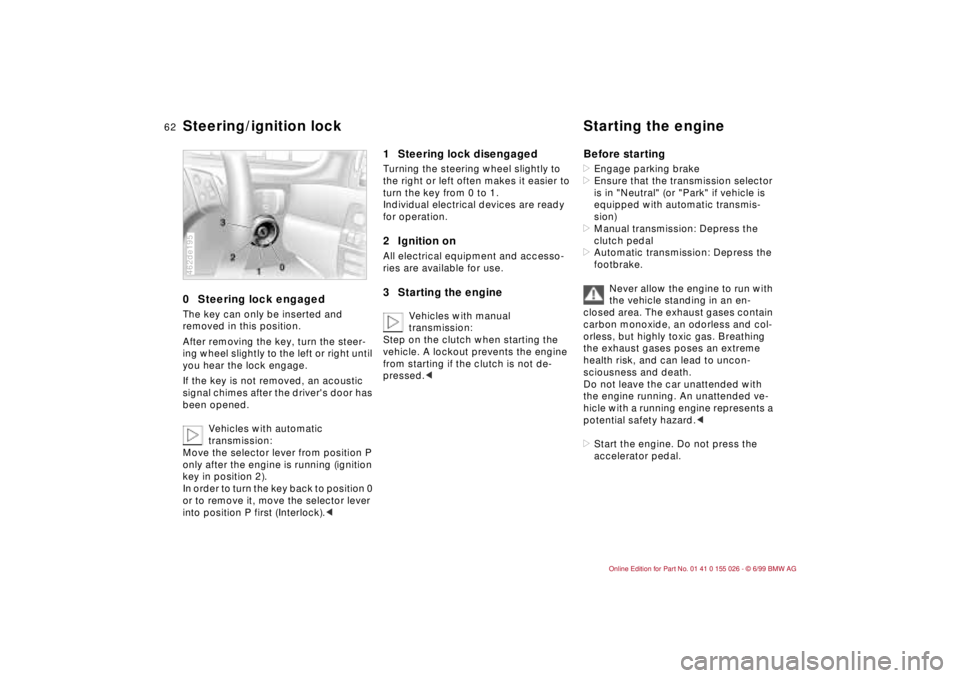
0 Steering lock engaged The key can only be inserted and
removed in this position.
After removing the key, turn the steer-
ing wheel slightly to the left or right until
you hear the lock engage.
If the key is not removed, an acoustic
signal chimes after the driver's door has
been opened.
Vehicles with automatic
transmission:
Move the selector lever from position P
only after the engine is running (ignition
key in position 2).
In order to turn the key back to position 0
or to remove it, move the selector lever
into position P first (Interlock).<462de195
1 Steering lock disengaged Turning the steering wheel slightly to
the right or left often makes it easier to
turn the key from 0 to 1.
Individual electrical devices are ready
for operation.2 Ignition onAll electrical equipment and accesso-
ries are available for use.3 Starting the engine
Vehicles with manual
transmission:
Step on the clutch when starting the
vehicle. A lockout prevents the engine
from starting if the clutch is not de-
pressed.c
Before starting>Engage parking brake
>Ensure that the transmission selector
is in "Neutral" (or "Park" if vehicle is
equipped with automatic transmis-
sion)
>Manual transmission: Depress the
clutch pedal
>Automatic transmission: Depress the
footbrake.
Never allow the engine to run with
the vehicle standing in an en-
closed area. The exhaust gases contain
carbon monoxide, an odorless and col-
orless, but highly toxic gas. Breathing
the exhaust gases poses an extreme
health risk, and can lead to uncon-
sciousness and death.
Do not leave the car unattended with
the engine running. An unattended ve-
hicle with a running engine represents a
potential safety hazard.<
>Start the engine. Do not press the
accelerator pedal.
Steering/ignition lock Starting the engine
Page 79 of 189
77n
RepairsIndexOverview Controls Car care Technology Data
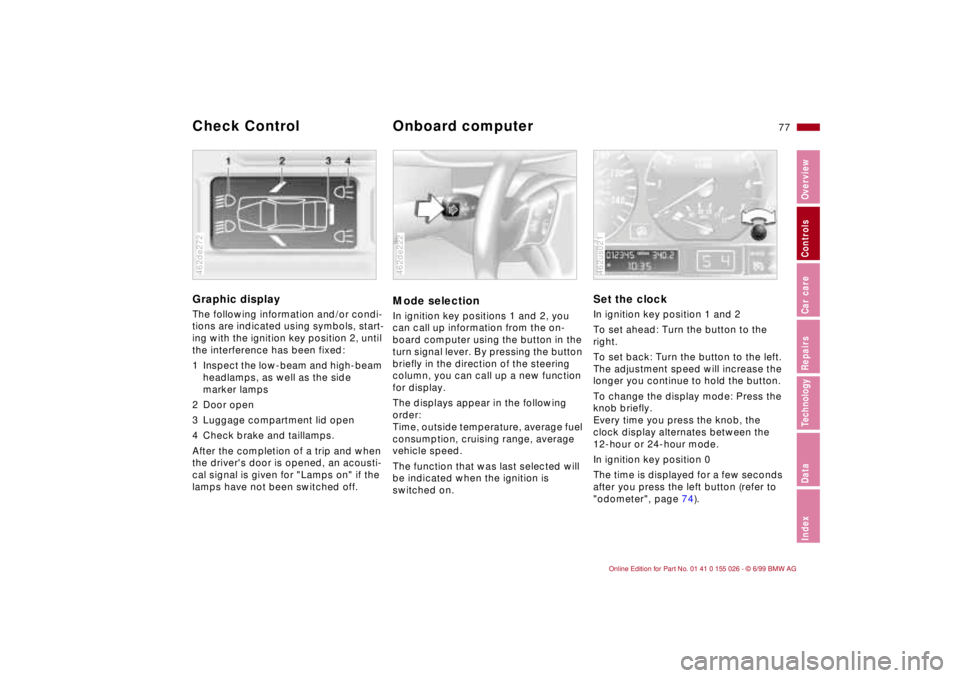
Graphic display
The following information and/or condi-
tions are indicated using symbols, start-
ing with the ignition key position 2, until
the interference has been fixed:
1 Inspect the low-beam and high-beam
headlamps, as well as the side
marker lamps
2 Door open
3 Luggage compartment lid open
4 Check brake and taillamps.
After the completion of a trip and when
the driver's door is opened, an acousti-
cal signal is given for "Lamps on" if the
lamps have not been switched off.462de272
Mode selectionIn ignition key positions 1 and 2, you
can call up information from the on-
board computer using the button in the
turn signal lever. By pressing the button
briefly in the direction of the steering
column, you can call up a new function
for display.
The displays appear in the following
order:
Time, outside temperature, average fuel
consumption, cruising range, average
vehicle speed.
The function that was last selected will
be indicated when the ignition is
switched on.462de222
Set the clockIn ignition key position 1 and 2
To set ahead: Turn the button to the
right.
To set back: Turn the button to the left.
The adjustment speed will increase the
longer you continue to hold the button.
To change the display mode: Press the
knob briefly.
Every time you press the knob, the
clock display alternates between the
12-hour or 24-hour mode.
In ignition key position 0
The time is displayed for a few seconds
after you press the left button (refer to
"odometer", page 74).462us021
Check Control
Onboard computer
Page 96 of 189
94n
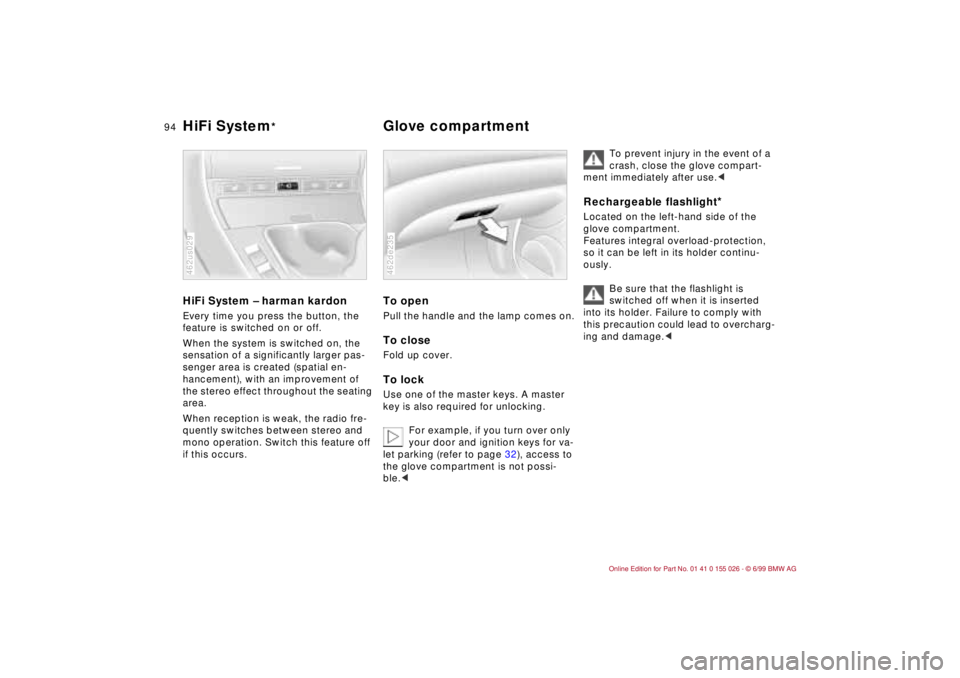
HiFi System – harman kardonEvery time you press the button, the
feature is switched on or off.
When the system is switched on, the
sensation of a significantly larger pas-
senger area is created (spatial en-
hancement), with an improvement of
the stereo effect throughout the seating
area.
When reception is weak, the radio fre-
quently switches between stereo and
mono operation. Switch this feature off
if this occurs.462us029
To openPull the handle and the lamp comes on.To closeFold up cover.To lockUse one of the master keys. A master
key is also required for unlocking.
For example, if you turn over only
your door and ignition keys for va-
let parking (refer to page 32), access to
the glove compartment is not possi-
ble.<462de235
To prevent injury in the event of a
crash, close the glove compart-
ment immediately after use.<
Rechargeable flashlight
*
Located on the left-hand side of the
glove compartment.
Features integral overload-protection,
so it can be left in its holder continu-
ously.
Be sure that the flashlight is
switched off when it is inserted
into its holder. Failure to comply with
this precaution could lead to overcharg-
ing and damage.<
HiFi System
*
Glove compartment
Page 112 of 189

110n
Winter operationThe onset of winter is often accompa-
nied by rapid changes in weather. Adap-
tations in driving style should be accom-
panied by preparations on the vehicle
itself to ensure that your progress
through the winter remains safe and
trouble-free.CoolantBe sure that the coolant mixture is kept
at the year-round ratio of 50:50 of water
and antifreeze/corrosion protection.
This mixture provides protection against
freezing down to approx. – 347
(– 376). Replace the coolant every four
years.LocksBMW door lock deicer can be used to
free them if frozen. This deicer also
contains lubricant.
After using deicer, treatment with BMW
lock barrel grease is recommended.Rubber seals and components To prevent the weather-stripping from
freezing, apply a spray-on rubber treat-
ment or silicone spray to the door, hood
and luggage compartment lid seals.
A full range of car-care products is
available from your BMW center.<
Snow chains BMW snow chains
* can be mounted on
both summer and winter tires. Mount
them in pairs on the rear wheels only
and comply with the manufacturer's
safety precautions. Do not exceed a
maximum speed of 30 mph (50 km/h).
In this situation (snow chains mounted),
deactivate the DSC. Refer to page 81.
Starting offWe recommend that you use the man-
ual control switch to deactivate DSC
when starting off in deep snow or when
rocking the car to free it (refer to
page 81).Driving on low-traction road
surfacesUse smooth, gentle pressure to control
the accelerator pedal. Avoid excessive
engine speeds and shift to the next
higher gear at an early point. Adapt
your speed and driving style when ap-
proaching grades or slopes. Maintain
an adequate distance between yourself
and the car ahead.
BrakesWinter road conditions substantially
reduce the traction available between
the tires and the road surface.
Remember that braking distances will
be significantly longer as a result.
ABS is intended to prevent the wheels
from locking during brake applications,
thus helping to maintain vehicle stability
and steering response.
If the ABS does not respond in a critical
braking situation and the wheels lock:
Reduce the pressure on the brake
pedal until the wheels just start to roll
again while still maintaining enough
force to continue braking. Then in-
crease the pressure, reduce the pres-
sure when the wheels lock, reapply
pressure etc.
This staggered braking procedure will
reduce stopping distances while help-
ing you maintain steering control.
You can then attempt to steer around
hazards after you have reduced pres-
sure on the brake pedal.