light BMW 323Ci 2000 Service Manual
[x] Cancel search | Manufacturer: BMW, Model Year: 2000, Model line: 323Ci, Model: BMW 323Ci 2000Pages: 189, PDF Size: 1.68 MB
Page 133 of 189

131n
RepairsIndexOverview Controls Car care Technology Data
Caring for your carExterior finish To provide effective corrosion protec-
tion, multilayer paintwork is applied at
the factory. Cataphoretic immersion
priming techniques are supplemented
using special body-cavity protectants,
with the application of specially-devel-
oped and extensively tested materials.
A layer of flexible PVC is first applied to
the undercarriage. Following this, a
comprehensive undercoating treatment
with a wax-based protectant is applied.
Regular maintenance makes an impor-
tant contribution to maintaining the
safety and resale value of your vehicle.
Increasing awareness of the effects of
harmful environmental factors on vehi-
cle finishes have led paint and vehicle
manufacturers to initiate ongoing pro-
grams designed to further improve the
durability of their finishes. Despite this,
environmental factors that occur locally
or regionally can have negative effects
on the finish of your vehicle. These
should guide you in determining the fre-
quency and extent of your efforts to
maintain the vehicle finish.
Depending upon material and type
of impact (perforation of paint layer),
physical stresses from sand, road salt,
gravel, etc., can cause corrosion to
start extending beneath the finish, start-
ing at the point of impact.Road dirt, tar spots, dead insects, ani-
mal droppings (strong alkali concentra-
tion) and tree excretions (resins and
pollen) all contain substances capable
of causing damage when allowed to re-
main on the finish of your car for any
period of time (spots, etching, flaking,
separation in the top coat).
In industrial areas, deposits of flue dust,
lime, oily soot, precipitation containing
sulfur-dioxide (acid rain) and other envi-
ronmental pollutants will damage the
car's finish unless adequate care is pro-
vided – even though this generally lim-
ited to the outside horizontal surfaces.
In coastal regions, high levels of atmo-
spheric salt and humidity promote cor-
rosion.
In tropical zones temperatures of over
1007 (406) in the shade prevail, in
addition to heavy ultraviolet radiation
and high humidity. Under those circum-
stances light colored paints reach tem-
peratures of up to 1807 (806) and
dark paints up to 2507 (1206).
Caring for the vehicle finish Regular washing is a preventive mea-
sure against long-term effects from
substances that are harmful to the vehi-
cle's finish, especially if you drive your
vehicle in areas with high levels of air
pollution or aggressive natural sub-
stances (tree resins, pollen).
Nevertheless, you should immediately
remove especially aggressive sub-
stances. Failure to do so can lead to
changes in the paint's chemical struc-
ture or to discoloration. Gasoline spilled
during refueling, oil, grease and brake
fluid should always be cleaned away
immediately, as should bird droppings.
All of these substances cause damage
to the finish.
Any contamination remaining on the
surface of the vehicle will be especially
conspicuous after washing. Use clean-
ing fluid or alcohol with a clean cloth or
cotton pad to remove. Remove tar
spots with tar remover. After cleaning,
the affected areas should be waxed to
ensure continued protection.
A full range of car-care products is
available from your BMW center.<
Page 134 of 189

132n
Caring for your carWaxing your car Protect the finish using carnauba or
synthetic-based waxes only.
The best way to determine when the
finish needs to be waxed is by noting
when water stops beading on the sur-
face.
You can use a glass cleaner to remove
any wax or silicone that may have been
left on the windows during waxing.
A full range of car-care products is
available from your BMW center.<
Paint damageYou can touch up small areas of paint
damage with a BMW spray paint or a
BMW touch-up stick.
The paint color code for your car is pro-
vided on a sticker located next to the
type plate and on the first page of your
Service and Warranty Information
Booklet.
Damage caused by flying stones,
scratches, etc., must be touched up
without delay to prevent rust from form-
ing.
If corrosion has started to form in an
area with paint damage, remove all rust
and clean the area. Then prime the area
with a BMW Primer Stick. Finally, apply
the finish coat. Wait a few days, then
polish the repaired area. Finish by ap-
plying a wax preservative.
More extensive paint damage should be
professionally repaired in accordance
with the manufacturer's instructions.
Your BMW center uses original BMW
finish materials in accordance with offi-
cial repair procedures.
Caring for other vehicle
components and materials Light-alloy wheels should be treated
with alloy wheel cleaner, especially dur-
ing the winter months. However, do not
use aggressive products containing ac-
ids, strong alkalis or abrasives. Do not
use steam cleaners operating at tem-
peratures above 1407 (606). Follow
the manufacturer's instructions.
If your vehicle has chrome parts
* such
as the window frames and door handles,
be especially careful about cleaning
them with plenty of water and possibly a
shampoo supplement as well after the
roads have been salted. Use chrome
polish as an additional treatment.
You can use window and glass cleaner
to clean inside window surfaces and
mirrors without smearing and streaking.
Never use polishing pastes or abrasive
(quartz) cleansers on mirror lenses.
Page 135 of 189

133n
RepairsIndexOverview Controls Car care Technology Data
Caring for your carPlastic components, vinyl upholstery,
headliners, lamp lenses, the clear cover
of the instrument panel and compo-
nents with a sprayed dull black surface
can be cleaned with water (add plastic
shampoo as required). Do not allow
moisture to soak through the seats or
headliner. Never use solvents such as
lacquer thinner, heavy-duty grease re-
mover, fuels, etc.
Rubber components should be cleaned
with water only; a rubber treatment or
silicone spray may also be applied.
Clean the wiper blades with soapy wa-
ter. The wiper blades should be re-
placed twice a year, before and after
the cold season. This especially impor-
tant for vehicles with a rain sensor.
Use only wiper blades approved
by BMW.<
The safety belts should be cleaned with
a mild soap and water solution without
removing them from the car. Never at-
tempt chemical or dry cleaning, as
damage to the belt fabric could result.
After cleaning, never allow the inertia
reel to retract the belts until they are
completely dry. Dirty safety belts pre-
vent the inertia reel mechanism from
retracting the strap properly, and thus
constitute a safety hazard.
Heavily soiled floor carpets and mats
*
can be cleaned with an interior cleaner.
The floor mats can be removed from the
vehicle for cleaning.
Please use only a damp cloth to clean
wooden fascia panels and components.
Follow up by drying with a soft cloth.
A full range of car-care products is
available from your BMW center.<
Care of upholstery materials Depressions in the upholstered materi-
als resulting from everyday use can be
brushed up by brushing "against the
nap" with a lightly dampened brush.
The tendency of the pile to lie in a par-
ticular direction on velour upholstery is
not a quality defect, and, just as on
home textiles or clothing, cannot be
avoided.
Lint on upholstery materials, textile or
leather remnants that have been worn
into the upholstery may be removed
with a lint brush or a Velcro
â brush. A
cleaning glove is available for particu-
larly "stubborn" lint. Stains and fairly
large areas of dirt should be cleaned off
without delay, using lukewarm water
and an interior cleaner, stain remover or
cleaning-grade benzene. Brush the fab-
ric afterwards to restore its appearance.
If the vehicle will be stored for an ex-
tended period, or if it is exposed to in-
tense sunlight, cover all seats or the
windows to prevent fading.
A full range of car-care products is
available from your BMW center.<
Page 136 of 189

134n
Caring for your carThe buildup of an electrostatic charge
on the seat covers, particularly if atmo-
spheric humidity is low, can give the
occupants an unpleasant electric shock
if they touch metal body parts after leav-
ing the vehicle. Although this not dan-
gerous in any way, it can be avoided by
touching a bare or polished metal part
of the car while getting out.
Leather care The leather upholstery
* used by BMW
is a natural product of the highest qual-
ity, processed using state-of-the-art
methods to ensure that it will maintain
its high quality for years to come, pro-
vided that it is properly cared for.
Because this product is manufactured
using natural materials, you must make
allowance for its special characteristics
and for the peculiarities of its use and
care.
Regular periodic cleaning and care are
essential, as dust and road dirt act as
abrasives in the pores and creases of
the material. This leads to wear spots
and premature brittleness on the sur-
face of the leather. We therefore sug-
gest that you clean the leather with a
vacuum cleaner or dust cloth at fre-
quent intervals.
For cleaning use BMW leather cleaning
foam.Since dirt and grease gradually attack
the protective layer of the leather, the
cleaned surfaces should be treated with
BMW leather care agent. This also acts
as an antistatic agent.
To protect against moisture and water
treat the leather with BMW Impregnat-
ing Agent.
We recommend that you perform this
procedure twice a year on leather ex-
posed to normal use.
Spills should be wiped up immediately.
Remove grease and oil stains without
rubbing, but rather by dabbing with
spot remover.
If the upholstery is to be exposed to in-
tense sunlight or if the vehicle is to be
stored for an extended period, cover all
leather surfaces (or, better yet, the win-
dows) to prevent fading.
A full range of car-care products is
available from your BMW center.<
Page 138 of 189

136n
Vehicle storage Technical modifications to the vehicleConsult your authorized BMW center
regarding special procedures if you in-
tend to store the vehicle for more than
three months. Any BMW center will gladly provide
information on the value of technical
modifications to the car, the legal posi-
tion and the manufacturer's recommen-
dations. For this purpose, the center re-
quires the Vehicle Identification Number
and, in some cases, also the engine
number.
Light-Emitting Diodes (LEDs)Light-emitting diodes installed behind
translucent lenses serve as the light
source for many of the controls and
displays in your vehicle. These LEDs
resemble conventional lasers and are
classified by law as "Class 1 light-
emitting diodes".
Do not remove the protective lens
and avoid staring directly at the
unfiltered beam for extended periods
(several hours), as inflammation of the
iris could result.<
Page 139 of 189
137n
RepairsIndexOverview Controls Car care Technology Data
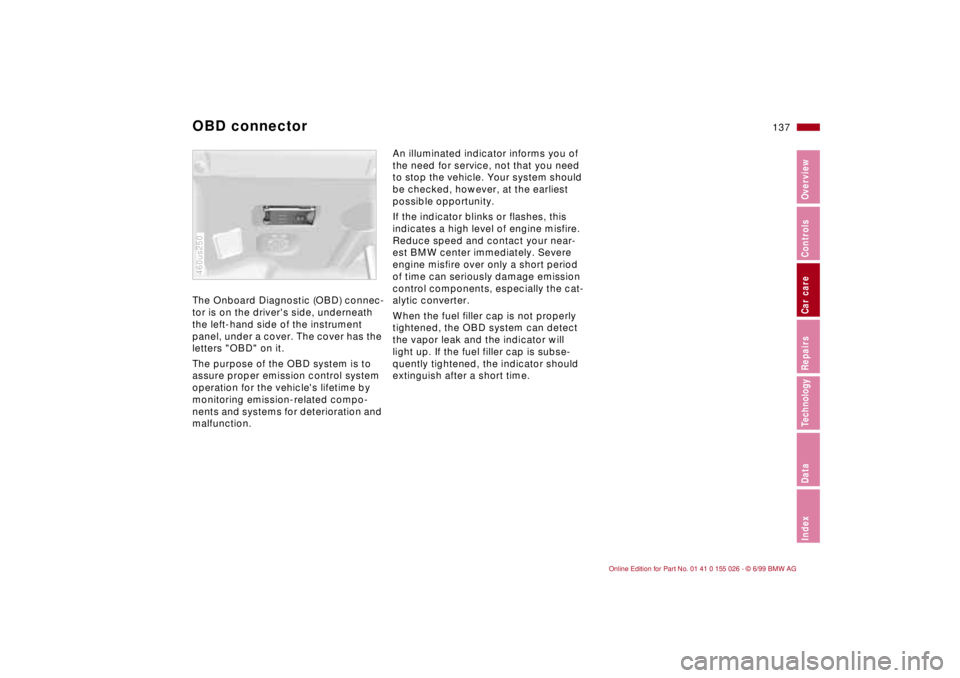
OBD connector The Onboard Diagnostic (OBD) connec-
tor is on the driver's side, underneath
the left-hand side of the instrument
panel, under a cover. The cover has the
letters "OBD" on it.
The purpose of the OBD system is to
assure proper emission control system
operation for the vehicle's lifetime by
monitoring emission-related compo-
nents and systems for deterioration and
malfunction.460us250
An illuminated indicator informs you of
the need for service, not that you need
to stop the vehicle. Your system should
be checked, however, at the earliest
possible opportunity.
If the indicator blinks or flashes, this
indicates a high level of engine misfire.
Reduce speed and contact your near-
est BMW center immediately. Severe
engine misfire over only a short period
of time can seriously damage emission
control components, especially the cat-
alytic converter.
When the fuel filler cap is not properly
tightened, the OBD system can detect
the vapor leak and the indicator will
light up. If the fuel filler cap is subse-
quently tightened, the indicator should
extinguish after a short time.
Page 143 of 189
141n
RepairsIndexOverview Controls Car care Technology Data
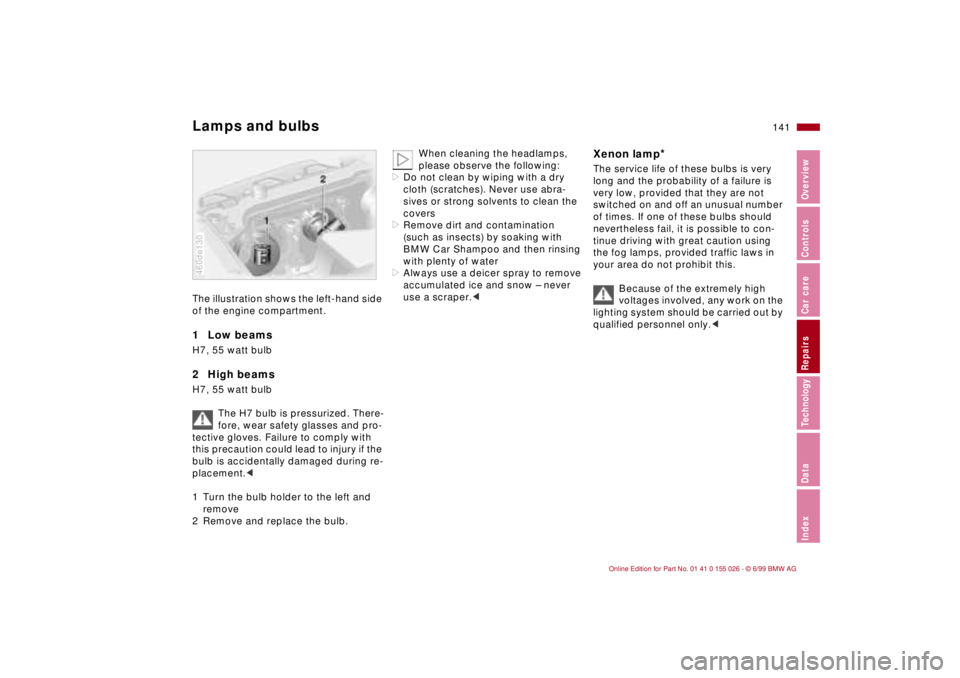
Lamps and bulbsThe illustration shows the left-hand side
of the engine compartment.1 Low beams H7, 55 watt bulb2 High beamsH7, 55 watt bulb
The H7 bulb is pressurized. There-
fore, wear safety glasses and pro-
tective gloves. Failure to comply with
this precaution could lead to injury if the
bulb is accidentally damaged during re-
placement.<
1 Turn the bulb holder to the left and
remove
2 Remove and replace the bulb.460de130
When cleaning the headlamps,
please observe the following:
>Do not clean by wiping with a dry
cloth (scratches). Never use abra-
sives or strong solvents to clean the
covers
>Remove dirt and contamination
(such as insects) by soaking with
BMW Car Shampoo and then rinsing
with plenty of water
>Always use a deicer spray to remove
accumulated ice and snow – never
use a scraper.<
Xenon lamp
*
The service life of these bulbs is very
long and the probability of a failure is
very low, provided that they are not
switched on and off an unusual number
of times. If one of these bulbs should
nevertheless fail, it is possible to con-
tinue driving with great caution using
the fog lamps, provided traffic laws in
your area do not prohibit this.
Because of the extremely high
voltages involved, any work on the
lighting system should be carried out by
qualified personnel only.<
Page 144 of 189
142n
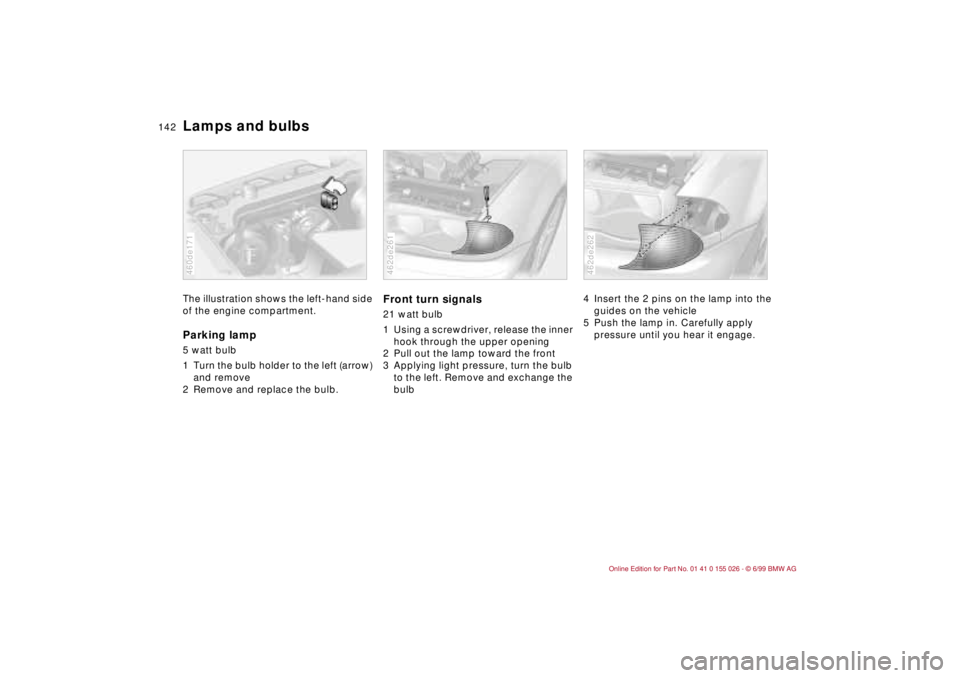
Lamps and bulbsThe illustration shows the left-hand side
of the engine compartment.Parking lamp5 watt bulb
1 Turn the bulb holder to the left (arrow)
and remove
2 Remove and replace the bulb.460de171
Front turn signals 21 watt bulb
1 Using a screwdriver, release the inner
hook through the upper opening
2 Pull out the lamp toward the front
3 Applying light pressure, turn the bulb
to the left. Remove and exchange the
bulb462de261
4 Insert the 2 pins on the lamp into the
guides on the vehicle
5 Push the lamp in. Carefully apply
pressure until you hear it engage.462de262
Page 146 of 189
144n
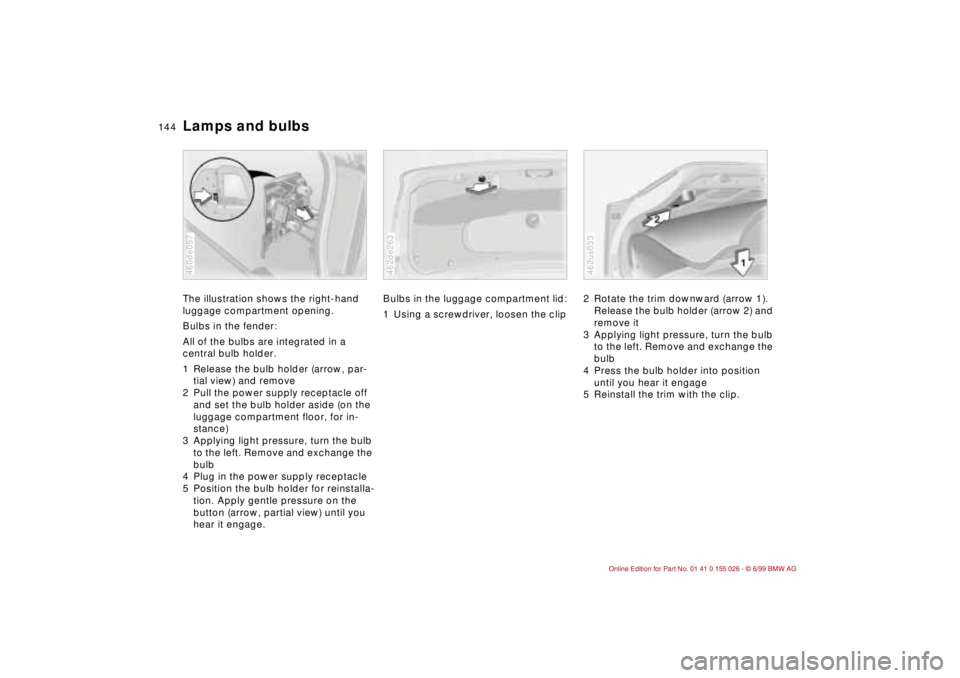
Lamps and bulbsThe illustration shows the right-hand
luggage compartment opening.
Bulbs in the fender:
All of the bulbs are integrated in a
central bulb holder.
1 Release the bulb holder (arrow, par-
tial view) and remove
2 Pull the power supply receptacle off
and set the bulb holder aside (on the
luggage compartment floor, for in-
stance)
3 Applying light pressure, turn the bulb
to the left. Remove and exchange the
bulb
4 Plug in the power supply receptacle
5 Position the bulb holder for reinstalla-
tion. Apply gentle pressure on the
button (arrow, partial view) until you
hear it engage.460de057
Bulbs in the luggage compartment lid:
1 Using a screwdriver, loosen the clip462de263
2 Rotate the trim downward (arrow 1).
Release the bulb holder (arrow 2) and
remove it
3 Applying light pressure, turn the bulb
to the left. Remove and exchange the
bulb
4 Press the bulb holder into position
until you hear it engage
5 Reinstall the trim with the clip.462us033
Page 147 of 189
145n
RepairsIndexOverview Controls Car care Technology Data
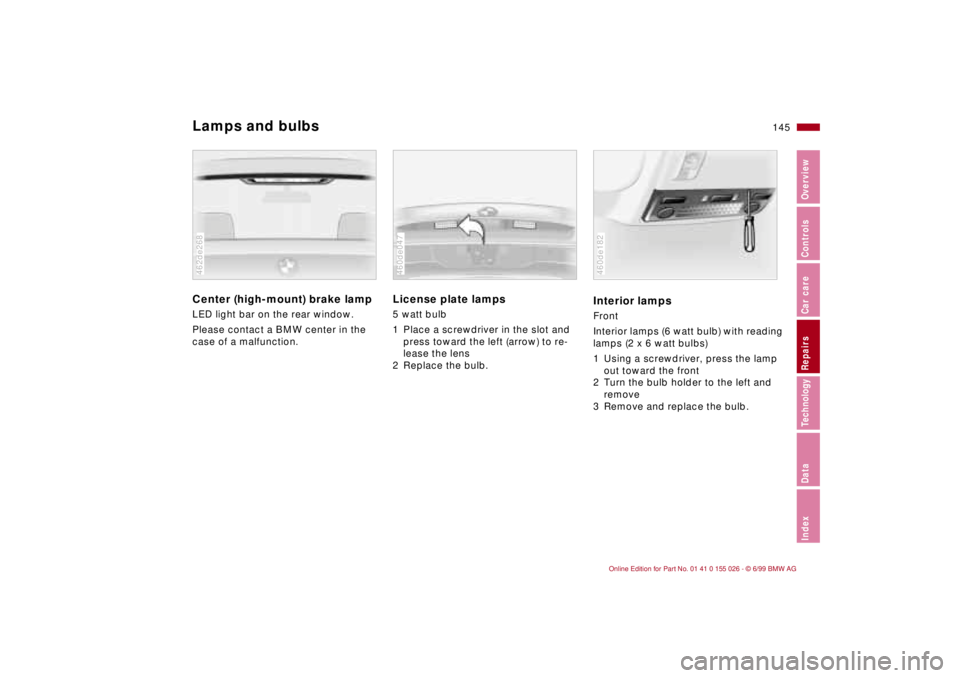
Lamps and bulbsCenter (high-mount) brake lamp
LED light bar on the rear window.
Please contact a BMW center in the
case of a malfunction.462de268
License plate lamps5 watt bulb
1 Place a screwdriver in the slot and
press toward the left (arrow) to re-
lease the lens
2 Replace the bulb.460de047
Interior lamps Front
Interior lamps (6 watt bulb) with reading
lamps (2 x 6 watt bulbs)
1 Using a screwdriver, press the lamp
out toward the front
2 Turn the bulb holder to the left and
remove
3 Remove and replace the bulb.460de182