light BMW 323Ci 2000 User Guide
[x] Cancel search | Manufacturer: BMW, Model Year: 2000, Model line: 323Ci, Model: BMW 323Ci 2000Pages: 189, PDF Size: 1.68 MB
Page 48 of 189

46n
Sliding/tilt sunroof
*
Safety featureIf the sliding/tilt sunroof encounters
resistance at a point roughly past the
middle of its travel when it is closing,
the closing cycle is interrupted and the
sunroof will open again slightly.
In spite of this safety feature,
always make sure that the sun-
roof's path is clear. Otherwise in some
cases (e. g. with thin objects) proper
contact with the contact strip is not en-
sured.
You can disable this safety feature by
pressing the switch beyond the resis-
tance point and holding it.<
Power loss or malfunctionIn the event of an electrical system mal-
function, the sliding/tilt sunroof can be
manually operated. Refer to page 155.
Page 50 of 189
48n
Mechanical seat Head restraints Correct sitting postureTo reduce strain on the spinal column,
sit all the way back in the seat and rest
your back fully against the backrest.
Ideal sitting posture is achieved with
your head extending from your spine in
a straight line.
For long-distance driving, you may wish
to to increase the backrest angle slightly
to reduce muscular tension. You should
be able to grab the steering wheel at its
highest point with your arms slightly
bent.
After a seat adjustment, adjust the
height of the safety belt also. Refer to
page 55.
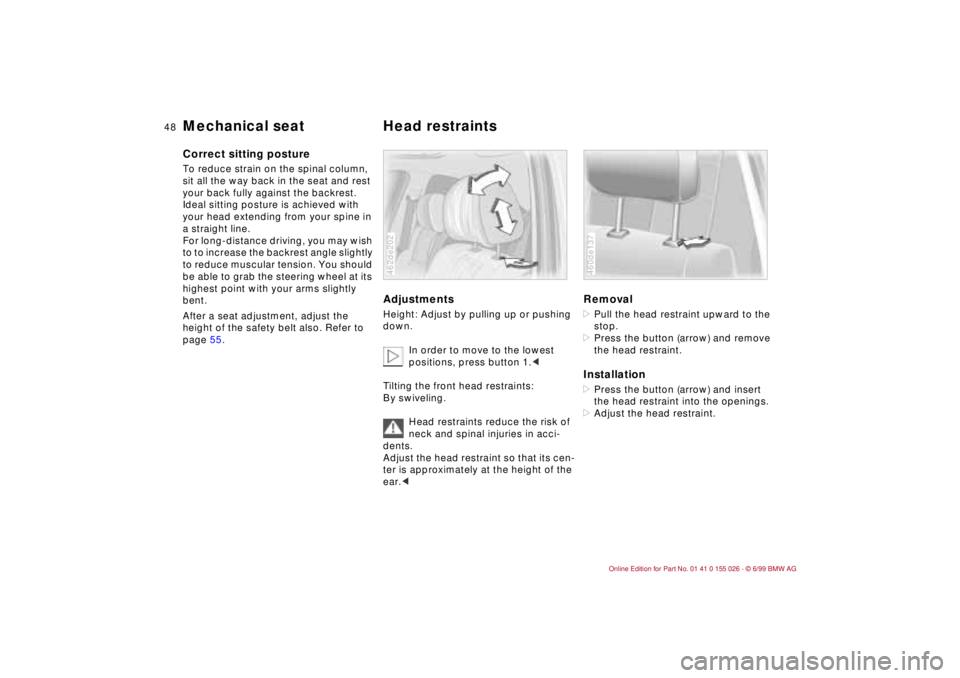
Adjustments Height: Adjust by pulling up or pushing
down.
In order to move to the lowest
positions, press button 1.<
Tilting the front head restraints:
By swiveling.
Head restraints reduce the risk of
neck and spinal injuries in acci-
dents.
Adjust the head restraint so that its cen-
ter is approximately at the height of the
ear.<462de202
Removal>Pull the head restraint upward to the
stop.
>Press the button (arrow) and remove
the head restraint.Installation>Press the button (arrow) and insert
the head restraint into the openings.
>Adjust the head restraint.460de137
Page 52 of 189
50n
Electric power seat
*
Seat and mirror memory
*
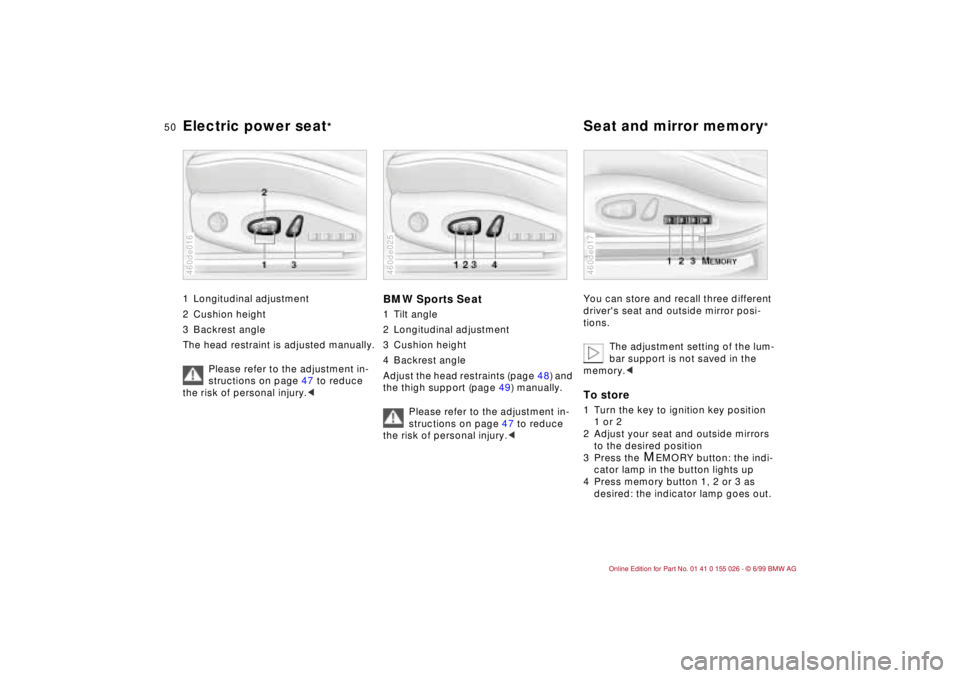
1 Longitudinal adjustment
2 Cushion height
3 Backrest angle
The head restraint is adjusted manually.
Please refer to the adjustment in-
structions on page 47 to reduce
the risk of personal injury.<460de016
BMW Sports Seat1 Tilt angle
2 Longitudinal adjustment
3 Cushion height
4 Backrest angle
Adjust the head restraints (page 48) and
the thigh support (page 49) manually.
Please refer to the adjustment in-
structions on page 47 to reduce
the risk of personal injury.<460de025
You can store and recall three different
driver's seat and outside mirror posi-
tions.
The adjustment setting of the lum-
bar support is not saved in the
memory.
2 Adjust your seat and outside mirrors
to the desired position
3 Press the
M
EMORY button: the indi-
cator lamp in the button lights up
4 Press memory button 1, 2 or 3 as
desired: the indicator lamp goes out.
460de017
Page 54 of 189
52n
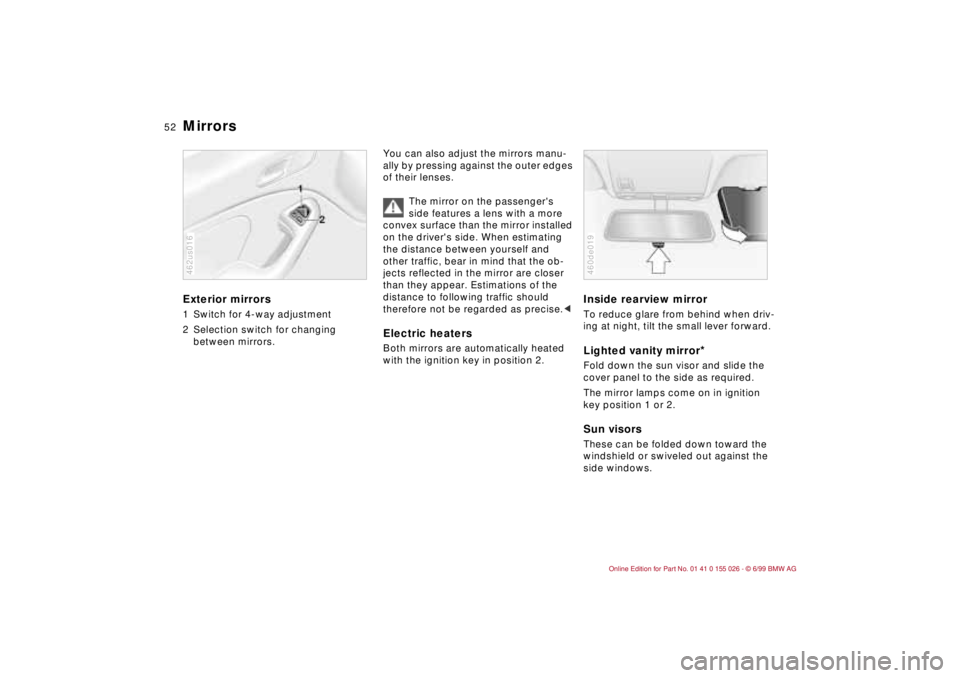
Mirrors Exterior mirrors1 Switch for 4-way adjustment
2 Selection switch for changing
between mirrors.462us016
You can also adjust the mirrors manu-
ally by pressing against the outer edges
of their lenses.
The mirror on the passenger's
side features a lens with a more
convex surface than the mirror installed
on the driver's side. When estimating
the distance between yourself and
other traffic, bear in mind that the ob-
jects reflected in the mirror are closer
than they appear. Estimations of the
distance to following traffic should
therefore not be regarded as precise.
Inside rearview mirror To reduce glare from behind when driv-
ing at night, tilt the small lever forward.Lighted vanity mirror
*
Fold down the sun visor and slide the
cover panel to the side as required.
The mirror lamps come on in ignition
key position 1 or 2.Sun visorsThese can be folded down toward the
windshield or swiveled out against the
side windows.460de019
Page 55 of 189
53n
RepairsIndexOverview Controls Car care Technology Data
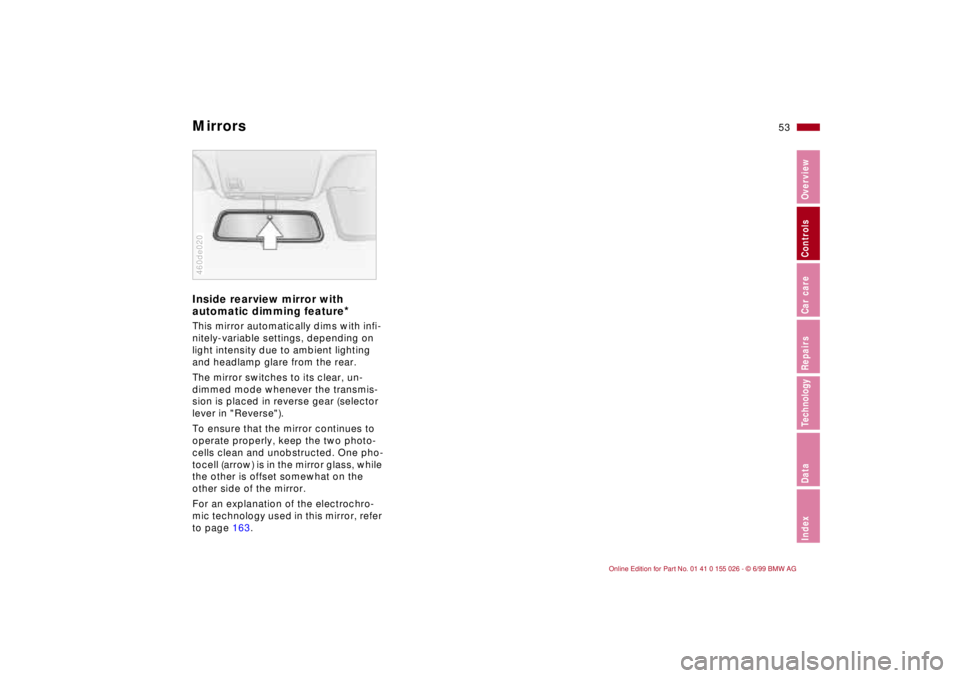
MirrorsInside rearview mirror with
automatic dimming feature
*
This mirror automatically dims with infi-
nitely-variable settings, depending on
light intensity due to ambient lighting
and headlamp glare from the rear.
The mirror switches to its clear, un-
dimmed mode whenever the transmis-
sion is placed in reverse gear (selector
lever in "Reverse").
To ensure that the mirror continues to
operate properly, keep the two photo-
cells clean and unobstructed. One pho-
tocell (arrow) is in the mirror glass, while
the other is offset somewhat on the
other side of the mirror.
For an explanation of the electrochro-
mic technology used in this mirror, refer
to page 163.460de020
Page 59 of 189
57n
RepairsIndexOverview Controls Car care Technology Data
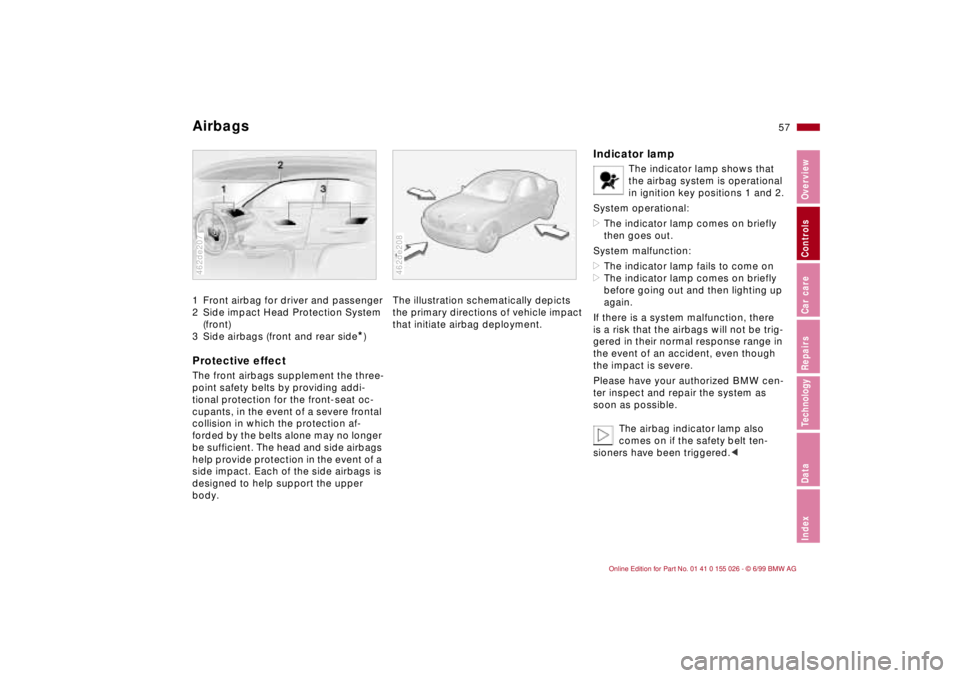
Airbags 1 Front airbag for driver and passenger
2 Side impact Head Protection System
(front)
3 Side airbags (front and rear side
*)
Protective effectThe front airbags supplement the three-
point safety belts by providing addi-
tional protection for the front-seat oc-
cupants, in the event of a severe frontal
collision in which the protection af-
forded by the belts alone may no longer
be sufficient. The head and side airbags
help provide protection in the event of a
side impact. Each of the side airbags is
designed to help support the upper
body.462de207
The illustration schematically depicts
the primary directions of vehicle impact
that initiate airbag deployment.462de208
Indicator lamp
The indicator lamp shows that
the airbag system is operational
in ignition key positions 1 and 2.
System operational:
>The indicator lamp comes on briefly
then goes out.
System malfunction:
>The indicator lamp fails to come on
>The indicator lamp comes on briefly
before going out and then lighting up
again.
If there is a system malfunction, there
is a risk that the airbags will not be trig-
gered in their normal response range in
the event of an accident, even though
the impact is severe.
Please have your authorized BMW cen-
ter inspect and repair the system as
soon as possible.
The airbag indicator lamp also
comes on if the safety belt ten-
sioners have been triggered.<
Page 64 of 189
62n
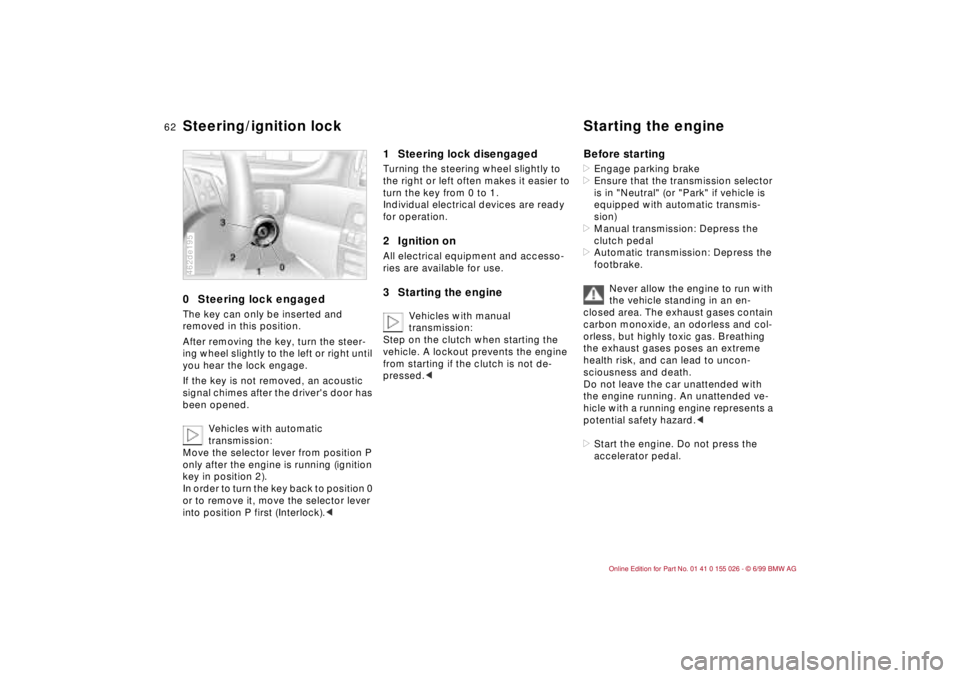
0 Steering lock engaged The key can only be inserted and
removed in this position.
After removing the key, turn the steer-
ing wheel slightly to the left or right until
you hear the lock engage.
If the key is not removed, an acoustic
signal chimes after the driver's door has
been opened.
Vehicles with automatic
transmission:
Move the selector lever from position P
only after the engine is running (ignition
key in position 2).
In order to turn the key back to position 0
or to remove it, move the selector lever
into position P first (Interlock).<462de195
1 Steering lock disengaged Turning the steering wheel slightly to
the right or left often makes it easier to
turn the key from 0 to 1.
Individual electrical devices are ready
for operation.2 Ignition onAll electrical equipment and accesso-
ries are available for use.3 Starting the engine
Vehicles with manual
transmission:
Step on the clutch when starting the
vehicle. A lockout prevents the engine
from starting if the clutch is not de-
pressed.c
Before starting>Engage parking brake
>Ensure that the transmission selector
is in "Neutral" (or "Park" if vehicle is
equipped with automatic transmis-
sion)
>Manual transmission: Depress the
clutch pedal
>Automatic transmission: Depress the
footbrake.
Never allow the engine to run with
the vehicle standing in an en-
closed area. The exhaust gases contain
carbon monoxide, an odorless and col-
orless, but highly toxic gas. Breathing
the exhaust gases poses an extreme
health risk, and can lead to uncon-
sciousness and death.
Do not leave the car unattended with
the engine running. An unattended ve-
hicle with a running engine represents a
potential safety hazard.<
>Start the engine. Do not press the
accelerator pedal.
Steering/ignition lock Starting the engine
Page 66 of 189
64n
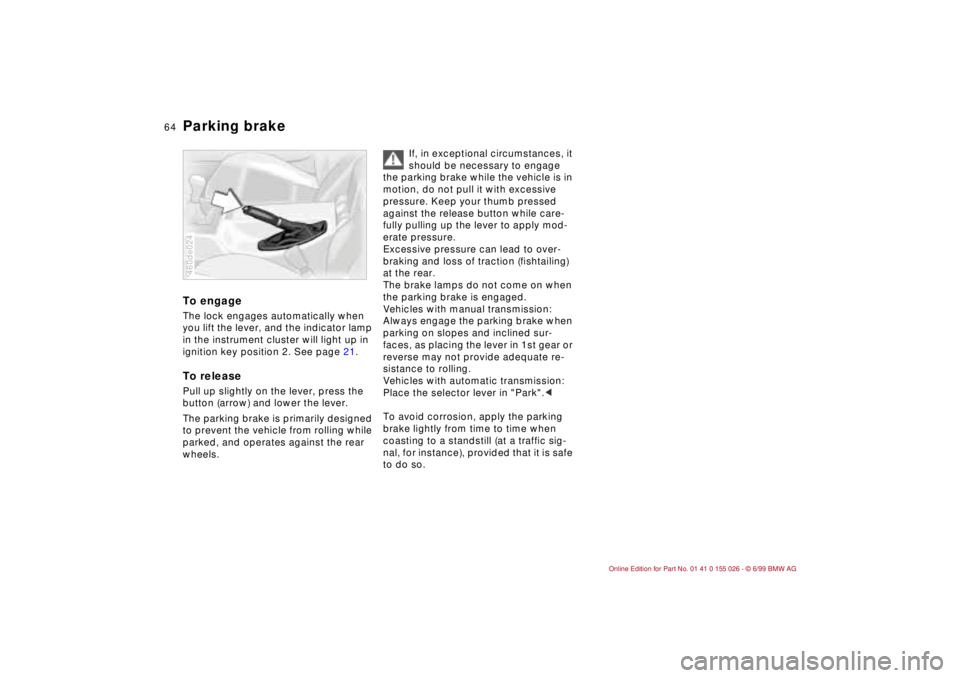
Parking brake To engageThe lock engages automatically when
you lift the lever, and the indicator lamp
in the instrument cluster will light up in
ignition key position 2. See page 21.To releasePull up slightly on the lever, press the
button (arrow) and lower the lever.
The parking brake is primarily designed
to prevent the vehicle from rolling while
parked, and operates against the rear
wheels.460de024
If, in exceptional circumstances, it
should be necessary to engage
the parking brake while the vehicle is in
motion, do not pull it with excessive
pressure. Keep your thumb pressed
against the release button while care-
fully pulling up the lever to apply mod-
erate pressure.
Excessive pressure can lead to over-
braking and loss of traction (fishtailing)
at the rear.
The brake lamps do not come on when
the parking brake is engaged.
Vehicles with manual transmission:
Always engage the parking brake when
parking on slopes and inclined sur-
faces, as placing the lever in 1st gear or
reverse may not provide adequate re-
sistance to rolling.
Vehicles with automatic transmission:
Place the selector lever in "Park".<
To avoid corrosion, apply the parking
brake lightly from time to time when
coasting to a standstill (at a traffic sig-
nal, for instance), provided that it is safe
to do so.
Page 67 of 189
65n
RepairsIndexOverview Controls Car care Technology Data
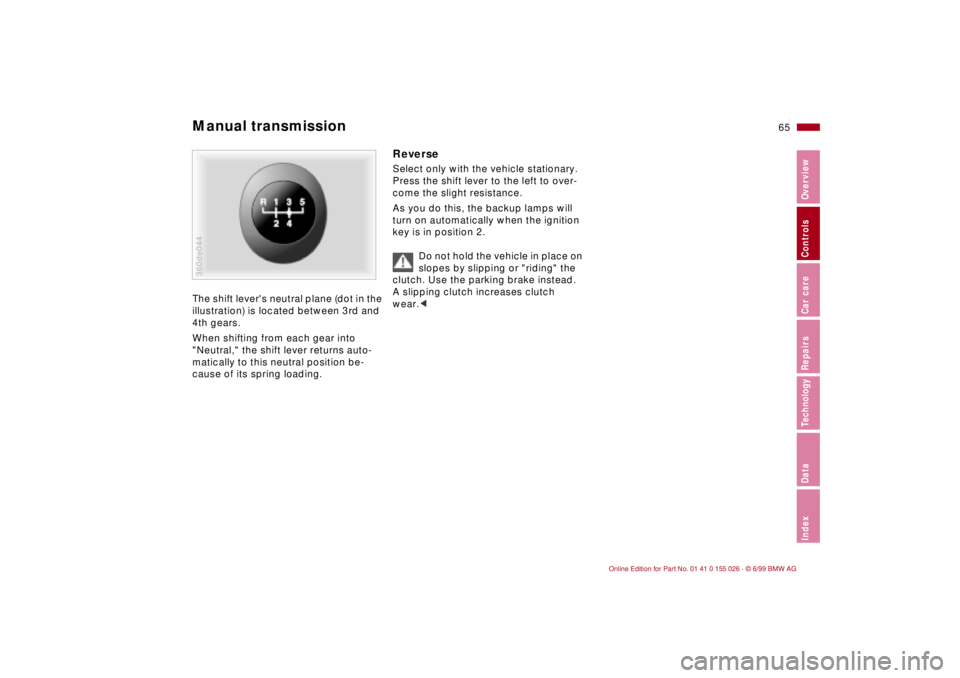
Manual transmission The shift lever's neutral plane (dot in the
illustration) is located between 3rd and
4th gears.
When shifting from each gear into
"Neutral," the shift lever returns auto-
matically to this neutral position be-
cause of its spring loading.360de044
Reverse Select only with the vehicle stationary.
Press the shift lever to the left to over-
come the slight resistance.
As you do this, the backup lamps will
turn on automatically when the ignition
key is in position 2.
Do not hold the vehicle in place on
slopes by slipping or "riding" the
clutch. Use the parking brake instead.
A slipping clutch increases clutch
wear.<
Page 69 of 189
67n
RepairsIndexOverview Controls Car care Technology Data
Automatic transmission with Steptronic
*
D Drive (automatic shift program)This position is designed for driving un-
der all normal operating conditions. All
forward gears are available, the Adap-
tive Transmission Control (ATC) is fully
operational."Kickdown" (automatic downshift)In the "Kickdown" mode, you achieve
maximum performance.
To activate this mode, depress the ac-
celerator pedal beyond the full-throttle
position, at which a resistance point
must be overcome.
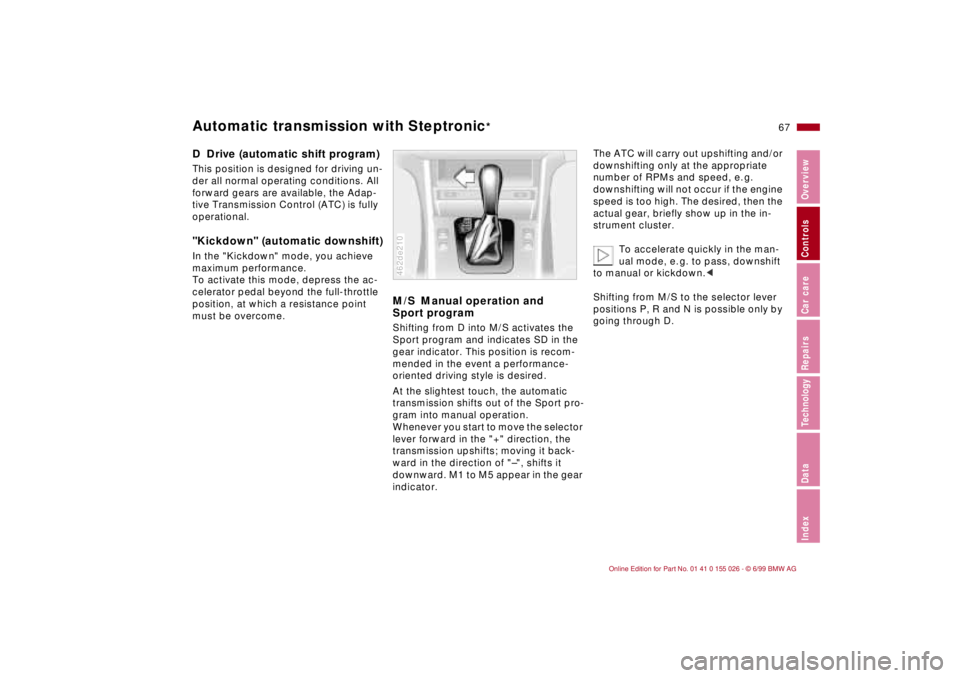
M/S Manual operation and
Sport programShifting from D into M/S activates the
Sport program and indicates SD in the
gear indicator. This position is recom-
mended in the event a performance-
oriented driving style is desired.
At the slightest touch, the automatic
transmission shifts out of the Sport pro-
gram into manual operation.
Whenever you start to move the selector
lever forward in the "+" direction, the
transmission upshifts; moving it back-
ward in the direction of "–", shifts it
downward. M1 to M5 appear in the gear
indicator.462de210
The ATC will carry out upshifting and/or
downshifting only at the appropriate
number of RPMs and speed, e. g.
downshifting will not occur if the engine
speed is too high. The desired, then the
actual gear, briefly show up in the in-
strument cluster.
To accelerate quickly in the man-
ual mode, e. g. to pass, downshift
to manual or kickdown.<
Shifting from M/S to the selector lever
positions P, R and N is possible only by
going through D.