brake BMW 323Ci CONVERTIBLE 2000 E46 User Guide
[x] Cancel search | Manufacturer: BMW, Model Year: 2000, Model line: 323Ci CONVERTIBLE, Model: BMW 323Ci CONVERTIBLE 2000 E46Pages: 199, PDF Size: 1.77 MB
Page 72 of 199
72n
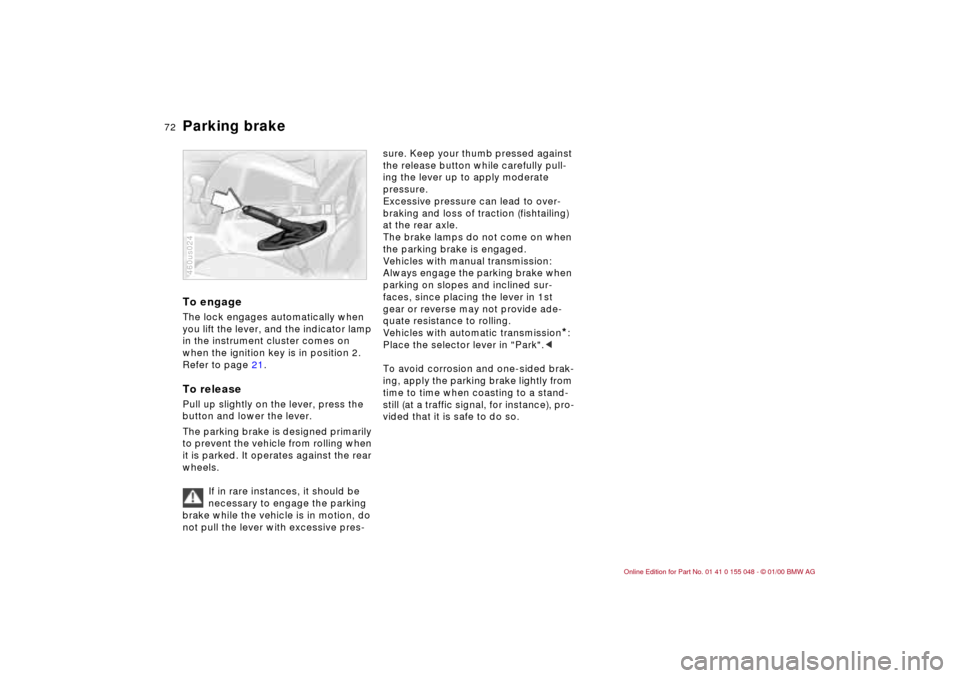
Parking brake To engageThe lock engages automatically when
you lift the lever, and the indicator lamp
in the instrument cluster comes on
when the ignition key is in position 2.
Refer to page 21.To releasePull up slightly on the lever, press the
button and lower the lever.
The parking brake is designed primarily
to prevent the vehicle from rolling when
it is parked. It operates against the rear
wheels.
If in rare instances, it should be
necessary to engage the parking
brake while the vehicle is in motion, do
not pull the lever with excessive pres-460us024
sure. Keep your thumb pressed against
the release button while carefully pull-
ing the lever up to apply moderate
pressure.
Excessive pressure can lead to over-
braking and loss of traction (fishtailing)
at the rear axle.
The brake lamps do not come on when
the parking brake is engaged.
Vehicles with manual transmission:
Always engage the parking brake when
parking on slopes and inclined sur-
faces, since placing the lever in 1st
gear or reverse may not provide ade-
quate resistance to rolling.
Vehicles with automatic transmission
*:
Place the selector lever in "Park".<
To avoid corrosion and one-sided brak-
ing, apply the parking brake lightly from
time to time when coasting to a stand-
still (at a traffic signal, for instance), pro-
vided that it is safe to do so.
Page 73 of 199
73n
IndexDataTechnologyRepairsCar careControlsOverview
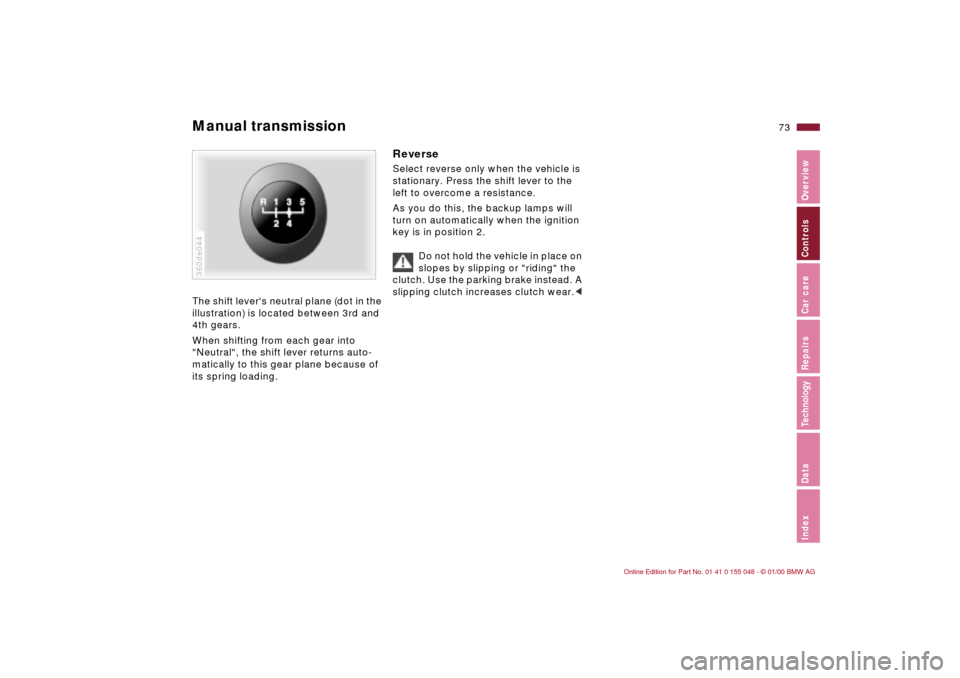
Manual transmission The shift lever's neutral plane (dot in the
illustration) is located between 3rd and
4th gears.
When shifting from each gear into
"Neutral", the shift lever returns auto-
matically to this gear plane because of
its spring loading.360de044
Reverse Select reverse only when the vehicle is
stationary. Press the shift lever to the
left to overcome a resistance.
As you do this, the backup lamps will
turn on automatically when the ignition
key is in position 2.
Do not hold the vehicle in place on
slopes by slipping or "riding" the
clutch. Use the parking brake instead. A
slipping clutch increases clutch wear.<
Page 74 of 199
74n
Automatic transmission with Steptronic
*
You have the option of driving with a
normal automatic transmission or
switching to manual.
When you move the selector lever from
the "D" position to the left into the M/S
range, the performance-oriented shift
programs of the automatic transmission
are engaged. As soon as you briefly
touch the selector lever in the "+" or "–"
direction, Steptronic changes the gear.
The manual mode is engaged. When-
ever you want to use automatic again,
just shift the selector lever toward the
right to position "D".
The automatic transmission with Step-
tronic is equipped with ATC (Adaptive
Transmission Control). ATC reacts with
precision to your individual driving style
and the current driving conditions. To
achieve this, different shift programs
are engaged.
For additional details concerning ATC,
please refer to the chapter describing
"Advanced technology" on page 172.
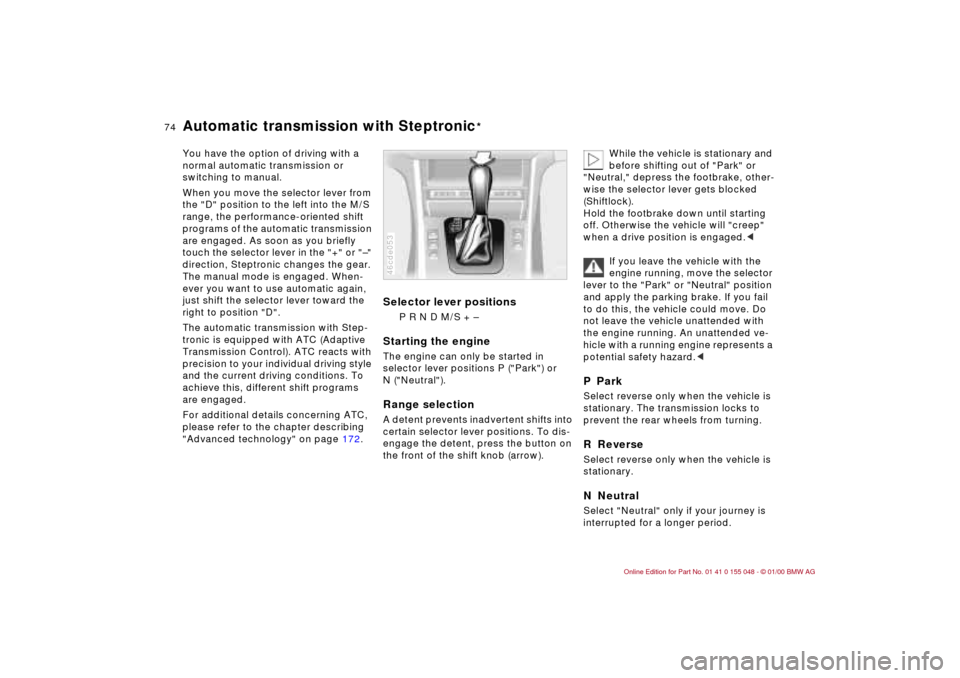
Selector lever positions
P R N D M/S + –
Starting the engineThe engine can only be started in
selector lever positions P ("Park") or
N ("Neutral").Range selectionA detent prevents inadvertent shifts into
certain selector lever positions. To dis-
engage the detent, press the button on
the front of the shift knob (arrow).46cde053
While the vehicle is stationary and
before shifting out of "Park" or
"Neutral," depress the footbrake, other-
wise the selector lever gets blocked
(Shiftlock).
Hold the footbrake down until starting
off. Otherwise the vehicle will "creep"
when a drive position is engaged.<
If you leave the vehicle with the
engine running, move the selector
lever to the "Park" or "Neutral" position
and apply the parking brake. If you fail
to do this, the vehicle could move. Do
not leave the vehicle unattended with
the engine running. An unattended ve-
hicle with a running engine represents a
potential safety hazard.<
P ParkSelect reverse only when the vehicle is
stationary. The transmission locks to
prevent the rear wheels from turning.R ReverseSelect reverse only when the vehicle is
stationary.N NeutralSelect "Neutral" only if your journey is
interrupted for a longer period.
Page 76 of 199
76n
Automatic transmission with Steptronic
*
In the following situations, the Step-
tronic "thinks" for you in the manual
mode:
>In order to prevent the engine from
overrevving, the transmission shifts
automatically to the next higher gear
just before the RPM cutoff point
>If you do not do anything to inter-
vene, it will automatically downshift
at lower speeds
>In the "Kickdown" mode, the trans-
mission shifts down to the lowest
gear which is possible, depending on
the engine speed
>Depending on the situation – when
driving in adverse winter conditions,
for example – you may also start out
in 2nd or 3rd gear.
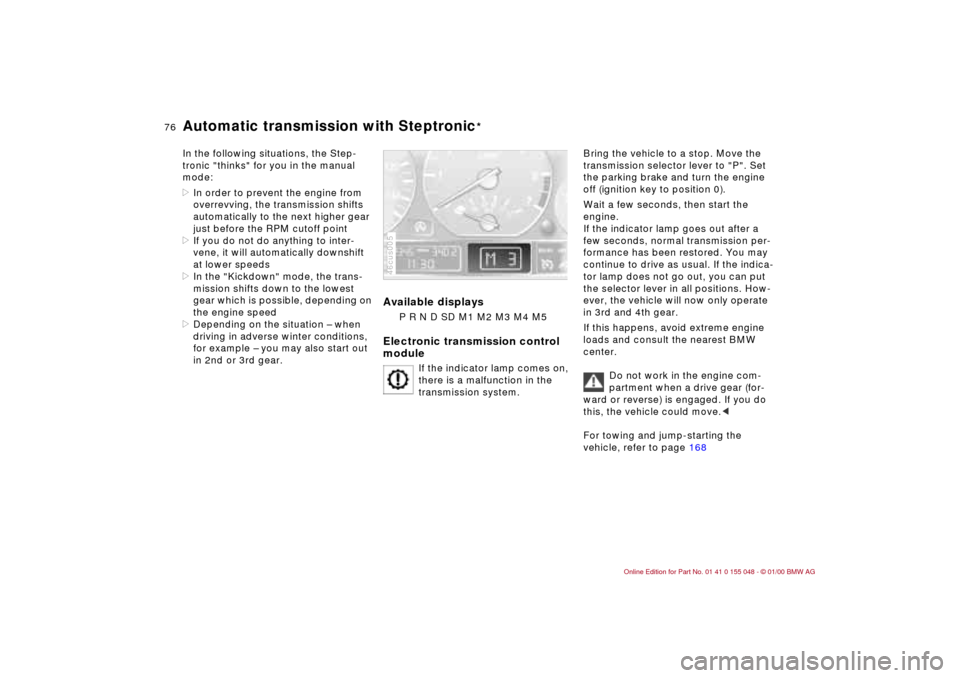
Available displays
P R N D SD M1 M2 M3 M4 M5
Electronic transmission control
module
If the indicator lamp comes on,
there is a malfunction in the
transmission system.
46cus005
Bring the vehicle to a stop. Move the
transmission selector lever to "P". Set
the parking brake and turn the engine
off (ignition key to position 0).
Wait a few seconds, then start the
engine.
If the indicator lamp goes out after a
few seconds, normal transmission per-
formance has been restored. You may
continue to drive as usual. If the indica-
tor lamp does not go out, you can put
the selector lever in all positions. How-
ever, the vehicle will now only operate
in 3rd and 4th gear.
If this happens, avoid extreme engine
loads and consult the nearest BMW
center.
Do not work in the engine com-
partment when a drive gear (for-
ward or reverse) is engaged. If you do
this, the vehicle could move.<
For towing and jump-starting the
vehicle, refer to page 168
Page 81 of 199

81n
IndexDataTechnologyRepairsCar careControlsOverview
Cruise controlTo cancel the cruise control When the system is activated, press
button 1. The indicator lamp stays on.
You can use the cruise control again as
required.
In addition, cruise control is canceled
automatically:
>If the brakes are applied
>If the clutch pedal is depressed or
the automatic transmission
* selector
lever is moved from "D" to "N"
>If you exceed or fall below the pro-
grammed speed for an extended pe-
riod, for example by depressing the
accelerator.
To resume the stored settingPress button 4:
The vehicle accelerates to and main-
tains the last speed stored. When you
turn the ignition key to position 0, the
stored speed is deleted and the system
is deactivated.
To deactivate the system When the cruise control has been can-
celed, press button 1 again. The indica-
tor lamp goes out and the stored speed
is deleted.
Do not use cruise control on twist-
ing roads, when high traffic den-
sity prevents driving at a constant
speed, when the road surface is slick
(snow, rain, ice), or when the road sur-
face is loose (rocks, sand).<
Page 84 of 199
84n
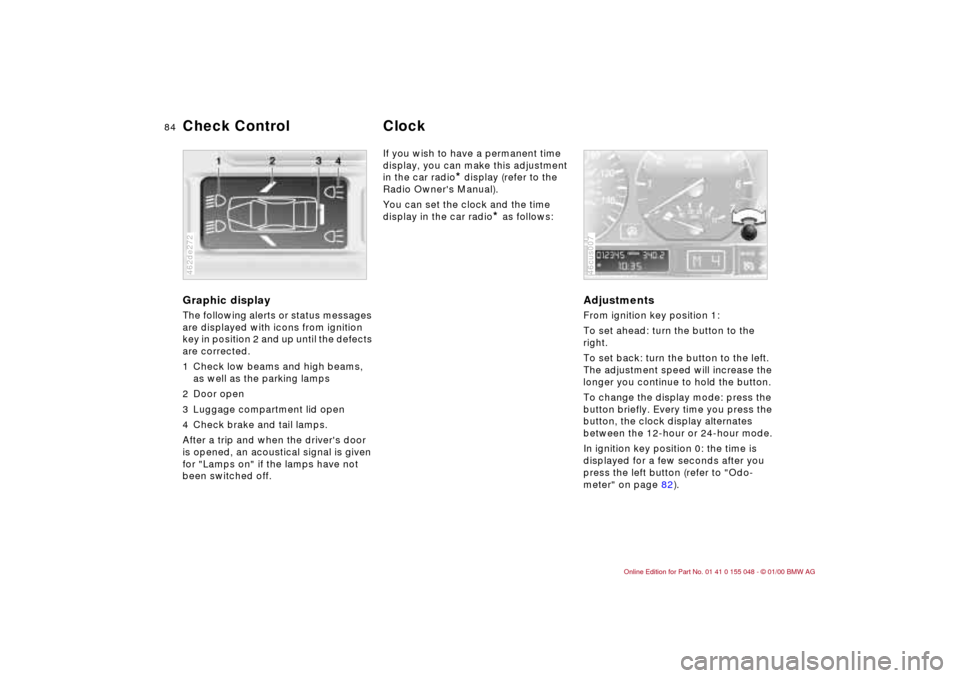
Graphic display
The following alerts or status messages
are displayed with icons from ignition
key in position 2 and up until the defects
are corrected.
1 Check low beams and high beams,
as well as the parking lamps
2 Door open
3 Luggage compartment lid open
4 Check brake and tail lamps.
After a trip and when the driver's door
is opened, an acoustical signal is given
for "Lamps on" if the lamps have not
been switched off.462de272
If you wish to have a permanent time
display, you can make this adjustment
in the car radio
* display (refer to the
Radio Owner's Manual).
You can set the clock and the time
display in the car radio
* as follows:
Adjustments From ignition key position 1:
To set ahead: turn the button to the
right.
To set back: turn the button to the left.
The adjustment speed will increase the
longer you continue to hold the button.
To change the display mode: press the
button briefly. Every time you press the
button, the clock display alternates
between the 12-hour or 24-hour mode.
In ignition key position 0: the time is
displayed for a few seconds after you
press the left button (refer to "Odo-
meter" on page 82).46cus007
Check Control
Clock
Page 90 of 199
90n
Tire Pressure Control (RDC)
*
Flat tireIf there is a tire failure with loss of pres-
sure, the indicator lamp comes on with
a red lamp. In addition, an acoustic sig-
nal goes off.
If this occurs, reduce vehicle speed im-
mediately and stop the vehicle. Avoid
hard brake applications. Do not over-
steer. Replace the wheel and flat tire.
The space-saver spare tire is pro-
vided for temporary use only in the
case of a tire failure. It does not have
RDC electronics and is not monitored.<
RDC cannot inform you of sudden
and severe tire damage caused by
external influences.<
Have the tires changed by your
BMW center.
Your BMW center is familiar with, and
has the special tools necessary, for
working on the RDC.<
System interferenceThe RDC may encounter interference
from outside equipment or devices
which use the same radio frequency.
The indicator lamp will come on with a
yellow lamp during the malfunction.
The indicator lamp also comes on
>in the event of a system fault
>if a wheel is mounted without RDC
electronics
>or if additional wheels using RDC
electronics are transported.
Please contact your BMW center for
additional information.
Page 111 of 199
Overview
Controls and features
Operation, care
and maintenance
Owner service procedures
Technical data
Index Advanced technology
111n
IndexDataTechnologyRepairsCar careControlsOverview
Special operating instructions:
Break-in procedures112
Driving notes113
Catalytic converter113
Antilock Brake System
(ABS)114
Disc brakes116
Brake system117
Winter operation118
Power steering120
Cellular phone120
Radio reception120
Hardtop121
Wheels and tires:
Tire inflation pressure123
Tire condition123
Tire replacement124
Tire rotation125
Wheel and tire
combinations126
Winter tires127
Snow chains127
Approved wheel and tire
specifications128Under the hood:
Hood129
Engine compartment130
Washer fluids132
Washer nozzles132
Engine oil133
Coolant135
Brake fluid136
Vehicle Identification
Number137
Care and maintenance:
The BMW Maintenance
System138
Caring for your vehicle139
Cleaning and caring for your
convertible top144
Airbags146
Vehicle storage147
Laws and regulations:
Technical modifications to the
vehicle148
OBD interface socket149
Car care
Page 112 of 199

112n
To ensure that your vehicle provides
maximum economy throughout a long
service life, we request that you comply
with the following recommendations.
Engine and differentialUp to 1,200 miles (2,000 km):
Drive at varying engine and road
speeds, but do not exceed 4,500 rpm
or 100 mph (160 km/h) during this time.
Obey your local and state maximum
speed limits.
Refrain from using full throttle and avoid
pressing the accelerator beyond the
"kickdown" point.
After you have driven 1,200 miles
(2,000 km), you can gradually increase
the engine and road speed.
You should also comply with these
break-in procedures if the engine or
differential is replaced at a later point.
TiresDue to technical factors associated
with their manufacture, tires do not
achieve their full traction potential until
an initial break-in period has elapsed.
Thus, drive with extra care during the
initial 200 miles (300 km).
Obey your local and state maximum
speed limits.
When the vehicle is operated on
wet or slushy roads, a wedge of
water may form between the tire and
the road surface. This phenomenon is
referred to as aquaplaning, or hydro-
planing, and can lead to partial or com-
plete loss of traction, vehicle control
and braking effectiveness. Reduce your
speed on wet roads.
tact patterns until you have driven
approx. 300 miles (500 km).
To break in the separate parking brake
drums, apply the parking brake lightly
when coasting to a standstill (at a traffic
signal, for instance), provided that traf-
fic conditions allow you to do so.
To avoid corrosion, repeat this proce-
dure from time to time.
The brake lamps do not come on
when the parking brake is applied.
Vacuum for the brake system servo unit
on your BMW is available only when the
engine is running. When you move the
vehicle with the engine shut off – when
towing, for example – substantially
higher levels of pedal force will be
required to brake the vehicle.<
Break-in procedures
Page 113 of 199

113n
IndexDataTechnologyRepairsCar careControlsOverview
Brakes:
Do not drive with your foot resting
on the brake pedal. Even light but con-
sistent pedal pressure can lead to high
temperatures, brake wear, and possibly
to brake failure.
Aquaplaning:
When driving on wet or slushy roads,
reduce vehicle speed. If you do not, a
wedge of water may form between the
tires and the road surface. This phe-
nomenon is referred to as aquaplaning
or hydroplaning. It is characterized by a
partial or complete loss of contact be-
tween the tires and the road surface.
The ultimate results are loss of steering
and braking control.
Driving through water:
Do not drive through water over the
road if it is deeper than 1 ft (30 cm), and
then only at walking speed, otherwise
the engine, electrical system and trans-
mission could be damaged.
Clothes hooks (when hardtop
* is
mounted):
When suspending clothing from the
hooks, ensure that they will not obstruct
the driver's vision. Do not hang heavy
objects on the hooks. If you do, they
could cause personal injury during
braking or evasive maneuvers.<
The catalytic converter reduces harmful
exhaust emissions. It is designed for
use with unleaded fuel only.
Even minute quantities of lead would be
enough to permanently damage both
the catalytic converter and the system
oxygen sensor.To ensure efficient, trouble-free engine
operation and to avoid potential damage:>Be sure to comply with the scheduled
maintenance requirements
>Fill the fuel tank well before it is
empty
>Tow-start only when the engine is
cold. If you attempt to tow-start with
a warm engine, unburned residual
fuel in the catalytic converter could
ignite and cause damage. It is better
to jump-start the vehicle with outside
assistance
>Avoid other situations in which the
fuel is not burned, or burns incom-
pletely, such as engaging the starter
frequently or for extended periods, or
repeated start attempts in which the
engine does not start (stopping and
restarting an engine which is running
properly does not present a problem).
Never allow the engine to run with
any of the spark plug cables
disconnected.Be sure to observe the instruc-
tions above to prevent unburned
fuel from reaching the catalytic con-
verter, otherwise, the catalytic con-
verter could overheat and be damaged.
High temperatures occur in every vehi-
cle equipped with a catalytic converter.
Heat shields are installed adjacent to
some sections of the exhaust system.
Never remove these shields; do not
apply undercoating to their surfaces.
When driving, standing at idle, and
parking the vehicle, take extra care to
avoid contact between the exhaust sys-
tem and flammable materials (grass,
hay, leaves, etc.). Such contact could
lead to a fire, resulting in serious per-
sonal injury and property damage.<
Driving notes Catalytic converter