brake BMW 323Ci CONVERTIBLE 2000 E46 Owner's Guide
[x] Cancel search | Manufacturer: BMW, Model Year: 2000, Model line: 323Ci CONVERTIBLE, Model: BMW 323Ci CONVERTIBLE 2000 E46Pages: 199, PDF Size: 1.77 MB
Page 114 of 199

114n
Antilock Brake System (ABS)The concept ABS enhances active driving safety
by helping to prevent the wheels from
locking while braking. This is because
locked wheels are dangerous. When
the front wheels slide, the driver loses
steering control over the vehicle.
Traction loss at the rear wheels can
cause the rear end to break into an
uncontrolled skid.
ABS is designed to meet two essential
requirements during every brake appli-
cation:
>To help provide vehicle stability
>To help maintain steering control and
maneuverability – on all types of road
surfaces (asphalt, concrete, mud, wet
road surfaces, snow, ice).
The system can achieve the shortest
braking distances possible under most
conditions (on straight aways and in
curves, on asphalt, ice, wet road sur-
faces, etc.).
Braking with ABSThe system is operative once the vehi-
cle exceeds a speed of approx. 6 mph
(10 km/h). It is deactivated once again
below approx. 4 mph (6 km/h). This
means that the wheels can lock in the
final phase of a panic stop – a factor of
no significance in actual use.
If you are in a situation that requires full
braking, you will exploit the full benefits
of the ABS system if you apply maxi-
mum brake pressure ("panic stop").
Since the vehicle maintains steering
responsiveness, you can nevertheless
avoid possible obstacles with a mini-
mum of steering effort.
The ABS closed-loop control circuit
cycles in fractions of a second. A pulsa-
tion at the brake pedal, together with
the sounds associated with the hydrau-
lic controls, tells you that the brake sys-
tem is within its maximum limit range,
and reminds you that you should adapt
road speed to the road conditions.
On road surfaces that have a loose
surface layer on a firm base with good
traction (on gravel or snow, for exam-
ple), or when snow chains are mounted,
braking distances may be longer than
with locked wheels. However, ABS continues to provide
enhanced vehicle stability and steering
response under these conditions.
Information for your safetyNot even ABS can suspend the laws of
physics. ABS cannot prevent the conse-
quences of brake applications with inad-
equate clearances for safety between
vehicles, when exceeding the speed
limit in curves, or the risks involved
when aquaplaning occurs. Responsibil-
ity for these types of situations remains
in the hands (and at the feet) of the
driver. You should never allow the
added safety of ABS to lull you into a
false sense of security, or mislead you
into taking increased risks that could
affect your own safety and that of others.
Do not make any modifications to
the ABS system.
Service procedures on ABS are to be
performed by authorized technicians
only.<
Page 115 of 199
115n
IndexDataTechnologyRepairsCar careControlsOverview
Antilock Brake System (ABS)Antilock Brake System (ABS)/
Cornering Brake Control (CBC) CBC is an advanced engineering de-
sign of the ABS. When braking while
cornering at high speed or braking dur-
ing high lateral acceleration, or when
braking during a lane change, vehicle
stability is improved and steering re-
sponse is enhanced.
In the event of a malfunction
If the ABS warning lamp in the
instrument cluster lights up,
refer to page 22. The brake
system then reverts to conventional
operation as on vehicles without ABS.
However, have the brake system
checked by your BMW center as soon
as possible, to prevent undetected
defects and cumulative faults from
adversely affecting the brake system.
ABS warning lamp for Canadian
models.
If the brake warning lamp
comes on together with the indi-
cator lamps for ABS and DSC –
refer to page 21 – the entire
ABS, CBC and DSC control sys-
tem has failed. Continue driving
cautiously and defensively.
Avoid full brake applications.
This could cause the vehicle to lose
stability and you might no longer be
able to control it.
Have the system checked as soon as
possible by your BMW center.
Indicator and warning lamps
CBC, ABS and DSC for Cana-
dian models.
Page 116 of 199

116n
Disc brakesDisc brakes furnish optimum decelera-
tion and braking control and greater
fade resistance under heavy use.
When the vehicle is driven only occa-
sionally, during extended periods when
the vehicle is not used at all, and in
operating conditions where brake appli-
cations are less frequent, there is an
increased tendency for corrosion of the
rotors and accumulation of contamina-
tion on the brake pads. This occurs
because the minimal pressure that
must be exerted by the pads to clean
the rotors by brake applications is
not reached.
If the brake rotors are corroded, they
will tend to respond to braking with a
pulsating effect that even extended
brake applications will fail to cure.
For your own safety: use only
brake pads that BMW has ap-
proved for your particular vehicle
model. BMW cannot evaluate non-ap-
proved brake pads to determine if they
are suited for use, and therefore cannot
ensure the operating safety of the vehi-
cle if they are installed.<
Driving notesWhen driving in wet conditions and in
heavy rain, it is advisable to apply light
pressure to the brake pedal every few
miles or kilometers. Watch traffic condi-
tions to ensure that this maneuver does
not endanger other drivers. The heat
which is generated by the brake appli-
cations helps to dry the brake pads and
rotors.
Maximum braking force is obtained
while the wheels continue to rotate, but
rather when they are still barely turning
immediately prior to locking. ABS main-
tains this state automatically. If the ABS
fails, you should revert to the staggered
braking technique described on
page 119.
Extended or steep mountain descents
do not necessarily lead to reduced
braking efficiency if you drive downhill
with the transmission in a gear that
allows minimal brake applications (or,
with automatic transmission
*, in an
appropriate lower gear).
You can further increase the engine's
braking effect by selecting a lower gear,
downshifting as far as first gear or plac-
ing the selector lever in position 1.If engine braking should prove to be
inadequate, you should still avoid ex-
tended, continuous braking. Instead of
maintaining low to moderate pressure
over an extended period of time, you
should decelerate by applying more
substantial pressure to the brake pedal
(watch for following traffic), releasing
the pedal, and then repeating the appli-
cation (staggered braking). The cooling
phases between active braking inter-
vals prevent the brakes from overheat-
ing, thus ensuring that full braking
capacity remains available at all times.
Do not coast with the clutch de-
pressed or with the shift lever or
selector lever in "Neutral". Do not drive
with the engine shut off. The engine
provides no braking effect when the
clutch is depressed or the transmission
is in "Neutral", and there is no power
assist for braking or steering when the
engine is not running.
Do not allow floor mats, carpets or any
other objects to protrude into the area
around the brake pedal, the clutch or
the accelerator, which could obstruct
their freedom of movement.<
Page 117 of 199

117n
IndexDataTechnologyRepairsCar careControlsOverview
Brake systemBrake fluid level
If the warning lamp for the brake
system comes on with the park-
ing brake released:
The brake fluid level is too low in the
reservoir (refer to page 136).
If the brake fluid level is too low and
brake pedal travel has become notice-
ably longer, there may be a defect in
one of the hydraulic circuits of the
brake system.
Warning lamps or the brake
system for Canadian models.
Proceed to the nearest BMW
center. Increased brake applica-
tion pressure may be necessary under
these conditions, and brake pedal
travel may be significantly longer.
Please remember to adapt your driving
style accordingly.<
Brake linings
If the warning lamp for the brake
pads lights up:
The brake pads have reached
their minimum pad thickness. Proceed
to the nearest BMW center as soon as
possible to have the pads replaced.
For your own safety: use only
BMW approved brake pads for
your particular vehicle model. BMW
cannot evaluate non-approved brake
pads to determine if they are suited for
use, and therefore cannot ensure the
operating safety of the vehicle if they
are installed.<
Page 119 of 199

119n
IndexDataTechnologyRepairsCar careControlsOverview
Winter operationBrakesWinter road conditions substantially
reduce the amount of traction available
between the tires and the road surface.
Keep this in mind, because the braking
distance increases substantially.
ABS is intended to prevent the wheels
from locking during brake applications,
thus helping to maintain vehicle stability
and steering response.
If the ABS does not respond in a critical
braking situation and the wheels lock,
reduce the pressure on the brake pedal
until the wheels just start to roll again
while still maintaining enough force to
continue braking. Then increase the
pressure, reduce the pressure when the
wheels lock, reapply pressure, etc.
This staggered braking procedure will
reduce stopping distances while help-
ing you maintain steering control.
You can then attempt to steer around
hazards after you have reduced pres-
sure on the brake pedal.Do not shift down on slick road
surfaces. Doing so could cause
the rear wheels to lose traction and
skid, which could result in the loss of
vehicle control.<
Depress the clutch during hard
braking on road surfaces that pro-
vide only poor or uneven traction.<
Skid control Depress the clutch and release the ac-
celerator pedal, or place the selector
lever of the automatic transmission into
the "Neutral" position. Countersteer
carefully and attempt to regain control
of the vehicle.
ParkingEngage first or reverse gear. If your
vehicle is equipped with an automatic
transmission, place the selector lever in
Park. On vehicles with manual trans-
mission, also apply the parking brake
when parking on inclined surfaces. In
order to prevent the parking brake pads
from locking due to frost or corrosion,
dry them by gently applying the parking
brake as the vehicle is coming to a
stop. Make sure that following traffic
is not endangered.
The brake lamps do not come
on when the parking brake
is applied.<
Page 131 of 199

131n
IndexDataTechnologyRepairsCar careControlsOverview
Engine compartment1 Brake fluid reservoir136
2 Engine oil dipstick133
3 Coolant expansion tank135
4 Engine oil filler neck133
5 Reservoir for the headlamp
* and
windshield washer system132
6 Auxiliary terminal for jump
starting168
Page 136 of 199
136n
Coolant Brake fluidAdding coolant Wait until the engine cools before re-
moving the cap from the expansion
tank. The coolant gauge needle in the
instrument cluster must be located in
the blue zone. If it is not, there is a
danger of scalding.
1 Turn the cap slightly counterclock-
wise in order to allow accumulated
pressure to escape. Then open
the cap
2 If the coolant is low, slowly add
coolant until the correct level is
reached – do not overfill.
The coolant is a mixture of water and
extended-duty antifreeze with corrosion
inhibitor. Always maintain the pre-
scribed all-season 50:50 mixture ratio
for year-round protection against inter-
nal corrosion. No other additives are
required.
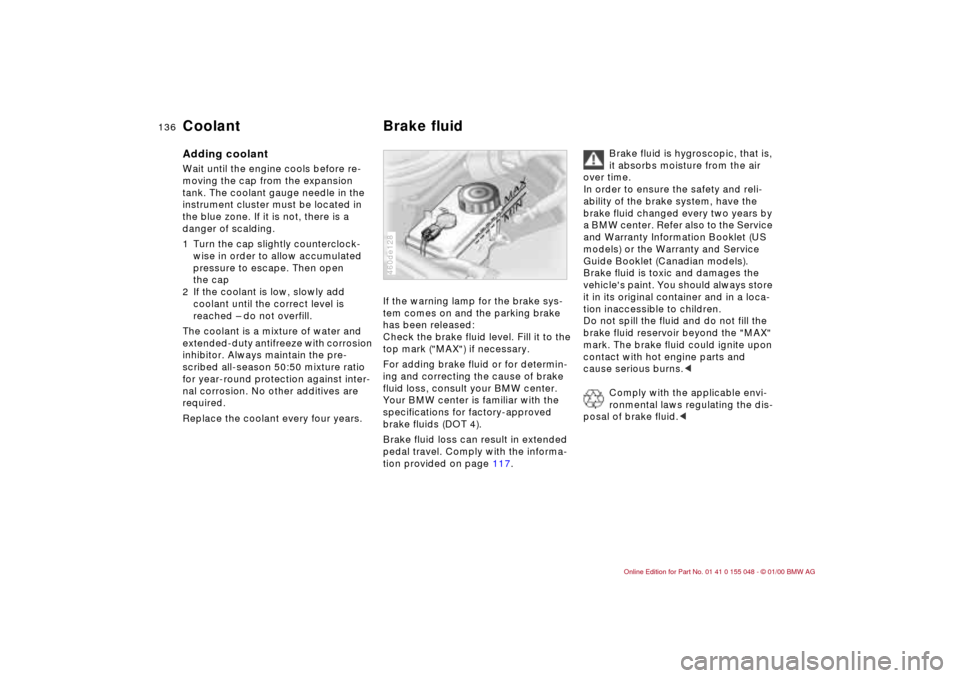
Replace the coolant every four years.If the warning lamp for the brake sys-
tem comes on and the parking brake
has been released:
Check the brake fluid level. Fill it to the
top mark ("MAX") if necessary.
For adding brake fluid or for determin-
ing and correcting the cause of brake
fluid loss, consult your BMW center.
Your BMW center is familiar with the
specifications for factory-approved
brake fluids (DOT 4).
Brake fluid loss can result in extended
pedal travel. Comply with the informa-
tion provided on page 117.
460de128
Brake fluid is hygroscopic, that is,
it absorbs moisture from the air
over time.
In order to ensure the safety and reli-
ability of the brake system, have the
brake fluid changed every two years by
a BMW center. Refer also to the Service
and Warranty Information Booklet (US
models) or the Warranty and Service
Guide Booklet (Canadian models).
Brake fluid is toxic and damages the
vehicle's paint. You should always store
it in its original container and in a loca-
tion inaccessible to children.
Do not spill the fluid and do not fill the
brake fluid reservoir beyond the "MAX"
mark. The brake fluid could ignite upon
contact with hot engine parts and
cause serious burns.<
Comply with the applicable envi-
ronmental laws regulating the dis-
posal of brake fluid.<
Page 139 of 199

139n
IndexDataTechnologyRepairsCar careControlsOverview
Washing your vehicle You can wash your BMW at an auto-
matic car wash, even when it is new.
Brushless systems are preferable (refer
to page 144 as well).
Wipe away tough dirt and loosen and
remove dead insects before washing
the vehicle.
In order to avoid spots, do not wash the
vehicle when the hood is warm, or dur-
ing or immediately after exposure to
strong sunlight.
When using an automatic car wash, be
sure that:
>The car wash system is suited for the
dimensions of your vehicle
>No damage will occur to vehicles
with attached body accessories (such
as spoilers or antennas). Consult the
car wash operator if necessary
>The wheels and tires of your vehicle
cannot be damaged by the convey-
ance devices of the car wash system
>The vehicle is cleaned with minimum
brush pressure, and that ample water
is available for washing and rinsing.Vehicles with rain sensor
*:
Clean the windshield regularly. Wax
from automatic car washes or insects
can cause the rain sensor* to malfunc-
tion.
Turn the rain sensor* off (refer to
page 78) when passing through an
automatic car wash. Failure to do so
could result in damage caused by unin-
tended wiper activation.<
Parts of the vehicle that are inaccessi-
ble to the automatic washer – such as
door sills, door and hood edges, etc. –
should be cleaned by hand.
In the winter months, it is especially im-
portant to ensure that the vehicle is
washed on a regular basis. Large quan-
tities of dirt and road salt are difficult to
remove, and they also damage the
vehicle.
If spray wands or high-pressure
washers are used, be sure to
maintain an adequate distance between
the spray source and the vehicle's sur-
face. Inadequate distance and exces-
sive pressure can damage or weaken
the finish, making it more susceptible to
subsequent attack. In addition, mois-
ture could penetrate to vehicle compo-
nents, leading to long-term damage.<
When cleaning the headlamps,
please observe the following:
Do not clean by wiping with a dry cloth
(scratches). Never use abrasives or
strong solvents to clean the covers.
Remove dirt and contamination (such
as insects) by soaking with BMW Car
Shampoo and then rinsing with plenty
of water. Always use a deicer spray to
remove accumulated ice and snow –
never use a scraper.<
After washing the vehicle, apply
the brakes briefly to dry them.
Braking efficiency might otherwise be
reduced by the moisture and the brake
rotors could also corrode.<
Caring for your vehicle
Page 140 of 199

140n
Caring for your vehicleExterior finish To provide effective corrosion protec-
tion, multilayer paintwork is applied at
the factory. Cataphoretic immersion
priming techniques are supplemented
with special body-cavity protectants,
by applying specially developed and
extensively tested materials.
A layer of flexible PVC is first applied to
the undercarriage. Following this, a
comprehensive undercoating treat-
ment with a wax-based protectant is
applied. Regular maintenance makes
an important contribution to maintaining
the safety and value of your vehicle.
Increasing awareness of the effects of
harmful environmental factors on vehi-
cle finishes have led paint and vehicle
manufacturers to initiate programs de-
signed to further improve the durability
of their finishes. Despite this, environ-
mental factors that occur locally or re-
gionally can have negative effects on
the finish of your vehicle. Use the fac-
tors to determine the frequency and
extent of your efforts to maintain the
vehicle finish.
Depending upon material and type of
impact (perforation of paint layer), phys-
ical stresses from sand, road salt, gravel, etc., can cause corrosion to
start extending beneath the finish, start-
ing at the point of impact.
Road dirt, tar spots, dead insects, ani-
mal droppings (strong alkali effect) and
tree excretions (resins and pollen) all
contain substances capable of causing
damage when allowed to remain on the
finish of your vehicle for any extended
period of time. This includes spots,
etching, flaking, and separations in the
top coat.
In industrial areas, flue dust deposits,
lime, oily soot, precipitation containing
sulfur-dioxide (acid rain) and other envi-
ronmental pollutants will damage the
vehicle's finish unless adequate care is
provided – even though this is generally
limited to the outside horizontal sur-
faces.
In coastal regions, high levels of atmo-
spheric salt and humidity promote
corrosion.
In tropical zones, temperatures of over
105 7 (+40 6) in the shade prevail, in
addition to heavy ultraviolet radiation
and high humidity. Under these condi-
tions, light paints can reach tempera-
tures up to 175 7 (+80 6) and dark
paints up to 250 7 (+120 6).
Caring for the vehicle finish Regular washing is a preventive mea-
sure against long-term effects from
substances that are harmful to the vehi-
cle's finish, especially if you drive your
vehicle in areas with high levels of air
pollution or aggressive natural sub-
stances (tree resins, pollen).
Nevertheless, you should immediately
remove especially aggressive sub-
stances. Failure to do so can lead to
changes in the paint's chemical struc-
ture or to discoloration. Gasoline spilled
during refueling, oil, grease and brake
fluid should always be cleaned away
immediately, as should bird droppings.
Any contamination remaining on the
surface of the vehicle will be especially
conspicuous after washing. Use clean-
ing fluid or alcohol with a clean cloth or
cotton pad to remove. Remove tar
spots with tar remover. After cleaning,
the affected areas should be waxed to
ensure continued protection.
Use the cleaning and car-care
products available at your BMW
center.<
Page 147 of 199

147n
IndexDataTechnologyRepairsCar careControlsOverview
Vehicle storage
If you intend to store the vehicle
for more than three months, have
the maintenance operations described
on this page performed.<
Preparations for storageHave your BMW center perform the fol-
lowing procedures:
1 Clean and apply a rustproofing agent
or other treatment to the engine,
engine compartment, undercarriage,
axles and major components in ac-
cordance with approved repair pro-
cedures. Washing the vehicle, any in-
terior cleaning and subsequent paint-
and chrome care, and cleaning any
rubber seals for the hood and doors,
should be carried out in compliance
with approved procedures as well
2 Change engine oil and oil filter at op-
erating temperature. As an additional
corrosion protection measure, an an-
ticorrosive agent can be added to the
engine when refueling in accordance
with the manufacturer's instructions
3 Check the coolant level and concen-
tration and top off if necessary
4 Fill the fuel tank completely to pre-
vent the formation of condensation
5 Increase the tire inflation pressure to
51 psi (350 kPa).
Before parking the vehicle1 Dry the parking brake and footbrakes
completely to keep the brake discs
and drums from corroding
2 Park the vehicle in a covered, dry,
and well-ventilated space. Place the
transmission in first gear or set the
selector lever to the "P" position.
Chock the wheels to prevent the ve-
hicle from rolling if necessary. Do not
apply the parking brake
3 Remove the battery, charge it com-
pletely and store it in a cool (but
frost-free) room
4 Remove the hardtop
* and store it
separately. Refer to page 121
5 Close the convertible top.
During storageRecharge the battery every six months.
If it is not recharged, it will not be ser-
viceable. Every time the battery drains,
especially over extended periods, its
service life is reduced.
Removing the vehicle from
storageRecharge the battery if the "Magic
Eye"
* turns black. Refer to page 162.
Then have Inspection I performed by
your BMW center, including a brake
fluid replacement if necessary. Refer to
the Service and Warranty Information
Booklet (US models) or the Warranty
and Service Guide (Canadian models).