page 81 BMW 323Ci COUPE 2000 E46 Service Manual
[x] Cancel search | Manufacturer: BMW, Model Year: 2000, Model line: 323Ci COUPE, Model: BMW 323Ci COUPE 2000 E46Pages: 189, PDF Size: 1.68 MB
Page 96 of 189
94n
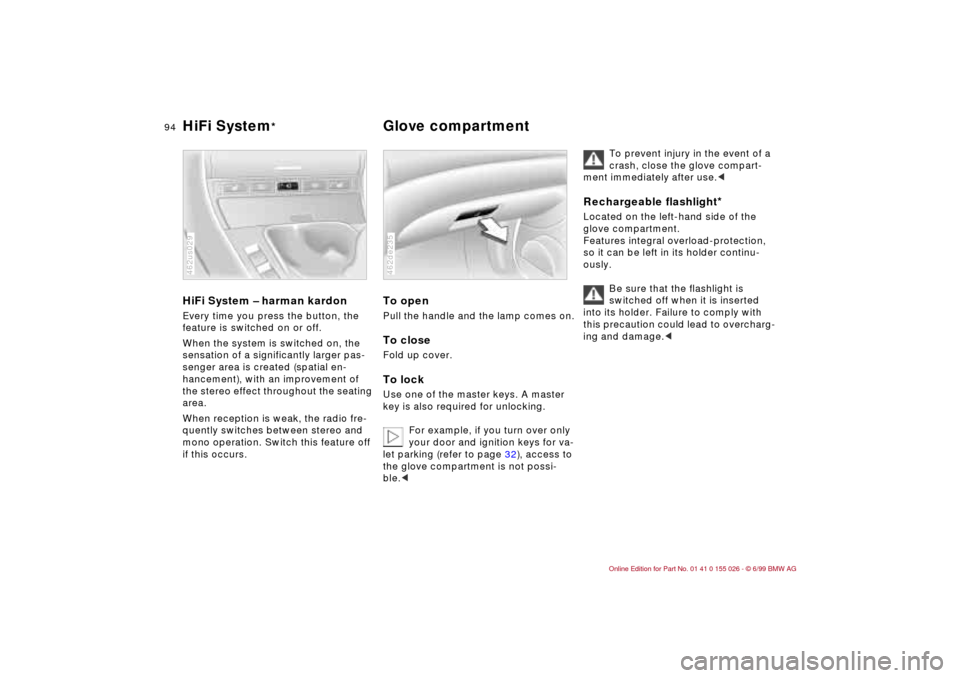
HiFi System – harman kardonEvery time you press the button, the
feature is switched on or off.
When the system is switched on, the
sensation of a significantly larger pas-
senger area is created (spatial en-
hancement), with an improvement of
the stereo effect throughout the seating
area.
When reception is weak, the radio fre-
quently switches between stereo and
mono operation. Switch this feature off
if this occurs.462us029
To openPull the handle and the lamp comes on.To closeFold up cover.To lockUse one of the master keys. A master
key is also required for unlocking.
For example, if you turn over only
your door and ignition keys for va-
let parking (refer to page 32), access to
the glove compartment is not possi-
ble.<462de235
To prevent injury in the event of a
crash, close the glove compart-
ment immediately after use.<
Rechargeable flashlight
*
Located on the left-hand side of the
glove compartment.
Features integral overload-protection,
so it can be left in its holder continu-
ously.
Be sure that the flashlight is
switched off when it is inserted
into its holder. Failure to comply with
this precaution could lead to overcharg-
ing and damage.<
HiFi System
*
Glove compartment
Page 99 of 189
97n
RepairsIndexOverview Controls Car care Technology Data
Ashtray, rear
* Clothes hooks
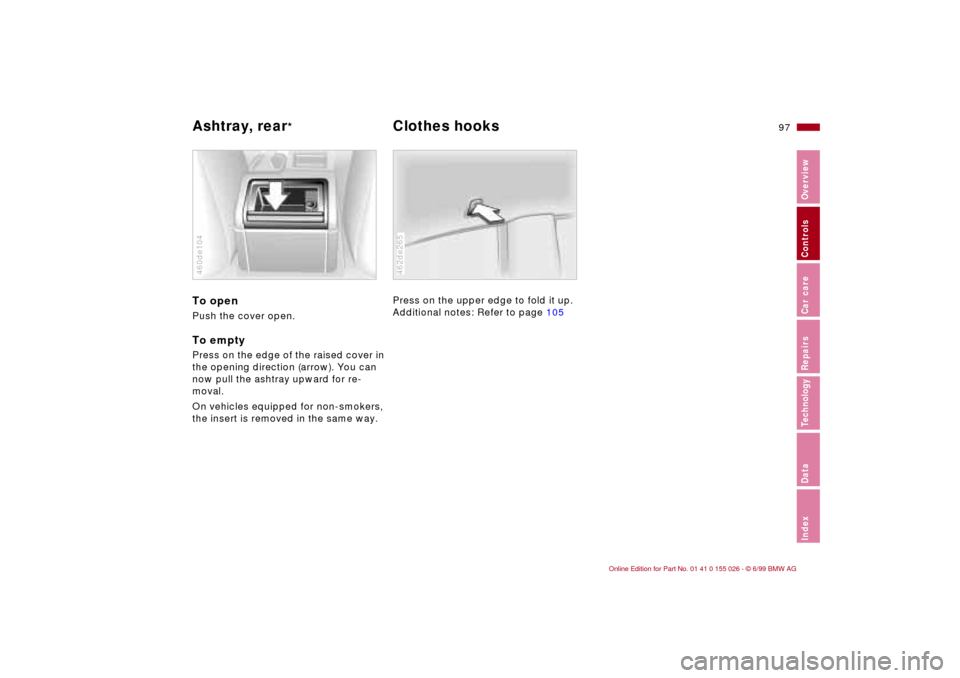
To openPush the cover open.To emptyPress on the edge of the raised cover in
the opening direction (arrow). You can
now pull the ashtray upward for re-
moval.
On vehicles equipped for non-smokers,
the insert is removed in the same way.460de104
Press on the upper edge to fold it up.
Additional notes: Refer to page 105462de265
Page 100 of 189
98n
Through-loading facility The rear backrest is divided into two
sections, one-third and two-thirds of
the seat respectively. For carrying
longer objects, you can fold down either
section of the backrest separately.
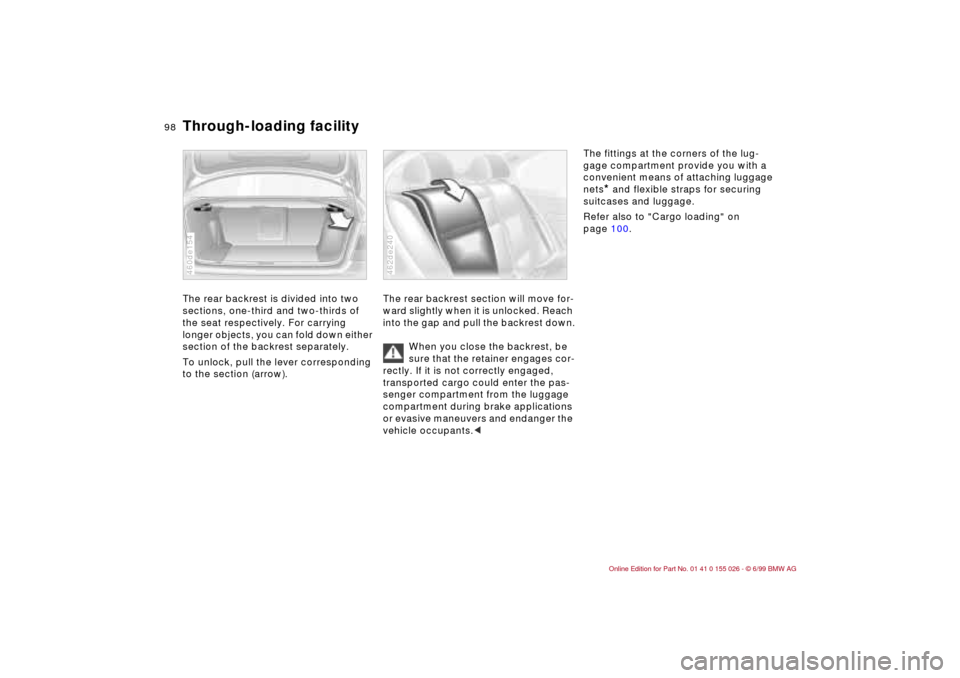
To unlock, pull the lever corresponding
to the section (arrow).460de154
The rear backrest section will move for-
ward slightly when it is unlocked. Reach
into the gap and pull the backrest down.
When you close the backrest, be
sure that the retainer engages cor-
rectly. If it is not correctly engaged,
transported cargo could enter the pas-
senger compartment from the luggage
compartment during brake applications
or evasive maneuvers and endanger the
vehicle occupants.<462de240
The fittings at the corners of the lug-
gage compartment provide you with a
convenient means of attaching luggage
nets
* and flexible straps for securing
suitcases and luggage.
Refer also to "Cargo loading" on
page 100.
Page 102 of 189
100n
Cargo loadingStowing cargo If you are transporting a load in your
BMW:
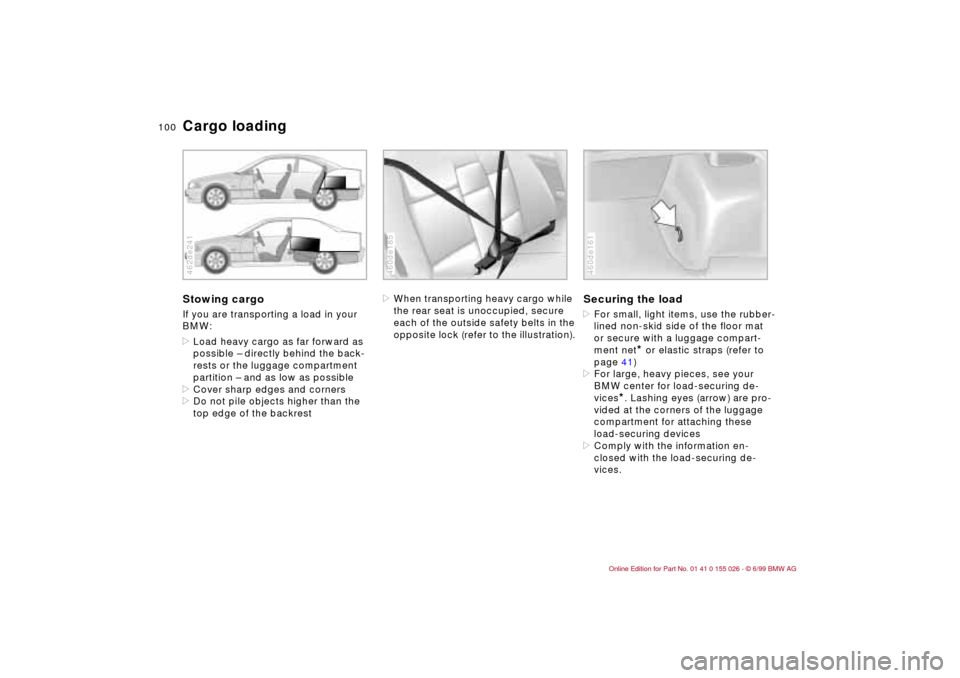
>Load heavy cargo as far forward as
possible – directly behind the back-
rests or the luggage compartment
partition – and as low as possible
>Cover sharp edges and corners
>Do not pile objects higher than the
top edge of the backrest462de241
>When transporting heavy cargo while
the rear seat is unoccupied, secure
each of the outside safety belts in the
opposite lock (refer to the illustration).460de185
Securing the load >For small, light items, use the rubber-
lined non-skid side of the floor mat
or secure with a luggage compart-
ment net
* or elastic straps (refer to
page 41)
>For large, heavy pieces, see your
BMW center for load-securing de-
vices
*. Lashing eyes (arrow) are pro-
vided at the corners of the luggage
compartment for attaching these
load-securing devices
>Comply with the information en-
closed with the load-securing de-
vices.
460de161
Page 103 of 189
101n
RepairsIndexOverview Controls Car care Technology Data
Cargo loading Roof-mounted luggage rack
*
Always position and secure the
load correctly, otherwise it can en-
danger the passengers in the event of
braking or swerving.
Do not exceed the permissible gross
weight and axle load (refer to page 172),
otherwise the vehicle's operating safety
is no longer assured and you are in vio-
lation of the law.
Do not stow heavy or hard objects in the
passenger compartment without first
securing them. Otherwise they would
be thrown around during braking and
evasive maneuvers and endanger the
occupants.<
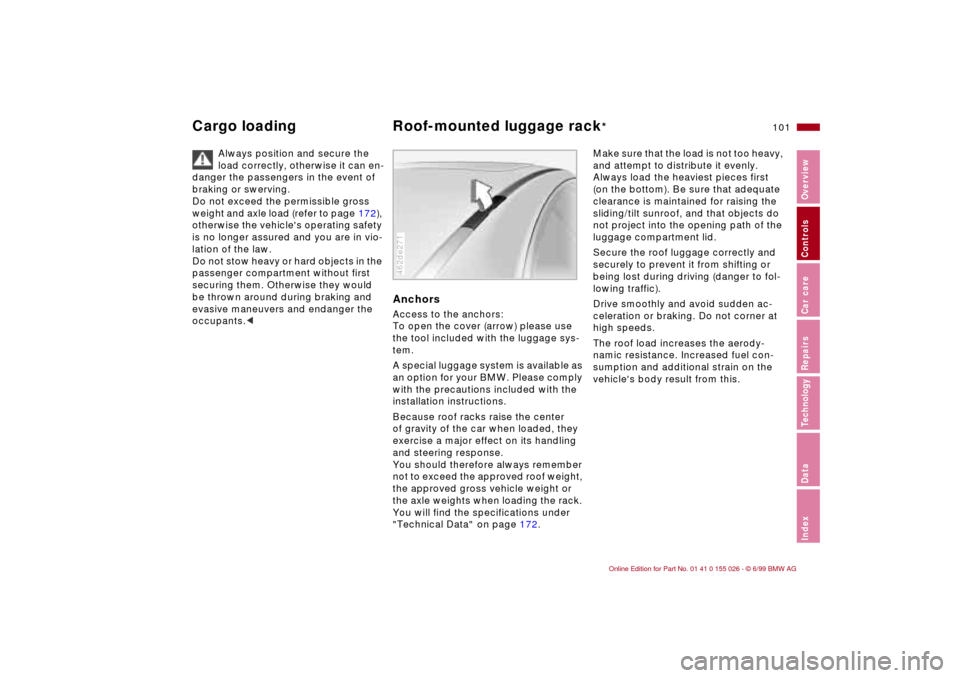
AnchorsAccess to the anchors:
To open the cover (arrow) please use
the tool included with the luggage sys-
tem.
A special luggage system is available as
an option for your BMW. Please comply
with the precautions included with the
installation instructions.
Because roof racks raise the center
of gravity of the car when loaded, they
exercise a major effect on its handling
and steering response.
You should therefore always remember
not to exceed the approved roof weight,
the approved gross vehicle weight or
the axle weights when loading the rack.
You will find the specifications under
"Technical Data" on page 172.462de271
Make sure that the load is not too heavy,
and attempt to distribute it evenly.
Always load the heaviest pieces first
(on the bottom). Be sure that adequate
clearance is maintained for raising the
sliding/tilt sunroof, and that objects do
not project into the opening path of the
luggage compartment lid.
Secure the roof luggage correctly and
securely to prevent it from shifting or
being lost during driving (danger to fol-
lowing traffic).
Drive smoothly and avoid sudden ac-
celeration or braking. Do not corner at
high speeds.
The roof load increases the aerody-
namic resistance. Increased fuel con-
sumption and additional strain on the
vehicle's body result from this.
Page 109 of 189
107n
RepairsIndexOverview Controls Car care Technology Data
Antilock Brake System (ABS)Antilock Brake System (ABS)/
Cornering Brake Control (CBC) CBC is an advanced engineering devel-
opment of ABS. When braking while
cornering at high speed or braking dur-
ing high lateral acceleration, or when
braking during a lane change, vehicle
stability is improved and steering
response is enhanced.
In the event of a fault
If the ABS warning lamp in the
instrument cluster lights up,
refer to page 22. The brake sys-
tem then reverts to conventional opera-
tion as on vehicles without ABS. How-
ever, have the brake system checked by
your BMW center as soon as possible.
To prevent undetected defects and cu-
mulative faults from adversely affecting
the brake system, refer any problems to
your authorized BMW center at the ear-
liest opportunity.
ABS warning lamp for Canadian
model.
If the brake warning lamp comes
on together with the indicator
lamps for the ABS and DSC sys-
tems, refer to page 21. The en-
tire ABS, CBC and DSC
govern-
ing system has deactivated.
Continue driving cautiously and
defensively. Avoid full brake ap-
plications. This could cause the vehicle
to lose stability and you might no longer
be able to control it.
Have the system checked as soon as
possible by your authorized BMW cen-
ter.
Warning lamps CBC, ABS and
DSC for Canadian models.
Page 110 of 189

108n
Disc brakesDisc brakes furnish optimum decelera-
tion and braking control and greater
fade resistance under heavy use.
When the vehicle is driven only occa-
sionally, during extended periods when
the vehicle is not used at all, and in op-
erating conditions where brakes appli-
cations are less frequent, there is an in-
creased tendency for corrosion of the
rotors and accumulation of contamina-
tion on the brake pads. This occurs be-
cause the minimal pressure that must
be exerted by the pads to clean the
rotors by brake applications is not
reached.
If the brake rotors are corroded, they
will tend to respond to braking with a
pulsating effect that even extended
brake applications will fail to cure.
For your own safety: Only use
brake linings that BMW has re-
leased for your particular vehicle model.
BMW cannot vouch for driving safety or
the suitability of brake linings other than
those they have released.<
Driving notesWhile driving in wet conditions and in
heavy rain, it is effective to apply light
pressure to the brake pedal every few
miles (kilometers). Watch traffic condi-
tions to ensure that this maneuver does
not endanger other road users. The
heat that is generated by the brake ap-
plications helps to dry the brake pads
and rotors.
Maximum braking force is obtained
while the wheels continue to rotate,
peaking when the wheels remain on the
verge of locking without actually doing
so. ABS maintains this state automati-
cally. If the ABS fails, you should revert
to the staggered braking technique
described on page 110.
Long or steep mountain descents do
not necessarily lead to reduced braking
efficiency if you drive downhill with the
transmission in a gear that allows mini-
mal brake applications (or, with an auto-
matic transmission, in an appropriate
lower range).
You can further increase the engine's
braking effect by selecting a lower gear,
downshifting as far as first gear or plac-
ing the selector lever in position (1).Should engine braking prove inade-
quate, you should still avoid extended,
continuous braking. Instead of main-
taining low to moderate pressure over
an extended period of time, you should
decelerate the vehicle by applying more
substantial force on the pedal (watch
for following traffic!) and then pausing
before repeating the application. This
staggered braking technique allows the
brakes to cool in the intervals between
active braking phases, preventing over-
heating and ensuring that full braking
capacity remains available at all times.
Do not coast with the clutch de-
pressed or with the transmission
or selector lever in neutral. Do not drive
with the engine shut off. The engine
provides no braking effect when the
clutch pedal is depressed or the trans-
mission is in neutral, and there is no
power-assist for brakes and steering
when the engine is not running.
Never allow floor mats, carpets or any
other objects to protrude into the area
around the accelerator, clutch and
brake pedals and obstruct their move-
ment.<
Page 111 of 189
109n
RepairsIndexOverview Controls Car care Technology Data
Brake systemBrake fluid level
If the brake-warning lamp
comes on with the parking brake
released:
The brake fluid level is too low in the
reservoir (refer to page 127).
If the brake fluid level is too low and
brake pedal travel has become notice-
ably longer, there may be a defect in
one of the brake system's hydraulic
circuits.
Brake-warning lamp for Cana-
dian model.
Proceed to the nearest authorized
BMW center. Higher brake appli-
cation pressure may be necessary un-
der these conditions, and brake pedal
travel may be significantly longer.
Please remember to adapt your driving
style accordingly.<
Brake pads
If the warning lamp for the brake
pads lights up:
The brake pads have reached
their minimum pad thickness. Proceed
to the nearest authorized BMW center
as soon as possible to have the pads
replaced.
For your own safety: Only use
brake linings that BMW has re-
leased for your particular vehicle model.
BMW cannot vouch for driving safety or
the suitability of brake linings other than
those they have released.<
Page 112 of 189

110n
Winter operationThe onset of winter is often accompa-
nied by rapid changes in weather. Adap-
tations in driving style should be accom-
panied by preparations on the vehicle
itself to ensure that your progress
through the winter remains safe and
trouble-free.CoolantBe sure that the coolant mixture is kept
at the year-round ratio of 50:50 of water
and antifreeze/corrosion protection.
This mixture provides protection against
freezing down to approx. – 347
(– 376). Replace the coolant every four
years.LocksBMW door lock deicer can be used to
free them if frozen. This deicer also
contains lubricant.
After using deicer, treatment with BMW
lock barrel grease is recommended.Rubber seals and components To prevent the weather-stripping from
freezing, apply a spray-on rubber treat-
ment or silicone spray to the door, hood
and luggage compartment lid seals.
A full range of car-care products is
available from your BMW center.<
Snow chains BMW snow chains
* can be mounted on
both summer and winter tires. Mount
them in pairs on the rear wheels only
and comply with the manufacturer's
safety precautions. Do not exceed a
maximum speed of 30 mph (50 km/h).
In this situation (snow chains mounted),
deactivate the DSC. Refer to page 81.
Starting offWe recommend that you use the man-
ual control switch to deactivate DSC
when starting off in deep snow or when
rocking the car to free it (refer to
page 81).Driving on low-traction road
surfacesUse smooth, gentle pressure to control
the accelerator pedal. Avoid excessive
engine speeds and shift to the next
higher gear at an early point. Adapt
your speed and driving style when ap-
proaching grades or slopes. Maintain
an adequate distance between yourself
and the car ahead.
BrakesWinter road conditions substantially
reduce the traction available between
the tires and the road surface.
Remember that braking distances will
be significantly longer as a result.
ABS is intended to prevent the wheels
from locking during brake applications,
thus helping to maintain vehicle stability
and steering response.
If the ABS does not respond in a critical
braking situation and the wheels lock:
Reduce the pressure on the brake
pedal until the wheels just start to roll
again while still maintaining enough
force to continue braking. Then in-
crease the pressure, reduce the pres-
sure when the wheels lock, reapply
pressure etc.
This staggered braking procedure will
reduce stopping distances while help-
ing you maintain steering control.
You can then attempt to steer around
hazards after you have reduced pres-
sure on the brake pedal.
Page 116 of 189

114n
To maintain good handling and vehicle
response, use only tires of a single
tread configuration from a single manu-
facturer. BMW tests and approves
wheel/tire combinations. Refer to
page 117.
Do not use retreaded tires, since
driving safety may be impaired by
their use. This due to the possible varia-
tions in casing structures and, in some
cases, to their extreme age, that can
lead to a decrease in their durability.<
Tire ageThe date on which the tire was manu-
factured is indicated by the code on the
sidewall:
DOT ... 129 indicates that the tire was
manufactured in Week 12 of 1999.
BMW recommends the replacement of
all tires when the tires are no more than
6 years old, even if a tire life of 10 years
is possible.
Spare tires over 6 years old should be
used only in case of emergency. Such
a tire should be replaced by a new tire
immediately, and should not be fitted
together with new tires.
Between the axlesThe tread wear patterns at the front end
differ from those at the rear – the actual
patterns will vary according to individ-
ual driving conditions. In the interests of
safety and maintaining optimal handling
characteristics, tire rotation is not rec-
ommended.
If a proposed interaxle rotation of tires
is based on economic considerations,
one should consider whether the costs
for the rotation are likely to be recap-
tured by any increase in the service life
of the tires which might be realized.
In principle, interaxle rotation should be
performed in short intervals, with a
maximum of 3,000 miles (5,000 km).
Consult your authorized BMW center
for more information.
Should you decide to rotate the tires, it
is essential to comply with the following:
Rotate tires on the same side only, since
braking characteristics and road grip
could otherwise be adversely affected.
Following rotation, correct the tire infla-
tion pressure.
If different tire sizes are mounted
on the front and rear axles (refer to
page 117), the wheels may not be ro-
tated from one axle to the other.<
Tire replacement Tire rotation