parking brake BMW 323i 2000 User Guide
[x] Cancel search | Manufacturer: BMW, Model Year: 2000, Model line: 323i, Model: BMW 323i 2000Pages: 189, PDF Size: 1.81 MB
Page 65 of 189
65n
IndexDataTechnologyRepairsCar careControlsOverview
Automatic transmission with Steptronic
*
You have the option of driving with a
normal automatic transmission or
switching to manual.
When you move the selector lever from
the "D" position to the left into the M/S
range, the performance-oriented shift
programs of the automatic transmission
are engaged. As soon as you briefly
touch the selector lever in the "+" or "Ð"
direction, Steptronic changes the gear.
The manual mode is engaged. When-
ever you want to use automatic again,
just shift the selector lever toward the
right to position D.
The automatic transmission with Step-
tronic is equipped with ATC (Adaptive
Transmission Control). ATC reacts with
precision to your individual driving style
and the current driving conditions. It is
for this reason that various shift pro-
grams are used.
For additional details concerning the
ATC, please refer to the chapter de-
scribing "Advanced technology" on
page 162.
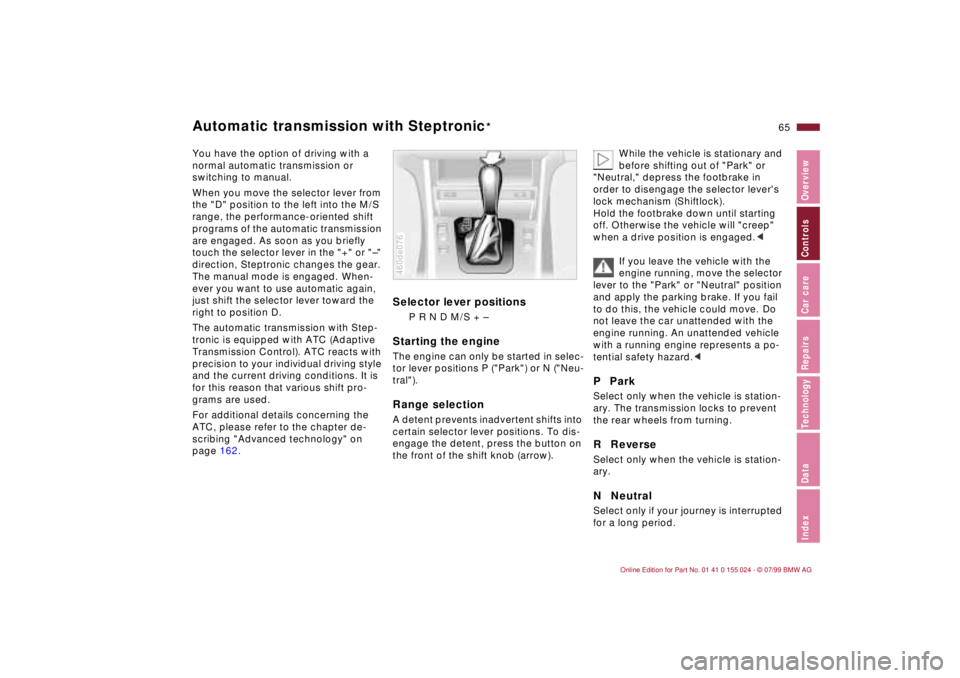
Selector lever positions
P R N D M/S + Ð
Starting the engineThe engine can only be started in selec-
tor lever positions P ("Park") or N ("Neu-
tral").Range selectionA detent prevents inadvertent shifts into
certain selector lever positions. To dis-
engage the detent, press the button on
the front of the shift knob (arrow).460de076
While the vehicle is stationary and
before shifting out of "Park" or
"Neutral," depress the footbrake in
order to disengage the selector lever's
lock mechanism (Shiftlock).
Hold the footbrake down until starting
off. Otherwise the vehicle will "creep"
when a drive position is engaged.<
If you leave the vehicle with the
engine running, move the selector
lever to the "Park" or "Neutral" position
and apply the parking brake. If you fail
to do this, the vehicle could move. Do
not leave the car unattended with the
engine running. An unattended vehicle
with a running engine represents a po-
tential safety hazard.<
P ParkSelect only when the vehicle is station-
ary. The transmission locks to prevent
the rear wheels from turning.R ReverseSelect only when the vehicle is station-
ary.N NeutralSelect only if your journey is interrupted
for a long period.
Page 67 of 189
67n
IndexDataTechnologyRepairsCar careControlsOverview
Automatic transmission with Steptronic
*
In the following situations, the Step-
tronic "thinks" for you in the manual
mode:
>In order to prevent the engine from
overrevving, the transmission shifts
automatically to the next higher gear
just before the RPM cutoff point.
>If you do not do anything to inter-
vene, it will automatically downshift
at lower speeds.
>In kickdown, it will downshift into
the lowest gear possible, depending
on the engine speed.
>According to the situation, for in-
stance in wintry conditions, the
vehicle can be started in 2nd or
3rd gear.
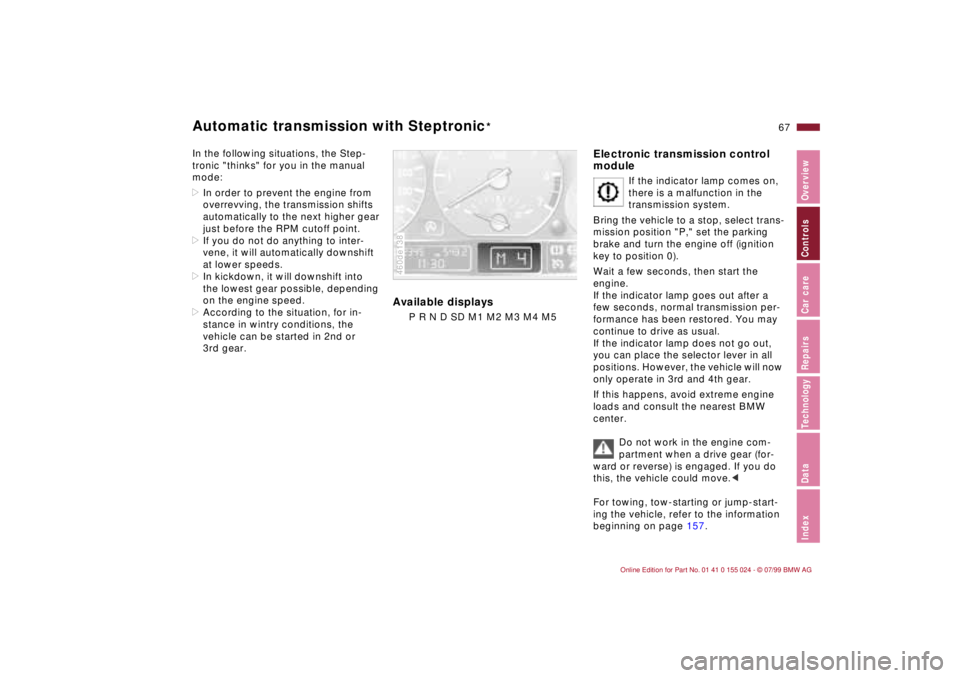
Available displays
P R N D SD M1 M2 M3 M4 M5460de138
Electronic transmission control
module
If the indicator lamp comes on,
there is a malfunction in the
transmission system.
Bring the vehicle to a stop, select trans-
mission position "P," set the parking
brake and turn the engine off (ignition
key to position 0).
Wait a few seconds, then start the
engine.
If the indicator lamp goes out after a
few seconds, normal transmission per-
formance has been restored. You may
continue to drive as usual.
If the indicator lamp does not go out,
you can place the selector lever in all
positions. However, the vehicle will now
only operate in 3rd and 4th gear.
If this happens, avoid extreme engine
loads and consult the nearest BMW
center.
Do not work in the engine com-
partment when a drive gear (for-
ward or reverse) is engaged. If you do
this, the vehicle could move.<
For towing, tow-starting or jump-start-
ing the vehicle, refer to the information
beginning on page 157.
Page 104 of 189

104n
To ensure that your vehicle provides
maximum economy throughout a long
service life, we request that you comply
with the following recommendations:
Engine and differentialUp to 1,200 miles (2,000 km):
Drive at varying engine speeds and
road speeds, but do not exceed
4,500 RPM or a road speed of 100 mph
(160 km/h) during this initial period.
Do not apply full throttle and avoid
pressing the accelerator beyond the
kickdown point.
After 1,200 miles (2,000 km), you can
gradually increase the engine speed or
road speed.
Follow the same break-in procedure if
either the engine or the differential is
replaced in the future.
TiresDue to technical factors associated
with their manufacture, tires do not
achieve their full traction potential until
an initial break-in period has elapsed.
For this reason, drive cautiously during
the first 200 miles (300 km).Brake systemBrake pads and disks do not attain their
optimal wear patterns until after approx.
300 miles (500 km).
To break-in the separate parking brake
drums, apply the parking brake lightly
when coasting to a standstill (at a traffic
signal, for instance), provided that traf-
fic conditions allow you to do so.
To avoid corrosion, repeat this proce-
dure from time to time.
The brake lamps do not come on
when the parking brake is set.
Vacuum for the brake system servo unit
on your BMW is available only when the
engine is running. When you move the
car with the engine off Ð when towing,
for example Ð substantially higher levels
of pedal force will be required to brake
the vehicle.<
Brakes:
Do not drive with your foot resting
on the brake pedal. Even light but con-
sistent pedal pressure can lead to high
temperatures, brake wear, and possibly
to brake failure.
Aquaplaning:
Reduce your speed when you drive on
wet or slushy roads. If you do not, a
wedge of water can form between the
tires and the road surface. This phe-
nomenon is referred to as aquaplaning
or hydroplaning. It is characterized by a
partial or complete loss of contact be-
tween the tires and the road surface.
The ultimate results are loss of steering
and braking control.
Driving through water:
Do not drive through water that is
deeper than 1 foot (30 cm). If you must
drive through water accumulations up
to that depth, drive only at walking
speed. Driving at a faster speed could
cause damage to the engine, the elec-
trical systems and the transmission.
Package tray:
Never use the rear window shelf to
store heavy or bulky objects. If you do
so, such objects could pose the risk of
injury to vehicle occupants during brak-
ing or evasive maneuvers or in a crash.
Break-in procedures Driving notes
Page 109 of 189
109n
IndexDataTechnologyRepairsCar careControlsOverview
Brake systemBrake fluid level
If the brake warning lamp
comes on and the parking brake
has been released:
The brake fluid level is too low in the
reservoir (refer to page 129).
If the brake fluid level is too low and
brake pedal travel has become notice-
ably longer, there may be a defect in
one of the hydraulic circuits of the brake
system.
Brake warning lamp for Cana-
dian models.
Proceed to the nearest BMW
center. Higher brake application
pressure may be necessary under these
conditions, and brake pedal travel may
be significantly longer. Please remem-
ber to adapt your driving style accord-
ingly.<
Brake pads
If the warning lamp for the brake
pads lights up:
The brake pads have reached
their minimum pad thickness. Proceed
to the nearest BMW center as soon as
possible to have the pads replaced.
For your own safety: Use only
brake pads that BMW has ap-
proved for your particular vehicle
model. BMW cannot evaluate non-
approved brake pads to determine if
they are suited for use, and therefore
cannot ensure the operating safety of
the vehicle if they are installed.<
Page 111 of 189

111n
IndexDataTechnologyRepairsCar careControlsOverview
Winter operation Power steering
Do not shift down on slick road
surfaces. Doing so could cause
the rear wheels to lose traction and
skid, resulting in a loss of vehicle con-
trol.<
Depress the clutch during hard
braking on road surfaces that pro-
vide only poor or uneven traction.<
Skid control Depress the clutch and release the ac-
celerator pedal, or place the selector
lever of the automatic transmission into
the "Neutral" position. Countersteer
carefully and attempt to regain control
of the vehicle.
ParkingEngage 1st or reverse gear. If your car
is equipped with an automatic trans-
mission, place the selector lever in
Park. On vehicles with manual trans-
mission, also apply the parking brake
when parking on inclined surfaces. In
order to prevent the parking brake lin-
ings from locking due to frost or corro-
sion, dry them by gently applying the
parking brake as the vehicle is coming
to a stop. Make sure that following traf-
fic is not endangered.
The brake lamps do not light up
when the parking brake is ap-
plied.<
High steering effort:
Contact an BMW center immediately to
have this system inspected.
If the power steering fails, in-
creased effort will be required to
steer the vehicle.<
Page 129 of 189
129n
IndexDataTechnologyRepairsCar careControlsOverview
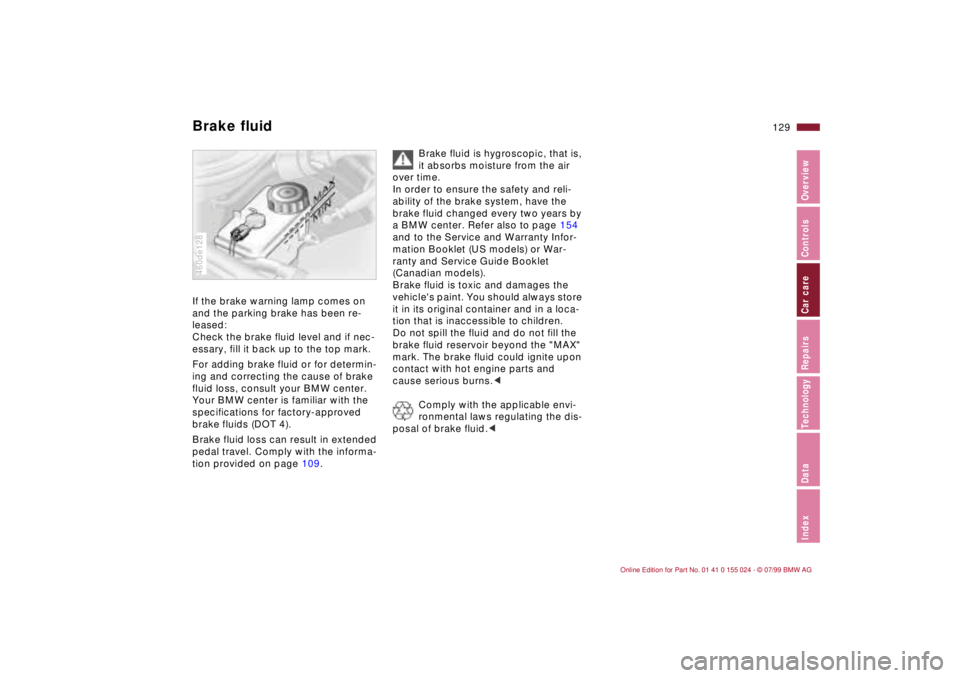
Brake fluidIf the brake warning lamp comes on
and the parking brake has been re-
leased:
Check the brake fluid level and if nec-
essary, fill it back up to the top mark.
For adding brake fluid or for determin-
ing and correcting the cause of brake
fluid loss, consult your BMW center.
Your BMW center is familiar with the
specifications for factory-approved
brake fluids (DOT 4).
Brake fluid loss can result in extended
pedal travel. Comply with the informa-
tion provided on page 109.460de128
Brake fluid is hygroscopic, that is,
it absorbs moisture from the air
over time.
In order to ensure the safety and reli-
ability of the brake system, have the
brake fluid changed every two years by
a BMW center. Refer also to page 154
and to the Service and Warranty Infor-
mation Booklet (US models) or War-
ranty and Service Guide Booklet
(Canadian models).
Brake fluid is toxic and damages the
vehicle's paint. You should always store
it in its original container and in a loca-
tion that is inaccessible to children.
Do not spill the fluid and do not fill the
brake fluid reservoir beyond the "MAX"
mark. The brake fluid could ignite upon
contact with hot engine parts and
cause serious burns.<
Comply with the applicable envi-
ronmental laws regulating the dis-
posal of brake fluid.<
Page 149 of 189
149n
IndexDataTechnologyRepairsCar careControlsOverview
Changing a wheel
Take these precautionary mea-
sures if you have either a flat tire
or are changing the tire.
Stop the vehicle as far as possible from
passing traffic. Park on a firm, flat sur-
face. Switch on the hazard flashers.
Turn the steering wheel to the straight-
ahead position, remove the key and en-
gage the steering lock. Shift into 1st or
reverse (selector lever in "Park" with
automatic) and engage the parking
brake.
Have all passengers leave the car and
remain well away from your immediate
working area (behind a guardrail, for in-
stance).
If a warning triangle or portable hazard
warning lamp is available, set it up on
the roadside at an appropriate distance
from the rear of the vehicle. Comply
with all applicable safety guidelines and
regulations.
Change the wheel only on a level, firm
surface that is not slippery. Avoid jack-
ing the car on a soft or slippery support
surface (snow, ice, loose gravel, etc.),
as it could slide sideways.
Position the jack on a firm support sur-
face.
Do not place wooden blocks or similar
objects under the jack. If you do so, the
jack might not be able to reach its full
support capacity because of the limited
height.
Do not lie under the vehicle or start the
engine when the vehicle is supported
by the jack. Failure to comply with this
creates a risk of fatal injury.<
Your BMW has either a spare wheel
* or
a space-saver spare tire
* for temporary
use and to ensure your mobility.
To remove the spare wheel
*,
lift the floor panel in the luggage
compartment completely out (refer to
page 41).<
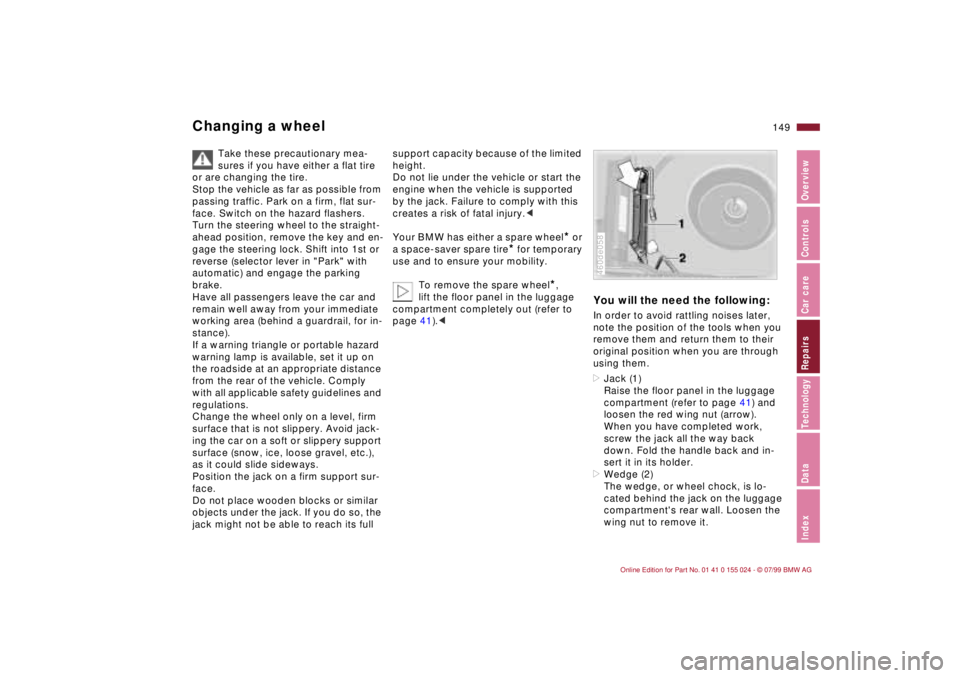
You will the need the following:In order to avoid rattling noises later,
note the position of the tools when you
remove them and return them to their
original position when you are through
using them.
>Jack (1)
Raise the floor panel in the luggage
compartment (refer to page 41) and
loosen the red wing nut (arrow).
When you have completed work,
screw the jack all the way back
down. Fold the handle back and in-
sert it in its holder.
>Wedge (2)
The wedge, or wheel chock, is lo-
cated behind the jack on the luggage
compartment's rear wall. Loosen the
wing nut to remove it.460de058
Page 183 of 189
Everything from A to Z
183n
IndexDataTechnologyRepairsCar careControlsOverview
OOBD interface socket139
Obstruction protection44
Odometer73
Oil
capacity175
consumption125
dipstick125
quality126
specifications126
viscosity126
Oil additives125
Oil change intervals, see the
Service and Warranty
Information Booklet
Oil filter change175
Oil level
check125
indicator lamp20
Oil pressure, indicator
lamp20
OILSERVICE74
Onboard computer76
Onboard tool kit142
Outside temperature
display76PPaint blemishes133
Paint, care133
Paintwork, minor
repairs134Paintwork, waxing134
Park Distance Control
(PDC)78
Parking brake63
Parking help78
Parking lamps83
Parking, winter111
PDC (Park Distance
Control)78
Performance172
Pocket flashlight92
Pollen90
Power seat49
Power steering111
Power windows44
safety switch45
Pressure monitoring,
tires80, 167
Pressure, tires27, 113
RRadiator175
Radio
refer to the separate
Owner's Manual
Radio Data System
(RDS)164
Radio reception112, 164
Rain sensor69, 166
RDC (Tire Pressure
Control)80, 167
RDS (Radio Data
System)164Reading lamps84
Rear backrest, folding97
Rear lamps145
Rear window
defroster70, 90
Rearview mirror52
Reclining seat47
Refueling26
Remote control35
Removing condensation,
windows89
Replacement key32
Reporting safety defects7
Restraint system59
Reverse17, 64
Roller blind, sun
protection91
Roller sun blind91
Roof load capacity174
Roof-mounted luggage
rack100
Rubber parts110
SSafety belt tensioner164
Safety belts54
height adjustment54
Safety feature44
Safety lock buttons38
Seat
mechanical47
power49
Seat adjustment47Seat heating91
Seat memory50
Securing cargo99
Securing loads99
Selector lever, automatic
transmission65
Self-defrosting mirrors52
Self-diagnostics168
Service and Warranty
Information Booklet131
Service Interval
Display74, 131
Shiftlock65
Side airbags56
Side impact Head Protection
System56
Side lamps82
bulb replacement144
Ski bag98
Skid control111
Sliding/Tilt sunroof45
closing following an
electrical malfunction156
convenience operation34
Slippery roads110
Snow chains110, 118
Space-saver spare tire149
Spare key32
Spare tire149
Spare wheel149
Spark plugs176
Speaker95
Speed control71