door lock BMW 325Ci 2003 User Guide
[x] Cancel search | Manufacturer: BMW, Model Year: 2003, Model line: 325Ci, Model: BMW 325Ci 2003Pages: 178, PDF Size: 4.59 MB
Page 39 of 178
39
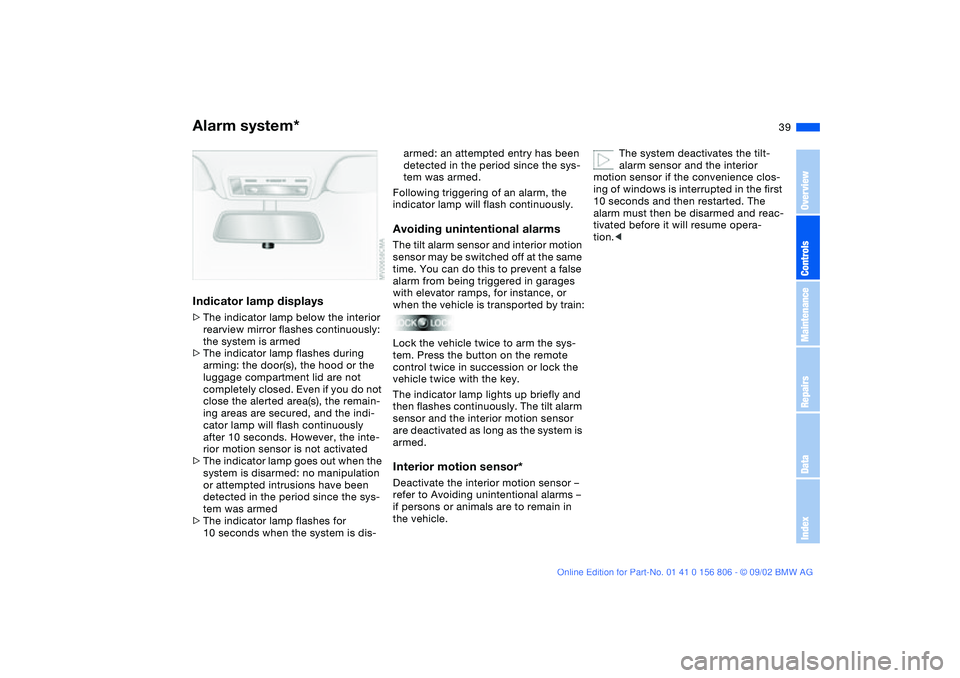
Indicator lamp displays>The indicator lamp below the interior
rearview mirror flashes continuously:
the system is armed
>The indicator lamp flashes during
arming: the door(s), the hood or the
luggage compartment lid are not
completely closed. Even if you do not
close the alerted area(s), the remain-
ing areas are secured, and the indi-
cator lamp will flash continuously
after 10 seconds. However, the inte-
rior motion sensor is not activated
>The indicator lamp goes out when the
system is disarmed: no manipulation
or attempted intrusions have been
detected in the period since the sys-
tem was armed
>The indicator lamp flashes for
10 seconds when the system is dis-
armed: an attempted entry has been
detected in the period since the sys-
tem was armed.
Following triggering of an alarm, the
indicator lamp will flash continuously.Avoiding unintentional alarmsThe tilt alarm sensor and interior motion
sensor may be switched off at the same
time. You can do this to prevent a false
alarm from being triggered in garages
with elevator ramps, for instance, or
when the vehicle is transported by train:
Lock the vehicle twice to arm the sys-
tem. Press the button on the remote
control twice in succession or lock the
vehicle twice with the key.
The indicator lamp lights up briefly and
then flashes continuously. The tilt alarm
sensor and the interior motion sensor
are deactivated as long as the system is
armed.Interior motion sensor*Deactivate the interior motion sensor –
refer to Avoiding unintentional alarms –
if persons or animals are to remain in
the vehicle.
The system deactivates the tilt-
alarm sensor and the interior
motion sensor if the convenience clos-
ing of windows is interrupted in the first
10 seconds and then restarted. The
alarm must then be disarmed and reac-
tivated before it will resume opera-
tion.<
Alarm system*
OverviewControlsMaintenanceRepairsDataIndex
handbook.book Page 39 Wednesday, July 31, 2002 9:29 AM
Page 40 of 178
40
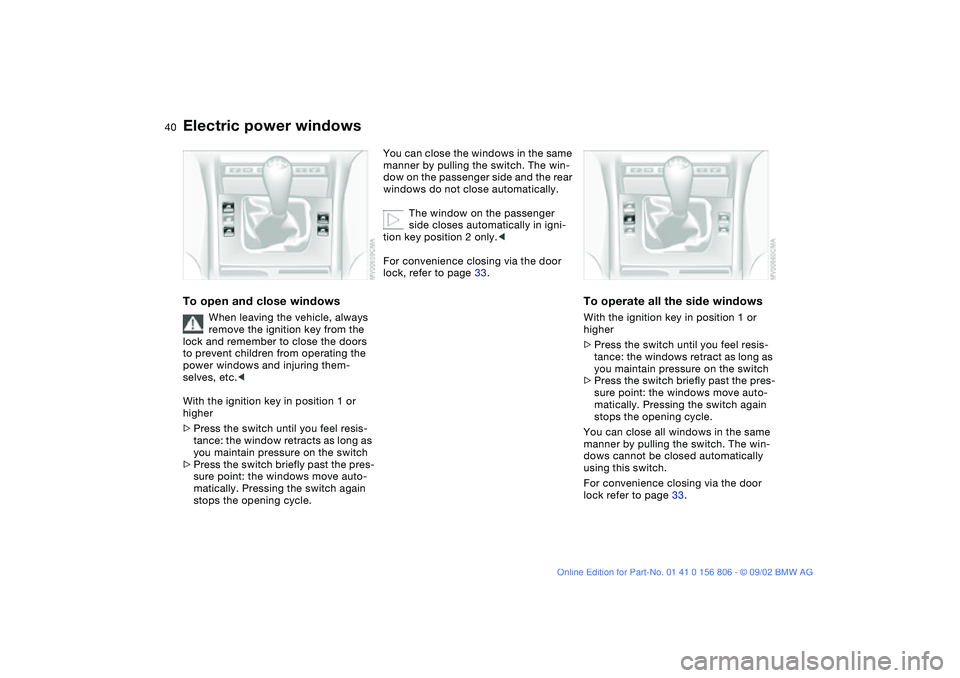
Electric power windowsTo open and close windows
When leaving the vehicle, always
remove the ignition key from the
lock and remember to close the doors
to prevent children from operating the
power windows and injuring them-
selves, etc.<
With the ignition key in position 1 or
higher
>Press the switch until you feel resis-
tance: the window retracts as long as
you maintain pressure on the switch
>Press the switch briefly past the pres-
sure point: the windows move auto-
matically. Pressing the switch again
stops the opening cycle.
You can close the windows in the same
manner by pulling the switch. The win-
dow on the passenger side and the rear
windows do not close automatically.
The window on the passenger
side closes automatically in igni-
tion key position 2 only.<
For convenience closing via the door
lock, refer to page 33.
To operate all the side windowsWith the ignition key in position 1 or
higher
>Press the switch until you feel resis-
tance: the windows retract as long as
you maintain pressure on the switch
>Press the switch briefly past the pres-
sure point: the windows move auto-
matically. Pressing the switch again
stops the opening cycle.
You can close all windows in the same
manner by pulling the switch. The win-
dows cannot be closed automatically
using this switch.
For convenience closing via the door
lock refer to page 33.
handbook.book Page 40 Wednesday, July 31, 2002 9:29 AM
Page 41 of 178
41
After the ignition has been
switched offYou can still use the electric power win-
dows for up to 15 minutes, as long as
no one opens any of the doors.
Manual convertible topThe fabric top offers the perfect protec-
tion against weather and one person
can open and close it easily and simply.
To gain maximum satisfaction from your
convertible, please observe the follow-
ing: We strongly recommend that you
close the convertible top before leaving
the vehicle parked. When closed, the
top not only guards the passenger
compartment from unforeseeable dam-
age from the weather, but also affords a
degree of protection against theft.
However, even when the top is closed
valuables should always be stored in
the locked luggage compartment.
Never attempt to mount any kind of roof
rack or luggage carrier on the convert-
ible top.
Closing the electric power win-
dows: to help ensure that the win-
dows seal securely, you should either
close the rear windows first or close all
four windows at the same time.<
Electric power windows
OverviewControlsMaintenanceRepairsDataIndex
handbook.book Page 41 Wednesday, July 31, 2002 9:29 AM
Page 48 of 178
48
the closing phase is completed, press
against the front section of the convert-
ible top frame from the outside to help
the closing process along. Continue
pressing the switch while doing so until
the top starts up again on its own.<
Operate the convertible top manu-
ally in emergency situations only
to avoid causing damage due to incor-
rect operation.<
If the opening or closing process
has been interrupted, the convert-
ible top will remain in that position for
15 minutes. After that, the convertible
top can be moved again and, if it is an
emergency situation, you may need to
help the top along manually.
This can also be done in ignition key
position 0.
In certain cases, the luggage compart-
ment lid cannot be opened if the open-
ing or closing operation has been inter-
rupted.
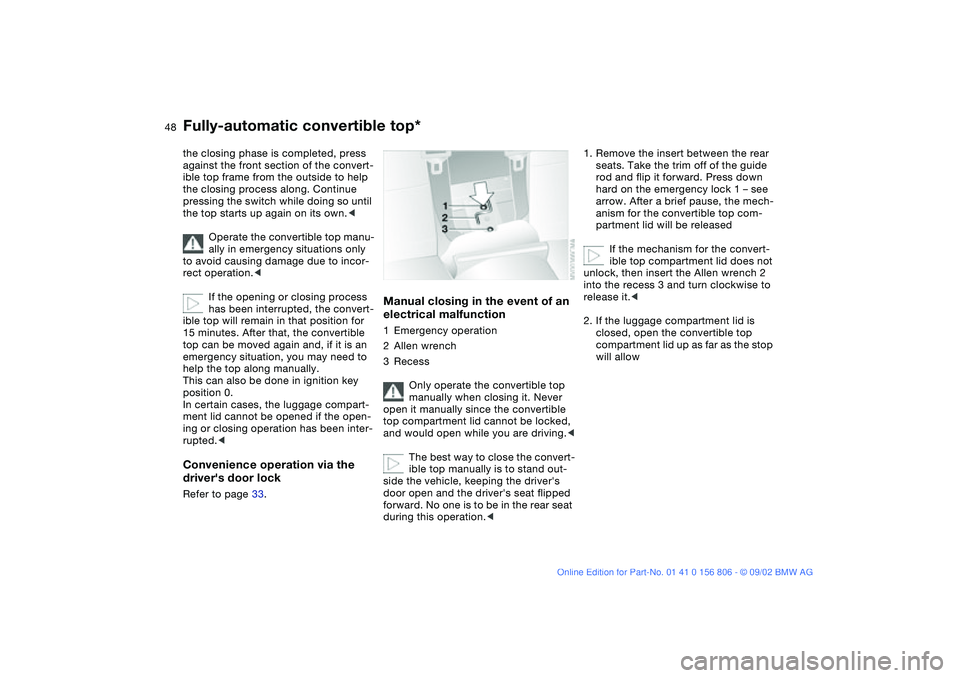
Manual closing in the event of an
electrical malfunction1Emergency operation
2Allen wrench
3Recess
Only operate the convertible top
manually when closing it. Never
open it manually since the convertible
top compartment lid cannot be locked,
and would open while you are driving.<
The best way to close the convert-
ible top manually is to stand out-
side the vehicle, keeping the driver's
door open and the driver's seat flipped
forward. No one is to be in the rear seat
during this operation.<
1. Remove the insert between the rear
seats. Take the trim off of the guide
rod and flip it forward. Press down
hard on the emergency lock 1 – see
arrow. After a brief pause, the mech-
anism for the convertible top com-
partment lid will be released
If the mechanism for the convert-
ible top compartment lid does not
unlock, then insert the Allen wrench 2
into the recess 3 and turn clockwise to
release it.<
2. If the luggage compartment lid is
closed, open the convertible top
compartment lid up as far as the stop
will allow
Fully-automatic convertible top*
handbook.book Page 48 Wednesday, July 31, 2002 9:29 AM
Page 57 of 178
57
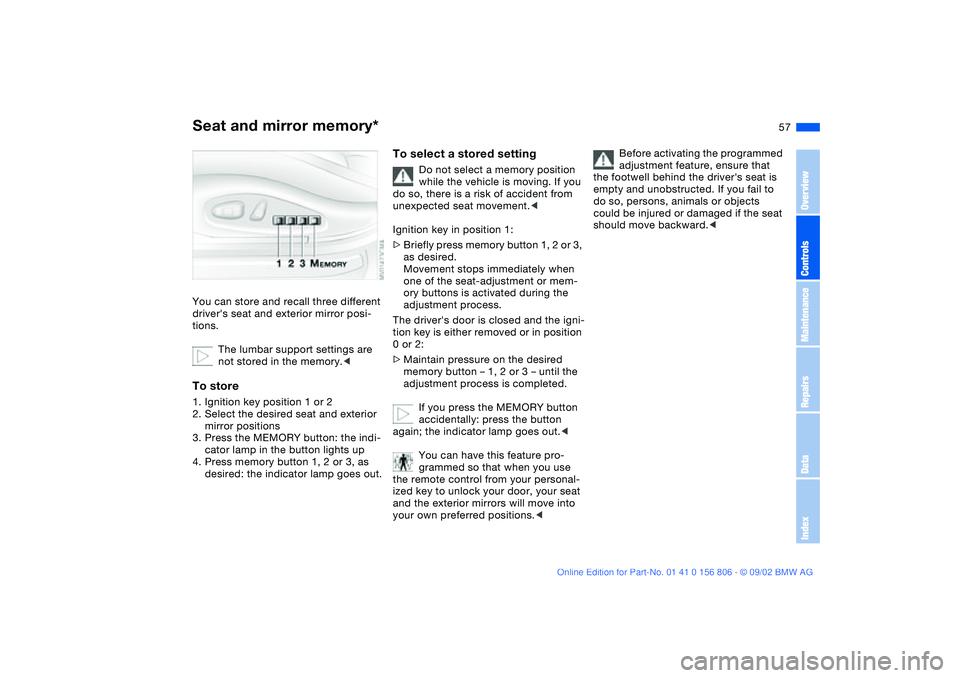
Seat and mirror memory*You can store and recall three different
driver's seat and exterior mirror posi-
tions.
The lumbar support settings are
not stored in the memory.
mirror positions
3. Press the MEMORY button: the indi-
cator lamp in the button lights up
4. Press memory button 1, 2 or 3, as
desired: the indicator lamp goes out.
To select a stored setting
Do not select a memory position
while the vehicle is moving. If you
do so, there is a risk of accident from
unexpected seat movement.<
Ignition key in position 1:
>Briefly press memory button 1, 2 or 3,
as desired.
Movement stops immediately when
one of the seat-adjustment or mem-
ory buttons is activated during the
adjustment process.
The driver's door is closed and the igni-
tion key is either removed or in position
0 or 2:
>Maintain pressure on the desired
memory button – 1, 2 or 3 – until the
adjustment process is completed.
If you press the MEMORY button
accidentally: press the button
again; the indicator lamp goes out.<
You can have this feature pro-
grammed so that when you use
the remote control from your personal-
ized key to unlock your door, your seat
and the exterior mirrors will move into
your own preferred positions.<
Before activating the programmed
adjustment feature, ensure that
the footwell behind the driver's seat is
empty and unobstructed. If you fail to
do so, persons, animals or objects
could be injured or damaged if the seat
should move backward.<
OverviewControlsMaintenanceRepairsDataIndex
handbook.book Page 57 Wednesday, July 31, 2002 9:29 AM
Page 69 of 178
69
Vehicle Memory, Key MemoryHow the system functionsNo doubt you have reflected at one
time or another on how great it would
be if you could permanently configure
your vehicle's various features and
adjustments to mirror your own individ-
ual preferences. In engineering your
vehicle, BMW has provided for a num-
ber of options for personal adjustment
that can be programmed into your vehi-
cle at your BMW center.
The available configuration data fall into
two categories, according to whether
their primary orientation is the vehicle –
Vehicle Memory – or the individual –
Key Memory. Provided that each per-
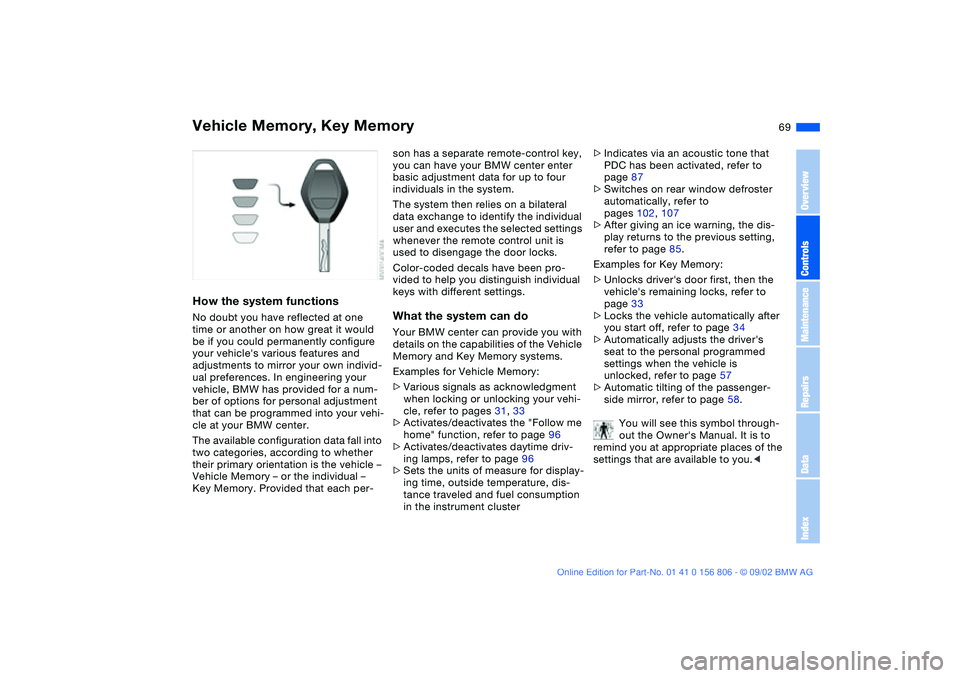
son has a separate remote-control key,
you can have your BMW center enter
basic adjustment data for up to four
individuals in the system.
The system then relies on a bilateral
data exchange to identify the individual
user and executes the selected settings
whenever the remote control unit is
used to disengage the door locks.
Color-coded decals have been pro-
vided to help you distinguish individual
keys with different settings.What the system can doYour BMW center can provide you with
details on the capabilities of the Vehicle
Memory and Key Memory systems.
Examples for Vehicle Memory:
>Various signals as acknowledgment
when locking or unlocking your vehi-
cle, refer to pages 31, 33
>Activates/deactivates the "Follow me
home" function, refer to page 96
>Activates/deactivates daytime driv-
ing lamps, refer to page 96
>Sets the units of measure for display-
ing time, outside temperature, dis-
tance traveled and fuel consumption
in the instrument cluster>Indicates via an acoustic tone that
PDC has been activated, refer to
page 87
>Switches on rear window defroster
automatically, refer to
pages 102, 107
>After giving an ice warning, the dis-
play returns to the previous setting,
refer to page 85.
Examples for Key Memory:
>Unlocks driver's door first, then the
vehicle's remaining locks, refer to
page 33
>Locks the vehicle automatically after
you start off, refer to page 34
>Automatically adjusts the driver's
seat to the personal programmed
settings when the vehicle is
unlocked, refer to page 57
>Automatic tilting of the passenger-
side mirror, refer to page 58.
You will see this symbol through-
out the Owner's Manual. It is to
remind you at appropriate places of the
settings that are available to you.<
OverviewControlsMaintenanceRepairsDataIndex
handbook.book Page 69 Wednesday, July 31, 2002 9:29 AM
Page 70 of 178
70Driving
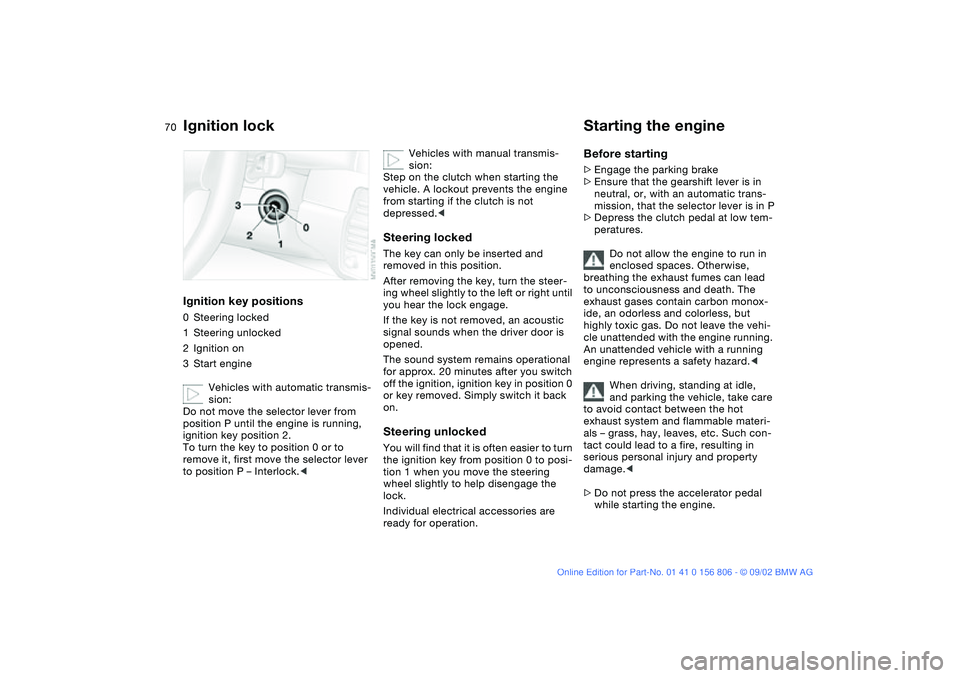
Ignition lockIgnition key positions0Steering locked
1Steering unlocked
2Ignition on
3Start engine
Vehicles with automatic transmis-
sion:
Do not move the selector lever from
position P until the engine is running,
ignition key position 2.
To turn the key to position 0 or to
remove it, first move the selector lever
to position P – Interlock.<
Vehicles with manual transmis-
sion:
Step on the clutch when starting the
vehicle. A lockout prevents the engine
from starting if the clutch is not
depressed.<
Steering lockedThe key can only be inserted and
removed in this position.
After removing the key, turn the steer-
ing wheel slightly to the left or right until
you hear the lock engage.
If the key is not removed, an acoustic
signal sounds when the driver door is
opened.
The sound system remains operational
for approx. 20 minutes after you switch
off the ignition, ignition key in position 0
or key removed. Simply switch it back
on.Steering unlockedYou will find that it is often easier to turn
the ignition key from position 0 to posi-
tion 1 when you move the steering
wheel slightly to help disengage the
lock.
Individual electrical accessories are
ready for operation.
Starting the engineBefore starting>Engage the parking brake
>Ensure that the gearshift lever is in
neutral, or, with an automatic trans-
mission, that the selector lever is in P
>Depress the clutch pedal at low tem-
peratures.
Do not allow the engine to run in
enclosed spaces. Otherwise,
breathing the exhaust fumes can lead
to unconsciousness and death. The
exhaust gases contain carbon monox-
ide, an odorless and colorless, but
highly toxic gas. Do not leave the vehi-
cle unattended with the engine running.
An unattended vehicle with a running
engine represents a safety hazard.<
When driving, standing at idle,
and parking the vehicle, take care
to avoid contact between the hot
exhaust system and flammable materi-
als – grass, hay, leaves, etc. Such con-
tact could lead to a fire, resulting in
serious personal injury and property
damage.<
>Do not press the accelerator pedal
while starting the engine.
handbook.book Page 70 Wednesday, July 31, 2002 9:29 AM
Page 109 of 178
109 Interior conveniences
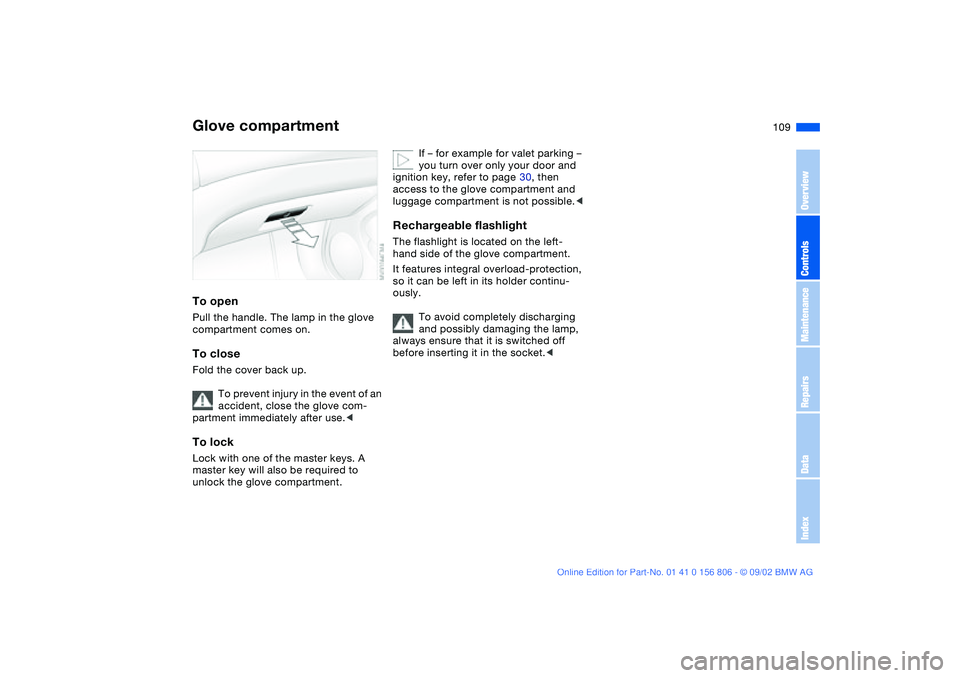
Glove compartmentTo openPull the handle. The lamp in the glove
compartment comes on.To closeFold the cover back up.
To prevent injury in the event of an
accident, close the glove com-
partment immediately after use.
unlock the glove compartment.
If – for example for valet parking –
you turn over only your door and
ignition key, refer to page 30, then
access to the glove compartment and
luggage compartment is not possible.<
Rechargeable flashlightThe flashlight is located on the left-
hand side of the glove compartment.
It features integral overload-protection,
so it can be left in its holder continu-
ously.
To avoid completely discharging
and possibly damaging the lamp,
always ensure that it is switched off
before inserting it in the socket.<
OverviewControlsMaintenanceRepairsDataIndex
handbook.book Page 109 Wednesday, July 31, 2002 9:29 AM
Page 110 of 178
110
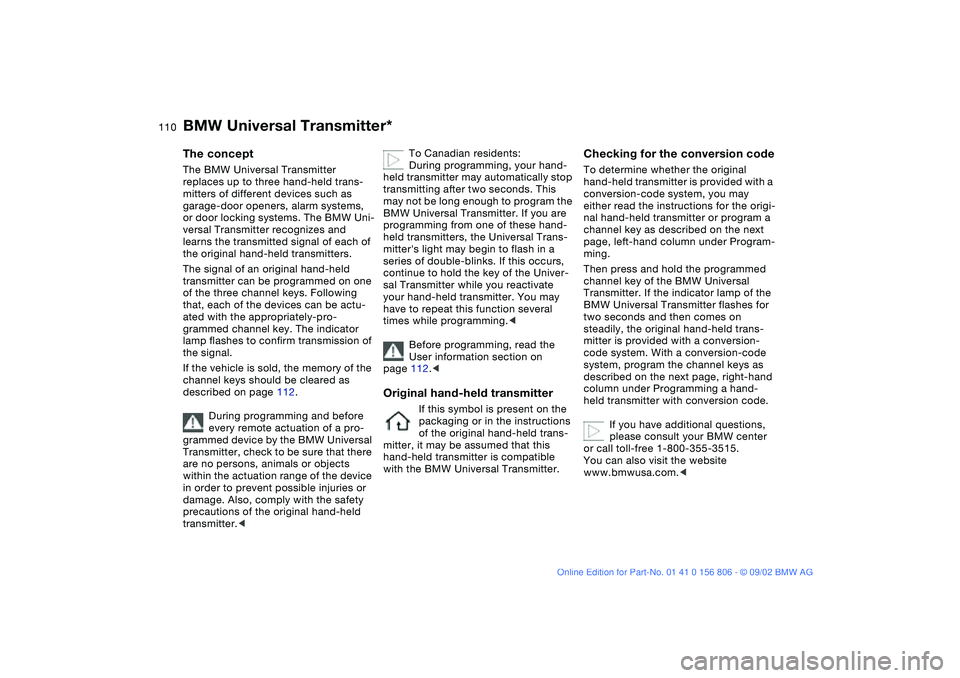
BMW Universal Transmitter*The conceptThe BMW Universal Transmitter
replaces up to three hand-held trans-
mitters of different devices such as
garage-door openers, alarm systems,
or door locking systems. The BMW Uni-
versal Transmitter recognizes and
learns the transmitted signal of each of
the original hand-held transmitters.
The signal of an original hand-held
transmitter can be programmed on one
of the three channel keys. Following
that, each of the devices can be actu-
ated with the appropriately-pro-
grammed channel key. The indicator
lamp flashes to confirm transmission of
the signal.
If the vehicle is sold, the memory of the
channel keys should be cleared as
described on page 112.
During programming and before
every remote actuation of a pro-
grammed device by the BMW Universal
Transmitter, check to be sure that there
are no persons, animals or objects
within the actuation range of the device
in order to prevent possible injuries or
damage. Also, comply with the safety
precautions of the original hand-held
transmitter.<
To Canadian residents:
During programming, your hand-
held transmitter may automatically stop
transmitting after two seconds. This
may not be long enough to program the
BMW Universal Transmitter. If you are
programming from one of these hand-
held transmitters, the Universal Trans-
mitter's light may begin to flash in a
series of double-blinks. If this occurs,
continue to hold the key of the Univer-
sal Transmitter while you reactivate
your hand-held transmitter. You may
have to repeat this function several
times while programming.<
Before programming, read the
User information section on
page 112.<
Original hand-held transmitter
If this symbol is present on the
packaging or in the instructions
of the original hand-held trans-
mitter, it may be assumed that this
hand-held transmitter is compatible
with the BMW Universal Transmitter.
Checking for the conversion codeTo determine whether the original
hand-held transmitter is provided with a
conversion-code system, you may
either read the instructions for the origi-
nal hand-held transmitter or program a
channel key as described on the next
page, left-hand column under Program-
ming.
Then press and hold the programmed
channel key of the BMW Universal
Transmitter. If the indicator lamp of the
BMW Universal Transmitter flashes for
two seconds and then comes on
steadily, the original hand-held trans-
mitter is provided with a conversion-
code system. With a conversion-code
system, program the channel keys as
described on the next page, right-hand
column under Programming a hand-
held transmitter with conversion code.
If you have additional questions,
please consult your BMW center
or call toll-free 1-800-355-3515.
You can also visit the website
www.bmwusa.com.<
handbook.book Page 110 Wednesday, July 31, 2002 9:29 AM
Page 169 of 178
Everything from A to Z
169
Car wash, refer to the Caring
for your vehicle brochure
Cargo loading 116
Cassette player operation,
refer to the Owner's Man-
ual for Radio
CBC Cornering Brake
Control 123
indicator lamp 19
CD player operation, refer to
the Owner's Manual for
Radio
Cellular phone 113
Center armrest 112
Center high-mount brake
lamp 150
Central locking system 30
button 34
Changing a wheel 151
Check Control 83
Check Filler Cap
indicator lamp 19
Checking coolant level 138
Checking oil level 136
Child seats 63
integrated 61
Child-restraint mounting
system (LATCH) 66
Child-restraint system 63
Cigarette lighter 113
Clean headlamps 79Cleaning position, convert-
ible top 45, 50
Cleaning windshield 79
Clock 84
setting 84
Cockpit 14
Code, refer to the Owner's
Manual for Radio
Coin box 113
Compartments 112
Compression ratio 162
Computer 85
Condensation
removing from windows
103, 106
Consumption
display 82
fuel 86
Convertible top
cleaning position 45, 50
closing in an
emergency 48
electrical fault 48
Convertible top activation
fully automatic top 46
manual top 41
Convertible top compart-
ment panel, folding
down 37
Coolant 134, 138, 165
indicator lamp 19
Cooling system 165Copyright 4
Cornering Brake Control
(CBC) 123
indicator lamp 19
Cruise control 79
indicator lamp 20
Cup holder, see Beverage
holder 113
Curb weight 164
Cushion height 163
D
Data
dimensions 163
engine 162
technical 162
weights 164
Daytime driving lamps 96
DBC Dynamic Brake
Control 123
warning lamp 19
Defrost position 103, 106
Defrosting rear window
102, 107
Defrosting windows
103, 106
Digital clock 84
Dimensions 163
Dipstick, engine oil 136
Disc brakes 124
Displacement 162
Display lighting 97Displays 16
Distance warning PDC 87
Door key 30
Door lock buttons 34
Doors
emergency operation 33
manual operation 33
remote control 31
unlocking and locking
31, 33
Driving notes
braking 123
disc brakes 124
general information 123
hydroplaning 123
DSC Dynamic Stability
Control 90
indicator lamp 19
DTC Dynamic Traction
Control 90
Dynamic Brake Control
(DBC) 123
warning lamps 19
Dynamic Stability Control
(DSC) 90
indicator lamp 19
Dynamic Traction Control
(DTC) 90
E
Electric power windows 40
OverviewControlsMaintenanceRepairsDataIndex
handbook.book Page 169 Wednesday, July 31, 2002 9:29 AM