warning BMW 325CI 2004 Owner's Manual
[x] Cancel search | Manufacturer: BMW, Model Year: 2004, Model line: 325CI, Model: BMW 325CI 2004Pages: 186, PDF Size: 2.76 MB
Page 95 of 186
95
System limitations
The Flat Tire Monitor cannot pro-
vide you with advance warning of
sudden and severe tire damage caused
by external factors and does not detect
the balanced and very gradual pressure
loss that takes place in all four tires
over an extended period of time.<
On the other hand, the following situa-
tions can lead to a delayed detection of
pressure loss and even to the system
not functioning:
>Driving on snow-covered or slippery
roads
>Performance-oriented driving: slip at
the drive wheels, high levels of lateral
acceleration
>When driving with snow chains, false
warnings and undetected pressure
losses may occur
>When driving with a space-saver
spare tire, the Flat Tire Monitor can-
not function.
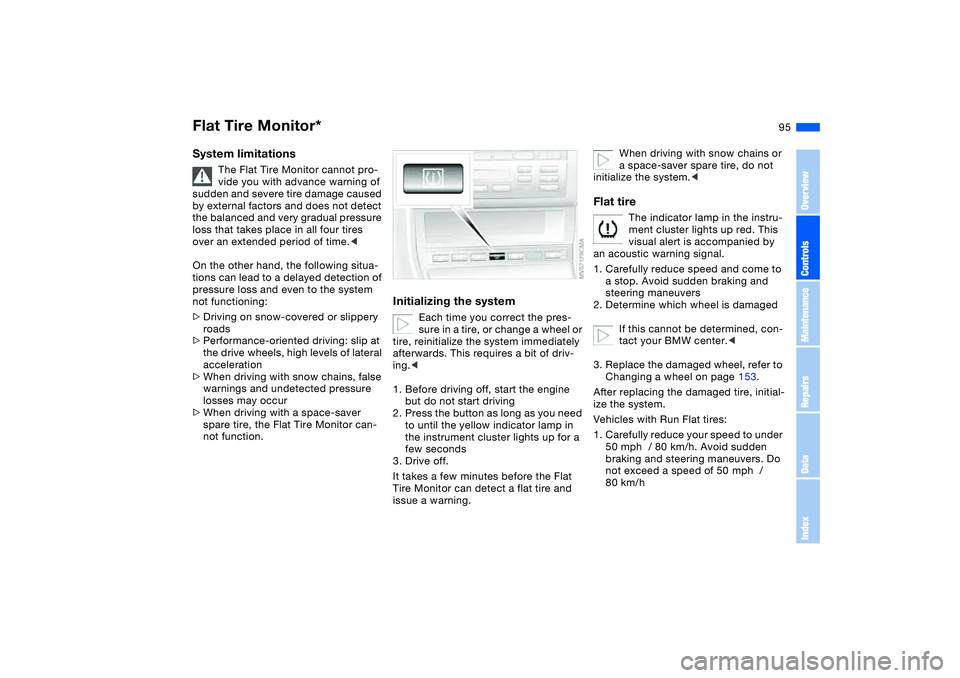
Initializing the system
Each time you correct the pres-
sure in a tire, or change a wheel or
tire, reinitialize the system immediately
afterwards. This requires a bit of driv-
ing.<
1. Before driving off, start the engine
but do not start driving
2. Press the button as long as you need
to until the yellow indicator lamp in
the instrument cluster lights up for a
few seconds
3. Drive off.
It takes a few minutes before the Flat
Tire Monitor can detect a flat tire and
issue a warning.
When driving with snow chains or
a space-saver spare tire, do not
initialize the system.<
Flat tire
The indicator lamp in the instru-
ment cluster lights up red. This
visual alert is accompanied by
an acoustic warning signal.
1. Carefully reduce speed and come to
a stop. Avoid sudden braking and
steering maneuvers
2. Determine which wheel is damaged
If this cannot be determined, con-
tact your BMW center.<
3. Replace the damaged wheel, refer to
Changing a wheel on page 153.
After replacing the damaged tire, initial-
ize the system.
Vehicles with Run Flat tires:
1. Carefully reduce your speed to under
50 mph / 80 km/h. Avoid sudden
braking and steering maneuvers. Do
not exceed a speed of 50 mph /
80 km/h
Flat Tire Monitor*
OverviewControlsMaintenanceRepairsDataIndex
Page 97 of 186
97 Lamps
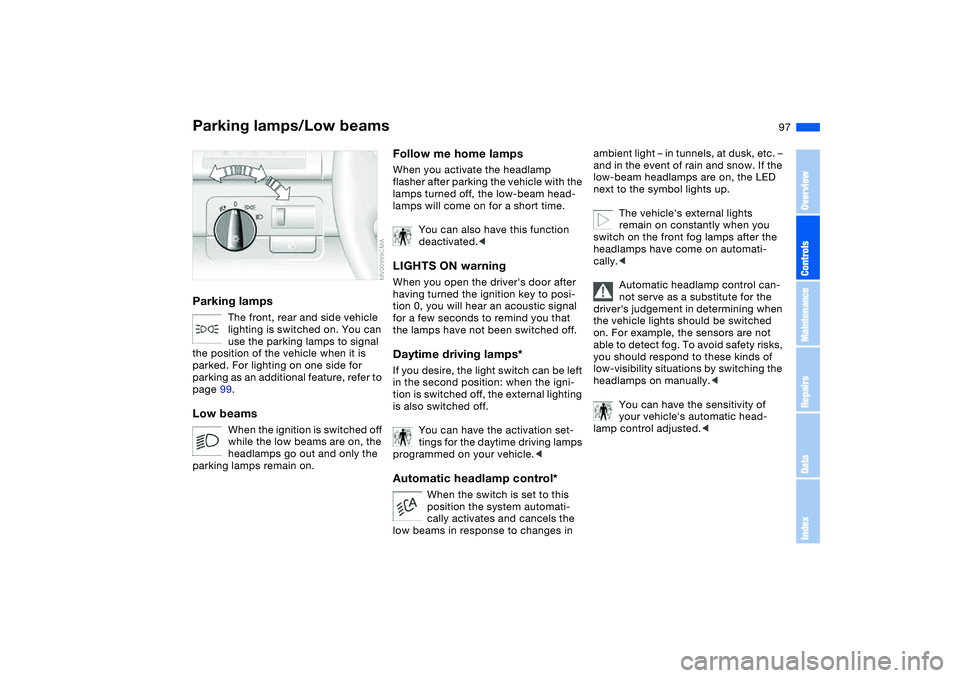
Parking lamps/Low beamsParking lamps
The front, rear and side vehicle
lighting is switched on. You can
use the parking lamps to signal
the position of the vehicle when it is
parked. For lighting on one side for
parking as an additional feature, refer to
page 99.
Low beams
When the ignition is switched off
while the low beams are on, the
headlamps go out and only the
parking lamps remain on.
Follow me home lampsWhen you activate the headlamp
flasher after parking the vehicle with the
lamps turned off, the low-beam head-
lamps will come on for a short time.
You can also have this function
deactivated.
tion 0, you will hear an acoustic signal
for a few seconds to remind you that
the lamps have not been switched off.Daytime driving lamps*If you desire, the light switch can be left
in the second position: when the igni-
tion is switched off, the external lighting
is also switched off.
You can have the activation set-
tings for the daytime driving lamps
programmed on your vehicle.
position the system automati-
cally activates and cancels the
low beams in response to changes in
ambient light – in tunnels, at dusk, etc. –
and in the event of rain and snow. If the
low-beam headlamps are on, the LED
next to the symbol lights up.
The vehicle's external lights
remain on constantly when you
switch on the front fog lamps after the
headlamps have come on automati-
cally.<
Automatic headlamp control can-
not serve as a substitute for the
driver's judgement in determining when
the vehicle lights should be switched
on. For example, the sensors are not
able to detect fog. To avoid safety risks,
you should respond to these kinds of
low-visibility situations by switching the
headlamps on manually.<
You can have the sensitivity of
your vehicle's automatic head-
lamp control adjusted.<
OverviewControlsMaintenanceRepairsDataIndex
Page 139 of 186
139
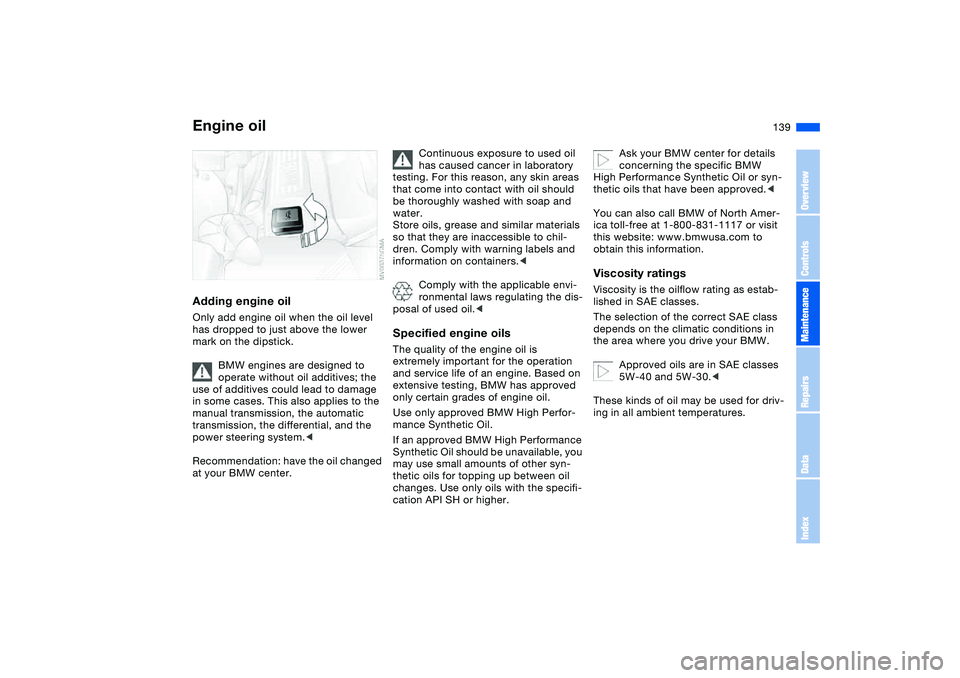
Adding engine oilOnly add engine oil when the oil level
has dropped to just above the lower
mark on the dipstick.
BMW engines are designed to
operate without oil additives; the
use of additives could lead to damage
in some cases. This also applies to the
manual transmission, the automatic
transmission, the differential, and the
power steering system.<
Recommendation: have the oil changed
at your BMW center.
Continuous exposure to used oil
has caused cancer in laboratory
testing. For this reason, any skin areas
that come into contact with oil should
be thoroughly washed with soap and
water.
Store oils, grease and similar materials
so that they are inaccessible to chil-
dren. Comply with warning labels and
information on containers.<
Comply with the applicable envi-
ronmental laws regulating the dis-
posal of used oil.<
Specified engine oilsThe quality of the engine oil is
extremely important for the operation
and service life of an engine. Based on
extensive testing, BMW has approved
only certain grades of engine oil.
Use only approved BMW High Perfor-
mance Synthetic Oil.
If an approved BMW High Performance
Synthetic Oil should be unavailable, you
may use small amounts of other syn-
thetic oils for topping up between oil
changes. Use only oils with the specifi-
cation API SH or higher.
Ask your BMW center for details
concerning the specific BMW
High Performance Synthetic Oil or syn-
thetic oils that have been approved.<
You can also call BMW of North Amer-
ica toll-free at 1-800-831-1117 or visit
this website: www.bmwusa.com to
obtain this information.
Viscosity ratingsViscosity is the oilflow rating as estab-
lished in SAE classes.
The selection of the correct SAE class
depends on the climatic conditions in
the area where you drive your BMW.
Approved oils are in SAE classes
5W-40 and 5W-30.<
These kinds of oil may be used for driv-
ing in all ambient temperatures.
Engine oil
OverviewControlsMaintenanceRepairsDataIndex
Page 141 of 186
141
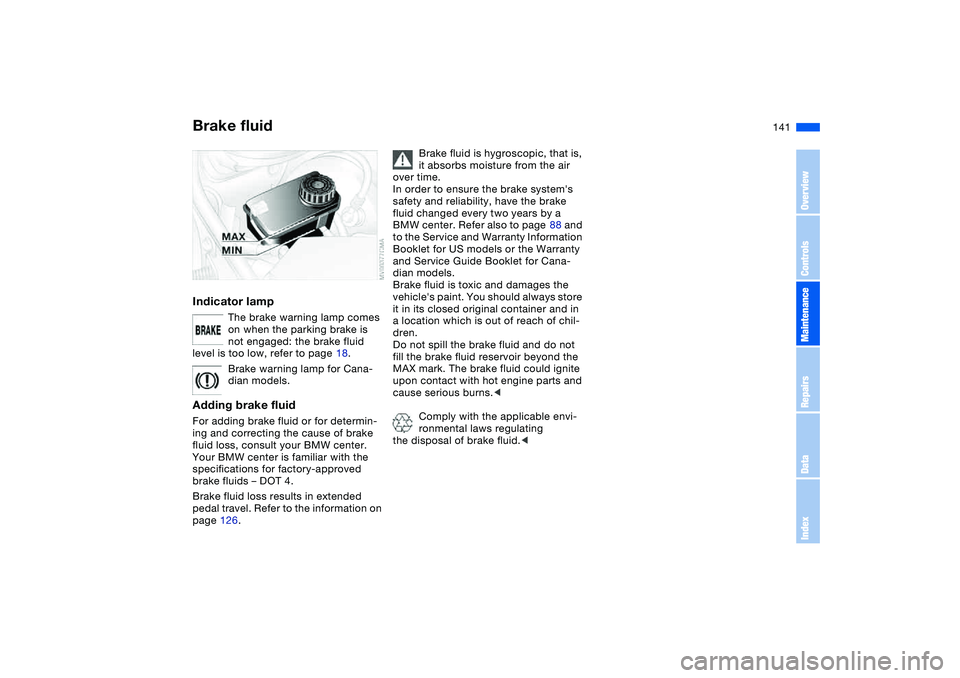
Brake fluidIndicator lamp
The brake warning lamp comes
on when the parking brake is
not engaged: the brake fluid
level is too low, refer to page 18.
Brake warning lamp for Cana-
dian models.
Adding brake fluidFor adding brake fluid or for determin-
ing and correcting the cause of brake
fluid loss, consult your BMW center.
Your BMW center is familiar with the
specifications for factory-approved
brake fluids – DOT 4.
Brake fluid loss results in extended
pedal travel. Refer to the information on
page 126.
Brake fluid is hygroscopic, that is,
it absorbs moisture from the air
over time.
In order to ensure the brake system's
safety and reliability, have the brake
fluid changed every two years by a
BMW center. Refer also to page 88 and
to the Service and Warranty Information
Booklet for US models or the Warranty
and Service Guide Booklet for Cana-
dian models.
Brake fluid is toxic and damages the
vehicle's paint. You should always store
it in its closed original container and in
a location which is out of reach of chil-
dren.
Do not spill the brake fluid and do not
fill the brake fluid reservoir beyond the
MAX mark. The brake fluid could ignite
upon contact with hot engine parts and
cause serious burns.<
Comply with the applicable envi-
ronmental laws regulating
the disposal of brake fluid.<
OverviewControlsMaintenanceRepairsDataIndex
Page 143 of 186
143 Laws and regulations
California Proposition 65 warningCalifornia laws require us to state the
following warning:
Engine exhaust and a wide variety
of automobile components and
parts, including components found in
the interior furnishings in a vehicle, con-
tain or emit chemicals known to the
State of California to cause cancer and
birth defects and reproductive harm. In
addition, certain fluids contained in
vehicles and certain products of com-
ponent wear contain or emit chemicals
known to the State of California to
cause cancer and birth defects or other
reproductive harm.
Battery posts, terminals and related
accessories contain lead and lead com-
pounds. Wash your hands after hand-
ling.
Used engine oil contains chemicals that
have caused cancer in laboratory ani-
mals. Always protect your skin by
washing thoroughly with soap and
water.<
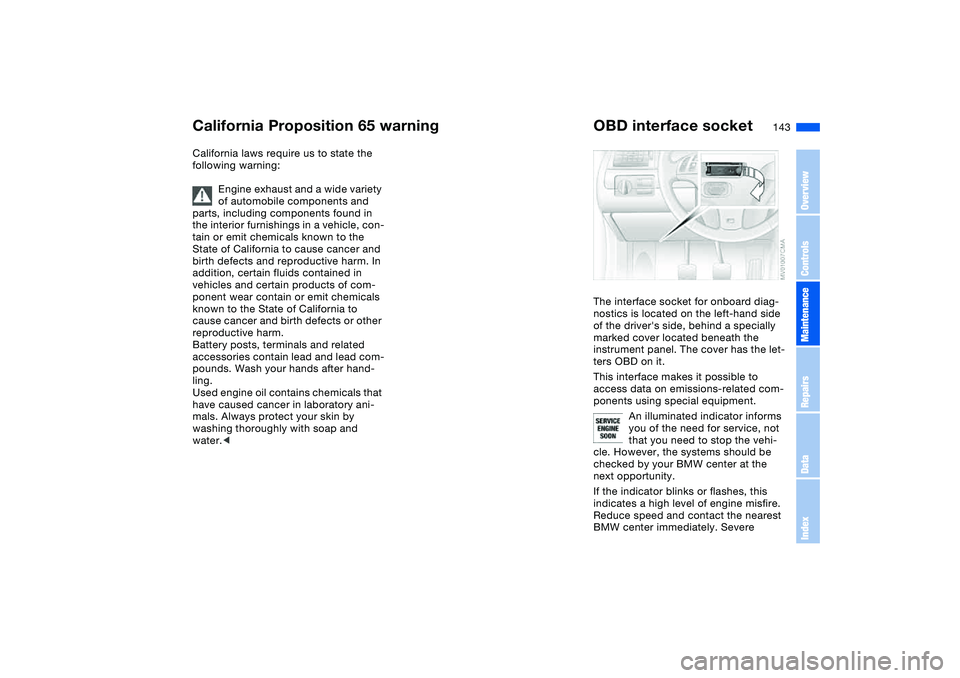
OBD interface socketThe interface socket for onboard diag-
nostics is located on the left-hand side
of the driver's side, behind a specially
marked cover located beneath the
instrument panel. The cover has the let-
ters OBD on it.
This interface makes it possible to
access data on emissions-related com-
ponents using special equipment.
An illuminated indicator informs
you of the need for service, not
that you need to stop the vehi-
cle. However, the systems should be
checked by your BMW center at the
next opportunity.
If the indicator blinks or flashes, this
indicates a high level of engine misfire.
Reduce speed and contact the nearest
BMW center immediately. Severe
OverviewControlsMaintenanceRepairsDataIndex
Page 153 of 186
153
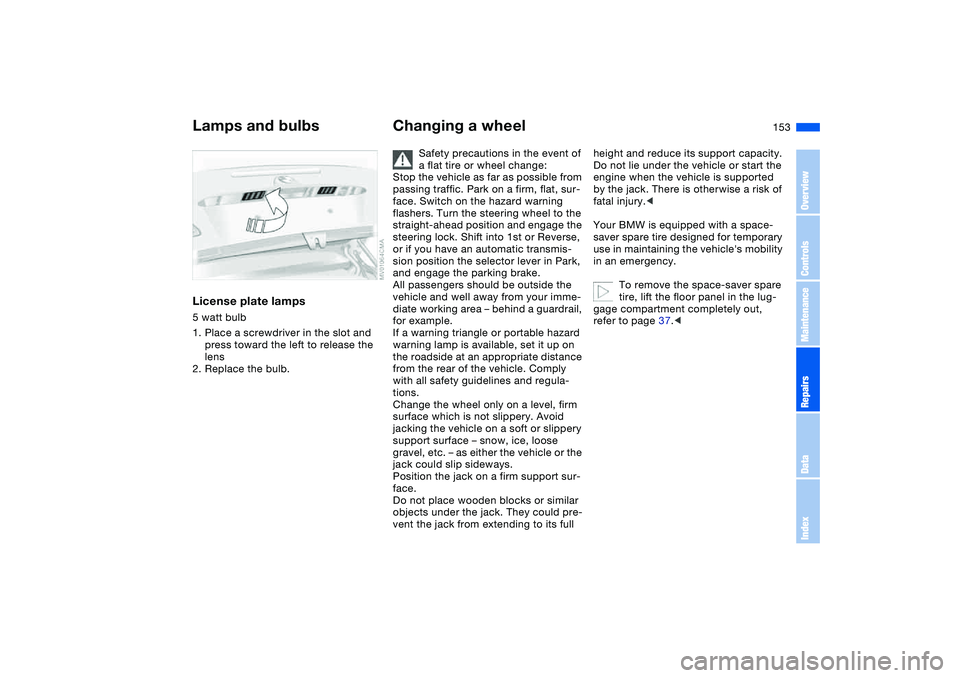
License plate lamps5 watt bulb
1. Place a screwdriver in the slot and
press toward the left to release the
lens
2. Replace the bulb.
Changing a wheel
Safety precautions in the event of
a flat tire or wheel change:
Stop the vehicle as far as possible from
passing traffic. Park on a firm, flat, sur-
face. Switch on the hazard warning
flashers. Turn the steering wheel to the
straight-ahead position and engage the
steering lock. Shift into 1st or Reverse,
or if you have an automatic transmis-
sion position the selector lever in Park,
and engage the parking brake.
All passengers should be outside the
vehicle and well away from your imme-
diate working area – behind a guardrail,
for example.
If a warning triangle or portable hazard
warning lamp is available, set it up on
the roadside at an appropriate distance
from the rear of the vehicle. Comply
with all safety guidelines and regula-
tions.
Change the wheel only on a level, firm
surface which is not slippery. Avoid
jacking the vehicle on a soft or slippery
support surface – snow, ice, loose
gravel, etc. – as either the vehicle or the
jack could slip sideways.
Position the jack on a firm support sur-
face.
Do not place wooden blocks or similar
objects under the jack. They could pre-
vent the jack from extending to its full
height and reduce its support capacity.
Do not lie under the vehicle or start the
engine when the vehicle is supported
by the jack. There is otherwise a risk of
fatal injury.<
Your BMW is equipped with a space-
saver spare tire designed for temporary
use in maintaining the vehicle's mobility
in an emergency.
To remove the space-saver spare
tire, lift the floor panel in the lug-
gage compartment completely out,
refer to page 37.<
Lamps and bulbs
OverviewControlsMaintenanceRepairsDataIndex
Page 172 of 186
Everything from A to ZA
ABS Antilock Brake
System 125
indicator lamp 19
Acceleration assistant 78
Accessories, refer to For
your own safety 5
Accident, refer to Emer-
gency call 158
Activated-charcoal filter 110
Adaptive headlights 98
Adding brake fluid 141
Additional sources of infor-
mation 4
Air conditioning 102
Air conditioning mode 104
automatic climate
control 108
Air distribution
air conditioning 104
automatic climate
control 108
Air distribution,
individual 108
Air outlets, refer to Ventila-
tion 102, 106
Air pressure, refer to Tire
inflation pressure 25, 129
Air recirculation, refer to
Recirculated-air mode
104, 109Air supply
air conditioning 104
automatic climate
control 108
Air, drying, refer to Air con-
ditioning mode 104, 108
Airbags 61
deactivating 64
indicator lamp 18, 63
sitting safely 52
Airing out, refer to Ventila-
tion 102, 106
AKI, refer to Fuel specifica-
tions 25
Alarm system 38
avoiding unintentional
alarms 39
All-season tires, refer to
Winter tires 132
Antifreeze 140
coolant 140
washer fluid 138
Antilock Brake System
(ABS) 125
indicator lamp 19
Anti-theft system 30
Anti-theft warning system,
refer to Alarm system 38
Approved axle loads, refer
to Weights 168
Approved gross weight,
refer to Weights 168Armrest 114
Artificial leather, refer to the
Caring for your vehicle
brochure
Ashtray
front 115
rear 116
Assistant systems, refer to
Dynamic Stability Control
(DSC) 93
AUC Automatic recircu-
lated-air control 109
AUTO program, refer to
Automatic air
distribution 108
Automatic
air distribution 108
air supply 108
cruise control 84
headlamp control 97
Automatic car wash, refer to
the Caring for your vehicle
brochure
Automatic climate
control 106
Automatic curb monitor 58
Automatic dimming, interior
rearview mirror 60
Automatic recirculated-air
control (AUC) 109Automatic transmission with
Steptronic 79
indicator lamp 19, 81
interlock 71
selector lever lock 79
shiftlock 79
Automatic windshield
washer, refer to Rain sen-
sor 83
Average fuel
consumption 91
Average speed 91
Avoiding unintentional
alarms 39
Axle loads, refer to
Weights 168
B
Backrest
unlock 55
Backrest, refer to Seat
adjustment 53
Backup lamps 74
bulb replacement 151
Bandages, refer to First-aid
kit 23
Bar, towing 161
Page 173 of 186
Everything from A to Z
173
Battery 157
charge 157
disposal 157
indicator lamp 18
jump-starting 159
remote control 30, 31
Battery charge current 18
Belts, refer to Safety
belts 56
Beverage holders 115
Blower
air conditioning 104
automatic climate
control 108
BMW High Performance
Synthetic Oils 139
BMW Maintenance
System 142
BMW sports seat 53
Bore, refer to Engine
data 166
Bottle holders, see Bever-
age holders 115
Brake fluid 141
indicator lamp 18, 141
level 141
Brake force display 96
Brake hydraulic system 126
Brake lamps
bulb replacement 151
indicator lamp, defective
lamp 88Brake lights
brake force display 96
Brake pads 126
brake fluid level
18, 126, 141
breaking in 124
disc brakes 126
indicator lamp 19
Brake rotors
brake system 126
breaking in 124
Brake wear warning
indicator lamp 19
Brakes
ABS 125
brake fluid 141
breaking in 124
indicator/warning lamp
18, 19
parking brake 73
Break-in procedures 124
Bulb replacement, refer to
Lamps and bulbs 149
Bulb, replacing 149
Buttons in steering wheel 22
C
California Proposition
65 warning 143
Can holders, see Beverage
holders 115
Capacities 169Car battery 157
Car care, refer to the Caring
for your vehicle brochure
Car keys, refer to Keys 30
Car radio, refer to the
Owner's Manual for Radio
Car telephone
preparation 115
Car telephone, refer to the
separate Owner's Manual
Car vacuum cleaner, con-
necting 116
Car wash, refer to the Caring
for your vehicle brochure
Carpet care, refer to the
Caring for your vehicle
brochure
Cassette operation, refer to
the Owner's Manual for
Radio/Onboard Computer
CBC Cornering Brake Con-
trol 125
warning lamp 19
CD changer, refer to the
Owner's Manual for
Radio/Onboard Computer
CD operation, refer to the
Owner's Manual for
Radio/Onboard Computer
Cellular phone 115
Center armrest
front 114Center high-mount brake
lamp
bulb replacement 152
Central locking system 30
button 34
passenger
compartment 34
Changing a wheel 153
Charge indicator lamp 18
Check Control 88
Check Gas Cap
indicator lamp 19
Child seats, refer to Child-
restraint systems 64
Child-restraint mounting
system (LATCH) 66
Child-restraint system 64
Chock 154
Cigarette lighter 115
Cigarette lighter socket 116
Cleaning chrome parts, refer
to the Caring for your vehi-
cle brochure
Cleaning light alloy wheels,
refer to the Caring for your
vehicle brochure
Cleaning position, convert-
ible top 45, 50
Cleaning the vehicle, refer to
the Caring for your vehicle
brochure
Cleaning windshield 84
OverviewControlsMaintenanceRepairsDataIndex
Page 174 of 186
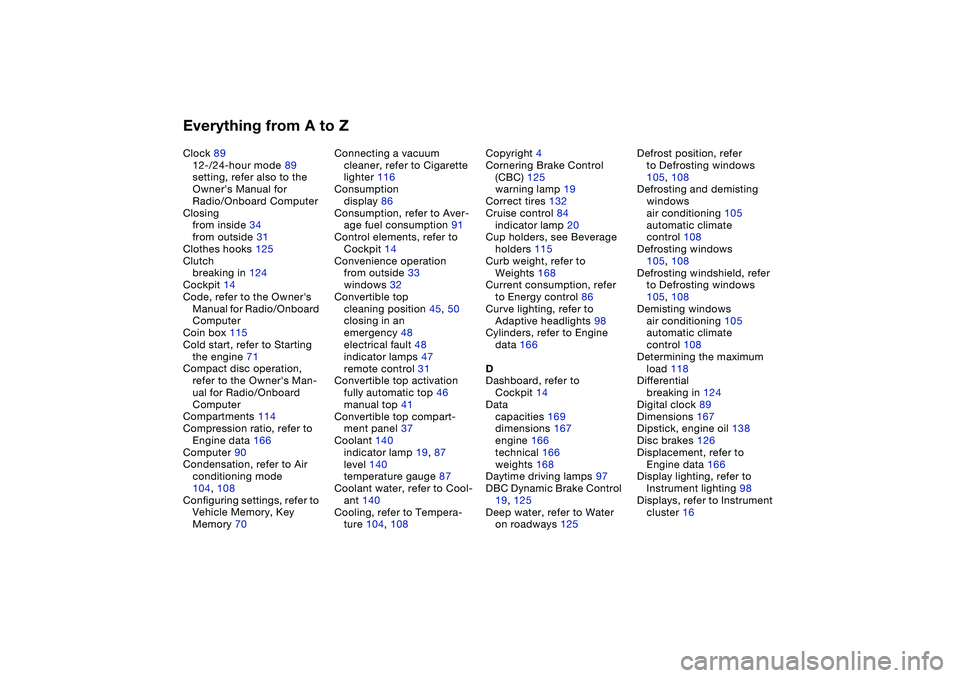
Everything from A to ZClock 89
12-/24-hour mode 89
setting, refer also to the
Owner's Manual for
Radio/Onboard Computer
Closing
from inside 34
from outside 31
Clothes hooks 125
Clutch
breaking in 124
Cockpit 14
Code, refer to the Owner's
Manual for Radio/Onboard
Computer
Coin box 115
Cold start, refer to Starting
the engine 71
Compact disc operation,
refer to the Owner's Man-
ual for Radio/Onboard
Computer
Compartments 114
Compression ratio, refer to
Engine data 166
Computer 90
Condensation, refer to Air
conditioning mode
104, 108
Configuring settings, refer to
Vehicle Memory, Key
Memory 70Connecting a vacuum
cleaner, refer to Cigarette
lighter 116
Consumption
display 86
Consumption, refer to Aver-
age fuel consumption 91
Control elements, refer to
Cockpit 14
Convenience operation
from outside 33
windows 32
Convertible top
cleaning position 45, 50
closing in an
emergency 48
electrical fault 48
indicator lamps 47
remote control 31
Convertible top activation
fully automatic top 46
manual top 41
Convertible top compart-
ment panel 37
Coolant 140
indicator lamp 19, 87
level 140
temperature gauge 87
Coolant water, refer to Cool-
ant 140
Cooling, refer to Tempera-
ture 104, 108Copyright 4
Cornering Brake Control
(CBC) 125
warning lamp 19
Correct tires 132
Cruise control 84
indicator lamp 20
Cup holders, see Beverage
holders 115
Curb weight, refer to
Weights 168
Current consumption, refer
to Energy control 86
Curve lighting, refer to
Adaptive headlights 98
Cylinders, refer to Engine
data 166
D
Dashboard, refer to
Cockpit 14
Data
capacities 169
dimensions 167
engine 166
technical 166
weights 168
Daytime driving lamps 97
DBC Dynamic Brake Control
19, 125
Deep water, refer to Water
on roadways 125Defrost position, refer
to Defrosting windows
105, 108
Defrosting and demisting
windows
air conditioning 105
automatic climate
control 108
Defrosting windows
105, 108
Defrosting windshield, refer
to Defrosting windows
105, 108
Demisting windows
air conditioning 105
automatic climate
control 108
Determining the maximum
load 118
Differential
breaking in 124
Digital clock 89
Dimensions 167
Dipstick, engine oil 138
Disc brakes 126
Displacement, refer to
Engine data 166
Display lighting, refer to
Instrument lighting 98
Displays, refer to Instrument
cluster 16
Page 175 of 186
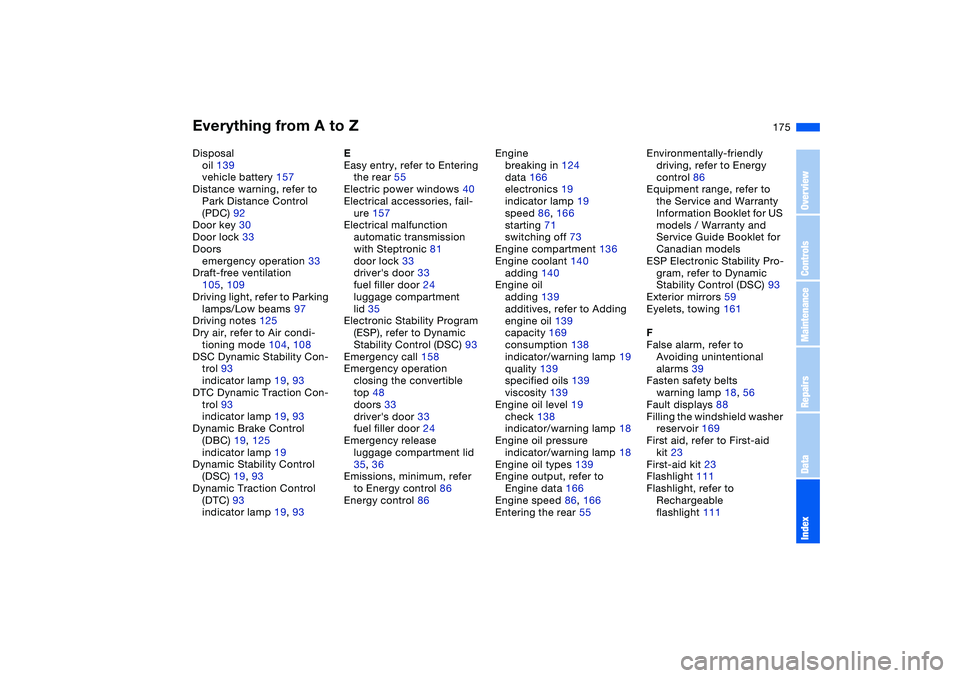
Everything from A to Z
175
Disposal
oil 139
vehicle battery 157
Distance warning, refer to
Park Distance Control
(PDC) 92
Door key 30
Door lock 33
Doors
emergency operation 33
Draft-free ventilation
105, 109
Driving light, refer to Parking
lamps/Low beams 97
Driving notes 125
Dry air, refer to Air condi-
tioning mode 104, 108
DSC Dynamic Stability Con-
trol 93
indicator lamp 19, 93
DTC Dynamic Traction Con-
trol 93
indicator lamp 19, 93
Dynamic Brake Control
(DBC) 19, 125
indicator lamp 19
Dynamic Stability Control
(DSC) 19, 93
Dynamic Traction Control
(DTC) 93
indicator lamp 19, 93E
Easy entry, refer to Entering
the rear 55
Electric power windows 40
Electrical accessories, fail-
ure 157
Electrical malfunction
automatic transmission
with Steptronic 81
door lock 33
driver's door 33
fuel filler door 24
luggage compartment
lid 35
Electronic Stability Program
(ESP), refer to Dynamic
Stability Control (DSC) 93
Emergency call 158
Emergency operation
closing the convertible
top 48
doors 33
driver's door 33
fuel filler door 24
Emergency release
luggage compartment lid
35, 36
Emissions, minimum, refer
to Energy control 86
Energy control 86Engine
breaking in 124
data 166
electronics 19
indicator lamp 19
speed 86, 166
starting 71
switching off 73
Engine compartment 136
Engine coolant 140
adding 140
Engine oil
adding 139
additives, refer to Adding
engine oil 139
capacity 169
consumption 138
indicator/warning lamp 19
quality 139
specified oils 139
viscosity 139
Engine oil level 19
check 138
indicator/warning lamp 18
Engine oil pressure
indicator/warning lamp 18
Engine oil types 139
Engine output, refer to
Engine data 166
Engine speed 86, 166
Entering the rear 55Environmentally-friendly
driving, refer to Energy
control 86
Equipment range, refer to
the Service and Warranty
Information Booklet for US
models / Warranty and
Service Guide Booklet for
Canadian models
ESP Electronic Stability Pro-
gram, refer to Dynamic
Stability Control (DSC) 93
Exterior mirrors 59
Eyelets, towing 161
F
False alarm, refer to
Avoiding unintentional
alarms 39
Fasten safety belts
warning lamp 18, 56
Fault displays 88
Filling the windshield washer
reservoir 169
First aid, refer to First-aid
kit 23
First-aid kit 23
Flashlight 111
Flashlight, refer to
Rechargeable
flashlight 111
OverviewControlsMaintenanceRepairsDataIndex