brake fluid BMW 325Ci COUPE 2001 E46 Owner's Manual
[x] Cancel search | Manufacturer: BMW, Model Year: 2001, Model line: 325Ci COUPE, Model: BMW 325Ci COUPE 2001 E46Pages: 203, PDF Size: 2.03 MB
Page 11 of 203

11n
Controls and features
Operation, care and maintenance
Lamps:
Side lamps/Low beams87
Instrument panel lighting87
High beams/Parking lamps88
Fog lamps88
Interior lamps88
Controlling the climate
for pleasant driving:
Air conditioner90
Automatic climate control96
Seat heating101
Roller sun blind101
Interior convenience:
HiFi system101
Glove compartment102
Storage facilities102
Cellular phone104
Ashtray, front104
Cigarette lighter105
Ashtray, rear105
Clothes hooks105
Loading and transporting:
Through-loading system106
Ski bag107
Cargo loading108
Roof-mounted luggage rack109
Special operating instructions:
Break-in procedures112
Driving notes113
Catalytic converter113
Antilock Brake System
(ABS)115
Disc brakes117
Brake system118
Winter operation119
Power steering121
Cellular phones121
Radio reception121
Wheels and tires:
Tire inflation pressure122
Tire condition122
Tire replacement123
Tire rotation124
Wheel and tire
combinations125
Winter tires126
Snow chains126
Approved wheel and tire
specifications127
Under the hood:
Hood130
Engine compartment132
Washer fluids134
Washer nozzles134
Engine oil135
Coolant137
Brake fluid138
Vehicle Identification
Number139
Care and maintenance:
The BMW Maintenance
System140
Caring for your vehicle141
Airbags146
Vehicle storage147
Laws and regulations:
Technical modifications148
California Proposition
65 Warning148
ODB interface socket149
Page 19 of 203

19n
IndexDataTechnologyRepairsCar careControlsOverview
Instrument cluster
1 Fuel gauge with indicator lamp
for fuel reserve76
2 Indicator lamp for turn signal
indicator23
3 Speedometer
4 Indicator lamp for:
>
Battery charge current20
>
High beams23
>
Engine oil pressure/Engine oil
level20, 22
5 Tachometer and Energy control75
6 Engine coolant temperature gauge
with "Coolant temperature too high"
indicator76
7 Indicator and warning lamps
(clockwise) for:
>
Parking brake/Brake hydraulic
system/Cornering Brake Control
(CBC/DBC)20
>
Antilock Brake System (ABS)22 > Brake pads22
>
Tire Pressure Control
(RDC)
*
20, 22
>
Airbags21
>
Please fasten safety belts21
>
Cruise control23
8 Set button for the clock789 Program display for automatic
transmission
*
69
Indicator lamp for automatic
transmission
*
21, 69
10 Indicator lamp for Automatic
Stability Control plus Traction
(ASC+T)/Dynamic Stability Control
(DSC)
*
and ADB22
11 Indicator for:
>
Odometer75
>
Trip odometer75
>
Clock78
>
Service Interval76
Indicator for computer, operation
using the turn signal lever, refer to
page 77:
>
Clock
>
Outside temperature
>
Average fuel consumption
> Range >
Average speed
12 Indicator for Check Control77
13 Trip odometer, reset to zero7514 Indicator and warning lamps
(clockwise) for:
>
Front fog lamps23
>
Add washer fluid22
>
Coolant level23
>
Electronic Throttle Control
(EML)
*
23
>
Service Engine Soon22
You can display the outside
temperature and distance driven
in different units of measurement.
<
Page 20 of 203
20n
Indicator and warning lamps
Technology that monitors itself
Many of the systems of your BMW
monitor themselves automatically, both
during engine starts and while you are
driving. Indicator and warning lamps
that are identified by "
l
" are tested for
proper functioning whenever the igni-
tion key is turned. They each light up
once for different periods of time.
If a fault should occur in one of these
systems, the corresponding lamp does
not go out after the engine is started, or
it lights up while the vehicle is moving.
You will see how to react to this below.
Red: stop immediately
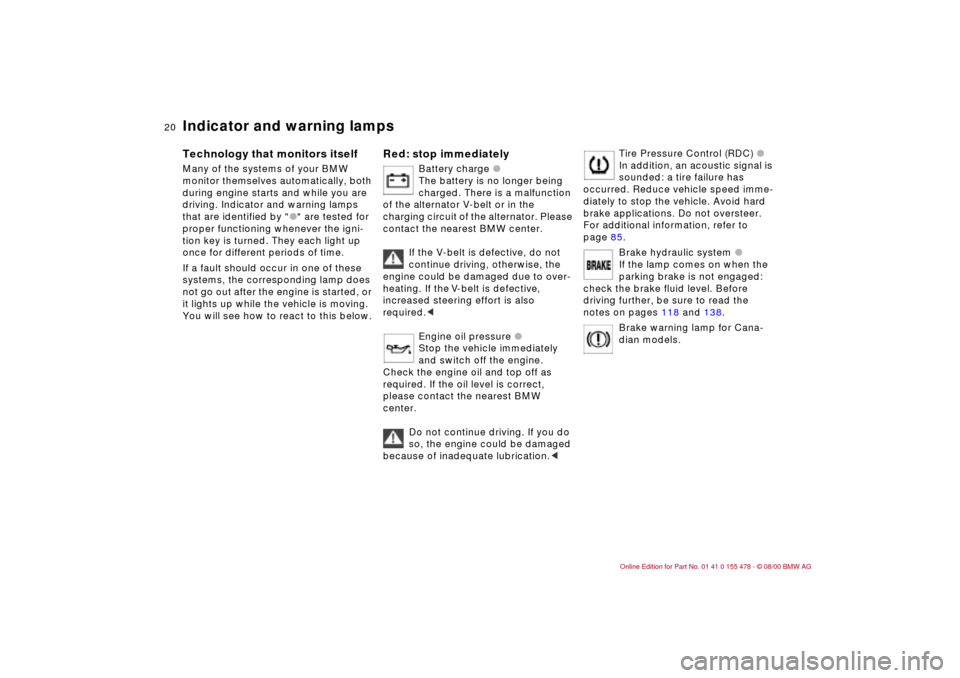
Battery charge
l
The battery is no longer being
charged. There is a malfunction
of the alternator V-belt or in the
charging circuit of the alternator. Please
contact the nearest BMW center.
If the V-belt is defective, do not
continue driving, otherwise, the
engine could be damaged due to over-
heating. If the V-belt is defective,
increased steering effort is also
required.
<
Engine oil pressure
l
Stop the vehicle immediately
and switch off the engine.
Check the engine oil and top off as
required. If the oil level is correct,
please contact the nearest BMW
center.
Do not continue driving. If you do
so, the engine could be damaged
because of inadequate lubrication.
<
Tire Pressure Control (RDC) l
In addition, an acoustic signal is
sounded: a tire failure has
occurred. Reduce vehicle speed imme-
diately to stop the vehicle. Avoid hard
brake applications. Do not oversteer.
For additional information, refer to
page 85.
Brake hydraulic system l
If the lamp comes on when the
parking brake is not engaged:
check the brake fluid level. Before
driving further, be sure to read the
notes on pages 118 and 138.
Brake warning lamp for Cana-
dian models.
Page 22 of 203
22n
Indicator and warning lampsYellow: check as soon as possible
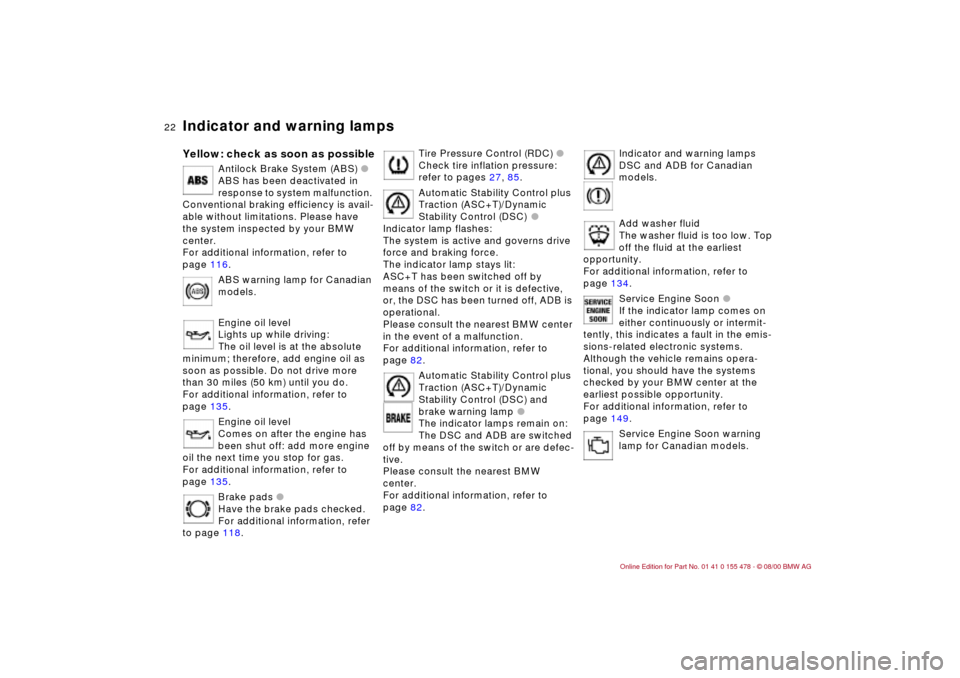
Antilock Brake System (ABS) l
ABS has been deactivated in
response to system malfunction.
Conventional braking efficiency is avail-
able without limitations. Please have
the system inspected by your BMW
center.
For additional information, refer to
page 116.
ABS warning lamp for Canadian
models.
Engine oil level
Lights up while driving:
The oil level is at the absolute
minimum; therefore, add engine oil as
soon as possible. Do not drive more
than 30 miles (50 km) until you do.
For additional information, refer to
page 135.
Engine oil level
Comes on after the engine has
been shut off: add more engine
oil the next time you stop for gas.
For additional information, refer to
page 135.
Brake pads l
Have the brake pads checked.
For additional information, refer
to page 118.
Tire Pressure Control (RDC) l
Check tire inflation pressure:
refer to pages 27, 85.
Automatic Stability Control plus
Traction (ASC+T)/Dynamic
Stability Control (DSC)
l
Indicator lamp flashes:
The system is active and governs drive
force and braking force.
The indicator lamp stays lit:
ASC+T has been switched off by
means of the switch or it is defective,
or, the DSC has been turned off, ADB is
operational.
Please consult the nearest BMW center
in the event of a malfunction.
For additional information, refer to
page 82.
Automatic Stability Control plus
Traction (ASC+T)/Dynamic
Stability Control (DSC) and
brake warning lamp l
The indicator lamps remain on:
The DSC and ADB are switched
off by means of the switch or are defec-
tive.
Please consult the nearest BMW
center.
For additional information, refer to
page 82.
Indicator and warning lamps
DSC and ADB for Canadian
models.
Add washer fluid
The washer fluid is too low. Top
off the fluid at the earliest
opportunity.
For additional information, refer to
page 134.
Service Engine Soon l
If the indicator lamp comes on
either continuously or intermit-
tently, this indicates a fault in the emis-
sions-related electronic systems.
Although the vehicle remains opera-
tional, you should have the systems
checked by your BMW center at the
earliest possible opportunity.
For additional information, refer to
page 149.
Service Engine Soon warning
lamp for Canadian models.
Page 111 of 203
Overview
Controls and features
Operation, care
and maintenance
Owner service procedures
Technical data
Index Advanced technology
111n
IndexDataTechnologyRepairsCar careControlsOverview
Special operating instructions:
Break-in procedures112
Driving notes113
Catalytic converter113
Antilock Brake System
(ABS)115
Disc brakes117
Brake system118
Winter operation119
Power steering121
Cellular phones121
Radio reception121
Wheels and tires:
Tire inflation pressure122
Tire condition122
Tire replacement123
Tire rotation124
Wheel and tire
combinations125
Winter tires126
Snow chains126
Approved wheel and tire
specifications127Under the hood:
Hood130
Engine compartment132
Washer fluids134
Washer nozzles134
Engine oil135
Coolant137
Brake fluid138
Vehicle Identification
Number139
Care and maintenance:
The BMW Maintenance
System140
Caring for your vehicle141
Airbags146
Vehicle storage147
Laws and regulations:
Technical modifications148
California Proposition
65 Warning148
OBD interface socket149
Car care
Page 118 of 203
118n
Brake systemBrake fluid level
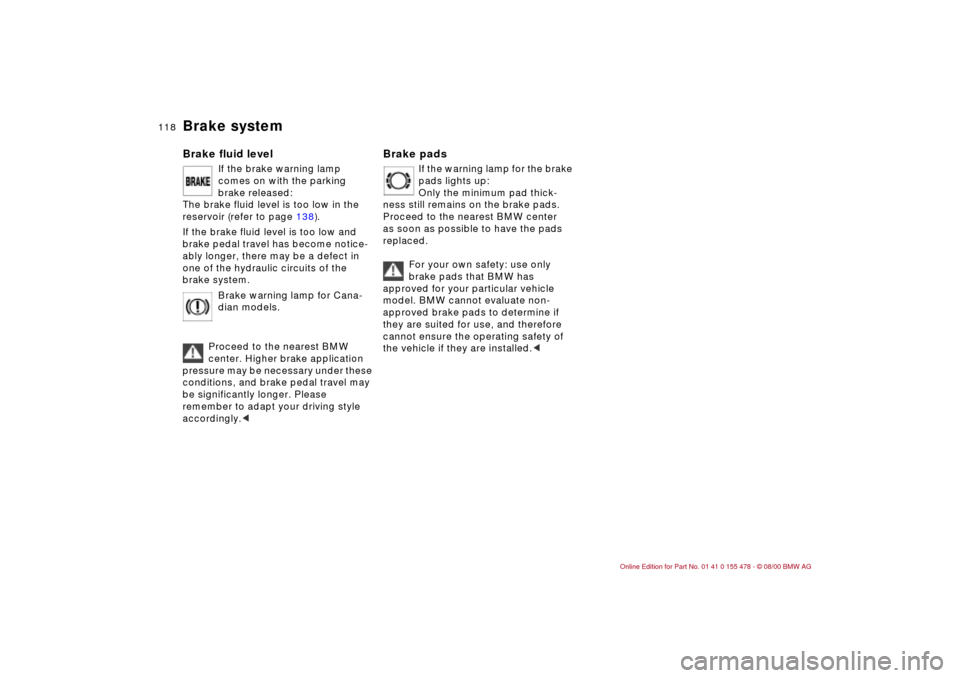
If the brake warning lamp
comes on with the parking
brake released:
The brake fluid level is too low in the
reservoir (refer to page 138).
If the brake fluid level is too low and
brake pedal travel has become notice-
ably longer, there may be a defect in
one of the hydraulic circuits of the
brake system.
Brake warning lamp for Cana-
dian models.
Proceed to the nearest BMW
center. Higher brake application
pressure may be necessary under these
conditions, and brake pedal travel may
be significantly longer. Please
remember to adapt your driving style
accordingly.<
Brake pads
If the warning lamp for the brake
pads lights up:
Only the minimum pad thick-
ness still remains on the brake pads.
Proceed to the nearest BMW center
as soon as possible to have the pads
replaced.
For your own safety: use only
brake pads that BMW has
approved for your particular vehicle
model. BMW cannot evaluate non-
approved brake pads to determine if
they are suited for use, and therefore
cannot ensure the operating safety of
the vehicle if they are installed.<
Page 133 of 203

133n
IndexDataTechnologyRepairsCar careControlsOverview
Engine compartment Ð BMW 325Ci, 330Ci1 Brake fluid reservoir138
2 Dipstick for the engine oil135
3 Coolant expansion tank137
4 Engine oil filler neck135
5 Reservoir for the headlamp
* and
windshield washer system134
6 Auxiliary terminal for jump
starting168
Page 138 of 203
138n
Coolant Brake fluidAdding coolant Wait until the engine cools before
removing the cap from the expansion
tank. The needle of the coolant
temperature gauge in the instrument
cluster must be located in the blue
zone. If it is not, there is a danger of
scalding.
1 Turn the cap slightly counterclock-
wise in order to allow accumulated
pressure to escape. Then open.
2 If the coolant is low, slowly add
coolant until the correct level is
reached Ð do not overfill.
The coolant is a mixture of water and
extended-duty antifreeze with corrosion
inhibitor. Always maintain the pre-
scribed all-season 50:50 mixture ratio
for year-round protection against inter-
nal corrosion. No other additives are
required.
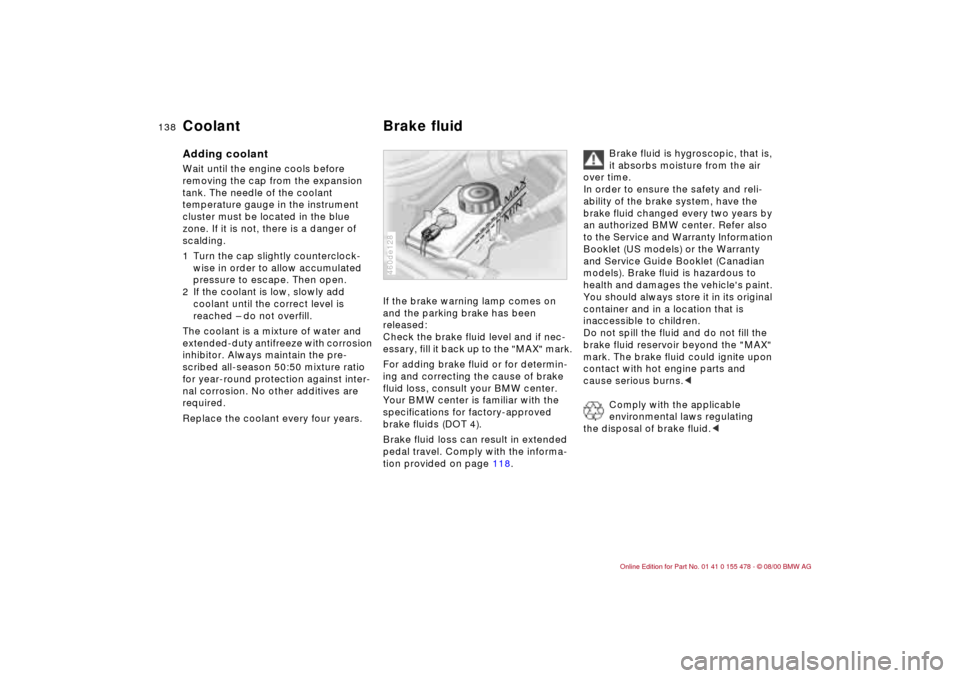
Replace the coolant every four years.If the brake warning lamp comes on
and the parking brake has been
released:
Check the brake fluid level and if nec-
essary, fill it back up to the "MAX" mark.
For adding brake fluid or for determin-
ing and correcting the cause of brake
fluid loss, consult your BMW center.
Your BMW center is familiar with the
specifications for factory-approved
brake fluids (DOT 4).
Brake fluid loss can result in extended
pedal travel. Comply with the informa-
tion provided on page 118.
460de128
Brake fluid is hygroscopic, that is,
it absorbs moisture from the air
over time.
In order to ensure the safety and reli-
ability of the brake system, have the
brake fluid changed every two years by
an authorized BMW center. Refer also
to the Service and Warranty Information
Booklet (US models) or the Warranty
and Service Guide Booklet (Canadian
models). Brake fluid is hazardous to
health and damages the vehicle's paint.
You should always store it in its original
container and in a location that is
inaccessible to children.
Do not spill the fluid and do not fill the
brake fluid reservoir beyond the "MAX"
mark. The brake fluid could ignite upon
contact with hot engine parts and
cause serious burns.<
Comply with the applicable
environmental laws regulating
the disposal of brake fluid.<
Page 143 of 203
143n
IndexDataTechnologyRepairsCar careControlsOverview
Caring for your vehicleCaring for the vehicle's finish Regular washing is a preventive
measure against long-term effects from
substances that are harmful to the
vehicle's finish, especially if you drive
your vehicle in areas with high levels of
air pollution or aggressive natural
substances (tree resins, pollen).
Nevertheless, you should immediately
remove especially aggressive
substances. Failure to do so can
lead to changes in the paint's chemical
structure or to discoloration. Gasoline
spilled during refueling, oil, grease and
brake fluid should always be cleaned
away immediately, as should bird drop-
pings.
Any contamination remaining on the
surface of the vehicle will be especially
conspicuous after washing. Use
cleaning fluid or alcohol with a clean
cloth or cotton pad to remove. Remove
tar spots with tar remover. After
cleaning, the affected areas should be
waxed to ensure continued protection.
Use the cleaning and car-care
products available at your BMW
center.<
Waxing your vehicle Protect the finish using carnauba or
synthetic-based waxes only.
The best way to determine when the
finish needs to be waxed is by noting
when water stops beading on the
surface.
You can use a glass cleaner to remove
any wax or silicone that may have been
left on the windows during waxing.
Use the cleaning and car-care
products available at your BMW
center.<
Paint damageYou can touch up small areas of paint
damage with a BMW spray paint or a
BMW touchup stick.
The paint color code for your vehicle
is provided on a sticker located on the
right hand-side under the hood and on
the first page of your Service and
Warranty Information Booklet (US
models) or Warranty and Service Guide
Booklet (Canadian models).
Damage caused by flying stones,
scratches, etc., must be touched up
without delay to prevent rust from
forming.
If corrosion has started to form in an
area with paint damage, remove all rust
and clean the area. Then prime the area
with a BMW Primer Stick. Finally, apply
the finish coat. Wait a few days, then
polish the repaired area. Finish by
applying a wax preservative.
More extensive paint damage should
be repaired professionally in accor-
dance with the manufacturer's instruc-
tions. Your BMW center uses original
BMW finish materials in accordance
with approved repair procedures.
Page 165 of 203
165n
IndexDataTechnologyRepairsCar careControlsOverview
BatteryCharging the battery Charge the battery in the vehicle only
when the engine is not running.
Before doing any work on the
electrical system, be sure to
unclamp the cable from the battery's
negative terminal. Failure to do so can
result in short circuits, a fire or personal
injury.<
If you plan to park the vehicle for longer
than 4 weeks, disconnect the battery
from the vehicle electrical system by
disconnecting the cable at the negative
terminal. Have the battery recharged
with an appropriate battery charger.
If the vehicle is parked for more than
12 weeks, remove the battery, recharge
it and store it in a cool yet frost- and
dust-free area. During storage, have the
battery recharged every 3 months.
Also, recharge the battery before it is
reinstalled. If this is not done, the
battery will not be serviceable. Every
time the battery is discharged, espe-
cially over extended periods, its service
life is reduced.
Return used batteries to a recy-
cling center or your BMW center.
Maintain the battery in an upright posi-
tion for transport and storage. Secure
the battery to prevent it from tilting
during transport.<
Storage periods during which the
battery is disconnected are not
taken into consideration by the Service
Interval Display for changing the brake
fluid.
For this reason, be sure that the brake
fluid is changed every two years,
regardless of the information displayed.
Please read the pertinent information
on page 138.<