tow BMW 325Ci COUPE 2002 E46 User Guide
[x] Cancel search | Manufacturer: BMW, Model Year: 2002, Model line: 325Ci COUPE, Model: BMW 325Ci COUPE 2002 E46Pages: 147, PDF Size: 2.2 MB
Page 98 of 147

98n
To ensure that your vehicle provides
maximum economy throughout a long
service life, we request that you comply
with the following information.
Engine and differentialUp to 1,200 miles (2,000 km):
Constantly vary both engine and vehicle
speed, remembering not to exceed
4,500 rpm or 100 mph (160 km/h)
during this period.
Always obey all official speed limits.
Do not use full throttle, and avoid
pressing the accelerator beyond the
kickdown point during these initial
miles.
You can then proceed to increase both
engine and vehicle speed once the
initial 1,200 miles (2,000 km) have
elapsed.
You should also observe the same
break-in procedures if the engine or
differential is replaced later in the
course of the vehicle's life.
TiresDue to technical factors associated
with their manufacture, tires do not
achieve their full traction potential until
after an initial break-in period. We thus
ask you to drive with extra care during
the first 200 miles (300 km).
Always obey all official speed limits.
When the vehicle is operated on
wet or slushy roads, a wedge of
water may form between the tire and
the road surface. This phenomenon is
referred to as aquaplaning, or hydro-
planing, and can lead to partial or
complete loss of traction, vehicle
control and braking effectiveness.
Reduce your speed on wet roads.
rotors achieve the optimal pad-surface
and wear patterns required for trouble-
free operation and an extended service
life later on.
To break-in the separate parking brake
drums, apply the parking brake lightly
when coasting to a standstill (at a traffic
signal, for instance), provided that
traffic conditions allow you to do so.
To avoid corrosion, repeat this proce-
dure from time to time.
The brake lamps do not come on
when the parking brake is set.
Vacuum for the brake system servo unit
on your BMW is available only when the
engine is running. When you move the
vehicle with the engine off Ð when
towing, for example Ð substantially
higher levels of pedal force will be
required to brake the vehicle.
operate at optimum efficiency.
Remember to engage the clutch care-
fully during this initial period.
Break-in procedures
Page 101 of 147
101n
OverviewControlsMaintenanceRepairsDataIndex
Information for your safetyThe factory-approved radial tires are
matched to the vehicle and have been
selected to provide optimum safety and
driving comfort.
It is not merely the tire's service life, but
also driving comfort and Ð above all else
Ð driving safety that depend on the
condition of the tires and the mainte-
nance of the specified tire inflation
pressure.
Incorrect tire inflation pressure is
a frequent cause of tire damage. It
also significantly influences the road-
holding ability of your BMW.
Be sure to check the tire inflation pres-
sure, including the space-saver spare
tire or the spare tire, on a regular basis,
at least twice a month and before every
extended journey, refer to page 24. If
this is not done, incorrect tire pressures
can cause driving instability and tire
damage, ultimately resulting in acci-
dents.<
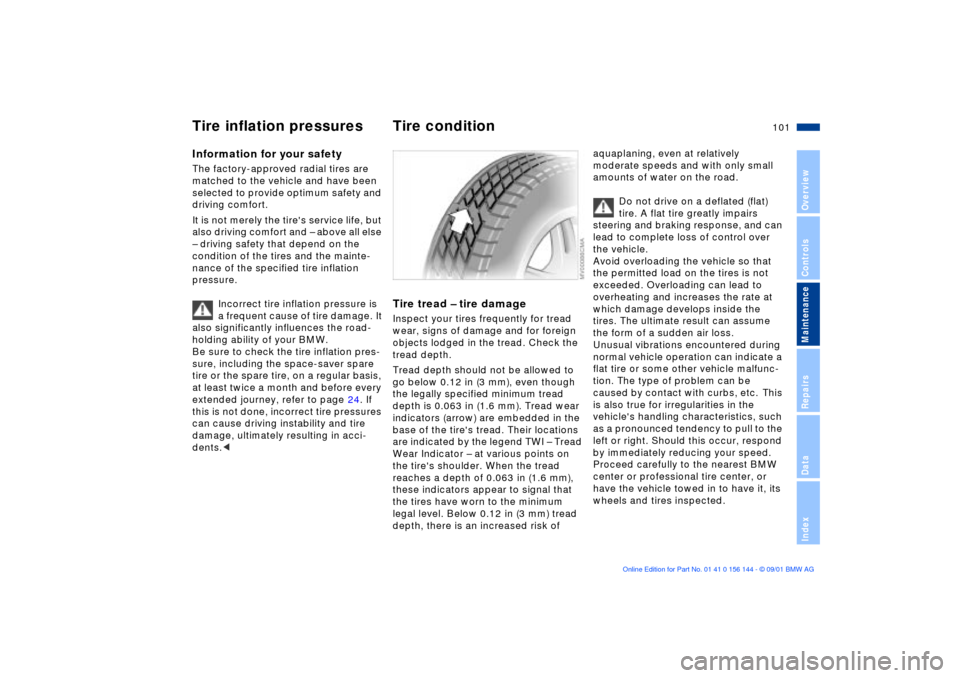
Tire tread Ð tire damageInspect your tires frequently for tread
wear, signs of damage and for foreign
objects lodged in the tread. Check the
tread depth.
Tread depth should not be allowed to
go below 0.12 in (3 mm), even though
the legally specified minimum tread
depth is 0.063 in (1.6 mm). Tread wear
indicators (arrow) are embedded in the
base of the tire's tread. Their locations
are indicated by the legend TWI Ð Tread
Wear Indicator Ð at various points on
the tire's shoulder. When the tread
reaches a depth of 0.063 in (1.6 mm),
these indicators appear to signal that
the tires have worn to the minimum
legal level. Below 0.12 in (3 mm) tread
depth, there is an increased risk of
aquaplaning, even at relatively
moderate speeds and with only small
amounts of water on the road.
Do not drive on a deflated (flat)
tire. A flat tire greatly impairs
steering and braking response, and can
lead to complete loss of control over
the vehicle.
Avoid overloading the vehicle so that
the permitted load on the tires is not
exceeded. Overloading can lead to
overheating and increases the rate at
which damage develops inside the
tires. The ultimate result can assume
the form of a sudden air loss.
Unusual vibrations encountered during
normal vehicle operation can indicate a
flat tire or some other vehicle malfunc-
tion. The type of problem can be
caused by contact with curbs, etc. This
is also true for irregularities in the
vehicle's handling characteristics, such
as a pronounced tendency to pull to the
left or right. Should this occur, respond
by immediately reducing your speed.
Proceed carefully to the nearest BMW
center or professional tire center, or
have the vehicle towed in to have it, its
wheels and tires inspected.
Tire inflation pressures
Tire condition
Page 109 of 147
109n
OverviewControlsMaintenanceRepairsDataIndex
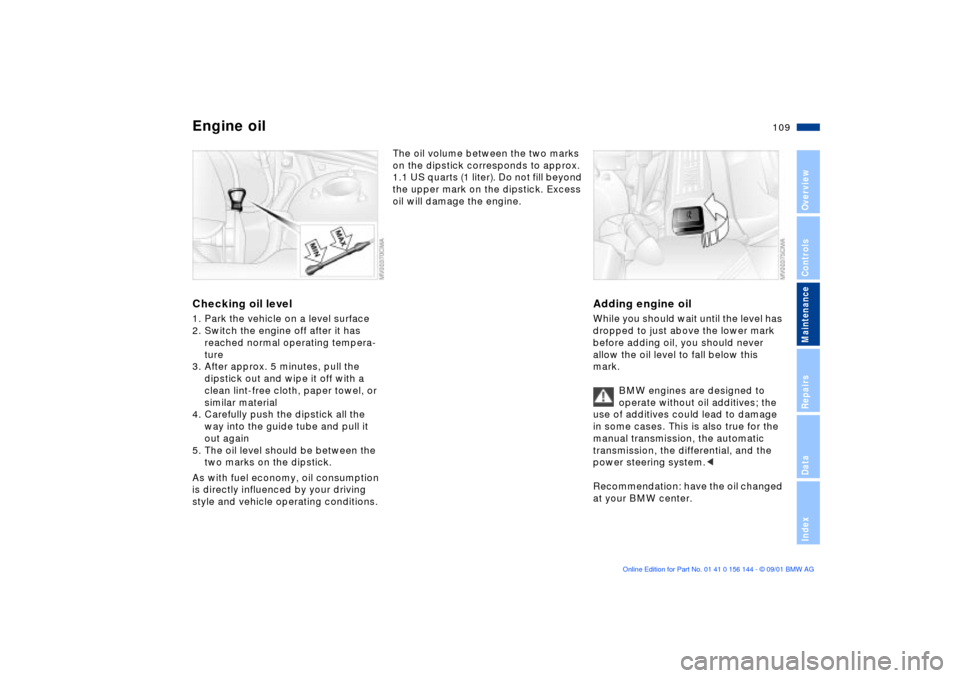
Engine oilChecking oil level1. Park the vehicle on a level surface
2. Switch the engine off after it has
reached normal operating tempera-
ture
3. After approx. 5 minutes, pull the
dipstick out and wipe it off with a
clean lint-free cloth, paper towel, or
similar material
4. Carefully push the dipstick all the
way into the guide tube and pull it
out again
5. The oil level should be between the
two marks on the dipstick.
As with fuel economy, oil consumption
is directly influenced by your driving
style and vehicle operating conditions.
The oil volume between the two marks
on the dipstick corresponds to approx.
1.1 US quarts (1 liter). Do not fill beyond
the upper mark on the dipstick. Excess
oil will damage the engine.
Adding engine oilWhile you should wait until the level has
dropped to just above the lower mark
before adding oil, you should never
allow the oil level to fall below this
mark.
BMW engines are designed to
operate without oil additives; the
use of additives could lead to damage
in some cases. This is also true for the
manual transmission, the automatic
transmission, the differential, and the
power steering system.<
Recommendation: have the oil changed
at your BMW center.
Page 118 of 147
118n
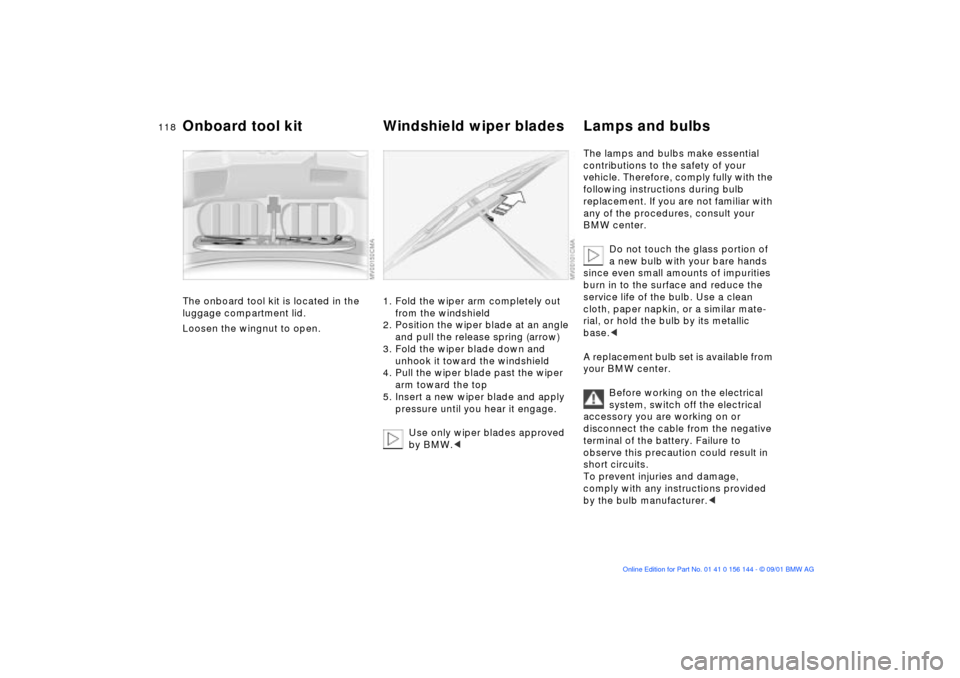
The onboard tool kit is located in the
luggage compartment lid.
Loosen the wingnut to open.
1. Fold the wiper arm completely out
from the windshield
2. Position the wiper blade at an angle
and pull the release spring (arrow)
3. Fold the wiper blade down and
unhook it toward the windshield
4. Pull the wiper blade past the wiper
arm toward the top
5. Insert a new wiper blade and apply
pressure until you hear it engage.
Use only wiper blades approved
by BMW.<
The lamps and bulbs make essential
contributions to the safety of your
vehicle. Therefore, comply fully with the
following instructions during bulb
replacement. If you are not familiar with
any of the procedures, consult your
BMW center.
Do not touch the glass portion of
a new bulb with your bare hands
since even small amounts of impurities
burn in to the surface and reduce the
service life of the bulb. Use a clean
cloth, paper napkin, or a similar mate-
rial, or hold the bulb by its metallic
base.<
A replacement bulb set is available from
your BMW center.
Before working on the electrical
system, switch off the electrical
accessory you are working on or
disconnect the cable from the negative
terminal of the battery. Failure to
observe this precaution could result in
short circuits.
To prevent injuries and damage,
comply with any instructions provided
by the bulb manufacturer.<
Onboard tool kit Windshield wiper blades Lamps and bulbs
Page 120 of 147
120n
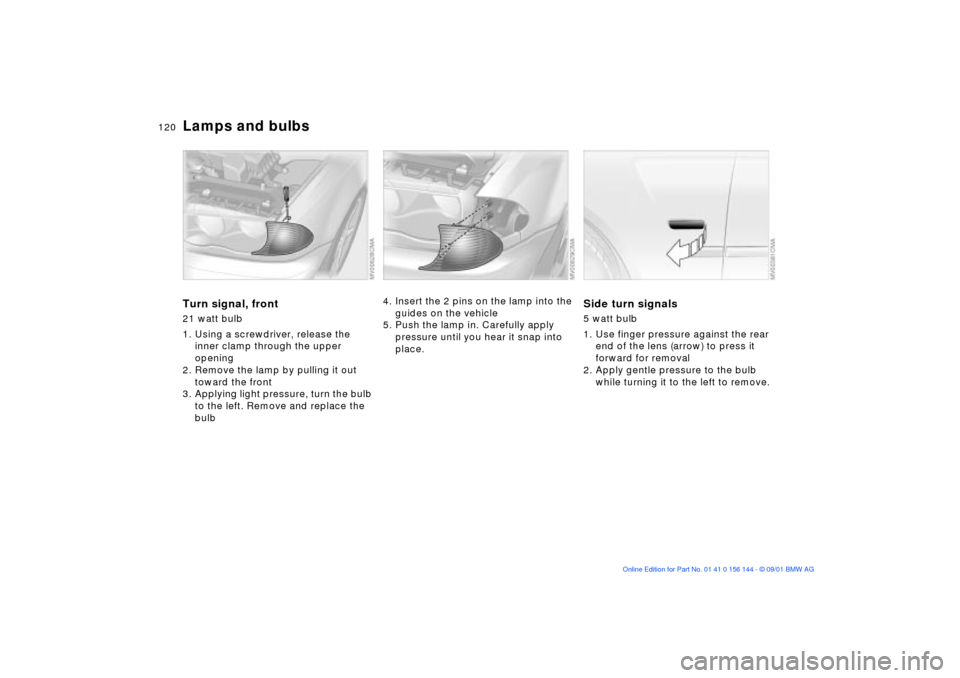
Lamps and bulbsTurn signal, front21 watt bulb
1. Using a screwdriver, release the
inner clamp through the upper
opening
2. Remove the lamp by pulling it out
toward the front
3. Applying light pressure, turn the bulb
to the left. Remove and replace the
bulb
4. Insert the 2 pins on the lamp into the
guides on the vehicle
5. Push the lamp in. Carefully apply
pressure until you hear it snap into
place.
Side turn signals5 watt bulb
1. Use finger pressure against the rear
end of the lens (arrow) to press it
forward for removal
2. Apply gentle pressure to the bulb
while turning it to the left to remove.
Page 122 of 147
122n
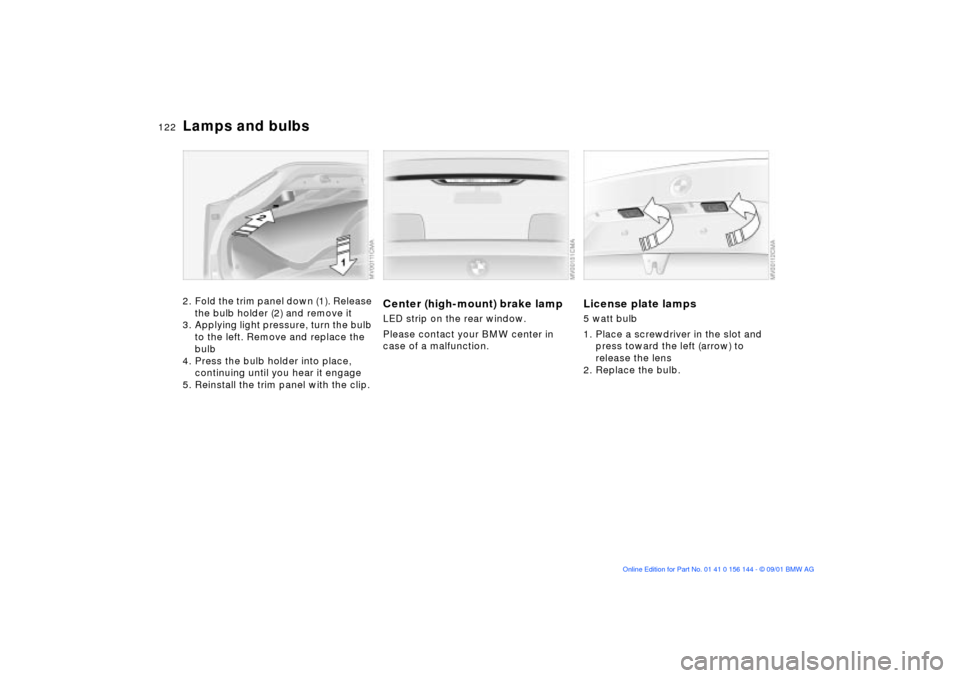
Lamps and bulbs2. Fold the trim panel down (1). Release
the bulb holder (2) and remove it
3. Applying light pressure, turn the bulb
to the left. Remove and replace the
bulb
4. Press the bulb holder into place,
continuing until you hear it engage
5. Reinstall the trim panel with the clip.
Center (high-mount) brake lampLED strip on the rear window.
Please contact your BMW center in
case of a malfunction.
License plate lamps5 watt bulb
1. Place a screwdriver in the slot and
press toward the left (arrow) to
release the lens
2. Replace the bulb.
Page 129 of 147
129n
OverviewControlsMaintenanceRepairsDataIndex
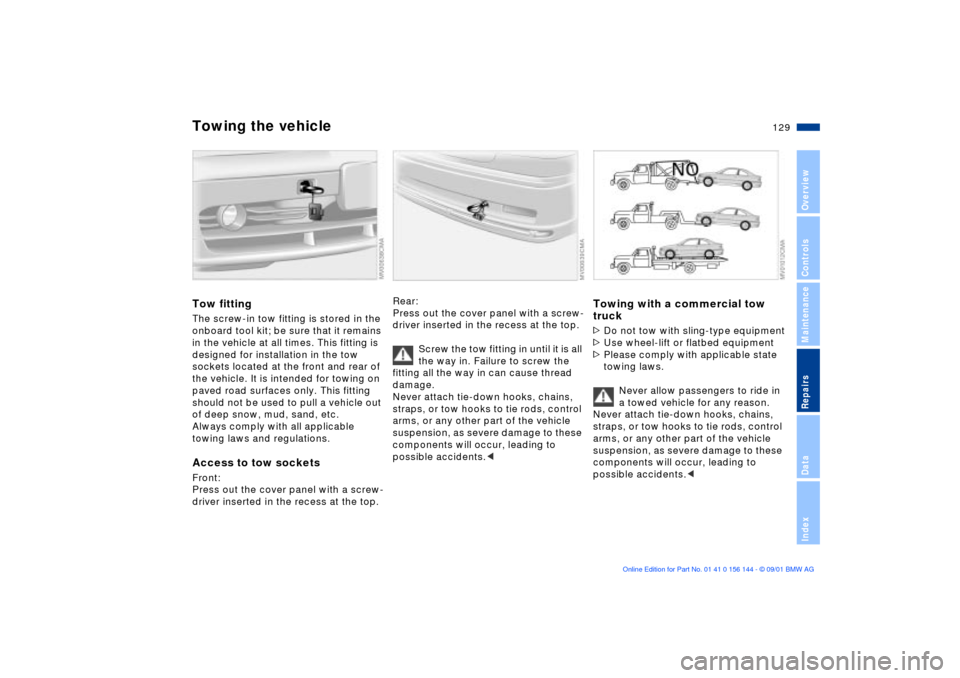
Towing the vehicleTow fittingThe screw-in tow fitting is stored in the
onboard tool kit; be sure that it remains
in the vehicle at all times. This fitting is
designed for installation in the tow
sockets located at the front and rear of
the vehicle. It is intended for towing on
paved road surfaces only. This fitting
should not be used to pull a vehicle out
of deep snow, mud, sand, etc.
Always comply with all applicable
towing laws and regulations.Access to tow socketsFront:
Press out the cover panel with a screw-
driver inserted in the recess at the top.
Rear:
Press out the cover panel with a screw-
driver inserted in the recess at the top.
Screw the tow fitting in until it is all
the way in. Failure to screw the
fitting all the way in can cause thread
damage.
Never attach tie-down hooks, chains,
straps, or tow hooks to tie rods, control
arms, or any other part of the vehicle
suspension, as severe damage to these
components will occur, leading to
possible accidents.<
Towing with a commercial tow
truck>Do not tow with sling-type equipment
>Use wheel-lift or flatbed equipment
>Please comply with applicable state
towing laws.
Never allow passengers to ride in
a towed vehicle for any reason.
Never attach tie-down hooks, chains,
straps, or tow hooks to tie rods, control
arms, or any other part of the vehicle
suspension, as severe damage to these
components will occur, leading to
possible accidents.c
Page 140 of 147

Everything from A to ZDivided rear-seat
backrest91
Door keys28
Doors
electrical malfunction31
locking and unlocking29
manual operation31
DOT Quality Grades102
Draft-free ventilation82, 85
Driving notes99
DSC (Dynamic Stability
Control)19, 71
Dynamic Brake Control
(DBC)19, 72
Dynamic Stability Control
(DSC)19, 71 E
Electric power windows38
Electrical heating, exterior
mirror47
Electrical malfunction
doors31
fuel filler door22
luggage compartment
lid33
sliding/tilt sunroof39 Elements of operation14
Emergency release of
luggage compartment lid
from luggage
compartment's interior35
Energy control64
Engine compartment
essentials107
Engine coolant, refer to
coolant111
Engine data132
Engine oil
capacity135
consumption109
level19
level, check109
level, indicator lamp17
pressure17
pressure, indicator
lamp17
quality110
specifications110
viscosity110
Engine speed132
Engine, starting54
Engine, switching off55
Entering the rear43
Exterior mirrors47
electrical heating47
F
Failure messages66
Fault displays66
Filling capacities135
Finger guard38
Fittings, tow starting and
towing129
Flashlight87
Flat Tire
Monitor75, 103, 126
Flat tires101, 123, 126
Floor mat, luggage
compartment35
Floor panel, luggage
compartment35
Fog lamps78
Follow me home lamps77
Fuel consumption68
display65
Fuel filler door22
electrical malfunction22
manual operation22
Fuel gauge65
Fuel preparation132
Fuel reserve indicator
lamp65
Fuel specifications23
Fuel tank capacity135
Fuel tank gauge65
Fuses127
G
Gasoline gauge65
Glove compartment87
Grilles83
Gross vehicle weight134 H
Handbrake56
Hands-free system89
Hazard warning triangle22
Head restraints43
Headlamp cover, care119
Headlamp flasher78
Headlamp washer
system108
capacity135
Headlamps77
Headlight control77
Headrests43
Heated seats46
Heater and ventilation83
Heavy cargo93
Height133
High beams20, 59, 78
bulb replacement119
Holder for canned
beverages88
Hood release106
Horn14
Page 143 of 147

Everything from A to Z
143n
OverviewControlsMaintenancRepairsDataIndex
Selector lever, automatic
transmission57
Service and Warranty
Information Booklet (US
models)113
Service Interval
Display65, 113
Setting temperature81
Shiftlock57
Side airbags48
Side Impact Head Protection
System48
Ski bag92
Sliding/tilt sunroof38
electrical malfunction39
manual operation39
Snow chains105
Socket89
Sound system86
Space-saver spare
tire25, 123
Spare key28
Spare tire123
Speedometer15
Sport steering wheel21
Sports seat
manual adjustment41
power adjustment42 Standing lamps78
Starting the engine54
Steering wheel46
Steering wheel lock54
Stopping the vehicle55
Storage compartments87
Stowing cargo93
Stroke132
Sun blind cover86
Switching off the engine55
Switching off the interior
motion sensor37
Switching off the tilt alarm
sensor37
Symbols8
Synthetic oils110
T
Tachometer64
Tail lamps
bulb replacement121
Tank capacity135
Technical data132
Technical
modifications10, 114
Telephone preparation89
Temperature display
outside temperature67 Temperature gauge
engine coolant65
Temperature
layering82, 85
Thigh support
adjustment41
Third brake light122
Through-loading system91
Tilt alarm sensor30, 37
remote control30
switching off37
Tire change123
Tire condition101
Tire damage101
Tire inflation
pressures24, 101
monitoring73
table25
Tire Pressure Monitor
(RDC)73, 103, 126
Tire pressure warning73
Tire Quality Grading103
Tire replacement102
Tire tread101
Tires and wheels101
Tool kit118
Torque132
Towing fittings129 Towing the vehicle129
Track133
Transmission56
Transmitter keys28
Transporting children
safely51
Tread depth, tires101
Tread Wear Indicator101
Trip odometer64
Trunk lid, refer to luggage
compartment lid33
Trunk, refer to luggage
compartment35
Turn signal
indicator20, 59, 120
bulb replacement120
Turning radius133
U
Uniform Tire Quality
Grading103