brake BMW 325Ci COUPE 2002 E46 Owner's Guide
[x] Cancel search | Manufacturer: BMW, Model Year: 2002, Model line: 325Ci COUPE, Model: BMW 325Ci COUPE 2002 E46Pages: 147, PDF Size: 2.2 MB
Page 100 of 147

100n
Brake systemBrake fluid level If the brake fluid level is too low and
brake pedal travel has become longer,
there may be a defect in one of the
brake system's hydraulic circuits.
Proceed to the nearest BMW
center. It may be necessary to
apply higher levels of pressure to the
pedal when stopping and braking
distances may also be longer. Please
remember to adapt your driving style
accordingly.
and operating conditions in which
braking is restricted to gentle, low-
pressure applications will all increase
the tendency for corrosion to form on
the rotors; this is often accompanied by
a simultaneous accumulation of
contamination on the brake pads. The
pads must exert a certain minimal level
of pressure against the rotors for the
disc brakes' inherent self-cleaning
effect to remain effective; the pressure
available under the above conditions
may not provide adequate cleansing.
If the brake rotors are corroded, they
will tend to respond to braking with a
pulsating effect that even extended
brake applications will fail to cure.
When driving in heavy rain and on wet
roads it is a good idea to apply light
pressure to the brake pedal every few
miles. Monitor traffic conditions to
ensure that this maneuver does not
pose a hazard to you or to other road
users. The heat generated in this
process helps dry the pads and rotors
to ensure that your brake system will
respond with undiminished efficiency
when you need it.
When descending steep hills and
extended grades, downshift to a gear
that will allow you to continue safely
with only a minimal amount of braking.
By minimizing the loads placed on the
brake system, this strategy helps
ensure that optimal brake system
response will remain available at all
times. Use care to avoid exceeding the
approved engine-speed range, refer to
page 64.Do not coast with the clutch
depressed or with the transmis-
sion or selector lever in Neutral. Do not
coast with the engine shut off. The
engine provides no braking effect when
the clutch is depressed and there is no
power-assist for braking or steering
when the engine is not running.
Never allow floor mats, carpets or any
other objects to protrude into the area
around the accelerator, clutch and
brake pedals and obstruct their move-
ment.<
Brake pads
For your own safety: use only
brake pads that the manufacturer
has released for your particular vehicle
model. The manufacturer cannot eval-
uate non-approved brake pads to
determine if they are suited for use, and
therefore cannot ensure the operating
safety of the vehicle if they are
installed.<
Page 107 of 147
107n
OverviewControlsMaintenanceRepairsDataIndex
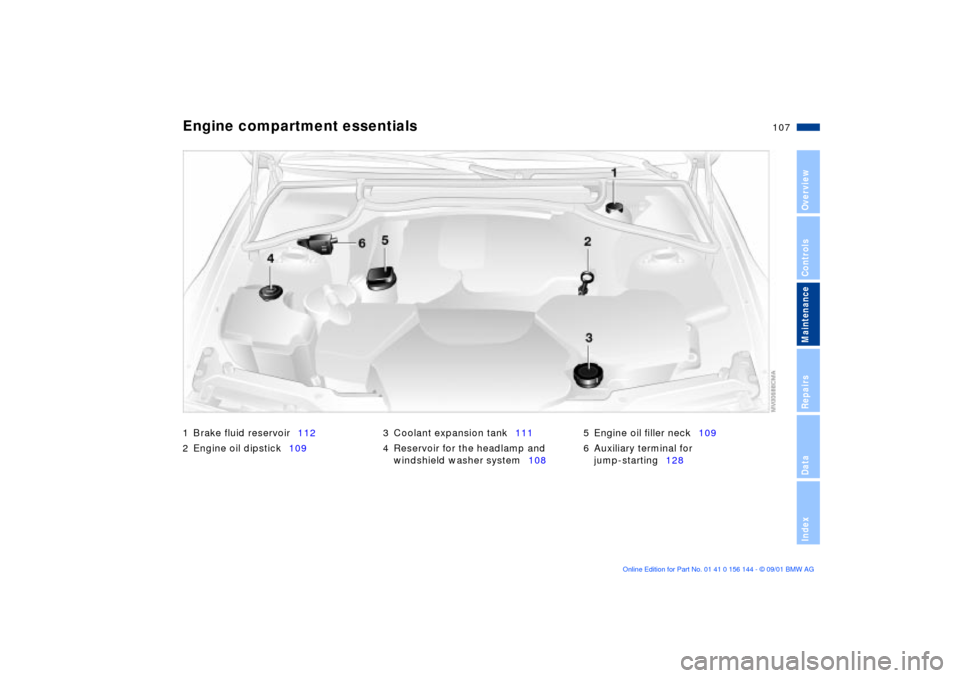
Engine compartment essentials1 Brake fluid reservoir112
2 Engine oil dipstick1093 Coolant expansion tank111
4 Reservoir for the headlamp and
windshield washer system1085 Engine oil filler neck109
6 Auxiliary terminal for
jump-starting128
Page 112 of 147
112n
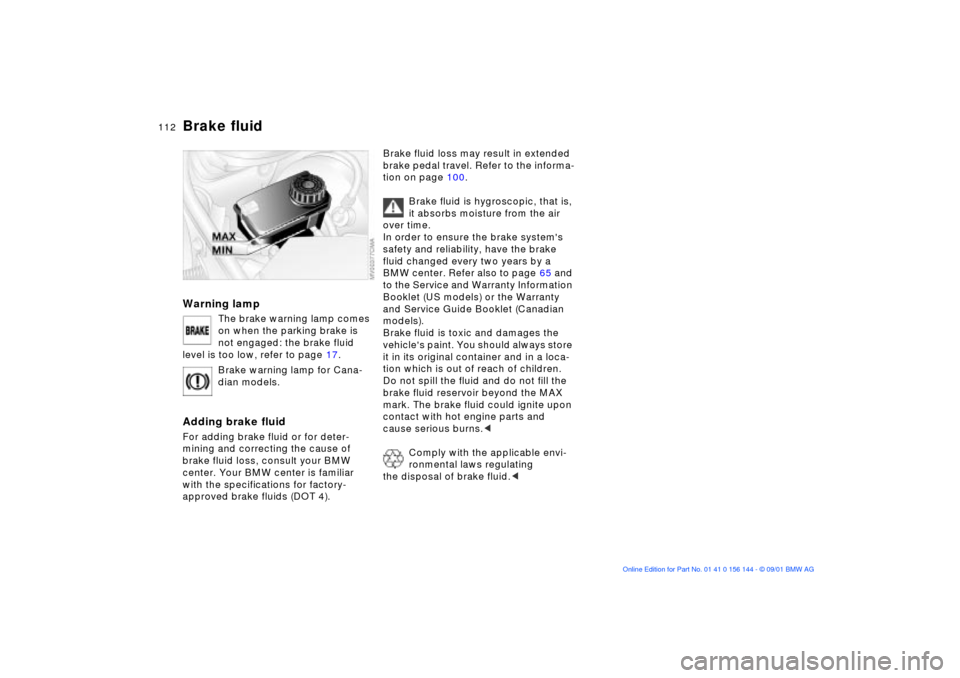
Brake fluidWarning lamp
The brake warning lamp comes
on when the parking brake is
not engaged: the brake fluid
level is too low, refer to page 17.
Brake warning lamp for Cana-
dian models.
Adding brake fluidFor adding brake fluid or for deter-
mining and correcting the cause of
brake fluid loss, consult your BMW
center. Your BMW center is familiar
with the specifications for factory-
approved brake fluids (DOT 4).
Brake fluid loss may result in extended
brake pedal travel. Refer to the informa-
tion on page 100.
Brake fluid is hygroscopic, that is,
it absorbs moisture from the air
over time.
In order to ensure the brake system's
safety and reliability, have the brake
fluid changed every two years by a
BMW center. Refer also to page 65 and
to the Service and Warranty Information
Booklet (US models) or the Warranty
and Service Guide Booklet (Canadian
models).
Brake fluid is toxic and damages the
vehicle's paint. You should always store
it in its original container and in a loca-
tion which is out of reach of children.
Do not spill the fluid and do not fill the
brake fluid reservoir beyond the MAX
mark. The brake fluid could ignite upon
contact with hot engine parts and
cause serious burns.<
Comply with the applicable envi-
ronmental laws regulating
the disposal of brake fluid.<
Page 121 of 147
121n
OverviewControlsMaintenanceRepairsDataIndex
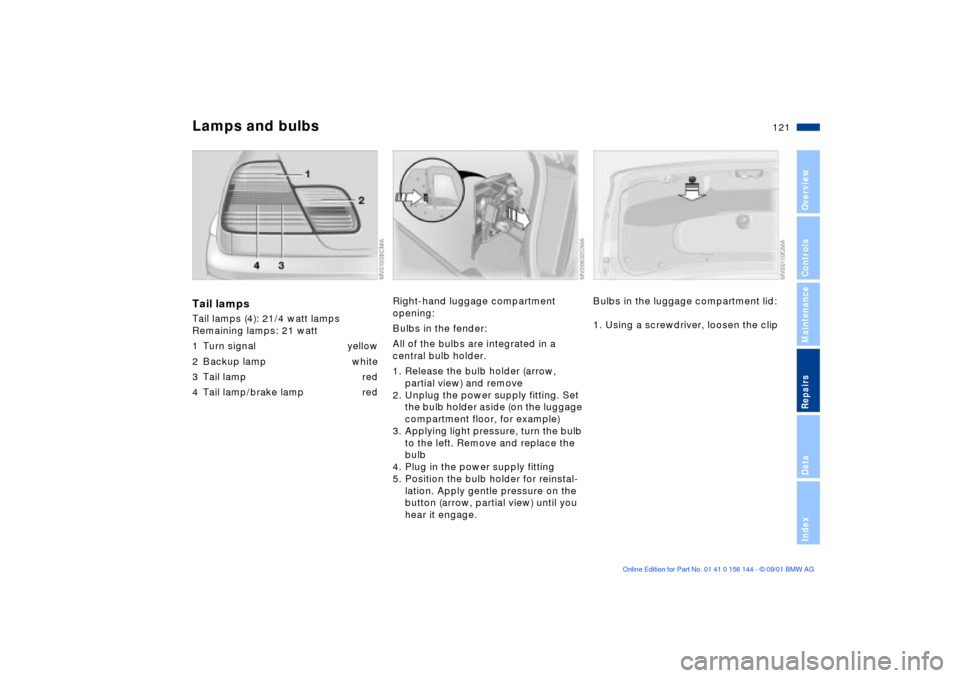
Lamps and bulbsTail lampsTail lamps (4): 21/4 watt lamps
Remaining lamps: 21 watt
1 Turn signal yellow
2 Backup lamp white
3 Tail lamp red
4 Tail lamp/brake lamp red
Right-hand luggage compartment
opening:
Bulbs in the fender:
All of the bulbs are integrated in a
central bulb holder.
1. Release the bulb holder (arrow,
partial view) and remove
2. Unplug the power supply fitting. Set
the bulb holder aside (on the luggage
compartment floor, for example)
3. Applying light pressure, turn the bulb
to the left. Remove and replace the
bulb
4. Plug in the power supply fitting
5. Position the bulb holder for reinstal-
lation. Apply gentle pressure on the
button (arrow, partial view) until you
hear it engage.
Bulbs in the luggage compartment lid:
1. Using a screwdriver, loosen the clip
Page 122 of 147
122n
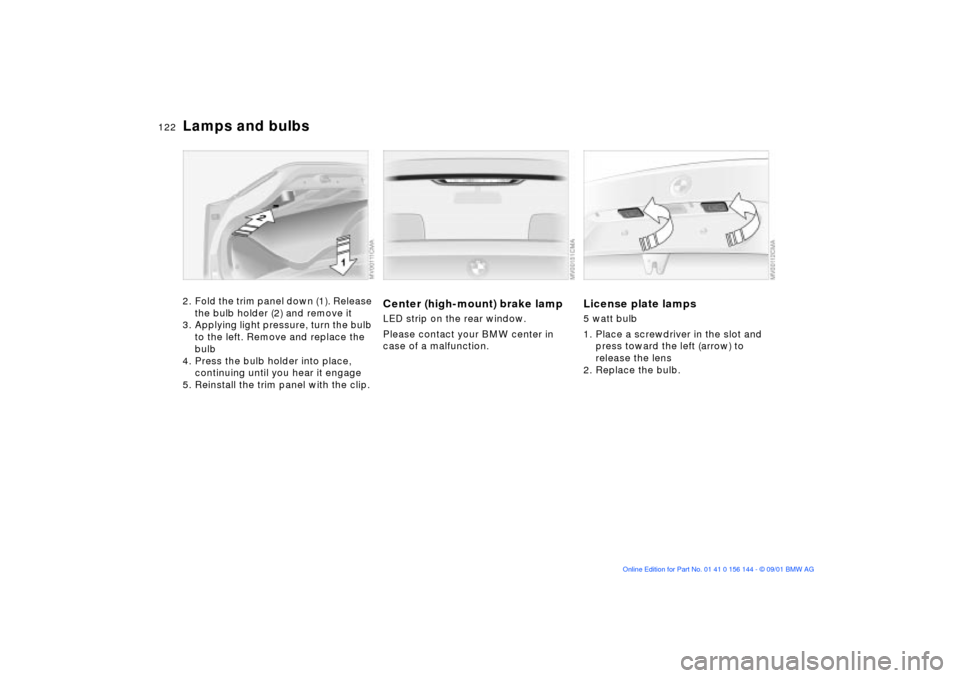
Lamps and bulbs2. Fold the trim panel down (1). Release
the bulb holder (2) and remove it
3. Applying light pressure, turn the bulb
to the left. Remove and replace the
bulb
4. Press the bulb holder into place,
continuing until you hear it engage
5. Reinstall the trim panel with the clip.
Center (high-mount) brake lampLED strip on the rear window.
Please contact your BMW center in
case of a malfunction.
License plate lamps5 watt bulb
1. Place a screwdriver in the slot and
press toward the left (arrow) to
release the lens
2. Replace the bulb.
Page 123 of 147
123n
OverviewControlsMaintenanceRepairsDataIndex
Changing a wheel
Safety precautions in the event of
a flat tire or wheel change:
Stop the vehicle as far as possible from
passing traffic. Park on a firm support
surface. Switch on the hazard warning
flashers. Turn the steering wheel to the
straight-ahead position, remove the key
and engage the steering lock. Shift into
1st or reverse (selector lever in Park
with automatic transmission) and
engage the parking brake.
All passengers should be outside the
vehicle and well away from your imme-
diate working area (behind a guardrail,
for example).
If a warning triangle or portable hazard
warning lamp is available, set it up on
the roadside at an appropriate distance
from the rear of the vehicle. Comply
with all local safety guidelines and
regulations.
Change the wheel only on a level, firm
surface which is not slippery. Avoid
jacking the vehicle on a soft or slippery
support surface (snow, ice, loose
gravel, etc.), as either the vehicle or the
jack could slip sideways.
Position the jack on a firm support
surface.
Do not place wooden blocks or similar
objects under the jack. They could
prevent the jack from extending to its
full height and reduce its support
capacity.
Do not lie under the vehicle or start the
engine when the vehicle is supported
by the jack Ð risk of fatal injury.<
Your BMW is equipped with a spare tire
or a space-saver tire designed for
temporary use in maintaining the
vehicle's mobility in an emergency.
To remove the spare tire, lift the
floor panel in the luggage
compartment completely out, refer to
page 35.<
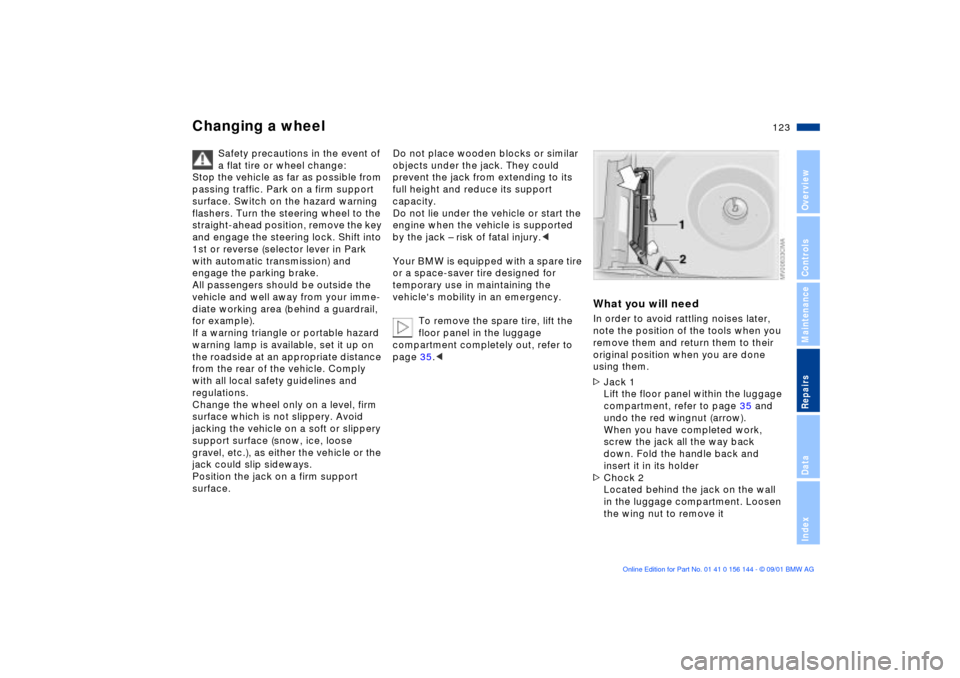
What you will needIn order to avoid rattling noises later,
note the position of the tools when you
remove them and return them to their
original position when you are done
using them.
>Jack 1
Lift the floor panel within the luggage
compartment, refer to page 35 and
undo the red wingnut (arrow).
When you have completed work,
screw the jack all the way back
down. Fold the handle back and
insert it in its holder
>Chock 2
Located behind the jack on the wall
in the luggage compartment. Loosen
the wing nut to remove it
Page 126 of 147

126n
Changing a wheelAlways use BMW-approved balance
weights on black-finished aluminum-
alloy wheels. Never allow anyone to
attempt to balance these wheels using
conventional rim-clip balance weights.Driving with the space-saver
spare tireDrive cautiously. Do not exceed a
speed of 50 mph (80 km/h).
You can anticipate changes in vehicle
handling such as delayed braking
response, longer braking distances and
sacrifices in roadholding.
The changes in handling characteristics
will be even more pronounced if winter
tires are mounted.
Only one space-saver spare tire
may be mounted at a time. Rein-
stall wheels and tires of the same size
and specification as soon as possible.
Maintain correct tire pressures. Refer to
page 25.<
Safety tires
*
Safety tires consists of self-contained
tires and special rims. The tire rein-
forcement ensures that the tire retains
some residual safety in the event of
pressure drop and driving remains
possible to a restricted degree. The
vehicle is equipped with Tire Pressure
Monitor (RDC) or Flat Tire Monitor,
which indicate a flat tire.Flat tireIf there is a tire failure, the red warning
lamp symbol lights up. A supplemen-
tary gong is also heard.
For additional information on Tire Pres-
sure Monitor (RDC) or Flat Tire Monitor
refer to pages 73 bzw. 75.
Reduce vehicle speed carefully to
under 50 mph (80 km/h), avoiding hard
brake applications and steering maneu-
vers.
With the safety tires, you can drive
another approx. 155 miles (250 km) to
reach a safe parking location, a service
station or the nearest BMW center.
With a low vehicle load, this can also be
considerably more than 155 miles
(250 km).Safety tires are only possible in
conjunction with Tire Pressure
Monitor (RDC) or Flat Tire Monitor.<
If the defective wheel can not be seen
as such immediately from the outside,
check the tire inflation pressure at all
four wheels.
Have the tires changed by your
BMW center. For safety reasons,
do not have a safety tire repaired. Your
BMW center has the information
needed for working with safety tires
and is equipped with the necessary
special tools.<
If appropriate, please consult your
BMW center to reequip your
vehicle from summer to winter tires Ð or
vice versa.<
Page 138 of 147

Everything from A to ZA
ABS (Antilock Brake
System)19, 99
Acceleration traction control,
refer to DSC71
Accessories10
Activated-charcoal filter86
Adaptive Transmission
Control (ATC)58
ADB (Automatic Differential
Brake)71
Adding
brake fluid112
coolant111
engine oil109
washer fluid108
Adjusting
head restraints43
lumbar support42
manual seat41
power seat42
steering wheel46
thigh support41
Air conditioning80
temperature settings81
Air distribution81, 84 Air nozzles80, 83
Air outlets80, 83
ventilation80
Air supply81, 84
Airbags18, 48
sitting correctly40
Alarm system36
Antifreeze111
radiator111
Antilock Brake System
(ABS)19, 99
Anti-theft system36
Aquaplaning99
Armrest87
ASC+T (Automatic Stability
Control plus Traction)70
Ashtray
front89
rear90
ATC (Adaptive Transmission
Control)58
Attach vehicle vacuum
cleaner89
AUC (Automatic
recirculated-air
control)85
Automatic climate
control83
temperature settings84 Automatic cruise control62
Automatic Differential Brake
(ADB)71
Automatic headlight
control77
Automatic recirculated-air
control (AUC)85
Automatic Stability Control
plus Traction (ASC+T)70
Automatic transmission57
Automatic transmission with
Steptronic18, 57
Automatic-dimming inside
rearview mirror48
Average consumption68
Average speed68
Axle loads134
B
Backrest
adjusting41
releasing43
Backup lamps56
bulb replacement121
Battery127
charge current indicator
lamp17
charging127 Beverage holder88
Blower81, 84
BMW High Performance
Synthetic Oil110
BMW Maintenance
System113
BMW sports seat
manual adjustment41
power adjustment42
Bore132
Bottle holder, refer to
beverage holder88
Brake fluid112
Brake hydraulic system17
Brake lamps
bulb replacement121
Brake system100
brake fluid level100
brake pads100
brake pads, indicator19
disc brakes100
Brake system, brake
malfunction100
Break-in procedure98
Bulbs and lamps,
replacement118
A-Z
Page 139 of 147

Everything from A to Z
139n
OverviewControlsMaintenancRepairsDataIndex
C
California Proposition
65 Warning114
Canned beverage holder88
Capacities135
Car care, refer to the "Caring
for your vehicle" manual
Car keys28
Car wash systems, refer to
the "Caring for your
vehicle" manual
Care of upholstery materials,
refer to the "Caring for your
vehicle" manual
Cargo loading93
CBC (Cornering Brake
Control)18, 71
Cellular phone89
refer also to the separate
"Owner's Manual"
Center (high-mount) brake
lamp122
Center 3-point belt in the
rear91
Center armrest87
Central locking system28
button32 Changing a wheel123
Check Control66
Check engine oil level109
Checking tire inflation
pressure24
Child restraint
installation52
Child-restraint anchorage
points51
Clean the headlamps61
Cleaning windshield61
Clock66
refer also to the "Radio
Owner's Manual" or to the
"Onboard Computer
Owner's Manual"
Clothes hooks90
Cockpit14
Coin box88
Compartments87
Compression132
Computer refer also to the "Onboard
Computer Owner's
Manual"
Configuring individual
settings with Vehicle and
Key Memory53
Consumption68
display65
Convenience operation via
the door lock
sliding/tilt sunroof31
windows31
Coolant111
Coolant temperature
gauge65
Cooling system,
capacity135
Copyright4
Cornering Brake Control
(CBC)18, 71
Correct sitting posture40
Cover, sun blinds86
Cruise control62
Cruising range68
Cup holder, refer to
beverage holder88
Curb weight134 Current check indicator17
D
Dash lighting78
Dashboard14
Data
dimensions133
engine132
technical132
weights134
Daytime driving lamp77
DBC (Dynamic Brake
Control)19, 72
Deep water99
Defrost setting82, 84
Defrost windows82, 84
Defrostable rear
window81, 85
Digital clock66
Dimensions133
Dipstick, engine oil109
Displacement132
Display lighting78
Displays15
Distance warning69
Page 140 of 147

Everything from A to ZDivided rear-seat
backrest91
Door keys28
Doors
electrical malfunction31
locking and unlocking29
manual operation31
DOT Quality Grades102
Draft-free ventilation82, 85
Driving notes99
DSC (Dynamic Stability
Control)19, 71
Dynamic Brake Control
(DBC)19, 72
Dynamic Stability Control
(DSC)19, 71 E
Electric power windows38
Electrical heating, exterior
mirror47
Electrical malfunction
doors31
fuel filler door22
luggage compartment
lid33
sliding/tilt sunroof39 Elements of operation14
Emergency release of
luggage compartment lid
from luggage
compartment's interior35
Energy control64
Engine compartment
essentials107
Engine coolant, refer to
coolant111
Engine data132
Engine oil
capacity135
consumption109
level19
level, check109
level, indicator lamp17
pressure17
pressure, indicator
lamp17
quality110
specifications110
viscosity110
Engine speed132
Engine, starting54
Engine, switching off55
Entering the rear43
Exterior mirrors47
electrical heating47
F
Failure messages66
Fault displays66
Filling capacities135
Finger guard38
Fittings, tow starting and
towing129
Flashlight87
Flat Tire
Monitor75, 103, 126
Flat tires101, 123, 126
Floor mat, luggage
compartment35
Floor panel, luggage
compartment35
Fog lamps78
Follow me home lamps77
Fuel consumption68
display65
Fuel filler door22
electrical malfunction22
manual operation22
Fuel gauge65
Fuel preparation132
Fuel reserve indicator
lamp65
Fuel specifications23
Fuel tank capacity135
Fuel tank gauge65
Fuses127
G
Gasoline gauge65
Glove compartment87
Grilles83
Gross vehicle weight134 H
Handbrake56
Hands-free system89
Hazard warning triangle22
Head restraints43
Headlamp cover, care119
Headlamp flasher78
Headlamp washer
system108
capacity135
Headlamps77
Headlight control77
Headrests43
Heated seats46
Heater and ventilation83
Heavy cargo93
Height133
High beams20, 59, 78
bulb replacement119
Holder for canned
beverages88
Hood release106
Horn14