Trip BMW 325i 1994 E36 User Guide
[x] Cancel search | Manufacturer: BMW, Model Year: 1994, Model line: 325i, Model: BMW 325i 1994 E36Pages: 759
Page 335 of 759
3
.
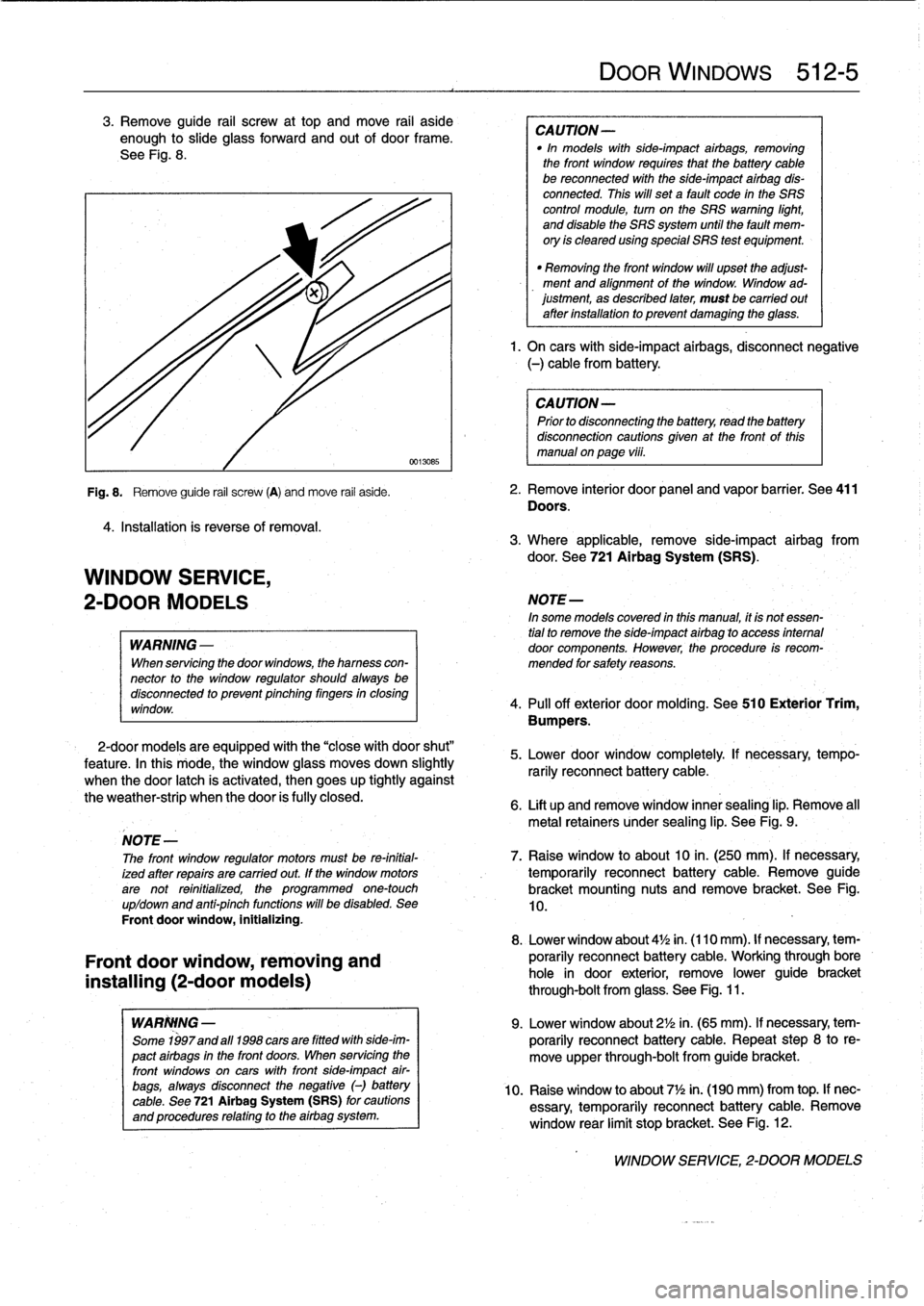
Remove
guide
rail
screw
at
top
and
move
rail
aside
enough
to
slide
glass
forward
and
out
of
door
frame
.
See
Fig
.
8
.
4
.
Installation
is
reverse
of
removal
.
WINDOW
SERVICE,
2-DOOR
MODELS
WARNING
-
When
servicing
the
door
windows,
the
hamess
con-
nector
to
the
window
regulator
shouldalwaysbe
disconnectod
to
prevent
pinching
fingers
in
closing
window
.
2-door
models
are
equipped
with
the
"close
with
door
shut"
feature
.
In
this
rriode,
the
window
glass
moves
down
slightly
when
the
door
latch
is
activated,
then
goes
up
tightly
against
the
weather-strip
when
the
door
is
fully
closed
.
Front
door
window,
removing
and
installing
(2-door
models)
WARIWNG
-
Some
1997and
a111998
cars
are
fitted
with
side-im-
pact
airbags
in
the
front
doors
.
When
servicing
the
front
windows
on
cars
with
front
side-impact
air-
bags,
always
disconnect
the
negative
(-)
battery
cable
.
See
721
Airbag
System(SRS)
for
cautions
and
procedures
relating
to
the
airbag
system
.
DOOR
WINDOWs
512-
5
CAUTION-
"In
models
with
side-impact
airbags,
removing
the
front
window
requires
fhat
the
battery
cable
be
reconnected
with
the
side-impact
airbag
dis-
connected
.
This
will
set
a
fault
code
in
the
SRS
control
module,
turn
on
the
SRS
warning
light,
and
disable
the
SRS
system
until
the
fault
mem-
ory
is
cleared
using
special
SRS
test
equipment
.
"
Removing
the
front
window
will
upset
the
adjust-
ment
and
alignment
of
the
window
.
Window
ad-justment,
as
described
later,
must
be
carried
out
after
installation
to
prevent
damaging
the
glass
.
1.
On
carswith
side-impact
airbags,
disconnect
negative
(-)
cable
from
battery
.
CAUTION-
Prior
to
disconnectiog
the
battery,
read
the
battery
disconnection
cautions
given
at
the
front
of
this
manual
on
page
viii
.
Fig
.
8
.
Remove
guide
rail
screw
(A)
and
move
rail
aside
.
2
.
Remove
interior
door
panel
and
vapor
barrier
.
See
411
Doors
.
3
.
Where
applicable,
remove
side-impact
airbag
from
door
.
See
721
Airbag
System
(SRS)
.
NOTE-
In
some
models
covered
in
this
manual,
it
is
notessen-
tial
to
remove
the
side-impact
airbag
lo
access
intemal
door
components
.
However,
the
procedure
is
recom-
mended
for
safety
reasons
.
4
.
Pull
off
exterior
doormolding
.
See
510
Exterior
Trim,
Bumpers
.
5
.
Lower
door
window
completely
If
necessary,
tempo-
rarily
reconnect
battery
cable
.
6
.
Lift
up
and
remove
window
innersealing
lip
.
Remove
all
metal
retainers
under
sealing
lip
.
See
Fig
.
9
.
NOTE
-
The
front
window
regulator
motors
must
be
re-initial-
7
.
Raise
window
to
about10
in
.
(250
mm)
.
If
necessary,
ized
after
repairs
are
carried
out
.
If
the
window
motors
temporarily
reconnect
battery
cable
.
Remove
guide
arenot
reinitialized,
the
programmed
one-touch
bracket
mounting
nuts
and
remove
bracket
.
See
Fig
.
up/down
and
anti-pinch
functions
will
be
disabled
.
See
10,
Front
doorwindow,
initializing
.
8
.
Lower
window
about
4'/2
in
.
(110mm)
.
If
necessary,
tem-
porarily
reconnect
batterycable
.
Working
through
bore
hole
in
door
exterior,
remove
lower
guide
bracket
through-bolt
from
glass
.
See
Fig
.
11
.
9
.
Lower
window
about
2'/2
in
.
(65
mm)
.
If
necessary,
tem-
porarily
reconnect
battery
cable
.
Repeat
step
8
to
re-
move
upper
through-bolt
from
guide
bracket
.
10
.
Raise
window
to
about
7
1
/2in
.
(190
mm)
from
top
.
If
nec-
essary,
temporarily
reconnect
batterycable
.
Remove
window
rear
limit
stop
bracket
.
See
Fig
.
12
.
WINDOW
SERVICE,
2-DOOR
MODELS
Page 341 of 759
0013080
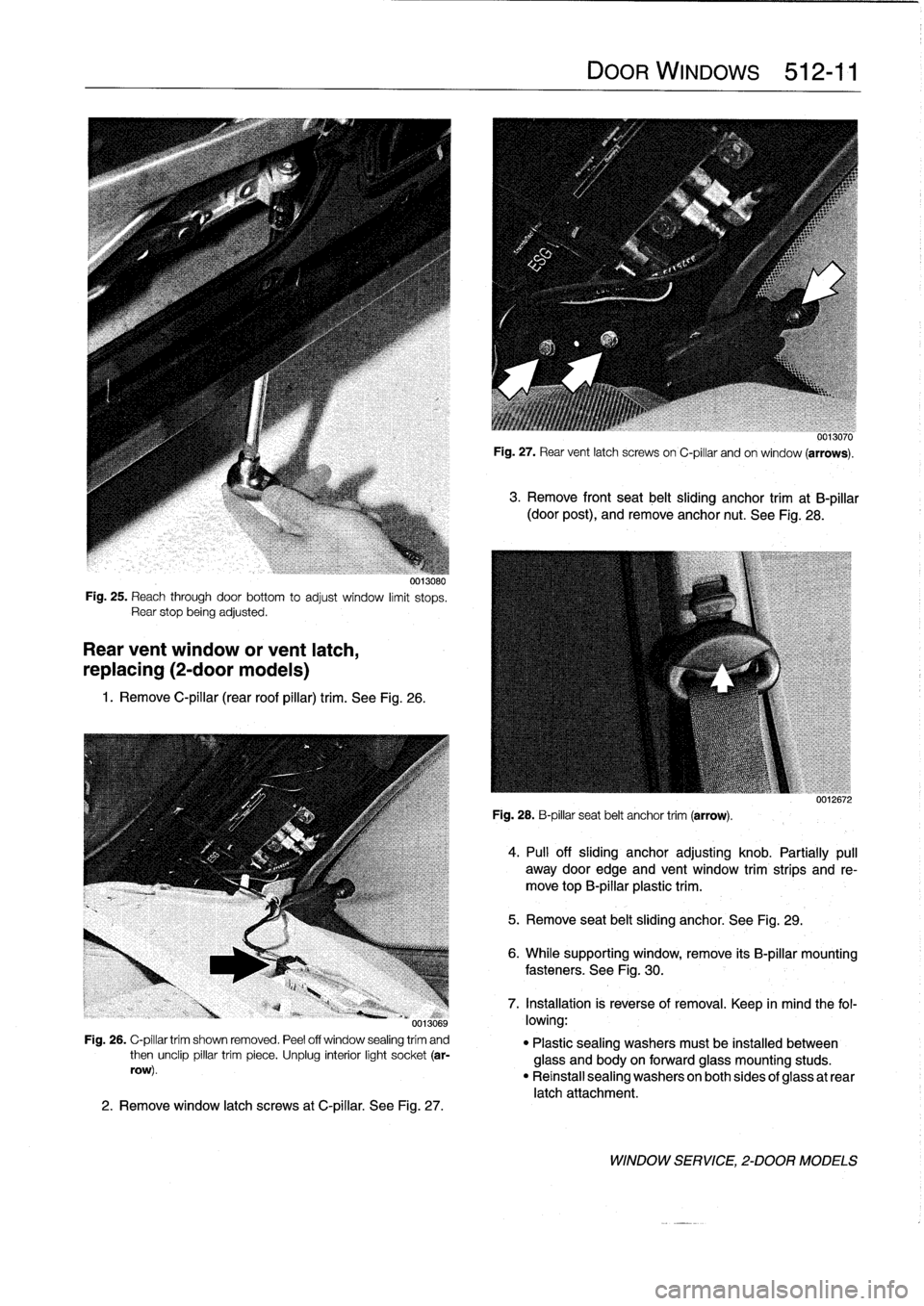
Fig
.
25
.
Reach
through
doorbottom
to
adjust
window
limit
stops
.
Rear
stop
beingadjusted
.
Rear
vent
window
or
vent
latch,
replacing
(2-door
modeis)
1
.
Remove
C-pillar
(rear
roof
pillar)
trim
.
See
Fig
.
26
.
0013069
Fig
.
26
.
C-pillar
trim
shown
removed
.
Peel
off
window
sealing
trím
and
then
unclip
pillar
trim
piece
.
Unplug
interior
light
socket
(ar-
row)
.
2
.
Remove
window
latch
screws
atC-pillar
.
See
Fig
.
27
.
DOOR
WINDows
512-11
0013070
Fig
.
27
.
Rear
vent
latch
screws
on
C-pillar
andon
window
(arrows)
.
3
.
Remove
front
seat
belt
sliding
anchor
trim
at
B-pillar
(door
post),
andremove
anchor
nut
.
See
Fig
.
28
.
Fig
.
28
.
B-pillar
seat
belt
anchor
trim
(arrow)
.
5
.
Remove
seat
belt
sliding
anchor
.
See
Fig
.
29
.
úulzoiz
4
.
PA
off
sliding
anchor
adjustíng
knob
.
Partially
pull
away
door
edge
and
vent
window
trimstrips
and
re-
move
top
B-pillar
plastic
trim
.
6
.
While
supporting
window,
remove
its
B-pillar
mounting
fasteners
.
See
Fig
.
30
.
7
.
Installation
is
reverseof
removal
.
Keep
in
mind
the
fol-
lowing
:
"
Plastic
sealing
washers
mustbe
installed
between
glass
and
body
on
forward
glass
mounting
studs
.
"
Reinstall
sealing
washers
on
both
sides
of
glass
at
rear
latch
attachment
.
WINDOW
SERVICE,
2-DOOR
MODELS
Page 342 of 759
512-
1
2
DOOR
WINDOWS
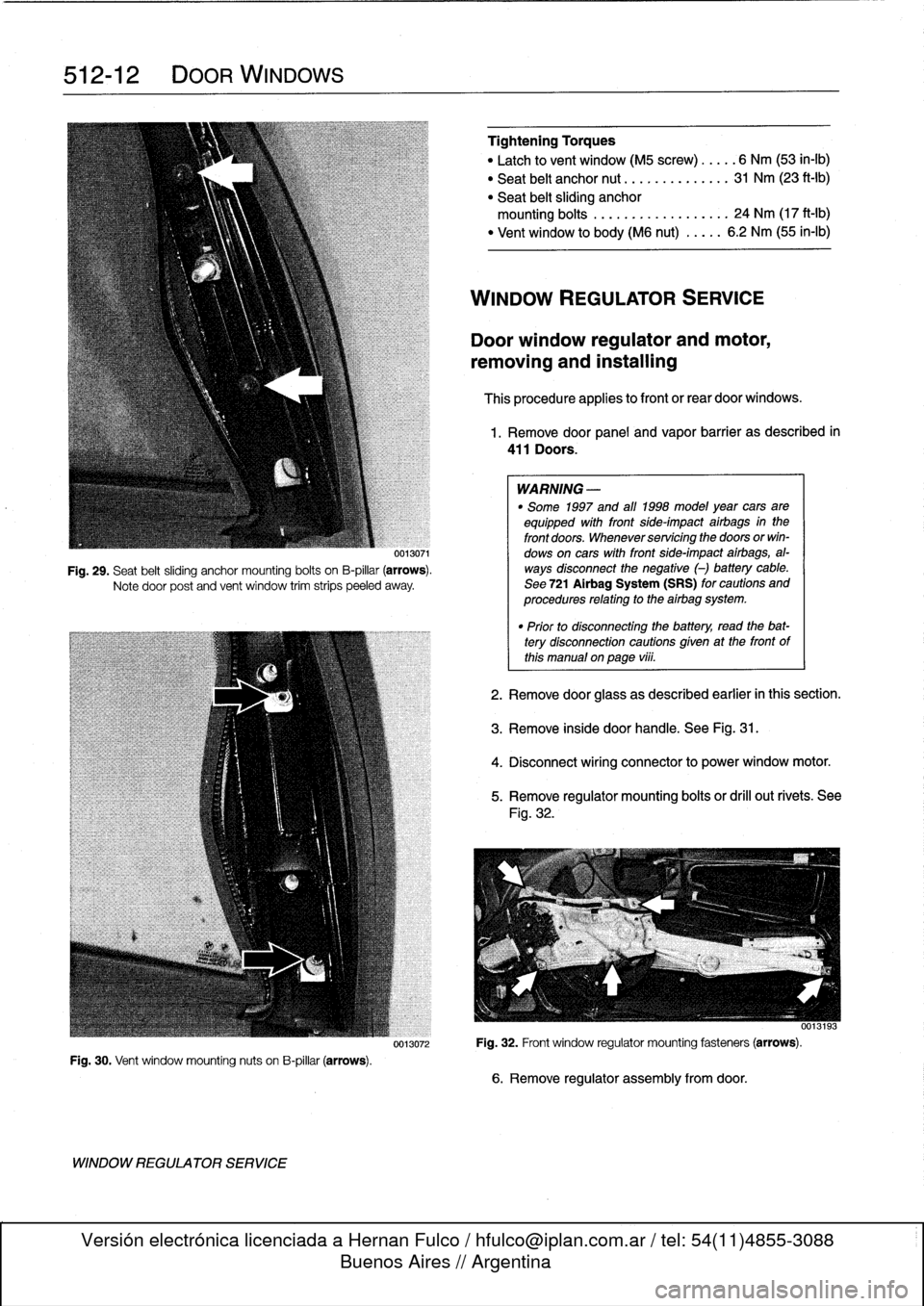
Fig
.
30
.
Vent
window
mounting
nuts
on
B-pillar
(arrows)
.
WINDOW
REGULATOR
SERVICE
0013071
Fig
.
29
.
Seat
belt
sliding
anchor
mounting
bolts
on
B-pillar
(arrows)
.
Notedoor
post
and
vent
window
trim
strips
peeled
away
.
Tightening
Torques
"
Latch
to
vent
window
(M5
screw)
.....
6
Nm
(53
in-lb)
"
Seat
belt
anchor
nut
..............
31
Nm
(23
ft-Ib)
"
Seat
belt
sliding
anchor
mounting
bolts
.
..
...
.
...........
24
Nm
(17
ft-Ib)
"
Vent
window
to
body(M6
nut)
.....
6
.2
Nm
(55
in-lb)
WINDOW
REGULATOR
SERVICE
Door
window
regulator
and
motor,
removing
and
installing
This
procedure
applies
to
front
or
rear
door
windows
.
1
.
Remove
door
panel
and
vapor
barrier
as
described
in
411
Doors
.
WARNING
-
"
Some
1997
and
all
1998
model
year
cars
are
equipped
with
front
side-impact
airbags
in
the
front
doors
.
Whenever
servicing
the
doors
orwin-
dows
on
cars
with
front
side-impact
airbags,
al-
ways
disconnect
the
negative
(-)
battery
cable
.
See
721
Airbag
System
(SRS)
for
cautions
and
procedures
relating
to
the
airbag
system
.
"
Prior
to
disconnectiog
the
battery,
read
the
bat-tery
disconnection
cautions
gíven
at
the
front
of
this
manual
onpage
vi¡¡
.
2
.
Remove
door
glass
as
described
earlier
in
this
section
.
3
.
Remove
inside
door
handle
.
See
Fig
.
31
.
4
.
Disconnect
wiring
connector
to
power
window
motor
.
5
.
Remove
regulator
mounting
bolts
or
drill
out
rivets
.
See
Fig
.
32
.
0013193
0013072
Fig
.
32
.
Front
window
regulator
mounting
fasteners
(arrows)
.
6
.
Remove
regulator
assembly
fromdoor
.
Page 375 of 759
The
left
latch
in
the
fully
automatic
version
hastwo
mi-
croswitches
(S7
and
S8)which
signal
open,
closed
and
latched
states
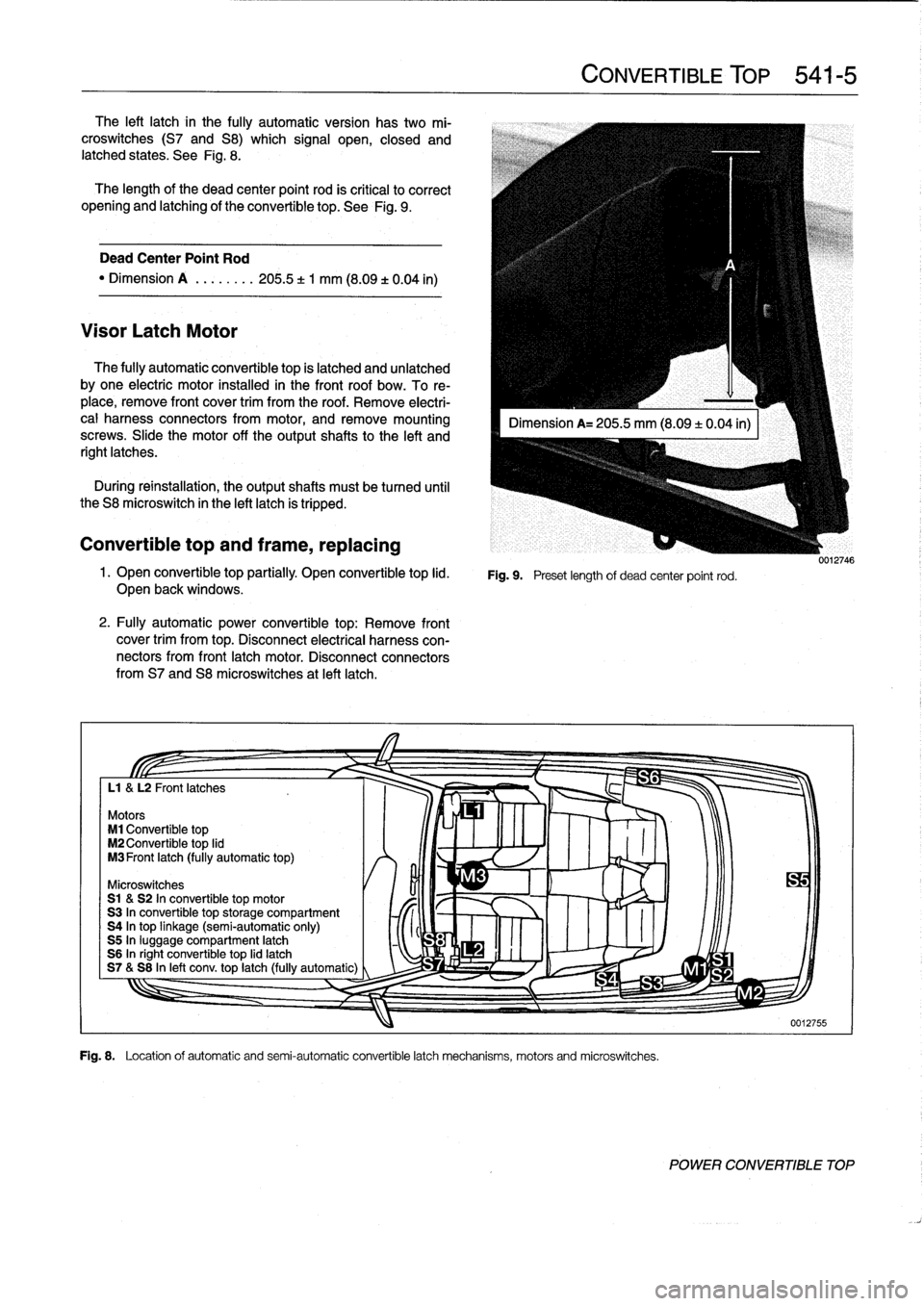
.
See
Fig
.
8
.
The
length
of
the
dead
center
point
rod
is
critica¡
lo
correct
opening
and
latching
of
the
convertible
top
.
See
Fig
.
9
.
Dead
Center
Point
Rod
"
Dimension
A
........
205
.5
f
1
mm
(8
.09
t0
.04
in)
Visor
Latch
Motor
The
fully
automatic
convertible
top
is
latched
and
unlatched
by
one
electric
motor
installed
in
the
front
roof
bow
.
To
re-
place,
remove
front
cover
trim
from
the
roof
.
Remove
electri-
cal
harness
connectors
from
motor,
andremove
mounting
screws
.
Slide
the
motor
off
the
output
shafts
to
the
left
and
right
latches
.
During
reinstallation,
theoutput
shafts
must
be
tumed
until
the
S8
microswitch
in
the
left
latch
is
tripped
.
Convertible
top
and
frame,
replacing
1
.
Open
convertible
top
partially
.
Open
convertible
top
lid
.
Fig
.
9
.
Preset
lengthof
dead
centerpoint
rod
.
Open
back
windows
.
2
.
Fully
automatic
power
convertible
top
:
Remove
front
cover
trim
from
top
.
Disconnect
electrical
harness
con-
nectors
from
frontlatch
motor
.
Disconnect
connectors
from
S7
and
S8
microswitches
at
left
latch
.
Motors
M1
Convertible
top
M2
Convertible
top
lid
M3Front
latch
(fully
automatic
top)
Microswitches
S1
&S2
In
convertible
top
motor
S3
In
convertible
top
storage
compartment
S4
In
top
linkage
(semi-automatic
only)
S5
In
luggage
compartment
latch
S6
In
right
convertible
top
lid
latch
S7&S8
In
left
conv
.
top
latch
(fully
automatic)
Fig
.
8
.
Locationof
automatic
and
semi-automatic
convertible
latch
mechanisms,
motors
and
microswitches
.
CONVERTIBLE
TOP
541-5
POWER
CONVERTIBLE
TOP
Page 382 of 759
600-2
ELECTRICAL
SYSTEM-GENERAL
CAUTION
-
"
Always
turn
off
the
engine
and
disconnect
the
negative
()
cable
from
the
batterybefore
remov-
ing
any
electrical
components
.
Disconnecting
the
battery
may
erase
fault
code(s)
stored
in
control
module
memory
.
Check
for
fault
codes
using
spe-
cial
BMW
diagnostic
equipment
.
"
Prior
to
disconnecting
the
battery,
read
the
bat-
tery
disconnection
cautions
given
at
the
front
of
this
manual
onpage
viii
.
"
Connect
and
disconnect
ignition
system
wires,
multiple
connectors,
and
ignition
test
equipment
leads
only
while
the
ignition
is
off
.
"
Do
not
disconnect
the
battery
with
engine
run-
ning
.
"
Do
not
quick-charge
the
battery
(for
boost
start-
ing)
for
longer
than
one
minute,
and
do
not
ex-
ceed
16
.5
volts
at
the
battery
with
the
boosting
cables
attached
.
Wait
at
feast
one
minute
before
boosting
the
battery
a
second
time
.
"
Do
not
usea
test
famp
that
has
a
normal
incan-
descent
bulb
to
test
circuits
contafning
electronic
components
.
The
high
electrical
consumptionof
these
test
lamps
may
damage
the
components
.
"
Do
not
use
an
analog
meter
.
Use
onfy
a
digital
multimeter
.
"
Many
of
the
solid-state
modules
are
static
sensi-
tive
.
Static
discharge
will
permanently
damage
them
.
Always
handle
the
modules
using
proper
static
prevention
equipment
and
techniques
.
"
To
avoid
damaging
harness
connectors
or
relay
panel
sockets,
use
jumper
wires
with
flat-blade
connectors
that
are
the
same
size
as
the
connec-
tor
or
relay
terminals
.
"
Always
switch
a
digital
multimeter
to
the
appropri-
ate
function
and
range
before
making
test
con-
nections
.
"
Do
not
tryto
start
the
engine
of
a
carwhich
has
been
heated
above176°F
(80°C),
(for
example,
in
a
paint
dryingbooth)
.
Allow
it
to
cool
to
normal
temperature
.
"
Disconnect
the
battery
before
dolng
any
electric
welding
on
the
car
.
"
Do
not
wash
the
engine
while
it
is
runnfng,
or
any-
time
the
ignition
is
switched
on
.
WIRING
DIAGRAMS
Electrical
Test
Equipment
Many
of
the
electrical
tests
described
in
this
manual
call
for
measuring
voltage,
currentorresistanceusing
a
digital
multi-
meter
(DMM)
.
Digital
meters
are
preferred
for
precise
mea-
surements
and
for
electronics
work
because
they
are
generally
more
accuratethan
analog
meters
.
The
numerical
display
is
alsoless
likely
to
be
misread,
since
there
is
no
nee-
dle
position
to
be
misinterpreted
by
reading
at
an
angle
.
An
LED
test
light
is
a
safe,
inexpensive
tool
that
can
be
used
to
perform
many
simple
electrical
tests
that
would
otherwise
require
a
digital
multimeter
.
The
LED
indicates
when
voltage
is
present
between
anytwo
test-points
in
a
circuit
.
CA
UTION-
"
Choose
test
equipment
carefully
.
Use
a
digital
multimeter
with
at
leadt
10
megaohm
input
im-
pedance,or
an
LED
test
light
.
An
analog
meter
(swing-need1e)
ora
test
light
with
a
normal
incan-
descent
bulb
may
draw
enough
current
to
dam-
age
sensitive
electronic
components
.
"
An
ohmmeter
must
not
beused
to
measure
resis-
tance
on
solidstate
components
suchas
controlunits
or
time
delay
relays
.
"
Always
disconnect
the
battery
before
making
re-
sístance
(ohm)
measurements
on
the
circuit
.
WIRING
DIAGRAMS
The
wiring
diagrams
shown
in
Electrical
Wiring
Diagrams
have
been
specially
designed
to
enable
quick
and
efficientdi-
agnosis
and
troubleshooting
of
electrical
malfunctions
.
Wiring
Codes
and
Abbreviations
A
lot
of
information
is
included
in
each
wiring
diagram
if
you
know
how
to
read
them
.
Wire
colors
in
the
diagrams
are
ab-
breviated
.
Combined
color
codes
indicate
a
multi-colored
wire
.
For
example
the
code
BLU/RED
indicates
a
Blue
wire
with
a
Red
stripe
.
Many
electrical
components,
connectors,
fuses,
and
ground
locations
are
identified
using
a
unique
number
.
Each
of
there
numbers
corresponds
to
a
particular
part
in
the
circuit
commonly
found
in
Electrical
Wiring
Diagrams
.
Page 420 of 759

611-2
WIPERS
AND
WASHERS
5
.
Slide
new
insert
through
wiperblade
guides
.
Lock
in-
sert
m
place
at
end
gudes
.
.,
\
-
-
--
,
1
Wiper
arms,
removing
and
installing
Fig
.
1
.
Windshield
wiper
biade
retaining
tab
.
Press
in
on
tab
(arrow)
to
release
bfade
from
arm
.
4
.
Installation
is
reverse
of
removal
.
Instan
wiperblade
to
wiper
arm
until
retaining
tab
can
be
heard
toclickinto
position
.
Wiper
biade
inserts,
replacing
1
.
Remove
wiper
blade
as
described
earlier
.
2
.
Unhook
end
of
wiper
blade
insert
fromwiper
arm
guides
.
See
Fig
.
2
.
0011784
Fig
.
2
.
Unhook
wiperbiade
insert
from
wiper
arm
guide
.
If
necessary,
guide
slightly
usingneed1e
nose
pliers
.
3
.
Pull
old
insert
fromwiper
arm
guides,
noting
installation
position
.
4
.
Remove
metal
support
strips
from
old
insert
and
instan
intoslots
in
new
insert,
noting
installation
direction
of
cutouts
in
support
strips
.
GENERAL
NOTE
-
The
notched
cutouts
in
the
retaining
strips
should
en-
gage
the
molded
notches
in
the
inserts
.
NOTE-
On
2-door
models
it
may
be
necessary
to
raise
the
hood
to
the
service
position
.
See
410
Fenders,
Engine
Hood
.
CAUTION-
"
Use
fender
cover
to
protect
windshield
.
"
Remove
windshield
wiper
fuse
to
prevent
acci-
dents
.
1.
With
engine
hood
in
closed
position,
remove
both
wiper
blades
.
2
.
Open
hood
.
Remove
cap
covering
wiper
arm
retaining
nutsby
inserting
anarrow
screwdriver
biade
in
slot
be-
low
capand
prying
upward
.
NOTE
-
Marking
position
of
wiper
arm
on
shaft
will
aid
installa-tion
.
3
.
Using
a13
mm
socket,
remove
wiper
arm
retaining
nut
andremove
wiper
arm
.
See
Fig
.
3
.
Fig
.
3
.
Wiper
arm
retaining
nut
.
(arrow)
.
,
NOTE
-
ft
may
benecessary
to
gently
rock
wiper
arm
back
and
forth
to
loosen
arm
from
shaft
.
Page 437 of 759
INSTRUMENT
CLUSTER
....
.
.
.
.
.
...
.
..
620-1
Instrument
cluster,
seif-testing
.
.
.......
.
..
620-1
Instrument
cluster,
removing
and
installing
...
620-1
Instrument
cluster
bulbs,
replacing
.
.
.
.
.
.
...
620-2
GENERAL
This
repair
group
covers
removal
and
installation
of
the
in-
strument
cluster
and
the
Multi-information
Display
(MID)
mod-
ule
.
Bulb
replacement
information
for
these
units
is
also
included
here
.
NOTE
-
A
quick
check
of
the
temperature
gauge
and
its
electri-
cal
circuitis
given
in
170
Radiator
and
Cooling
Sys-
tem
.
Use
this
procedure
to
diagnosea
faulty
temperature
gauge
INSTRUMENT
CLUSTER
When
servicing
the
instrument
cluster,
always
disconnect
the
negative
(-)
cable
from
the
battery
and
insulate
the
cable
end
to
prevent
accidental
re-connection
.
Instrument
cluster,
seif-testing
Severa¡
different
versions
of
the
basic
instrument
cluster
havebeen
fitted
in
E36
cars
.
It
is
possibleto
perform
an
instru-
ment
cluster
test
and
display
system
test
information
.
Some
of
the
information
displayed
by
the
instrument
cluster
during
seif-testing
is
used
for
interna¡
BMW
organizationpur-
poses,
suchasmatching
the
correct
instrument
cluster
com-
ponents
during
parts
replacement
.
Other
functions
test
the
various
instrument
modules
.
Self-test
is
also
used
to
recode
the
instrument
cluster
after
removal
.
In
later
production
vehicles
(1996
and
later)
the
test
results
canbe
downioaded,
via
the
diagnostic
plug,
byan
authorized
BMW
dealertechnician
.
1
.
Turn
ignition
to
"radio"position
.
2
.
Press
and
hold
reset
button
on
trip-odometer
untiltrip-
odometer
display
shows
numerical
codes
.
620
Instruments
4
.
Turn
off
ignition
.
Instrument
cluster,
removing
and
installing
INSTRUMENTS
620-1
GENERAL
.....
.
.
.
.
.
.
.
.
.
.........
.
....
620-1
Odometer
coding
plug,
replacing
.....
.
.
.
.
.
.
620-2
Vehicle
speed
sender,
replacing
...
.
.
.
.
.
.
.
.
620-3
MULTI-INFORMATION
DISPLAY
(MID)
.
.
.
620-4
Multi-Information
Display,
removing
and
installing
..
.
....
.
.........
620-4
3
.
With
each
subsequent
press
of
the
button,
a
different
function
is
tested
.
Some
functions
will
activate
need1e
gauges
.
1
.
Disconnect
negative
(-)
cable
from
battery
and
cover
terminal
with
insulating
material
.
CAUTION-
Prior
to
disconnectiog
the
battery,
read
the
battery
disconnection
cautionsgiven
at
the
front
of
this
manual
on
page
vi¡¡
.
2
.
Remove
airbag
unit
from
steering
wheel
.
See
721
Air-
bag
System
(SRS)
.
Store
unit
in
a
safe
place
.
WARNING
-
The
airbag
is
an
explosive
devfce
and
should
be
treated
with
extreme
caution
.
Improper
handling
of
the
airbag
could
cause
serious
injury
or
death
.
Store
the
airbag
with
the
horn
pad
facing
up
.
If
stored
facing
down,
accidental
deployment
couldpropel
it
vfolently
into
the
air,
causing
injury
.
3
.
With
front
wheels
pointed
straight
ahead,
remove
steer-
ing
wheel
.
See
320
Steering
and
Wheel
Alignment
.
4
.
Remove
instrument
cluster
retaining
screws
.
See
Fig
.
1
.
5
.
Place
a
towel
over
steering
column
.
Carefully
tilt
top
of
cluster
out
of
dash
panel
.
Unlock
and
disconnect
har-
ness
connectors
from
back
of
cluster
.
See
Fig
.
2
.
INSTRUMENT
CLUSTER
Page 457 of 759
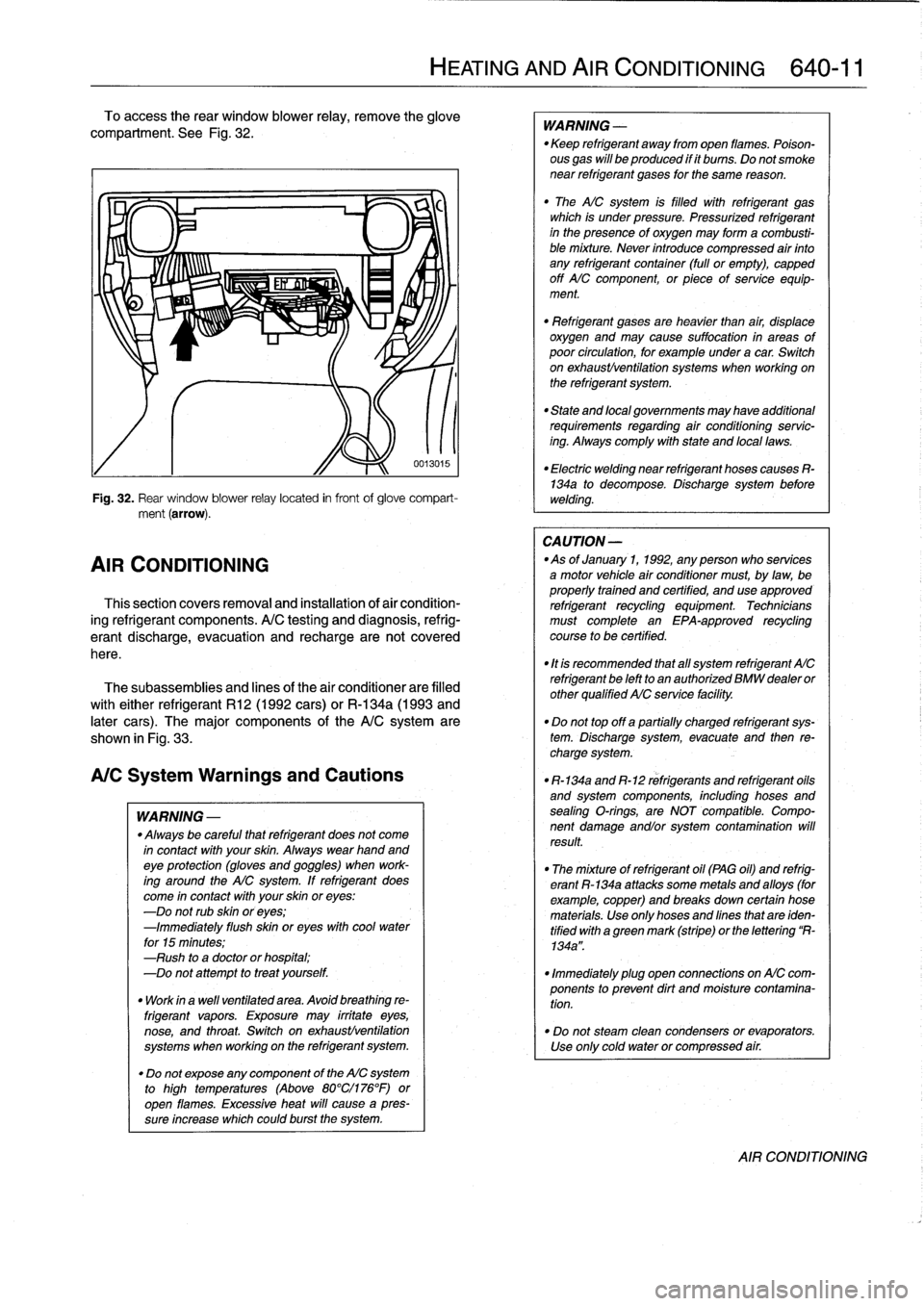
To
access
the
rear
window
blower
relay,
remove
the
glove
compariment
.
See
Fig
.
32
.
Fig
.
32
.
Rear
window
blower
relay
located
in
frontof
glove
compart-
ment
(arrow)
.
AIR
CONDITIONING
Thissection
covers
removal
and
installation
of
air
condition-
ing
refrigerant
components
.
A/C
testing
and
diagnosis,
refrig-
erantdischarge,
evacuatíon
and
recharge
are
not
covered
here
.
The
subassemblies
and
lines
of
the
air
conditionerare
filled
with
either
refrigerant
R12
(1992
cars)
or
R-134a
(1993
and
later
cars)
.
The
major
components
of
the
A/Csystem
are
shown
in
Fig
.
33
.
A/CSystem
Warnings
and
Cautions
WARNING
-
"
Always
be
careful
that
refrigerant
does
not
come
in
contact
with
your
skin
.
Always
wearhand
andeye
protection
(gloves
and
goggles)
when
work-
ing
around
the
AIC
system
.
If
refrigerant
does
come
in
contact
with
your
skin
oreyes
:
-Do
not
rub
skin
oreyes
;
-Immediately
flush
skin
oreyes
withcool
water
for
15
minutes
;
-Rush
to
a
doctor
orhospital
;
-Do
not
attempt
to
treat
yourself
.
"
Work
in
a
wefl
ventilated
area
.
Avoid
breathing
re-
frigerant
vapors
.
Exposure
may
irrítate
eyes,
nose,
and
throat
.
Switch
on
exhaustlventilation
systems
when
working
on
the
refrigerant
system
.
"
Do
not
expose
any
component
of
the
AIC
system
to
high
temperatures
(Above
80°Cl176°F)or
open
flames
.
Excessive
heat
will
cause
a
pres-
sureincrease
whichcould
burst
the
system
.
HEATING
AND
AIR
CONDITIONING
640-
1
1
0013015
WARNING
-
"
Keep
refrigerant
away
from
open
llames
.
Poison-
ous
gas
will
be
produced
if
it
bums
.
Do
not
smoke
near
refrigerant
gases
for
the
same
reason
.
"
The
AICsystem
is
filled
with
refrigerant
gas
which
is
under
pressure
.
Pressurized
refrigerant
in
the
presenceof
oxygen
may
forma
combusti-
ble
mixture
.
Never
introduce
compressed
air
finto
any
refrigerant
container
(full
or
empty),
capped
off
AIC
component,
or
piece
of
service
equip-
ment
.
"
Refrígerant
gases
are
heavier
than
air,
displace
oxygen
and
may
cause
suffocation
in
areas
of
poor
círculation,
for
example
under
a
car
.
Switch
on
exhaustlventilation
systems
when
working
on
the
refrigerant
system
.
"
State
and
local
governments
may
have
additional
requirements
regarding
air
conditioning
servic-
ing
.
Alwayscomply
with
state
and
local
laws
.
"
Electric
welding
near
refrigerant
hoses
causes
R-134a
to
decompose
.
Discharge
system
before
welding
.
CA
UTION
-
-As
of
January
1,
1992,
any
person
who
services
a
motor
vehicle
air
conditioner
must,
by
law,
be
properly
trained
and
certified,
and
use
approved
refrigerant
recycling
equipment
.
Technicians
must
complete
an
EPA-approved
recycling
course
to
be
certified
.
"
It
is
recommended
that
al¡
system
refrigerant
AIC
refrigerant
be
left
to
an
authorized
BMW
dealer
or
other
qualified
AIC
service
facility
.
"
Do
not
top
off
a
partially
charged
refrigerant
sys-
tem
.
Dischargesystem,evacuate
and
then
re-
charge
system
.
"
R-134a
and
R-12
refrigerants
and
refrigerant
oils
and
system
components,
including
hoses
and
sealing
O-rings,
are
NOT
compatible
.
Compo-
nent
damage
andlor
system
contamination
will
result
.
"
The
mixture
of
refrigerant
oil
(PAG
oil)
and
refrig-
erant
R-134a
attacks
some
metals
and
alloys
(for
example,copper)
and
breaks
down
certain
hose
materials
.
Use
only
hoses
and
lines
that
are
iden-
tified
with
a
green
mark
(stripe)
or
the
lettering
R-
134a"
.
"
Immediately
plug
open
connections
on
AIC
com-
ponents
to
prevent
dirt
and
moisture
contamina-
tion
.
"
Do
not
steam
clean
condensers
or
evaporators
.
Use
only
cold
water
or
compressed
air
.
AIR
CONDITIONING
Page 756 of 759
N
WARNING
Your
common
sense,
good
judge-
ment,
and
general
alertness
are
cru-
cial
to
safe
and
successful
service
work
.
Before
attempting
any
workonyour
BMW,
read
the
warnings
and
cautions
on
page
vi¡
and
the
copyright
page
at
the
front
of
the
manual
.
Review
these
warningsand
cautions
each
time
you
prepare
to
work
on
your
BMW
.
Please
also
read
any
warnings
and
cautions
that
accom-
pany
the
procedures
in
the
manual
.
Master
cylinder
See
Brakes
See
also
Clutch
Mechanical
troubleshooting
See
Engine-general
Microfilter
See
Air
conditioning
Mirror
See
Exterior
trim,
bumpers
Muffler
See
Exhaustsystem
Multi-information
display
(MID)
See
Instruments
Neutral
safetyswitch
See
Gearshift
linkage
O
Oil,
changing
See
Maintenance
program
Oil
panSee
Lubrication
system
Oil
pressure
See
Lubrication
system
Oil
pump
See
Lubrication
systemOn-board
diagnostics
(OBD)
See
Engine-general
See
alsoFuel
injection
See
also
Ignition
system
On-board
trip
computer
See
Multi-information
display
620-4
Oxygen
sensor
See
Engine-general
See
alsoFuel
injection
See
also
Maintenance
program
P
Parking
brake
See
Brakes
See
also
Maintenance
program
Parts
See
Fundamentals
for
the
do-it-
yourself
owner
Poly-ribbed
belt
See
Maintenance
program
Power
steering
See
Steering
and
wheel
alignment
Power
steering
(luid
See
Maintenance
program
R
Radiator
See
Cooling
system
Radio
general
information
650-1audio
system
650-1
radio
connector
650-6
removing/installing
650-2speakersdoor
panel
speaker,
removing/
installing
650-5
left
footwell
speaker,
removing/
installing
650-3
rear
speaker,
removing/installing
650-5
right
footwell
speaker,
removing/
installing
650-4Rearsuspension
See
also
Maintenance
program
general
information
330-1
coil
spring,
removing/installing
330-4
CV
boot,
replacing
330-8
drive
axle,
removing/installing
330-6
drive
axles
330-6
final
drive
carrier
330-12
final
drive
carrier,
removing/installing
330-12
lower
control
arm,
removing/installing
330-12
rear
shock
absorber,
removing/
installing
330-3
rear
suspension
arms
330-9
ride
heíght
330-1
shock
absorbers
and
springs
330-2
trailing
arm,
removing/installing
330-10
trailing
arm
bushing,
replacing
330-11upper
control
arm,
removing/installing
330-12
rear
wheel
bearing,
replacing
330-5
rear
wheel
bearings
330-4
Rear
view
mirror
See
Exterior
trim,
bumpers
Receiver/drivr
See
Air
conditioning
Relays
See
Electrical
component
locations
INDEX
7
Ride
height
See
Front
suspension
or
Rearsuspension
Ring
antenna
See
Central
locking
and
anti-theft
Roof
See
Convertible
top
See
also
Sunroof
Roundel
See
Exterior
trim,
bumpers
S
Seat
belts
general
information
720-1
automatic
front
seat
belt
lock
tensioners
720-2
center
rear
lap-belt,
removing/
installing
720-5
front
seat
beltreel,
removing/installing
720-3
mechanical
spring
tensioner,
disarming
720-2
rear
seat
belt,
removing/installing
(fixed
seat
back
models)
720-4
rear
seat
belt,
removing/installing
(fold-down
seat
back
models)
720-5Seats
general
information
520-1
front
seats520-1
manual
front
seat
assembly
520-3
power
front
seat
assembly
520-4
removing/installing
520-1
rear
seats
520-5
rear
seat
cushion
and
backrest,
removing/installing
(fixed
seat
backmodels)
520-5
rear
seat
cushion
and
backrest,
removing/installing
(fold-down
seat
back
models)520-5
rear
seat
backrest
side
section,
removing/installing
(fold-down
seat
back
models)520-6
Shiftinterlock
See
Gearshift
linkage
Shiftlever
See
Gearshift
linkage
Shíftlock
See
Gearshift
linkage
Shock
absorber
See
Front
suspension
See
also
Rear
suspension
Side-impact
airbag
See
Airbag
system
(SRS)
Slave
cylinder
See
Clutch
Service
indicator
See
Maintenanceprogram
Solenoid
See
Battery,
starter,
alternator
Spark
See
Ignition
system
Spark
plugs
See
Maintenance
program